
中考英语语法精讲精练--情态动词和动词短语
情态动词和动词短语
2.情态动词的特征 ①有一定的词义,但不能单独作谓语,必须 和行为动词或系动词连用,构成谓语。 ②无人称和数的变化(have to例外:用于第三 人称单数时用has to)。如: We must stay here. 我们必须待在这儿。
情态动词和动词短语
We have to walk home. 我们不得不步行回家。 He has to walk home. 他不得不步行回家。 ③后接动词原形,即不带to的不定式。 如:She may lose her way.她可能迷路了。
情态动词和动词短语
中考英语语法精讲精练
情态动词和动词短语
情态动词和动词短语
情态动词
1.情态动词的类型 ①只作情态动词的有:must; can(could), may(might), ②可作情态动词也可作实义动词的有:need; ③ 可 作 情 态 动 词 也 可 作 助 动 词 的 有 : will(would), shall (should); ④具有情态动词的某些特征的有:have t 头 的 问 句 进 行 回 答 时 , 肯 定 回 答 用 “ Yes, please.” 或 “ Certainly/OK/Sure.” 等 ; 否 定 回 答 用 “Please don't.”或“No, you mustn't./No, you can't.”。
(4)have to,must 二者都是“必须”的意思,have to表示客观需要, must表示说话人的主观看法,即主观上的必要。
情态动词和动词短语
(8)had better had better后接动词原形,表劝告、建议,意 思是“最好做某事”。其否定形式是had better not do。如: You had better stay at home. 你最好待在家里。
情态动词和动词短语
4.must, can, may, could, might表示推测的用法。 (1) 表 推 测 的 可 能 性 的 大 小 依 次 是 : can't( 不 可 能)→might→ may(可能)→could→can(可能)(can用于疑 问句)→must(一定是)。如: The book can't be Tom's. Look! Lucy's name is on the cover of the book. 这本书不可能是汤姆的。看!露西的名字在书的封 面上。
情态动词和动词短语
动词短语
常考动词短语归纳: ①look:look for寻找 look after照顾;看管 look around环顾四周 look up查找(在字典或参考书中);抬头看
情态动词和动词短语
look at看…… look like看起来像…… look through 浏览 look down upon看轻 look over仔细检查 look out 向外看
情态动词和动词短语
如: —Could I have the television on? 我可以打开电视吗?(表示请求) —Yes, you can./No, you can't. 是的,你可以。/不,你不能。 He couldn't be a bad man. 他不大可能是坏人。(表示推测或怀疑)
情态动词和动词短语
作实义动词,表示“需要,要求”,常用结 构:need+n./to do sth.。如:
She needs some food and drink. 她需要一些食物和饮料。 We need to repair the road in two weeks. 我们要在两周内修好这条路。
情态动词和动词短语
②turn:turn on打开(电器,水龙头等) turn off关上(电器,水龙头等) turn up开大(音量,煤气) turn down关小(音量,煤气)
情态动词和动词短语
③fall:fall off从……掉下来 fall behind落后 fall over摔跤,跌倒在地 ④put:put away收拾好,放好 put on穿上 put…down把……放下 put up举起
情态动词和动词短语
(2)“主语+must, can, may, could, might+ be doing”指对现在正在做的事情进行猜测。如:
They can't be cleaning the room now. 他们现在不可能在打扫房间。 He must be sleeping. 他现在肯定在睡觉。
情态动词和动词短语
(2)can,be able to 两者都表示能够;可能。be able to可以用于各 种时态, can没有将来时和完成时。如: They will be able to tell you the news soon. 他们很快就能告诉你消息了。 can和它的过去式could还可表示请求和猜测。
Shall I take you to the hospital? 要不要我带你去医院?
情态动词和动词短语
②shall用于第二、三人称时,表允诺、警告、 命令等。如:
You shall do as I say. 你应该照我说的做。 ③should用于表“义务,应该”。如:
We should help the poor. 我们应该帮助穷人。
情态动词和动词短语
He may know the way to the post office.I am not sure. 他可能知道去邮局的路,但我不确定。 I saw a girl with long hair in our classroom. Who can she be?我看见教室里有个长头发女孩。她可能是谁? No one can answer the question. It must be very difficult. 没有人能回答这个问题。那一定很难。
情态动词和动词短语
如: You don't have to tell him about it. 你不一定要把此事告诉他。 You mustn't tell him about it. 你一定不要把这件事告诉他。
情态动词和动词短语
(5)may,can may和can都可以表示推测, can用于否定句和 疑问句, may用于肯定句和否定句。两者都可 用于否定句,但含义不同:can't是“不可能”, may not意思是“可能不”。如: It can't be true.这不可能是真的。 It may not be true.这可能不是真的。
情态动词和动词短语
注意:以must开头的疑问句,否定回答用needn't或 don't have to。如:
—Must I go there with you? 我必须跟你去那儿吗? —No, you needn't/don't have to.不,你不必/不一定。 在否定结构中:not have to表示“不必”, mustn't表 示“禁止”。
情态动词和动词短语
如: My brother was very ill, so I had to call the doctor in the middle of the night. 我弟弟病得很厉害,我只得半夜里把医生请来。 (客观上需要做这件事) He said that they must work hard.他说他们必须努力工 作。(主观上要做这件事)
情态动词和动词短语
情态动词记忆口诀 情态动词一要点,动词原形跟后面。 can“ 能 够 ” may“ 许 可 ” , must“ 责 任 ” 或 “义务”, 否定回答needn't换;need“需要”, should“应该”,would“愿”, have to“被迫”表客观。
情态动词和动词短语
(6)shall,should ①shall用于第一人称的疑问句,征询听话人的 意见、看法或请求指示。如:
情态动词和动词短语
(3)may,might 二者都可以表示“请求,许可”,might的语 气较为委婉。如: You may go home if you finish your homework. 如果你做完作业了,你就可以回家了。 May I use your pen? 我可以用你的笔吗?
情态动词和动词短语
情态动词和动词短语
(7)need 既是情态动词又是实义动词。作为情态动词,主要 用于否定句和疑问句中,表示“必须,必要”。如: —She needn't go there right now. 她不需要现在去那儿。 —Need I come?那需要我过去吗? —Yes, you must.是的,你必须来。
表示推测时, could本身可以作为一个情态动 词使用,而不是can的过去式;could只有用于表 示过去的推测时才是can的过去式。如:
What can your sister be doing now? 你妹妹现在可能在干什么呢? You could be right, but I don't think so. 你可能是对的,但我认为不是这样。
情态动词和动词短语
④具有助动词的作用,可用来构成否定句、 疑问句及用于简明答语。如:
—Can you sing an English song? 你会唱英语歌吗? —Yes, I can. 是的,我会。
情态动词和动词短语
3.几个重要情态动词的用法 (1)can,could 情态动词can和could的三个基本用法: ①都可表示能力,意思是“能,会”,can的 否定形式是can't (cannot),意思是“不能,不 会”。在过去时态中则对应用could和couldn't。
情态动词和动词短语
如: My brother can't fly a kite. 我弟弟不会放风筝。 Could you swim at the age of six? 你6岁时会游泳吗? ②都可表示推测,意思是“可能”,一般用于否定 句和疑问句中,can的否定式can't的意思是“不可能”。
02 语态要点精读与精练-备战2023年中考英语一轮复习语法知识+语篇能力双清(通用版)
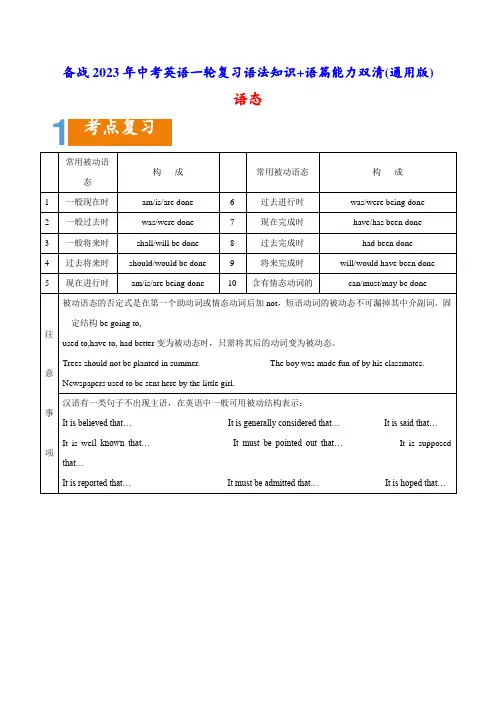
备战2023年中考英语一轮复习语法知识+语篇能力双清(通用版)语态1一、单项选择1. Many buildings in Lushan ________ in the earthquake on April 20th. It will surely be reconstructed (重建) more beautifully.A. have destroyedB. are destroyedC. were destroyedD. are destroying2. At present all Chinese couples _________ to have two children.A. is allowedB. allowedC. are allowedD. were allowed3. This kind of medicine _________ in a dry and cool place.A. keepB. must keepC. must be keptD. must be keeping4. A marathon ________ in Yancheng on 21st April, which drew 12,000 runners.A. was heldB. is heldC. were heldD. will hold5. The old ________ well.A. looks afterB. must be looked afterC. must look afterD. looked after6. The monkey ________ to jump off the tree.A. seeB. seesC. sawD. was seen7. Your shoes ________. You need a new pair.A. wear outB. worn outC. are worn outD. is worn8. —Excuse me! I’d like some Shaoyang rice noodles.—Sorry, sir. Rice noodles ________ only in the morning.A. serveB. will serveC. are served9. —The passenger refused to move after taking another one’s seat!—What a shame! He ________ according to the newly credit system (诚信体系).知识强化2A. punishB. punishedC. will punishD. will be punished10. We ________ into five groups to go to the old people’s home. We did many things to cheer up the elders.A. were dividedB. dividedC. are dividedD. divide11. —Our school sports meeting ________ last week. And we won the first prize.—Sounds great. Congratulations!A. happenedB. took placeC. was happenedD. was taken place12. —Do you know when he ________ the work?—Sorry, I don’t know. But I think when the work ________, he will let me know.A. will finish; will be finishB. finishes; finishesC. finishes; will finishD. will finish; is finished13. The 31st FISU World University Games _________ from June to July in 2022 in Chengdu, Sichuan.A. holdsB. is heldC. will holdD. will be held14. Chinese ________ in many schools outside China.A. teachesB. is taughtC. will teachD. will be taught15. Reusable bags ________ by more and more people now though a little expensive.A. acceptB. are acceptedC. were acceptedD. accepted16. The old should ________ in our society.A. be take good care ofB. take good care ofC. be taken good care ofD. are taken good care of17. Dumplings ________ by millions of foreign people as a kind of traditional Chinese food.A. were lovedB. have lovedC. are lovedD. are loving18. — Look, Linda is laughing happily. What happened?— She ________ by our teacher just now.A. praisedB. is praisedC. was praisedD. was praising19. The old book that I found in the shelf ________ by my grandfather many years ago.A. was boughtB. is boughtC. buysD. bought20. More school clubs ________ to students. They are sure to enjoy them.A. offeredB. were offeredC. are offeredD. have offered21. —The 19th Asian Games ________ in Hangzhou on September 10th this year. I’m looking forward to it verymuch.— So am I.A. holdsB. was heldC. will be heldD. will hold22. Bing Dwen Dwen ________ by its cute shape. I plan to buy one.A. is welcomedB. will be welcomedC. was welcomedD. has welcomed23. —The Winter Olympic Games ________ in Beijing during these days.—Yes! Beijing is called “Double Olympic City”.A. holdB. is heldC. will holdD. holds24. —Kung fu is our traditional sports. It is wonderful.—Yes, it ________ by lots of people all over the world.A. enjoyB. enjoyedC. was enjoyedD. is enjoyed25. The 2022 Winter Olympics _________ in Beijing and many people watched the events.A. be heldB. are heldC. were heldD. will be held26. I usually felt very nervous as I ________ to answer the teacher’s questions in class.A. askB. will askC. was askedD. have asked27. Shijiazhuang is greener city now because more and more trees ________ every spring.A. plantedB. are plantedC. will be plantedD. were planted28. —China plans to send another spaceship into space.—Wow! More and more secrets ________ soon.A. are going to discoverB. will be discoveredC. have discoveredD. will discover29. It is reported that a new school ________ in our city in five years.A. was builtB. will be builtC. builtD. will build30. These modern medical machines ________ treat patients in hospital.A. are used toB. used toC. are used forD. use to31. A new school ________ here.The local government hopes to finish it next year.A. is builtB. was builtC. has been builtD. is being built32. More and more electric cars ________ in the future to protect environment.A. useB. will useC. are usedD. will be used33. With the fast increasing of cars, lots of convenience(方便) ________ for us.A. providedB. was providedC. is providedD. were provided34. —When did you take these photos?—The photos ________ a few days ago in memory of the graduation.A. takeB. tookC. was takenD. were taken35. This sign ________ to warn people to keep away from the river.A. usesB. usedC. is usingD. is used36. —I am glad to see that there is less stress of learning for middle school students.—Yes. Some new after-class activities ________ in our school life now.A. are addedB. will be addedC. addD. will add37. Three astronauts ________ into outer space by the manned spacecraft Shenzhou 13 last October.A. sendsB. sentC. are sendingD. were sent38. Shy students should ________ to be brave enough to speak in public.A. be encouragedB. are encouragedC. encouragedD. encourage39. —Mr Wu, why are you still here? They are all ready to start.—Sorry, but I ________when to meet.A. wasn’t toldB. did n’t tellC. haven’t toldD. don’t tell40. It is said that a new school ________ in my hometown next year.A. will be builtB. was builtC. is builtD. has built二、完成句子41. 它是在泰国造的。
2023年中考英语语法---动词及动词短语专题复习及练习题(含答案)

2023年中考英语语法---动词及动词短语专题复习及练习题(含答案)一、动词的基本框架动词包括实义动词、系动词、助动词和情态动词。
(一)实义动词实义动词是能独立作谓语的动词。
按其句法功能可分为及物动词和不及物动词;按其持续性可分为延续性动词和非延续性动词。
1.及物动词:及物动词本身意义不完整,需要接宾语才能使其意思完整。
(1)动词+宾语I like this book very much.我非常喜欢这本书。
(2)动词+宾语+宾补We call the bird Polly.我们叫这只鸟Polly。
I saw the children play in the park yesterday.昨天我看见孩子们在公园玩。
注意:用省略to的不定式或现在分词作宾补的动词有:have,see,watch,notice,hear等。
(3)动词+间接宾语+直接宾语Please pass me the salt.请把盐递给我。
常见的带双宾语的动词有:give,bring,buy,get,leave,lend,make,offer,pass,teach,tell等。
2.不及物动词不及物动词自身意思完整,不用接宾语。
Horses run fast.马跑得快。
(1)有些动词既可作及物动词又可作不及物动词。
We study English.我们学习英语。
(及物动词)We study hard.我们努力学习。
(不及物动词)(2)有些不及物动词与一些别的词搭配在一起构成动词短语,它的作用相当于一个及物动词。
①动词+介词Listen to the teacher carefully.仔细听老师讲。
此类动词短语后面的宾语无论是名词还是代词,都只能放在介词后面,不能放在动词和介词之间。
②动词+副词+介词Let’s go on with our work!让我们继续我们的工作吧!He gets along well with his classmates.他与他的同学们相处得很好。
初中英语语法详解精练 13第十三章 助动词和情态动词
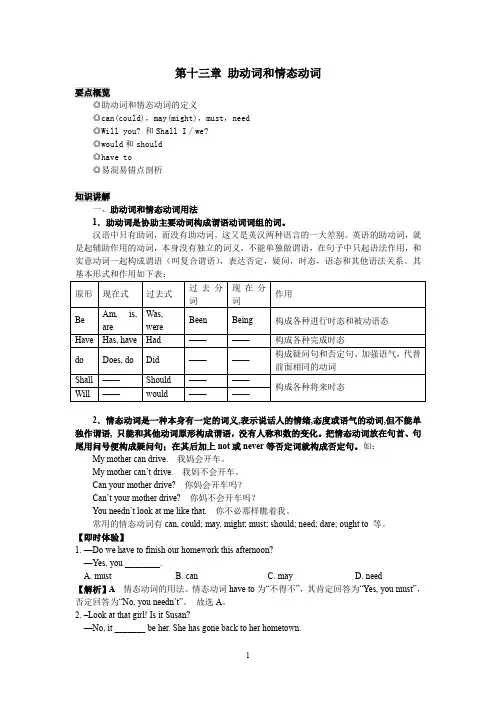
第十三章助动词和情态动词要点概览◎助动词和情态动词的定义◎can(could),may(might),must,need◎Will you? 和Shall I/we?◎would和should◎have to◎易混易错点剖析知识讲解一、助动词和情态动词用法1.助动词是协助主要动词构成谓语动词词组的词。
汉语中只有助词,而没有助动词。
这又是英汉两种语言的一大差别。
英语的助动词,就是起辅助作用的动词,本身没有独立的词义,不能单独做谓语,在句子中只起语法作用,和实意动词一起构成谓语(叫复合谓语),表达否定,疑问,时态,语态和其他语法关系。
其2.情态动词是一种本身有一定的词义,表示说话人的情绪,态度或语气的动词,但不能单独作谓语, 只能和其他动词原形构成谓语,没有人称和数的变化。
把情态动词放在句首、句尾用问号便构成疑问句;在其后加上not或never等否定词就构成否定句。
如:My mother can drive. 我妈会开车。
My mother can’t drive. 我妈不会开车。
Can your mother drive? 你妈会开车吗?Can’t your mother drive? 你妈不会开车吗?You needn’t look at me like that. 你不必那样瞧着我。
常用的情态动词有can, could; may, might; must; should; need; dare; ought to 等。
【即时体验】1. —Do we have to finish our homework this afternoon?—Yes, you ________.A. mustB. canC. mayD. need【解析】A 情态动词的用法。
情态动词have to为“不得不”,其肯定回答为“Yes, you must”,否定回答为“No, you needn’t”。
故选A。
2. –Look at that girl! Is it Susan?—No, it _______ be her. She has gone back to her hometown.A. mustn’tB. can’tC. needn’tD. wouldn’t【解析】B 情态动词的用法。
浙江省中考英语总复习 第2部分 语法专题复习篇 第33课时 动词和动词短语(精讲)试题 外研版-外研
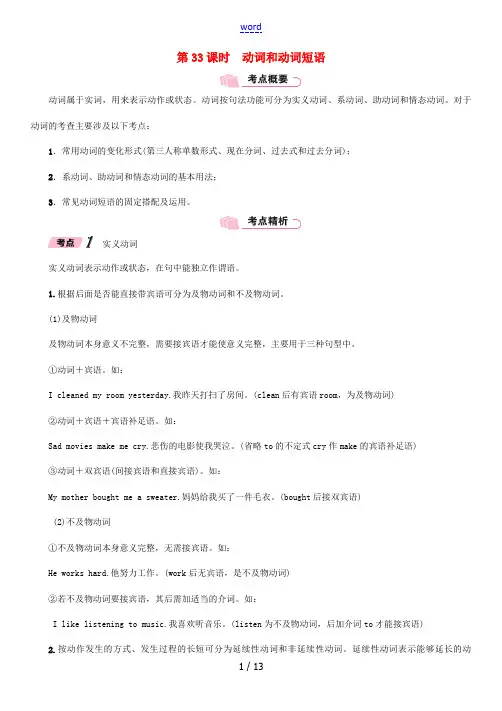
第33课时动词和动词短语动词属于实词,用来表示动作或状态。
动词按句法功能可分为实义动词、系动词、助动词和情态动词。
对于动词的考查主要涉及以下考点:1.常用动词的变化形式(第三人称单数形式、现在分词、过去式和过去分词);2.系动词、助动词和情态动词的基本用法;3.常见动词短语的固定搭配及运用。
实义动词实义动词表示动作或状态,在句中能独立作谓语。
1.根据后面是否能直接带宾语可分为及物动词和不及物动词。
(1)及物动词及物动词本身意义不完整,需要接宾语才能使意义完整,主要用于三种句型中。
①动词+宾语。
如:I cleaned my room yesterday.我昨天打扫了房间。
(clean后有宾语room,为及物动词)②动词+宾语+宾语补足语。
如:Sad movies make me cry.悲伤的电影使我哭泣。
(省略to的不定式cry作make的宾语补足语)③动词+双宾语(间接宾语和直接宾语)。
如:My mother bought me a sweater.妈妈给我买了一件毛衣。
(bought后接双宾语)(2)不及物动词①不及物动词本身意义完整,无需接宾语。
如:He works hard.他努力工作。
(work后无宾语,是不及物动词)②若不及物动词要接宾语,其后需加适当的介词。
如:I like listening to music.我喜欢听音乐。
(listen为不及物动词,后加介词to才能接宾语)2.按动作发生的方式、发生过程的长短可分为延续性动词和非延续性动词。
延续性动词表示能够延长的动作,如:learn,work,keep,sleep,live等,可以与表示时间段的状语(for+时间段,since+时间点,since 从句)连用。
非延续性动词也称瞬间动词,表示不能延续的动作,动作发生后立即结束,如:open,die,begin,finish,e,borrow,lend,buy等,不能与表示时间段的状语连用。
初中英语中考情态动词考点及练习

情态动词情态动词又叫情态助动词;它们具有以下特点:⑴它们必须与其他动词连用,即:情态动词+动词原形表示说话人对所述动作的看法,如需要、可能、意愿或怀疑等;⑵绝大多数情态动词没有人称和数的变化,即第三人称单数不加-s以be和have 开头的情态动词短语除外;⑶在意义上,情态动词具有“多义性”;例:can既可表示能力,又可表示可能、允许等意义;情态动词的基本用法1. can的基本用法:⑴表示体力或智力上的能力,即“能够,会”,可与be able to转换;例:He can speak English. = He is able to speak English.—Can you play basketball— No, I can’t.如果表示将来具备的能力,要用will be able to;例:If I have a good sleep, I will be able to do the problem.⑵表示许可,主要用于口语,书面语一般用may;例:—Can we go home now, please— No, you can’t.You can only smoke in this room.You can’t keep the library books for more than a month.⑶表示“可能”,与may同义,但一般用在疑问句中;例:What can he possibly want在否定句中,否定形式can’t表示推测“不大可能”;例:Anybody can make mistakes.The news can’t be true.与第一、二人称连用时,还可以就可能的解决问题的方式或可能的行为提出建议;在这里,也可用could使语气婉转;例:Can / Could we meet again next week 下周我们可以再见面吗—What shall we do 我们怎么办呢— We can / could try asking Lucy for help.——我们可以请露茜帮忙试试看;You can / could help me with the cooking. 你可以帮我做饭;2. may的基本用法:⑴表示“许可”,用can比较口语化;例:You may / can come if you wish. 如果你想来,你就来;You may not pick flowers in this park. 本公园内不许摘花;may not表示按规定不许可,如果用mustn’t则表示说话人不许可;我可以在这里抽烟吗—;mustn’t表示明确的禁止;⑵;例:It may rain tomorrow. 明天可能会下雨;;注意:如果,通常用例:那会是真的吗他究竟是谁呢⑶注意—Yes, you —No3. must的基本用法:⑴表示必须,强调说话人的主观意志;例:I must go now, or I’ll be late.You must be here by注意:表示“必须“时,must的否定式为或而不是mustn’t;也就是:—Must—Yes, you—No, you例:——No, you .⑵表示推测,一般只用于肯定陈述句,表示非常肯定;例:She didn’t look at me. She must be angry. 她不朝我看,一定是生气了;He is good at English. He must know the word. 他英语好,准知道这个词;You must be Mr. Jones. 想必您就是琼斯先生吧;4. have to的基本用法:have to可视为情态动词,但它与其他情态动词在用法上稍有不同;其他情态动词没有人称和数的变化,而have to却有人称和数的变化,要视主语的不同而变化;例:I / You / We / They have to….He / She / It has to….You don’t have to….意思是“必须,不得不”;have to强调客观需要;例:Sorry, I have to leave now. 对不起,现在我得走了;I’ve got to go to a meeting. 我得去参加一个会议;Will he have to work deep into the night 他将不得不工作到深夜吗5. need的基本用法:need的基本词义是“需要”,它既可作情态动词,又可作实义动词;⑴ need用作情态动词时,只用于否定句和疑问句;它只有一种形式,后接动词原形;例:I don’t believe you need worry. 我相信你没有必要焦急;—Need we go so soon我们需要这么早就去吗— Yes, we must. / No, we needn’t.是的,必须;/不,不必;So I needn’t tell him, need I 所以我不需要告诉他,对吧请比较以下两句话的不同意思:You needn’t buy the coat. 你没有必要买那件外衣;你还没买You needn’t have bought the coat. 你没有必要买这件外衣的;而你⑵My watch needs mending/to be mended. 我的手表需要修理了;We don’t need to work today. = We needn’t work today.Does he need to go right now = Need he go right now6. had better的基本用法:had bette r常略作’d better;现代语法认为它是一个助动词,因为它后接不意思是“最好做某事;还是做某事比较好”;get some sleep. 你最好睡一会儿;You’d better not do that again. 你最好别再做那件事;What had we better do now 我们现在怎么做才好呢, should, would, might表示推测:①.must多用于肯定句中表示把握性极大的推测,意思为“一定、肯定”;如: You have worked hard all day. You must be tired. 你已辛苦工作一整天了,一定累了;The book must be his. His name is on the cover. 这本书一定是他的,封面上写着他的名字;注意 must不表推测时,在肯定句中意思为“必须强调内在的职责”,在否定句中意思为“不许、禁止”,以它开头的疑问句否定回答常用needn’t或don’t doesn’t have to;如:We must obey the traffic rules. 我们必须遵守交通规则;Cars mustn’t be parked here. 此处严禁停车;—Must we hand in the papers this week 我们必须本星期交论文吗—No, you needn’t. 不,你们不必本星期交;②. can / could多用于否定句、疑问句或间上没有差别;用can时不相信的程度更强一些,如:The man under the tree can’t be Tom人不可能是Tom,他已经去英国了;Can it be true that he was fooled by a five-year-old boy 他被一个五岁的孩子愚弄了,这能是真的吗Could this be an excuse 这会不会是个借口How can you be so careless 你怎么这样粗心③.may / might多用来表示把握性不大的推测,意思为“也许、可能”, might比;注意区分“不可能”与“可能;如:Mr. Wang may know Professor Li’s telephone number.王先生也许知道李教授的电话号码;This might be the key Tom has been looking for.这可能就是汤姆一直在找的钥匙;She may not be there today. 今天她可能不在那儿;一、典型例题中考链接1.—Who is the man over there Is it Mr. Li— No, it ______ be him. Mr. Li is much taller.A. mustn’tB. may noC. can’tD. needn’t2.—Must I go with them tomorrow— No,you ______.A. mustn'tB. shouldn'tC. needn'tD. can't3.—______ I take some photos in the hall— No, you ______.A. Can, needn’tB. Must, mustn’tC. Could, won’tD. May, m ustn’t4.—Dad, must I finish my homework today—No, you ________. You may do it tomorrow.A. needn’tB. mustn’tC. don’tD. won’t5.—The lake is said to be dry. Is that true—It , some kids are swimming in it.A. must be trueB. can’t be trueC. may not be true6.—What is your mother going to do this Saturday—I’m not sure. She _____ go to see my grandmother.A. canB. mustC. may7.—Susan has bought a large house with a swimming pool.—It ______ be very expensive. I never even dream about it.A. mustB. mightC. can’tD. shouldn’t8.—Listen Is Professor Johnson giving a report in the hall —No, it be him. He has gone to Japan.A. needn’tB. may notC. mustn’tD. can’t9.—Let’s go to the West Hill Park by taxi.—Oh, it is not far away from here. We _______take a taxi.A. couldn’tB. mustn’tC. needn’tD. can’t10.—Can you play the piano—Yes, I _______. I often practice it on weekends.A. needn’tB. needC. can’tD. can三、课后练习一、用can, may, must, need, have to, had better的适当形式填空:1.You ________________ return the library book on time.2.I ______________ not find the way to the hospital. _______________ youshow me the way3.—________________ I finish the work right now— No, you ________________ not. You ____________ do it later.4.He said he ________________ not come tonight.5.Her mother was ill. She ________________ stay at home and look afterher.6.It’s time for class. You ________________ stop playing football oryou __________be late for class.7.We ________________ start right now, or they would get there first.8.The cloud is lifting, so it ________________ not be a rainy daytomorrow.二、选择填空1.—Do we have to finish our homework this afternoon—Yes, you ________.A. mustB. canC. mayD. need2. —Must I be in hospital for a week, Doctor—No, you . You can go back home tomorrow.’t B.needn’t C. must3. The desk is not dirty. You _______clean it.A. mustn’tB. shouldn’tC. needn’t C. can’t4. —May I watch TV for a while—No, you _______. You have to finish your homework first.A. shouldn’tB. needn’tC. mustn’tD.won’t5.—Is Jessica giving us a speech this evening—No, it ________be her. She________ to Japan.A. mustn’t; has goneB. mustn’t ;has beenC. can’t ;hasgone D. can’t ;has been6. It’s the library So you________ know shouting is no t allowed here.A. canB. mustC. needD. may7. Boys and girls, don’t forget your report . It ______ today.A. can’t finishB. can’t be finishedC. should finishD. should be finished8.—Mr Smith must have been to your home this morning.—No, he ______ ,because he didn’t know my address.A. couldn’tB. can’tC. mustn’tD. may not9. —Must I mop up the window now—No, you________.’t B. can’t C. shouldn’t D. mustn’t10. —Is Lucy knocking at the door—No. It ________ be Lucy. She is in Japan now.A. needn’tB. mustC. can’t11. —Another cup of coffee—No, thanks. I _____ be off. Mary is waiting for me.A. canB. mayC. mustD. might12. —I’m a little tired. Let’s go to t he zoo by taxi.—We take a taxi. It’s not far from here.A. can’tB. mustn’tC. couldn’tD.needn’t13. If the traffic light is red, you ________ cross the road. It’s very dangerous.A. don’tB. mustn’tC. needn’tD.wouldn’t14. —Must I finish watering the flowers now—No, you________.A. mustB. won’tC. needn’tD. can’t15. —I can’t give up smoking, doctor.—For your health, I’m afraid you ________.A. mayB. canC. have toD. must。
2021年上海市中考英语语法复习:情态动词讲解及提升练习(有答案)
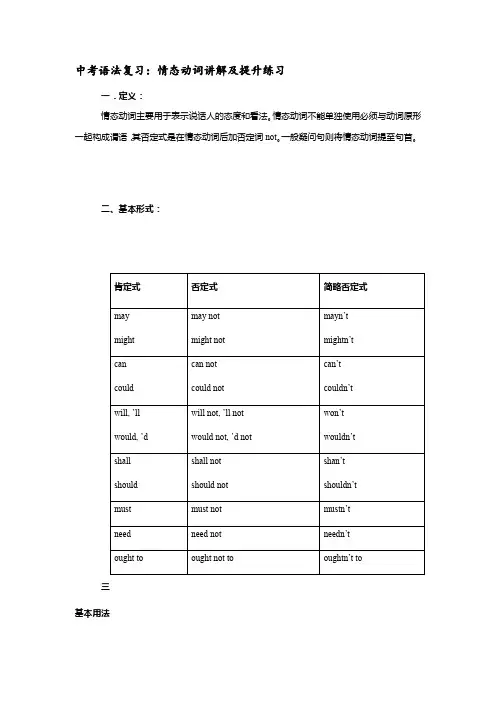
中考语法复习:情态动词讲解及提升练习一.定义:情态动词主要用于表示说话人的态度和看法。
情态动词不能单独使用必须与动词原形一起构成谓语,其否定式是在情态动词后加否定词not。
一般疑问句则将情态动词提至句首。
二、基本形式:三基本用法1. can 的用法1)表能力can表能力时意味着凭体力或脑力或技术等可以无甚阻力地去做某事。
I can climb this pole. 我能爬这根杆子。
He is only four , but he can read. 他只有4岁,但已认得字了。
Fire can’t destroy gold. 火烧不毁金子。
2)表可能性多用于否定与疑问结构中,但也可用在肯定句中。
Can the news be true? 这消息可能是真的吗?It can’t be true. 它不可能是真的。
What can he possibly mean? 他可能是什么意思?3)表示允许(和may意思相近)常见于口语。
Can (May) I come in ? 我能进来吗?Can I smoke here ? 我可以在这里抽烟吗?2.could的用法1)表过去的可能和许可,Father said I could swim in the river. 爸爸说我可以在河里游泳。
2)表过去的能力I could swim when I was only six. 我刚六岁就能游泳。
3)表“允许”。
可表示委婉客气的提出问题或陈述看法,不是can的过去时态。
---Could I use your bike? ---Yes, you can./No, you can’t.注意:be able to 表示能力,意为“能够做成某事”,相当于can 的用法,但是有区别:can泛指一般的能力;be able to 则主要指成功做了某件事的能力。
3. may(might)的用法1)表示请求、可以、允许。
You may drive the tractor. 你可以开那台拖拉机。
2023年江苏中考英语核心语法精讲精练专题09 情态动词-含详解
专题09 情态动词情态动词是一种本身有一定的词义,表示说话人的情绪,态度或语气的动词,但不能单独作谓语,只能和其他动词的原形构成谓语。
主要有:can (could), may (might), must, need, shall (should), will (would)。
一、情态动词can/couldcan可表示能力或可能性,过去式could。
和其他的情态动词一样,can和could后面直接接动词原形,否定形式直接加not。
can用法(1) 表示能力(体力、知识、技能)。
Can you lift this heavy box? Yes, I can.(体力)Mary can speak three languages.(知识)Can you skate? No, I can’t.(技能)注意:be able to代替can, 也可以表示能力。
但can只有一般现在时和一般过去时(could), 而be able to则有更多的时态形式。
例:①You will be able to talk with the foreign teacher in English next week.下星期你将能与外国老师用英语交谈了。
②My little brother has been able to write. 我的弟弟已会写字了。
这两种情况除外:①表将来时不可以用can替换如:I’ll not be able to finish all the work tomorrow morning.①表示“经过努力才得以做成功某事”时应用be able to,不能用Can。
如:He was able to go to the party yesterday evening in spite of the heavy rain.(2) 表示请求和允许。
—Can I go now? —Yes, you can. / No, you can’t.此时可与may互换。
初中英语语法专题动词语常用短语
初中英语语法专题动词语常用短语初中英语语法专题动词一、概念及分类动词(Verb)一般就是用来表示动作或状态的词汇。
我们接触的动词包括实义动词(Notional Verb)、系动词(Linking Verb)、助动词(Auxiliary)、情态动词(Modal Auxiliary)。
二、动词的用法1. 实义动词按照句法作用可以分为及物动词和不及物动词;按照动词的持续性可分为延续性动词和非延续性动词。
及物动词(Transitive Verb) :本身意义不完整,后面直接跟宾语。
例:I like the book very much. 我非常喜欢这本书。
You can call me Lucy. 你可以叫我Lucy.Give me a glass,please. 请给我一个杯子。
不及物动词(Intransitive Verb):本身意义完整,后面不可以直接跟宾语,若要跟宾语,必须先在其后加上某个介词。
例如: She dances well. 她舞跳得很好。
Look at me. 看着我。
延续性动词(Durative Verb):表示动作是可以持续的,可以和表示时间的状语连用。
例如:We have lived here for 20 years. 我们已经在这里住了20年了。
非延续性动词(Non-durative Verb):表示瞬间动作,动作一旦发生立即结束,不能和表示一段时间的状语连用。
如果和表示一段时间的状语连用,要用其它的词代词。
例如: She has kept the book for 2 months. 她借这本书已经2个月了。
(这里不能用has borrowed)2. 系动词系动词本身有词义,但不能单独使用,和表语在一起组成主系表结构,说明主语的状态、性质、特征和身份。
常见的系动词如下:be 动词am/is/are/was/were变化系动词get/turn/come/go/become/grow感官系动词feel/sound/look/smell/taste后面必须加形容词保持系动词keep/remain/stay似乎系动词seem例如: I am a student. 我是一个学生。
【中考英语一轮复习语法一点通】语法专题八 情态动词(学生版)
语法专题八、情态动词(常考)考点精讲情态动词表示讲话人的态度、请求、许可、愿望、可能等。
本身具有一定的意义,但不能独立作谓语,没有人称和数的变化,且后面必须跟动词原形。
常考的情态动词有:can/could(能够,可以),may/might(可能,可以),must(必须,一定),should(应该),need(必要),have to(不得不)等。
Need用作情态动词时常用于否定句和疑问句,need还可作实意动词,常用结构need to do sth.考点1.情态动词+动原➢He can play the violin. 他会拉小提琴。
➢It might snow tomorrow. 明天可能下雪。
➢We should respect everyone. 我们应该尊重每一个人。
考点2.常考的一般疑问句的回答—Can you swim?—Yes, I can. /No, I can’t.—May I smoke here?—Yes, you may/can. /Sure. / Certainly. / Of course. /No, you mustn't / can’t.—Must we finish the work at once?—Yes,you must. /No,you needn't. / No,you don't have to.(must引导的一般疑问句的否定回答是常考点)考点3.must必须(强调主观看法)mustn’t表示禁止,不允许➢You must study harder this term. 你们这学期必须更加努力学习。
(说话者的个人看法)➢You mustn’t swim in the river. 你们千万不能去河里游泳。
(这条河禁止游泳)考点4.情态动词表推测表推测:由强到弱肯定:must 准是,一定can 可能could(可能)may (或许) might(大概)否定:can’t 不可能may/ might not 或许不能can 和could 表示推测,can 表示推测时,往往用于否定句和疑问句。
情态动词英语语法知识精讲
情态动词英语语法知识精讲情态动词(modal verb)本身有词义,表示说话人的语气或情态,但词义不完全,不能单独用作谓语动词,一般只能和动词原形一起构成谓语动词。
小编在这里整理了相关资料,希望能帮助到您。
特征1)情态动词(modal verb)本身有词义,表示说话人的语气或情态,但词义不完全,不能单独用作谓语动词,一般只能和动词原形一起构成谓语动词。
2)情态动词所表示的情态有:命令、允诺、请求、拒绝、愿望、愿意、义务、必要、可能、能力、敢于、需要等。
3)情态动词(ought 除外)和助动词 shall,will,should,would 一样,后面的动词不定式一般皆不带。
形式变化1)没有人称和数的变化,第三人称单数的现在时也无变化。
如:I can We canYou can You canHeThey canShe canIt2)有些情态动词有过去式,有少数过去式和它的原形相同。
a)有过去式的情态动词有:may -- wouldcan ―― couldmay ― ― nigh tshall -- shouldhave to -- had tob)过去式不变的情态动词有:must - must (或 had to)ought to - ought toneed---needdare - dare(亦可用 dared)3)大多数情态动词后面可用动词的进行式、完成式和被动形式,如:can(may,must)be doing,can(may,must) have done,can(may,must)be done 等。
否定式情态动词和助动词一样,后面可直接跟否定词not。
现将情态动词的否定式及其否定式的简略式(简略式用于口语中)列举如下:shall not--shan't [FB:nt]will not---won't [wEunt]can not-can't [kB:nt]must not-mustn't [5mQsnt]should not-- shouldn'twould not-- wouldn'tcould not-- couldn'tdare not- daren't [dZEnt]need not-- needn't在疑问句中的用法情态动词在疑问句中的用法和助动词相同。