
人教版七年级英语下册 Unit5 Section(A·GF-B·1d)预习-训练案
(3)If you are __fr_i_e_n_d_ly_____(friend)to your classmates,you can get along well with them. ( C )(4)Many people like to keep a dog as a pet,because dogs are very ________. A.friend B.scary C.friendly D.ugly
1.很,非常_a__lo_t_________________ 2.真的很酷__r_e_a_l_ly__c_o_o_l __________ 3.为什么不_w__h_y_n_o_t______________ 4.黑白相间___b_la_c_k__a_n_d_w__h_i_te______
三、经典句型
【拓展】表示方位的词还有:(5)___ea_s_t_______ 东 (6)__w_e_s_t_______ 西 (7)__n__o_rt_h______ 北 三、friendly的意思及用法 friendly 意为“友好的”,是(1)__形__容__词______(填词性)。 Our teachers are friendly to us.我们的老师对我们友好。 由这个句子可知,“对……友好”的短语是 (2)__b_e__fr_i_e_n_d_ly__to____,其意思与be kind to/be nice to相同。
1.——你为什么喜欢熊猫? ——因为它们有点儿有趣。
—Why do you like pandas? —Because they're kind of interesting.
2.——约翰为什么喜欢考拉? —Why does John like koalas?
——因为它们很可爱。
—Because they're very cute.
3.你为什么不喜欢老虎? __W__h_y__d_o_n_’t______________ you like tigers? 4.莉莎喜欢穿黑白相间的衣服。 Lisa likes wearing ___b_la_c_k__a_n_d__w_h_i_te_________ clothes.
思考探究
(4)你放学后为什么不打篮球呢? Why don't you play basketball after school? = __W__h_y_n_o_t____ play basketball after school? [该句用于 _提__出__建__议_____(提出建议/询问原因)。]
二、south 的用法 They are from South Africa.他们来自南非。 South Africa意为“南非”,是专有名词,所以首字母要大写。 其中,south 用作(1)___形__容__词_____(填词性),意为“南方的, 南部的”,后加名词, 如:(2)南美洲 __S_o_u_t_h_A__m_e_r_i_c_a______。
D.America
二、完成句子,词数不限。 11.我妈妈非常喜欢逛街。 My mother ___li_k_e_s_s_h_o_p_p_i_n_g_a__lo_t_/_v_er_y__m_u__ch___________. 12.你的朋友为什么不帮助你? Why ___d__o_es_n_’_t___ your friend ___h_e_l_p______ you? 13.托尼不喜欢猫,因为它们真的很懒。 Tony doesn't like cats __b_e_c_a_u_se__th__e_y_a_r_e_r_e_a_l_ly__la_z_y____.
Tickets Grown-ups(成人):$4.00 Children: Over 12: $2.00 Under 12: Free Opening Time From Wednesday to Monday 9:00 a.m.— 4:00 p.m.but on Tuesday 10:00 a.m.— 3:00 p.m. Keep the zoo clean! Do not touch(摸), give food or go near the animals!
四、请用以上重点短语和句型完成下列句子。
1.我非常喜欢动物。 I like animals ___a__lo_t_/_v_er_y__m_u__ch_________. 2.这些机器人有不同的形状,真的很酷。 These robots have different shapes and they are ____r_ea_l_l_y_c_o_o_l____________.
及时训练
一、单项填空。 ( D )1.My dog is very ________.It's safe(安全的)to play with it. A.smart B.brave C.happy D.friendly ( D )2.Let him ________ home and watch TV now. A.goes B.going C.to go D.go
(2)她今天好多了。 She is ____a__lo_t_____________ better today. (修饰形容词比较级better) 【拓展】和a lot 相似的短语:a lot of, lots of a lot of =lots of,意为“许多,很多”,可修饰 (3)__可__数________ 名词复数,相当于many,
A.are B.is
C.does D.do
( C )5.Zhanjiang is in ________ Guangdong. A.the south B.south of C.the south of D.south
( B )6.There is ________ elephant in the zoo.
Unit 5 Why do you like pandas?
预习案 训练案
目录导航 学习目标
思考探究
课前预习 及时训练
学习目标
1.能正确使用形容词描述各种动物的 特点并表达自己的喜好;
2.能正确使用why引导的特殊疑问句询 问原因并作出回答。
课前预习
一、必背单词 形容词 1.友好的__f_r_ie_n_d_l_y__ 2.羞怯的;腼腆的__sh__y__ 二、常用短语
( A )3.—Why don't you ________ a walk with us now?
—Because I have to do my homework.
A.take B.to take C.takes D.taking
( D )4.—Where ________ the lions come from? —I think they come from Africa.
( C )16.How many new animals come to the zoo? A.Seven. B.Fourteen. C.Sixteen. D.Seventeen.
14.这些老虎来自哪里? Where _a_r_e__th_e__ti_g_e_r_s_或__d_o_t_h_e_t_i_g_er_s__c_o_m_e_ from? 15.这小姑娘有点儿害羞。 The little girl is _____k_in_d__o_f_/a__li_t_tl_e_s_h_y___________________.
三、阅读理解。 Good news is for you.Some new animals come to our zoo.They want to meet e and see the big South China Tiger and two Indian Elephants.Three lions from Africa want to meet you, and four monkeys from Zhangjiajie are smiling at you.Four cute koalas from Australia are going to welcome you, and two giraffes from America are waiting to look down on you.
A.a
B.an
C.the
D./
( A )7.Do you like playing the piano ________?
A.a lot
B.a lo( A )8.Do you want ________ rice? A.to eat B.eats C.eat D.eating
四、a lot的用法 a lot作副词短语,一般在句中作程度状语,意为“很,非 常”,常用于修饰实义动词或形容词的比较级,修饰实义动 词时相当于 very much。 (1)我非常喜欢英语。I like English a lot.(修饰实义动词like) =I like English ___v_e_ry__m__u_c_h_________.
( C )9.—Let's see the elephant first.
—________.
A.Yes
B.You are right
C.Sounds good D.That's all right
( C )10.—Where are the elephants from? —They are from ________. A.Australia B.Russia C.Thailand
意为“为什么不……呢?”其同义句为 (2)_W__h__y_n_o_t_+_动__词__原__形__…__?。 (3)你为什么不喜欢画画? Why don't you _l_ik_e__d_r_a_w_i_n_g_/_p_a_in_t_i_n_g____________? [该句用于 __询__问__原__因__________(提出建议/询问原因)。]
英语七年级下册人教版uniu5笔记讲解
英语七年级下册人教版uniu5笔记讲解全文共6篇示例,供读者参考篇1Hi friends! Today I'm going to explain the notes for Unit 5 in our English textbook. Get ready because this is going to be a long one!Unit 5 is all about food and healthy eating habits. The first few lessons introduce us to different kinds of food and drinks. We learn words for fruits like apples, bananas and oranges. We also learn words for vegetables like carrots, tomatoes and lettuce. Then we move on to things like milk, juice, water, coffee and tea.One really important lesson is about fast food. We all love McDonald's, KFC and pizza, right? But the book tells us that too much fast food can be unhealthy. Fast food is often high in fat, salt and sugar which can lead to obesity and other health problems if we eat it too frequently. The book recommends limiting fast food to an occasional treat.Instead, we should try to eat more home-cooked meals made with fresh ingredients like lean meats, whole grains, fruits and veggies. These "balanced meals" provide all the nutrientsour bodies need to grow strong and healthy. The textbook has some really yummy looking recipes for balanced meals that even kids can help prepare.Another big part of this unit is about good eating habits and table manners. We learn that it's important to wash our hands before meals, chew with our mouths closed, and avoid talking with food in our mouths. The book also says we shouldn't play with our food or make a mess.My favorite lesson is about special holidays and festivals around the world that involve food traditions. For example, during the American holiday of Thanksgiving, families get together and eat a huge turkey dinner with sides like mashed potatoes, stuffing and cranberry sauce. Yum!In China, the Mid-Autumn Festival is celebrated by eating mooncakes and enjoying the bright full moon with loved ones. And for the Indian festival of Holi, people have fun throwing brightly colored powders made from foods like turmeric, beets and green gram.The readings teach us about the fascinating history behind many of these celebrations too. I think it's so cool to learn about the diverse cultures and customs from around the globe!Towards the end of the unit, the book discusses the importance of physical activity and exercise for staying fit and healthy. It explains that along with a balanced diet, we need at least 60 minutes of exercise every day to keep our hearts strong and prevent obesity.The textbook gives examples of fun activities like playing sports, riding bikes, swimming, dancing and even household chores that can count as exercise. It reminds us that exercising doesn't have to be boring - it can be really enjoyable if we find activities we love!Throughout the unit, we practice useful language for discussing food preferences, ordering at a restaurant, describing how to prepare dishes, and more. There are lots of fun dialogue examples that really bring the lessons to life.The readings also teach us about nutrition facts labels, how to understand ingredients lists, and shopping tips for choosing healthy foods at the grocery store or market. Super practical stuff that I know will come in handy!Honestly, this is one of my favorite units so far because I just love learning about different world cultures and their unique food traditions. The lessons make me want to taste delicacies from every corner of the globe!Plus, developing positive eating habits while I'm still young will help me stay fit as I grow older. I'm going to put what I've learned into practice by trying new fruits and veggies, limiting junk food, and being more active through sports and play. Healthy body, healthy mind!Those are the key points I took away from Unit 5 of our English book. Let me know if any part was still unclear or if you need me to explain further. I'm happy to go into more detail on specific topics that interested you. Study hard and stay healthy, friends!篇2Unit 5 - Our EnvironmentHey guys! In this unit, we're going to learn all about the environment and how we can protect it. It's a super important topic because our planet is our home and we need to take care of it.First up, let's talk about what the environment actually is. The environment is everything around us - the air we breathe, the water we drink, the land we live on, the plants and animals, and even the buildings and roads. It's basically our whole world!Now, why is it so important to protect the environment? Well, for starters, we need a healthy environment to survive. Clean air and water are essential for our health. Plants and animals are also really important because they provide us with food, medicine, and other resources we need.But it's not just about us humans. Plants and animals need a healthy environment to thrive too. When their habitats are destroyed or polluted, they can get sick or even go extinct. And that's really sad because every living thing has an important role to play in the big circle of life.Speaking of pollution, that's one of the biggest threats to our environment. Pollution happens when harmful substances are released into the air, water, or soil. Things like factory smoke, car exhaust, and trash can all cause pollution.Pollution is really bad news for the environment. It can make air and water unsafe, harm plants and animals, and even contribute to climate change. Climate change is the long-term shift in global temperatures and weather patterns, and it's causing all sorts of problems like rising sea levels and more extreme weather events.But don't worry, there are lots of things we can do to help protect the environment! One of the easiest things is to reduce,reuse, and recycle. Reducing means cutting down on the amount of stuff we use and waste we create. Reusing means finding new ways to use things instead of throwing them away. And recycling means turning old materials into new products.We can also save energy by turning off lights and electronics when we're not using them. And walking, biking, or taking public transportation instead of driving can help reduce air pollution from cars.Planting trees and gardens is another great way to help the environment. Trees absorb carbon dioxide (a greenhouse gas that contributes to climate change) and produce oxygen for us to breathe. Plus, gardens provide habitats for bees, birds, and other wildlife.Governments, businesses, and communities are also working hard to protect the environment. They're passing laws to limit pollution, investing in renewable energy sources like solar and wind power, and creating protected areas for plants and animals.But they can't do it alone - we all need to pitch in and do our part. Even small actions like using a reusable water bottle or turning off the tap while brushing our teeth can make a big difference when lots of people do it.So let's all work together to take care of our amazing planet! It's the only one we've got, and we want to make sure it stays healthy and beautiful for generations to come.篇3Title: Explaining Unit 5 of the 7th Grade PEP English TextbookHi kids! In this essay, I'll explain the key points and lessons from Unit 5 of your 7th grade English textbook. Let's get started!Unit 5 is called "An Environmental Aktivist". It's all about someone named Greta Thunberg who tries really hard to protect the environment. She's from Sweden and started protesting about climate change when she was just 15 years old! Pretty cool, right?The unit starts with a reading passage introducing Greta and her story. It says that in 2018, Greta decided to strike from school every Friday. She would sit outside the Swedish parliament holding a sign saying "School Strike for Climate". At first she was alone, but gradually more and more students joined her protest.Greta was trying to get governments and leaders to take stronger action against climate change. She wanted them tolisten to the science and work harder to reduce emissions of greenhouse gases that cause global warming.The passage explains that Greta's solo protest grew into a huge global movement called "Fridays for Future". Millions of students around the world started holding strikes and protests every Friday, inspired by Greta.In 2019, Greta attended the United Nations Climate Action Summit in New York. There she gave a very famous and passionate speech, scolding world leaders for not doing enough about climate change. Her speech got a lot of attention globally.After the reading, there are some exercises to practice your understanding. You have to answer comprehension questions, fill in blanks, put sentences in order, and discuss Greta's reasons for protesting. Pay close attention to the details in the passage!Next up is the language section, focused on modal verbs like "can", "could", "should", "must", etc. The exercises get you using these modals properly to express ability, possibility, obligation and so on. Pretty useful stuff!Then there are some listening exercises where you hear people talk about environmental issues and Greta's activism. Youhave to answer questions and fill in missing details. Good listening practice!The unit also has a long reading about Greta's speech at the UN summit. It's a bit harder than the first passage. The exercises ask you to analyze the speech and Greta's use of rhetorical techniques like rhetorical questions, repetition, and emotive language. This helps build your critical reading skills.In the writing section, you have to write an argumentative essay about climate change, stating your view and providing supporting evidence. You can agree or disagree with Greta's activism, whichever side you choose.For the speaking section, you'll discuss environmental issues in groups and role-play situations related to climate activism. For example, you might role-play a debate between Greta and a world leader about climate policies. Gets you thinking critically and articulating your views!Finally, at the end there are some fun activities like aeco-themed word search and scramble. A nice little break after all the hard work in the unit.That's Unit 5 in a nutshell! By working through it carefully, you'll improve your reading, writing, listening and speaking skillsin English. You'll also learn a lot about the important issue of climate change and Greta Thunberg's impactful activism.Protecting the environment is so crucial for our planet's future. I hope this unit inspires you kids to be more environmentally conscious and to consider taking action, just like Greta did at such a young age. Small steps can lead to big changes when we all work together!Let me know if you have any other questions about Unit 5. Study hard and don't be afraid to raise your voice for causes you believe in!篇4Unit 5: My Favorite ThingsHey there, friends! It's me again, ready to share my thoughts on Unit 5 from our English textbook. This time, we're diving into the world of our favorite things – the stuff that makes us happy and puts a smile on our faces. Get ready for some fun stories and interesting vocabulary!The unit kicks off with a dialogue between Sam and Lucy. They're chatting about their favorite things, and it's pretty relatable stuff. Sam loves playing basketball, while Lucy is moreinto reading novels. It's cool to see how different people can have such diverse interests, right?One of the first new words we learn is "collection." A collection is a group of things that someone likes to gather and keep, like stamps, coins, or rocks. Personally, I've got a pretty sweet collection of Pokémon cards going on. Gotta catch 'em all!Next up, we read a story about a girl named Li Ming and her grandpa. It's called "My Grandpa's Treasures." Li Ming thinks her grandpa's old things are just junk, but he explains that they're actually treasures with special memories attached. By the end, Li Ming realizes how important it is to appreciate the things that matter to our loved ones, even if they seem ordinary to us.There are some great vocabulary words in this story, like "treasure" (something precious), "valuable" (worth a lot), and "memorabilia" (objects that bring back memories). I really liked learning about how different cultures value different things. For example, in China, certain stamps or ancient coins could be seen as priceless treasures!The next reading is a short article called "What's Your Favorite Sport?" It talks about different popular sports around the world, like soccer, basketball, and gymnastics. I was surprised to learn that table tennis is really big in China – who knew? Thearticle had some handy words about sports, like "teammate," "opponent," and "champion."Then we get to one of my favorite parts of the unit: a poem called "My Teddy Bear." It's a cute, rhyming poem about a kid's love for their special stuffed animal. Even though we're getting older, I think lots of us still have that one toy or blanket thatwe've had forever and can't let go of. The poem uses great descriptive words like "cuddly," "furry," and "cherished."We also practiced using possessive pronouns, like "my," "your," "his," and "her." These help us show ownership and talk about the things that belong to us or others. For instance, I might say, "That's my comic book collection over there."One of the highlights for me was the project we did at the end of the unit. We had to create a little museum exhibit showcasing our favorite things and explaining why they're so special to us. I made a display about my beloved superhero action figures. Others showed off things like seashell collections, family heirlooms, or trophies from their favorite sports. It was so cool to see the range of interests and learn about the stories behind everyone's treasures.Overall, Unit 5 was a fun one! It reminded me to appreciate the simple things that bring me joy, whether it's a beloved toy, afun hobby, or just quality time with family and friends. Plus, I got to expand my English vocabulary with words all about describing the things we love most.I'm already looking forward to the next unit. Who knows what exciting adventures await? But for now, I'll just kick back, relax, and enjoy some of my favorite things. Maybe I'll even bust out that old teddy bear for a cuddle. No judgments, okay?篇5Here are notes explaining Unit 5 from the English textbook for 7th grade, second semester (PEP edition) in about 2000 words, written in an elementary student's tone:Unit 5 - Sharing FeelingsHey friends! This unit is all about feelings and how we express them. It's really important to understand our emotions and be able to talk about them in a healthy way. Let's dive in!Part A: At the PlaygroundThe first part introduces us to two friends, Mona and Jean. They're hanging out at the playground and chatting. Mona seems really excited about something, while Jean looks a bit worried or sad.The conversations have some useful expressions for showing different feelings:"How exciting!" shows you're feeling thrilled or enthusiastic about something."That's too bad" is a way to sympathize when someone tells you bad news."Cheer up" is what you say to encourage a sad friend to feel happier.We also learn about using "so" to give a reason for a feeling. Like "I'm so excited because..." or "I'm so sad that..." Being able to explain our feelings helps others understand us better.Part B: Expressing FeelingsThis section teaches us more ways to talk about emotions in English. There are words for basic feelings like:Happy, glad, delighted (positive feelings)Sad, unhappy, upset (negative feelings)Afraid, scared, frightened (feelings of fear)But there are also more specific emotion words like:Proud, embarrassed, disappointed, relieved, etc.The examples show how to use these feeling words in sentences like "I feel proud that I did well on the test." Pay attention to the patterns!Part C: An EmailNow we get to read an email that Danny wrote to his friend Alex. In it, Danny talks about his cousin Mark coming to visit. He expresses different emotions about the situation:He's excited because they'll get to do fun activities together.But he's also a bit nervous because Mark is quite a few years older.And he feels worried that Mark might think he's just a little kid.Danny uses great expressions like "I can't wait to..." to show his enthusiasm. And he asks Alex for advice on how to get along better with his older cousin.Part D: A StoryFinally, there's a short story called "The Package." It's about a boy named Tim who orders a pet lizard online as a surprise for his sister. But there's some miscommunication and confusion with the delivery!As you read, notice how the characters' feelings change throughout based on the events:Tim is eager and impatient at first, waiting for the package.Then he's shocked and disappointed when there's no lizard inside!His sister is first puzzled, then amused when she realizes what happened.The story uses great descriptive language to convey the emotions the characters are experiencing. Pay close attention to those details!Well, that's the overview of Unit 5! Remember, understanding and expressing feelings is an important life skill. The more you practice, the better you'll get at it. Let me know if you have any other questions!篇6Hi there, fellow students! Today, we're going to dive into Unit 5 of our English textbook, and I'll be your guide through this exciting journey. Get ready to explore new topics, sharpen your language skills, and maybe even have a bit of fun along the way!The unit kicks off with a delightful conversation between two friends, Amy and Tom. They're chatting about their plans for the upcoming summer vacation. Amy mentions that she's going to visit her grandparents in the countryside, while Tom excitedly shares that he'll be attending a summer camp. Can you relate to the excitement of making plans for the holidays? I know I can!As we move further into the unit, we'll learn all about different kinds of vacations and the activities people enjoy during their time off. From camping and hiking to visiting museums and historical sites, there's something for everyone. Who knows, maybe you'll get some inspiration for your next family trip!One of the highlights of this unit is learning how to talk about future plans and intentions. We'll explore various ways to express what we're going to do, what we want to do, and what we're planning to do. Trust me; these language skills will come in handy when you're making plans with your friends or family.Speaking of plans, have you ever thought about what you'd like to do when you grow up? Well, this unit also covers different professions and the qualities required for certain jobs. You might discover your dream career or at least get a better understanding of the vast array of possibilities out there.But that's not all! We'll also delve into the world of science and technology, exploring fascinating topics like robots, artificial intelligence, and space exploration. Who knows, maybe one of you will become a future scientist or engineer and make groundbreaking discoveries!Throughout the unit, we'll encounter a variety of engaging texts, including conversations, stories, and informative passages. These will not only help us improve our reading comprehension skills but also provide valuable insights into different cultures and perspectives.And let's not forget about the fun activities and exercises! From role-playing scenarios to puzzles and games, there's no shortage of interactive learning opportunities. These will help reinforce the concepts we've learned and make the learning process more enjoyable.Now, I know what you might be thinking: "That's a lot of stuff to cover!" And you're absolutely right. But don't worry; we'll take it one step at a time, and I'll be here to guide you every step of the way. Remember, learning a language is a journey, and the more we practice and explore, the better we'll become.So, are you ready to embark on this exciting adventure with me? Let's dive into Unit 5 and discover all the amazing things it has in store for us!。
(完整版)人教版七年级英语下册Unit5知识点讲解

Unit 5 Why do you like pandas?本单元重点短语kind of 有点,稍微 a kind of 一种want sb to do sth 想要某人做某事want sth 想要某物let sb do sth 让某人做某事like to do sth 喜欢做某事play with 与....一起have a look it ...看....every day 每天(be) made of 由....制成的cut down 砍倒be quiet 安静get lost 迷路be in (great)danger 处于(极大)危险中本单元日常用语归纳1.--Why do you like pandas? 你为什么喜欢熊猫?---Because they’re very cute.因为它们非常可爱。
2.--What animal do you like ?你喜欢什么动物?--I like elephants.单元语言知识精讲1.kind of 有点,稍微,用来修饰形容词。
Why do you like pandas?--Because they are kind of interesting.因为它们有点儿有趣。
辨析:kind of a kind of all kinds of①kind of “有点,稍微”与a little 同义The monkey is kind of smart.这只猴子有点聪明。
②a kind of “一种....”This is a kind of pen.这是一种钢笔③all kinds of “各式各样的”I like all kinds of flowers. 我喜欢各式各样的花。
考考你:用kind of a kind of all kinds of1.The pig is _______animal.2.We have ______beautiful flowers in our school.3.Koala are _____shy.2.interesting 和interested 的用法区别①interesting 用来表示“使人感兴趣的”,所修饰或说明的对象是物(sth) Panda is a kind of interesting animal.The movie is very interesting.②.interested 用来表示对某事物的的兴趣。
七年级英语下unit5预习提纲
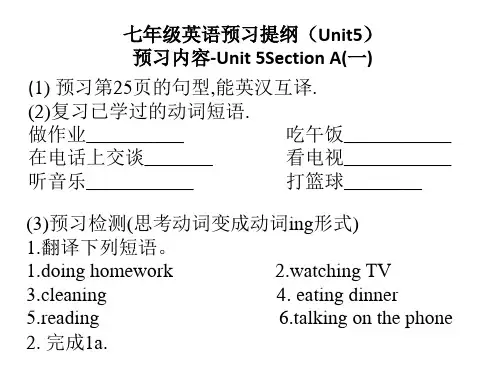
知识点拨 1. Thanks for your letter and the photos. thanks for =thank you for因为… 感谢 其中for是介词,介词后通常接名词,代词,或动词— ing 形式。 如: Thank you very much for taking me home. 非常感谢 你把我送回家。 2.Here are some of my photos 这是一个倒装句,其正常语序为:Some of my photos are here. 倒装句中的谓语动词按就近原则:即离here近 的名词是单数则谓语动词就用 ,如:Here is a photo of my family. 离here近后的名词是复数则谓语动 词就用 。如:Here are two pens.
预习内容-Unit 5Section A(三) 预习内容 三
1.预习指导: A预习 P28、29 ,阅读3a ,能英汉互译 B.重点短语:预习85页SectionB录音原文与29页3a,, 理解翻译其中的句子。(试一试,你肯定行) C.用英语打电话的表示方法: (1)Hello!意思是“喂”。听到电话铃响,外国人习 ) 惯拿起话筒,先向对方说Hello!并告诉自己的电话号码。 (2)This is Sam.意思是“我是山姆”。在打电话时, 介绍自己时一般不用I am···, 而是This is···。 (3)Is that Bill? 该句意思是“你是比尔吗?”。在 打电话时,询问对方是谁时不用Are you …?,而用Is that···?或者Who’s that?。
D.熟读85页SectionB录音原文与29页3a找出你不懂得短 语或句子:(积极动脑哦 ) 2.预习检测.:写出下列短语与句子。 ①在游泳池 ②在家 ③一张我家的照片 ④在第一/第二/下一个/最后一张照片里 ⑤他正在哪里游泳?Where he ? 他在游泳池里游泳。 the pool. ⑥非常感谢你的来信与照片。 your letters and the .
(2021年整理)人教版七年级英语下册Unit5知识点讲解
人教版七年级英语下册Unit5知识点讲解(推荐完整)编辑整理:尊敬的读者朋友们:这里是精品文档编辑中心,本文档内容是由我和我的同事精心编辑整理后发布的,发布之前我们对文中内容进行仔细校对,但是难免会有疏漏的地方,但是任然希望(人教版七年级英语下册Unit5知识点讲解(推荐完整))的内容能够给您的工作和学习带来便利。
同时也真诚的希望收到您的建议和反馈,这将是我们进步的源泉,前进的动力。
本文可编辑可修改,如果觉得对您有帮助请收藏以便随时查阅,最后祝您生活愉快业绩进步,以下为人教版七年级英语下册Unit5知识点讲解(推荐完整)的全部内容。
人教版七年级英语下册Unit5知识点讲解(推荐完整)编辑整理:张嬗雒老师尊敬的读者朋友们:这里是精品文档编辑中心,本文档内容是由我和我的同事精心编辑整理后发布到文库,发布之前我们对文中内容进行仔细校对,但是难免会有疏漏的地方,但是我们任然希望人教版七年级英语下册Unit5知识点讲解(推荐完整) 这篇文档能够给您的工作和学习带来便利。
同时我们也真诚的希望收到您的建议和反馈到下面的留言区,这将是我们进步的源泉,前进的动力。
本文可编辑可修改,如果觉得对您有帮助请下载收藏以便随时查阅,最后祝您生活愉快业绩进步,以下为〈人教版七年级英语下册Unit5知识点讲解(推荐完整)〉这篇文档的全部内容。
Unit 5 Why do you like pandas?本单元重点短语kind of 有点,稍微 a kind of 一种want sb to do sth 想要某人做某事 want sth 想要某物let sb do sth 让某人做某事 like to do sth 喜欢做某事play with 与。
..一起 have a look it 。
..看。
..every day 每天(be) made of 由。
.。
制成的cut down 砍倒 be quiet 安静get lost 迷路 be in (great)danger 处于(极大)危险中本单元日常用语归纳1.-—Why do you like pandas? 你为什么喜欢熊猫?---Because they’re very cute.因为它们非常可爱。
2020-2021学年人教版英语七年级下册Unit5第四课时SectionB(1a-1d)教案
1.理论介绍:首先,我们要了ump等,是描述我们在运动时所做的动作。它们在日常生活中非常重要,帮助我们更好地交流。
2.案例分析:接下来,我们来看一个具体的对话案例。这个案例展示了如何运用本课词汇和句型在实际中进行交流,以及它们如何帮助我们表达自己的喜好和提出建议。
其次,在新课讲授环节,我发现部分学生对一般现在时句子结构的理解仍有困难。在今后的教学中,我应更加注重句子结构的讲解和练习,可以通过错误分析、对比练习等方法,帮助学生突破这个难点。
在实践活动环节,角色扮演活动让学生们积极参与,课堂气氛活跃。但我也注意到,有些学生在口语表达时仍然显得紧张和不自信。为了提高学生的口语表达能力,我计划在后续教学中增加更多类似的活动,鼓励学生多开口,增强他们的自信心。
2.引导与启发:在讨论过程中,我将作为引导者,帮助学生发现问题、分析问题并解决问题。我会提出一些开放性的问题来启发他们的思考。
3.成果分享:每个小组将选择一名代表来分享他们的讨论成果。这些成果将被记录在黑板上或投影仪上,以便全班都能看到。
(五)总结回顾(用时5分钟)
今天的学习,我们了解了描述运动动作的词汇、一般现在时句子结构和提出建议的句型。同时,我们也通过实践活动和小组讨论加深了对这些知识点的理解。我希望大家能够掌握这些知识点,并在日常生活中灵活运用。最后,如果有任何疑问或不明白的地方,请随时向我提问。
五、教学反思
今天在Unit 5 Section B (1a-1d)的教学过程中,我发现学生们对于描述运动动作的词汇和一般现在时的句子结构掌握程度参差不齐。在授课过程中,我尽量通过生动的例子和实际操作,让学生更好地理解这些知识点。以下是我对今天教学的一些思考:
首先,关于词汇教学,我采用了图片展示和动作模仿的方法,让学生更直观地理解和记忆词汇。从学生的反馈来看,这种方法效果不错,他们能够较快地掌握新词汇。但在接下来的教学中,我还需要关注那些对词汇拼写和用法掌握不够扎实的学生,通过更有针对性的练习帮助他们巩固记忆。
人教版八年级英语下册 Unit4 Section(A·GF-B·1d)预习-训练案

sports.
Children should enjoy
France No homework
Happy
their childhood! They shouldn't spend time
English
4.你为什么不忘记它呢? 5.他应该和他的朋友谈谈 ,以便他能说声抱歉。
Why don't you forget about it? He should talk to his friend so that he can say he's sorry.
English
四、请用以上重点短语和句型完成下列句子。 1.我再也不担心我的数学考试了。 I ___d_o_n_’_t_w__o_r_ry__a_b_o_u_t______ my math test _a_n__y_m_o_r_e____. 2.不要忘记把书还给图书馆。 Don't forget to _r_e_t_u_r_n__ the books __to______ the library.
English
3.在学校我必须和我的同学竞争。 I have to ___c_o_m_p_e_t_e_w__it_h_______ my classmates at school. 4.他应该和他的朋友谈谈,以便他能说声抱歉。 He should talk to his friend__s_o_t_h_a_t____ he can say he's sorry. 5.不要害怕犯错误。 Don't __b_e__a_fr_a_i_d_o_f_________ making mistakes.
English
(3) could也可以用于提出建议,语气比can更为委婉。如: Maybe you could do more jobs around the house so that they have more time for proper communication. 也许你可以在家里多做些事情,以便他们有更多的时间进行 适当的交流。
人教版七年级英语上册 Unit9 Section(A·GF-B·1d) 预习-训练案
( C )10. —How’s your day, Bob?
—_____.
A. I’m fine
B. It’s right
C. It’s OK
D. It’s cloudy
二、完成句子, 词数不限。 11. ——你今晚有空吗? —— —__A_r_e__y_o_u_f_r_e_e_this evening? —No, I’m _(_v_e_ry_)_b_u_s_y_____. 12. Linda thinks math is__d_if_fi_c_u_lt_a_n_d__b_o_r_in__g_. 13. 汤姆最喜欢的科目是音乐。 Tom’s _f_a_v_o_ri_t_e_s_u_b_je_c_t is music. 14. 你的音乐老师是谁? Who is your _m__u_si_c_t_e_a_c_h_er__? 15. I like _P_._E_._ because it’s __fu_n__/i_n_te_r_e_s_ti_n_g___.
After school, they often have much 32. _h_o_m__e_w_o_r_k__ to do. They must 33. _f_in_i_s_h_/_d_o__ their homework on time. Sometimes, their homework is difficult. The teachers 34.__d_o_n_’_t____want their students to copy (抄袭) others’ homework, so the students have to ask their teachers for 35. ___h_e_lp_____. Then they can learn better.
人教版七年级下册英语Unit 5 SectionA (1a-2d)
第一课时:SectionA (1a-2d)
Let’senjoyasongandsaywhatanimalscanyouseeinthevideo?
1a
LanguageGoals:Describeanimals; Expressreferences
【点拨】用交际法解题。Notatall. 意为“别客气。”; Nevermind. 意为“没关系。”;Itdoesn’tmatter. 意为“没 关系。”;Goodidea. 意为“好主意。”。上句“测试后 让我们去看电影吧。” 表示建议,四个选项中只有D项可 作为对其的回答,表示同意、支持对方的建议。
【点拨】用语法分析法解题。第一空填基数词,指“四个 孩子”;第二空填序数词,指“他的第一个孩子”。
知识点 3 They’remyfavoriteanimals.
考点5 animal/ænɪml/n. 动物 e.g. Canyouseeananimalinthetree? 你能看见树上有一只动物吗?
知识点 4 Becausethey’reverycute.
考点6 because/bɪkɒz/conj. 因为 e.g.
TheybelieveHuaweibecauseitisoneofthebiggestsm artphonemakersintheworld. 他们相信华为,因为它是世界上最大的智能手机制 造商之一。
考点2 交际用语
“Let’s+动词短语.”意为“咱们……吧。” 它是以Let’s开头的祈使句,是提建议的句型。 Let’s是Letus的缩写,其后接动词原形作宾 语补足语。常用的肯定答语有“OK./Allright./ Goodidea.”;否定答语可用“Sorry,I...”。
人教七年级下册unit 5 知识点(共32张ppt)
Linda is very kind to the kids.
Section A 知识点:
6.Where are they from?
be from + 地点=come from
来自...
Where are they from=Where do they come from?
Section A 知识点:
辨析:sleep, sleepy, asleep
sleep
作动词意为“睡觉”;作名词意为“睡眠”
sleepy
形容词意为“疲惫的,困的”
asleep
形容词意为“睡着的,熟睡的”fall asleep
Section A 知识点:
e.g. 用sleep, asleep, sleepy 填空 1. Little Tom sleeps for 8 hours every day. 3. Jack is sleepy in class. 4. He always falls asleep on the bus. [用法速记] I didn't sleep well last night, so I feel sleepy in class, I'm afraid I will fall asleep.
Grammar focus:
Why 用法拓展: why 可用于提建议,通常句型为: why don't you + v原+ 其他?
=why not + v原+其他? 你为什么不做...呢? 答语:Good idea. That's a good idea.
完整版人教版七年级英语下册第五单元知识点总结
人教版七年级下册英语第五单元Unit5 Why do you like pandas? 知识要点重要短语like…a lot 非常喜欢…black and white 黑白相间all day整天Let's do= let us do 让我们做……kind of 有点儿,稍微South Africa南非be from/come from 来自于save the elephants救助大象one of…其中之一a symbol of good luck好运的象征get lost迷路cut down 砍倒for a long time 很长时间in great danger处于(极大)危险之中things be made of ivory由象牙制成的东西places with food and water有食物和水的地方kill……for……为……杀1.see the pandas 看熊猫35.be friendly with和某人关系好36. be kind to sb对某人善良、好2.my favorite animals我最喜欢的动物37.3. welcome to sp 欢迎来某地be good to sb对某人好38. the other people=the others其他的人4.welcome back to sp 欢迎回到某地39.5.be from 来自many other animals许多其他的动物40.three other men另外三个男人 e from来自41.another three men另外三个男人7.in the zoo 在动物园里42.three more men另外三个男人8.on the farm 在农场里43.我的新宠物else其他的,它放在疑问代词和不定代词后my new pet 9. other10.walk on two legs 用两条腿走其他的,它放在名词前44.eat grass吃草45.11.kind of有点go to sleep 睡着,入睡有点有趣kind of interesting 46.12. go to beda little13.有点上床睡觉47.every day每天48.14.a little boring有点无聊everyday 一种日常的49.15.a kind of 16.all kinds of 好的幸运标志、象征50.各种各样的a symbol of good luck 忘记要做某事all day17.整天51.forget to do sth 忘记做过某事52.18.a good name for sb对某人是一个好名字forget doing sth走很长时间53.South Africa19.南非walk for a long time 迷路be/get lost54.华南20.South China从不迷路never get lost55.South America21.南美洲places with food and water 22.美国America, the USA 56. the UK ,England23.英国带有食物和水的地方be in (great) danger在危险中57.南极24.the South Polecut down 什么动物what animals25.砍倒58.cut into pieces挽救大象26.save the elephants 切成碎片59.切断60.cut off 。