
人教版九年级英语第八单元知识点复习总结
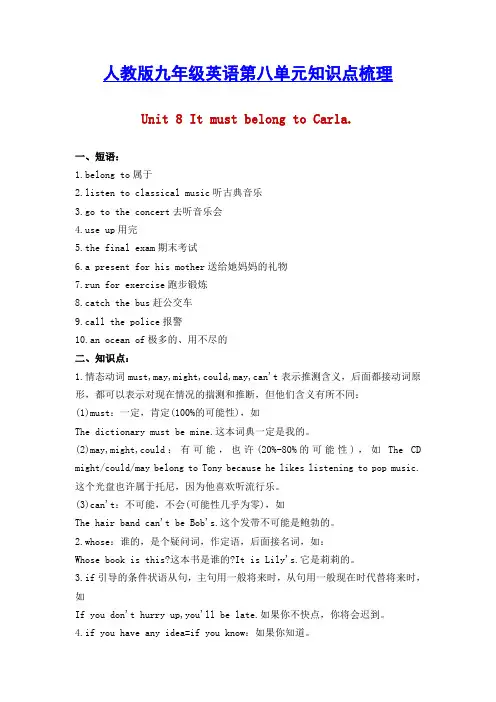
人教版九年级英语第八单元知识点总结Unit 8 It must belong to Carla.一.单词whose truck picnic rabbit attend valuable pink anybody happening noise policeman wolf uneasy laboratory outdoors coat sleepy land alien run after suit express all the same time circle Britain mystery receive historian leader midsummer medical purpose prevent energy position burial honor ancestor victory enemy period hard-working情态动词表推测:语气+时态(一)情态动词表推测的三种语气1.在肯定句中一般用must (一定),may(可能),might / could(也许,或许)。
He must/may/might know the answer to this question?他一定/可能/也许知道这个问题的答案。
2.否定句中用can’t / couldn’t(不可能), may not/might not(可能不)。
It can’t/couldn’t be the headmaster. He has gone to America.这不可能是校长,他去美国了。
3.疑问句中用can/could (能……?)。
Could he have finished the task? 他可能把任务完成了吗?(注:以上三种句式中情态动词的语气按程度都是依次递减的。
Might, could并非may, can 的过去式,而表示语气较为委婉或可能性较小。
(二)情态动词表推测的三种时态1.对将来情况的推测,用“情态动词 + 动词原形”。
She must / may / might / could arrive before 5. 5:00前她一定/可能/也许到。
2.对现在或一般情况的推测,用“情态动词 + be”,“情态动词 +be doing”或“情态动词 + 动词原形”(1)He must / may / might / could be listening to the radio now.(2)He can’t ( couldn’t ) / may ( might ) not be at home at this time.(3)Mr. Bush is on time for everything. How can ( could ) he be late for the opening ceremony ?布什先生一向准时,这次开幕式他怎么可能迟到呢?3.对过去情况的推测,用“情态动词 + have +过去分词”。
(1)It must / may / might / could have rained last night .The ground is wet. (2)The door was locked. He can ( could ) not / may ( might ) not have been at home .门锁着,他不可能/可能不在家。
(3)Can / Could he have gotten the book?难道他找到书了吗?总结:对某一次的推测句型有两部分:语气和时态语气部分:(以下情态动词语气由强至弱)肯定句:must、may、might(=could)否定句:can’t(=couldn’t)、mayn’t、mightn’t疑问句:can、could(语气更加委婉不确定)时态部分:be表示对现在的推测have done表示对过去的推测be doing表示对正在进行的推测语气部分写在前时态部分写在后,组合在一起就是推测There be 句型表推测There+情态动词+be/do sthThere+情态动词+be doing sthThere+情态动词+have done sth二.1.attend/join/join in/take part in1)join有两个用法:(1)指加入某个党派,团体组织等,成为其成员之一,意为:“参军、入团、入党”等。
如:①When did your brother join the army? 你哥哥什么时候参军的?②She joined the Young Pioneers. 她加入了少先队。
(2)和某人一道做某事,其结构为:join sb. in (doing) sth.,根据上下文,in (doing) sth. 也可以省去。
如:①Will you join us in the discussion? 你参加我们的讨论吗?②He'll join us in singing the song. 他将和我们一道唱歌。
③We're going to the East Lake Park on Sunday. Will you join us?我们打算星期天去东湖公园。
你跟我们一道去好吗?2)join in多指参加小规模的活动如“球赛、游戏”等,常用于日常口语。
①Come along, and join in the ball game. 快,来参加球赛。
②Why didn't you join in the talk last night? 昨晚你为什么没参加座谈?3)take part in 指参加会议或群众性活动等,着重说明句子主语参加该项活动并在活动中发挥作用。
①We'll take part in social practice during the summer vacation.暑假期间我们将参加社会实践。
②We often take part in physical labor. 我们经常参加体力劳动。
【注意】take part in是惯用词组,part前一般不用冠词,但part前有形容词修饰时,要用不定冠词。
如:①Lincoln took an active part in polities and was strongly against slavery.林肯积极参加政治活动,强烈反对奴隶制。
4)attend是正式用语,及物动词,指参加会议,婚礼,葬礼,典礼;去上课,上学,听报告等。
句子的主语只是去听,去看,自己不一定起积极作用。
如:①He'll attend an important meeting tomorrow.他明天要参加一个重要的会议。
②I attended his lecture. 我听了他的讲课。
2.value相关Value名词(1)价值(不可数名词)①His advice is of great value to me. 他的忠告对我很有价值。
(2)益处,重要性(不可数名词)。
①In fact, sports and games can be of great value to people's health.实际上,体育运动对人们的健康很有益处。
②We have already realized the value of good story books to children.我们已经认识到好的故事书对孩子们的益处。
动词①评价,尊重,重视I value our friendship very much. 我非常尊重我们的友谊。
valuable (宝贵的,有价值的)和 invaluable (极宝贵的,极有价值的)并不是一对反义词,而是一对意义相近的词,后者比前者语气更强,相当于 extremely valuable。
如:It was a valuable (an invaluable) painting. 那是一幅很有(极有)价值的画。
valuable (宝贵的,有价值的)与 valueless (无价值的,没有用的)是一对反义词。
如:This jewellery is valueless; it is made of glass and ordinary metals. 这首饰不值钱,它是由玻璃和普通金属做的。
注:valueless 和 worthless 是同义词,均指“无价值的”、“不值钱的”。
3.happena.表示“某地(某时)发生了什么事”,常用“sth.+ happen +地点/时间”这一结构来表达,此时主语应是事情。
The story happened in 2003. 这个故事发生在2003年。
An accident happened in that street. 那条街上发生了一起事故。
b.表示“某人出了某事(常指不好的事)”,要用“sth.+ happen+to sb.”这一结构来表达。
A car accident happened to her this morning. 今天上午她发生了交通事故。
What happened to you? 你怎么啦?c.表示“某人碰巧做某事”,要用“sb.+ happen+ to do sth.”这一结构来表达。
I happened to meet a friend of mine in the street yesterday. 昨天我碰巧在街上遇到了我的一个朋友。
d.happen表示“碰巧或恰巧发生某事”时,还可用“It happens / happened that...”这一结构来表达。
It happened that Brian and Peter were at home that day. 碰巧那天布莱恩和彼得在家了。
It happened that he had to take part in a meeting that afternoon. 碰巧那天下午他不得不参加一个会议。
注:that从句中的主语是人时,此种结构可以与“sb.+ happen + to do sth.”结构互换。
It happened that Brian and Peter were at home that day. = Brian and Peter happened to be at home that day.4.noise/sound/voicesound泛指任何声音,不论其高低、是否悦耳等。
如:I heard the sound of running water. 我听见流水声。
Light travels faster than sound. 光比声音传播得快。
人教版九年级8单元背诵版
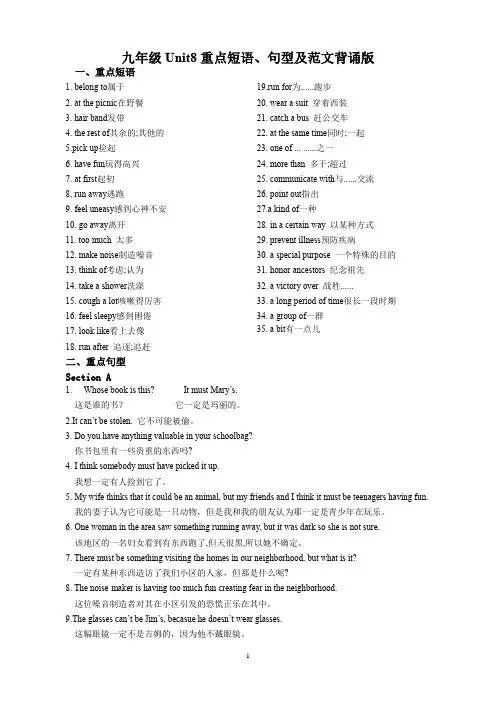
九年级Unit8重点短语、句型及范文背诵版一、重点短语1. belong to属于2. at the picnic在野餐3. hair band发带4. the rest of其余的;其他的5.pick up捡起6. have fun玩得高兴7. at first起初8, run away逃跑9. feel uneasy感到心神不安10. go away离开11. too much 太多12. make noise制造噪音13. think of考虑;认为14. take a shower洗澡15. cough a lot咳嗽得厉害16. feel sleepy感到困倦17. look like看上去像18. run after 追逐;追赶19.run for为......跑步20. wear a suit 穿着西装21. catch a bus 赶公交车22. at the same time同时;一起23. one of ... ......之一24. more than 多于;超过25. communicate with与......交流26. point out指出27.a kind of一种28. in a certain way 以某种方式29. prevent illness预防疾病30. a special purpose 一个特殊的目的31. honor ancestors 纪念祖先32. a victory over 战胜......33. a long period of time很长一段时期34. a group of一群35. a bit有一点儿二、重点句型Section A1.----Whose book is this? ----It must Mary’s.这是谁的书?它一定是玛丽的。
2.It can’t be stolen. 它不可能被偷。
3. Do you have anything valuable in your schoolbag?你书包里有一些贵重的东西吗?4. I think somebody must have picked it up.我想一定有人捡到它了。
人教版九年级英语第八单元3a知识点
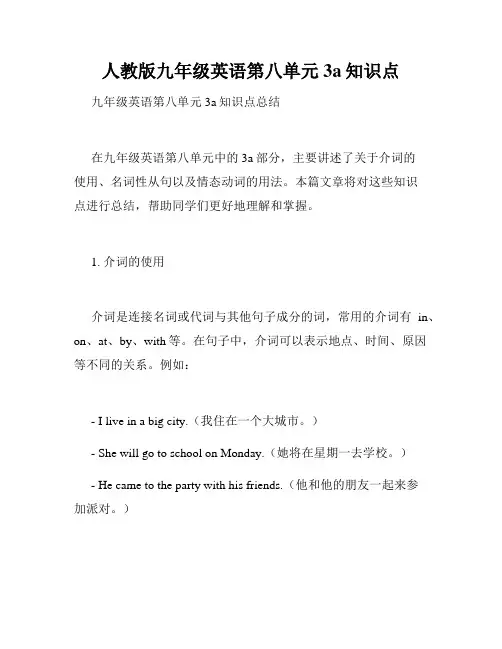
人教版九年级英语第八单元3a知识点九年级英语第八单元3a知识点总结在九年级英语第八单元中的3a部分,主要讲述了关于介词的使用、名词性从句以及情态动词的用法。
本篇文章将对这些知识点进行总结,帮助同学们更好地理解和掌握。
1. 介词的使用介词是连接名词或代词与其他句子成分的词,常用的介词有in、on、at、by、with等。
在句子中,介词可以表示地点、时间、原因等不同的关系。
例如:- I live in a big city.(我住在一个大城市。
)- She will go to school on Monday.(她将在星期一去学校。
)- He came to the party with his friends.(他和他的朋友一起来参加派对。
)需要注意的是,介词后面往往需要搭配相应的名词、代词或动词的-ing形式。
例如:- He is interested in playing basketball.(他对打篮球很感兴趣。
)- I am tired of studying.(我对学习感到厌倦。
)2. 名词性从句名词性从句是句子的一种成分,可以在句子中充当主语、宾语、表语或同位语。
常见的引导名词性从句的词有that、whether/if、who、which等。
例如:- I don't know if he will come to the party.(我不知道他是否会来参加派对。
)- What she said is very interesting.(她说的话很有趣。
)名词性从句的时态和语序要根据句子的主句情况来确定。
需要注意的是,当主句是一般现在时态时,从句要使用一般现在时态;主句是一般过去时态时,从句要使用一般过去时态;主句是将来时态时,从句要使用将来时态。
3. 情态动词的用法情态动词在句子中起到了一种特殊的作用,它们用来表示说话人的态度、意愿、能力等。
常见的情态动词有can、could、may、might、will、would、shall、should、must等。
九年级英语人教版第八单元知识点汇总
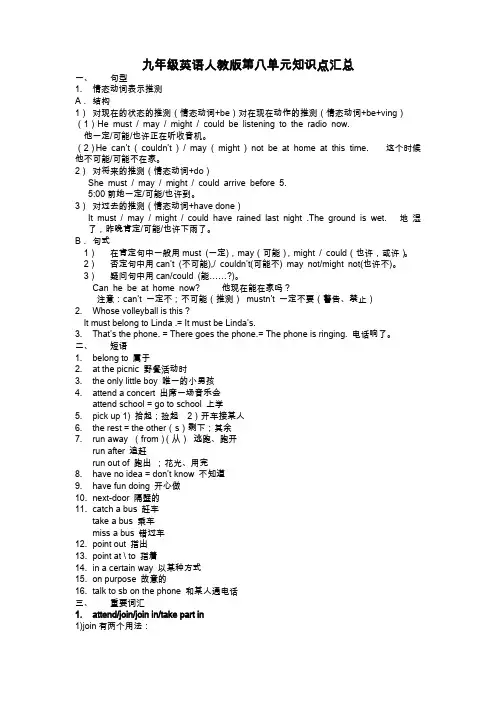
九年级英语人教版第八单元知识点汇总一、句型1. 情态动词表示推测A.结构1)对现在的状态的推测(情态动词+be)对在现在动作的推测(情态动词+be+ving)(1)He must / may / might / could be listening to the radio now.他一定/可能/也许正在听收音机。
(2)He can’t( couldn’t ) / may ( might ) not be at home at this time. 这个时候他不可能/可能不在家。
2)对将来的推测(情态动词+do)She must / may / might / could arrive before 5.5:00前她一定/可能/也许到。
3)对过去的推测(情态动词+have done)It must / may / might / could have rained last night .The ground is wet. 地湿了,昨晚肯定/可能/也许下雨了。
B.句式1)在肯定句中一般用must (一定),may(可能),might / could(也许,或许)。
2)否定句中用can’t(不可能),/ couldn’t(可能不) may not/might not(也许不)。
3)疑问句中用can/could (能……?)。
Can he be at home now? 他现在能在家吗?注意:can’t 一定不;不可能(推测)mustn’t 一定不要(警告、禁止)2. Whose volleyball is this?It must belong to Linda .= It must be Linda’s.3. That’s the phone. = There goes the phone.= The phone is ringing. 电话响了。
二、短语1. belong to 属于2. at the picnic 野餐活动时3. the only little boy 唯一的小男孩4. attend a concert 出席一场音乐会attend school = go to school 上学5. pick up 1) 拾起;捡起2)开车接某人6. the rest = the other(s)剩下;其余7. run away (from)(从)逃跑、跑开run after 追赶run out of 跑出;花光、用完8. have no idea = don’t know 不知道9. have fun doing 开心做10. next-door 隔壁的11. catch a bus 赶车take a bus 乘车miss a bus 错过车12. point out 指出13. point at \ to 指着14. in a certain way 以某种方式15. on purpose 故意的16. talk to sb on the phone 和某人通电话三、重要词汇1. attend/join/join in/take part in1)join有两个用法:(1)指加入某个党派,团体组织等,成为其成员之一,意为:“参军、入团、入党”等。
Unit8笔记人教版英语九年级全册
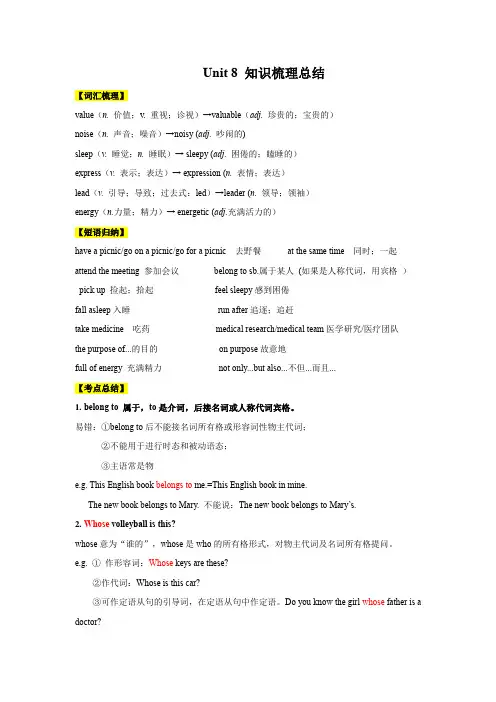
Unit 8 知识梳理总结【词汇梳理】value(n.价值;v. 重视;诊视)→valuable(adj.珍贵的;宝贵的)noise(n.声音;噪音)→noisy (adj. 吵闹的)sleep(v.睡觉;n.睡眠)→ sleepy (adj. 困倦的;瞌睡的)express(v.表示;表达)→ expression (n. 表情;表达)lead(v.引导;导致;过去式:led)→leader (n. 领导;领袖)energy(n.力量;精力)→ energetic (adj.充满活力的)【短语归纳】have a picnic/go on a picnic/go for a picnic 去野餐at the same time 同时;一起attend the meeting 参加会议belong to sb.属于某人(如果是人称代词,用宾格)pick up 捡起;拾起feel sleepy感到困倦fall asleep入睡run after追逐;追赶take medicine 吃药medical research/medical team医学研究/医疗团队the purpose of...的目的on purpose故意地full of energy 充满精力not only...but also...不但...而且...【考点总结】1.belong to 属于,to是介词,后接名词或人称代词宾格。
易错:①belong to后不能接名词所有格或形容词性物主代词;②不能用于进行时态和被动语态;③主语常是物e.g. This English book belongs to me.=This English book in mine.The new book belongs to Mary. 不能说:The new book belongs to Mary’s.2.Whose volleyball is this?whose意为“谁的”,whose是who的所有格形式,对物主代词及名词所有格提问。
人教版九年级英语第八单元知识点梳理
play football踢足球play basketball打篮球play baseball打棒球
【语法重点】
第八单元的语法重点是:情态动词表推测。
情态动词表推测
情态动词must,may,might,could,may,can表示推测含义与用法后面都接动词原形,都可以表示对现在情况的揣测和推断但他们含义有所不同。
Please wake me up at 8 o'clock.请在8点钟叫醒我。
11.look for:寻找,强调找的过程(重要);find:找到,强调找的结果,如
I am looking for a pen.我正在找一支笔。
I found my pen just now.我刚刚找到了我的笔。
12.hear:听到,强调听的结果;listen:听,强调听的过程,如
(1)must:一定,肯定(100%的可能性),如
The dictionary must be mine.这本词典一定是我的。
(2)may,might,could:有可能,也许(20%-80%的可能性),如The CD might/could/may belong to Tony because he likes listening to pop music.这个光盘也许属于托尼,因为他喜欢听流行乐。
6.neighbor:邻居,指人;neighborhood:街区、街坊,指附近的地区。
7.当形容词修饰something,anything,nothing,everything等不定代词时,放在这些词的后面(重要,切记),如something strange奇怪的某物。
8.escape from…:从...逃跑出来(常考短语),如
人教版九年级英语(全一册)Unit8_单元知识总结

Unit8 单元知识总结短语归纳1. belong to… 属于……2. hair band 发带3. go to/attend a concert 参加音乐会4. in the music hall 在音乐大厅5. something valuable/unusual 贵重/不寻常的东西6. something strange 奇怪的事情7. at the picnic 在野餐时8. the rest of.... 其余的……9. pick it up 捡起,拾起10. each other=one another 互相,彼此11. nothing much 没什么(事)12. go to a picnic=go for a picnic 去野餐13. anything else 其它的东西14. be interviewed by... 被……采访15. strange noises 奇怪的16. outside our window 在我们的窗外17. next-door neighbor 隔壁邻居18. at first 首先,起初19. run away 逃走20. feel uneasy 感到不安21. have no idea=don’t know 不知道22. a long period of time 很长一段时间23. have fun doing sth. 做某事开心24. create fear制造恐惧1/ 625. There must be …doing sth. 一定有……在做某事26. cough a lot 咳得厉害27. run after 追赶28. run to do sth. 跑着去做某事29. must be dreaming 一定在做梦30. run for exercise 跑步锻炼31. make a movie 拍电影32. wear a suit 穿西服/套装33. express a difference / result 表达差异/结果34. add information 添加信息35. at the same time 同时36. a rock circle 一个石头圈37. the most famous historical places 最著名的历史名胜38. a group of… 一群……39. a bit late 有点晚儿40. communicate with ...与……交流41. so many centuries ago许多世纪前42. point out 指出43. put together 放在一起44. in a certain way 以某种方式45. on midsummer’s morning 在仲夏的上午46. shine directly into… 直接照进……47. the center of ... ……的中心48. move up 上升,提升49. the position of... ……的位置50. burial place 墓地51. a place to honor ancestors祭拜祖先的地方52. celebrate a victory over an enemy庆祝战胜敌人用法集萃1. belong to 属于It must belong to Carla. = It must be Carla's.2. attend a concert参加音乐会(go to concert 去听音乐会)【比较应用】attend 主要指以观众或听众的身份参加婚礼,丧礼,会议或讲座或上课。
人教版九年级英语Unit8知识点梳理及语法讲义(教师版)
九年级英语Unit 8知识点与语法精讲精练词汇梳理(一)完成单词梳理:名词:1. truck 卡车;货车 2. picnic 野餐 3. rabbit 兔;野兔4. happening 事件;发生的事情5. noise 声音;噪音6. policeman 男警察7. wolf 狼8. laboratory 实验室9. coat 外套;外衣10. alien 外星人11. Britain 大不列颠12. mystery 奥秘13. historian 历史学家14. leader 领导;领袖15. midsummer 仲夏16. purpose 目的;目标17. energy 力量;精力18. position 位置;地方19. burial 埋葬;安葬20. ancestor 祖宗;祖先21. victory 胜利;成功22. enemy 敌人;仇人23. period 一段时间;时期动词:1. attend 出席;参加 2. land 着陆;降落 3. prevent 阻止;阻挠4. receive 接待;接受;收到5. express 表示;表达副词:1. outdoors 在户外;在野外代词:1. anybody 任何人形容词:1. valuable 贵重的;很有用的;宝贵的 2. uneasy担心的;不安的3. sleepy 困倦的;瞌睡的4. medical 医疗的;医学的兼类词:1. whose (adj/pron)谁的 2. pink (adj)粉红色的(n)粉红色3. suit (n)西服;套装(v)适合4. circle (n)圆圈(v)圈出5. honor (v)尊重;表示敬意(n)荣幸;荣誉(二) 词汇变形小结:1. who (pron. 谁) — whose (adj/pron. 谁的)2. value(n. 价值) — valuable (adj. 贵重的;宝贵的)— valueless (adj. 无价值的;不值钱的)3. happen (v. 发生) — happening (n. 事件;发生的事情)4. noise (n. 声音;噪音) — noisy (adj. 吵闹的;嘈杂的)— noisily (adv. 吵闹地)5. policeman (n. 男警察)— policemen (复数)6. wolf (n. 狼) — wolves (复数)7. easy(adj. 容易的) — uneasy (adj. 担心的;不安的)8. sleep(v. 睡觉) — sleepy (adj. 困倦的) — asleep (adj. 睡着的)9. suit(v. 适合) — suitable (adj. 合适的;适宜的)10. express(v. 表示;表达) — expression (n. 表示;表情)11. history(n. 历史) — historical (adj. 有关历史的) — historian (n. 历史学家)12. lead(v. 通向;导致) — leader (n. 领导;领袖)13. medicine(n. 药;医学) — medical (adj. 医疗的;医学的)14. energy(n. 力量;精力) — energetic (adj. 精力充沛的;充满活力的)【练一练】用所给词的适当形式填空1.When you watch an English movie, the characters’ body language and the __expressions__(express) on their faces can help you understand the movie better.2.There used to be many ___wolves_____ (wolf), but only a few of them remain today.3.I stayed up to watch TV last night. Now I feel ____sleepy_____ (sleep).4.He put something ___valuable____ (value) into the drawer and locked it.5.Bill gave a lot of money ___medical_____ (medicine) research last year.6.Liu Yu and Wang Li want to be ___historians____(history)when they grow up.7.She is one of the ___leaders______(lead) in our school.8.Don’t be shy. Just try your best to ___express_____(expression) your own idea to us.9.We were worried about the children’s ___safety______ (safe).10.The teacher often encourage his students ___to watch_____ (watch) English films.(三) 短语攻关:run after 追逐;追赶at the same time 同时;一起belong to 属于have a picnic 野餐pick up 捡起;拿起run away 逃跑have no idea 不知道not only...but also... 不但……而且……point out 指出point to 指向point at 指着on the phone通过知识点梳理1.It must belong to Carla. 它一定是卡拉的。
人教版九年级英语全一册知识点Unit8知识点总结
Unit 8 It must belong to Caral一.短语归纳1. belong to…属于…2. toy truck 玩具卡车3. her favorite writer 她最宠爱的作家4. the only little lid唯一的小孩5. listen to pop music听流行音乐6. hair band 发带7. attend a concert 参与音乐会8. in the music hall 在音乐大厅9. something valuable 贵重的东西10.go to a picnic=go for a picnic去野餐11. at the picnic在野餐时12. the rest of my friends 我其余的朋友13. pick it up 捡起,捡起14. each other=one another 相互,彼此15. nothing much没什么〔事〕16. something unusual不寻常的东西17. something strange惊异的事18. anything else其它的东西19. be interviewed by…被…采访20. strange noises 惊异的声音21. outside our window在我们的窗外22. next-door neighbor隔壁邻居23. at first 首先,起初24. run away 逃走25. feel uneasy 感到担忧26. have no idea=don’t know 不知道27. go away 走开,离开28. noise-maker 噪音的制造者29. have fun doing sth.做某事快活30. create fear制造恐惊31. in the neighborhood 在社区32. There must be …doing sth. 肯定有…在做某事33. in the laboratory 在试验室34. hear water running听见流水声35. cough a lot 咳得厉害36. run after追赶37. a woman with a camera 一位拿相机的妇女38. at work 在工作39.might be late for work 可能上40. must be dreaming肯定在做梦41. run for exercise跑步熬炼42. run to do sth. 跑着去做某事43. catch a bus 赶公共汽车44. make a movie 拍电影45. wear a suit 穿西服/套装46. express a difference / result表达差异/ 结果47. add information 添加信息48. at the same time 同时49. a rock circle 一个石头圈50. not only …but also…不仅…而且…51.Britain’s most famous historical places 英国最有名的的历史名胜52.r eceive more than 10 visitors 接待10多名游客53.o n the longest day of the year 在一年中最长的那天54. ancient leaders古代领导者55. a group of…一群…56.. a bit late 有点晚儿57. communicate with the gods 与上帝沟通58 so many centuries ago很多世纪前59. point out 指出60. a kind of calendar 一种日历61. put together 放在一起62. in a certain way 以某种方式63. on midsummer’s morning 在仲夏的上午44.shine directly into… 直接照进…65. the center of the stones石头的中心66. a medical purpose 一个医学目的67. prevent illness 阻挡疾病68. move up 上升,提升69.from your feet move up your body 从你的脚上升到你的身体70.the position of……的位置71.for a special purpose为了一个特别的目的72. a burial place 一个墓地73. a place to honor ancestors祭拜祖先的地方74.celebrate a victory over an enemy庆祝战胜敌人75. a long period of time 很长一段时间二.用法集萃1.must, may, might, could, may, can’t+动词原形表示推想,程度不同must 肯定,确定(100%的可能性)may, might, could 有可能, 或许(20%-80%的可能性)can’t不行能, 不会(可能性几乎为零)例:The dictionary must be mine. It has my name on it.The CD might/could/may belong to Tony, because he likes listening to pop music.The hair band can’t be Bob’s. After all, he is boy!2.take place 常指“(某事)按打算进展或按打算发生”(二者都无被动)happen 常指具体大事的发生,特别指那些偶然或未能预见“的发生”例:Great changes have taken place in China since.New things are happening all around us.take place 还有“进展”之意。
Unit8知识点人教版九年级英语全册
Unit8 It must belong to Carla.英语教研组词汇精讲1、attendattend用作及物动词,意为“出席;参加”。
指参加会议、婚礼、典礼、葬礼;也指去上课、上学、听报告等。
例:He needs to attend an important meeting. 他需要参加一个重要的会议。
【辨析】join/take part in/attend(1)join指加入某个党派, 团体组织等, 成为其中一员, 意为“参军, 入党, 入团”例:join the Army/the Party/the League (2)join sb. in (doing) sth. 和某人一道做某事例:Will you join us in the picnic? 你参加我们的野炊吗?(3)join in多指参加小规模的活动如“游戏, 比赛”, 口语中常用。
例:Join in the basketball game. 参加篮球赛。
(4)take part in 指参加会议或群众性活动, 着重说明主语参加该项活动并在活动中发挥作用。
例:We’ll take part in the sports meeting/club.(5)take an active part in 积极参加……(6)attend 正式用语vt. 指参加会议, 婚礼, 葬礼, 典礼; 去上课, 上学, 听报告等。
句子主语只是去听, 去看, 自己不一定起积极作用。
例:I attended a night school. 我上夜校。
【即学即练】Would you like to ________ my birthday party this Saturday?—Sorry, I have an important meeting to ________. A.attend; join B.take part in; attend C.join; take part in D.attend; join in2、belong to someone 和be someone’sbelong to someone 和be someone’s 含义基本相同,都表示“属于某人,归某人所有”区别:①belong to +名词或宾格代词。
新人教版九年级英语unit8知识点归纳
新人教版九年级英语unit8知识点归纳新人教版九年级英语Unit 8知识点归纳在新人教版九年级英语教材的Unit 8中,我们学习了许多有关网络与社交媒体的知识,这些知识对于我们现代社会的学习、工作与交流起着重要的作用。
在本篇文章中,我们将对Unit 8中的一些重要知识点进行归纳总结,为大家巩固学习提供帮助。
第一部分:网络和社交媒体的介绍在Unit 8的第一部分,我们了解到了网络和社交媒体对我们的生活产生了巨大的影响。
我们可以通过互联网搜索信息,使用社交媒体平台与朋友分享生活、交流想法。
社交媒体的开展为我们提供了许多便利,但同时也需要我们提高信息的安全意识,避免上当受骗。
第二部分:信息的价值和安全性在这一部分,我们学习了信息的价值以及如何保证信息的安全性。
我们应该正确评估信息的真实性和可靠性,避免被虚假信息所误导。
同时,我们还学习了一些保护个人信息的方法,如设置复杂的密码、不随意分享个人信息等。
第三部分:网络对人际关系的影响网络的兴起对人际关系产生了深远的影响。
我们可以通过社交媒体与朋友、家人保持联系,拓展社交圈子。
然而,过度沉迷网络也会使我们与现实世界的人际交往减少。
因此,我们要学会合理利用网络,保持平衡的生活方式。
第四部分:网络安全问题及解决方法在网络上,我们也会面临一些安全问题,如网络欺诈、网络侵犯等。
我们应该学会辨别垃圾信息,不随意下载和点击可疑链接。
同时,我们还需要保护好自己的个人信息,避免泄露给不明身份的人。
第五部分:虚拟社交和现实社交的比较在这一部分中,我们探讨了虚拟社交和现实社交两种不同形式的人际交往。
虚拟社交使我们能够与更多人联系,但同时也带来了面对面交流的减少。
我们应该在虚拟社交和现实社交之间寻找平衡,发展健康的人际关系。
第六部分:如何利用社交媒体提升自己在这一部分中,我们学习了如何利用社交媒体平台提升自己。
我们可以通过发布优秀的作品、分享知识与经验来展示自己的才艺与能力。
同时,我们还要注意自我管理,避免沉迷于社交媒体而忽视其他重要的事务。