
外研版四年级英语下册Module5 Unit 1 I was two then授课课件【新版】
反义词: short 短的
I was two then.
You were so cute!
最佳介绍员
四人一组,先准备几张自己幼时的照片,然后向同伴展示自己 的照片,介绍自己幼时的特征。规定时间内看谁介绍得最多、最正 确,推选为最佳介绍员,参加全班比赛。句型:I was...
A:Her hair was short then. B:Now her hair is long.
发:字母组合or 发/ɔː/ 音。 反义词: long 长的 形近词: shirt 衬衫 一词多义: short 矮的
魔法记忆: The short man’s shorts are short. 这个矮个子男人的短裤很短。
知识点 5
/ lɒŋ/ adj.(形容词) 长的[四会]
例句: It is so long. 它那么长。 发音: 字母组合o 发/ ɒ/ 音。
我们的学校那时候很小。
/heə(r)/ n.(名词)头发 [四会] 例句: Her hair is short. 她的头发很短。 发音: air 组合在单词中发/eə(r)/ 音。 加法记忆法: h+air(空气)=hair 头发 整体记忆法: hair 头发 air 空气,chair 椅子 so /səʊ/adv.(副词)这么,那么 [三会] 例句: This boy is so tall. 这个男孩那么高。
知识点 3
/əʊld/ adj.(形容词)老的,年老的
例句: My grandparents are old. 我的祖父母老了。 减法记忆法: cold(寒冷的)-c=old(老的)
一词多义:old 旧的 反义词: young 年轻的
知识点 4 Your hair was so short. 那时你的头发那么短。 描述单数事物过去的状态的句型 句型结构: 名词(单数)+was/were+ 其他. 例句: Our school was small then.
去时,am的过去式是was,故选A。
4. You __C___ so cute then, but now you ______ naughty.
A. are, are B. were, were
C. were, are
点拨:then 那时,用于一般过去时中,you是第二人称, 用are。are的过去式是were,故第一空填were; now现在,用在一般现在时中,故第二空填are。
用法: 此处的so 是副词,表示程度,意思为“这么, 那么”,后面常跟形容词或副词。
短语: so long 这么长 so cute 这么可爱 一词多义: so conj.(连词) 所以 short / ʃɔːt/ adj.(形容词) 短的 例句: Your hair is so short. 你的头发那么短。
3. His little brother is ____A____ naughty.
A. so
B. such
C. such a
点拨:因为副词so后面直接跟形容词,而such后面跟名 词,所以选A。
二、根据提示填入合适的单词补全句子。
1. The students ___w_e_r_e__ (be) in the classroom then. 点拨:因为句子中的时间状语为then,所以句子可以用 一般过去时,又因为主语是The students,是复 数形式,所以用were。
是复数人称或第二人称单数。 /jʌŋ/ adj.(形容词)年轻的[四会]
例句: John is a young man. 约翰是个年轻人。 加法记忆法: you(你)+ng=young 年轻的
短语: young man 年轻人 反义词: old 老的,年老的
/jʌŋ/ adj.(形容词)年轻的[四会] 例句: She was cute then. 那时她可爱。 加法记忆法: t+hen(母鸡)=then 那时 短语: just then 就在那时
一、单项选择。
1. _____A____ I young then.
A. was
B. am
C. were
2. His hair ____C____ long now.
A. are
B. was
C. is
3. I ____A_____ young then.
A. was B. am C. were
点拨:根据句意“那时我很年轻。”可知此句用一般过
1 熟记本节课所学的句型、短语和单词,必须会 听、说、读、写。
2 将Listen and read. 朗读流利。
Module 5
四年级下册
This is me. I was one. I was short. Now I’m tall.
知识点 1 I was one. 我一岁。 描述某人过去的年龄的句型 句型结构: 主语+ was/were+ 数词. 例句: Lucy was four.(那时)露西四岁。
/wəz/ v.(动词)是[四会] 例句: He was a student ten years ago.十年前他是一名学生。 考向: was 是am, is 的过去式。用在过去时态的句子中。
魔法记忆: am, is 过去was。
知识点 2 They were young then. 那时他们年轻。 用来描述某人过去的外貌特征或性格特征的句型 句型结构: 主语(复数)+ was/were + 表示外貌特征或性格特
I was... We were...
火眼金睛
六人一组,先准备组内成员小时候和现在的照片,分别放在两 个A、B 盒子里,一人先从A 盒子里摸出一张照片,用He/She was 介绍照片上的人物,其他成员迅速地从另一个盒子里找出照片上的 这个同学并用He/She is…介绍,在规定的时间内,看谁找得最快、 说得最准确!
2. The man was __y_o_u_n_g__ then.
3. He is ___o_l_d____
now.
三、根据上下文,用所给词的适当形式填空。 When I __w_a_s__ (1) (am) two, I __w_a_s__ (2) (am) cute.
My father ___w_a_s__ (3) (is) thin. My grandparents __w_e_r_e_ (4) (are) fat. Now I ___a_m___ (5) (am) twelve. I ___a_m____ (6) (am) naughty. My father ___is___ (7) (is) fat. My grandparents __a_r_e___ (8) (are) still(仍然) fat.
征的形容词. 考向: 此句为一般过去时的陈述句,常与表示过去的时间状语,
如then,ago 等连用。其中were 是are 的过去式。 例句: He was short then. 那时他个子矮。
/wə(r)/ v.(动词)是[四会] 例句: They were naughty then. 他们那时淘气。 考向: were 是are 的过去式。用于一般过去时中,其主语应该
本节课我们学习了以下知识,请同学们一定加 强巩固,以便能和同学们进行灵活交流哦! 重点词汇:was, were, young, then, old, hair, so, short, long 重点句式:I was one.
They were young then. Your hair was so short.
四年级下册英语说课稿-Module5 Unit1 I was two then|外研社(三起)

四年级下册英语说课稿-Module5 Unit1 I was two then教学背景本次教学是针对四年级下册学生所进行的英语教学,教材为外研社(三起)。
本次教学将主要围绕英语单元Module5 Unit1展开,目的在于帮助学生掌握I was two then这个句型,并能够用简单的语言描述过去的个人事情。
教学目标•通过学习本节课的内容,学生能够理解I was two then句型的意思•能够简单描述自己过去的一个事件•能够听懂并使用一些简单的过去式教学重点•理解I was two then的用法•能够用简单的语言描述过去的个人事情教学难点•能够听懂并使用一些简单的过去式教学准备•Unit1的课件•一些小道具,如图片等•课本上的相关内容教学过程1. 热身为了让学生更好地进入学习状态,我们首先可以进行一些热身活动。
这些可以是一些简单的谈话,让学生用英语来表达一些简单的事情。
2. 导入在学生进入状态之后,我们可以通过一些图片来引出一些问题,如展示一张自己小时候的照片,说出当时的年龄、做过的事情等等。
通过这种方式,我们可以引导学生进入过去时的学习状态。
3. 学习I was two then在学生进入状态之后,我们可以开始正式讲解I was two then这个句型,让学生能够理解其用法。
我们可以简单地解释这个句型的含义,然后通过一些实际例子来引导学生练习,例如:•I was two then. I played with my dolls.•I was three then. I went to kindergarten.在这些练习过程中,老师可以反复强调句型的用法,帮助学生更好地掌握。
4. 练习过去时通过学习I was two then这个句型,我们也可以引入一些过去时态的讲解。
可以先让学生听一些过去时的句子,然后来解释一些常用的过去式,如went、played、ate等等。
然后,让学生来尝试说出一些过去式,帮助他们更好地理解。
外研版四年级下册英语第五模块第一单元教案
外研版四年级下册英语第五模块第⼀单元教案四年级下册英语第五模块第⼀单元教案Module 5 Unit1 I was two then.教学⽬标:知识与技能:The Ss can describe the past.Using the simple past tense. They were young then. I was two then. The Ss can grasp the new wo rds and phrases.Using the simple past tense of the irregular verb ―be‖ to talk about the past. Cultivate the Ss’ cooperation.过程与⽅法:讲授、接触过去时情感、态度和价值观:看图回忆过去德育⽬标:有个家真好重点:The Ss can grasp the new words and phrases.难点:Using the simple past tense of the irregular verb “be” to talk about the past. 教学⽅法:讲授、接触过去时教学过程:(⼀)导⼊:Sing the song“OH, we love holidays.”( 调动学⽣的学习兴趣,营造英语教学⽓氛 ) Review some adjectives.E.g. tall, short; fat, thin; big, small etc. Have the Ss make the sentences with the pictures.( 为后⾯的课⽂教学做铺垫)3. Free talkHave the Ss talk about countries and their capitals (the USA an d China)(⼆)探究新知LeadingTake out a photo of my family. Then introduce it. ―It’s old. Because I was four then. Look, there are my parents. They were young then. But now they a re old.‖ Point to me and say ―I was fat and short then. Now you can look at me.‖ Then get the Ss to look at today’s story. ( 教师可以通过肢体语⾔及神情让学⽣领会这段英语的意思。
Module5Unit1 I was two then(说课稿)外研版(三起)英语四年级下册
Module5Unit1 I was two then (说课稿)一、教学内容概述本课旨在让学生学会用英语表达自己的年龄,并能通过听、说、读、写等多种方式掌握词汇、句型和语法知识。
通过本课的学习,学生将会更好地了解自己的成长历程,提高英语综合能力。
二、教学目标知识与技能:1.掌握表示年龄的基本用语;2.理解、朗读并背诵课文;3.能认读并书写常用数字;4.形成正确的语音、语调、语法和表达习惯。
过程与方法:1.学生能够自己设计和开展口语交际练习活动;2.学生能够在小组内完成简短的读写任务;3.广泛阅读与听力材料的积累,增进对英语的兴趣和自信;4.体验学生参与的乐趣,注重学习的积极性和主动性。
情感态度及价值观:1.学习包容道德,培养互助友爱、积极向上的人生态度;2.加强团队协作合作,营造积极的学习氛围;3.尊重他人,包容不同文化背景、生活方式的人群。
三、教学重点1.掌握表示年龄的基本用语;2.学习并掌握数字的认读及书写;3.朗读、背诵并理解课文。
四、教学难点1.用英语叙述自己的成长历程;2.学习数字的认读及书写。
五、教学准备学生教材、词汇卡片、多媒体教学设备。
六、教学过程设计1. Warming-up(10分钟)1.与学生们互动问好,开启好奇心;2.请学生报出自己的年龄及英文表述。
教师会鼓励学生可以活用手势或形象化的方式来表述。
2. Pre-reading(10分钟)1.提问学生:“小朋友你小时候会做什么?”请学生自由发挥回答;2.教师会邀请学生分享他们童年时的趣事和成长历程。
3. Reading and comprehension(25分钟)1.请学生自己朗读、模仿、背诵教材Unit1 Part A;2.引导学生理解Part A的内容,通过学生的自由分享,巩固对课文的理解和记忆;3.可以让学生尝试回答课后练习Part R的问题。
4. Vocabulary(10分钟)1.准备相应的词汇图片,让学生边看边认读;2.教师与学生一起朗读、跟读,强化对数字的记忆;3.请学生仿照写下所学的数字并大声朗读。
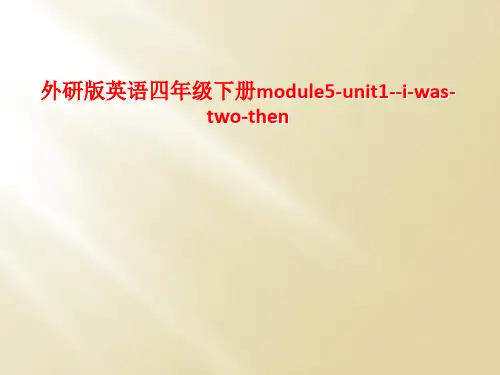
外研版英语四年级下册module5-unit1--i-was-two-then
TGhrisains mdypgararnednmtas.
/T‘ghirsæisnmdypgeraəndrəpan. ts/ T祖he父y a母re m、y 外gra祖ndp父are母nts.
then
1955年
now
2015年
They were young then. Now they are old.
1.Who are they? They were Lingling’s__A___.
A. grandparents. B. parents.
2. They were ____B___thenWho is that little girl? B She is _______.
long —— short
big —— small
cold —— hot
air chair fair
hair
long hair
short hair
10CM
A
B
short
A 20CM
B long
then
2010年
now
2015年
Now my hair is short My hair was long then.
then
now
They were short then. Now they are tall.
then
now
They were thin then. Now they are fat.
So
tall
So
short
So
So
young
old
New words:
• Then
was were young short grandparents
Module 5 Unit1I was two then.(教案)外研版(三起)英语四年级下册

Module 5 Unit1: I was two then (教案)教学目标1.能够听懂、理解并能使用以下词汇:old, young, now, then。
2.能够理解并用简单的句子表达自己的年龄以及过去和现在的对比。
3.能够听懂、并能够依据所听到的内容完成与自己过去或现在相关的问答内容。
教学重点1.年龄的表达。
2.现在与过去的对比。
教学难点1.对于一些学生而言,年龄表达上可能存在语言障碍。
2.视频对话和听力练习中,学生需要理解用于表达过去时间的词汇:then。
教学准备1.PPT演示文稿。
2.视频对话及听力练习材料。
3.黑板或白板与可擦笔。
教学流程时间教学过程5分钟通过幻灯片介绍教学目标和重点。
10分钟向学生传授表示年龄的表达方法。
让学生对比自己目前的年龄与三岁时的年龄。
10分钟播放视频对话,并让学生以简单语句表达对话的内容。
10分钟打开听力练习,传达重点词汇以及之前学过的内容。
让学生听录音答题。
10分钟引导学生讲述自己三岁时的事情,并与现在做对比。
5分钟总结所学内容,并简要介绍下一堂课的主题。
教学方法1.让学生多举例子,并用自我经历来加深对于所学内容的理解。
2.班级问答、个人练习以及小组讨论等多种方式。
教学评估1.在课堂上对个体学生进行提问或让学生参与快速问答。
2.观察学生的表现,评价学生是否理解课堂所讲述内容。
教学扩展1.让学生使用更丰富的时间表达方式,如:yesterday, last week, lastyear等词汇。
2.让学生用不同的词汇、语言描述自己的照片,如:我的头发变白了,我现在戴眼镜了等等。
课后习题1.让学生描述自己最喜欢的过去一天。
2.让学生对照老照片,找出更多的过去与现在的对比。
教学反思本堂课的重点是年龄表达和现在与过去的对比。
在本堂课中,涉及到的时间词汇并不是特别多,但在实际教学时,我发现有些同学很难掌握这些时间表达。
因此,下一节课的课程安排,会更加强调时间的表达,提供更多的例子以供学生借鉴,并尝试更多不同的情境练习,以帮助学生更好掌握所学内容。
外研版四年级英语下册 Module5 Unit1 I was two then优课件
A. old
B. young
3.Who is that little girl? B She is _______.
A. Amy
B. Lingling
4. Lingling’s hair was so___A___.
A. short B. long
now
It was small then.
Now it is big.
She was fat then. Now she is thin.
Practice 1
Practice 2
Listening
1.Who are they? They were Lingling’s__A___.
A. grandparents. B. parents.
谢谢观赏
You made my day!
我们,还在路上……
That’s me. I was two then.
then
now
They were thin then. Now they are fat.
then
now
He was short then. Now he is tall.
then
now
He was young then. Now he is old.
This is my father. This is my mother. They are my parents.
This is my grandma. This is my grandpa. They are my grandparents.
then
now
They were young then. Now they are old.
外研版(三起)英语四年级下册Module 5 Unit 1 I was two then 课件
(3) Who is that little girl? She is _____. A Amy B Lingling
then
I was two then. I was short then.My hair was short then.
Now I am 26.
Now I am tall.
Now my hair is long.
(4) Lingling's hair were _____ then. A long B short
A
B
B
B
1 2 3 4 5
listen, point and Nhomakorabeacircle “was , were”
They were young then.
I was two then.
Your hair were so short.
You were so cute.
I was very naughty too.
角色扮演
play in roles
Amy...Lingling...
This is Amy's mather.
They are Amy's .
parents
['peərənts]
This is Amy's grandma.
This is Amy's grandpa.
They are Amy's .
grandparents
['grændpeərənts]
then
now
They were young then.
四年级英语下册课件-Module 5 Unit 1 I was two then-外研版(三起)
Fat,fat. He is fat.
Thin,thin. She is thin.
Naughty,naughty.It is naughty.
Old,old.
They are old.
Young,young. We are young.
跟老师唱反调
Let’s say and do some actions. I say “long” and you say “short” Are you ready? Now ,together! tall---short fat---thin old---young long---short big---small
grandma grandpa grandparents
Then
Now
They were young,then. Now,they are old.
now then are→were
They are ……now. They were ……then.
读课文,回答问题。
• 1. Who was the little girl? • 2. How old was Lingling? • 3.Was Lingling’s hair short?
then
now
1was/were/is/are
2short/fat/tall/thin
She w_a_s _fa_tthen. She _is_ _th_innow.
then
1.was/were /is/are
now
2.cute/short/tall/cool
He _w_as_ _sh_o_rtthen. He _is__ _ta_ll_ now.
I am……now, I was …… then. She is ……now,she was ……then.
四年级英语下册课件-Module 5 Unit 1 I was two then.-外研版(三起)
Now, she _is__ thin.
then
now
He _w_a_s thin, t_h_e_n_.
_N_o_w_ , he __is__ fat.
then
now
It __w__a_s_l_o_n_g__, then. Now, it ___is_s_h_o_r_t___.
then
now
They w__e_r_e young, then. Now, they _a_r_e_ old.
This is me. I was four. I was short.
This is me. I am 38. Now I am tall.
Who is this little boy?
How old was Sam?
He was one.
How was he then? He was short.
我一直在这里爱你们
Homework
• Talk about the changes of your families or your friends.
• Show your love to your families.
was was was
were
was
They were _y_o_u_n_g_. Now they are __o_ld_ .
Love will never change
You were always there to help me
你们总是在那里帮我
You were always there to guide me
你们总是在那里引导我
You were always there to laugh with me 你们总是在那里和我笑
外研版四年级下册英语Module 5《Unit 1 I was two then.》教案
外研版四年级下册英语Module 5《Unit 1 I was two then.》教案【教材分析】本节课是外研版四年级下册Module 5的第一单元,主题为"I was two then.",教材主要内容是学习描述过去和现在发生的变化。
通过学习单词和句型,学生将能够谈论自己和他人的过去,并对比过去与现在的不同之处。
【教学目标】1. 学生能够识别并拼写单词: was, then, grandparent, were, young, old, hair, so, short, long,以及个人选择的2-3个单词。
2. 学生能够运用句型"I was two..."和"They were young, then."描述过去的情况。
3. 学生能够对比过去和现在的不同之处,运用所学知识描述过去和现在发生的变化。
【教学重点和教学难点】教学重点:1. 能够运用所学知识描述过去和现在发生的变化。
2. 能够区分was-is/am和were-are的用法。
教学难点:1. 区分was-is/am和were-are的用法。
【学情分析】学生是四年级学生,已经学过一定的英语基础知识,包括基本的动词变化和句型结构。
他们对于过去时态的使用可能还不够熟练,需要通过本节课的学习来加强对过去时态的理解和运用。
【教学过程】Step 1: Lead-in1. Greet the students and briefly review the previous lesson by asking questions related to the topic of changes and the past.Example: "Good morning, class! In our last lesson, we talked about changes. Can anyone tell me something that has changed in their life recently?"2. Show some pictures of yourself at different ages and ask the students to guess how old you were in each picture. Encourage them to use the sentence pattern "I was ___ then" to make guesses.Example: "Now, let's look at these pictures. How old do you think I was in this picture? Can you complete the sentence using 'I was ___ then'?"Step 2: Vocabulary1. Introduce the target vocabulary: was, then, grandparent, were, young, old, hair, so, short, long.Example: "Now, let's learn some new words. Repeat after me: was, then, grandparent, were, young, old, hair, so, short,long."2. Use real objects, flashcards, or pictures to help students understand and remember the meanings of the words.Example: Show a picture of a grandparent and ask students to identify the word. Provide real objects or pictures to help students understand the words young, old, hair, short, and long.3. Practice pronunciation and spelling of the words together as a class.Example: Say each word aloud and have the students repeat after you. Then, ask individual students to spell the words on the board or in their notebooks.Step 3: Grammar1. Introduce the sentence pattern "I was two..." and "They were young, then." Explain that "was" is used to talk about the past, while "were" is used to talk about a group of people in the past.Example: "Now, let's talk about the past. When we talk about ourselves in the past, we use 'was,' like 'I was two.' When we talk about a group of people in the past, we use 'were,' like 'They were young, then.'"2. Give examples and ask students to repeat after you.Example: Say a sentence using the sentence pattern and have the students repeat after you. For example, say "I was three then" and ask the students to repeat.3. Provide more examples and ask students to complete sentences using the correct form of "was" or "were."Example: Give students a worksheet with incomplete sentences and ask them to fill in the blanks with the correct form of "was" or "were." For example, "We ___ happy, then" or "She ___ tall, then."Step 4: Practice1. Divide the class into pairs or small groups.2. Give each group a set of picture cards depicting different scenes or situations.Example: Provide each group with picture cards showing different stages of a person's life or different places at different times.3. Students take turns describing the pictures using the sentence pattern "I was ___ then" or "They were ___ then."Example: One student describes a picture while the other student listens and completes the sentence. For example, "In this picture, I was five years old. My friends were playing with me."4. Monitor the students' practice and provide assistance when needed.Example: Circulate around the classroom, listen to the students' conversations, and provide feedback or assistance as necessary.Step 5: Consolidation1. Review the main points of the lesson by asking questions and eliciting responses from the students.Example: "Can someone tell me when we use 'was' and 'were'? How do we describe ourselves in the past? How do we describea group of people in the past?"2. Have a class discussion about the changes that have happened in their own lives or the lives of their family members.Example: "Now, let's talk about changes. Can you think of a change that has happened in your life or your family? How would you describe it using the sentence patterns we learned today?"3. Encourage students to use the target vocabulary and sentence patterns to describe the changes.Example: Provide sentence starters for students to complete, such as "Before, my hair was ___, but now it is ___" or "When I was younger, I ___ but now I ___."Step 6: Wrap-up1. Summarize the key points of the lesson and reinforce the use of the target vocabulary and sentence patterns.Example: "Today, we learned how to talk about the past and changes. We practiced using 'was' and 'were' to describe ourselves and groups of people. We also learned new words to help us talk about the past."2. Assign homework, which could be writing a short paragraph about a change thathas happened in their lives or creating a dialogue using the target language.Example: "For homework, I would like you to write a short paragraph about a change that has happened in your life. Use the vocabulary and sentence patterns we learned today. You can also create a dialogue between two people discussing a change. Be creative!"【板书设计】Title: Unit 1 - I was two then.Vocabulary:- was, then, grandparent, were, young, old, hair, so, short, longSentence Patterns:- I was ___ then.- They were ___ then.【教学反思】本节课通过引导学生运用句型描述过去和现在的变化,培养了学生对过去时态的理解和运用能力。