
七年级英语下册 第六单元知识点归纳 冀教版
冀教版七年级下册英语第六单元知识点归纳
七年级英语第六单元知识点归纳
1、感叹句:表示惊讶、愤怒、喜悦、赞赏。
结构:What+ a/an +形容词+名词单数(主+谓)!
What+形容词+名词复数或不可数名词(主+谓)!
How + adj. /adv.(主+谓)!
※一般情况下,what和how引导的感叹句可以相互转换,转换后意义不变。
What a beautiful girl she is != How beautiful the girl is!
2、look out of 向……外看 look at 看……
look for 寻找 look like看起来像
3、play in the snow:打雪仗,在雪地里玩耍
4、put on穿上:当宾语为it或them时,必须要中间→put it on;put them on
5、名词→形容词
rain(雨)→ rainy(下雨的) snow(雪)→ snowy(下雪的)
cloud (云)→ cloudy(有云的) wind (风)→ windy (刮风的)
sun (太阳)→ sunny (晴朗的)
6、skate(动词原形)→ skating(现在分词):be skating正在滑冰 go skating 去滑冰
ski(动词原形)→ skiing(现在分词):be skiing正在滑雪 go skiing去滑雪
7、另一个:the other(用于两者之间);another(用于三者以上或不确定的数字)
8、make a snowman:堆雪人
9、throw…at…:向……扔……
Don't throw snowballs at me!
10、tell sb about sth:告诉某人关于……
11、what about=how about怎么样
What about +动词ing形式;What about+名词或代词
12、一般将来时:用来表示未来的时间将要发生的事或打算做的事。
will+动词原形; be going to+动词原形
13、talk about谈论
14、pick摘; pick up:捡起拿起
15、双宾语动词:
show sb. sth. = show sth. to sb. (向某人展示某物)
send sb. sth. = send sth. to sb. (发送某物给某人)
give sb. sth. = give sth. to sb. (给某人某物)
write sb. sth. = write sth. to sb. (给某人写……)
buy sb. sth. = buy sth. for sb. (给某人买某物)
※目前所学的可接双宾语的动词中,只有buy是物for人,其余都是物to人。
I bought you a birthday gift yesterday.(改为同义句)
人物
I bought a birthday gift for you yesterday.
物 for 人
16、at Christmas:在圣诞节
17、- Merry Christmas!
- The same to you!或Merry Christmas!
18、It is one's turn to do sth:该轮到某人做某事了
19、on Spring Festival :在春节(指具体某一天)
on the first day of Spring Festival 在春节的第一天
during Spring Festival在春节期间
20、on a rainy day on rainy days:在雨天
on a snowy day on snowy days 在雪天
21、不规则形容词、副词比较级:
many/much-more good/well-better far-farther
※一般情况下,句中含有than,形容词或副词用比较级。
22、much too+形容词或副词“太” too much+不可数名
词“太多……”
much too hot “太热”too much water “太多的水”
23、句型转换例句:
1、He is a good driver.(改为感叹句)
What a good driver!
What a good driver he is!
2、They are happy. (改为感叹句)
How happy!
How happy they are!
3、I am from China.(同义句转换)
I come from China.
4、My brother is 12 years old. (划线提问)
How old is your brother?
5、We leave on February the first. (划线提问)
When do you leave?
6、 I go to Beijing by plane. (划线提问)
How do you go to Beijing?
7、He goes to school on foot. (改为一般疑问句)
Does he go to school on foot?
8、It is 8500 kilometres from China to Canada. (划线提问)How far is it from China to Canada?
9、It is 6500 kilometres long. (划线提问)
How long is it?
10、I would like to eat lunch. (改为一般疑问句)
Would you like to eat lunch?
11、It is 30 degrees outside. (划线提问)
What is the temperature outside?
12、A donut is a circle. (划线提问)
What shape is a donut?
13、Danny starts to cry. (改为一般疑问句)
Does Danny start to cry?
14、I can go skating in winter.(改为否定句)
I can not go skating in winter. (can not = can't)
15、My favourite holiday is Christmas. (划线提问)
What is your favourite holiday?。
冀教版七年级英语下第6单元知识点总结
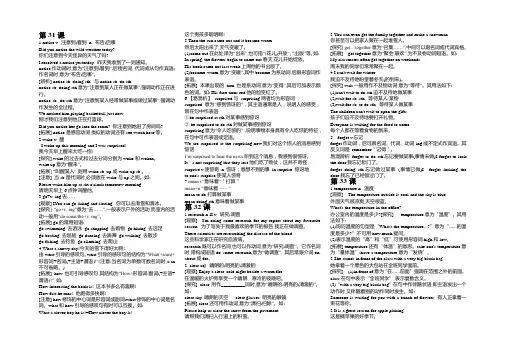
第31课1.notice v. 注意到;看到n. 布告;启事Did you notice the wild weather today?你们注意到今天怪异的天气了吗?I received a notice yesterday. 昨天我收到了一则通知。
notice作动词时,意为“注意到;看到”,后接名词、代词或从句作宾语;作名词时,意为“布告;启事”。
[辨析] notice sb. doing sth. 与notice sb. do sth.notice sb. doing sth.意为“注意到某人正在做某事”,强调动作正在进行。
notice sb. do sth.意为“注意到某人经常做某事或做过某事”,强调动作发生的全过程。
We noticed him playing basketball just now.刚才我们注意到他正在打篮球。
Did you notice her go into the room? 你注意到她进了房间吗? [拓展] notice是感官动词,类似的动词还有see,watch,hear等。
2.wake v. 醒I woke up this morning and I was surprised!我今天早上醒来大吃一惊![探究] wake的过去式和过去分词分别为woke和woken。
wake up意为“醒来”。
[拓展] “叫醒某人”,则用wake sb. up或wake up sb.。
[注意] 当sb.是代词时,必须放在wake与up之间。
如:Please wake him up at six o'clock tomorrow morning.请明天早上6点钟叫醒他。
3.go+v.-ing去……[观察] IYou can go skiing and skating. 你可以去滑雪和滑冰。
[探究] “go+v.-ing”意为“去……”,一般表示户外的活动,而室内的活动一般用“do some/the+v.-ing”。
冀教版英语七年级下册 Unit 6 知识点汇总
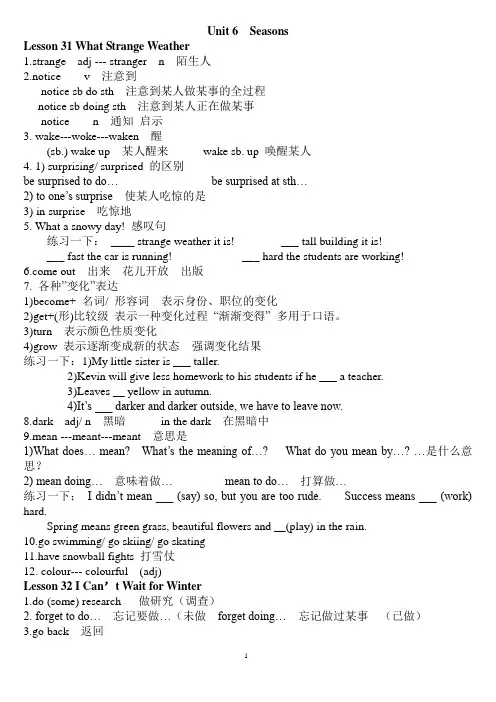
Unit 6 SeasonsLesson 31 What Strange Weather1.strange adj --- stranger n 陌生人2.notice v 注意到notice sb do sth 注意到某人做某事的全过程notice sb doing sth 注意到某人正在做某事notice n 通知启示3. wake---woke---waken 醒(sb.) wake up 某人醒来wake sb. up 唤醒某人4. 1) surprising/ surprised 的区别be surprised to do… be surprised at sth…2) to one’s surprise 使某人吃惊的是3) in surprise 吃惊地5. What a snowy day! 感叹句练习一下:____ strange weather it is! ___ tall building it is!___ fast the car is running! ___ hard the students are working!e out 出来花儿开放出版7. 各种”变化”表达1)become+ 名词/ 形容词表示身份、职位的变化2)get+(形)比较级表示一种变化过程“渐渐变得” 多用于口语。
3)turn 表示颜色性质变化4)grow 表示逐渐变成新的状态强调变化结果练习一下:1)My little sister is ___ taller.2)Kevin will give less homework to his students if he ___ a teacher.3)Leaves __ yellow in autumn.4)It’s ___ darker and darker outside, we have to leave now.8.dark adj/ n 黑暗in the dark 在黑暗中9.mean ---meant---meant 意思是1)What does… mean? What’s the meaning of…? What do you mean by…? …是什么意思?2) mean doing… 意味着做… mean to do… 打算做…练习一下:I didn’t mean ___ (say) so, but you are too rude. Success means ___ (work) hard.Spring means green grass, beautiful flowers and __(play) in the rain.10.go swimming/ go skiing/ go skating11.have snowball fights 打雪仗12. colour--- colourful (adj)Lesson 32 I Can’t Wait for Winter1.do (some) research 做研究(调查)2. forget to do… 忘记要做…(未做forget doing… 忘记做过某事(已做)3.go back 返回4. clear---clearly 晴朗、清晰5. hard adj 硬的--- soft hard adj 困难的--- easyhard adv 努力地猛烈地hardly adv 几乎不6. in the snow/ in the sun/ in the rain /on the ice7.wait for…. 等待Can’t wait to do…. 等不及要做…Lesson 33 Kim’s Favourite Season1.以y结尾的形容词描述天气sun-sunny snow-snowy cloud-cloudy wind-windy fog-foggy ice-icy2.on/at weekends 在周末3.pick 採摘pick sth up捡起拾起pick sb up 接某人4.clap for sb 为某人鼓掌5.fill A with B 用B 装满AA be filled withB A 里面装满了BLesson 34 Steven’s Report1.It’s one’s turn to do …轮到某人做…2.go on a trip to… 去… 旅行3.play catch 玩传/接球游戏4.have a picnic 野餐5.feed---fed---fed6.goose---geese (复数)7. begin-began-begun 开始begin to do…= begin doing… 开始做…8. wet---wetter---wettestLesson 35 Surfing in Sydney1.reach 1)达到The temperature reaches 40 degrees.2)到达reach; arrive in/ arrive at; get toWhen did you ___ there last night?2.on a windy day 在刮风天3.ride the waves= surf 冲浪4.be popular with… 很受…的欢迎5.watch 观看watch sb do …/ watch sb doing…6.one day 指过去或将来的某一天someday= some day 将来某一天7…be short for … 是…的简称/缩写8. another way of doing… 做…的另一种方法Lesson 36 Spring in China1.everywhere/ somewhere/ anywhere/ nowhereI look for my dog ____, but I can’t find him ___. He must lose his way.We want to find ___ cool and have a drink.We can go ___ because it is raining outside.2.everything/ something/anything/ nothingYou look worried, Is ___ all right?Is there ___ special in today’s newspapers?Let’s do ___ to help those poor children.。
冀教版七年级下册Unit 6知识点梳理
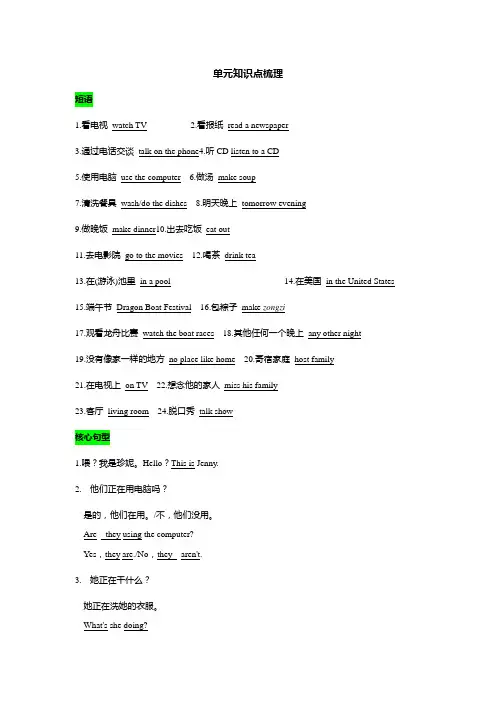
单元知识点梳理短语1.看电视watch TV2.看报纸read a newspaper3.通过电话交谈talk on the phone4.听CD listen to a CD5.使用电脑use the computer6.做汤make soup7.清洗餐具wash/do the dishes 8.明天晚上tomorrow evening9.做晚饭make dinner10.出去吃饭eat out11.去电影院go to the movies 12.喝茶drink tea13.在(游泳)池里in a pool14.在美国in the United States 15.端午节Dragon Boat Festival 16.包粽子make zongzi17.观看龙舟比赛watch the boat races 18.其他任何一个晚上any other night19.没有像家一样的地方no place like home 20.寄宿家庭host family21.在电视上on TV 22.想念他的家人miss his family23.客厅living room 24.脱口秀talk show核心句型1.喂?我是珍妮。
Hello?This is Jenny.2.---他们正在用电脑吗?---是的,他们在用。
/不,他们没用。
---Are they using the computer?---Yes,they are./No,they aren't.3.---她正在干什么?---她正在洗她的衣服。
---What's she doing?---She's washing her clothes.4.你想跟我一起吃晚饭吗?Do you want to join me for dinner?5.他正在看报纸吗?Is he reading a newspaper?6.我父母不在家。
我们可以出去吃饭。
冀教版英语七年级下册Unit 6 Seasons单元知识点归纳总结
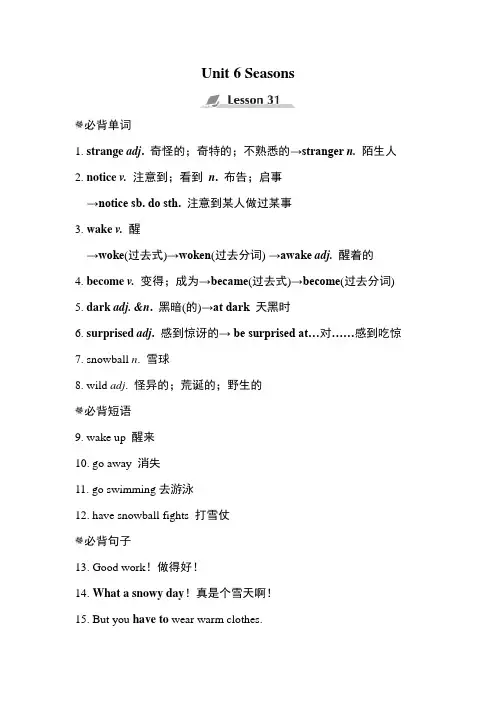
Unit 6 Seasons必背单词1. strange adj. 奇怪的;奇特的;不熟悉的→stranger n. 陌生人2. notice v.注意到;看到n. 布告;启事→notice sb. do sth. 注意到某人做过某事3. wake v.醒→woke(过去式)→woken(过去分词)→awake adj.醒着的4. become v. 变得;成为→became(过去式)→become(过去分词)5. dark adj. &n. 黑暗(的)→at dark 天黑时6. surprised adj. 感到惊讶的→ be surprised at…对……感到吃惊7. snowball n. 雪球8. wild adj. 怪异的;荒诞的;野生的必背短语9. wake up 醒来10. go away 消失11. go swimming去游泳12. have snowball fights 打雪仗必背句子13. Good work!做得好!14. What a snowy day!真是个雪天啊!15. But you have to wear warm clothes.但是你必须穿暖和的衣服。
必背单词1. research n. &v.研究;调查→do research on sth. 研究某物2. clear adj. 晴朗的;明亮的;清澈的→clearly adv. 清晰地;明显地→clear up (天空)放晴3. snowman n. 雪人→snowmen (复数形式)4. website n. 网站5. hill n. 山丘;小山6. ice n. 冰必背短语7. wait for 等待8. do some research 做研究9. get…together 召集……必背句子10. I'm going to talk about winter.我打算讨论冬天。
【冀教版】七年级英语下册:Unit6复习提纲

Unit6复习提纲1.notice n.布告;启事v.注意到;看到Did you notice the notice?notice sb.do sth.注意到某人做某事的全过程I noticed them come in.notice sb.doing sth.注意到某人正在做某事The girl noticed the boy reading books.2.watch sb.do sth.观看某人做了某事的全过程watch sb.doing sth.观看某人正在做某事I watched him taking pictures of the library just now.我刚才看到他正在拍那个图书馆的照片。
3.wake up醒来(wake--woke--woken)She woke up early yesterday.她昨天醒的很早。
wake sb.up把某人叫醒(代中原则)My mom woke me up this morning.今天上午我的妈妈把我叫醒。
4.Then the sun came out.It became warm and all the snow went away.然后太阳出来了,天气变暖了,所有的雪消失了。
①become-became-become②go away消失(go-went-gone)③The rainbow came out after rain.出来(常指太阳、月亮和星星的出现)His novel will come out soon.(书、唱片等)推行,发行The flowers come out in spring.(花朵)开放5.go ice skating去滑冰go swimming去游泳go skiing去滑雪go skating去滑冰go surfing去冲浪6.Good work!=Great work!=Good job!=Well done!做得好!7.I can’t wait for winter.我急切盼望冬天的到来.①wait for sb/sth…等待......I am waiting for the bus.8.research[U]研究do some research做研究9.clear adj.晴朗的;清澈的;明白的clearly adv.清晰地,清楚地Eg.It is clear today and I can see the clouds clearly.今天天气是晴朗的,我能清晰地看到云。
冀教版七年级英语下第6单元知识点总结
第31课1.notice v. 注意到;看到n. 布告;启事Did you notice the wild weather today?你们注意到今天怪异的天气了吗?I received a notice yesterday. 昨天我收到了一则通知。
notice作动词时,意为“注意到;看到”,后接名词、代词或从句作宾语;作名词时,意为“布告;启事”。
[辨析] notice sb. doing sth. 与notice sb. do sth.notice sb. doing sth.意为“注意到某人正在做某事”,强调动作正在进行。
notice sb. do sth.意为“注意到某人经常做某事或做过某事”,强调动作发生的全过程。
We noticed him playing basketball just now.刚才我们注意到他正在打篮球。
Did you notice her go into the room? 你注意到她进了房间吗? [拓展] notice是感官动词,类似的动词还有see,watch,hear等。
2.wake v. 醒I woke up this morning and I was surprised!我今天早上醒来大吃一惊![探究] wake的过去式和过去分词分别为woke和woken。
wake up意为“醒来”。
[拓展] “叫醒某人”,则用wake sb. up或wake up sb.。
[注意] 当sb.是代词时,必须放在wake与up之间。
如:Please wake him up at six o'clock tomorrow morning.请明天早上6点钟叫醒他。
3.go+v.-ing去……[观察] IYou can go skiing and skating. 你可以去滑雪和滑冰。
[探究] “go+v.-ing”意为“去……”,一般表示户外的活动,而室内的活动一般用“do some/the+v.-ing”。
七年级英语下册 Unit 6 Lesson 41-44短语单词 冀教版
冀教版英语七年级下册Unit 6 Lesson 41-44短语单词Unit 6 Winter in CanadaLesson 41-44一、知识概述1.了解有关圣诞的习俗。
2.掌握be going to do结构的用法。
3.灵活运用、掌握部分新单词及表达法。
二、重难点讲解(一)重点单词和词组1. else 别的,其它的;此外else多用于疑问词和不定代词后面。
e.g. What else do you want?你还要什么?When else can we come again?我们什么时候还能来呢?Did you see anybody else?你还看到别的人没有?Have you anything else to do?你有别的事情要做吗?Is there anything else?还有别的吗?2. invite 动词邀请invite sb . to some place 邀请某人到某地invite sb. to do sth. 邀请某人做某事e.g. He invites me to his birthday party.他邀请我到他的生日晚会去。
Can I invite you to my home?我能邀请你到我家去吗?He invites me to go to Wuhan.他邀请我到武汉去。
3. help 动词帮,帮忙e.g. I can't lift this box, please help me.我一个人提不动这箱子,请帮助我。
※help sb. with sth. 帮助某人某事help sb (to) do sth. 帮助某人干某事e. g. My teacher often helps me with my English.=My teacher often helps me (to) learn my English.我的老师经常帮助我学英语。
He often helps me with my homework.=He often helps me to do my homework.他经常帮助我做作业。
冀教版七年级下英语各单元知识点总结
冀教版七年级下英语各单元知识点总结冀教版七年级下英语各单元知识点总结Unit1 单元短语句型归纳【短语集萃】1、guess what 猜猜看;你猜怎么着2、learn about 学习;了解3、How far is it from…to…? 从……到……多远?4、climb up 爬上;攀登5、No photos! 禁止拍照!6、go for a walk 散步7、Take a picture 照相8、take a tour 参观;旅游9、be famous as 作为……而出名10、on one s way to 某人在去的路上11、fall off 跌落;下降;减少;离开12、all right 可以的;好的13、a few 一些;几个14、thousands of 数以千计的;许多的【典句必背】1、We're learning about the Silk Road this month in school.本月我们在学校正学习丝绸之路。
2、Mum and Dad, may I ask you a question?妈妈,爸爸,我可以向你们一个问题吗?3、My school is planning a trip around China with Li Ming’s school.我的学校正在计划与李明的学校同游中国。
4、This is a good chance for you.这对你来说是一个好机会。
5、I will send Li Ming an e-mail and tell him the good news.我将给李明发送一封电子邮件并告诉他这个好消息。
6、How exciting!多么令人激动啊!7、We will travel along the Silk Road together.我们将一起沿着丝绸之路旅行。
8、How far is it from Beijing to Xi’an?从北京到西安有多远?9、The Silk Road is about 6 500 kilometres long!丝绸之路大约长6500千米!10、But we don’t have enough time to see it all.但我们没有足够的时间把它全部看完。
七年级英语下册 第六单元知识点归纳 冀教版
七年级英语第六单元知识点归纳1、感叹句:表示惊讶、愤怒、喜悦、赞赏。
结构:What+ a/an +形容词+名词单数(主+谓)!What+形容词+名词复数或不可数名词(主+谓)!How + adj. /adv.(主+谓)!※一般情况下,what和how引导的感叹句可以相互转换,转换后意义不变。
What a beautiful girl she is != How beautiful the girl is!2、look out of 向……外看 look at 看……look for 寻找 look like看起来像3、play in the snow:打雪仗,在雪地里玩耍4、put on穿上:当宾语为it或them时,必须要中间→put it on;put them on5、名词→形容词rain(雨)→ rainy(下雨的) snow(雪)→ snowy(下雪的)cloud (云)→ cloudy(有云的) wind (风)→ windy (刮风的)sun (太阳)→ sunny (晴朗的)6、skate(动词原形)→ skating(现在分词):be skating正在滑冰 go skating 去滑冰ski(动词原形)→ skiing(现在分词):be skiing正在滑雪 go skiing去滑雪7、另一个:the other(用于两者之间);another(用于三者以上或不确定的数字)8、make a snowman:堆雪人9、throw…at…:向……扔……Don't throw snowballs at me!10、tell sb about sth:告诉某人关于……11、what about=how about怎么样What about +动词ing形式;What about+名词或代词12、一般将来时:用来表示未来的时间将要发生的事或打算做的事。
will+动词原形; be going to+动词原形13、talk about谈论14、pick摘; pick up:捡起拿起15、双宾语动词:show sb. sth. = show sth. to sb. (向某人展示某物)send sb. sth. = send sth. to sb. (发送某物给某人)give sb. sth. = give sth. to sb. (给某人某物)write sb. sth. = write sth. to sb. (给某人写……)buy sb. sth. = buy sth. for sb. (给某人买某物)※目前所学的可接双宾语的动词中,只有buy是物for人,其余都是物to人。
英语初一下冀教版unit6语法重难点解析
英语初一下冀教版unit6 语法重难点解析(—)话题Topic(二)重点词组和句型Christmas Day Spring Festival at the front of, pick up, Merry Christmas look out of ... in April, make a snowman, Put...on top of ..., show sth.to sb., Christmas tree, on the First day of ..., run away,My favourite holiday is Christmas.I like winter because I like to ski and skate.My favourite seasons are spring and fall.What are you going to do tomorrow?I ' m going to talk about Christmas.Are you going to give something to Jenny ' s family?What a cold, snowy day!How happy they are!(三)重难点释义1. Snow is falling.snow 可用作名词, 意为“雪” , 一般是不可数名词, 如果表示“一场大/ 小雪时, 可用a heavy /light snow 表示. 例如:Children are playing in the snow.What a heavy snow!snow 还可作动词, 意为下雪. 要表示下大雪应用副词hard 或heavily 来修饰动词snow . 例如: It ' s snowing hard now.It often snows in winter in the north of China.2. Let ' s make a snowman.Let 开头旳祈使句旳结构: Let sb. /sth. + 动词原形.例如: Let me make a cake for you.3. Then we make another snowball, and put it on that snowball. another 形容词, “另一个” 例如: another apple put: put ............ …on… "把放在上面” 例如:He put the book on the desk.put on “穿上, 戴上” 例如:Mr. Smith put on his coat and hat.put away “收起来, 保存起来” Put your books away .4. Winter will be over.be over 意思是“结束, 完了”例如:Class is over. Let 's have rest.5. Spring will come and Easter, too.本句省略了will come . 全句为: Spring will come and Easter will come, too.6. We play a game together called “Roll the Stones ”.called 是过去分词作定语, 意思是“叫作, 称作”例如: This is the boy called Li Ming.7.She stands at the front of the classroom.at the front of 意思是“ 在.................... 前面” . 例如:Teachers usually stand at the front of the classroom.8. Then she picks up the bright red card.pick up 意思是“捡起, 拾起”例如:He picks up his suitcase and goes out.9. This is for you.介词for 后旳代词需要用宾格. 例如:The gift is for us.10. It is Li Ming ' s turn to speak.turn 是名词, 意思是“轮流” .It 's sb. 's turn to do sth. 意思是“该轮到某人做某事了” .It ' s your turn to clean the room.11. Li Ming holds something else in his hand.else 意思是“别旳, 其他旳” , 修饰不定代词或疑问代词, 并放在他们旳后面. 例如:Do you have anything else?What else can you see?12. You can play outside with no winter coat and mittens!with no 意思是“没有任何”相当于without any .He came to school with no food.13. They run away, laughing, singing, and jumping in all the puddles.run away 意思是“跑开, 逃走”句子中laughing , singing,and jumping 都是现在分词, 作伴随状语. 如:Jenny arrives, dancing and singing a happy song .14. Well, Canada is farther north than China. farther 是far 旳比较级. 例如:Hudson sailed farther north and west than any European before him. 哈德逊比他以前旳任何欧洲人航行旳往北, 往西.15. In Shijiazhuang, the winter is cold and the summer is much too hot.much too 相当于very , 意思是“很, 十分” too much意思是“太多” . 例如:The coat is much too expensive.Watching TV too much is bad for your eyes.(四)语法知识be going to 旳用法1. be going to 结构表示一般将来时态, be 动词和人称旳数保持一致;表示即将发生旳动作, 也可与will 替换, 例如:A. I am going to play ping-pong this afternoon.= I will go to play ping-pong this afternoon.B. She is going to sing a song for us .= She will sing a song for us.2. be going to + 动词原形这一结构还表示打算, 计划决定做某事, 常与be going to 结构连用旳时间状语有tomorrow, this evening, next week, next month,next year 等. 例如:I am going to do my homework this evening .They aren ' t going to have a ny lessons next week.3. Will + 动词原形这一结构表示将来, 不是打算做旳事而是表示将要发生旳事. 例如It will be sunny tomorrow.。