
2017六年级英语上册 Unit 10 Healthy eating课件4 牛津上海版(一起)
Did Mr Lin live in the countryside or in the city? Mr Lin lived in the city.
Was he healthy? HNeo,whaeswfaats afantdaunndheuanlhtheya.lthy.
Did he have an unhealthy diet? HYeesh,ahde ahnadunahneaulntheyadltihety. diet.
rice, plenty of fresh fruit
and vegetables, and some
meat and fish. He became
fit and healthy.
• 1 Mr. Lin stayed with his cousin for ___.
• A. a week • B. a month • C. a few weeks • D. a few days • 2 Mr. Lin ate some ___. • A. rice • B. meat • C. vegetables • D. fresh fruit
16:00
He does a lot of exercise every morning.
20:00
Mr Lin stayed with his
5-3
cousin for a few weeks.
He worked in Miss Chen’s
garden. He ate a lot of
rice, plenty of fresh fruit
and vegetables, and some
meat and fish. He became
5-2
• One day, Miss Chen went to visit Mr Lin. • False
• Mr Lin had dinner with Miss Chen. • False
• Mr Lin would like some pizza, some chips and some ice cream. • True
__p_l_e_n_t_y__o_f__ fresh fruit
and vegetables, and ___so__m__e___ meat and fish.
He became fit and
_h_e_a__lt_h_y_s_ta_y. /
/
12345
Read the text and fill in the blanks.
Module 3
Food and drink
Unit 10
Healthy eating
2
_unhealthy
//
be unhealthy
have an unhealthy diet
dodsoomnoe e_xe_rc_ise
/e/ /ə/ /ai/
Listen and answer
Mr Lin
I lived in the city. I was fat and unhealthy. I had an unhealthy diet and did no exercise …
chips
a lot of plenty of
an unhealthy diet
some a little
8:00
• 3 Mr. Lin became ___
later.
• A. fat
5-4
• B. unhealthy
• C. fit
• D. lazy
My dear friends: One year ago, I was fat and
unhealthy. I had an unhealthy diet, and I did no exercise. I wanted to be healthy. So I did a lot of exercise every day. I ate a lot of rice, plenty of fresh fruit and vegetables, and some meat and fish. Then I became fit and healthy.
Do you want to see me?
fit and healthy
------Super Garfield
How to be the Super Garfield?
Consolidation
• Answer the questions on page 70
How to be a Super Garfield?
fit and healthy.
stay with
Read the text and fill in the blanks.
Mr Lin stayed with his
5-3
cousin for a few weeks.
He worked in Miss Chen’s
garden. He ate a lot of
I lived in Amercia. I was …. I had…. I …… I wanted to be healthy. So I did … … Look! I am a Super Garfield now.
Speak
Pretend that you are Mr Lin. Tell your classmates about the changes in your life.
Did he do any exercise? HNeo,dhide dniodenxoerecxiseer.cise.
Who was Mr Lin’s cousin? Miss Chen was Mr Lin’s cousin.
Was Miss Chen fat and unhealthy?
NSoh.e Swhaeswfiats afnitdahnedalhtehayl.thy.
He had an unhealthy diet.
He did no exercise.
Miss Chen was Mr Lin’s cousin.
She .was fit and healthy.
fit
Miss Chen
She worked in her garden every day.
Read and tell True or False.
fit
What did she do in her garden every day? She worked in her garden every day.
5-1
Miss Chen
Listen and answer
Mr Lin
Mr Lin lived in the city.
5-1
He was fat and unhealthy.
Read the text and fill in the blanks.
Mr Lin stayed with his
5-3
Hale Waihona Puke cousin for a few weeks.
He worked in Miss Chen’s ___g_a_r_d__e_n___. He ate
__a__l_o_t__o_f___ rice,
沪教版六年级英语第一学期:Unit10 Healthy eating 课件(共25张PPT)
7. Do you eat plenty of fruit and vegetables?
8. Do you eat a lot of fried food?
9. Do you eat breakfast, lunch and dinner?
10. Do you eat a lot of sweet food?
Danny should eat a lot of rice. Danny shouldn’t eat too little rice.
What should/shouldn’t Danny do?
Danny should eat a little cheese. Danny shouldn’t eat too much cheese.
Last week, I ate ______________ sweeatslotanofd chocolate. I drank ______________ watera. little
Talk and write
Write down what your classmate ate and drank last week. Talk about his/her diet.
S1: What did you eat/drink last week?
S2: I ate/drink a lot of ___/a little ___.
S1: You ate/drank too many ___/too much ___. ___ (and ___) is/are bad for us. You should not ___.
Danny’s diet yesterday
What should/shouldn’t Danny do?
Unit10 Healthy eating
Unit 10 Healthy eatingTasks in this unitReading about the food pyramid; talking about eating habits; writing about healthy eating; reading a modern fable about eating habits; talking about food eaten the day before; talking about daily menus and completing a survey and quiz.Period OneLanguage focus:Using the simple present tense to express needse.g., We need a little fat, salt and sugarUsing adjectives to express quantitiese.g., a little, some, plenty of, a lot ofAsking How questions to find out quantitiese.g. How much fruit do we need every day?Language skills:ListeningUse visual clues, context and knowledge of the world to work out the meaning of an unknown word and a complete expressionSpeakingOpen and maintain an interaction by asking and answering questionsReadingUse visual clues, context and knowledge of the world to work out the meaning of an unknown word and a complete expressionMaterials:1.Student’s Book 6A page 692.Workbook 6A pages 623.Cassette 6A4.Cassette playerPre-task preparationAsk the students what they know about healthy eating. Ask: Do we need a lot of sugar/salt/fat every day?While-task procedure1 Give the students time to study the food pyramid.Explain that we need less Of the foods as we go up the pyramid.2 Play the cassette for Look and read. The students listen.3 Ask questions about the food pyramid: e.g., How much rice, noodles and bread do we need every day?4 Play the cassette for Look and say. The students listen. S In pairs, students practise Ask and answer.Consolidation:Workbook 6a page 62Period TwoLanguage focus:Using the simple past tense to talk about past states and activitiese.g., Mr. Lin lived in the city. One day Mr Lin went to visit Miss Chen and had lunch with herUsing adjectives to express quantitiese.g., a little, some, plenty of, a lot ofAsking wh- and How questions to find out various kinds of informatione.g. Why was Mr Lin fat and unhealthy? What did Mr Lin like to have for lunch. How did Mr Lin become fit and healthy?Language skills:ListeningListen for specific informationSpeakingMaintain an interaction by asking and answering questionsReadingRead written language in meaningful chunksMaterials:1.Student’s Book 6A page 702.Cassette 6A3.Cassette playerPre-task preparationAsk: How do we keep fit? Do you play games? Do you walk a lot?While-task procedure1 Give the students time to read the story silently.2 Play the cassette. The students follow in their books.3 Select individual students to read a sentence each.4 Give the students time to prepare answers to thequestions. Ask the questions.5 Ask the students to do a role-play. The students play the roles of Mr Lin and Miss chen and act out the story.ConsolidationWorkbook 6A page 63Period ThreeLanguage focus:Using the simple past tense to talk about past activitiese.g., I had eggs and milk.Using adjectives to make comparisonse.g., healthier than, less healthy than, as healthy as, as unhealthy asAsking Wh-questions to find out specific informatione.g., Joe, what did you have for breakfast yesterday?Language skills:ListeningListen for specific informationSpeakingOpen and maintain an interaction by asking and answering questionsReadingRecognize recurrent patterns in language structureWritingUsing appropriate format, conventions and language features when writing non-narrative textsMaterials:1.Student’s Book 6A page 712.Workbook 6A pages 643.Cassette 6A4.Cassette playerPre-task preparationAsk: What did you eat for breakfast/lunch/dinner ye sterday? On the board, compile lists of the food mentioned under the meals.While-task procedure1 Give the students time to read the dialogue silently.2 Play the cassette. The students listen.3 In pairs, students practise the dialogue. Select pairs to read the dialogue.4 Ask: What food and drink did Alice/ioe have yesterday for breakfast/lunch/dinner ?5 The students complete the table. Ask the questions again.6 In pairs, students practise the dialogue in Ask and answer. Select pairs to say a dialogue.7 Workbook 6A page 64a Give the students time to look at the page.b Play the cassette. The students listen, choose and write.ConsolidationWorkbook 6A pages 64Period FourLanguage focus:Asking wh-questions to find out specific informatione.g., What do you usually have for breakfast?Using adverbs of frequencye.g., I usually have…Using adjectives to make comparisonse.g., healthier than, less healthy than, as healthy as, as unhealthy asLanguage skills:ListeningListening for specific informationSpeakingOpen and maintain an interaction by asking and answering questionsReadingScan a text for specific informationMaterials:1.Student’s Book 6A page 722.Workbook 6A page 63 and 663.Cassette 6A4.Cassette playerPre-task preparationAsk: What do you usually have for breakfast/lunch/dinner?While-task procedure1 Give the students time to look at Listen and say.2 Play the cassette for Listen and say. The students repeat.3 In pairs, students practise the dialogue in Think and say. Sele ct pairs to say a dialogue.Post-task activitiesWorkbook 6A page 66a In pairs, students discuss the food pyramid and where to put the food they eat.b The students complete the table with the food they usually have. Ask individual students: What do you usually have? The students then write food names in the food pyramid.c Select individual students to say what they have in the food pyramid.Ask them: Is your diet healthy or unhealthy? The students write their answers.ConsolidationWorkbook 6A pages 63Period FiveLanguage focus:Using inverted word order to ask questionse.g., Do you drink a lot of water every day?Language skills:ListeningUse visual clues, context and knowledge of the world to work out the meaning of an unknown word and a complete expressionSpeakingOpen and maintain an interaction by asking and answering questionsReadingRecognize the presentation of ideas through headingsWritingWrite out a piece of work when a framework is providedMaterials:1.Student’s B ook 6A page 732.Cassette 6A3.Cassette playerPre-task preparationAsk: What do you eat every day? Do you eat a lot or a little?While-task procedure1 Play the cassette for Listen and say. The students listen and repeat with their books closed.2 Select pairs to read the dialogue.3 Play the cassette for Do a quiz. The students listen.4 Ask individual students to answer the questions in the quiz.5 The students read the questions in the quiz and tick their answers.6 In pairs, students take turns to ask and answer the questions in the quiz.ConsolidationWorkbook 6A pages 66Period SixLanguage focus:Using inverted word order to ask questionse.g., Do you have good eating habits?Using modal verbs to express obligatione.g., I should drink a lot of water every day.Language skills:ListeningRecognize differences in the use of intonationSpeakingMaintain an interaction by asking and responding to others’ opinionsReadingScan a text for specific informationWritingUse appropriate format, conventions and language features when writing non-narrative textMaterials:1.Student’s Book 6A page 742.Workbook 6A page 653.Cassette 6A4.Cassette playerPre-task preparation1 The students work out how many points they got, and write their total. Ask individual students: Do you have good eating habits?2 Ask the questions in Score and answer.While-task procedure1 Ask individual students: What should you do to improve your eating habits?2 The students write the suggestions. Select individual students to read their suggestions.3 You can use Photocopiable page 7 for the students to write down their promises.ConsolidationWorkbook 6A pages 65。
2017六年级英语上册Unit10Healthyeating课件3牛津上海版一起20180104110

A letter to Danny
Dear Danny, __________________________ I’m sorry to hear that you are _______________________________ not very well and feel unhappy. _______________________________ I don’t think your diet is_________ healthy _______________________________ enough. In my opinion, … _______________________________ _______________________________ beginning yours, ______
9-1
Danny’s diet yesterday
9-2
What was wrong with his diet? too many too much too little
Danny’s diet yesterday
9-3
ቤተ መጻሕፍቲ ባይዱ
What should / shouldn’t he do? He should… He shouldn’t…
Oxford English 6A Shanghai Edition
Unit 10 Healthy eating
Danny’s lunch
8
7
6
5
4
3
2
1
0
计时 开始
Danny’s supper
计时 开始 8 7 6 5 4 3 2 1 0
Look and learn
健康饮食英语课件
sandwich at home rather than spending money at a rest-
aurant.
By devoting a few minutes to planning for more nutritious eating, you invest in your own health and that of your family. And when I say few, I mean it: Studies from UCLA suggest that a wholesome homecooked dinner takes only about ten minutes longer to prepare, on average, than serving processed or ready-made food. If you make enough for leftovers you'll save time in the long run. And don't forget: Obesity, diabetes, and heart disease all lead to doctor and hospital visits—which take a lot of time.
9.Sit down to dinner with the entire family. Kids who eat with their parents are less likely to consume junk, less likely to overeat, and less likely to be overweight. Parents who eat with their children report greater satisfaction with family life. And families who eat together are far less likely to be plagued by eating disorders, drug use, smoking, and alcohol abuse. That's a remarkable benefit to something as simple as sitting down together for a family meal.
2017六年级英语上册Unit10Healthyeating课件3牛津上海版(一起)
A letter to Danny
Dear Danny, __________________________ _______________________________ _______________________________ Ending: healthy eating habits _______________________________ can keep us ___, make our life ____. _______________________________ I hope you will be better soon and _______________________________ enjoy your life. yours, ______
A letter to Danny
Danny is our classmate, he is fat and unhealthy. He has an unhealthy diet. Today he is ill and asked for leave again. As Danny’s friend, please write a letter to Danny to tell him how to have good eating habits.
Danny’s diet yesterday
Danny’s eating habits
1. always eat French fries or chips 2. eat too little fresh fruit 3. always drink soft drinks such as cola 4. have a little rice 5. eat much meat and few vegetables 6. always have little for breakfast 7. sometimes have a cup of milk in the morning 8. eat too many sweets and chocolates
Unit 10 Healthy eating 单元复习课件-英语六年级上册(牛津上海试用本)
重要句型分析
★ one ...the other… 指“一…另一…”是指两者中的“一个;另 一个。” 例如:I have two hats. One is red, and the other is yellow. 我有两顶帽子,一顶是红色的,另一顶是黄色的。
重要句型分析
★句中的less healthy than解释为“不及…健康”。 less+原级十than相当于not so十原级+as, 例如:①Helen is less busy than Mary.=Helen is not so busy as Mary. 海伦没有玛丽忙。 【友情提示】less十形容词/副词+than的结构表示“不如…(怎么样 )”。
重要句型分析
★ need在这里作实义动词,意为“需要”。
need to do sth /need sth. 意思为:需要去做某事/需要某物。 例如:1.We need to wash our hands before meals. 吃饭前我们需要洗手。
否定句:We don't need to wash our hands before meals. 吃饭前我们不需 要洗手。
2.She needs food and clothes. 她需要食物和衣物。 否定句:She doesn’t need food or clothes. 她不需要食物和衣物。 need作情态动词,后直接加动词原形need do sth, 否定形式为:needn't do sth。 例如:
Ben needn't clean the room now. 本不需要现在打扫房间。 Students needn't go to school at weekends. 学生们周末不用去上学。
Healthyeating课件10
Pre-reading
Which food contains more...?
Examples of foods
Answer
chocolate or grapes chocolate
sugar cakes or bananas cakes
cream or rice cream fat
chocolate or chicken chocolate
slim
fat …
Questions:
• How many meals do you have every day? Do you always skip breakfast?
• What do you eat for breakfast/lunch/supper? Which meal do you think is the most important?
Suggestion:
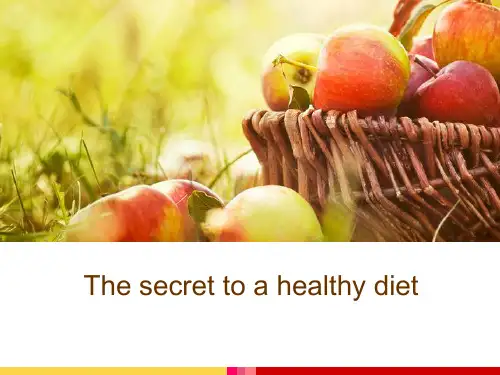
Good dining habits are very important to a person’s health. so we should form a good dining habit.
1.Be sure to eat a variety of foods.
2.Drink lots of water.
I like them very much!!
Eat healthily, and be healthy!
COME AND EAT HERE
Functions of food
Prevent diseases
Keep healthy
Maintain life
Why do we have to eat everyday?
沪教版六年级英语第一学期:Unit10 Healthy eating 课件(共23张PPT)
One day, Mr Lin went to visit Miss Chen and had lunch with her. ‘What would you like for lunch?’ asked Miss Chen. ‘I’d like some pizza, some chips and some ice cream,’ said Mr Lin.
stay //
Answer
• Why was Mr Lin fat and unhealthy?
He had an unhealthy diet and he did no exercise.
• What did Mr Lin like to have for lunch?
He liked to have pizza, chips and ice cream.
‘I don’t have that kind of food in my house. I eat a lot of rice. I eat plenty of fresh fruit and vegetables. I also eat some meat and fish, but I only eat a little salt and sugar,’ said Miss Chen.
• How did Mr Lin become fit and healthy?
He worked in Miss Chen’s garden. He ate a lot of rice, plenty of fresh fruit and vegetables, and some meat and fish.
What kind of food would you like to eat?
2017六年级英语上册Unit10Healthyeating课件3牛津上海版一起2
A letter to Danny
Dear Danny, __________________________ _______________________________ _______________________________ Ending: healthy eating habits _______________________________ can keep us ___, make our life ____. _______________________________ I hope you will be better soon and _______________________________ enjoy your life. yours, ______
Think and write Good eating habits are _____ because they are good for ______. Here are some suggestions on them. First, We we should _______________. Next, We we shouldn’t _____________. Then __________________________. In a word, Good good eating habits can keep us____.
A letter to Danny
important Good eating habits are ________.
We should _______________.
We shouldn’t _____________.
Good eating habits can keep us____.
2017六年级英语上册 Unit 10 Healthy eating讲义4 牛津上海版(一起)
Read the text and fill in the blanks.
Mr Lin stayed with his
5-3
cousin for a few weeks.
He worked in Miss Chen’s ___g_a_r_d__e_n___. He ate
__a__l_o_t__o_f___ rice,
• 3 Mr. Lin became ___
later.
• A. fat
5-4
• B. unhealthy
• C. fit
• D. lazy
My dear friends: One year ago, I was fat and
unhealthy. I had an unhealthy diet, and I did no exercise. I wanted to be healthy. So I did a lot of exercise every day. I ate a lot of rice, plenty of fresh fruit and vegetables, and some meat and fish. Then I became fit and healthy.
fit and healthy.
stay with
Read the text and fill in the blanks.
Mr Lin stayed with his
5-3
cousin for a few weeks.
He worked in Miss Chen’s
garden. He ate a lot of
Mr Lin stayed with his