
新课标新教材人教版必修第三册高中英语Unit1SectionⅠ教学案
Unit 1 FESTIVALS AND CELEBRATIONS1.An optimist stays up until midnight to see the new year in. A pessimist stays up to make sure the old year leaves.乐观者等至深夜,为的是看到新的一年。
悲观主义者等着,只为送别旧岁。
2.The object of a New Year is not that we should have a new year. It is that we should have a new soul.我们过新年的目的并不是为了迎接新的一年,而是迎接一个全新的自我。
3.May your happiness last forever and your holidays last forever.愿你幸福永驻,假期长存。
4.Feeling the relentless passage of time, my heart gives birth to new hope. Let's embrace the New Year and go to the future!感受岁月无情流逝,心中又升腾起新的希望。
让我们拥抱新年,共赴未来!5.The breeze sent my blessings, and the bright moon brought my greetings.清风送去了我的祝福,明月带来了我的问候。
6.In this brilliant and happy Spring festival, I wish you all the best!在这辉煌快乐的新春佳节,祝您一切顺心如意!THE VALUE OF TIMETo realize the value of one year:Ask a student who has failed a final exam.To realize the value of one month:Ask a mother who has given birth to a premature baby.To realize the value of one week:Ask an editor of a weekly newspaper.To realize the value of one hour:Ask the lovers who are waiting to meet.To realize the value of one minute:Ask a person who has missed the train, bus or plane.To realize the value of one second:Ask a person who has survived an accident.To realize the value of one millisecond:Ask the person who has won a silver medal in the Olympics.Time waits for no one.Treasure every moment you have.February has long been a month of romance.With the sweet smell of roses in the air, romantic films hit cinemas and love stories fill newspapers and magazines.On the 14th day, it is a custom for a boy to take his girlfriend out to dinner,buy her flowers and chocolates, write poems, sing to her or even spell out her name with rose! This is what you see on Valentine's Day, a day named after Valentine who was a priest in the third century Rome.When the emperor (皇帝) thought that single men could become better soldiers than those with wives, he didn't allow marriage.But Valentine continued to perform marriage ceremonies for young lovers in secret. When his actions were discovered, the emperor sentenced him to death. While in prison, it is said that Valentine fell in love with the daughter of his prison guard.Before his death, he wrote her a letter, which he signed“From your Valentine”, an expression that is still in use today. Valentine died for what he believed in and so he was made a Saint (圣徒), as well as becoming one of history's most romantic characters.Nowadays, Valentine's Day is also popular among Chinese young people. Some students are planning to make Valentine's cards for parents, teachers and friends. Others want to hold parties at which they will exchange small gifts and eat heart shaped cakes.The significane of the holiday is to have fun and encourage people to share the spirit of St. Valentine.[探索发现]1.Why did the emperor in Rome not allow marriage in his country?Because he thought men without wives could be better soldiers.2.Valentine was put into prison because he didn't obey the emperor's order.3.The best title for this passage should be Valentine's Day.Section ⅠListening and Speaking & Reading and Thinking——ComprehendingⅠ.匹配词义a.给下列单词选择正确的汉语意思( )1.figure A.vt.显示;反映;反射( )2.gather B.n.人物;数字;身材vt.认为;认定( )3.decorate C.vi.聚集;集合vt.聚集;搜集;收割( )4.significant D.vt.装饰;装潢( )5.reflect E.adj.有重大意义的;显著的( )6.ceremony F.n.典礼;仪式( )7.religion G.n.宗教;宗教信仰( )8.occasion H.n.魅力;迷人的特征;咒语( )9.gratitude I.n.感激之情;感谢( )10.charm J.n.特别的事情(或仪式、庆典);(适当的)机会[答案] 1-5 BCDEA 6-10 FGJIHb.给下列短语选择正确的汉语意思( )11.have sth.in common A.穿上盛装;装扮( )12.range from...to B.包括从……到……之间( )13.in spite of C.不管;尽管( )14.take advantage of D.利用;欺骗;占……的便宜( )15.dress up E.(兴趣,想法等方面)相同;有相同的特征( )16.after all F.毕竟;别忘了( )17.fade away G.逐渐消失;(身体)变得虚弱( )18.reflect on H.思考[答案] 11-15 EBCDA 16-18 FGHⅡ.默写单词1.riddle n.谜语;神秘事件2.origin n. 起源;起因;出身3.joy n. 高兴;喜悦4.harvest n. 收获季节;收获;收成vi.&vt. 收割(庄稼);捕猎(动物、鱼) 5.grateful adj. 感激的;表示感谢的6.feature vt. 以……为特色n. 特色;特征;特点7.typical adj. 典型的;有代表性的;平常的8.commercial adj. 商业(化)的;以获利为目的的9.belief n. 信仰;信心;信任10.faith n. 宗教信仰;信任;相信Ⅰ.语境填空march;feature;reflect;faith;riddle;occasion;gather;origin;figure;harvest 1.Many workers marched on the streets for their rights last week.2.We often visit a Lantern fair and guess riddles on Chinese Lantern Festival every year.3.All the crops had been gathered and stored before the storm came.4.Most ancient festivals would celebrate the end of cold weather,planting in spring and harvest in autumn.5.Today's festivals have many origins,some religious,some seasonal and some for special people or events.6.Some festivals can also be held to honour famous figures such as Qu Yuan and Mohandas Gandhi.7.Festivals give us some occasions where we can relax and enjoy life.8.My father has much faith in doctors of traditional Chinese medicine.9.The festivals reflect people's wishes and attitudes toward future life.10.In ancient Egypt,the harvest festival featured a parade and a great feast with music,dancing and sports.Ⅱ.语法填空之派生词1.We expressed our congratulations(congratulate) to them in the letter.2.We should respect the religious(religion) beliefs of their countries.3.How easy it is to recommend joy to those who cannot be joyful(joy).4.This is the agricultural(agriculture) school I told you about last time.5.I would be grateful(gratefully) if you could tell me how to operate the machine.6.How do you like this decoration(decorate) of the room?7.Do you know the significance(significant) of this plan to me?8.It is typical(typically) of Jill to come to school late.9.Now some festivals are becoming more and more commercial (commercialise) withbusinesses taking advantage of the celebrations.10.The West holiday Halloween also had its origin in old beliefs (belief) about the return of the spirits of dead people.1.They have a wide range of origins...它们有各种各样的起源……2.Every festival has its different customs and unique charms.每个节日都有它不同的习俗和独特的迷人的特征。
高中英语 Unit1 Section Ⅰ 新人教版必修第三册
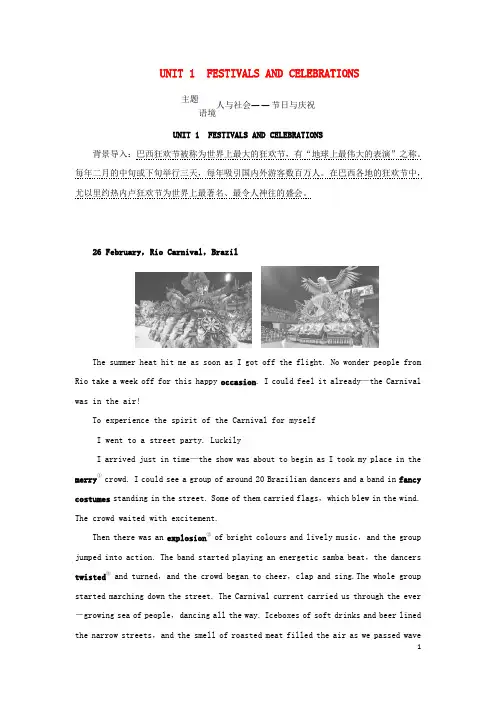
UNIT 1 FESTIVALS AND CELEBRATIONS主题人与社会——节日与庆祝语境UNIT 1FESTIVALS AND CELEBRATIONS背景导入:巴西狂欢节被称为世界上最大的狂欢节,有“地球上最伟大的表演”之称。
每年二月的中旬或下旬举行三天,每年吸引国内外游客数百万人。
在巴西各地的狂欢节中,尤以里约热内卢狂欢节为世界上最著名、最令人神往的盛会。
26 February,Rio Carnival,BrazilThe summer heat hit me as soon as I got off the flight. No wonder people from Rio take a week off for this happy occasion. I could feel it already—the Carnival was in the air!To experience the spirit of the Carnival for myselfI went to a street party. LuckilyI arrived just in time—the show was about to begin as I took my place in the merry①crowd. I could see a group of around 20 Brazilian dancers and a band in fancy costumes standing in the street. Some of them carried flags,which blew in the wind. The crowd waited with excitement.Then there was an explosion②of bright colours and lively music,and the group jumped into action. The band started playing an energetic samba beat,the dancers twisted③ and turned,and the crowd began to cheer,clap and sing.The whole group started marching down the street. The Carnival current carried us through the ever -growing sea of people,dancing all the way. Iceboxes of soft drinks and beer lined the narrow streets,and the smell of roasted meat filled the air as we passed waveafter wave of street stands. I was so caught up in④ the party fever that I hardly noticed five hours fly by!Even as I lay in bed that evening,the bright colours and lively music were still swimming all around me. What an amazing first day in Rio!(选自译林版新教材必修第二册Unit 3)①merry /'meri/ adj.欢乐的,愉快的②explosion /ɪk'spləʊʒn/n.爆炸;爆炸声③twist /twɪst/ vt. &vi.缠绕;扭动(身体部位)④be caught up in 被卷入,陷入I was so caught up in the party fever that I hardly noticed five hours fly by!我沉浸在派对狂热中,几乎没有注意到五个小时过去了![句式分析] 此句含有so...that...“如此……以至于……”的句型。
高中英语新课标必修三Unit1教案

高中英语新课标必修三Unit1教案标题:高中英语新课标必修三Unit1教案一、教学目标通过本单元的学习,学生能够:1、掌握与旅行、探险相关的词汇和表达方式;2、了解和掌握如何写旅游计划和游记;3、提高听、说、读、写四项技能;4、培养对旅游和探险的兴趣和热情。
二、教学内容本单元围绕旅行和探险主题展开,包括以下内容:1、单元导入:介绍旅行和探险的概念和意义,激发学生兴趣;2、课文学习:阅读与旅行和探险相关的文章,了解旅游计划和游记的写作技巧;3、词汇学习:掌握与旅行、探险相关的常用词汇和表达方式;4、听力训练:通过听录音材料,提高听力理解能力;5、口语练习:通过小组讨论、角色扮演等活动,提高口语表达能力;6、阅读理解:阅读与旅行和探险相关的文章,提高阅读理解能力;7、写作训练:根据所学内容,写一篇旅游计划或游记。
三、教学过程1、单元导入:通过展示一些美丽的旅游景点图片,引导学生谈论旅行和探险的意义和价值,激发学生兴趣。
2、课文学习:通过多媒体设备,展示课文内容,引导学生阅读和理解。
在阅读过程中,教师可适当解释生词和难句,帮助学生理解文章。
3、词汇学习:通过讲解、示范、例句等方式,帮助学生掌握本单元的词汇和表达方式。
4、听力训练:播放与旅行和探险相关的录音材料,让学生听并做听力理解练习。
教师可适当解释生词和难句,帮助学生理解。
5、口语练习:通过小组讨论、角色扮演等活动,让学生练习口语表达。
教师可适当引导和纠正。
6、阅读理解:根据本单元主题,选取相应文章进行阅读理解练习。
教师可适当解释生词和难句,帮助学生理解。
7、写作训练:根据所学内容,让学生写一篇旅游计划或游记。
教师可适当指导和纠正。
四、教学评估1、通过课堂表现、作业、测验等方式,对学生的学习情况进行评估;2、通过小组讨论、角色扮演等活动,对学生的口语表达能力进行评估;3、通过写作练习,对学生的写作能力进行评估。
五、教学反思根据学生的学习情况和其他反馈,对本次教学进行反思和总结,以便更好地指导今后的教学工作。
人教版高中英语必修三Unit 1 Festivals around the World教学设计
Book 3 Unit 1 Festivals around the world
Festivals and Celebrations Warming up and Reading 教学设计
体会古代节日
与现代节日的
节日名称,庆祝目的,国家,及庆祝活动
了解该节日的目的;对中国的清明节,日本的盂兰盆节及墨西哥的亡灵节进行对比,能列举节日活动;对亡灵节进行深入理解,能正确
看待死亡。
通过组织对话的形式,灵活运用语段内的有效信息,做到学以致用
学生结合实际生活,总结春节期间的活动。
还须给出其他活动,拓
识知展学生面。
排序题意在
考查学生对于细节的把握,找出关键词总结节日的意义,重在实际应用
例,知识上
部分难度较大,为得到较好效果,须给出关键词,帮助学生思考归纳)。
高中英语新人教版精品教案《必修三 Unit 1 Festivals around the world》
高中课程标准实验教科书英语必修3设计主题: Fetiva around the word所教年级:高一所教单元:第一单元1教学设计理论依据:英语教学是一种动态教学或者活动教学,教学过程是交际活动的过程。
只有从组织教学活动入手,大量地进行语言实践,使英语课堂交际化,才能有效地培养学生的英语交际能力。
《高中英语课程标准》要求我们要改变以往过分强调英语单词和语法知识的简单传授的倾向,加强对学生实际语言能力的培养。
因此,本节课各个环节的教学设计都要突出体现以下几种新理念:1、任务型教学模式(ta-baed teaching method)2、以学生为主体,重视体验参与3、突出交际性,注重读写的实用性4、正视个体差异,多用积极的正面评价2教学背景分析一、教材分析:本课是高中英语必修三第1单元,课题是 Fetiva around the word 。
这是一节阅读课。
在本单元中处于中心地位。
内容介绍了世界各地不同主题的节日和庆祝活动。
我在本课的教学中将淡化语言点和语法知识的简单传授,采用任务型教学法和小组合作探究学习法,扩大课堂语料输入量和学生的语料输出量,主要锻炼学生的听说与阅读能力。
二、学生情况分析:高一 3 班的学生具有以下两个特点:1、他们已经初步具备了略读、跳读等阅读技巧以及确定主题句,预测材料内容等阅读微技能,形成了基本的阅读策略。
但是很多学生英语基础相对较弱,语言交际能力相对较差。
2、很多学生求知欲旺盛,思维活跃,好胜心强,但学习缺乏主动性,有畏难心理。
因此,教师要通过精心设计使他们感兴趣的活动,用活动教学的方法来调动学生的学习积极性,在师生互动,生生互动的过程中完成教学任务并达到目标。
3教学目标分析1、知识目标:⑴词汇和语言点⑵理解课文大意,用所学词汇复述课文,并用所学词汇与学生交流沟通。
2、能力目标在运用语言的过程中培养学生观察、分析、思维与自学能力,加强记忆力,提高英语综合运用能力,激发创造能力。
人教版高中英语必修3unit1电子教案
课堂教学设计课 题:Unit 1 Festivals around the world 授课时数授课时数 6 日期:2011年 2月 28日设计要素要素 设计内容设计内容教学内容分析分析 This This unit unit unit talks talks talks about about about festivals festivals festivals of of of many many many kinds kinds kinds in in in different different different parts parts parts of of of the the the world world and nearly all the teaching materials center on it. The first reading briefly five different different kinds kinds kinds of of of festivals. festivals. festivals. Two Two Two others, others, others, V V alentine ’s s day day day and and and Carnival, Carnival, Carnival, are are introduced introduced in in in the the the rest rest rest of of of the the the unit. unit. unit. Through Through Through this this this unit unit unit we we we should should should have have have the the students think about the reason foe festivals and the reasons for different ways of celebrating. 教学目标目标 知识与技能技能 1, Get students to learn new words and expressions in this unit; 2, Let students learn to make phone call and invitations and thanks; 3, Learn how to use modal words; 4, Develop students ’ listening, speaking reading and writing skills. 过程与 方法方法 1,Task-based teaching and learning 2,Cooperative learning 3,Discussion 情感态度价值观1, Stimulate students ’ love for their own national culture and custom; 2, Develop students ’ sense of cooperative learning. 学习者 特征分析分析Many Many students students students are are are very very very familiar familiar familiar with with with Chinese Chinese Chinese traditional traditional traditional festivals. festivals. festivals. They They They can can can list list many many different different different festivals festivals festivals of of of our our our country country country and and and foreign foreign foreign countries. countries. countries. According According According their their their own own experience, I will list many kinds of different festivals and tell them how to speak them in English. 教学教学分析分析 教学教学重点重点1, 1, have have have students students students learn learn learn some some some useful useful useful new new new words words words and and and expression expression about festivals 2, let students learn the new grammar : modal words 教学教学难点难点 难点难点 1, let them master the using skill of modal words 2, let students learn to write a different ending of a story 解决解决 办法办法Explanation carefully, provide some more practice 教学教学策略策略 1, Cooperation exercise 2, Skipping reading , intensive reading 3, Practice 教学教学资源资源 A tape recorder, teaching guide for the teachers; book, internet 板书板书设计设计 单元备课,板书在各课教案后呈现。
【——人教版高一英语】必修三unit1教案
【——人教版高一英语】必修三unit1教案【教案】一、教学内容人教版高一英语必修三Unit 1《Festivals around the world》。
该单元主要介绍世界各地的节日,包括西方的圣诞节、复活节等,以及东方的春节、中秋节等。
通过学习,学生能够掌握相关的词汇和表达方式,了解不同文化的节日习俗,提高跨文化交际的能力。
二、教学目标1. 学生能够熟练掌握本单元的生词和短语,正确使用动词过去式描述过去发生的事情。
2. 学生能够听懂、会说、会读、会写关于节日的故事,能够用英语介绍自己喜欢的节日。
3. 学生能够通过阅读和听力材料,了解不同国家的节日习俗,提高文化意识。
三、教学难点与重点重点:1. 掌握动词过去式的正确用法。
2. 能够用英语介绍自己喜欢的节日。
难点:1. 理解和运用本单元的生词和短语。
2. 正确使用动词过去式描述过去发生的事情。
3. 了解不同国家的节日习俗,提高文化意识。
四、教具与学具准备教具:多媒体课件、录音机、磁带或光盘、黑板、粉笔。
学具:课本、练习册、录音机、磁带或光盘、笔记本。
五、教学过程1. 情景引入(5分钟)教师通过向学生提问:“你们最喜欢的节日是什么?为什么?”来引出本课的主题。
学生可以自由发言,分享自己喜欢的节日和原因。
教师引导学生用英语进行表达,同时板书关键词“festival”和“celebrate”。
2. 课堂讲解(15分钟)教师带领学生学习本课的生词和短语,如“Christmas”、“Easter”、“Spring Festival”等,并通过例句解释其用法。
接着,教师讲解动词过去式的正确用法,并通过练习题让学生进行随堂练习。
3. 听力训练(10分钟)教师播放课文中的听力材料,学生边听边做练习。
听力材料内容包括不同国家的节日习俗。
听后,教师提问学生关于听力材料的问题,检查学生对听力内容的理解。
4. 阅读理解(10分钟)教师分发课文阅读材料,学生独立阅读,并回答相关问题。
【——人教版高一英语】必修三unit1教案
【——人教版高一英语】必修三unit1教案一、教学内容1. Reading and Writing: “Festivals and Celebrations”2. Listening and Speaking: “A Visit to the Spring Festival”3. Grammar: Relative clauses and adverbial clauses of time and place4. Vocabulary: Words and expressions related to festivals and celebrations二、教学目标1. 能够理解和运用关于节日的词汇和表达方式,提高阅读和写作能力。
2. 能够听懂并参与关于节日的讨论,提高听说能力。
3. 掌握相对句和时间和地点状语从句的用法,提高语法水平。
三、教学难点与重点1. 教学难点:相对句和时间和地点状语从句的用法。
2. 教学重点:关于节日的词汇和表达方式,以及听说读写技能的培养。
四、教具与学具准备1. 教具:多媒体设备、黑板、粉笔、教学课件。
2. 学具:课本、练习本、笔。
五、教学过程1. 实践情景引入(5分钟)利用多媒体展示世界各地节日的图片,引导学生谈论他们所了解的节日,激发兴趣。
2. 阅读与写作(20分钟)1)学生阅读“Festivals and Celebrations”部分,理解文章大意。
2)教师讲解关于节日的词汇和表达方式,并指导学生进行写作练习。
3. 听力与口语(20分钟)1)学生听“Spring Festival”的对话,回答相关问题。
2)教师组织学生进行小组讨论,分享他们最喜欢的节日。
4. 语法讲解(15分钟)1)教师讲解相对句和时间和地点状语从句的用法。
2)学生进行语法练习,巩固所学知识。
5. 随堂练习(10分钟)学生完成课堂练习,检测对本节课知识点的掌握情况。
六、板书设计1. 关于节日的词汇和表达方式2. 相对句和时间和地点状语从句的用法3. 课堂练习答案七、作业设计1. 作业题目:1)根据课堂所学,写一篇关于你最喜欢的节日的短文。
2020学年人教版高中英语必修三unit1 单元教案
2020学年人教版高中英语必修三English Teaching PlanTeaching lesson:Unit 1 Festivals around the worldTeaching target:First year students in the senior high schoolClass type:ReadingTime:45 minutesI. Teaching objectivesA. Know the purposes, customs and activities of the festivals in thetext book;B. Understand the brief background and the culture information ofdifferent countries mentioned;C. Know some other common festivals in different countries;II. The analysis of the teaching backgroundA. The analysis of the studentsAfter at lease 3-year learning of English, the first year students inthe senior high school have mastered basic grammar knowledgeand learned the brief culture of the English countries. They canread some text individually and want to know more about theculture because of their curiosity.B. The analysis of the teaching materialsThe lesson Festivals around the world is the main text inunite of the third book in senior high school. It introducesdifferent festivals in the world, including their names, times,countries, purposes, customs and activities of them.The teacher can use the PPT, pictures, videos, Internet and other sources during the classC. The analysis of the learning environment (according to thepractical situation of them)III. The teaching tasksA. Make the students familiar with the names, purposes, customs andactivities of the festivals in different countries in the text;B. Guide the students learn the brief background and the culture ofdifferent festivals mentioned in the text;IV. Teaching contentsA. The names, countries, purposes, customs and activities of differentfestivals mentioned, including:1. Festivals of the Dead2. Festivals to the Honor People3. Harvest Festivals4. Spring FestivalsB. The background and the culture of different festivals mentionedin the text;C. The other main festivals of the foreign countries;V. The important pointsA. The names and the countries of different festivals;B. The purposes, customs and activities of the festivals.VI. The difficult pointsA. The purposes, customs and activities of the festivalsB. The background and the culture of different festivals;VII. Teaching aidsBlackboard, chalk, PPT, pictures, white papers,VIII. Choices and development of the sourceChoose the available facilities and source through the Internet and the library, such as graphs, videos, pictures and description.IX. Teaching methodsA. TBLT (task-based language teaching);B. CLT (communicative Language Teaching);X. ProceduresStep1. Pre-reading activities (10 minutes)A. The teacher shows some pictures of the different festivals by PPTand the students guess the names of them.1. The teacher shows the pictures of the Qing Ming Festival andthe Dragon Boat Festival by PPT and asks the students whatthey are doing in the pictures;2. Show the pictures of the Moon cakes and the Zongzi (粽子)byPPT and ask the students when do they eat them;3. The teacher shows the pictures of the famous people by PPTand asks the students who are they;4. Pair worksa. Make the students ask their partners the followingquestions and the other answers them.i. What is your favorite Chinese festival?ii. Do you know some foreign festivals and name them.b: the teacher asks 2 pairs to show their work.Step2. While- reading (20minutes)A. the students scan the test book, find the festivals and underlinethem;B. The teacher asks the student to speak out the names of the festivalsthey have found and then the teacher completes the students’ answers, writing them on the blackboard;C. The teacher teaches the students to read the festivals on theblackboard;D. The teacher shows the festivals mentioned in the text by PPT andintroduce some background of the festivals and people to them;1. Festivals of the Deada. Obon (Japan)b. Halloween (Western countries)c. Day of the Dead (Mexico)2. Festivals to the Honor Peoplea. Columbus Day (USA)b. Indian National Day on October 2 (India)c. The Dragon Boat Festival (China)3. Harvest Festivalsa. Thanksgiving Festivalb. Mid-autumn Festival4. Spring Festivalsa. The Chinese Spring Festival (show a video about it)b. Easterc. Cherry Blossom FestivalE. the teacher makes the students read the text carefully and find thepurposes, customs and activities of different festivals;Step3. Post-reading (15minutes)A. The students answer the questions above and the teacher shows them in PPT step by step;B. the teacher leads the students to summary the reading;1. Festivals of the Dead1).Obon (Japan) ------to honor the dead or to satisfy the ancestors------clean graves, light incense (香),light lamps, play music.2). Day of the Dead (Mexico) ------ eat food in the shape of skulls and cakes with "bones" on them, offer food, flowers and gifts to the dead (early November);3).Halloween (Western) ------ beliefs about the return of the spirits of dead people------ dresses up and go to their neighbors’ homes to ask for sweets, play some tricks;2. Festivals to Honor People1)The Dragon Boat Festival (China) ------ honor the famous poet, Qu Yuan(屈原).2)Columbus Day (USA) ------ in memory of the arrival of Christopher Columbus in the New World.3)National festival on October 2 (India) ------ to honor Mohandas Gandhi3. Harvest Festivals1)Thanksgiving festivals (America and Canada) ------ food is gathered for the winter and the agricultural work is over------ decorate churches and town halls with flowers and fruit, get together to have meals, Some people might win awards for their farm produce;2)Mid-autumn festivals (China, Japan) ------ admire the moon------ appreciate the moon; Enjoy the moon cakes and wine;4. Spring Festivals1)The Spring Festival(China)------look forward to the end of winter and to the coming of spring------ eat dumplings, fish and meat and may give children lucky money in red paper. There are dragon dances and carnivals, and families celebrate the Lunar New Year together;2)Easter (western countries) ------ celebrates the return of Jesus from the dead and the coming of spring and new life;3)Cherry Blossom Festival (Japan) ------appreciate cherry tree flowersC. The teacher asks the students if they have any other questions and thenanswers the questions advocated by the students;D. Homework for the students;1. Talk with your friends:Which festivals do you like best, why?2. Search more information about the festivals mentioned in the text. XI. ReflectionTo be written immediately after the lesson附:课文:普通高中课程标准实验教科书英语必修3 Unit 1Festivals around the worldFestivals and celebrations of all kinds have been held everywhere since ancient times. Most ancient festivals would celebrate the end of cold weather, planting in spring and harvest in autumn. Sometimes celebrations would be held after hunters had caught animals. At that time people would starve if food was difficult to find, especially during the cold winter months. Today's festivals have many origins, some religious, some seasonal, and some for special people or events.Festivals of the DeadSome festivals are held to honor the dead or to satisfy the ancestors, who might return either to help or to do harm. For the Japanese festivalObon, people should go to clean graves and light incense in memory of their ancestors. They also light lamps and play music because they think that this will lead the ancestors back to earth. In Mexico, people celebrate the Day of the Dead in early November. On this important feast day, people eat food in the shape of skulls and cakes with "bones" on them. They offer food, flowers and gifts to the dead. The Western holiday Halloween also had its origin in old beliefs about the return of the spirits of dead people. It is now a children's festival, when they can dress up and go to their neighbors' homes to ask for sweets. If the neighbors do not give any sweets, the children might play a trick on them.Festivals to Honor PeopleFestivals can also be held to honor famous people. The Dragon Boat Festival in China honors the famous ancient poet, Qu Yuan. In the USA, Columbus Day is in memory of the arrival of Christopher Columbus in the New World. India has a national festival on October 2 to honor Mohandas Gandhi, the leader who helped gain India's independence from Britain.Harvest FestivalsHarvest and Thanksgiving festivals can be very happy events. People are grateful because their food is gathered for the winter and the agricultural work is over. In European countries, people will usuallydecorate churches and town halls with flowers and fruit, and will get together to have meals. Some people might win awards for their farm produce, like the biggest watermelon or the most handsome rooster. China and Japan have mid-autumn festivals, when people admire the moon and in China, enjoy moon cakes.Spring FestivalsThe most energetic and important festivals are the ones that look forward to the end of winter and to the coming of spring. At the Spring Festival in China, people eat dumplings, fish and meat and may give children lucky money in red paper. There are dragon dances and carnivals, and families celebrate the Lunar New Year together. Some Western countries have very exciting carnivals, which take place forty days before Easter, usually in February. These carnivals might include parades, dancing in the streets day and night, loud music and colorful clothing of all kinds. Easter is an important religious and social festival for Christians around the world. It celebrates the return of Jesus from the dead and the coming of spring and new life. Japan's Cherry Blossom Festival happens a little later. The country, covered with cherry tree flowers, looks as though it is covered with pink snow.People love to get together to eat, drink and have fun with each other. Festivals let us enjoy life, be proud of our customs and forget our work for a little while.Wangguo Festival。
英语人教版新课标必修3Unit1同步12课时教案.docx
英语人教版新课标必修3Unitl同步1-2课时教案授课日期:序号:1、2授课进度:正常教学课题:Unitl FESTIVALS AROUND THE WORLDPeriod 1.Warming・up and Pre-reading授课课时:1教学目的:1.了解节H和庆典的背景知识。
2.引发关于节日和庆典的讨论。
3.学习重点词汇的用法。
教学重点:1.学习重点词汇的用法。
教学难点:1.讨论有关节日和庆典的话题共同完成表格。
教学步骤:STEP1: Warming-up1.What are festivals? (find the answer on the book.)2.Different countries have different festivals which have different purposes・ For example,Chinese celebrate Mid- Autumn Festival in autumn for the beauty of the full moon, harvest and time with family and friends. On that day, Chinese give and eat mooncakes, watch the full moon with their family and friends.Fill in the following form.F estival Time ofyear/date What itcelebratesWhat peopledoMid-Autumn F estival autumn/fallthe beauty ofthe fullmoon,harvest, timewith familyand friendsgive and eatmooncakes;watch thefull moonwith familyand friendsImportant phrases: be meant to, celebrate important times of year,take place. Be meant toMean V•意思是,意味着V menus victory.Mean dong sth 意味着success means working hard・Mean (sb) to sth打算或企图(让某人)做某事what do you mean to do with it?I mean you to work as our spokesman.被动:be meant to do/be meant for 打算做。
人教新课标必修3unit1单元教案
人教新课标必修3 Unit 1 单元教案教学目标1.熟练掌握本单元的所有词汇和短语;2.能够听懂并复述相关话题的内容,并能够写出简单的句子和段落;3.提高学生根据线索推断和理解文章的能力;4.培养学生合作和交流的能力。
教学方法1.灵活运用各种教学方法,包括听、说、读、写、演等多种形式;2.让学生通过小组讨论等方式积极参与到教学活动中来;3.引导学生理解并记忆课文重点内容。
课堂活动Activity One: Warm-upStep 1: 观看视频播放相关视频,让学生对话题进行初步了解和热身。
Step 2: 小组讨论将学生分为小组,要求讨论的问题包括以下内容:1.对话题的理解;2.对话题相关的问题的探讨;3.个人对话题的看法和想法。
Activity Two: Listening and SpeakingStep 1: 预学词汇在学生未听完录音之前,先将相关词汇和短语讲解和学习。
Step 2: 配对练习通过配对练习的方式进行听力练习,让学生听懂相关话题的内容。
Step 3: 集体讨论在配对练习完成后,进行集体讨论,可以让学生就听到的内容展开讨论和交流,进一步加深对话题的理解。
Activity Three: Reading and WritingStep 1: 阅读课文在学生熟练掌握相关词汇之后,开始教授课本上的相关内容,让学生理解文章内容。
Step 2: 分小组阅读将学生分为小组,每个小组读一段,然后进行概括和简单的复述,让学生能够更好地理解文章的核心内容。
Step 3: 写作练习通过写作练习提高学生的写作和表达能力。
可以让学生回答课本上的问题,或者写出自己对话题的看法和想法。
Activity Four: Summary在课程结束前,复习本次课程的重点内容,让学生记忆并理解课文中重点内容。
教学评估通过各种方式对学生的学习成果进行评估,包括听力、口语、阅读和写作能力等方面。
课程总结本课程主要着重于对Unit 1内容的理解和掌握,通过各种教学方法提高学生的英语能力和合作交流能力。