
六年级英语上册:Unit 2《Ways to go to school》(A )
Urumqi Lhasa
Harbin
LanzhouBeijingFra bibliotekXian
Qindao
Shengsi
Chongqin
安徽
Shanghai
Changsha
Hangzhou
Kunming
Fuzhou
Guangzhou
Taiwan
Hong kong
Haikou
How do you go to the zoo? I go to the zoo … .
I never go to school by plane. I always go to school by car.
How do you go there? --I go there by bike.
How can I go there? --You can go there by bike.
---表示频率的词语放在句首或者动词前面。
Usually I go to school on foot. =I usually go to school on foot.
Sometimes I go to school by bus. =I sometimes go to school by bus.
train
subway
on foot
√A. I go to school on foot.
B. I go to school ×by foot.
P10 Make a survey (小调查)
A: Hello! How do you go to school? B: I usually go to school _____. What about you? A: I go to school ______.
Exercise
●一、写出下列单词。
1、火车
2、飞机
3、步行
4、自行车
5、公交车
●二、找出一个不同类的词。
( )1. A. on foot B. by bike C. by train D. by a car
( )2. A. stop B. wait
C. bus
D. go
( )3. A. Canada B. England C. the USA D. Chinese
on foot
-go on foot = walk to
How do you go there?
I go there
by bike by car by train by plane by ship by subway by the No.17 bus on foot
频率副词(表示次数的多少)
● never ['nevə]
PEP7 Unit1 How do you go there? A Let’s learn
to her hometown(家乡) last year? What kind of vehicles did she need?
(她需要哪些交通工具呢?)
What kind of vehicles do you know? (你知道哪些交通工具呢?)
get to school by……
plane
by
ship
bike
bus
train
subway
乘飞机 乘 轮船 骑 自行车 乘公交车
坐 火车 乘 地铁
“by +交通工具”表示出行方式
by bike的意思是“骑自行车”,
by在这里是“乘坐…..”的意思。
by +交通工具”表示“乘坐…..”。例如:
taxi
Taxi
train
ai |ei| train wait rain painting
a long train
subway
乘公交车去学校
1 go to school on the bus 2 go to school by bus
3 take the bus to school
同学们, 你会读 吗?
从不
● sometimes ['sʌmtaimz] 有时候
● often ['ɔfən]
经常
● usually ['ju:ʒuəli]
通常
● always ['ɔ:lwei]
总是,一直
少
↓ 多
频率的表达
usually 通常
ofter 经常
sometimes 有时候
never 从不
always 总是
is there a/an….
Excuse me ,
where is the… ? how can I get to … ?
can you tell me the way to…? How far is it ?
How can/do I get there ?
How long does it take me ?
I go by ____ / on foot.
by bike by car by taxi by bus
by train by subway on foot by ship
Pair work
A: Excuse me! How do you go to ?
[ik'skju:z]
B: I go to
by train\plane\ship\on foot.
What\How about you?
A: I go to
by …….
the USA
Beijing
Shanghai
Which city (城市) do you like best? I like … best.
How do you go to …?
I go to … by ___ / on foot.
by plane On foot by bike by bus by ship by train by subway
询问交通方式的句型 How do you go to school? 你怎样去上学? How do you go to …? 是一个询问交通方式
的句型,根据主语的人称和数的变化,助动词可以
by train 乘火车
by plane 乘飞机
by bike 骑自行车
by boat 乘船
by subway 乘地铁
by car 乘小汽车
I go to the park by bus. 我乘公共汽车去公园。
1
2
3
4
by bus
by bike
by car
by plane
by train
用do 或者does。它的回答通常用“…on foot / by bike / by plane / by car.”等。例如: How do you go to work? 你怎样去上班? By bike. 骑自行车。 How does your brother go to school? 你弟弟怎样去上学? On foot. 步行。
way name
by taxi by bus by by subway by bike on foot car
how 如何, 怎样
--询问方式的特殊
方式的表达
by bike
by car
by train
by plane
by ship
by subway
by taxi
by the No.17 bus
=take the No.17bus
( )4. A. library B. school C. bookstore D. subway
●三、单选。
( )1. A: How do you go to school?
B:I go ____
A. on foot B. by bike C. by bus D. by plane
● 四、根据答句写出问句。(10分)
乘公交车去学校
1 go to school on the bus 2 go to school by bus
3 take the bus to school
How do you go to school? I go to school by ______.
plane
car
taxi
bus
bike
bus.(同义句)
=I usually
the No.20 bus to school.
I usually go to the park by bus.(一般疑问句)
-Do you usually go to the park by bus?
-Do you usually go to the park by bus?。 (作肯定回答) -Yes, I do.
一般疑问句
Do you go there by bike? --Yes, you do.(肯定回答) --No,you don't.(否定回答)
Can I go there by bike?
--Yes, you can. --No,you can't.
How do you go to Canada/China/ American?
by ship by plane by car by taxi
by bus by bike by train on foot
二. Role play(角色表演). Student B is not from Changsha, now he is in Changsha, he wants to find some places, so he needs help from student A. Please write the conversation and then act it out.
六年级上册英语第二单元a课文
六年级上册英语第二单元a课文一、课文原文。
Unit 2 Ways to go to school.A Let's talk.Mike: Good morning, Mrs Smith!Mrs Smith: Hi, children. You're early. How do you come to school?Amy: Usually, I come on foot.Mike: Sometimes I come by bike.Amy: I often come by bus.Mrs Smith: How do you come to school, Mrs Smith? By car?Mrs Smith: Sometimes, but I usually walk.Mike: That's good exercise.二、重点词汇与短语。
1. come to school.- 到校,这是一个常用的表达,表示到达学校这个动作。
例如:How do you come to school?(你怎么来学校的?)2. on foot.- 步行,是一种出行方式。
例如:I go to the park on foot.(我步行去公园。
)3. by bike.- 骑自行车,“by+交通工具”表示乘坐某种交通工具的方式。
例如:He goes to work by bike.(他骑自行车去上班。
)4. by bus.- 乘公共汽车。
例如:Many students go to school by bus.(许多学生乘公共汽车上学。
)5. exercise.- 在这里是名词,意为“锻炼;运动”。
That's good exercise.(那是很好的锻炼。
)三、重点句型。
1. How do you come to school?- 这是一个用来询问出行方式的特殊疑问句,回答通常用“by+交通工具”或者“on foot”等。
人教版六年级英语上册《Ways to go to school A 第二课时》PPT课件

• --How do you come
to school?
• --I usually come to
school by bus.
• --How do you go to
school?
• --I usually go o
school by bike.
人教版小学英语六年级上册
UNIT2. Ways to go to school.
by bike
by bus
by train
by plane
by ship
on foot
•Do and say
From
China
Your school
To
USA
Your home
cinema
hospital
How do you come to school?
I sometimes come to school by bike.
sometimes意为"有时",频度比often小, 表示动作偶尔发生,间断较大
--How do you come to school? -- I usually/often/sometimes ….
……
usually
often
sometim es坐出租车• on foot 步行
How do you go to school?
I usually go to school by bike.
How do you come to school?
I often come to school by bus.
How do you come/go to school?
人教PEP版英语六上Unit 2《Ways to go to school》(Part A)教学设计
人教PEP版英语六上Unit 2《Ways to go to school》(Part A)教学设计一. 教材分析人教PEP版英语六上Unit 2《Ways to go to school》(Part A)主要介绍了孩子们上学的交通方式,包括步行、骑自行车、坐公交车、坐私家车等。
本节课的主要语言目标是通过询问和描述同学们上学的交通方式,来练习一般现在时的特殊疑问句和回答。
教材内容贴近学生生活,有利于激发学生的学习兴趣和参与度。
二. 学情分析六年级的学生已经掌握了基本的英语语法知识和一定量的词汇,具备了一定的听说读写能力。
同时,他们对于自己的上学方式有一定的了解和认识,这为开展本节课的教学提供了良好的基础。
然而,部分学生可能在英语表达方面还存在一定的困难,需要教师耐心引导和鼓励。
三. 教学目标1.能听懂、会说、会读本节课的主要词汇和句型,如“on foot”、“bybike”、“by bus”、“by car”等。
2.能运用一般现在时的一般疑问句和回答询问同学上学的交通方式。
3.能通过描述自己上学的交通方式,提高自己的英语表达能力。
4.培养学生的合作意识和团队精神。
四. 教学重难点1.重点:掌握本节课的主要词汇和句型,能正确运用一般现在时的一般疑问句和回答询问同学上学的交通方式。
2.难点:能够流畅地运用英语描述自己上学的交通方式,并在对话中正确使用一般现在时的一般疑问句和回答。
五. 教学方法1.任务型教学法:通过设定各种真实的任务,让学生在完成任务的过程中学习和运用英语。
2.情境教学法:创设各种真实的语境,让学生在特定的语境中学习和运用英语。
3.合作学习法:鼓励学生分组合作,进行互动交流,提高学生的参与度和积极性。
六. 教学准备1.准备课件和教学素材,如图片、视频等。
2.准备教材和练习册。
3.准备录音机和录音带(或使用多媒体设备)。
4.准备黑板和粉笔。
七. 教学过程1.导入(5分钟)利用课件展示各种交通方式的照片,引导学生谈论自己上学的交通方式。
人教版PEP六年级上册Unit2 Ways to go to school课件A lets learn

by boat 乘船
by subway 乘地铁
by car 乘小汽车
I go to the park by bus. 我乘公共汽车去公园。
How do you go/get to ____?
I go/get to __
by bike by taxi by train by plane by ship by subway by bus on foot
B: I get to _________by train/plane/ship/on foot. What/How about you?
A: I get to_____ by …….
the USA
Beijing Shanghai the Sydney
Which city (城市) do you like best? I like … best.
Taiwan
Hong kong
Haikou
1
2
3
4
5
6
7
8
by plane
by train
你不用回答任何问题
by plane On foot by bike by bus by ship by train by subway
on
foot
走路
plane ship
乘飞机 坐轮船
by
How do you go to …?
I go to … by ___ / on foot.
Urumqi Lhasa
Harbin
Lanzhou
Beijing
Xi'an
Qindao
Shengsi
Chongqin
安徽
Shanghai
六年级英语上册《Unit 2 Ways to go to school》Part A

S__om__e_ti_m_e_s I come to school _b_y_t_a_x_i .
I _o_f_te_n_ come to school _b_y_b_u_s_.
_U_s_u_a_ll_y_ I come to school _b_y_b_i_ke_.
Exercise
一、选出每组中不同类的单词。
Mike: I often come by bike.③ Amy: How do you come to school,
Mrs Smith? By car? Mrs Smith: Sometimes, but I usually walk.
Mike: That’s good exercise.
Task 1 1. How does Mike come to school? 2. How does Amy come to school? 3. How does Mrs Smith come to school?
by bus. Mary: I often come by bike. Sometimes I
come by car. Lily: Usually, I come on foot.
阅读对话,完成表格。
usually: √
often:△
sometimes:○
Peter
Mary △
Lily
○
√
○
√
Name Amy Mike Mrs Smith
Ways on foot/by bus
by bike by car/walk
Task 2 Fill in the blanks.
Mike: Good morning, _M__rs__S_m_i_th__! Mrs Smith: Hi, children. You’re early. _H_o_w__do_
六年级上册英语教案-Unit 2 Ways to go to school A Let’s talk 人教PEP
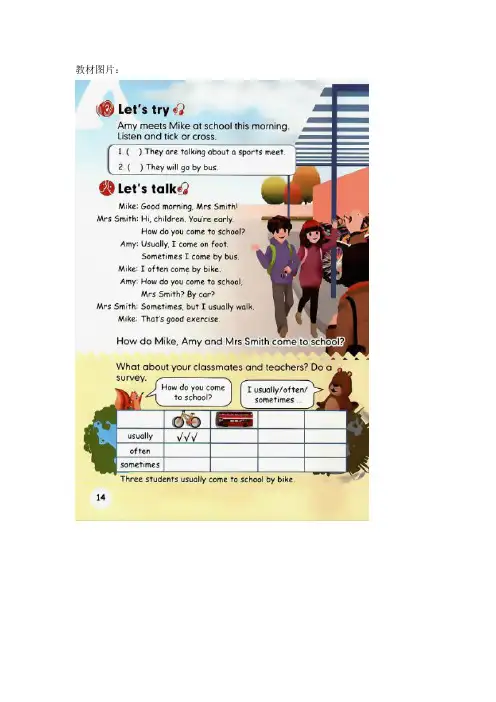
教材图片:Unit2 Part A Let’s talk教材:人教PEP小学英语六年级上册P14单元主题:Ways to go to school课型:听说课一、教材解析本课时是六年级上册Unit1的第一课时,包含A Let’s try及Let’s talk。
Let’s try通过Amy和Mike早晨到校后谈话的情景呈现新句型。
学生通过听力练习获得Let’s talk板块的人物及场景信息,为进入正式的对话学习做准备;Let’s talk通过Mike、Amy和Mrs Smith早晨到校后谈话的情景,让学生感知核心句型How do you come to school? I usually/sometimes/often come on foot.的语义和语用情景。
二、目标预设1. 学生能读懂题目要求,学会听前预测要听的重点内容;能运用基本听力技巧完成本部分的听力任务。
2. 能够在图片和教师的帮助下理解对话大意;能够按照正确的意群及语音、语调朗读并表演对话。
3. 能够在情景中运用句型How do you come to school? I usually/sometimes/often come on foot.谈论交通方式。
三、重难点预设教学重点:理解并能朗读对话;在情景中运用句型How do you come to school? I usually/sometimes/often come on foot.谈论交通方式。
教学难点:常用频度副词的用法及区别;come和go的用法区别;四、教学过程(一)热身(Warm-up)1. 师生相互问候,练习课堂口语。
2. 教师播放热身歌曲The wheels on the bus,学生跟唱,进行课堂热身。
【设计意图】与本课内容相关的朗朗上口的热身歌曲,可以激发学生的学习热情,为新课的学习创造良好的氛围。
3. 师生谈论彼此上班、上学的交通方式:I come to school by bus. How do you come to school?(二)导入(Lead-in)1. 教师介绍对话背景,学生进行听前预测。
六年级英语上册《Unit-2--Ways-to-go-to-school》Part-A(第二课时)
A:Cool! We can go by car or by bus. How do we get to school?
B:By bike/bus./On foot. A:How does Mrs Smith go to school? B:Sometimes by car.
Today Mrs Smith and the students are going to the nature park. Let’s see how they get there!
Free talk
car bus
train ship
plane bike
subway walk/on foot
A:How do we go to Canada? By car? By plane?
B:By plane. A:Yes, maybe we go by plane. How do
we go to Wuhan? B:By car/bus.
By car/bus/bike/subway/taxi/ — plane/ship/train.
On foot.
1. Practice the dialogue. 2. Do the exercises.
Look and discuss
➢ Who are they? ➢ What are they talking about? ➢ What are they going to do?
Where? nature park
How? ?
Listen and circle the traffic tool that you have heard in the book.
Do a survey
From Beijing
人教pep六年级上册英语第二单元Unit2《Ways to go to school》重要知识点总结
【精选】人教pep版六年级上册英语第二单元Unit2《Ways to go to school》重要知识点总结Unit2 Ways to go to school一、重点单词和短语on foot= walk,走路by bus =take a bus 乘公交车by plane乘飞机by taxi 乘出租车by ship乘船by subway 乘地铁by train乘火车by bike骑自行车by ferry乘轮渡Hooray!好极了slow down 慢下来stop 停wait等pay attention to注意cross the road横穿马路traffic light通信号灯at home在家missed(miss的过去式)想念different,不同chopsticks,筷子(复数) cross穿过look right向右看same 相同的door门look at朝……看play with和……一起玩buy买want to想要a pair of一双get on上车get off下车turn left左转turn right右转am上午pm下午now现在look for寻找top停止get to到达driver司机must必须二、重点句子1.Let's go to the nature park,让我们一起去公园吧!2.How do we get there?我们怎样到达这里?By bus乘公交。
3.The park is over there,公园在那里。
4.Let's go .我们一起出发吧!5.Slow down and stop at a yellow light.黄灯等一等。
6.Stop and wait at a red light.红灯停。
Go at a green light.绿灯行。
三、重点知识1.Is there 开头的问句怎么回答呢?例如:Is there a cinema near here? 只要把前两个词语的顺序换一下就可以了,肯定回答是:Yes, there is.否定:No, there isn't.2.buy和by的区别,这两个词语发音相同,但是意思完全不同,by:乘,坐、buy:买3.地点名词前面一定要有the,例如:Where is the cinema? How can I get to the hospital?4.时间前面用at. 例如:在三点钟:at 3 o' clock.;一段时间前面用for,例如:三分钟for 3 minutes. 星期前面用on,例如:on Monday, on Tuesday, on Wednesday, on Thursday, on Friday, on Saturday, on Sunday.5.在表达第几路公交车时,注意No. 的书写,N要大写,后面别少了一点!!!6.在哪里上下车,在哪里左右转,都用介词at,例如:Get on/ off at the cinema.在电影院的地方上下车。
Unit2Waystogotoschool单词讲解(课件)人教PEP版英语六年级上册
例句
in Scotland 在苏格兰
Thanks!
同音词
bye 再见 buy 买
prep.(介词)(表示方式)乘
短语
by car 乘小汽车 by bus 乘公共汽车
例句
My brother goes to work by bike. 我哥哥骑自行车去上班。
口诀记忆
by 是一个多面手,交通工具牵着走。
复数
buses
短语
school bus 校车
n.(名词)公共汽车
短语
traffic lights 交通信号灯
traffic rules 交通规则
n.(名词)交通
例句
Turn left at the traffic lights. 在交通信号灯处左转。
n.(名词)慕尼黑(德国城市) 德国东南部城市。
n.(名词)德国
例句
Do you still live in Germany? 你还居住在德国吗?
歌谣记忆
公共汽车叫巴士, 巴士 bus 音相似。
形近词
but 但是 buy 买
例句
I usually go home by bus. 我通常乘公共汽车回家。
复数
planes
n.(名词)飞机
形近词
plate 盘子
同义词
airplane
变换字母记忆
t
植物
改
为 e
plane 飞机
例句
There is a plane in the sky. 空中有一架飞机。
同
whereHale Waihona Puke 音词在哪里
其 他 词 义
v.(动词)戴
短 wear a hat 语 戴帽子
人教pep六年级上册英语Unit2 Ways to go to school A教案
教学设计一、教学内容:Unit 2 Ways to go to school A Let’s learn内容分析:本部分学习的词组是:by plane,by train,by taxi,by ship,by bus,by subway,on foot。
教材通过Mrs Smith和学生们谈论下周三如何去自然公园的场景呈现了以上词组的词形和意义。
教学目标:1.能够听说读写上述词组。
2.能结合本部分核心句型谈论交通方式的选择。
重难点:掌握四会词组,注意train,plane,subway等几个生词的发音。
掌握句型How do we get there?并能用所学的出行方式词组交替回答。
二、Teaching ProcedureStep 1: warming-up (free talk)(1)课件呈现A let’s learn的挂图,提问:What are they ?What are they talking about?Can you guess?(2)T: They are going to the nature park. But how do they getthere? There are many different ways to come tothe nature park. Do you know?Step 2: Presentation学生列举出生活中各种出行方式后,ppt上出示挂图,呈现图片一部分,挡住,让学生猜测是什么交通工具,逐一进行教授。
1.新授by bus 操练:全班-小组-个人by 乘坐(同音词)bye/buy2.新授by taxi 操练:全班-小组-个人by car 乘坐小汽车3.新授by train 操练:全班-小组-个人4. I am a bird. I can fly. I’m big and hard.I don’t eat. What am I?引出飞机,新授by plane5. I live in the sea. I can swim very fast.But I’m not a fi sh. I’m a traffic tool. What am I?引出轮船,新授by ship6.It’s a kind of train.It’s under the ground.It runs fast. What’s this?引出地铁,新授by subway7.生活中有一种最便捷的方式,对我们的身体起到锻炼作用的出行方式是on foot。