
人教版七年级下册英语《Unit 6 Section A》PPT课件
小结
what与how的用法
how的用法
五 询问频率 常以how often 的形式出现,表示“多久, 多长时间”, 用于对动作发生的频率进行提 问,如对once / twice / three times等等提问。 如:
I write to my parents once a month.
How often do you write to your parents? how often 也可以对表示频度的副词如: sometimes,usually,always等进行提问。
点击查看 动画词汇
sunny
阳光充足的 下一页
New words
点击查看 动画词汇
snow
下雪 下一页
Explanation
rainy; windy; cloudy; sunny rainy, windy, cloudy, sunny是由rain, wind, cloud, sun加后缀-y (sunny 双写n再加y)构成 的形容词,用来表示天气状况,意思分别为 “下雨的;多雨的“、“有风的;多风的”、 “多云的;阴天的”、“晴朗的;阳光充足 的”。 以后我们还将会学到几组类似结构 的词:snow (n. 雪) — snowy (adj.下雪的; 有雪的), fog (n. 雾) — foggy (adj. 有雾的; 多雾的), 等。
— It’s great.
How’s it going? 是询问处境或事情现在的状 况如何。great在口语中意为“妙;好”。如:
—How’s everything? 一切都好吧? —Great!很好! —How is your study? 你的学习情况如何? —Terrible! 糟透了。 —How’s the life? 日子过得如何? —Not bad!不错!
Conversation 3 Peter: So, how’s the weather there in Beijing? Girl: It’s sunny.
1b
Tapescript
Conversation 4 Peter: Happy New Year, Uncle Bill! Uncle Bill: Happy New Year, Peter! Peter: How’s the weather in Toronto? Tom: It’s raining, as usual!
How do you usually go to work? 二. 询问某人或某事的状态,如:
How is the computer ?
小结
what与how的用法
how的用法
三 .询问某人的品行或对某事物的评价,如: How do you like Chinese food?
四. How+形容词用语询问年龄 身高或高度 体 积重量等,如: How tall is that tree behind the house? How old is your brother?
Unit 6 It’s raining!
Section A
Section A
教学目标
1.描述并谈论天气 2.描述正在发生的事情—学习现在
进行时的用法
New words
点击查看 动画词汇
rain
下雨
下一页
New words
windy
有风的;多风的
New words
cloudy
多云的;阴天的
New words
What are they doing? They’re studying.
What’s he doing? He’s playing basketball.
What’s she doing? She’s cooking.
How’s it going?
Great!
— How is it going? =How’s it going (with you)? =How’s everything going?
1. _c__ Uncle Joe a. is playing computer games.
2. _a__ Jeff
b. is cooking.
3. _d__Mary
c. is playing basketball.
4. __b_ Aunt Sarah d. is watching TV.
2a,2b
五. 询问对某人或某事的看法, 如: What do you think of our English teacher?
六. What+名词,如: What sport do you like best?
小结
what与how的用法
how的用法
how是疑问副词,主要询问方式 状态或程度,表示 “如何”“怎么样”,在特殊疑问句中常作状语 或表语。如: 一. 询问某动作执行方式,如:
1b
Toronto
1. raining __a_ 2. windy__e___ 3. cloudy __d__ 4. sunny __b__ 5. snowing__c__
Boston
Beijing
Moscow Shanghai
1b
Tapescript
Conversation 1 Tom: Hey, Peter. Happy New Year! Peter: Happy New Year, Tom! Tom: How’s the weather down there in Shanghai? Peter: It’s cloudy. How’s the weather in Boston? Tom: It’s windy.
1b
Tapescript
Conversation 2 Peter: Hi, Aunt Sally. Happy New Year! Aunt Sally: Hello, Peter. Happy New Year! Peter: How’s the weather in Moscow? Aunt Sally: Oh, it’s snowing right now.
拓展
—How’s the weather in Shanghai? —It’s cloudy.
这是谈论天气的常用表达法之一。询问天气 状况,英语中常见的有两种句式:
How is the weather ...?
What’s the weather like ...? 其答语常用:
It’s sunny / rainy / cloudy / windy / snowy ... 天气晴朗 / 有雨 / 多云 / 有风 / 有雪…… It’s warm / hot / cool / cold...
How’s the weather in Moscow? It’s snowing.
How’s the weather in…? CCTV Weather Report
2a Listen. Number [1-4] the pictures as you hear them.
2
4
1
3
2b Listen again. Match the names with the activities.
Match the words with the faces in the box. 3a
Not bad
Great
Terrible
Pretty good
小结
what与how的用法
what的用法
一. 对于一个或多个事物提问,询问他们是什么 或属于什么,如:
What are these on the table? 二. 询问某人的职业身份,头衔相貌等,如:
can get her. Scott: Thanks. And can I say “Hi” to Jeff, too? Lucy: Sure. He’s playing computer games.
Grammar Focus
How’s the weather? It’s raining.
What are you doing? I ’m watching TV.
拓展 How is it going?
how
(怎样)
121
/extern/wetterin.htm
Homework
Review the new words and sentences in this period.
天暖和 / 炎热 / 凉爽 / 寒冷……
拓展 英语中表示雨或风的大小,不用big 或small, 习惯上使用下列说法: heavy rain大雨 light rain小雨 strong wind大风 soft wind和风
Listen and write these city names in the boxes.
小结
what与how的用法
how的用法
六 询问数量 how many 用于对可数名词前的数量进行提 问。注意:how many后面必须接复数名词, 涉及到数的变化时,前后要一致。如:
I can see seven kites in the sky. How many kites can you see in the sky? There is only one bottle on the table. How many bottles are there on the table?
What does your mother do? 三. 询问时间 价格 号码 距离 尺寸 体积 面积等
数字,如:
What's your telephone number, please?
小结
what与how的用法
what的用法
四. 询问数学中加 减 乘 除等运算结果是多少, 如: What’s eleven plus five?
新人教版七年级英语下册Unit6 Section A(1a—2d)优质课课件.ppt

▪ (3) 李雷的妈妈正在做汤。 ▪ Li Lei’s mother _____ _____soup. ▪ (4) 杰克正在玩电脑游戏。 ▪ Jack _____ _____ computer games. ▪ (5)三班的学生正在听CD。 ▪ The students of Class 3 _____ _____ to
What is she doing?
She is cleaning .
1a
Match the activities with the pictures.
1. watching TV ____ .
2. cleaning ___.
3. reading a
newspaper .
4. talking on the
_______.Do you want to ________ the movies? Jack: That sounds good.
▪ 2c Role-play the conversation in 2b.
2d Role-play the conversation.
▪ Jenny: Hello? This is Jenny. ▪ Laura: Hi, Jenny. It’s Laura here. ▪ Jenny: Oh, hi, Laura. What are you doing? ▪ Laura: Not much. I’m just washing my clothes. What
▪ (3) —Let’s _____ at the school gate. ▪ —That sounds good. ▪ (4)Where is your pen pal _____? ▪ (5) —What is Jane doing? ▪ —She is _____ TV.
最新人教版七年级英语下册Unit6 Section A 1a-2b公开课课件
What’s he doing?
He’s making the soup.
What’s she doing?
She’s talking on the phone.
What are they doing?
They’re watching TV.
1c Ask and answer questions about what people are doing in 1a.
2c
Role-play the conversation in 2b.
1.预习下一课时的内容。 2.编写对话。 3.做练习册上的题。
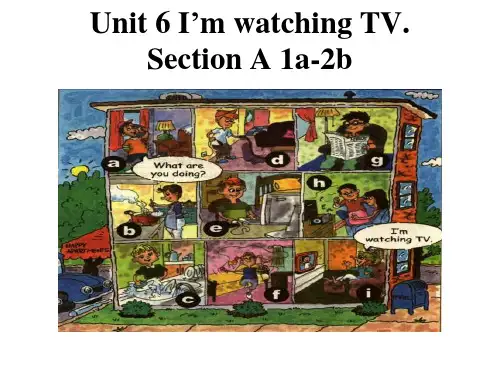
Unit 6 I’m watching TV. Section A 1a-2b
What are you doing now? I’m watching TV.
At 7:30 pm, people are doing different things.
cleaning
reading a newspaper
1. Jenny is watching ________ TV.
2. John is _________ washing the dishes.
3. Dave and Mary are listening _______ to a
CD.
What’s she doing?
She’s using the computer.
Verb-ing
1a Match the activities with the pictures. i 1. watching TV __ d 2. cleaning __ g 3. reading a newspaper __ a 4. talking on the phone __ h 5. listening to a CD __ 6. using the computer __ e 7. making soup ___ b 8. washing the dishes __ c f 9. exercising ___
人教英语七年级下册Unit6Section A Grammar focus 3a—3c(共25张PPT)
I am not writing.
3)一般疑问句:直__接__把__b_e_提__到__句__首__ 肯定回答:_Y_e_s_,_主__语__+_b_e_.___ 否定回答:_N__o_, _主__语__+__b_e_+__n_o_t_.
He is reading. --Is he reading ? --Yes, he is./No, he isn’t.
现在进行时
1.定义: 表示现在(说话瞬间)_正__在__进__行__或__发__生__的动作
eg: The students are listening to the teacher.
He is watching TV now. 判断词:now,
be Байду номын сангаас着人称、数
look, listen等
2. 结构: 的变化而变化
7. Mike is doing his homework. (改为否定句) Mike _i_sn__’_t__d_o_i_n_ghis homework.
翻译下列句子。
1. 他正在等公共汽车。
He is waiting for a bus. 2. 那些男孩现在正和老师们打篮球。 The boys are playing basketball with their teachers now. 3. 听!你哥哥在弹吉他。 Listen! Your brother is playing the guitar.
Preview the new words and expressions.
Preview part 1a of Section B.
— Yes, I am.
人教版七年级下册英语RJ精品教学课件 Unit 6 第3课时 Section A

Yes, they are. / No, they aren’t. They’re exercising.
She’s exercising (now).
She exercises (on Mondays/ every night/ in the mornings/ etc.).
3 Write sentences following the examples.
house n. 房子
drink v. 喝 n. 饮料
tea n. 茶;茶叶 drink tea 喝茶
tomorrowadv. 在明天 n. 明天;未来
She’s
exercisin g (now). She
Grammar Focus
exWehractisaere you s doi(ngo?n
I’m watching TV.
isn’t sleeping David ______ _________ in his room.
布置作业
adv. 在明天 n. 明天;未 来
_1__ Do you want to go to the movies
n3ow?
_6__ Sure, what time?
take turns doing sth. 轮流做……
3 Take turns miming different activities in your c group. The others in the group guess what the
g Yes, ____ _____.
I am
4. He cleans his room every morning. (用now改写句 子) is cleaning
He ____ _________ his room now. 5. David is sleeping in his room. (改为否定句)
初一下册Unit6英语课件
初一下册Unit6英语课件Language goalsIn this unit students learn to talk about the weather and talk about what people are doing.New languageWhat are you doing? I'm watching TVWhat's he doing?He's playing basketball.What's she doing? She's cooking.What are they doing? They're studying.How's the weather? It's raining.Section AWrite the question. What are you doing? on the board.Read the question and ask the class to repeat it. Then act out an activity students are already familiar with, point to the question and have students repeat it. Answer the question using the target language.For example, you might pretend to be reading a book,playing soccer, playing the guitar or writing your name.When the class asks, What are you doing?, you answer,I'm reading a book, and so forth.1 aThis activity introduces the key vocabulary.Focus attention on the cities in the picture. Ask, What s the weather like here? If they can't answer, supply theword and ask the class to repeat it. Say a sentence or two about each kind of weather. For example, It's raining.Is it raining here today?Point out the numbered list of words. Say each one and ask students to repeat the words again.Then ask students to match each word with one of the cities in the picture. Say, Write the letter of each city next to one of the ivords. Point out the sample answer.Check the answers.1 bThis activity gives students practice in understanding the target language in spoken conversation.Play the recording the first time. Students only listen.Say, You will hear fourdifferent conversations. Each one is about the weather in a different city. Point to each city in the picture as it comes up on the tape.Play the recording a second time. Ask students to write the name of the city in the picture of its weather. Say, The first one has been done for you. Beijing is written in the picture of sunny weather. It is sunny inBeijing.Correct the answers.1 cThis activity provides guided oral practice using the target language.Point out the example conversation. Ask two students to read the dialogue to the class.Say, Now work with a partner. Make your own conversations about the weather in these five places.As the pairs talk, move around the room monitoring their work. Offer language or pronunciation support as needed.Ask several pairs to present their conversations to the class.2aThis activity gives students practice in understanding the target language in spoken conversation.Point to the four pictures. Ask students to tell what each person is doing in each picture. For example, This boy is talking on the phone. This man is playing basketball. Supply vocabulary words as needed.Play the recording the first time. Students only listen.Play the recording a second time. This time, ask students to listen to the recording and number the pictures 1 through 4 to show what each person is doing.Correct the answers.2bThis activity provides listening practice using the target language.Point out the list of names and the list of activities.Ask a different student to read each list to the class.Say, Now I will play the recording again. Thistime,please match each name with an activity. Write the letterof an activity in front of each name. Point out the sample answer for number 1.Play the recording and have students fill in the rest of the answers.,Correct the answers.2cThis activity provides guided oral practice using the target language.Call attention to the four people in the picture in activity 2a. Ask students to say something about each person. Guide students to use the words and phrases playing basketball, cooking, ivatching TV, and playing computer games.Point out the sample conversation in the speech bubbles and have a pair of students read it to the class.Say, Now please work with a partner. Make conversations like this one. Talk about the people in the I pictures.As students work in pairs, move around the room monitoring progress and offering assistance, if needed.Ask some pairs to present their conversations to the class.3a This activity introduces more key vocabulary.Call attention to the faces. Ask students to point to and describe each face using whatever vocabulary they can.Help students to identify how each person is feeling. For example, ask a student. Look at this face. Is it happy? Is it unhappy?Then point to the four words. Say the words and ask students to repeat each one. Use your tone of voice and facial expressions to reinforce the meaning of each. Add your own simple explanations of what each one means.For example: Not bad. This means something is not very good, but it's also not very bad. It's in themiddle.After that, ask students to match each numbered phrase with a face by writing the letter of each face in the blank in front of the correct phrase.As students work, move around the room answeringquestions as needed.Check the answers.3bThis activity provides oral practice using the target language.Point out the conversation in the large picture and ask two students to read it to the class. Ask students to explain what How's it going? means. (It is similar to How are you? or How is everything?)Ask students to practice the conversation in pairs.Move around the room monitoring their progress.Then call attention to the example in the small speech bubbles. Have two students read it to the class.Say, Now we'll change some of the words and make our own conversations. We can use our own names. We can give true answers or we can make up answers.Ask pairs of students tomake up their own conversations. Move around the room offering language support as needed.Ask some pairs to present their conversations to the class.4.This game provides oral practice using the target language.Say,Now let's work in pairs again. One student looksat the picture on page 85 and the other looks at the pictureon page 87. Please don't look at your part ner's picture.Say, Each picture has the same people in it, but they are doing different things. Take turns talking about what the people are doing in your picture. If I am student A, I will say. In my picture it is sunny. Guide one of the students Bs to respond.In my picture it is raining.As students work, move around the room, monitoring progress and offering assistance as needed.Section BNew languageMore words used to describe weather:cold, hot, cool, warm, humidAdditional materials to bring toclass:weather map from an English language newspaper1 aThis activity introduces more key vocabulary.Focus attention on the five pictures. Ask students to tell what the weather is like in each place, if they can. If not, supply the word and ask the class to repeat it. Say a sentence or two about each kind of weather. It's cold in this picture. Is it cold here today?Point out the numbered list of words. Say each one and ask students to repeat the words again.Then askstudents to match each word with one of the pictures. Say,Write the letter of each picture next to one of the words.Point out the sample answer.Check the answers.1 bThis activity provides oral practice using the target language.Call attention to the example in the speech bubbles.Read the conversation with a student.Ask students to work in pairs. Have students ask and answer questions about the weather in the pictures in activity la.2aThis activity provides listening and writing practice using the target language.Read the headings on the chart to the class. Point out the answer blanks.Say, Listen to this conversation between Sam and Maria. Listen carefully to their questions and answers.Play the tape the first time. Students only listen. Play the tape again and have students write their answers.Play the tape again and have students write their answers. Say, This time, please write the answers Maria and Sam give to the question "How's it going?"You may wish to play the tape more than once at this point.Correct the answers.2bThis activity provides more listening and writing practice using the target language.Point to and read the second two headings on the chart: What are you doing? How's the weather?Ask students to listen to the recording again and write the answers to these two questions in the blanks in the chart.Play the recording. Students fill in the blanks.Correct the answers.2cThis activity provides guided listening and speaking I practice using the target language.Point out the example in the speech bubbles. Ask two students to read it to theclass.Point out the three questions in 2a. Ask individual students each question and repeat their answers. Accept any reasonable answers.Say, Now work with a partner. Make your ownconversations. Student A is Maria. Student B is Sam. Athey talk, move around the room monitoring their work.Offer language support as needed.3a This activity provides reading practice using the target language.Call attention to the speech bubble and the picture.Ask students to say where the reporter is. Ask them to tell what they know about Egypt.Read the speech bubble to the class, or ask a student to do so. Answer any questions students may have. Use drawings on the board and/or translation to clarify the meanings of any new vocabulary words.Ask students to work alone. Say, Underline the words in the speech bubble that say what people are doing. Then circle the words that describe the weather. Two examples are done for you.3b This activity provides reading and writing practice using the target language.Draw attention to the pictures of France and the description below. Read the description to the class or ask a student to do so. Say the word blank each time you come to a blank line.Answer any questions students may have about the new words. Use drawings on the board and/or translation to clarify the meanings of any new vocabulary words.Ask students to work alone. Have students fill in the blanks. Point out the sample answer and read that sentence.Correct the answers.3c This activity provides writing practice using the targetlanguage.Ask one or two students to describe the weather in their home town, and to say what outdoor activities people there like to do (e.g. playing football, flying kites, fishing).Ask students to work alone. As they work, move around the class monitoring progress and offering help as necessary. Provide the students with any new vocabulary theyneed (e.g.for descri activities), or encourage them to use adictionary.Ask several students to read their reports to the class.4This survey provides listening, speaking, and writing practice using the target language.Call attention to the dialogue in the speech bubbles.Ask two students to read it to the class. Ask other students,What do you do when it's raining?Substitute another type of weather for "raining" and ask other students what they do. Accept all reasonable answers and write each one on the board.Introduce the use of present tense in both halves of answers such as, When it's sunny, I go to the beach.(See grammar note.)Now ask students to interview their classmates. Ask each student to choose one type of weather and ask as many classmates as possible what they do in that kind of weather. Remind students to write down the answers.Ask several students to read their questions and answers to the class. Write any new vocabulary items on the board and discuss these words. Students may wish to copy some of the words onto their notebooks.Alternative: If you do not want students to get up and walk around the classroom, then ask them to do this activity in groups of four.。
人教版七年级下册英语课件Unit 6 I’m watching TV (共54张PPT)

Look! These people are all at home.
What are they doing now?
Look and say.
What is Bob doing now? He is talking on the phone.
Look and say.
What is Tom doing now? He is cleaning.
at home
at school
in a park
cleaning, watching TV, talking on the phone, reading a newspaper
cleaning the blackboard, cleaning the floor, playing soccer, reading
What do they talk about?
Jenny: Hello? This is Jenny.
These people are doing different activities at home now.
People are doing different activities in different places.
1. at home 2. at school
in the classroom in the playground in the library …
What is Lucy doing now? She is exercising.
Look and say.
What is Jenny doing now?
She is watching TV and talking on the phone.
Who is Jenny talking to on the phone?
人教版七年级英语下册Unit 6全单元课件
are watching 1. It’s 6:30.pm My family _________(watch) TV. 2. Don’t be noisy. My soins_s_le_e_p_i_n_g(sleep) 3.- Where is Tom? -Oh, he __is__p_la_y_i(npglay) outside.
John doing? Boy: He’s washing the dishes. Girl: Well,what’re Dave and Mary doing? Boy: They’re listening to a CD.
1c. Pairwork
Ask and answer questions about what people are doing in the picture above.
He is using the computer use using
Look! What is he doing?
soup He is making soup make making
It’s 4 o’clock.
What are they doing? They are swimming.
swim--swimming clean--cleaning
T: What is he doing? S: He is…
He is eating.
T: What are they doing? S: They are…
They are dancing.
learning Aims
1. Master the key words and phrases;
七年级英语下册Unit6课时2SectionAGrammarFocus_3c课件pptx人教新目标版
课时 2 Section A ( Grammar Focus-3c)
一、用括号内所给单词的适当形式填空。 1. Listen! Who is talking (talk) in the room? 2. My father is drinking (drink) tea in the living room now. 3. There are many new houses (house) in our city.
A. Are; speaking
C. Do; speak
to our teacher now? B. Is; speaking D. Does; speak
一
二
三
四
( C )10. She
English with her brother in the room now.
A. is practicing speak
一
二
三
四
I 21. am reading (read) a storybook in my room. I just finished my homework at nine o’clock, so I want to relax. What about my brother? He 22. is watching (watch) an animal TV show on the sofa. He 23. likes (like) giraffes best because they are fun. But he can watch TV only 24. on
一
二
三
四
My mother 18. is washing (wash) the clothes. She always 19. has (have) much work to do in our home. And my father 20. is working (work) on the computer. He is really busy these days.
Unit6SectionAGrammarFocus-3c课件人教版七年级英语下册
3a Write sentences following the examples.
1. Jenny/ clean the house/ now Jenny is cleaning the house now.
2. Bob/ make dinner/ every Saturday Bob makes dinner every Saturday.
3. Mary’s parents/ drink tea/ after dinner
Ma_r_y_’_s_p_a_r_e_n__ts__d_r_in__k_t_e_a__a_f_te__r _d_i_n_n_e_r_.
Take turns miming different activities
3c in your group. The others in the group
guess what the activities are.
Are you Are you making soup? cleaning?
No, I’m not.
• swim—swimming run—running • 3. 以重读闭音节结尾,且末尾只有一个辅音字母
的动词,双写这个辅音字母,再加ing
请尝试写出下列动词的-ing形式
sing dance study write speak cut swim
singing dancing studying writing speaking cutting swimming
人教版七年级英语下册第六章课件PPT
输入您的文本输入您的文本输入您的文本输入您的文本输入您的文本输入您的文本输入您的文本输入您的文本
点击这里输入您的标题
在此添加标题或目录索引 在此添加标题或目录索引
在此添加标题或目录索引 在此添加标题或目录索引
单击添加标题
点击这里输入您的标题
文本
文本
文本
文本
您的文本您的文本
您的文本您的文本
您的文本您的文本
您的文本您的文本
章节
4
这里输入您的标题四
点击这里输入您的标题
您的文本您的文本
这里输入您的文本
这里输入您的文本
这里输入您的文本
这里输入您的文本
这里输入您的文本
这里输入您的文本
点击这里输入您的标题
点击这里输入您的标题
半球
海陆
经纬度
东
北
欧亚大陆
单击这里输入内容,单击这里输入内容,单击这里输入内容单击这里输入内容,单击这里输入内容,单击这里输入内容单击这里输入内容,单击这里输入内容,单击这里输入内容
单击这里输入内容,单击这里输入内容,单击这里输入内容单击这里输入内容,单击这里输入内容,单击这里输入内容单击这里输入内容,单击这里输入内容,单击这里输入内容
第一节 位置和范围
指图说出半球及分界线和大洲大洋名称
温故而知新
夯实基础,提前准备
浏览全文,做到胸有成竹。1、大洲的地理位置可以从 位置、 位置和 位置来描述。2、亚洲绝大部分位于 半球和 半球,亚洲占据了 的大部分,北、东、南环绕着 。
04
某某方面:这里输入你的文本内容这里输入你的文本内容这里输入你的文本内容这里输入你的文本内容你的文本内容