
人教版英语八年级上册(Go for it)
教版(Go for it)八年级上册
Review of units 1—6综合测试题
一.单词拼写(10分)
(A)根据句意和括号中汉语提示写单词。
1、Do you have a healthy (生活方式)?
2、You should see a (牙医)when you have a toothache .
3、My aunt keeps many chickens and ducks in the (乡下)
4、The twin brothers are (体格健美的)because they both like sports very much .
5、If you want to learn English ,please (开始)with ABC.
(B)根据句意和单词的首字母提示写单词
6、A it’s getting dark, the farmers are still working in the field.
7、Dumplings are our t food in China.
8、The scenery of Mount Huang is very beautiful. We’re going s there.
9、The old man d on her daughter two years ago.
10、Our English teacher told us the w story again and again.
二、选择填空(10分)
( )1、—does he go to the library?
—Twice a year.
A. How long
B. How many times
C. How about
D. How often
( )2、—Some students play sports three four a week.
A.and; times
B. or; times
C. and; time
D. or; time
( )3、—Can I talk to you for a moment, Tom?
—Sure, I have time now.
A. few
B. a few
C. little
D. a little
( )4、—Would you like some tea?
—Yes, please. By the way, do you have any sugar? I like tea sugar.
A. with
B. have
C. for
D. without
( )5、—What are you doing for vacation?
—。
(完整版)新人教版初中八年级英语电子课本(Goforit)上册
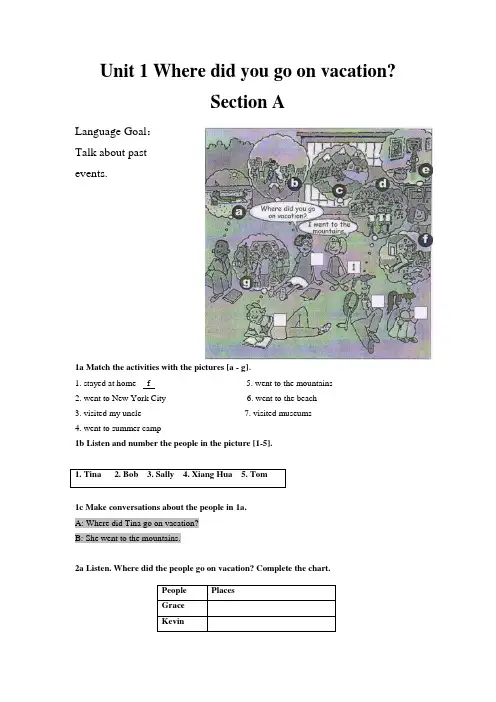
Unit 1 Where did you go on vacation?Section ALanguage Goal:Talk about pastevents.1a Match the activities with the pictures [a - g].1. stayed at home __f__ 5. went to the mountains ______2. went to New York City ______ 6. went to the beach ______3. visited my uncle ______ 7. visited museums ______4. went to summer camp ______1b Listen and number the people in the picture [1-5].1. Tina2. Bob3. Sally4. Xiang Hua5. Tom1c Make conversations about the people in 1a.A: Where did Tina go on vacation?B: She went to the mountains.2a Listen. Where did the people go on vacation? Complete the chart.People PlacesGraceKevin2b Listen again. Check(√)Yes, I did or No, I didn't for each question.Did you ... Yes, I did. No, I didn'tGrace go with anyone? √go to Central Park?buy anything special?Kevin play volleyball? swim?meet anyone interesting?Julie do anything interesting? study for tests?go out with anyone?2c Role-play conversations between Grace, Kevin and Julie.A: Grace, where did you go on vacation?B: I went to New York City.A: Oh, really? Did you go with anyone?B: Yes, I went with my mother.2d Role-play the conversation.Rick: Hi, Helen. Long time no see.Helen: Hi, Rick. Yes, I was on vacation last month.Rick: Oh, did you go anywhere interesting?Helen: Yes, I went to Guizhou with my family.Rick: Wow! Did you see Huangguoshu Waterfall?Helen: Yes, I did. It was wonderful! We took quite afew photos there. What about you? Did you do anything special last month? Rick: Not really. I just stayed at home most of the time to read and relax.Grammar FocusJulieDid you do fun on your vacation, Alice?Alice: Yes, I did. I went to Sanya.Linda: How did you like it?Alice: Well, it was my first time there, so was really interesting, Linda: Did you go with ?Alice: Yes, I did. I went with my sister.Linda: Did you go shopping?Alice: Of course! I bought for my parents, but for myself. Linda: Why didn't you buy for yourself?Alice: I didn't really see I liked.3b Fill in the blanks in the e-mail message with the words in the box.1a Match the words with the pictures below.1. f delicious 3. exciting 5. terrible2. expensive 4. cheap 6. boring1b Write ☺words on the left.Write ☹words on the right1c Listen. Lisa is talking about her vacation. Answer the questions.1. Where did Lisa go on vacation?2. Did she do anything special there? What?3. Did she buy anything for her best friend?4. Did Lisa like her vacation?1d Listen again and fill in the chart.What did Lisa say about…?her vacation great the peoplethe fun park the foodthe stores1e Ask and answer questions about Lisa's vacation. Begin your questions with:Where did...? What did...? Did she...?How was...? How were...?2a Discuss the questions with your partner.1. What do people usually do on vacation?2. What activities do you find enjoyable?☺ words ☹ wordsdelicious terrible2b Read Jane's diary entries about her vacation and answer the questions. Did Jane have a good time on Monday? What about on Tuesday?Monday, July 15thI arrived in Penang in Malaysia this morning with myfamily. It was sunny and hot, so we decided to go tothe beach near our hotel. My sister and I triedparagliding. I felt like I was a bird. It was so exciting!For lunch, we had something very special ——Malaysian yellow noodles. They were delicious! In the afternoon, werode bicycles to Georgetown. There are a lot of new buildings now, but many of the old buildings are still there. In Weld Quay, a really old place in Georgetown, we saw the houses of the Chinese traders from100 years ago. I wonder what life was like here in the past. I really enjoyed walking around the town.Tuesday, July 16thWhat a difference a day makes! My father and I decided to go to Penang Hill today. We wanted to walk up to the top, but then it started raining a little so we decided to take the train. We waited over an hourfor the train because there were too many people. When we got to the top, it was raining really hard. We didn'thave an umbrella so we were wet and cold.It was terrible! And because, of the badweather, we couldn't see anything below.My father didn't; bring enough money, sowe only had one bowl of fish and rice. I was so hungry!But it tasted great!Things Jane did or saw Did she like it? (Yes/No) Why or why not?2d Complete the conversation about Jane's trip to Penang using the information in the diary entries.Anna: Hi, Jane. Where did you go on vacation last week?Jane: I to Penang in .Anna: Who you go with?Jane: I went with myAnna: What did you do?Jane: The weather was hot and on Monday, so we went on the beach. Then in the afternoon, we bicycles to Georgetown.Anna: Sounds great!Jane: Well, but the next day was not as good. My and I went to Penang Hill, but the weather _ really bad and rainy. We a long time for the train and we were _and cold because we forgot to bring an .Anna: Oh, no!Jane: And that's not all! We also didn't bring money, so we only had one bowl of fish and rice.2e Imagine Jane went to Penang Hill again and had a great day. Fill in the blanks in her diary entry with the correct forms of the verbs in brackets.Thursday, July 18thToday (be) a beautiful day. My father and I (go) to Penang Hill again, but this time we (want) to walk to the top. We (start) our walk at 9:30 a.m. We (see) lots of special Malaysian flowers along the way. About one hour later, we (stop) and (drink) some tea. Then we (walk) for another two hours before we (get) to the top. I (be) quite tired, but the city (look) wonderful from the top of the hill!3a Complete the diary entry about a vacation at one of these places. Use the words and phrases in the box to help you.Wednesday,20thToday the weather was . I went to . Itwas . We . I liked this place because .For dinner we had . Itwas . In the evening, I felt really . hot and sunny tired happy Beijing duck delicioustake some photos beautiful buy something special interesting learn something important August3b Answer the questions to make notes about a vacation you took. 1. Where did you go? 5. What food did you eat? 2. Did you go with anyone? 6. What did you like best? 3. How was the weather?7. Did you dislike anything? 4. What did you do every day?8. How did you feel about the trip?3c Write a travel diary like Jane's on pages. Use your notes in 3b.4 Imagine you are all foreigners on vacation in China. You meet each other at the airport on your way home. Talk about what you did on your vacation.1. Complete the conversations with the correct words in the box. anything everything nothing anyone everyone no one 1. A: Did go on vacation with you last month?B: Yes, my family went to the countryside with me.2. A: Did your family go to the beach with you last weekend?B: No. from my family went, but my friend went with me.3. A: I didn't bring back anything from Malaysia.B: at all? Why not?4. A: Did you buy in the shopping center?B: No, I didn't. was very expensive.5. A: How was the volleyball game yesterday?B: Great! had a fun time!2. Complete the passage with the correct forms of the verbs in brackets.Last August, our class (do) something very special on our school trip. We (go) to Mount Tai. We (start) our trip at 12:00 at night. Everyone in our class (take) a bag with some food and water. After three hours, someone looked at the map and (find) out we (be, not) anywhere near the top. My legs (be) so tired that I wanted to stop. My classmates (tell) me to keep going, So I (go) on. At 5:00 a.m., we got to the top! Everyone (jump) up and down in excitement. Twenty minutes later, the sun (start) to come up. It was so beautiful that we (forget) about the last five hours!Unit 2 How often do you exercise?Section ALanguage Goal:Talk about how often you do things1a Look at the picture. Make a list of the weekend activities.1. help with house 4. ___________2. ______________ 5.___________3._______________1b Listen and write the letters from the picture above on the lines below. always(100%)________ usually_______ often______sometimes________ hardly ever______ never(0%)_____1c Talk about the people in the picture above. What do they do on weekends? A: What does he do on weekends?B: He usually watches TV.A: Does he go shopping?B: No, he never goes shopping.2a Listen. Listen. Cheng Tao is talking about how often he does these activities. Number the activities you hear[1-5] .Activities How oftena.___ go to the movies every dayb. ____watch TV once a weekc. _____shop twice a weekd. _____exercise three times a week2b Listen again. Match the activities in 2a with how often Cheng Tao does them.2c How often do you do these activities? Fill in the chart and then make conversations. Activities How often watch TV every day use the Internet read English books go to the movies exercise2d Role-play the conversation. Jack: Hi, Claire, are you free next week?Claire: Hmm …next week is quite full for me, Jack. Jack: Really? How come?Claire: I have dance and piano lessons. Jack: What kind of dance are you learning?Claire: Oh, swing dance. It ’s fun! I have class once a week, every Monday. Jack: How often do you have piano lessons? Claire: Twice a week, on Wednesday and Friday. Jack: Well, how about Tuesday?Claire: Oh, I have to play tennis with my friends. But do you want to come? Jack: Sure!Grammar FocusWhat do you usually do on weekends? I always exercise. What do they do on weekends?They often help with housework.e. ______read once a month twice a monthA: How often do you watch? B: I watch TV every day. A: What ’s your favorite program? B: Animal World.A: How often do you watch it? B: Twice a week.1. How often _______he play soccer? a. Yes. She usually does.2. _______you drink milk?b. Hardly ever. I don ’t like them.3. How often ______they stay up late? c. He plays at least twice a week.4. ________Sue eat a healthy breakfast? d. No, they don ’t. They ’re too busy..5. How often _______you eat apples? e. Never. They always go to bed early.6. _________ your parents play sports? f. Yes, I do. Every day.3b Use words given to write questions. Then ask and answer them with a partner.Then ask your classmates the questions and find the best English student.1a Match the words with the pictures.1b Ask and answer questions. Use the words from 1a.1c Listen to the interview about eating habits. Circle your answer to each question.Is Bill healthy?Yes.No. I don’t know.Is Tina healthy Yes. No. I don’t know.1d Listen again. Fill in the blanks in the survey.Questions Tina Bill1. How often do you exercise? Every day _ ____2. How often do you eat fruit?3. How many hours do you sleep every night?4. How often do you drink milk?5. How often do you eat junk food?6. How often do you drink coffee?1e Student A is the reporter. Student B is Tina or Bill. Ask and answer questions. Then change roles.2a Rank these activities according to how often you think your classmates do them (I=most often, 6=least often)watch TV go to the moviesplay computer games excise r play sports use the Internet go camping in the country2b Read the article and complete the pie charts on page 14.A: How often do you drink milk, Liu Fang?B: I drink milk every day.A: Do you like it?B: No. But my mother wants me to drink it.She says it’s good for my health.A: How often do you exercise?B: I exercise every day.A: And how often do you…?2c Read the article again and answer the questions.1. How many students do not exercise at all?2. How many students use the Internet every day?3. How often do most students watch TV? What do they usually watch?4. What doest the writer think is the best way to relax? Why?5. Do you think the students at No. 5 are healthy? Why or why not?2d According to the article and the pie charts, write sentences with the percentages using always, usually or sometimes.1. 90% Ninety percent of the students always use the Internet.2. 85%3.45%4.10%5.13%6.2%2e. Choose one of these free time activities or think of your own. Then ask your classmates how often they do this activity and make a pie chart. Show the pie chart to your class.3a Look at the information in the chart and complete the report.Jane is a 16-year-old high school student n the United States. American Teenager magazine asked her about her habits. Jan has a lot of food habits. She always exercise and she reads books . Also, she drinks juice and she stay up late. However, she has some bad habits, too. She watch TV for more than two hours a day,How often do you..?Names of classmates 1-2 times a week 3-4 times a week Every dayHabits Activities Days a year Good habitsExercise Read books Drink juice Stay up late365 365 210 15 Bad habits Watch TV for over 2 hours Eat hamburgersHelp with housework Got to the dentist320 95 20 0play computer gamesread booksgo shopping draw picturesplay sportsand she eats hamburgers. Her parents are not very happy because she helps with housework and she goes to the dentist for teeth cleaning. She was she is afraid.3b Complete the chart with your own information. In the last column, use expressions like always, every day, twice a week and never.3c write a report about your goof and bad habits. Say how often you do things. Use the report in 3a as an example.4. Take the health quiz. Compare your results with your partner ’s. Who ’s healthier? 1. Hoe often do you eat breakfast?a. Never.b. A few times a week.c. Almost every day. 2. How often do you eat fast food?a. Never.b. A few times a week.c. Almost every day. 3. How often o you eat fresh vegetables and fresh fruit?a. A few times a year.b. A few times a month.c. A few times a week. 4. How often do you exercise?a. A few times a year.b. A few times a month.c. A few times a week. 5. How many hours do you watch TV every week? a. None. b. One to four. c. Five or more. 6. How many hours do you usually sleep at night? a. Less than six. b. Six to seven. c. Eight or more.Self Check1. Complete the chart with activities you do and don’t do. What about your mother/ father?3. Fill in the blanks in the conversation.A: What do Tom and Mike do on weekends?B: They sometimes go to the museum.A: do they go to the shopping center?B: ever. Maybe about twice a month.A: do they watch TV?B: Mike never watches TV, but Tom watches TV day.A: Oh, I’m just like Tom. I watch TV, too.Unit 3 I’m more outgoing than my sister.Section ALanguage Goal:Talk about personal traits; Compare people1a Match each word with its opposite . Tall loudly Thin short hair long hair heavy quietly short1b Listen and number the pairs of twins in the picture [1-3].1c Practice the conversation in the picture above. Then make conversations about the other twins.A: That ’s Tara, isn ’t it?B: No, it isn ’t. It ’s Tina. Tina is taller than Tara. And she also sings more loudly than Tara.2a Listen. Are the words in the box used with –(i)er or more? Complete the chart. funny (run) fast friendly (jump) high hard-working (get up) early smart lazy2b Listen again. How are Tina and Tara different? Fill in the charts.Tina …Tara …-er/ ier more friendlyoutgoingis more outgoing thanTaraWorks as hard asTina.2c Student A, look at the chart on the right. Student B, look at the chart on page 81. Ask and answer questions about Sam and Tom.2d Role-play the conversation.Julie: Did you like the singing competition yesterday, Anna?Anna: Oh, it was fantastic! Nelly sang so well!Julie: Yes, but I think Lisa sang better than Nelly.Anna: Oh, which is Lisa?Julie: The one with shorter hair. I think she sang more clearly than Nelly. Anna: Yes, but Nelly danced better than Lisa. Did you do anything special last month?Julie: But you can tell that Lisa practiced a lot more and really wanted to win.Anna: Well, everyone wants to win. But the most important thing is to learn something and have fun.Grammar FocusIs Tom smarter than Sam? No, he isn’t. Sam is smarter than Tom.Is Tara more outgoing than Tina?No, she isn’t. Tina is more outgoing thanTara.Are you as friendly as your sister No, I’m not. I’m friendlier.Does Tara work as hard as Tina? Yes, she does.Who’s more hard- working at school? Tina thinks she works harder than me.1.Julie/ tall/ youQ: Is Julie as tall as you?A: No, she isn’t. She’s shorter than me.2. Jack/ run/ fast/ SamQ:A: No, he doesn’t. He runs than Sam.3. your cousin/ outgoing/ youQ:A: No, she isn’t. She’s than me.4. Paul/ funny/ CarolQ:A: No, he isn’t. He’s than Carol.3b Think of yourself two years ago. Write down how you are different now.1.Are you taller? Yes, I am. I’m taller now than two years ago.2. Are you funnier? ___________________________________3. Do you study English better? _________________________4. Are you more outgoing? _____________________________5. Do you sing better? _________________________________3c Compare your parents. Check () who is smarter, funnier, etc. in the chart. Then ask your partner about his/ her parents.A: Who is smarter, your mother or your father? B: I think my mother is smarter than my father.Mother FathersmartfunnyWork hardoutgoingfriendlysing wellSection B1a What kind of things are important in a friend? Rank the things below.[1-7](1 is the most important.A good friend_____ a. has cool clothes._____ b. is talented in music._____ c. likes to do the same things as me._____ d. is good at sports._____ e. truly cares about me._____ f. makes me laugh._____ g. is a good listener.1b Talk about what you think a good friend should be like.A:I think a good friend makes me laugh.B: For me, a good friend likes to do the same things as me.C: Yes, and a good friend is talented in music, too.D: That’s not very important for me …1c Listen. What do Molly and Mary like about their best friends? Fill in the first column of the chart.Like about their best friends The same as theirbest friends Different from their best friendsMolly Peter likes to do the samethings.Mary studies harderMary They’re very tall. Lisa is quieter.Complete the rest of the chart in it.1c Talk about Molly and Mary and their best friends.2a Write the comparative of the following adjectives. Then use them to write five sentences about you and your friends.popular _____ funny ____ quiet ____hard- working ____ serious ____ friendly ___outgoing _____ smart ______ shy _______2b Should friends be the same or different? Read about what these people think. Underline the differences between the friends and circle the similarities.My mother told me a good friend is like a mirror. I’mquieter and more serious than most kids. That’s why Ilike reading books and studying harder in class. Mybest friend Yuan Li is quiet too, so we enjoy studyingtogether. I’m shy so it’s not easy for me to make friends. But I think friends are like books – you needn’t a lot of them as long as they’re good.It’s not necessary to be the same. My best friendLarry is quite different from me. He is taller thanme. We both like sports, but he plays tennis better,so he always wins. I’m getting better, though. AsLarry often says, “My best friend helps to bring outthe best in me.”However, Larry is much less hard –working, so I always get better grades. Maybe I should help him more.I don’t really care if my friends are the same asme or different. My favorite saying is, “ A truefriend reaches for your hand and touches yourheart.”My best friend Carol is really kind andvery funny. In fact, she’s funnier than anyone I know. I broke my arm last year but she made me laugh and feel better. We can talk about and share everything. I know she cares about me because she’s always there to listen.2c Are the following statements true (T) or false (F)?1. Jeff is less serious than most kids.2. Jeff and Yuan Li are both quiet.3. Jeff thinks it is easy for him to make friends.4. Huang Lei is taller than Larry.5. Huang Lei isn’t as good at tennis as Larry.6. Larry works harder than Huang Lei.7. Mary thinks her friends should be the same as her.8. Carol broke her arm last year and Mary made her feel better.2d How do you and your friends compare with the people in the article? Write five sentences.I’m different from Jeff because I’m louder than the other kids in class. My best friend is similar to Larry because she’s less hard – working than me._______________________________________________________________________________ _______________________________________________________________________________ _______________________________________________________________________________ ___________________________________________2e Which saying about friends is your favorite? Which friend do you think about when you read this saying? Why? Tell your partner about it..1.A good friend is like a mirror.2. Friends are like books – you don’t need a lot of them as long as they’re good.3. My best friend helps to bring out the best in me.4. A true friend reaches your hand and touches your heart.Wang Lingling Liu Lilitall talllikes reading short straight hairpopular likes sportsoutgoing popularserious outgoinghard- working funny3a Wang Ling and Liu Lili are best friends. Looksmartat the chart below and compare them._______________________________________________________________________________ _______________________________________________________________________________ _________________________________________________3b Make notes about two of your friends. One friend should be similar to you; the otherfriend should be different.A friend who is similar to me A friend who is different from meName: Name:3c Write two paragraphs describing your friends.4 Read the job ad. Then compare two of your classmates. Decide which classmate is betterfor the job.Student Helper wanted!The English Study Center needs a weekend student helper for primary school students.You must:-be a middle school student-have good grades in English-be good with children-be outgoingCall the English Study Center at 443- 5667 for more information A: So who do you think should get the job, Jenny or Jill?B: Well, Jenny is smarter. I think she should get the job. A: Jenny is smarter, but I think Jill is more outgoing.Self Check1 Put the words in the correct columns in the chart.Hard- working run fast quiet serious jump high smartWhat people are like What people can do2 Fill in the blanks using the correct forms of the words in brackets.1. My brother is ____ (funny) than me. He makes people laugh a lot.2. I’m outgoing, but my best friend is a lot ____ (outgoing) than me.3. My brother is ___ (serious) as my sister. They both like to study.4. My cousin can run ____ (fast) than me. She is taller than me, too.5. Jim is ____ (friendly) than Tom, so Tom has more friends than Jim3 Think of your best friend. Write down two ways in which you are similar, and two ways you are different.Use comparatives.1._________________________________________________________________2._________________________________________________________________3._________________________________________________________________4._________________________________________________________________Unit 4 What’s the best movie theater?Section ALanguage Goals :Discuss Preferencescomparisons.1a How do you choose which movie theater to go to? Write the things in the boxunder "Important" or "Not Important".comfortable seats big screens best sound cheap new movies close to home buy tickets quickly popularImportant Not Important1c Practice the conversation. Thentalk about the movie theaters you know.A: What's the best movie theater? B: Sun Cinema. It's the cheapest.A: But I think Moon Theater has the most comfortable seats.2a Listen to a reporter interviewing a boy. (Circle) the boy's answers.Green City SurveyQualitiesMovie theatersIt has the biggest screens. It's the most popular.It's the closest to home.Town CinemaIt has the shortest waiting time.It has the best sound.It has the most comfortable seats.1. Which is the best clothes store?a. Miller sb. Blue Moonc. Dream Clothes2. Which is the best radio station?a.970AMb.97.9FMc. 107.9 FM2b Listen again. Write the correct store or radio station next to each statementClothes stores______It's the most expensive.______It has the best clothes.______It's the worst store.______You can buy clothes the most cheaply there.Radio stations______It has the worst music.______They play the most boring songs.______The DJs choose songs the most carefully.______It's the most popular.2c Student A, you are the reporter. Student B, you are the boy. Role-play a conversation.A: Hello! I'm a reporter. Can I ask you some questions?B: Sure.A: What's the best clothes store in town?B: I think Miller's is the best.A: Why do you think so?B: Well, Miller's has ...2d Role-play the conversation.Greg: Hi, I'm Greg. I'm new in town.Helen: Hi, I'm Helen. Welcome to the neighborhood! How doyou like it so far? Greg: It's fantastic, but I still don't reallyknow my way around. Helen: Well, the best supermarket ison Center Street. You can buy the freshest food there.Greg: Oh, great. Is there a cinema around here? I lovewatching movies.Helen: Yes, Sun Cinema is the newest one. You can sit the most comfortably because they have the biggest seats.Greg: Thanks for telling me.Helen: No problem.Grammar FocusWhat's the best movie theater go Town Cinema. It's the closest to home. And you canto? buy tickets the most quickly there. Which is the worst clothes store in town?Dream Clothes. It's worse than Blue Moon.It has the worst service.What do you think of 970 AM?I think 970 AM is pretty bad. It has the worst music.3a Fill in the blanks with the correct forms of the words in brackets.1. We went to the________ (bad) restaurant in town last night. The menu had only 10 dishes and the service was not good at all!2. Blue Moon is________ (good), but Miller's is_______(good) in town.3. The Big Screen is_______ (expensive) than most cinemas, but Cinema City is_______(expensive).4. Movie City has the________(bad) service, but we can sit the ________(comfortably) there.5. Johnny Depp acted the_______(good) in that movie. He's much _______(good) than others at finding the_______(interesting) roles.3b Think of three stores in your town and fill in the chart. Then write six sentences using the information in the chart. Service best: worst: New World has the Quality best: worst: best service in town.Pricescheapest: -most expensive:best one.Restaurants Danny'sHow much is a meal?How far is it from your home? 10 minutes by busIs the service good? Is the food good?1a. Write these words and phrases next to their opposites in the chart.Danny ’sis best one because it ’s the closet.。
《英语(Go-for-it!)》八年级上册单词表
2013年新人教版(go for it)八年级上册英语单词Unit1 Where did you go on vacation? anyone ['eniwʌn] pron.任何人anywhere ['eniweə(r)] adv.任何地方n.任何(一个)地方wonderful ['wʌndəfl] adj.精彩的;极好的few [fjuː] adj.很少的;n.少量most [məʊst] adj.最多的;大多数的;something ['sʌmθɪŋ] pron.某事物;nothi ng(=not…anything) ['nʌθɪŋ] pron.没有什么n.没有myself [maɪ'self] pron.我自己everyone ['evriwʌn] pron.每人;人人yourself [jɔː'self] pron.你自己;你亲自hen [hen] n.母鸡;雌禽bored [bɔːd] adj.无聊的;厌烦的;郁闷的pig n.猪diary ['daɪəri] n.日记;日记簿(keep a diary)seem [siːm] vi.似乎;好像someone ['sʌmwʌn] pron.某人;有人quite a few相当多;不少(后接可数名词)of course [əvkɔːs] 当然activity [æk'tɪvəti] n.活动;活跃decide [dɪ'saɪd] v.决定;选定(decide to do sth.)try [traɪ] v.尝试;设法;努力(try to do sth. /try doing sth.)bird [bɜːd] n.鸟;禽paragliding ['pærəɡlaɪdɪŋ] n.空中滑翔跳伞bicycle ['baɪsɪkl] n.自行车building ['bɪldɪŋ] n.建筑物trader ['treɪdə(r)] n.商人;商船wonder ['wʌndə(r)] v.惊奇;想知道;怀疑difference ['dɪfrəns] n.差异;不同top [tɒp] n.顶部;顶wait [weɪt] v.等;等待(wait for) umbrella [ʌm'brelə] n.伞;雨伞wet [wet] adj.湿的;雨天的below [bɪ'ləʊ] prep.低于;在...下面adv.在下面as [əz] conj.如同;像...一样enough [ɪ'nʌf] adj.足够的adv.足够地;充分地duck [dʌk] n.鸭肉;鸭hungry(反full) ['hʌŋɡri] adj.饥饿的;渴望的feel like(doing sth.)想要dislike [dɪs'laɪk] v.不喜欢;厌恶n.不喜爱;厌恶;反感because of因为;由于have a good time=enjoy oneself=have fun(doing sth.)玩得痛快Unit2 How often do you exercise? housework ['haʊswɜːk] n.家务劳动hardly ['hɑːdli] adv.几乎不;简直不;刚刚ever ['evə(r)] adv.曾经;在任何时候once [wʌns] adv.一次;曾经twice [twaɪs] adv.两倍;两次Internet ['ɪntənet] n.因特网program ['prəʊɡræm] n.节目;程序;课程;节目单full [fʊl] adj.满的;充满的;完全的swing [swɪŋ] n.摇摆;秋千v.摇摆;旋转maybe ['meɪbi] adv.或许;也许;可能swing dance摇摆舞least [liːst] adj.最小的;最少的at least至少hardly ever很少;几乎从不;难得junk n.垃圾;废旧杂物coffee ['kɒfi] n.咖啡;咖啡色health [helθ] n.健康;人的身体或精神状态result [rɪ'zʌlt] .结果;后果percent [pə'sent] adj.百分之...的online [ˌɒn'laɪn] adj.在线的adv.在线地television ['telɪvɪʒn] n.电视机;电视节目although [ɔːl'ðəʊ] conj.虽然;尽管;然而;可是through [θruː] prep.穿过;凭借;一直到body ['bɒdi] n.身体mind [maɪnd] .头脑;想法;意见;心思such [sʌtʃ] adj.这样的;如此的together [tə'ɡeðə(r)] adv.共同;一起die [daɪ] v.死;枯竭;消失writer ['raɪtə(r)] n.作者;作家dentist ['dentɪst] n.牙科医生magazine ['mæɡəziːn] n.杂志however [haʊ'evə(r)] adv.然而;无论如何;不管多么than [ðən] conj.比almost ['ɔːlməʊst] adv.几乎;差不多none [nʌn] pron.没有人;没有任何东西,毫无less [les] adj.更少的;较少的point [pɔɪnt] n.看法;要点;重点;小数点;目标;分数such as例如;诸如junk food n.垃圾食品;无营养食品more than超过;多于;不仅仅;非常less than不到;少于Unit3 I'm more outgoing than my sister. outgoing ['aʊtɡəʊɪŋ] adj.外向的better ['betə(r)] adj.更好的;较好的adv.更好地loudly ['laʊdli] adv.大声地;高声地;花俏地quietly ['kwaɪətli] adv.安静地;悄悄地;平静地hard-working [hɑːd'wɜːkɪŋ] adj.勤勉的;努力工作的competition [ˌkɒmpə'tɪʃn] n.竞争;比赛fantastic [fæn'tæstɪk] adj.极好的;了不起的which adj.哪一个;哪一些pron.哪一个;哪些clearly ['klɪəli] adv.清楚地;显然地win [wɪn] v.赢;赢得;获胜;获得n.胜利though conj.虽然;尽管;adv.不过care about关心talented ['tæləntɪd] adj.有才能的;有天赋的truly ['truːli] adv.真实地;真诚地;正确地care [keə(r)] v.关心;担忧;照顾;在乎serious ['sɪəriəs] adj.严肃的;严重的;庄重的mirror ['mɪrə(r)] n.镜子;反映necessary ['nesəsəri] adj.必要的;必然的both [bəʊθ] adj.两者都pron.两者should [ʃəd] aux.应该;可能;应当;将要touch [tʌtʃ] vt.触摸;感动reach [riːtʃ] v.到达;伸出;达成;取得联系;延伸;(伸手)去够heart [hɑːt] n.心脏;内心fact [fækt] n.事实;真相;实际break [breɪk] v.打碎;折断;违背;解决;中断laugh [lɑːf] v.发笑;笑;嘲笑n.笑声;笑;笑料similar ['sɪmələ(r)] adj.类似的share [ʃeə(r)] vt.分享,共享;分配;共有loud [laʊd] adj.大声的;adv.大声地;响亮地primary ['praɪməri] adj.最初的,最早的be different from和...不同information [ˌɪnfə'meɪʃn] n.信息;情报;资料;通知as long as只要bring out拿出;推出the same as与...同样的in fact事实上;实际上;确切地说be similar to类似于;与...相似Unit4 What's the best movie theater?theater ['θɪətə] n.剧场;电影院;戏院comfortable ['kʌmftəbl] adj.舒适的;充裕的seat [siːt] n.座位;screen [skriːn] n.屏幕;银幕close [kləʊs] v.关;合拢;不开放;停业worst [wɜːst] adj.最坏的;最差的cheaply ['tʃiːpli] adv.廉价地;粗俗地song [sɒŋ] n.歌曲;歌唱choose [tʃuːz] v.选择;决定carefully ['keəfəli] adv.小心地,认真地reporter [rɪ'pɔːtə(r)] n.记者fresh [freʃ] adj.新鲜的;清新的comfortably ['kʌmftəbli] adv.舒服地;容易地;充裕地worse [wɜːs] adj.更坏的;更差的service ['sɜːvɪs] n.服务pretty ['prɪti] adv.相当地adj.漂亮的menu ['menjuː] n.菜单act [ækt] v.行动;表演meal [miːl] n.一餐;膳食so far到目前为止;迄今为止no problem没什么;不客气creative [kri'eɪtɪv] adj.创造的,创造性的;performer [pə'fɔːmə(r)] n.表演者;执行者talent ['tælənt] n.天赋;才能,才艺;common ['kɒmən] adj.常见的;共同的;普通的magician [mə'dʒɪʃn] n.魔术师;术士beautifully ['bjuːtɪfli] adv.美丽地;完美地;role [rəʊl] n.作用;角色winner ['wɪnə(r)] n.获胜者prize [praɪz] n.奖品;奖金everybody ['evribɒdi] pron.每人;人人example [ɪɡ'zɑːmpl] n.例子;榜样poor [pɔː(r)] adj.可怜的;贫穷的seriously ['sɪəriəsli] 严重地,严肃地give [ɡɪv] v.给;赠予;送crowded ['kraʊdɪd] adj.拥挤的have…in common有相同特征all kinds of各种各样;各种类型be up to是…….的职责;由…….决定play a role发挥作用;有影响makeup编造for example例如take…serious ly认真对待Unit5 Do you want to watch a game show? sitcom ['sɪtkɒm] n.情景喜剧(= situation comedy) news [njuːz] n.新闻;消息soap [səʊp] n.肥皂;肥皂剧educational [ˌedʒu'keɪʃənl] adj.教育的;有教育意义的plan [plæn] n.计划;方法v.打算;计划hope [həʊp] .希望;期望;盼望n.希望discussion [dɪ'skʌʃn] n.讨论;谈论stand [stænd] v.站立;忍受happen ['hæpən] vi.发生;碰巧;出现;偶遇may [meɪ] aux.可以,能够;可能,也许expect [ɪk'spekt] v.预期;期待;盼望joke [dʒəʊk] n.笑话;玩笑v.说笑话;开玩笑comedy ['kɒmədi] n.喜剧;滑稽;幽默事件find out查明、弄清meaningless ['miːnɪŋləs] adj.无意义的;不重要的action ['ækʃn] n.行为;活动cartoon [kɑː'tuːn] n.卡通;漫画culture ['kʌltʃə(r)] n.栽培;文化;教养famous ['feɪməs] adj.著名的;有名的appear [ə'pɪə(r)] vi.出现;出版;显得become [bɪ'kʌm] v.变成;成为rich [rɪtʃ] adj.富有的;富饶的;丰富的successful [sək'sesfl] adj.成功的;圆满的might [maɪt] aux.可能;也许;may的过去式main [meɪn] adj.主要的;最重要的reason ['riːzn] n.原因;理由film [fɪlm] n.电影unlucky [ʌn'lʌki] adj.倒霉的;不幸的;不吉利的lose [luːz] vt.丢失;失败vi.失败ready ['redi] adj.准备好的;乐意的character ['kærəktə(r)] n.个性;品质;人物;simple ['sɪmpl] adj.简单的;朴素的;单纯的;笨的army ['ɑːmi] n.军队;陆军;一大批action movie动作片be ready to愿意迅速做某事dress up装扮;乔装打扮take sb.’s place代替;替换do a good job工作干得好;做得好Unit6 I'm going to study computer science.doctor ['dɒktə(r)] 医生engineer [endʒɪ'nɪr] 工程师violinist [ˌvaɪə'lɪnɪst] 小提琴手pilot ['paɪlət] 飞行员pianist ['pɪənɪst] 钢琴家scientist ['saɪəntɪst] 科学家college ['kɑːlɪdʒ] 大学education [ˌedʒu'keɪʃn] 教育medicine ['medsn] 药,医学university [ˌjuːnɪ'vɜːrsəti] 大学,高等学府article ['ɑːrtɪkl] 文章,论文send [send] 邮寄,发送grow up长大成长computer programmer计算机管理员be sure about确信make sure确保resolution [ˌrezə'luːʃn] 决心,决定foreign ['fɔːrən] 外国的able [ˌebəl] 能够discuss [dɪˌskʌs] 讨论,商量promise [ˌprɑmɪs] 承诺,诺言beginning [bɪˌɡɪnɪŋ] 开头,开端improve [ɪmˌpruv] 改进,改善physical ['fɪzɪkl] 身体的self-improvement [selfɪmp'ruːvmənt] 自我改进,自我提高hobby ['hɑːbi] 业余爱好own [oʊn] 自己的,本人的,拥有personal ['pɜːrsənl] 个人的,私人的relationship [rɪ'leɪʃnʃɪp] 关系write down写下have to do with关于;与……有关系take up学着做;开始做agree with同意be able to能够做某事Unit 7 Will people have robots?paper ['peɪpər] 纸pollution [pə'luːʃn] 污染;污染物prediction [prɪ'dɪkʃn] 预测future ['fjuːtʃər] 未来pollute [pə'luːt] 污染environment [ɪn'vaɪrənmənt] 环境planet ['plænɪt] 行星earth [ɜːrθ] n.地球;泥土plant [plænt] 种植,植物part [pɑːrt] 参加,部分peace [piːs] 和平sky [skaɪ] 天空play apart参与astronaut ['æstrənɔːt] 宇航员apartment [ə'pɑːrtmənt] 公寓房间rocket ['rɑːkɪt] 火箭;space [speɪs] .空间;太空even ['iːvn] 甚至;愈加human ['hjuːmən] 人的;n.人;人类servant ['sɜːrvənt] 仆人dangerous ['deɪndʒərəs] 危险的already [ɔːl'redi] 已经factory ['fæktri] 工厂believe [bɪ'liːv] 相信disagree [ˌdɪsə'ɡriː] 不同意shape [ʃeɪp] 形状fall [fɔːl] 倒塌;跌倒possible ['pɑːsəbl] 可能的probably ['prɑːbəbli] 大概;或许;很可能holiday ['hɑːlədeɪ] 假日word [wɜːrd] 单词;space station太空站over and over again多次;反复地hundreds of许多;大量;成百上千fall down突然倒下;跌倒;倒塌look for寻找;寻求Unit 8 How do you make a banana milk shake? blender ['blendər] 搅拌器;果汁机peel [piːl] vt.剥落;削皮pour [pɔːr] pour [pɔːr] 倒;倾倒yogurt ['joʊɡərt] 酸奶;honey ['hʌni] 蜂蜜watermelon ['wɔːtərmelən] 西瓜spoon [spuːn] 勺,调羹add [æd] 增加finally ['faɪnəli] 最后,最终salt [sɔːlt] 盐sugar ['ʃʊɡər] 糖cheese [tʃiːz] 干酪,奶酪popcorn ['pɑːpkɔːrn] 爆米花corn [kɔːrn] 玉米,谷物machine [mə'ʃiːn] 机器sandwich ['sænwɪtʃ] 三明治butter ['bʌtər] 黄油,奶油turkey ['tɜːrki] 火鸡lettuce ['letɪs] 莴苣,生菜piece [piːs] 件;篇;片;块;traditional [trə'dɪʃənl] 传统的traveler ['trævlə] 旅行者England ['ɪŋɡlənd] 英格兰;英国celebrate ['selɪbreɪt] 庆祝;庆贺pepper ['pepər] 胡椒粉;辣椒oven ['ʌvn] 烤箱;烤炉cover ['kʌvər] 遮盖,盖子,gravy ['ɡreɪvi] 肉汁;肉汤serve [sɜːrv] 接待,服务temperature ['temprətʃər] 温度,气候Unit 9 Can you come to my party? prepare [prɪ'per] v.预备;准备exam [ɪɡ'zæm] 考试available [ə'veɪləbl] 可得到的;有空的;hang [hæŋ] 悬挂;(使)低垂until [ən'tɪl] 直到...的时候;直到…为止catch [kætʃ] 赶上;抓住;捕捉invite [ɪn'vaɪt] 邀请accept [ək'sept] 接受;refuse [rɪ'fjuːz] 拒绝invitation [ˌɪnvɪ'teɪʃn] 邀请;邀请函reply [rɪ'plaɪ] 回答,回复forward ['fɔːrwərd] 转交;发送,向前的delete [dɪ'liːt] 删除preparation [ˌprepə'reɪʃn] 准备,准备工作opening ['oʊpnɪŋ] 开幕式,落成典礼guest [ɡest] 客人concert ['kɑːnsərt] 音乐会headmaster [ˌhed'mæstər] 校长event [ɪ'vent] 大事,公开活动calendar ['kælɪndər] 日历,日程表Unit10 If you go to the party,you 'll have a great time! video ['vɪdioʊ] 录像,录像带organize ['ɔːrɡənaɪz] 组织,筹备chocolate ['tʃɑːklət] 巧克力upset [ʌp'set] 难过,失望advice [əd'vaɪsɪ] 劝告,建议travel ['trævl] 旅行agent ['eɪdʒənt] 代理人,经纪人expert ['ekspɜːrt] 专家,能手teenager ['tiːnˌeɪdʒə] 青少年normal ['nɔːrml] 正常的unless [ən'les] 除非,如果不certainly ['sɜːrtnli] 当然,肯定wallet ['wɑːlɪt] 皮夹,钱包worried ['wɜːrid] 担心的,烦恼的angry ['æŋɡri] 生气的,发怒的careless ['kerləs] 粗心的,不小心的understanding [ˌʌndər'stændɪŋ] 善解人意的,体谅人的trust [trʌst] 相信,信任mistake [mɪ'steɪk] 错误,失误careful ['kerfl] 小心的,细致的advise [əd'vaɪz] v劝告,建议solve [sɑːlv] 解决;解答experience [ɪk'spɪriəns] 信任,经历halfway [ˌhæf'weɪ] 中途的adv.半路地else [els] 别的,其他的。
2013人教版英语翻译(Go For It! )八年级上一单元
八年级上一单元Section A图片原文你去哪里度假了?我去爬山了。
1a 待在家里去纽约市了看望了我叔叔去参加夏令营了去爬山了去海滩了参观了博物馆 1c 蒂娜去哪里度假了?她去爬山了。
2c 格雷斯,你去哪里度假了?我去纽约市了。
噢,真的吗?你和别人一起去的吗?是的,我和妈妈一起去的。
2d 嗨,海伦。
好久不见了。
嗨,里克。
是的,我上个月去度假了。
哦,你去有趣的地方了吗?是的,我和家人一起去贵州了。
哇!你看到黄果树瀑布了吗?是的,我看到了。
它太美了!我们在那里拍了不少照片。
你呢?上个月你做什么特别的事了吗?真的没有。
我大部分时间只是待在家里读书休息。
Grammar Focus 你去哪里度假了?我去纽约市了。
你和别人一起出去了吗?不,没有人在这儿。
大家都在度假。
你买特别的东西了吗?是的,我为我爸爸买了些东西。
不,我没买任何东西。
食物怎么样?所有的东西尝起来真的很好吃!大家都玩得很开心吗?哦,是的。
一切都很好。
3a 爱丽斯,你度假的时候做过有趣的事吗?是的,我做过。
我去了三亚。
你觉得它怎么样?嗯,我是第一次去那儿,因此那里的一切真的很有趣。
你和别人一起去的吗?是的,我是。
我和我姐姐一起去的。
你们去购物了吗?当然了!我为我父亲买了一些东西,但我没有为我自己买任何东西。
你为什么没有为自己买东西?我是真的没有看到我喜欢的东西。
3b 亲爱的比尔,你的假期过得怎么样?你做过有趣的事情吗?你的家人都和你在一起吗?我和家人一起去了乡下一个朋友的农场。
农场里的一切都很棒。
我们喂母鸡吃食,还看到了一些小猪,它们是如此可爱!唯一的问题是晚上除了读书没什么事可做。
(即使这样)仍然没有人看起来无聊。
到这儿该说再见了!马克Section B1a 美味的昂贵的令人兴奋的便宜的可怕的无聊的1c 莉萨去哪里度假了?她在那里做过一些特别的事吗?是什么事?她为她最好的朋友买东西了吗?莉萨喜欢她的假期吗?2a 人们通常在假期里做什么?你发现什么活动让人快乐?]2b 简在星期一玩得高兴吗?星期二呢?7月15日,星期一今天早上我和家人到达了马来西亚的槟城。
八年级英语人教版go-for-it上册知识点汇总

八年级上册英语知识重点复习Unit1 Where did you go on vacation?短语搭配:1. buy sth for ab./ buy sb. sth 为某人买某物2. taste + adj. 尝起来……3. nothing ….but + V.(原形) 除了……之外什么都没有4. seem + (to be) + adj 看起来5. arrive in + 大地方/ arrive at + 小地方到达某地6. decide to do sth. 决定做某事7. try doing sth. 尝试做某事/ try to do sth. 尽力做某事8. enjoy doing sth. 喜欢做某事9. want to do sth. 想去做某事10. start doing sth. 开始做某事11. stop doing sth. 停止做某事12. look + adj 看起来13. dislike doing sth. 不喜欢做某事14. Why not do sth. 为什么不做…….呢?15. so + adj + that + 从句如此……以至于……16. tell sb. (not) to do sth. 告诉某人(不要)做某事17. keep doing sth. 继续做某事18. forget to do sth. 忘记去做某事/ forget doing sth 忘记做过某事重难点精练1.复合不定代词或副词的构成及用法构成:由some, any, no, every分别加上-body, -thing, -one构成的不定代词叫做合成不定代词;加上-where 构成副词。
用法:(1)不定代词作主语时,谓语动词要用单数。
There is nothing wrong with the TV. Everybody likes reading.(2)some-不定代词,通常用于肯定句中;any-不定代词则多用于否定句、疑问句中。
人教版新目标英语(Go_for_it)八年级上册教案(全册)
Unit 1 How often do you exercise ?Teaching goals:1.Words &phrases: how often , hardly , twice , once ,difference , look after , although ,etc .2.Learn to talk about how often do you do things .3.一些表示频率的副词: always , usually , often , never ,hardly ever , sometimes .4.句子结构: What do you usually do on weekends ?How often ··· ?及回答.Important and difficult points :What does she /he do on weekends ?She often goes to the movies .How often do you shop ?Once a week / Twice a week ··· .Teaching aids : cards , pictures and a tape recorder .Period 1Teaching procedures :Step 1 Leading-in1.Greetings:Talk about something the students did onsummer vacation .Step 2 Pre-taskSB Page 1 , 1a .1.Look at the picture (学生识图). each activity .T: What are they doing ?They are shopping /reading /exercising /watching TV/skateboarding .(Help the students to answer )3.Write the activities on the line .4.Check the answers on the Bb .Correct their ownactivities .5.Practise reading .SB Page 1 , 1c .1.Focus on the conversation in the box .2.Practise reading .3.Pairwork : What do you do on weedends ? I ··· .4.Groupwork :Divide the class into groups of four orfive .Make conversations .First S1 to S2:S1:What do you do on weekends ?S2:I ··· .S1:What does she /he do on weekends ?S2:She /He ··· .5. Act out their own dialogues .Step 3 While-taskSB Page 1 , 1b .1.Look at each picture in 1c.Tell what the person does onweekends .Check the Ss orally.2.Make sure what they will hear and do .3.Read these adverbs and explain.4.Play the tape twice .Write the letters on the line.SB Page 2 , 2a & 2b .1.read the activities and the answers of “how often”first .2.Practise reading .3.In 2a we should know the activities you hear .In 2b weshould know the answers of how often he does the activities.4.Play the tape for a first time .Ss only listen .5.Play the tape a second time .Ss do 2a .6.Play the tape a third time .Check the answers .7.Play the tape .Ss do 2b .8.Check the answers .In this part ,we should pay attention to how often引起的特殊疑问句及回答.Step 4 Post-taskSB Page 2 , 2c .1.Focus on the conversation .2.Practice reading .3.Read the activities in the left box .4.Fill in the chart .5.Pairwork: Make conversations .Period 2Teaching procedures :Step 1 Leading-in1.Greetings2.Drills:T: What do you usually do on weekends ?S1: I usually play soccer .T: How often do you play soccer ?S1: I play soccer twice a week .T: How often does he play soccer ?The other Ss: He plays soccer twice a week .Repeat for three times .Step 2 Pre-taskSB Page 2 ,Grammar Focus .1.Review the grammar box .Ss say the questions andanswers .2.Practise reading .Step 3 While-taskSB Page 3 , Part 3 .1.Call attention to the survey .Make sure the Ss understandthe chart .T: What activity do ninety-five percent of Green High students do every day ?Ss answer .If necessary , give them help .2.Review the information in the green box with Ss .3.Read the article first by the Ss .4.Read it to the class .5.Look at the survey and fill in the blanks in the article .6.Finish the activity individually .7.Check the answers .8.Practise reading .Step 4 Post-taskSB Page 3,Part 4 .1.T: What can you do to improve your English ?(e.g. readEnglish books, practice reading and speaking ) How often do you ··· ?2.Think of more things you can do to improve your English andwrite them here .3.Ask several Ss each question .4.See: Who is the best English students in the classHomework:Revise the new words .Period 3Teaching procedures :Step 1 Leading in1.Greetings & free talk .2.Practise reading the article in Page3.3.Check the homework.Step 2 Pre-taskSB Page4 , 1a .1.Point out the five phrases .2.Ss read after the teacher .3.Make sure the Ss understand what do they mean .4.Call attention to the pictures .Say something about thepictures .5.Match the words with the pictures .6.Check the answers .7.Practice reading .Step 3 While-taskSB Page 4 , 1b .1.pay attention to the conversation in the box on theright .2.Read it to the class .3.Explain : “be good for” means :有益于…,对…有好处.4.Pairwork. Choose a new partner .Use the words in Activity1a to make conversations .5.Share the students’ conversations.SB Page 4 ,2a&2b .1.T : Now you will hear a reporter interview twopeople ,Katrina & Bill .Read the two names for the Ss. In 2a ,we’ll know who is healthy , Bill or Katrina ?2.Read the questions in 2a .3.Listen to the tape carefully twice .Circle “yes” , “no”or “I don’t know” in the chart .4.Before we check the answers in 2a,we’ll read throughthe questions in 2b .Pay attention to Katrina’s and Bill’s answers .5.Play the tape again .This time ,if we have heard onequestions and we have a pause .Make sure Katrina’s and Bill’s answer.6.From the answers in 2b ,we can tell who is healthy Billor Katrina ?Step 4 Post-taskRole-play .Groupwork .Divide the Ss into groups of three .S1 isinterview,S2 is Katrina ,S3 is Bill .S1: How often do you exercise ?S2: I exercise every day .S3: … .With the help of 2b .Homework请同学们用2b里面的问题调查你熟悉的两位同学,写出答案并做比较.Unit 2 What’s the matter ?Teaching goals:1.词汇.让学生熟记这些单词,能够很熟练地指出表示身体部位的某些单词.2.能够用所学的单词谈论身体并且能给出中肯的建议.3.通过听力练习,争取能够提高学生的听力能力.4.文化欣赏,中国文化.Important and difficult points:1.words .2.How to talk about the health and give the advice .Period 1Teaching procedures:Step 1 Leading in1.T :How many parts of the body can you name ?What’s this ?(head , mouth etc.)Today we’ll learn some parts of the body .2.This is my head .Oh ,I have a headache .Step 2 Pre-task1.Read the new words by the Ss first .2.Then check the Ss if they can read the new words bythemselves correctly .if there is a mistakes ,correct .3.Practice reading the new words .Give them 6 minutes .4.Have a competition between boys and girls .Write thewords you remembered just now on the blackboard .5.Page7,1a.Do this part by the Ss first. Write the correctletter after the name of each body part on the list .6.Check the answers .7.Play a game .All the Ss close your books ,we’ll havea instructor to say :Touch your nose /head /rightear … .Let’s see which student do it correctly andquickly .First all the Ss do this game .Then havecompetitions between boys and girls .5 boys and 5girls to the front to do what the instructor said .if you arewrong ,please go back to your seats ,the last one who stands at the front is the winner .Step 3 While-taskSB Page 7, 1b .Listen and check the answers .SB Page 7,1c .Work in pairs and act out .SB Page 8, 2a .1.Point out the eight items in this activity .Read the itemto the class .Ss repeat .2.There are different conversations .Listen carefully .people are talking about health problems they have and getting advice .3.Match the problems with the advice .4.Play the tape twice .5.Check the answers .Step 4 Post-task同桌之间设计一个医生与病人之间的对话.Step 5 Homework1.Remember the name of your body part .2.Write conversations between the doctor and the patient .Period 2Teaching procedures :Step 1 Leading in1.Free talk .2.Revise playing the game .3.Practice reading the dialogues .Step 2 Pre-taskSB Page 8, 2b .1.Pay attention to the four pictures .Each of thesepictures illustrates one of the conversations .2.Play the tape ,write the missing words on the blanklines .3.Play the tape again and check the answers .4.Pairwork .Practice reading the dialogues in thepictures .Take turns having the problem and giving the advice .5.Practice reading the dialogue in 2c ,and make their onwconversations .6.Act out the dialogue .Step 3 While-taskSB Page 9, 3a .1.Point out the picture and ask Ss to describe it .(Thereis a boy sitting on a bench .He’s sick .A teacher is talking to him )2.Pay attention to the dialogue and the blanks in thedialogue .3.Fill in the blanks in the conversation .4.Go over the answers.5.Practice reading the dialogue with a student, then workin pairs .Step 4 Post-taskSB Page 9 , 3b .1.Look at the picture with activity .A: What’s the matter ?B: I’m not feeling well . I have a toothache /fever/sorethroat /sore back .2.Pairwork.Make your own dialogues setting 3a as an example .3.Act out the dialogue .Ask some pairs to come to the frontto act out their onw dialogues .SB Page 9, Part 4.1.Read the instructions and demonstrate what a “mime”is .2.Read the dialogue by the Ss .3.Ask a student to come to the front and mime anillness ,the other Ss guess what the illness is .4.Ask one student to give advice .5.Give several students an opportunity to come to the frontand mime an illness .Step 5 Homework1.When you had some problems.please remember what thedoctor said .2.Remember the new words .Period 3Teaching procedures :Step 1 Leading in1.Free talk .2.Play the game :One student mimes an illness , the otherstudents guess the illness and give advice .What’s the matter? Do you have a sore throat ?Step 2 Pre-taskSB Page 10 ,1a .1.Look at the picture .Point out the four new words andexpressions .Say each word and ask Ss to repeat .2.The first picture .Explain something about it using oneof the four words and expressions .3.Match the words with the pictures by the Ss .4.Check the answers .5.Practice reading and make sure the Ss understand themeaning of the words .Step 3 While-taskSB Page 10,1b .1.Read the four sentences ,Ss practice reading .2.Look at the picture and match each picture with advice.3.Check the answers .SB Page 10 ,2a & 2b .1.First ,make sure the Ss understand what they will hear .2.Then read the four names3.Listen and write the problems on the bland lines .Ifpossible ,write what each person “should” and “shouldn’t” do for their problem.4.Check the answers .Step 4 Post-taskSB Page 10,2c .1.Ask two students to read the conversation to the class .2.Pairwork .Make conversations with your partner .3.Act out the conversations for the class .4.Write two dialogues in the exercise book .SB Page 11, 3a &3b .1.3a .Read the article and underline the things you shoulddo . Check the answers .2.3b .Let the Ss read the paragraph and fill in theblanks .Check the answers .SB Page 11 ,Part 4.Play the gameStep 5 SelfcheckSB Page 12 ,Part 1 .1.Fill in the blanks on their own .2.Make your own sentences with the words .SB Page 12,Part 2.Read the letter .Make sure Ss can understand it .Step 6 Homework1.Remember the words in this unit .2.Do the exercises on Pages 6-8of the workbook .Unit 3 What are you doing for vacation ?Teaching goals :1.Words & phrases: babysit ,get back , fishing , rent ,think about , decide(on) , tourist etc.2.How to talk about future plans .3.现在进行时表示将来计划或行动.4.特殊疑问句(where , when , how long引导)Important and difficult points :Drills :What are you doing for vacation ?I’m watching TV .When are you going ?I’m going … .How long are you staying ?We’re staying for five days .Teaching aids : cards and a tape ,a large wall calendar .Period 1Teaching procedures :Step 1 Leading in1.Free talk .2.Put up the wall calendar .T: I’m staying home on Saturday (pointing to next Saturday ).Ss repeat .Ss: I’m staying home on Saturday .T: OK. Today we’ll learn how to talk about future plans.Step 2 Pre-taskSB Page 13 , 1a .1.Look at the picture carefully and tell what you see inthe picture .2.Write the activities from the pictures in the box andadd some more .3.Practice reading .Step 3 While-tasking the activities we write in 1a to makeconversations .For example :What are you doing forvacation ? I’m visiting my uncle .2.Pairwork .Practice in pairs .3.用第三人称练习对话.4.Groupwork . Divide the Ss into groups of four orfive .Make conversations .5.Listening Page 13,1b. Check the answers .SB Page 14 ,2a & 2b .1.First ,read the names of the people .2.Play the recording and let Ss fill in the chart .3.Check the answers .Step 4 Post-taskSB Page 14,2c .Read the conversations first .Groupwork and fill in the chart .Step 5 Homework1.如果没填完上面的表格回去接着做完.2.记单词.Period 2Teaching procedures :Step 1 Leading in1.Free talk .2.Revise : Make conversations with the setences what areyou doing for vacation ?When are you going ?Who are you going with?Step 2 Pre-taskSB Page 14,Grammar focus .1.Call attention to the sentences together .Read them bythe Ss .Ask a student to say the question using the word he and then again using a boy’s name .2.Do in the same way with “she” and a girl’s name.Step 3 While-taskSB Page 15, 3a .1.Read the conversation by the Ss and practice reading .2.Listen and fill in the chart .3.Check the answers .SB Page 15, 3b .1.Look at the conversation in the box .2.Practice reading .3.Pairwork . Make conversations using the information in3b .4.Act out your conversations .Step 4 Post-taskVacation Dreams .Imagine your dream vacation .Write something on a piece of paper using what we learnt .Share the dreams .Step 5 HomeworkWrite 2 conversations about 3b in the exercise books .If you don’t finish your dream writing, do it at home .Period 3Teaching procedures :Step 1 Leading in1.Free talk .2.Check the homework :Ask one or two Ss to say somethingabout their dream vacation .并给出全适的评价.Step 2 Pre-taskSB Page 16, 1a .1.Say each phrase and ask Ss to repeat .2.Call attention to the pictures .Say something about thepictures .Match each phrase with a picture .3.Check the answers .Step 3 While task1.Make conversation. Work with your partner .Talk aboutwhat you would like to do on vacation .2.Share their conversations.SB Page 16 , 2a&2b .1.Read the reporter’s questions together .2. Play the recording and check the answers .Step 4 Post-task1. Find a new partner .Student A is the reporter .Student B is He Yu . A interview B .2. Read the conversation in 2c and with the help of thelistening .Step 5 Homework1. Remember the new words .2. Write the conversations about your interview .Period 4Teaching procedures :Step 1 Leading in1.Greetings .2.Make an interview with a student .Step 2 Pre-taskSB Page 17 ,Part 4 .T: What are you doing this weekend ?1.Ask each other ,write down their answers .2.One student to present his /her exercise .Step 3 While-taskSB Page 17 , 3a .1.Read the article about Ben Lambert’s vacation plans bythe Ss .Tick out the new words .2.Read the article to the class .3.Explain the new words .4.Play the tape .Ss listen and repeat .5.Point out the five numbered pictures .Ss identify theitems .6.Check the answers .7.Play the tape again .Practice reading .SB Page 17, 3b .T: This is an article about Julia’s vacation plans .Call attention to the blanks in the paragraph .Read theparagraph to the class ,saying blank each time when we come to a bland line .Read the paragraph and fill in the blanks .Step 4 Post-taskSB Page 17 , 3c .T: We read about Julia’s vacation and Ben’s vacation .If you are a famous singer or football player ,What are your vacation plans ?Write about your vacation plans .Give them help if they need .Step 5 HomeworkComplete the Selfcheck .Unit 4 How do you get to school?Teaching goals :1.Words & phrases: get to , how far , bicycle , subway ,minute , mile , bus stop .2.Talk about how to get to places (谈论出行方式)take the bus /subway /train /taxi , ride a bike /walk .3.how引导的特殊疑问句,表示乘坐何种交通工具的方式.howfar ,how long 引导的特殊疑问句.4.复习基数词及时间的表示方法.5.了解中外文化的差异.Important and difficult points :1.how /how far /how long 引导的特殊疑问句.2.乘坐交通工具的表示方法.3.It takes /will take/took sb some time to do sth .Teaching aids: cards and a tape-recorder .Period 1Teaching procedures :Step 1 Leading in1.Greetings and free talk .3.T: How do we get to school ? Some students walk ,somestudents take the bus ,some students ride a bike .Does anyone take the subway ? No , we have no subway .OK ,today we will learn Unit 4 .Explain : get toStep 2 While-taskSB Page19 ,1a&1c .1.Write down how you get to school .2.Look at the picture .Write down how the students get toschool.3.Make dialogues with the phrases .4.Groupwork: Divide the students into groups of three orfour .Practice reading the dialogues.5.Act out their dialogues .SB Page 19 , 1b .Listening1.Make sure the Ss know what ot do .Give them an exampleorally if possible .2.Read the names .3.Play the tape and check the answers .SB Page 20 , 2a&2b .1.Revise the numbers .2.Teach the new word :minute .3.Play the tape for the students to finish 2a&2b .Then playagain and check the answers .Step 3 Post-taskIf there is time ,make conversations .Step 4 Homework用对话的形式告诉老师你是怎么到达学校并需要多长时间,then please tell me how you get to school and how long it takes .Period 2Teaching procedures :Step 1 Leading in1.Greetings .2.Check the homework .3.Go over the dialogue in Page20 ,2c .Step 2 Pre-taskSB Page 20 ,Grammar focus .1.Review the grammar box .Ask students to say thestatements and responses .2.Practice reading .3.Explain the usage of “take” in “take the train” and“take sb some time to do sth” .Step 3 While-taskSB Page 21,3a .1.Pay attention to the speech bubbles .Read the questions .2.Read the passage by the Ss. Find the answers to thequestions and write the answers on the lines .3.Check the answers .SB Page 21, 3b .1.Show Ss the example in the box .Two students read it tothe class .2.Pairwork: Make your own conversations using theinformation in the left box.3.Ask some pairs to present the conversations to the classStep 4 Post-taskSB Page 21 ,Part 4 .Groupwork.Divide the Ss into groups of three .In each group ,one is A,who look at Page 21.One is B,who look at Page 85,the other is C,who look at Page 86 .Fill in the blanks .The group who fill in the blanks first wins .Step 5 HomeworkWrite two conversations in 3b in the exercise books .Period 3Teaching procedures :Step 1 Leading in1.Greetings and free talk .2.Check the homework.3.Go over the passage in 3a Page 21 .Step 2 Pre-taskSB Page 22 ,1a .1.Say the four new phrases and Ss repeat .2.Match the words with the pictures .3.Check the answers .Step 3 While-taskSB Page 22,2a&2b .1.Play the tape for the students to finish them .2.Point out the two sets of pictures with a blank line infront of each .3.Check the answers .SB Page 22, 2c .Talk about how Nina gets to school .Step 4 Post-taskSB Page 23, 3a .1.Read the instructions to the class and read through thestatements abut the article .2.Read the article again by the Ss .Write if the statementsare true or false in your exercise books.3.Do the activity individually and check the answers .SB Page 23 ,3b .Read the article and fill in the blanks .Check the answers.Selfcheck Part 2 .1.Look at the picture .Make sure what the people in thepicture doing .2.Finish the conversation .3.Practice reading .Step 5 Homework1.Write a newspaper article .2.Go over this unit .Unit 5 Can you come to my party ?Period 1Teaching contents :Section A:1a , 1b ,1c ,2a ,2b.Teaching goals :1.vocabubary: lesson , hey , baseball game ,test , piano ,guitar , aunt , concert , party .2.Patterns: Can you come to my party ?zSure, I’d love to .Sorry ,I can’t . I have to … .3.能力目标:学会邀请别人以及回答的方式.4.情感目标:培养学生礼貌用语的习惯.Teaching procedures :Step 1 leading inPlay the song : Happy birthday .Say ,today it’s Meimei’s birthday .She wants to invite you to her birthday party .Can you tell me what she should say ?Ask students to say .Step 2 Pre-taskPage 25 ,1a ,1b .Ask ,Can you come to my party ?Ask some students to answer .Ask the students who say I can’t go to say why .Call attention to the words in Activity 1a. Read together . Say ,look at the picture .Ask Ss to tell what they see in each scene .Match the words with the picture and check the answers . Say ,now listen to the recording .Write the name of each person next to his or her picture .Play the recording .Ask Ss to complete the activity individually .Correct the answers .Step 3 While-taskSB Page25 , 1c.Point to the example in the box .Ask Ss to do a practice with partners .Ask some groups to act .Game:One student invite some students to his/her party .The other students answer .SB Page 26, 2a .Point to the five sentences .Say ,listen to each conversation and then circle the word that makes the sentences correct .Play the recording .Check the answers .SB Page 26 ,2b .Call attention to the five sentences in activity 2a ,aska student to read these sentences to the class saying thecorrect word “can” or “can’t” .Say ,now listen to the recording again .Write the number of the conversation (1 through 3) in front of the reasons .Play the recording .Write down these answers .Check the answers .Step 4 Post-taskSB Page 26 ,2c .Call attention to the points listed in activity 2b .Ask students to make their own conversation like theexample .As students work ,move around the room and monitor .Ask some students to present their dialogue .Step 5 HomeworkPractice :Invite your friends to come to your party .Write down their answers .Period 2Teaching contents :Section A Grammar focus , 3a , 3b , 4 .Teaching goals :1.vocabulary : whom , start , join , practice , math test ,mall , calendar .2.Patterns : Can you go to the mall this week ?Can she/he/they go to movies ?3.能力目标:学会写请贴,会制做日程表.4.情感目标:学会人际交往的基本常识.Teaching procedures :Step 1 Leading inAsk :How many people did you invite yesterday ?What did they say ?Ask one student to show his answer .Step 2 Pre-taskSB Page 26 , Grammar focus .Review the grammar box .Ask Ss to say the questions and answers .Talk about the two ways people give reasons for saying no to an invitation .Call attention to “has to” and “have to” ,under the words write “I’m ing , and she’s ing .”Step 3 While-taskSB Page 27 , 3a .Call attention to the invitation .Ask questions about it .eg.What kind of invitation is it ?Call attention to the dialogue .Ask a pair of students to read it to the class ,saying blank each time they come toa blank line .Ask students to fill in the blanks according to theinvitation .Check the answers .SB Page 27 , 3b .Ask two students to act the conversation you justcompleted .Call attention to the blank invitation card .Complete this card .Ask some pairs to present their conversations to the class .Step 4 Post-taskSB Page 27 ,Part 4 .Read the instructions for this activity to the class .Read the dialogue with a student .Point out Eliza’s calendar on page 27 and Lu Qing’s calendar on Page 87.Ask students to make conversations.Discuss the answer with the class .Step 5 Homework1.Make your own calendar .2.Make an invitation .Period 3Teaching contents: Section A 1a,1b,1c,2a,2b,2c.Teaching goals:1.vocabulary:Sunday ,Monday ,Tuesday ,Wednesday ,Thursday ,Friday ,Saturday ,tomorrow .2.Pattern: Can you play tennis with me ?What’s today ?3.能力目标:能训练地用英语和别人进行交际.Teaching aids :Step 1 Leading inAsk the student who is on duty to say something to the class .Step 2 Pre-taskSB Page 28 ,1a , 1b .Show the days of the week in a large monthly calendar .Point out the days of the week at the top of the calendar and ask a student to read these words aloud .Ask a student to point out today’s date ,tomorrow’s date ,the day after tomorrow’s date and yesterday’s date .Complete activity 1a ,check the answer .Ask students to write the words today ,tomorrow , yesterday and the day after tomorrow in the correct spaces on the calendars in their books .Step 3 While-taskSB Page 28, 1c .Call attention to the example in the box .Ask two students to read it to the class .Ask Ss to work in pairs .Ask :What do you want to do on Monday , Tuesday … ?Write down your answers .Make some conversations with your partner .Ask some Ss to present their conversations .SB Page 28, 2a, 2b .Point to the picture .Listen to the conversation .Can Vince play tennis with Andy ?Circle “yes” or “no” .Play the recording .Ask what can Vince do today .Pay attention to the list of five activities ,and the three lettered words .Point out the sample answer ,say, Number 1 is b ,that means that Vince is playing soccer tomorrow .Play the recording .Correct the answers .Step 4 Post-taskSB Page 28, 2c .Help student find partners .Say ,one student is Andy ,the other is Vince .Ask the pairs to practice for a few minutes like theexample.Ask some pairs to present their conversation .Period 4Teaching contents :Section B 3a, 3b ,3c ,4, selfcheck .Teaching goals :1.vocabulary: e-mail message , invitation , science ,match ,whole ,come over to ,till2.Patterns: Thank you for your invitation. I’m sorry Ican’t . I have to … .3.能力目标:学会以“邀请”为主题的书面表达形式,弄懂E-mail的写作法.4.情感目标:理解“义务”涵义.Teaching aids : tape , tape-recorder , cards .Teaching procedures:Step 1 Leading inShow an article to the class .Say ,this is a e-mail message .Call attention to the form .Read the article individually .Step 2 Pre-taskSB Page 29 ,3a .Say ,there is another e-mail message .Ask a student to read it to the class .Call attention to the blank calendar .Say ,Now read it again .Then complete Sonia’s calendar .Check the answers .Step 3 While-taskSB Page 29 ,3b .Point out the e-mail message .Ask a student to read it aloud .Say ,Fill in the blanks in the e-mail message ,use “I’m+verb+ing” or “I have to +verb”.Ask students to complete the activity on their own .Ask some Ss to present the answers to the class .SB Page 29 ,3c .Say ,now write your own e-mail message to a friend .say why you can’t visit next week , give some reasons you wish .As Ss work ,move around the room monitoring their work.Ask some Ss to read their message to the class .Step 4 Post-taskSB Page 29 ,Part 4 .Read the instruction to the class.Complete the calendar on Page 88 .Say ,now go around the class .Ask Ss if they can come to your party at the time you are free .Step 5 ExerciseSelfcheckThen ask some students to present their answers .Check the answers .Unit 6 I’m more outgoing than my sister .Period 1Teaching contents : Section A 1a , 1b, 1c ,2a ,2b ,2c .Teaching goals :1.vocabulary : outgoing , more , than , calm , wild ,athletic , twin ,tall , short , thin .2.Pattern: He has shorter hair than Sam .。
2013年新人教版(go_for_it)八年级上册英语单词

2013年新人教版(go for it)八年级上册英语单词Unit1 Where did you go on vacation? anyone ['eniwʌn] pron.任何人anywhere ['eniweə(r)] adv.任何地方 n.任何(一个)地方wonderful ['wʌndəfl] adj.精彩的;极好的few [fjuː] adj.很少的;n.少量most [məʊst] adj.最多的;大多数的;something ['sʌmθɪŋ] pron.某事物;nothing(=not…anything) ['nʌθɪŋ] pron.没有什么n.没有myself [maɪ'self] pron.我自己everyone ['evriwʌn] pron.每人;人人yourself [jɔː'self] pron.你自己;你亲自hen [hen] n.母鸡;雌禽bored [bɔːd] adj.无聊的;厌烦的;郁闷的pig n.猪diary ['daɪəri] n.日记;日记簿(keep a diary) seem [siːm] vi.似乎;好像someone ['sʌmwʌn] pron.某人;有人quite a few相当多;不少(后接可数名词)of course [əvkɔːs] 当然activity [æk'tɪvəti] n.活动;活跃decide [dɪ'saɪd] v.决定;选定(decide to do sth.) try [traɪ] v.尝试;设法;努力 (try to do sth. /try doing sth.)bird [bɜːd] n.鸟;禽paragliding ['pærəɡlaɪdɪŋ] n.空中滑翔跳伞bicycle ['baɪsɪk l] n.自行车building ['bɪl dɪŋ] n.建筑物trader ['treɪdə(r)] n.商人;商船wonder ['wʌn də(r)] v.惊奇;想知道;怀疑difference ['dɪf rəns] n.差异;不同top [tɒp] n.顶部;顶wait [weɪt] v.等;等待(wait for)umbrella [ʌm'brelə] n.伞;雨伞wet [wet] adj.湿的;雨天的below [bɪ'ləʊ] prep.低于;在...下面adv.在下面as [əz] conj.如同;像...一样enough [ɪ'nʌf] adj.足够的adv.足够地;充分地duck [dʌk] n.鸭肉;鸭hungry(反full) ['hʌŋɡri] adj.饥饿的;渴望的feel like(doing sth.)想要dislike [dɪs'laɪk] v.不喜欢;厌恶 n.不喜爱;厌恶;反感because of因为;由于have a good time=enjoy oneself=have fun(doing sth.)玩得痛快Unit2 How often do you exercise? housework ['haʊswɜːk] n.家务劳动hardly ['hɑːdli] adv.几乎不;简直不;刚刚ever ['evə(r)] adv.曾经;在任何时候once [wʌns] adv.一次;曾经twice [twaɪs] adv.两倍;两次Internet ['ɪntənet] n.因特网program ['prəʊɡræm] n.节目;程序;课程;节目单full [fʊl] adj.满的;充满的;完全的swing [swɪŋ] n.摇摆;秋千v.摇摆;旋转maybe ['meɪbi] adv.或许;也许;可能swing dance摇摆舞least [liːst] adj.最小的;最少的at least至少hardly ever很少;几乎从不;难得junk n.垃圾;废旧杂物coffee ['kɒfi] n.咖啡;咖啡色health [helθ] n.健康;人的身体或精神状态result [rɪ'zʌl t] .结果;后果percent [pə'sent] adj.百分之...的online [ˌɒn'laɪn] adj.在线的adv.在线地television ['telɪvɪʒn] n.电视机;电视节目although [ɔːl'ðəʊ] conj.虽然;尽管;然而;可是through [θruː] prep.穿过;凭借;一直到body ['bɒd i] n.身体mind [maɪn d] .头脑;想法;意见;心思such [sʌtʃ] adj.这样的;如此的together [tə'ɡeðə(r)] adv.共同;一起die [daɪ] v.死;枯竭;消失writer ['raɪtə(r)] n.作者;作家dentist ['dentɪst] n.牙科医生magazine ['mæɡəziːn] n.杂志however [haʊ'evə(r)] adv.然而;无论如何;不管多么than [ðən] conj.比almost ['ɔːlməʊst] adv.几乎;差不多none [nʌn] pron.没有人;没有任何东西,毫无less [les] adj.更少的;较少的point [pɔɪnt] n.看法;要点;重点;小数点;目标;分数such as例如;诸如junk food n.垃圾食品;无营养食品more than超过;多于;不仅仅;非常less than不到;少于Unit3 I'm more outgoing than my sister. outgoing ['aʊtɡəʊɪŋ] adj.外向的better ['betə(r)] adj.更好的;较好的 adv.更好地loudly ['laʊdli] adv.大声地;高声地;花俏地quietly ['kwaɪətli] adv.安静地;悄悄地;平静地hard-working [hɑːd'wɜːkɪŋ] adj.勤勉的;努力工作的competition [ˌkɒmpə'tɪʃn] n.竞争;比赛fantastic [fæn'tæstɪk] adj.极好的;了不起的which adj.哪一个;哪一些pron.哪一个;哪些clearly ['klɪəli] adv.清楚地;显然地win [wɪn] v.赢;赢得;获胜;获得n.胜利though conj.虽然;尽管;adv.不过care about关心talented ['tæləntɪd] adj.有才能的;有天赋的truly ['truːli] adv.真实地;真诚地;正确地care [keə(r)] v.关心;担忧;照顾;在乎serious ['sɪəriəs] adj.严肃的;严重的;庄重的mirror ['mɪrə(r)] n.镜子;反映necessary ['nesəsəri] adj.必要的;必然的both [bəʊθ] adj.两者都pron.两者should [ʃəd] aux.应该;可能;应当;将要touch [tʌtʃ] vt.触摸;感动reach [riːtʃ] v.到达;伸出;达成;取得联系;延伸;(伸手)去够heart [hɑːt] n.心脏;内心fact [fækt] n.事实;真相;实际break [breɪk] v.打碎;折断;违背;解决;中断laugh [lɑːf] v.发笑;笑;嘲笑 n.笑声;笑;笑料similar ['sɪmələ(r)] adj.类似的share [ʃeə(r)] vt.分享,共享;分配;共有loud [laʊd] adj.大声的;adv.大声地;响亮地primary ['praɪməri] adj.最初的,最早的be different from和...不同information [ˌɪnfə'meɪʃn] n.信息;情报;资料;通知as long as只要bring out拿出;推出the same as与...同样的in fact事实上;实际上;确切地说be similar to类似于;与...相似Unit4 What's the best movie theater? theater ['θɪətə] n.剧场;电影院;戏院comfortable ['kʌmftəbl] adj.舒适的;充裕的seat [siːt] n.座位;screen [skriːn] n.屏幕;银幕close [kləʊs] v.关;合拢;不开放;停业worst [wɜːst] adj.最坏的;最差的cheaply ['tʃiːpli] adv.廉价地;粗俗地song [sɒŋ] n.歌曲;歌唱choose [tʃuːz] v.选择;决定carefully ['keəfəli] adv.小心地,认真地reporter [rɪ'pɔːtə(r)] n.记者fresh [freʃ] adj.新鲜的;清新的comfortably ['kʌmftəbli] adv.舒服地;容易地;充裕地worse [wɜːs] adj.更坏的;更差的service ['sɜːvɪs] n.服务pretty ['prɪti] adv.相当地adj.漂亮的menu ['menjuː] n.菜单act [ækt] v.行动;表演meal [miːl] n.一餐;膳食so far到目前为止;迄今为止no problem没什么;不客气creative [kri'eɪtɪv] adj.创造的,创造性的;performer [pə'fɔːmə(r)] n.表演者;执行者talent ['tælənt] n.天赋;才能,才艺;common ['kɒmən] adj.常见的;共同的;普通的magician [mə'dʒɪʃn] n.魔术师;术士beautifully ['bjuːtɪfli] adv.美丽地;完美地;role [rəʊl] n.作用;角色winner ['wɪnə(r)] n.获胜者prize [praɪz] n.奖品;奖金everybody ['evribɒdi] pron.每人;人人example [ɪɡ'zɑːmpl] n.例子;榜样poor [pɔː(r)] adj.可怜的;贫穷的seriously ['sɪəriəsli] 严重地,严肃地give [ɡɪv] v.给;赠予;送crowded ['kraʊdɪd] adj.拥挤的have…in common有相同特征all kinds of各种各样;各种类型be up to是…….的职责;由…….决定play a role发挥作用;有影响makeup编造for example例如take…seriously认真对待Unit5 Do you want to watch a game show? sitcom ['sɪtkɒm] n.情景喜剧 (= situation comedy) news [njuːz] n.新闻;消息soap [səʊp] n.肥皂;肥皂剧educational [ˌedʒu'keɪʃənl] adj.教育的;有教育意义的plan [plæn] n.计划;方法v.打算;计划hope [həʊp] .希望;期望;盼望n.希望discussion [dɪ'skʌʃn] n.讨论;谈论stand [stænd] v.站立;忍受happen ['hæpən] vi.发生;碰巧;出现;偶遇may [meɪ] aux.可以,能够;可能,也许expect [ɪk'spekt] v.预期;期待;盼望joke [dʒəʊk] n.笑话;玩笑v.说笑话;开玩笑comedy ['kɒmədi] n.喜剧;滑稽;幽默事件find out查明、弄清meaningless ['miːnɪŋləs] adj.无意义的;不重要的action ['ækʃn] n.行为;活动cartoon [kɑː'tuːn] n.卡通;漫画culture ['kʌltʃə(r)] n.栽培;文化;教养famous ['feɪməs] adj.著名的;有名的appear [ə'pɪə(r)] vi.出现;出版;显得become [bɪ'kʌm] v.变成;成为rich [rɪtʃ] adj.富有的;富饶的;丰富的successful [sək'sesfl] adj.成功的;圆满的might [maɪt] aux.可能;也许;may的过去式main [meɪn] adj.主要的;最重要的reason ['riːzn] n.原因;理由film [fɪlm] n.电影unlucky [ʌn'lʌki] adj.倒霉的;不幸的;不吉利的lose [luːz] vt.丢失;失败vi.失败ready ['redi] adj.准备好的;乐意的character ['kærəktə(r)] n.个性;品质;人物;simple ['sɪmpl] adj.简单的;朴素的;单纯的;笨的army ['ɑːmi] n.军队;陆军;一大批action movie动作片be ready to愿意迅速做某事dress up装扮;乔装打扮take sb.’s place代替;替换do a good job工作干得好;做得好Unit6 I'm going to study computer science. doctor ['dɒktə(r)] 医生engineer [endʒɪ'nɪr] 工程师violinist [ˌvaɪə'lɪnɪst] 小提琴手pilot ['paɪlət] 飞行员pianist ['pɪənɪst] 钢琴家scientist ['saɪəntɪst] 科学家college ['kɑːlɪdʒ] 大学education [ˌedʒu'keɪʃn] 教育medicine ['medsn] 药,医学university [ˌjuːnɪ'vɜːrsəti] 大学,高等学府article ['ɑːrtɪkl] 文章,论文send [send] 邮寄,发送grow up长大成长computer programmer计算机管理员be sure about确信make sure确保resolution [ˌrezə'luːʃn] 决心,决定foreign ['fɔːrən] 外国的able [ˌebəl] 能够discuss [dɪˌskʌs] 讨论,商量promise [ˌprɑmɪs] 承诺,诺言beginning [bɪˌɡɪnɪŋ] 开头,开端improve [ɪmˌpruv] 改进,改善physical ['fɪzɪkl] 身体的self-improvement [selfɪmp'ruːvmənt] 自我改进,自我提高hobby ['hɑːbi] 业余爱好own [oʊn] 自己的,本人的,拥有personal ['pɜːrsənl] 个人的,私人的relationship [rɪ'leɪʃnʃɪp] 关系write down写下have to do with关于;与……有关系take up学着做;开始做agree with同意be able to能够做某事Unit 7 Will people have robots? paper ['peɪpər] 纸pollution [pə'luːʃn] 污染;污染物prediction [prɪ'dɪkʃn] 预测future ['fjuːtʃər] 未来pollute [pə'luːt] 污染environment [ɪn'vaɪrənmənt] 环境planet ['plænɪt] 行星earth [ɜːrθ] n.地球;泥土plant [plænt] 种植,植物part [pɑːrt] 参加,部分peace [piːs] 和平sky [skaɪ] 天空play apart参与astronaut ['æstrənɔːt] 宇航员apartment [ə'pɑːrtmənt] 公寓房间rocket ['rɑːkɪt] 火箭;space [speɪs] .空间;太空even ['iːvn] 甚至;愈加human ['hjuːmən] 人的;n.人;人类servant ['sɜːrvənt] 仆人dangerous ['deɪndʒərəs] 危险的already [ɔːl'redi] 已经factory ['fæktri] 工厂believe [bɪ'liːv] 相信disagree [ˌdɪsə'ɡriː] 不同意shape [ʃeɪp] 形状fall [fɔːl] 倒塌;跌倒possible ['pɑːsəbl] 可能的probably ['prɑːbəbli] 大概;或许;很可能holiday ['hɑːlədeɪ] 假日word [wɜːrd] 单词;space station太空站over and over again多次;反复地hundreds of许多;大量;成百上千fall down突然倒下;跌倒;倒塌look for寻找;寻求Unit 8 How do you make a banana milk shake? blender 搅拌器;果汁机peel vt.剥落;削皮pour 倒;倾倒yogurt 酸奶;honey 蜂蜜watermelon 西瓜spoon 勺,调羹add 增加finally 最后,最终sale 盐sugar 糖cheese 干酪,奶酪popcorn 爆米花corn 玉米,谷物machine 机器sandwich 三明治butter 黄油,奶油turkey 火鸡lettuce 莴苣,生菜piece [piːs] 件;篇;片;块;traditional [trə'dɪʃənl] 传统的traveler ['trævlə] 旅行者England ['ɪŋɡlənd] 英格兰;英国celebrate ['selɪbreɪt] 庆祝;庆贺pepper ['pepər] 胡椒粉;辣椒oven ['ʌvn] 烤箱;烤炉cover ['kʌvər] 遮盖,盖子,gravy ['ɡreɪvi] 肉汁;肉汤serve [sɜːrv] 接待,服务temperature ['temprətʃər] 温度,气候Unit 9 Can you come to my party?prepare [prɪ'per] v.预备;准备exam [ɪɡ'zæm] 考试available [ə'veɪləbl] 可得到的;有空的;hang [hæŋ] 悬挂;(使)低垂until [ən'tɪl] 直到...的时候;直到…为止catch [kætʃ] 赶上;抓住;捕捉invite [ɪn'vaɪt] 邀请accept [ək'sept] 接受;refuse [rɪ'fjuːz] 拒绝invitation [ˌɪnvɪ'teɪʃn] 邀请;邀请函reply [rɪ'plaɪ] 回答,回复forward ['fɔːrwərd] 转交;发送,向前的delete [dɪ'liːt] 删除preparation [ˌprepə'reɪʃn] 准备,准备工作opening ['oʊpnɪŋ] 开幕式,落成典礼guest [ɡest] 客人concert ['kɑːnsərt] 音乐会headmaster [ˌhed'mæstər] 校长event [ɪ'vent] 大事,公开活动calendar ['kælɪndər] 日历,日程表Unit10 If you go to the party,you 'll have a greattime!video ['vɪdioʊ] 录像,录像带organize ['ɔːrɡənaɪz] 组织,筹备chocolate ['tʃɑːklət] 巧克力upset [ʌp'set] 难过,失望advice [əd'vaɪsɪ] 劝告,建议travel ['trævl] 旅行agent ['eɪdʒənt] 代理人,经纪人expert ['ekspɜːrt] 专家,能手teenager ['tiːnˌeɪdʒə] 青少年normal ['nɔːrml] 正常的unless [ən'les] 除非,如果不certainly ['sɜːrtnli] 当然,肯定wallet ['wɑːlɪt] 皮夹,钱包worried ['wɜːrid] 担心的,烦恼的angry ['æŋɡri] 生气的,发怒的careless ['kerləs] 粗心的,不小心的understanding [ˌʌndər'stændɪŋ] 善解人意的,体谅人的trust [trʌst] 相信,信任mistake [mɪ'steɪk] 错误,失误careful ['kerfl] 小心的,细致的advise [əd'vaɪz] v劝告,建议solve [sɑːlv] 解决;解答experience [ɪk'spɪriəns] 信任,经历halfway [ˌhæf'weɪ] 中途的adv.半路地else [els] 别的,其他的。
新人教版初中八年级英语电子课本(Go for it)上册(最新编写)
Unit 1 Where did you go on vacation?Section ALanguage Goal:Talk about pastevents.1a Match the activities with the pictures [a - g].1. stayed at home __f__ 5. went to the mountains ______2. went to New York City ______ 6. went to the beach ______3. visited my uncle ______ 7. visited museums ______4. went to summer camp ______1b Listen and number the people in the picture [1-5].1. Tina2. Bob3. Sally4. Xiang Hua5. Tom1c Make conversations about the people in 1a.A: Where did Tina go on vacation?B: She went to the mountains.2a Listen. Where did the people go on vacation? Complete the chart.People PlacesGraceKevin2b Listen again. Check(√)Yes, I did or No, I didn't for each question.Did you ...Yes, I did.No, I didn'tgo with anyone?√go to Central Park?Gracebuy anything special?play volleyball?swim?Kevinmeet anyone interesting?do anything interesting?study for tests?Juliego out with anyone?2c Role-play conversations between Grace, Kevin and Julie.A: Grace, where did you go on vacation?B: I went to New York City.A: Oh, really? Did you go with anyone?B: Yes, I went with my mother.2d Role-play the conversation.Rick: Hi, Helen. Long time no see.Helen: Hi, Rick. Yes, I was on vacation last month. Rick: Oh, did you go anywhere interesting?Helen: Yes, I went to Guizhou with my family.Rick: Wow! Did you see Huangguoshu Waterfall?Helen: Yes, I did. It was wonderful! We took quite afew photos there. What about you? Did you do anything special last month?Rick: Not really. I just stayed at home most of the time to read and relax.Grammar FocusJulieWhere did you go on vacation? I went to New York City.Did you go out with anyone?No. No one was here. Everyone was on vacation.Yes, I bought something for my father.Did you buy anything special?No, I bought nothing.How was the food?Everything tasted really good!Did everyone have a good time?Oh, yes. Everything was excellent.3a Fill in the blanks with the words in the box and practice the conversation.anyone something anything everything nothing Linda: Did you dofun on your vacation, Alice?Alice: Yes, I did. I went to Sanya.Linda: How did you like it?Alice: Well, it was my first time there, so was really interesting,Linda: Did you go with ?Alice: Yes, I did. I went with my sister.Linda: Did you go shopping?Alice: Of course! I bought for my parents, but for myself.Linda: Why didn't you buy for yourself?Alice: I didn't really seeI liked.3b Fill in the blanks in the e-mail message with the words in the box.anything everything nothing everyone no one Dear Bill,How was your vacation? Did you do interesting? Did in the family go with you? I went to a friend's farm in the countryside with my family.was great. We fed some hens and saw some baby pigs. They weresocute! The only problem was that there was much to do in the evening but read. Still seemed to be bored. Bye for now!Mark3c Ask your group questions about their last vacation. Then tell the class your results.1a Match the words with the pictures below.1.f delicious 3.exciting 5. terrible 2.expensive 4.cheap 6.boring1b Write ☺words on the left. Write ☹words on the right1c Listen. Lisa is talking about her vacation. Answer the questions.1. Where did Lisa go on vacation?1d Listen again and fill in the chart.What did Lisa say about…?1e Ask and answer questions about Lisa's vacation. Begin your questions with:Where did...? What did...? Did she...?How was...?How were...?2a Discuss the questions with your partner.1. What do people usually do on vacation?2. What activities do you find enjoyable?☺ words☹ wordsdeliciousterrible2b Read Jane's diary entries about her vacation and answer the questions. Did Jane have a good time on Monday? What about on Tuesday?Monday, July 15thI arrived in Penang in Malaysia this morning with myfamily. It was sunny and hot, so we decided to go tothe beach near our hotel. My sister and I triedparagliding. I felt like I was a bird. It was so exciting!For lunch, we had something very special ——Malaysian yellow noodles. They were delicious! In the afternoon, we rode bicycles to Georgetown. There are a lot of new buildings now, but many of the old buildings are still there. In Weld Quay, a really old place in Georgetown, we saw the houses of the Chinese traders from100 years ago. I wonder what life was like here in the past. I really enjoyed walking around the town.Tuesday, July 16thWhat a difference a day makes! My father and I decided to go to Penang Hill today. We wanted to walk up to the top, but then it started raining a little so we decided to take the train. We waited over an hourfor the train because there were too many people. When we got to the top, it was raining really hard. We didn'thave an umbrella so we were wet and cold.It was terrible! And because, of the badweather, we couldn't see anything below.My father didn't; bring enough money, sowe only had one bowl of fish and rice. I was so hungry!But it tasted great!2c Read Jane's diary entries again. Fill in the chart.Things Jane did or saw Did she like it? (Yes/No)Why or why not?2d Complete the conversation about Jane's trip to Penang using the information in the diary entries.Anna: Hi, Jane. Where did you go on vacation last week?Jane: I to Penang in .Anna: Who you go with?Jane: I went with myAnna: What did you do?Jane: The weather was hot and on Monday, so we went on the beach. Then in the afternoon, we bicycles to Georgetown.Anna: Sounds great!Jane: Well, but the next day was not as good. My and I went to Penang Hill, but the weather _ really bad and rainy. We a long time for the train and we were _and cold because we forgot to bring an .Anna: Oh, no!Jane: And that's not all! We also didn't bring money, so we only had one bowl of fish and rice.2e Imagine Jane went to Penang Hill again and had a great day. Fill in the blanks in her diary entry with the correct forms of the verbs in brackets.Thursday, July 18thwonderful from the top of the hill!3a Complete the diary entry about a vacation at one of these places. Use the words and phrases in the box to help you.Wednesday,20thToday the weather was . I went to . Itwas . We . I liked this place because .For dinner we had . Itwas. In the evening, I felt really.hot and sunny tired happy Beijing duck delicious take some photos beautiful buy something specialinterestinglearn something important August 3b Answer the questions to make notes about a vacation you took.1. Where did you go? 5. What food did you eat?2. Did you go with anyone? 6. What did you like best?3. How was the weather? 7. Did you dislike anything?4. What did you do every day?8. How did you feel about the trip?3c Write a travel diary like Jane's on pages. Use your notes in 3b.4 Imagine you are all foreigners on vacation in China. You meet each other at the airport on your way home. Talk about what you did on your vacation.1. Complete the conversations with the correct words in the box.anythingeverything nothing anyone everyone no one1. A: Didgo on vacation with you last month?B: Yes, my family went to the countryside with me.2. A: Did your family go to the beach with you last weekend?B: No. from my family went, but my friend went with me.3. A: I didn't bring back anything from Malaysia.B: at all? Why not?4. A: Did you buy in the shopping center?B: No, I didn't. was very expensive.5. A: How was the volleyball game yesterday?B: Great! had a fun time!2. Complete the passage with the correct forms of the verbs in brackets.Last August, our class (do) something very special on our school trip.We (go) to Mount Tai. We (start) our trip at 12:00 at night. Everyone in our class (take) a bag with some food and water. After three hours, someone looked at the map and (find) out we (be, not) anywhere near the top. My legs (be) so tired that I wanted to stop. My classmates (tell) me to keep going, So I (go) on.At 5:00 a.m., we got to the top! Everyone (jump) up and down in excitement. Twenty minutes later, the sun (start) to come up. It was so beautiful that we (forget) about the last five hours!Unit 2 How often do you exercise?Section ALanguage Goal:Talk about how often you do things1a Look at the picture. Make a list of the weekend activities.1. help with house 4. ___________2. ______________ 5.___________3._______________1b Listen and write the letters from the picture above on the lines below. always(100%)________ usually_______ often______sometimes________ hardly ever______ never(0%)_____1c Talk about the people in the picture above. What do they do on weekends? A: What does he do on weekends?B: He usually watches TV.A: Does he go shopping?B: No, he never goes shopping.2a Listen. Listen. Cheng Tao is talking about how often he does these activities. Number the activities you hear[1-5] .Activities How oftena.___ go to the movies every dayb. ____watch TV once a weekc. _____shop twice a weekd. _____exercise three times a week2b Listen again. Match the activities in 2a with how often Cheng Tao does them.2c How often do you do these activities? Fill in the chart and then make conversations. Activities How often watch TV every dayuse the Internet read English books go to the movies exercise2d Role-play the conversation.Jack: Hi, Claire, are you free next week?Claire: Hmm…next week is quite full for me, Jack.Jack: Really? How come?Claire: I have dance and piano lessons.Jack: What kind of dance are you learning?Claire: Oh, swing dance. It’s fun! I have class once a week, every Monday.Jack: How often do you have piano lessons?Claire: Twice a week, on Wednesday and Friday.Jack: Well, how about Tuesday?Claire: Oh, I have to play tennis with my friends. But do you want to come?Jack: Sure!Grammar FocusWhat do you usually do on weekends? I always exercise.What do they do on weekends?They often help with housework.e. ______read once a monthtwice a monthA: How often do you watch?B: I watch TV every day.A: What’s your favorite program?B: Animal World.A: How often do you watch it?B: Twice a week.What does she do on weekends?She sometimes goes shopping.How often do you go to the movies?I go to the movies maybe once a month. How often does he watch TV?He hardly ever watches TV.Does he go shopping?No, he never goes shopping.3a Complete the questions with do or does. Then match the questions and answers.1. How often _______he play soccer? a. Yes. She usually does.2. _______you drink milk? b. Hardly ever. I don’t like them.3. How often ______they stay up late? c. He plays at least twice a week.4. ________Sue eat a healthy breakfast? d. No, they don’t. They’re too busy..5. How often _______you eat apples? e. Never. They always go to bed early.6. _________ your parents play sports? f. Yes, I do. Every day.3b Use words given to write questions. Then ask and answer them with a partner. Questions My partner’s answers1.___________________________________? __________________________ (how often/help with housework)2.___________________________________? _________________________ (What /usually/do/weekends )3._________________________________? _____________________________ (how often/best friend/exercise)4.________________________________? _______________________________ (what/usually/do/after school)3c What can you do to improve your English? Add more things to the chart. Then ask your classmates the questions and find the best English student.How often do you…Names Frequencyread English books?Lin Ying twice a weekSection B1a Match the words with the pictures.1. b _ junk food 3. fruit 5. sleep2. milk 4. vegetables 6. coffee1b Ask and answer questions. Use the words from 1a.1c Listen to the interview about eating habits. Circle your answer to each question.1d Listen again. Fill in the blanks in the survey.Questions Tina Bill2. How often do you eat fruit?3. How many hours do you sleep every night?4. How often do you drink milk?5. How often do you eat junk food?6. How often do you drink coffee?1e Student A is the reporter. Student B is Tina or Bill. Ask and answer questions.Then change roles.2a Rank these activities according to how often you think your classmates do them (I=most often, 6=least often)2b Read the article and complete the pie charts on page 14.A: How often do you drink milk, Liu Fang?B: I drink milk every day.A: Do you like it?B: No. But my mother wants me to drink it.She says it’s good for my health.2c Read the article again and answer the questions.1. How many students do not exercise at all?2. How many students use the Internet every day?3. How often do most students watch TV? What do they usually watch?4. What doest the writer think is the best way to relax? Why?5. Do you think the students at No. 5 are healthy? Why or why not?2d According to the article and the pie charts, write sentences with the percentages using always, usually or sometimes.1. 90% Ninety percent of the students always use the Internet.2. 85%3.45%4.10%5.13%6.2%2e. Choose one of these free time activities or think of your own. Then ask your classmates how often they do this activity and make a pie chart.Show the pie chart to your class.3a Look at the information in the chart and complete the report.Jane is a 16-year-old high school student n the United States. American Teenager magazine asked her about her habits. Jan has a lot of food habits. She always exercise and she reads books . Also, she drinks juice and she stay up late. However, she has some bad habits, too. She watch TV for more than two hours aHabits Activities Days a year Good habitsExercise Read books Drink juice Stay up late36536521015Bad habitsWatch TV for over 2 hours Eat hamburgers Help with housework Got to the dentist32095200day, and she eats hamburgers. Her parents are not very happy because shehelps with housework and she goes to the dentist for teeth cleaning. She was she is afraid.3b Complete the chart with your own information. In the last column, use expressions like always, every day, twice a week and never. Habits ActivitiesHow often?Good habits Bad habits3c write a report about your goof and bad habits. Say how often you do things. Use the report in 3a as an example.4. Take the health quiz. Compare your results with your partner’s. Who’s healthier? 1. Hoe often do you eat breakfast?a. Never.b. A few times a week.c. Almost every day. 2. How often do you eat fast food?a. Never.b. A few times a week.c. Almost every day.3. How often o you eat fresh vegetables and fresh fruit?a. A few times a year.b. A few times a month.c. A few times a week.4. How often do you exercise?a. A few times a year.b. A few times a month.c. A few times a week.5. How many hours do you watch TV every week? a. None. b. One to four. c. Five or more. 6. How many hours do you usually sleep at night? a. Less than six. b. Six to seven. c. Eight or more.Self Check1. Complete the chart with activities you do and don’t do. What about your mother/ father?neveralways usually often sometimes hardlyeverIMo motheror father2. Write five sentences using the information above.3. Fill in the blanks in the conversation.A: What do Tom and Mike do on weekends?B: They sometimes go to the museum.A: do they go to the shopping center?B: ever. Maybe about twice a month.A: do they watch TV?B: Mike never watches TV, but Tom watches TV day.A: Oh, I’m just like Tom. I watch TV, too.Unit 3 I’m more outgoing than my sister.Section ALanguage Goal:Talk about personal traits; Compare people1a Match each word with its opposite .Tall loudly Thin short hair long hair heavy quietlyshort1b Listen and number the pairs of twins in the picture [1-3].1c Practice the conversation in the picture above. Then make conversations about the other twins.A: That’s Tara, isn’t it?B: No, it isn’t. It’s Tina. Tina is taller than Tara. And she also sings more loudly than Tara.2a Listen. Are the words in the box used with –(i)er or more? Complete the chart.funny (run) fast friendly (jump) highhard-working (get up) earlysmart lazy2b Listen again. How are Tina and Tara different? Fill in the charts.-er/ ier more friendlyoutgoing2c Student A, look at the chart on theright. Student B, look at the chart on page 81. Ask and answer questions about Sam and Tom.2d Role-play the conversation.Julie: Did you like the singing competition yesterday, Anna?Anna: Oh, it was fantastic! Nelly sang so well!Julie: Yes, but I think Lisa sang better than Nelly.Anna: Oh, which is Lisa?Julie: The one with shorter hair. I think she sang more clearly than Nelly. Anna: Yes, but Nelly danced better than Lisa. Did you do anything special last month?Julie: But you can tell that Lisa practiced a lot more and really wanted to win.Anna: Well, everyone wants to win. But the most important thing is to learn something and have fun.Grammar FocusIs Tom smarter than Sam? No, he isn’t. Sam is smarter than Tom.Is Tara more outgoing than Tina?No, she isn’t. Tina is more outgoing thanTara.Are you as friendly as your sister No, I’m not. I’m friendlier.Does Tara work as hard as Tina? Yes, she does.Who’s more hard- working at school? Tina thinks she works harder than me.3a Use the words to write questions and answers.1.Julie/ tall/ youQ: Is Julie as tall as you?A: No, she isn’t. She’s shorter than me.2. Jack/ run/ fast/ SamQ:A: No, he doesn’t. He runs than Sam.3. your cousin/ outgoing/ youQ:A: No, she isn’t. She’s than me.4. Paul/ funny/ CarolQ:A: No, he isn’t. He’s than Carol.3b Think of yourself two years ago. Write down how you are different now.1.Are you taller? Yes, I am. I’m taller now than two years ago.2. Are you funnier? ___________________________________3. Do you study English better? _________________________4. Are you more outgoing? _____________________________5. Do you sing better? _________________________________3c Compare your parents. Check () who is smarter, funnier, etc. in the chart. Then ask your partner about his/ her parents.A: Who is smarter, your mother or your father? B: I think my mother is smarter than my father.Mother FathersmartfunnyWork hardoutgoingfriendlysing wellSection B1a What kind of things are important in a friend? Rank the things below.[1-7](1 is the most important.A good friend_____ a. has cool clothes._____ b. is talented in music._____ c. likes to do the same things as me._____ d. is good at sports._____ e. truly cares about me._____ f. makes me laugh._____ g. is a good listener.1b Talk about what you think a good friend should be like.A:I think a good friend makes me laugh.B: For me, a good friend likes to do the same things as me.C: Yes, and a good friend is talented in music, too.D: That’s not very important for me …1c Listen. What do Molly and Mary like about their best friends? Fill in the first column of the chart.Like about their best friends The same as theirbest friends Different from their best friendsMolly Peter likes to do the samethings.Mary studies harderMary They’re very tall.Lisa is quieter.1d Listen again. How are Molly and Mary the same as and different from their best friends? Complete the rest of the chart in it.1c Talk about Molly and Mary and their best friends.2a Write the comparative of the following adjectives. Then use them to write five sentences about you and your friends.popular _____ funny ____ quiet ____hard- working ____ serious ____ friendly ___outgoing _____ smart ______ shy _______2b Should friends be the same or different? Read about what these people think. Underline the differences between the friends and circle the similarities.My mother told me a good friend is like a mirror. I’mquieter and more serious than most kids. That’s why Ilike reading books and studying harder in class. Mybest friend Yuan Li is quiet too, so we enjoy studyingtogether. I’m shy so it’s not easy for me to make friends. But I thinkfriends are like books – you needn’t a lot of them as long as they’regood.It’s not necessary to be the same. My best friendLarry is quite different from me. He is taller thanme. We both like sports, but he plays tennis better,so he always wins. I’m getting better, though. AsLarry often says, “My best friend helps to bring outthe best in me.” However, Larry is much less hard – working, so Ialways get better grades. Maybe I should help him more.I don’t really care if my friends are the same asme or different. My favorite saying is, “ A truefriend reaches for your hand and touches yourheart.” My best friend Carol is really kind andvery funny. In fact, she’s funnier than anyone Iknow. I broke my arm last year but she made me laugh and feel better.We can talk about and share everything. I know she cares about mebecause she’s always there to listen.2c Are the following statements true (T) or false (F)?1. Jeff is less serious than most kids.2. Jeff and Yuan Li are both quiet.3. Jeff thinks it is easy for him to make friends.4. Huang Lei is taller than Larry.5. Huang Lei isn’t as good at tennis as Larry.6. Larry works harder than Huang Lei.7. Mary thinks her friends should be the same as her.8. Carol broke her arm last year and Mary made her feel better.2d How do you and your friends compare with the people in the article? Write five sentences.I’m different from Jeff because I’m louder than the other kids in class. My best friend is similar to Larry because she’s less hard – working than me.________________________________________________________________________________________________________________________________________________________________________________________________________________________________________________________________________________________2e Which saying about friends is your favorite? Which friend do you think about when you read this saying? Why? Tell your partner about it..1.A good friend is like a mirror.2. Friends are like books – you don’t need a lotofthem as long as they’re good.3. My best friend helps to bring out the best in me.4. A true friend reaches your hand and touches your heart.3a Wang Ling and Liu Lili are best friends. Look at the chart below and compare them.Wang Lingling’s best friend is Liu Lili. They areboth tall, but …________________________________________Wang Lingling Liu Lili tall talllikes reading short straight hair popular likes sports outgoing popular serious outgoing hard- workingfunny smart_______________________________________________________________________________________________________________________________________________________________________3b Make notes about two of your friends. One friend should be similar to you; the other friend should be different.A friend who is similar to me A friend who is different from meName:Name:3c Write two paragraphs describing your friends.4 Read the job ad. Then compare two of your classmates. Decide which classmate is better for the job.Student Helper wanted!The English Study Center needs a weekend student helper for primary school students.You must:-be a middle school student-have good grades in English-be good with children-be outgoingCall the English Study Center at A: So who do you think should get the job, Jenny or Jill?B: Well, Jenny is smarter. I think she should get the job. A: Jenny is smarter, but I think Jill is more outgoing.443- 5667 for more informationSelf Check1 Put the words in the correct columns in the chart.Hard- working run fast quiet serious jump high smartWhat people are like What people can do2 Fill in the blanks using the correct forms of the words in brackets.1. My brother is ____ (funny) than me. He makes people laugh a lot.2. I’m outgoing, but my best friend is a lot ____ (outgoing) than me.3. My brother is ___ (serious) as my sister. They both like to study.4. My cousin can run ____ (fast) than me. She is taller than me, too.5. Jim is ____ (friendly) than Tom, so Tom has more friends than Jim3 Think of your best friend. Write down two ways in which you are similar, and two ways you are different.Use comparatives.1._________________________________________________________________2._________________________________________________________________3._________________________________________________________________4._________________________________________________________________Unit 4 What’s the best movie theater?Section ALanguage Goals:Discuss Preferences comparisons.1a How do you choose which movie theater to go to? Write the things in the boxunder "Important" or "Not Important".comfortable seats big screens best soundcheapnew moviesclose to homebuy tickets quickly popularImportant Not Important1b Listen and match the statements with the movie theaters.1c Practice the conversation. Thentalk about the movie theaters youknow.A: What's the best movie theater? B: Sun Cinema. It's the cheapest.A: But I think Moon Theater has the most comfortable seats.2a Listen to a reporter interviewing a boy. (Circle) the boy's answers.Green City Survey1. Which is the best clothes store? a. Miller sb. Blue Moonc. Dream Clothes2. Which is the best radio station?a.970AMb.97.9FMc. 107.9 FM2b Listen again. Write the correct store or radio station next to each statementClothes stores______It's the most expensive.______It has the best clothes.QualitiesMovie theatersIt has the biggest screens.It's the most popular.It's the closest to home.Town CinemaIt has the shortest waiting time.It has the best sound.It has the most comfortable seats.______It's the worst store.______You can buy clothes the most cheaply there.Radio stations______It has the worst music.______They play the most boring songs.______The DJs choose songs the most carefully.______It's the most popular.2c Student A, you are the reporter. Student B, you are the boy. Role-play a conversation.A: Hello! I'm a reporter. Can I ask you some questions?B: Sure.A: What's the best clothes store in town?B: I think Miller's is the best.A: Why do you think so?B: Well, Miller's has ...2d Role-play the conversation.Greg: Hi, I'm Greg. I'm new in town.Helen: Hi, I'm Helen. Welcome to the neighborhood! How doyou like it so far? Greg: It's fantastic, but I still don't reallyknow my way around. Helen: Well, the best supermarket ison Center Street. You can buy the freshest food there.Greg: Oh, great. Is there a cinema around here? I lovewatching movies.Helen: Yes, Sun Cinema is the newest one. You can sit the most comfortably because they have the biggest seats.Greg: Thanks for telling me.Helen: No problem.Grammar FocusWhat's the best movie theater go to?Town Cinema. It's the closest to home. And you can buy tickets the most quickly there.Which is the worst clothes store in town?Dream Clothes. It's worse than Blue Moon. It has the worst service.What do you think of 970 AM?I think 970 AM is pretty bad. It has the worst music.3a Fill in the blanks with the correct forms of the words in brackets.1. We went to the________ (bad) restaurant in town last night. The menu had only 10 dishes and the service was not good at all!2. Blue Moon is________ (good), but Miller's is_______(good) in town.。
新人教版英语八年级Go for it上册1-3单元(Units 1-3课文翻译)
Unit 1 Where did you go on vacation?你去哪儿度假了?Section A—1b(P1)Conversation 1(对话1)Xiang Hua: Hey, Tina. Where did you go on vacation?嘿,蒂娜。
你去哪儿度假了?Tina: I went to the mountains with my family. 我和家人去爬山了。
Xiang Hua: Did everyone have a good time?大家都玩得开心吗?Tina: Oh, yes. Everything was excellent. Where did you go, Xiang Hua?哦,是的。
一切都很棒。
你去哪儿了,项华?Xiang Hua: I went to New York City. 我去了纽约市。
Conversation 2(对话2)Girl: Where did yougo on vacation, Sally? 莎莉,你去哪儿度假了?Sally: Nothing. I just stayed at home. 没有,我只是呆在家里。
Girl: And did you do anything interesting, Bob?你做了什么有趣的事吗,鲍勃?Bob: Y es, I visited my uncle. We went fishing, but we didn’t get any fish. 是的,我看望了我叔叔。
我们去钓鱼了,但是没钓到鱼。
Conversation 3(对话3)Boy: Did you go anywhere on vacation, Tom? 汤姆,假期你去了什么地方吗?Tom: I went to summer camp.我去了夏令营。
Boy: Did you go with anyone?你和别人去的吗?Tom: Yes, I went with my friends. Everyone had a great time.是的,我和朋友们一起去的。
新人教版(go_for_it)八年级上册英语单词
新人教版(go for it)八年级上册英语单词Unit1 Where did you go on vacation? anyone ['eniwʌn] pron.任何人anywhere ['eniweə(r)] adv.任何地方n.任何(一个)地方wonderful ['wʌndəfl] adj.精彩的;极好的few [fjuː] adj.很少的;n.少量most [məʊst] adj.最多的;大多数的;something ['sʌmθɪŋ] pron.某事物;nothing(=not…anything) ['nʌθɪŋ] pron.没有什么n.没有myself [maɪ'self] pron.我自己everyone ['evriwʌn] pron.每人;人人yourself [jɔː'self] pron.你自己;你亲自hen [hen] n.母鸡;雌禽bored [bɔːd] adj.无聊的;厌烦的;郁闷的pig n.猪diary ['daɪəri] n.日记;日记簿(keep a diary)seem [siːm] vi.似乎;好像someone ['sʌmwʌn] pron.某人;有人quite a few相当多;不少(后接可数名词)of course [əvkɔːs] 当然activity [æk'tɪvəti] n.活动;活跃decide [dɪ'saɪd] v.决定;选定(decide to do sth.)try [traɪ] v.尝试;设法;努力(try to do sth. /try doing sth.) bird [bɜːd] n.鸟;禽paragliding ['pærəɡlaɪdɪŋ] n.空中滑翔跳伞bicycle ['baɪsɪkl] n.自行车building ['bɪldɪŋ] n.建筑物trader ['treɪdə(r)] n.商人;商船wonder ['wʌndə(r)] v.惊奇;想知道;怀疑difference ['dɪfrəns] n.差异;不同top [tɒp] n.顶部;顶wait [weɪt] v.等;等待(wait for)umbrella [ʌm'brelə] n.伞;雨伞wet [wet] adj.湿的;雨天的below [bɪ'ləʊ] prep.低于;在...下面adv.在下面as [əz] conj.如同;像...一样enough [ɪ'nʌf] adj.足够的adv.足够地;充分地duck [dʌk] n.鸭肉;鸭hungry(反full) ['hʌŋɡri] adj.饥饿的;渴望的feel like(doing sth.)想要dislike [dɪs'laɪk] v.不喜欢;厌恶n.不喜爱;厌恶;反感because of因为;由于have a good time=enjoy oneself=have fun(doing sth.)玩得痛快Unit2 How often do you exercise? housework ['haʊswɜːk] n.家务劳动hardly ['hɑːdli] adv.几乎不;简直不;刚刚ever ['evə(r)] adv.曾经;在任何时候once [wʌns] adv.一次;曾经twice [twaɪs] adv.两倍;两次Internet ['ɪntənet] n.因特网program ['prəʊɡræm] n.节目;程序;课程;节目单full [fʊl] adj.满的;充满的;完全的swing [swɪŋ] n.摇摆;秋千v.摇摆;旋转maybe ['meɪbi] adv.或许;也许;可能swing dance摇摆舞least [liːst] adj.最小的;最少的at least至少hardly ever很少;几乎从不;难得junk n.垃圾;废旧杂物coffee ['kɒfi] n.咖啡;咖啡色health [helθ] n.健康;人的身体或精神状态result [rɪ'zʌlt] .结果;后果percent [pə'sent] adj.百分之...的online [ˌɒn'laɪn] adj.在线的adv.在线地television ['telɪvɪʒn] n.电视机;电视节目although [ɔːl'ðəʊ] conj.虽然;尽管;然而;可是through [θruː] prep.穿过;凭借;一直到body ['bɒdi] n.身体mind [maɪnd] .头脑;想法;意见;心思such [sʌtʃ] adj.这样的;如此的together [tə'ɡeðə(r)] adv.共同;一起die [daɪ] v.死;枯竭;消失writer ['raɪtə(r)] n.作者;作家dentist ['dentɪst] n.牙科医生magazine ['mæɡəziːn] n.杂志however [haʊ'evə(r)] adv.然而;无论如何;不管多么than [ðən] conj.比almost ['ɔːlməʊst] adv.几乎;差不多none [nʌn] pron.没有人;没有任何东西,毫无less [les] adj.更少的;较少的point [pɔɪnt] n.看法;要点;重点;小数点;目标;分数such as例如;诸如junk food n.垃圾食品;无营养食品more than超过;多于;不仅仅;非常less than不到;少于Unit3 I'm more outgoing than my sister. outgoing ['aʊtɡəʊɪŋ] adj.外向的better ['betə(r)] adj.更好的;较好的adv.更好地loudly ['laʊdli] adv.大声地;高声地;花俏地quietly ['kwaɪətli] adv.安静地;悄悄地;平静地hard-working [hɑːd'wɜːkɪŋ] adj.勤勉的;努力工作的competition [ˌkɒmpə'tɪʃn] n.竞争;比赛fantastic [fæn'tæstɪk] adj.极好的;了不起的which adj.哪一个;哪一些pron.哪一个;哪些clearly ['klɪəli] adv.清楚地;显然地win [wɪn] v.赢;赢得;获胜;获得n.胜利though conj.虽然;尽管;adv.不过care about关心talented ['tæləntɪd] adj.有才能的;有天赋的truly ['truːli] adv.真实地;真诚地;正确地care [keə(r)] v.关心;担忧;照顾;在乎serious ['sɪəriəs] adj.严肃的;严重的;庄重的mirror ['mɪrə(r)] n.镜子;反映necessary ['nesəsəri] adj.必要的;必然的both [bəʊθ] adj.两者都pron.两者should [ʃəd] aux.应该;可能;应当;将要touch [tʌtʃ] vt.触摸;感动reach [riːtʃ] v.到达;伸出;达成;取得联系;延伸;(伸手)去够heart [hɑːt] n.心脏;内心fact [fækt] n.事实;真相;实际break [breɪk] v.打碎;折断;违背;解决;中断laugh [lɑːf] v.发笑;笑;嘲笑n.笑声;笑;笑料similar ['sɪmələ(r)] adj.类似的share [ʃeə(r)] vt.分享,共享;分配;共有loud [laʊd] adj.大声的;adv.大声地;响亮地primary ['praɪməri] adj.最初的,最早的be different from和...不同information [ˌɪnfə'meɪʃn] n.信息;情报;资料;通知as long as只要bring out拿出;推出the same as与...同样的in fact事实上;实际上;确切地说be similar to类似于;与...相似Unit4 What's the best movie theater? theater ['θɪətə] n.剧场;电影院;戏院comfortable ['kʌmftəbl] adj.舒适的;充裕的seat [siːt] n.座位;screen [skriːn] n.屏幕;银幕close [kləʊs] v.关;合拢;不开放;停业worst [wɜːst] adj.最坏的;最差的cheaply ['tʃiːpli] adv.廉价地;粗俗地song [sɒŋ] n.歌曲;歌唱choose [tʃuːz] v.选择;决定carefully ['keəfəli] adv.小心地,认真地reporter [rɪ'pɔːtə(r)] n.记者fresh [freʃ] adj.新鲜的;清新的comfortably ['kʌmftəbli] adv.舒服地;容易地;充裕地worse [wɜːs] adj.更坏的;更差的service ['sɜːvɪs] n.服务pretty ['prɪti] adv.相当地adj.漂亮的menu ['menjuː] n.菜单act [ækt] v.行动;表演meal [miːl] n.一餐;膳食so far到目前为止;迄今为止no problem没什么;不客气creative [kri'eɪtɪv] adj.创造的,创造性的;performer [pə'fɔːmə(r)] n.表演者;执行者talent ['tælənt] n.天赋;才能,才艺;common ['kɒmən] adj.常见的;共同的;普通的magician [mə'dʒɪʃn] n.魔术师;术士beautifully ['bjuːtɪfli] adv.美丽地;完美地;role [rəʊl] n.作用;角色winner ['wɪnə(r)] n.获胜者prize [praɪz] n.奖品;奖金everybody ['evribɒdi] pron.每人;人人example [ɪɡ'zɑːmpl] n.例子;榜样poor [pɔː(r)] adj.可怜的;贫穷的seriously ['sɪəriəsli] 严重地,严肃地give [ɡɪv] v.给;赠予;送crowded ['kraʊdɪd] adj.拥挤的have…in common有相同特征all kinds of各种各样;各种类型be up to是…….的职责;由…….决定play a role发挥作用;有影响makeup编造for example例如take…seriously认真对待Unit5 Do you want to watch a game show? sitcom ['sɪtkɒm] n.情景喜剧(= situation comedy)news [njuːz] n.新闻;消息soap [səʊp] n.肥皂;肥皂剧educational [ˌedʒu'keɪʃənl] adj.教育的;有教育意义的plan [plæn] n.计划;方法v.打算;计划hope [həʊp] .希望;期望;盼望n.希望discussion [dɪ'skʌʃn] n.讨论;谈论stand [stænd] v.站立;忍受happen ['hæpən] vi.发生;碰巧;出现;偶遇may [meɪ] aux.可以,能够;可能,也许expect [ɪk'spekt] v.预期;期待;盼望joke [dʒəʊk] n.笑话;玩笑v.说笑话;开玩笑comedy ['kɒmədi] n.喜剧;滑稽;幽默事件find out查明、弄清meaningless ['miːnɪŋləs] adj.无意义的;不重要的action ['ækʃn] n.行为;活动cartoon [kɑː'tuːn] n.卡通;漫画culture ['kʌltʃə(r)] n.栽培;文化;教养famous ['feɪməs] adj.著名的;有名的appear [ə'pɪə(r)] vi.出现;出版;显得become [bɪ'kʌm] v.变成;成为rich [rɪtʃ] adj.富有的;富饶的;丰富的successful [sək'sesfl] adj.成功的;圆满的might [maɪt] aux.可能;也许;may的过去式main [meɪn] adj.主要的;最重要的reason ['riːzn] n.原因;理由film [fɪlm] n.电影unlucky [ʌn'lʌki] adj.倒霉的;不幸的;不吉利的lose [luːz] vt.丢失;失败vi.失败ready ['redi] adj.准备好的;乐意的character ['kærəktə(r)] n.个性;品质;人物;simple ['sɪmpl] adj.简单的;朴素的;单纯的;笨的army ['ɑːmi] n.军队;陆军;一大批action movie动作片be ready to愿意迅速做某事dress up装扮;乔装打扮take sb.’s place代替;替换do a good job工作干得好;做得好Unit6 I'm going to study computer science. doctor ['dɒktə(r)] 医生engineer [endʒɪ'nɪr] 工程师violinist [ˌvaɪə'lɪnɪst] 小提琴手pilot ['paɪlət] 飞行员pianist ['pɪənɪst] 钢琴家scientist ['saɪəntɪst] 科学家college ['kɑːlɪdʒ] 大学education [ˌedʒu'keɪʃn] 教育medicine ['medsn] 药,医学university [ˌjuːnɪ'vɜːrsəti] 大学,高等学府article ['ɑːrtɪkl] 文章,论文send [send] 邮寄,发送grow up长大成长computer programmer计算机管理员be sure about确信make sure确保resolution [ˌrezə'luːʃn] 决心,决定foreign ['fɔːrən] 外国的able [ˌebəl] 能够discuss [dɪˌskʌs] 讨论,商量promise [ˌprɑmɪs] 承诺,诺言beginning [bɪˌɡɪnɪŋ] 开头,开端improve [ɪmˌpruv] 改进,改善physical ['fɪzɪkl] 身体的self-improvement [selfɪmp'ruːvmənt] 自我改进,自我提高hobby ['hɑːbi] 业余爱好own [oʊn] 自己的,本人的,拥有personal ['pɜːrsənl] 个人的,私人的relationship [rɪ'leɪʃnʃɪp] 关系write down写下have to do with关于;与……有关系take up学着做;开始做agree with同意be able to能够做某事Unit 7 Will people have robots? paper ['peɪpər] 纸pollution [pə'luːʃn] 污染;污染物prediction [prɪ'dɪkʃn] 预测future ['fjuːtʃər] 未来pollute [pə'luːt] 污染environment [ɪn'vaɪrənmənt] 环境planet ['plænɪt] 行星earth [ɜːrθ] n.地球;泥土plant [plænt] 种植,植物part [pɑːrt] 参加,部分peace [piːs] 和平sky [skaɪ] 天空play apart参与astronaut ['æstrənɔːt] 宇航员apartment [ə'pɑːrtmənt] 公寓房间rocket ['rɑːkɪt] 火箭;space [speɪs] .空间;太空even ['iːvn] 甚至;愈加human ['hjuːmən] 人的;n.人;人类servant ['sɜːrvənt] 仆人dangerous ['deɪndʒərəs] 危险的already [ɔːl'redi] 已经factory ['fæktri] 工厂believe [bɪ'liːv] 相信disagree [ˌdɪsə'ɡriː] 不同意shape [ʃeɪp] 形状fall [fɔːl] 倒塌;跌倒possible ['pɑːsəbl] 可能的probably ['prɑːbəbli] 大概;或许;很可能holiday ['hɑːlədeɪ] 假日word [wɜːrd] 单词;space station太空站over and over again多次;反复地hundreds of许多;大量;成百上千fall down突然倒下;跌倒;倒塌look for寻找;寻求Unit 8 How do you make a banana milk shake? blender ['blendər] 搅拌器;果汁机peel [piːl] vt.剥落;削皮pour [pɔːr] pour [pɔːr] 倒;倾倒yogurt ['joʊɡərt] 酸奶;honey ['hʌni] 蜂蜜watermelon ['wɔːtərmelən] 西瓜spoon [spuːn] 勺,调羹add [æd] 增加finally ['faɪnəli] 最后,最终salt [sɔːlt] 盐sugar ['ʃʊɡər] 糖cheese [tʃiːz] 干酪,奶酪popcorn ['pɑːpkɔːrn] 爆米花corn [kɔːrn] 玉米,谷物machine [mə'ʃiːn] 机器sandwich ['sænwɪtʃ] 三明治butter ['bʌtər] 黄油,奶油turkey ['tɜːrki] 火鸡lettuce ['letɪs] 莴苣,生菜piece [piːs] 件;篇;片;块;traditional [trə'dɪʃənl] 传统的traveler ['trævlə] 旅行者England ['ɪŋɡlənd] 英格兰;英国celebrate ['selɪbreɪt] 庆祝;庆贺pepper ['pepər] 胡椒粉;辣椒oven ['ʌvn] 烤箱;烤炉cover ['kʌvər] 遮盖,盖子,gravy ['ɡreɪvi] 肉汁;肉汤serve [sɜːrv] 接待,服务temperature ['temprətʃər] 温度,气候Unit 9 Can you come to my party? prepare [prɪ'per] v.预备;准备exam [ɪɡ'zæm] 考试available [ə'veɪləbl] 可得到的;有空的;hang [hæŋ] 悬挂;(使)低垂until [ən'tɪl] 直到...的时候;直到…为止catch [kætʃ] 赶上;抓住;捕捉invite [ɪn'vaɪt] 邀请accept [ək'sept] 接受;refuse [rɪ'fjuːz] 拒绝invitation [ˌɪnvɪ'teɪʃn] 邀请;邀请函reply [rɪ'plaɪ] 回答,回复forward ['fɔːrwərd] 转交;发送,向前的delete [dɪ'liːt] 删除preparation [ˌprepə'reɪʃn] 准备,准备工作opening ['oʊpnɪŋ] 开幕式,落成典礼guest [ɡest] 客人concert ['kɑːnsərt] 音乐会headmaster [ˌhed'mæstər] 校长event [ɪ'vent] 大事,公开活动calendar ['kælɪndər] 日历,日程表Unit10 If you go to the party,you 'll have a great time! video ['vɪdioʊ] 录像,录像带organize ['ɔːrɡənaɪz] 组织,筹备chocolate ['tʃɑːklət] 巧克力upset [ʌp'set] 难过,失望advice [əd'vaɪsɪ] 劝告,建议travel ['trævl] 旅行agent ['eɪdʒənt] 代理人,经纪人expert ['ekspɜːrt] 专家,能手teenager ['tiːnˌeɪdʒə] 青少年normal ['nɔːrml] 正常的unless [ən'les] 除非,如果不certainly ['sɜːrtnli] 当然,肯定wallet ['wɑːlɪt] 皮夹,钱包worried ['wɜːrid] 担心的,烦恼的angry ['æŋɡri] 生气的,发怒的careless ['kerləs] 粗心的,不小心的understanding [ˌʌndər'stændɪŋ] 善解人意的,体谅人的trust [trʌst] 相信,信任mistake [mɪ'steɪk] 错误,失误careful ['kerfl] 小心的,细致的advise [əd'vaɪz] v劝告,建议solve [sɑːlv] 解决;解答experience [ɪk'spɪriəns] 信任,经历halfway [ˌhæf'weɪ] 中途的adv.半路地else [els] 别的,其他的。
新人教版goforit八年级上册英语单词完整版
新人教版g o f o r i t八年级上册英语单词集团标准化办公室:[VV986T-J682P28-JP266L8-68PNN]新人教版(g o f o r i t)八年级上册英语单词Unit1 Where did you go on vacation?anyone ['eniwn] pron.任何人anywhere ['eniwe(r)] adv.任何地方 n.任何(一个)地方wonderful ['wnd?fl] adj.精彩的;极好的few [fju] adj.很少的;n.少量most [m?st] adj.最多的;大多数的;something ['smθ] pron.某事物;nothing(=not…anything) ['nθ] pron.没有什么n.没有myself [ma'self] pron.我自己everyone ['evriwn] pron.每人;人人yourself [j'self] pron.你自己;你亲自hen [hen] n.母鸡;雌禽bored [bd] adj.无聊的;厌烦的;郁闷的pig n.猪diary ['dari] n.日记;日记簿(keep a diary)seem [sim] vi.似乎;好像someone ['smwn] pron.某人;有人quite a few相当多;不少(后接可数名词)of course [vks] 当然activity [k'tv?ti] n.活动;活跃decide [d'sad] v.决定;选定(decide to do sth.)try [tra] v.尝试;设法;努力 (try to do sth. /try doing sth.)bird [bd] n.鸟;禽paragliding ['prɡlad] n.空中滑翔跳伞bicycle ['baskl] n.自行车building ['bld] n.建筑物trader ['tred(r)] n.商人;商船wonder ['wnd(r)] v.惊奇;想知道;怀疑difference ['dfr?ns] n.差异;不同top [tp] n.顶部;顶wait [wet] v.等;等待(wait for)umbrella [m'brel]n.伞;雨伞wet [wet] adj.湿的;雨天的below [b'l?] prep.低于;在...下面adv.在下面as [z] conj.如同;像...一样enough ['nf] adj.足够的adv.足够地;充分地duck [dk] n.鸭肉;鸭hungry(反full) ['hɡri] adj.饥饿的;渴望的feel like(doing sth.)想要dislike [ds'lak] v.不喜欢;厌恶 n.不喜爱;厌恶;反感because of因为;由于have a good time=enjoy oneself=have fun(doing sth.)玩得痛快Unit2 How often do you exercise?housework ['haswk] n.家务劳动hardly ['hɑdli] adv.几乎不;简直不;刚刚ever ['ev(r)] adv.曾经;在任何时候once [wns] adv.一次;曾经twice [twas] adv.两倍;两次Internet ['nt?net] n.因特网program ['pr?ɡr?m] n.节目;程序;课程;节目单full [fl] adj.满的;充满的;完全的swing [sw] n.摇摆;秋千v.摇摆;旋转maybe ['mebi] adv.或许;也许;可能swing dance摇摆舞least [list] adj.最小的;最少的at least至少hardly ever很少;几乎从不;难得junk n.垃圾;废旧杂物coffee ['kfi] n.咖啡;咖啡色health [helθ] n.健康;人的身体或精神状态result [r'zlt] .结果;后果percent [p'sent] adj.百分之...的online [n'lan] adj.在线的adv.在线地television ['telvn] n.电视机;电视节目although [l'e?] conj.虽然;尽管;然而;可是through [θru] prep.穿过;凭借;一直到body ['bdi] n.身体mind [mand] .头脑;想法;意见;心思such [st] adj.这样的;如此的together [t'ɡee(r)] adv.共同;一起die [da] v.死;枯竭;消失writer ['rat(r)] n.作者;作家dentist ['dentst] n.牙科医生magazine ['m?ɡzin] n.杂志however [ha'ev(r)] adv.然而;无论如何;不管多么than [e?n] conj.比almost ['lm?st] adv.几乎;差不多none [nn] pron.没有人;没有任何东西,毫无less [les] adj.更少的;较少的point [pnt] n.看法;要点;重点;小数点;目标;分数such as例如;诸如junk food n.垃圾食品;无营养食品more than超过;多于;不仅仅;非常less than不到;少于Unit3 I'm more outgoing than mysister.outgoing ['atɡ] adj.外向的better ['bet(r)] adj.更好的;较好的 adv.更好地loudly ['ladli] adv.大声地;高声地;花俏地quietly ['kwatli] adv.安静地;悄悄地;平静地hard-working [hɑd'wk] adj.勤勉的;努力工作的competition [kmp'tn] n.竞争;比赛fantastic [fn'tstk] adj.极好的;了不起的which adj.哪一个;哪一些pron.哪一个;哪些clearly ['klli] adv.清楚地;显然地win [wn] v.赢;赢得;获胜;获得n.胜利though conj.虽然;尽管;adv.不过care about关心talented ['tlntd] adj.有才能的;有天赋的truly ['truli] adv.真实地;真诚地;正确地care [ke(r)] v.关心;担忧;照顾;在乎serious ['sris] adj.严肃的;严重的;庄重的mirror ['mr(r)] n.镜子;反映necessary ['nessri] adj.必要的;必然的both [b?θ] adj.两者都pron.两者should [d] aux.应该;可能;应当;将要touch [tt] vt.触摸;感动reach [rit] v.到达;伸出;达成;取得联系;延伸;(伸手)去够heart [hɑt] n.心脏;内心fact [f?kt] n.事实;真相;实际break [brek] v.打碎;折断;违背;解决;中断laugh [lɑf] v.发笑;笑;嘲笑 n.笑声;笑;笑料similar ['sml(r)] adj.类似的share [e(r)] vt.分享,共享;分配;共有loud [lad] adj.大声的;adv.大声地;响亮地primary ['pram?ri] adj.最初的,最早的be different from和...不同information [nf'men] n.信息;情报;资料;通知as long as只要bring out拿出;推出the same as与...同样的in fact事实上;实际上;确切地说be similar to类似于;与...相似Unit4 What's the best movie theater? theater ['θt] n.剧场;电影院;戏院comfortable ['kmft?bl] adj.舒适的;充裕的seat [sit] n.座位;screen [skrin] n.屏幕;银幕close [kl?s] v.关;合拢;不开放;停业worst [wst] adj.最坏的;最差的cheaply ['tipli] adv.廉价地;粗俗地song [s] n.歌曲;歌唱choose [tuz] v.选择;决定carefully ['kefli] adv.小心地,认真地reporter [r'pt(r)] n.记者fresh [fre] adj.新鲜的;清新的comfortably ['kmft?bli] adv.舒服地;容易地;充裕地worse [ws] adj.更坏的;更差的service ['svs] n.服务pretty ['prti] adv.相当地adj.漂亮的menu ['menju] n.菜单act [kt] v.行动;表演meal [mil] n.一餐;膳食so far到目前为止;迄今为止no problem没什么;不客气creative [kri'etv] adj.创造的,创造性的;performer [p'fm(r)] n.表演者;执行者talent ['tlnt] n.天赋;才能,才艺;common ['km?n] adj.常见的;共同的;普通的magician [m'dn] n.魔术师;术士beautifully ['bjutfli] adv.美丽地;完美地;role [r?l] n.作用;角色winner ['wn(r)] n.获胜者prize [praz] n.奖品;奖金everybody ['evribdi] pron.每人;人人example [ɡ'zɑmpl] n.例子;榜样poor [p(r)] adj.可怜的;贫穷的seriously ['srisli] 严重地,严肃地give [ɡv] v.给;赠予;送crowded ['kradd] adj.拥挤的have…in common有相同特征all kinds of各种各样;各种类型be up to是…….的职责;由…….决定play a role发挥作用;有影响makeup编造for example例如take…seriously认真对待Unit5 Do you want to watch a gameshow?sitcom ['stkm] n.情景喜剧 (= situation comedy)news [njuz] n.新闻;消息soap [s?p] n.肥皂;肥皂剧educational [edu'kenl] adj.教育的;有教育意义的plan [pl?n] n.计划;方法v.打算;计划hope [h?p] .希望;期望;盼望n.希望discussion [d'skn] n.讨论;谈论stand [st?nd] v.站立;忍受happen ['hpn] vi.发生;碰巧;出现;偶遇may [me] aux.可以,能够;可能,也许expect [k'spekt] v.预期;期待;盼望joke [dk] n.笑话;玩笑v.说笑话;开玩笑comedy ['km?di] n.喜剧;滑稽;幽默事件find out查明、弄清meaningless ['minls] adj.无意义的;不重要的action ['kn] n.行为;活动cartoon [kɑ'tun] n.卡通;漫画culture ['klt(r)] n.栽培;文化;教养famous ['fem?s] adj.着名的;有名的appear ['p(r)] vi.出现;出版;显得become [b'km] v.变成;成为rich [rt] adj.富有的;富饶的;丰富的successful [s?k'sesfl] adj.成功的;圆满的might [mat] aux.可能;也许;may的过去式main [men] adj.主要的;最重要的reason ['rizn] n.原因;理由film [flm] n.电影unlucky [n'lki] adj.倒霉的;不幸的;不吉利的lose [luz] vt.丢失;失败vi.失败ready ['redi] adj.准备好的;乐意的character ['krkt(r)] n.个性;品质;人物;simple ['smpl] adj.简单的;朴素的;单纯的;笨的army ['ɑmi] n.军队;陆军;一大批action movie动作片be ready to愿意迅速做某事dress up装扮;乔装打扮take sb.’s place代替;替换do a good job工作干得好;做得好Unit6 I'm going to study computer science.doctor ['dkt(r)] 医生engineer [end'nr] 工程师violinist [va'lnst] 小提琴手pilot ['pal?t] 飞行员pianist ['pnst] 钢琴家scientist ['santst] 科学家college ['kɑld] 大学education [edu'ken] 教育medicine ['medsn] 药,医学university [jun'vrs?ti] 大学,高等学府article ['ɑrtkl] 文章,论文send [send] 邮寄,发送grow up长大成长computer programmer计算机管理员be sure about确信make sure确保resolution [rez'lun] 决心,决定foreign ['fr?n] 外国的able [ebl] 能够discuss [dsks] 讨论,商量promise [prɑms] 承诺,诺言beginning [bɡn] 开头,开端improve [m?pruv] 改进,改善physical ['fzkl] 身体的self-improvement [selfmp'ruvm?nt] 自我改进,自我提高hobby ['hɑbi] 业余爱好own [on] 自己的,本人的,拥有personal ['prs?nl] 个人的,私人的relationship [r'lenp] 关系write down写下have to do with关于;与……有关系take up学着做;开始做agree with同意be able to能够做某事Unit 7 Will people have robots? paper ['pep?r] 纸pollution [p'lun] 污染;污染物prediction [pr'dkn] 预测future ['fjutr] 未来pollute [p'lut] 污染environment [n'varnmnt] 环境planet ['pl?nt] 行星earth [rθ] n.地球;泥土plant [pl?nt] 种植,植物part [pɑrt] 参加,部分peace [pis] 和平sky [ska] 天空play apart参与astronaut ['strnt] 宇航员apartment ['pɑrtm?nt] 公寓房间rocket ['rɑkt] 火箭;space [spes] .空间;太空even ['ivn] 甚至;愈加human ['hjum?n] 人的;n.人;人类servant ['srv?nt] 仆人dangerous ['dendrs] 危险的already [l'redi] 已经factory ['f?ktri] 工厂believe [b'liv] 相信disagree [ds'ɡri] 不同意shape [ep] 形状fall [fl] 倒塌;跌倒possible ['pɑs?bl] 可能的probably ['prɑb?bli] 大概;或许;很可能holiday ['hɑl?de] 假日word [wrd] 单词;space station太空站over and over again多次;反复地hundreds of许多;大量;成百上千fall down突然倒下;跌倒;倒塌look for寻找;寻求Unit 8 How do you make a banana milk shake?blender ['blend?r] 搅拌器;果汁机peel [pil] vt.剥落;削皮pour [pr] pour [pr] 倒;倾倒yogurt ['joɡrt] 酸奶;honey ['hni] 蜂蜜watermelon ['wtrmeln] 西瓜spoon [spun] 勺,调羹add [d] 增加finally ['fan?li] 最后,最终salt [slt] 盐sugar ['ɡr] 糖cheese [tiz] 干酪,奶酪popcorn ['pɑpkrn] 爆米花corn [krn] 玉米,谷物machine [m'in] 机器sandwich ['s?nwt] 三明治butter ['bt?r] 黄油,奶油turkey ['trki] 火鸡lettuce ['lets] 莴苣,生菜piece [pis] 件;篇;片;块;traditional [tr'dnl] 传统的traveler ['trvl] 旅行者England ['ɡlnd] 英格兰;英国celebrate ['selbret] 庆祝;庆贺pepper ['pep?r] 胡椒粉;辣椒oven ['vn] 烤箱;烤炉cover ['kv?r] 遮盖,盖子,gravy ['ɡrevi] 肉汁;肉汤serve [srv] 接待,服务temperature ['tempr?tr] 温度,气候Unit 9 Can you come to my party? prepare [pr'per] v.预备;准备exam [ɡ'z?m] 考试available ['vel?bl] 可得到的;有空的;hang [h] 悬挂;(使)低垂until [n'tl] 直到...的时候;直到…为止catch [k?t] 赶上;抓住;捕捉invite [n'vat] 邀请accept [k'sept] 接受;refuse [r'fjuz] 拒绝invitation [nv'ten] 邀请;邀请函reply [r'pla] 回答,回复forward ['frw?rd] 转交;发送,向前的delete [d'lit] 删除preparation [prep'ren] 准备,准备工作opening ['opn] 开幕式,落成典礼guest [ɡest] 客人concert ['kɑns?rt] 音乐会headmaster [hed'mstr] 校长event ['vent] 大事,公开活动calendar ['k?lnd?r] 日历,日程表Unit10 If you go to the party,you 'll have agreat time!video ['vdio] 录像,录像带organize ['rɡnaz] 组织,筹备chocolate ['tɑkl?t] 巧克力upset [p'set] 难过,失望advice [d'vas] 劝告,建议travel ['tr?vl] 旅行agent ['ednt] 代理人,经纪人expert ['eksprt] 专家,能手teenager ['tin?ed] 青少年normal ['nrml] 正常的unless [n'les] 除非,如果不certainly ['srtnli] 当然,肯定wallet ['wɑlt] 皮夹,钱包worried ['wrid] 担心的,烦恼的angry ['ɡri] 生气的,发怒的careless ['kerl?s] 粗心的,不小心的understanding [ndr'stnd] 善解人意的,体谅人的trust [trst] 相信,信任mistake [m'stek] 错误,失误careful ['kerfl] 小心的,细致的advise [d'vaz] v劝告,建议solve [sɑlv] 解决;解答experience [k'spri?ns] 信任,经历halfway [hf'we] 中途的adv.半路地else [els] 别的,其他的。