
外研版九年级上册M11U3
• Students who __________ / that enter the competition should be between 10 and 16 years old. • The last date _______ which you should send your photos on is 30th November. who / that wins the • The lucky person ___________ competition will receive a new camera.
Complete the sentences. 1. 他就是去年赢得摄影比赛的男孩! He’s the boy ___________________ who won the photo competition last year ______________________________!
2. 在“城市与人”这组中,我们最喜欢的 照片是赵敏拍摄的。 The photo _________________ which we liked best in the City and People group was taken by Zhao Min. 3. 一组体现北京和英国剑桥生活的照片赢 得了“故乡与他乡”主题的奖项。 which show Beijing A group of photos _________________ and Cambridge in England have won the _______________________ prize.
Jerry: Hi, how are you? I haven’t seen you for a long time … Wow, is by the way that a new camera, ___________?
Tina: Yes. I dropped my old one, and it was too expensive to repair. So I bought a new one. This one is much better. It’s so much lighter and easier to use than the old one. I’ve learnt how to work it even though I’ve only had it already, ____________ for a couple of days. And I don’t have to worry about getting prints of all the thousands of photos — I can store _____________ photos on my computer!
Photo competition Send us your photos and win a new camera! that /which show • We need photos ___________ daily life at school.
• Your photos should record interesting things ___________ that /which happen at school, inside the classroom or outside. • The photos __________ that /which you take should be active, beautiful and true. that /which you send • The photos ___________ should include some words about them. that /which you • The size of the photos ___________ take should be 9cm×13cm.
She is a girl who has glasses and long hair.
Complete the conversation with the expressions in the box. by the way even though far from thousand of try … out
Look around the class and describe someone or something to your partner. Can your partner guess who or what you are describing?
It is something that you use to paint pictures.
以上两句中的引导词 who 和 that 在从 句中作主语, 不能省略。 此外, 需要注意的是, 虽然在定语从句中 作宾语的引导词在口语中往往被省略, 但在正式文体中则常常被保留。
Complete the poster for the photo competition. Use that, which or who. There may be more than one answer.
上一模块,我们学习了由that引导的定语从 句。本模块学习由which和who引导的定语 从句。从例句中,可以发现which和who引 导的定语从句的区别体现在先行词上。 which引导的定语从句的先行词是photo和 photos,是没有生命的物体;who引导的定 语从句先行词是boy和everyone,均指人。 具体区别:
定语从句中引导词的省略 不管定语从句修饰的是人还是物, 如果引 导词在从句中作宾语, 通常就可以省略。 e.g. Did you go to the talk (that/ which) the famous scientist gave at your school?
Is that the car (that/which) you bought last month? A friend is a person (who/whom) you know very well and like.
who引导的定语从句 如果先行词指人那么定语从句的引导词 就可以用who,在从句中充当主语。如 果先行词指人, 引导词在从句中充当宾语, 那么引导词就要用who的宾格形式whom, 口语中也可以用who代替。 e.g. She has two brothers, who are both doctors. The man whom I saw is called Smith.
引导词作宾语时可以省略是因为省略后的 从句仍然有主语和谓语, 我们仍然可以分 辨出哪部分是定语从句。但是, 引导词在 从句中作主语时就不能省略, 否则会造成 结构混乱。 e.g. I’d like to have a teacher who is good at speaking. He can make lessons that are usually boring interesting.
Get your camera and start taking your photos now!
In many English-speaking countries, two systems of measurement are used: imperial (inch, foot, yard, mile, pound) and metric (millimetre, centimetre, metre, kilometre, kilogram). You also need to recognise their short forms (in, ft, yd, ml, lb; mm, cm, m, km, kg).
Read the passage and complete the table.
When In 1827 What happened Niepce invented a camera and the first successful photograph was produced. A new kind of camera was invented.
4. My favourite band is the one that we saw at the concert last week ___________________________. 5. I have never seen a doctor who wears shorts in the operating theatre _________________________________. 6. I want to take a photo which shows my pet cat playing in a _______________________________ cardboard box _______________________________. 7. Our teacher is the man who is wearing a purple shirt ______________________________.
by the way even though far from thousand of try … out
Jerry: Wow, that’s great! I’m thinking of getting a camera too. Do you try it _____? out mind if I _____ Tina: Of course not. Let’s go to the lake. far from here. The lake It’s not __________ would make a really good photo.
Talk about the two photos.
I like the photo which … I don’t like the photo which … The photo which … is …
外研版九上M11 U3 Language in use课件

which引导的定语从句修饰的是无生 命的东西。which在从句中的成分是 可以作主语,也可以作宾语。 如果先行词是人,那么定语从句的引 导词就可以是who。
先行词是物 引导词在从句中作宾语
The photo which we liked best in the City and People group was taken by Zhao Min.
2. I would like to visit a place that _h_a_s___ __lo_t_s_o_f_s_u_n_n_y__b_ea_c_h_e_s_._______________
3. I go to a school which __o_n_ly__a_cc_e_p_t_s____ _s_tu_d_e_n_t_s_w__h_o_a_r_e_g_o_o_d__a_t _E_n_g_l_is_h_.______
Complete the poster for the photo competition. Use that, which or who. There may be more than one answer.
Photo competition Send us your photos and win a new camera!
● The photos t_h_a_t_/w__h_ic_h____ you take should
be active, beautiful and true. ● The photost_h_a_t_/w__h_i_ch____ you send should
include some words about them. ● The size of the photos _th__a_t _/w__h_ic_h___ you take should be 9cm × 13cm. ● Students _th__a_t _/w__h_o____ enter the
Module11Unit3外研版英语九年级上册单元教案
(1)时态运用:学生容易混淆一般将来时态和其他时态,如现在进行时、一般现在时等。
突破方法:通过对比不同时态的用法,让学生在实际语境中练习运用。
(2)词汇理解:部分目标词汇较为抽象,学生难以理解其意义和用法。
突破方法:通过图片、实物、例句等方式,帮助学生形象地理解和记忆词汇。
(3)句型运用:学生在使用目标句型时,可能存在语法错误或表达不清晰的问题。
1.提高学生的语言表达能力,学会用一般将来时态描述未来生活及计划,增强语用意识。
2.培养学生的思辨创新能力,通过对未来生活预测的讨论,激发创新思维,提高逻辑推理能力。
3.强化学生的跨文化意识,了解并尊重不同文化背景下人们对未来生活的期待和追求。
4.增强学生的团队协作能力,通过小组讨论、互动交流,培养学生的合作精神,提高人际沟通技巧。
突破方法:教师给出示范,让学生进行模仿练习,并及时纠正错误。
(4)思辨能力:学生在讨论未来生活预测时,可能缺乏创新性ቤተ መጻሕፍቲ ባይዱ逻辑性。
突破方法:引导学生结合现实生活,进行合理推测,并学会用论据支持自己的观点。
(5)合作交流:学生在小组讨论中可能存在分工不明确、交流不充分等问题。
突破方法:明确小组任务,制定讨论规则,引导学生积极参与,提高团队协作能力。
We are going to have a solar-powered car in the future.(未来我们将拥有一辆太阳能汽车。)
(2)词汇:掌握并运用本课的目标词汇,如solar, energy, recycle, pollution, predict, satellite, virtual等。
四、教学流程
(一)导入新课(用时5分钟)
同学们,今天我们将要学习的是Module 11 Unit 3《In the Future》这一章节。在开始之前,我想先问大家一个问题:“你们有没有想过未来的世界会是什么样子?”这个问题与我们将要学习的内容密切相关。通过这个问题,我希望能够引起大家的兴趣和好奇心,让我们一同探索未来世界的奥秘。
外研版九年级英语上册Module 1 Wonders of the world Unit 3 Language in use(共66张PPT)

C. 表计划、决定、时刻表。 The train leaves at 17:40. D. 用于时间、条件、方式、让步状语 从句中,表示将要发生的动作。 If you speak slowly, I understand.
If (如果)it doesn’t rain tomorrow, we’ll go on a picnic.(主句一般将来时从句一般现 在是,即主将从现)
一、时态定义:
在英语中,不同时间发生的动作 要用不同的动词形式来表示, 这每一种不同的形式就叫做时态。
二、时态的种类: 英语中共有16种时态 一般现在时 一般过去时 一般将来时 过去将来时 现在进行时 过去进行时 将来进行时 过去将来进行时 现在完成时 过去完成时 将来完成时 过去将来完成时 现在完成进行时 过去完成进行时 将来完成进行时 过去将来完成进行时
was/ were + Ving
have /has +P.P(过 去分词)
had + P.P过去 分词
9. 现在完成进行时
haveБайду номын сангаасhas+ been+Ving
四、时态的用法: 1. 一般现在时: 表现在或经常性的动作、 状态。 A. 表现阶段或经常性的动作、状态。 他每天骑自行车上学。 He goes to school by bike every day. B. 表客观真理 地球绕着太阳转。 The earth goes round the sun.
三、时态的形式: 时 态 主动形式
动词原形或动词+s/es(第三 人称单数)
1.一般现在时
2. 一般过去时 3. 一般将来时
4. 过去将来时
动词过去式(did)
外研版-英语-九上-Module1 3单元 教案
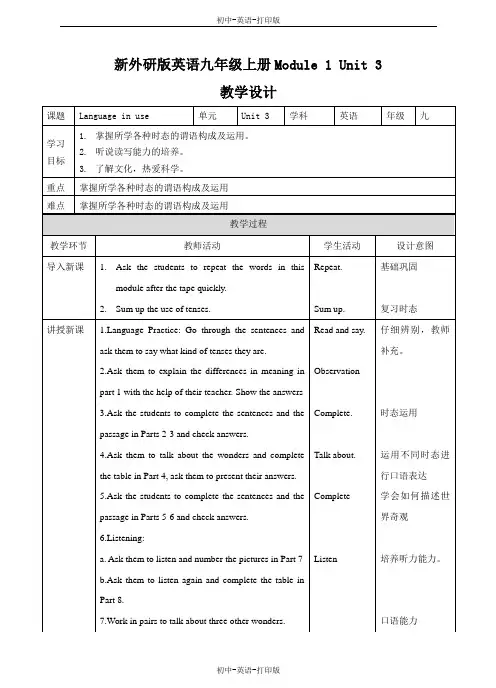
5.Ask thestudentsto complete the sentences and the passage in Parts 5-6 and check answers.
6.Listening:
a. Ask them to listen and number the pictures in Part 7
b.Ask them to listen again and complete the table in Part 8.
7.Work in pairs to talk about three other wonders.
口语能力
自主合作,提高创新能力。
课后巩固
补充材料
课堂小结
时态
板书
1. Unit 3 Language in use.
2. Tenses.
3. Posters.
8.Around the world
9.Module task: Making a poster about a wonder of the world. and present it in class.
10.Homework:
a.Make a poster about a wonder of the world.
b.Preview Module 2.
c.More exercises about tenses.
Read and say.
Observation
Complete.
外研版九年级英语上册Module 1 Unit 3教案
Unit 3Language in use【教学目标】【教学思路】本单元的教学内容是第一模块中的第三单元||。
首先||,为了激发学生的积极性和提高学生综合运用语言的能力||,让学生以小组的形式复习六种时态的用法及句型||。
然后||,利用多媒体和对话等多种形式||,引导学生积极参与课堂活动||。
最后||,让学生运用本模块所学的重要词汇的正确形式补全句子||。
【教学准备】黑板||,录音机||,多媒体||,教学图片||,巩固练习的幻灯片等等||。
【教学过程】Step 1 Warming up & Leading in1.师生问候||。
2.利用图片或多媒体||,分小组展示并复习六种时态的句型及用法||。
利用多媒体呈现含有六种时态的句子||,让学生翻译||。
(1)I visited the Giant's Causeway two years ago.(2)It produces electricity for millions of people in China.(3)I've never seen it||,so I'm not sure I agree with you.(4)I looked into the east—the sky was becoming grey.(5)You'll get there in five minutes.(6)Am I going the right way?活动小结:通过图片||,形象地区分六种时态的句型及用法||,激发学生的学习兴趣||。
Step 2 Presentation & Practice1.Language practice(1—3)(1)教师让学生看活动l中的第一组句子||,让学生说说两个句子的不同||。
a.I often play basketball.(一般现在时)b.I am playing basketball now.(现在进行时)一般现在时:表示通常性、规律性、习惯性的状态或者动作(有时间规律发生的事件)的一种状态||。
新外研版九级英语上册Module 1 Unit 3课件
4. I looked to the east-the sky was
becoming grey.
5. You’ll get there in five minutes. 6. Am I going the right way?
到目前为止,我们已经学过了英语 中常用的时态,包括一般现在时、一般 过去时、现在进行时、过去进行时、一 般将来时和现在完成时。在本模块中, 我们将对这些时态的用法进行总结。 首先,我们将本模块中出现的有代表性 的句子归纳如下:
1. 一般现在时 一般现在时可以用来表述或说明某 一事物的特性,如上面表格的(1);描述 现在的状态,如(2)。一般现在时还用来 描述经常发生的事情及真理,例如: Thousands of people visit Beijing every year. The sun rises in the east and sets in the west.
注意: have been to 曾去过某地, 表示一种经历 have gone to 到某地去了 e.g. My father has been to Shanghai twice. 我父亲去过两次上海。 Mr Wang isn’t here. He has gone to Dalian. 王先生不在这儿, 他去大连了。
Victoria Falls in Africa are ever more fantastic. They’re about 1,700 metres wide and 100 metres high.
the Terracotta Army
The Terracotta Army is more than 2,000 years old.
从对话中可以看出,当谈话重心在过去 的时间、地点或人物,而不是事件的结 果或影响时,要用一般过去时。反之, 如果我们要强调的是过去的事情对现在 的影响,则应该用现在完成时。 现在完成时还表示某个状态从过去 某个时间开始,一直持续到现在。例如: I have lived here for a long time. I have been ill for a week.
Module 1 Unit 3(课件) -九年级英语上册(外研版)
I / We shall not (shan’t) + do...
一般将来时 Is he / she / it + going to I am not (I’m not) going to
+ do …?
+ do …
We / You / They + are not
(aren’t) going to + do…
表示去了长城,现在还没回来; 不在说话现场。
2. (a) She has gone to the Great Wall. (b) She has been to the Great Wall.
表示去过长城,是一种经历。
表示过去的动作或状态
3. (a) They had an English class yesterday. (b) They were having an English class
The sun was going down when we (1) ___a_r_r_iv_e_d__ (arrive) at the ground floor of the building. I(2)___w__a_s___(be) afraid of going to the top of tall buildings, so I was a little nervous when I (3) __w_a_s_w__a_it_i_n_g___(walk) into the lift. The lift (4)___c_l_im__b_e_d___ (climb) faster and faster until we (5) __r_e_a_c_h_e_d__ (reach) the 88th floor. It(6) ___i_s____ (be) high up there, but I was not afraid when I stood at the top.
最新外研版九年级英语上册最新课件M11U3
His father is the person who will be
most unhappy.
Attributive Clause
引导词在从句中作主语
由此,我们可以看出: who引导的定语从句修饰的先行词是 人,可以作主语,也可以作宾语。
Do you know Mr Zhang who they like very much?
5. The children are very healthy. She is looking after the children.
__T_h_e_c_h_i_ld__re_n__(_th_a_t__/ _w_h_o_)_s_h_e__is_l_o_o_k_i_n_g_a_fter __a_re__v_e_r_y_h_e_a_l_th_y_._____________________ 6. He lives in an old house. The old house
3.It successfully shows the rich culture which makes Beijing so famous.
4.A group of photos which show Beijing and Cambridge in England has won the prize for the subject Home and Away.
Weight
inch - in foot - ft yard - yd
millimetre -mm
yard - yd mile - mi metre - m
pound -lb kilogram - kg
centimetre - cm kilometre - km
外研版九级英语上册M11 U3课件
Thinking1
1.We need photos ___________ show daily life at school.2.Your photos should record interesting things ___________ happen at school, inside the classroom or outside.3.The photos __________ you take should be active, beautiful and true.4.The photos ___________ you send should include some words about them.
Then talk about the people in the photos.The girl who...Now ask questions about the photos and write down your answers.
The girl who wears blue jeans is comforting her unhappy friend.
总结5.主句以who 或which 提问。
Exercise5:Who is the girl ____ has black long hair? Which is the pen _____ you bought?A. which B. that C. what D. who
Thingking3?当先行词是物时,所有的which 和that 都可互换吗?
A:--Which photo do you like best?B:--The one that the two girls are laughing.
外研版英语九年级上册 Module 11 Unit 3 Language in use.(共27张PPT)
Talk about the photos.
I like the photo which … I don’t like the photo which … The photo which … is …
which 引导的定语从句 which引导的定语从句修饰的是无生命 物体, which在从句中可以作主语, 也可 以作宾语。
只能用which的情况: a. 关系代词前有介词。 e.g. This is the house in which we lived
last year.
b. 先行词本身是that。 e.g. The clock is that which I bought yesterday.
在上一模块中,我们学习了由that引导的定 语从句。本模块我们学习由which和who引导 的定语从句。从上面的例句中,我们可以发 现which和who引导的定语从句的区别体现在 先行词上。which引导的定语从句的先行词是 photo和photos,是没有生命的物体;who引 导的定语从句先行词是boy和everyone,均指 人。来看看它们具体区别。
以上两句中的引导词 who 和 that 在从句 中作主语, 不能省略。 此外, 需要注意的是, 虽然在定语从句中作 宾语的引导词在口语中往往被省略, 但在 正式文体中则常常被保留。
Complete the poster for the photo competition. Use that, which or who. There may be more than one answer.