
外研版高一必修一Module3My First Ride on a Train
ship
ferry
submarine
travel on water.
yacht
plane aircraft
helicopter
travel in the air.
rocket ship/plane
Which kind of vehicle can you use to travel a long distance?
Desert
4. What Australian animals do you know about?
Kangaroo koala bear duck-billed platypus dingo
New work to the passage
Try to find out the main idea(段落大意) of each paragraph.
Do the Exercise One on Page 22 in <培优学案>
1.What's the main information of the author?
2.What did the author think of the ride? 3.Where did the author want to go and how long is the journey? 4.How long did the ride take?
5.Did the author find any diamond during the journey?
watched One night, at about midnight, I __________ the night sky for about an shone The stars diamonds hour. ________ like __________.
Module 3 My First Ride on a Train
Words Revision
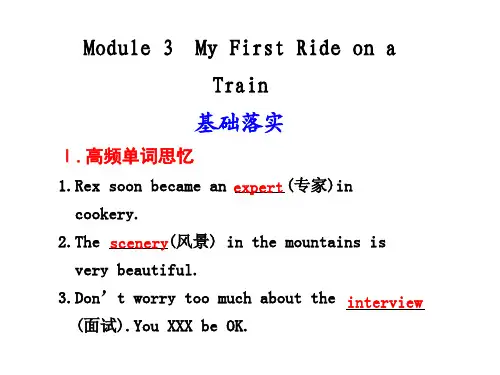
distance n.距离 _________ distant 1.________ adj.遥远的 expert 2.________ n.专家 scenery journey n.旅程 3.________ n.风景 ________ soil n.土壤 4._____ ________ n.沙漠 desert abandoned abandon 5.____________ adj.被遗弃的 _________v. 遗弃 product produce v.生产 6.________ n. 产品 ________ production n.生产 __________ 7.________ v.射杀 _______ (过去式、过去分词) shoot shot 8._______ v.训练 _______ train trained adj.受过训练的
Camels
Railway
Share your experience of a long distance travel
When: Where:
With whom:
How did you go there: What did you do and see:
What’s your feeling:
Today, you'll have a trip to Austrilia with your friends. How will you get there, by air, by sea or by land? Why?
Answer these questions:
组卷网
1. Do you know the name of the capital city?
The means of transport
bus
taxi
motorbike
bicycle
electric bike
tricycle
tram
are vehicles(交通工具) that travel self-balancing unicycle on roads.
subway underground rails travel on _______.
My first ride
• Role
• Ride •A B
Name, place and age What does the author think of her ride?
Start point, end point and distance How long did they spend?
D.How I spent the time on the train
E.The fate(命运) of the camels nowadays F.I had my first ride on a long distance train
Divide the passage into several parts
Fast Reading
Para 1: Para 2: Para 3: Para 4: Para 5: Para 6:
• • • • • •
A.The scenery along the railway B.Why is the train called Ghan? C.Things about the camels
Start point, end point and distance How long did they spend?
• Time
Description on the train
• Food
Scenery • Some • other
experience
How about the food? At first After that Suddenly
• Time
1.How about the food on the train? The train was comfortable _________ and the people nice sat and were ____. During the day, I ____ 2.What did the author see at first? looked out of the window, and sometimes ___________ 3.Howto is other the weather in the desert area? _______ passengers. I __________ talked read books Andlistened how about the scenery? to Chinese cassettes and ____________my _______________ did the author do during the day? am studying (I4.What ____________ at school).
During the day At about midnight
Development of transport ways
• Ghan
The origin of the way The horses 150, introduction of camels Advantage of camels What did the camels do? The 1920s New railway camels In 1925 camels In 1935
Paragraph 1
Paragraph 2
My first ride
Fast Reading
Paragraph 3
Paragraph 4 Paragraph 5 Paragraph 6
Description on the train
the origin of Ghan train
Development of transport ways
Description on the train
• Food
Scenery • Some • other
experience
How about the food? At first After that Suddenly
During the day At about midnight
1.Why did the Austrilian take horses to travel a long distance? Did they work well? 2.How did they solve the problem?
Canberra
2. Where do ቤተ መጻሕፍቲ ባይዱou think most of the people live, in the central part of the country or on the coast?
On the east coast and the southeast coast
3. What do you think the central part of the country is like?
Camels
Railway
Try to retell the passage with the help of the outline
My first ride
• Role
• Ride •A B
Name, place and age What does the author think of her ride?
3.What did the man use camels to do? 4.How about the ending of the camels from Afganistan?
Development of transport ways
• Ghan
外研版必修1Module3MyFirstRideonaTrain---reading课件
['kænbərə]
• Canberra(堪培拉) ,the capital city of Australia, is on the east coast.
• Sydney is famous for the Sydney Opera House and it also lies on the east coast.
2. Was her destination on the coast of Australia?
No, it was Alice Springs in the center of Australia.
3. Was the scenery the same during the whole journey? No, at first there were fields, then it was desert.
What’s the passage about? A. a train to Sydney B. taking the train to Australia C. travelling to the central part of
Australia D. a child visiting her grandmother
How many parts can we divide the passage into? What is each about?
Paragraph 1 Paragraph 2 Paragraph 3
I. Alice’s journey on the train. II. Alice’s experience and feeling.
cruise
外研版高中英语必修一Module3Three My First Ride on a train教案
Module Three My First Ride on a trainPeriod 4Teaching Content: VocabularyReading and SpeakingGrammar 2Step 1 VocabularyRead the places and activities. Can you remember the first experience of them? Places: cinema circus kindergarten park playgroundseaside sports stadium swimming pool theatre zooActivities: learning to ride a bicycle, seeing a wild animal, seeing a film, learning to draw, reading comic books, swimming, playing sports for the first time, meeting your best friendStep 2 Reading and speakinga. Lead-inDo you remember your first visit to the zoo?Did you see wild animals?What wild animals did you see?Brainstorming: ask Ss to say something about their childhood.b. Read the passage individually and then decide which are happy and which are unhappy.c. PracticeTell the others about the first time they did one of the activities.Put the Ss into groups to talk about their first experiences.Step 3 Past tense time expressionsa. Find the following time expressions that appear in “My First Ride on a Train.”Recently… A ling time ago…During the day… A hundred and fifty years agoOne night… Until the 1920sAt (about) midnight In 1925Which of them can refer to past or present actions?b. Recently: Alice went on her first long-distance train ride.During the day: She sat and looked out of the window.One night at about midnight: She watched the night sky for an hour.A long time ago: Australians needed a way to travel to the middle of the country.A hundred and fifty years ago: They bought some camels from Afghanistan.Until the 1920s: The camels carried food and other supplies across the street. In 1925: The government passed a law allowing people to shoot camels if they became a problem.c. Ask students to write down two sentences for during the day and at midnight. During the day:_______________________________At midnight:_________________________________d. Practice1. I first met Tom ten years ago. He _______in a radio factory at that time.A. had workedB. has workedC. was workingD. has been working2. His father gave up smoking for only 3days, but then ______ to his old ways.A. returnedB. returnsC. had returnedD. has returned3. I used to drink a lot of tea but thesedays I _______ coffee.A. preferB. preferredC. had preferredD. am preferringSuggested answers: C A AHomework:Write your description of a trip. Use the past tense and include some expressions, such as “On the first day…”, “After lunch…”, etc.。
外研版高中英语必修一Module3 My First Ride on a Train知识点精讲及练习(含答案)
外研版高中英语必修一Module3 My First Ride on a Train知识点精讲及练习【重点单词短语】match + A + to/with + B 把…和…搭配起来/调和起来e.g. match practice to theory 理论与实践相结合match one’s actions to one’s words【归纳拓展】match+ n. + in/ for + n. 在…与…匹敌,成为…的对手e.g. No one can match her in knowledge of classical music.match+ n. + against/ with+ n. 使…(和…)交手/比赛e.g. He matched his shooting skill against the expert’s.match+ n. 或 match + adv. (和…)调和、适合、与…相配e.g. Her clothes don’t match her age.Her fingerprints ________ (match) those _________ (find) at the scene of the crime.As a couple they are not very well _________ (match).辨析 match / suit/ fitMatch多指大小、色调、形状、性质等方面的搭配;suit多指合乎需要、口味、性格、条件、地位等;fit 多指尺寸、形状合适,引申为“吻合”“协调”。
That doesn’t match your temperament.No dish suits all tastes.My new evening dress fits me quite well.2. distance n.距离,远方,远处The faces of four famous American presidents on Mount Rushmore(拉什莫尔山)can be seen from a ____ of 60 miles.A. lengthB. distanceC. wayD. space【归纳拓展】in the distance 在远处;在远方at a distance 在稍远处keep one’s distance from 与…保持一定距离keep sb. at a distance 与…保持距离;不予某人接近distant adj. 远的;疏远的;稀疏的;冷淡的be distant towards sb. 对...冷淡be distant from 离… 远3.means n.方式,手段(单复数同形)e.g.There is no doubt that radio and television are important means of communication.There is no means of finding out what happened.【归纳拓展】1. by means of sth. 用…的办法e.g. The government helped the victims of the earthquake by every means.He climbed up the tree by means of a ladder.2.by no means 绝不,一点也不(置于句首时须倒装)e.g.By no means is this fight the end of out friendship.【及时训练】1.Every possible means ______ been tried, and we find only ______ this means can we do it we.A. have; inB. have; byC. has; inD. has; by2.For him ______ stage is just ______ means of making a living.A. a aB. the aC. the; theD. a; the4. refer to 提到,涉及;说起;参考,查阅;指的是 (referred, referred, referring)e.g We agreed never to refer to the matter again.我们一致同意再也不提这件事。
外研版高一英语课文翻译Module3,book1,MyFirstRideonaTrain(带要点)
Module 3 My First Ride on a TrainMy name is Alice Thompson. I come from Sydney Australia and I'm 18 years old.Recently I had my first ride on a long-distance train.And what a ride.The train was wonderful and the food was great.We ate great meals c ooked by experts.For the first few hundred kilometers of the journey, the scenery was very colourful.There were fields and the soil was dark red.After that, it was desert.The sun shone, there was no wind and there were no clouds in the sky.Suddenly, it looked like a place from another time.We saw abandoned farms which were built more than a hundred years ago.The train was comfortable and the people were nice.During the day, I sat and looked out of the window, and sometimes talked to other passengers.I read books and listened to my Chinese cassettes.One night, at about midnight, I watched the night sky for about an hour.The stars shone like diamonds.Why is the train called the Ghan?A long time ago, Australians needed a way to travel to the middle of the country.They tried riding horses, but the horses didn't like the hot weather and sand.A hundred and fifty years ago, they brought some camels from Afghanistan.Ghan is short for Afghanistan.Camels were much better than horses for travelling a long distance.For many years, trained camels carried food and other supplies, and returned with wool and other products. The Afghans and their camels did this until the 1920s.Then the government built a new railway line, so they didn't need the camels any more.In 1925, they passed a law which allowed people to shoot the animals if they were a problem.In 1935, the police in a town shot 153 camels in one day.我的首次火车之旅我是爱丽丝·汤普森。
1外研社高一英语必修一Module 3 My First Ride on a train教案

外研社高一英语必修一Module 3 My First Ride on a train Topic:My First Ride on a trainType:Reading1.Analysis of teaching material1.1.Status and functionsThe topic of this module is My First Ride on a Train,which can easily draw students’ attention and help them revise t he transport.The grammar point is the Past Tense that can be used when students describe their experiences.Therefore,this module is important,and it can help students talk about their trip they made to a tourist spot or other life experiences.2.Analysis of students2.1.Senior one students have learned the Past Tense before.2.2.They are able to talk about some simple topics and are curious about the foreigncountry.2.3.They can induce some language points themselves2.4.They are supposed to improve their reading skills.3.Teaching objectives3.1.After the lesson,students are able to understand these words on Page 22.3.2.Students can talk about their trip experiences using Past Tense3.3.Students are capable of talking about the general information aboutAustralia,and realizing the diversity of scenery and culture in different countries.4.Teaching methodsTask-based Language TeachingSituational Teaching Method5.Teaching key points and difficulties5.1.Key points5.1.1.The words on page 225.1.2.The usage of Past Tense5.1.3.Practice of reading skills5.1.4.How to talk about trip experience5.2.Difficulties5.2.1.Practice of reading skills5.2.2.How to talk about trip experience6.Teaching aidsMultimedia Blackboard7.Teaching progress7.1.Leading-inUse three questions which are related to students’ real trip experience to arous e students’ interest:Where did you go before?How did you get there?Did you enjoy it and why?T: Good morning, everyone.Today’s topic is travel,do you like it?S: Yes!We like it.T: So,boys and girls, have you ever been to someplace?Would you like to share something with us?Who wants to be the first one?Put up your hands,please.T: Yang Qing,please.Where did you go before?How did you get there?Did you enjoy it and why?S:……T:Wonderful experience,thank you!Now,please look at the sc reen,let’s revise these transportation words together,ok? First of all,tell me what’s this?S: 渡轮。
外研版必修一Module3MyFirstRideonaTrain知识点课件
视察思考 Everything was getting on very well. 一切进展非常顺利。 How are you getting on with your English? 你的英语学得怎么样? He is not an easy man to get on with. 他不好相处。 The workers couldn’t get on for lack of materials. 由于缺乏材料,工人们无法进行下去。
活学活用
The faces of the famous American Presidents
on Mount Rushmore can be seen from a B of
60 miles.
A.length
B.distance
C.way
D.space
解析 from a distance of 60 miles从60英里的
归纳拓展 frightened adj.畏惧的 frightening adj.令人畏惧的;令人恐惧的 frighten sb. into doing sth.吓唬某人做某事 frighten sb. out of doing sth.吓唬某人不做 某事 be frightened of...对……畏惧 be frightened to do sth.做……而畏惧
scenery.
我们不时地停下来欣赏美景。
The road passes through the most charming
scenery.
这条大路穿过迷人的风景区。
易混辨异 scenery/view/scene/sight/landscape (1)scenery是不可数名词,指某地总的自然风景 或风景。 (2)view是可数名词,指从远处或高处看到的景观 或景物。 (3)scene是可数名词,常指自然风景,一般是 scenery的一部分;还可指舞台的场景。 (4)sight指“风景、情景、奇迹”讲时为可数名 词;sights表示“风景,名胜”的含义。 (5)landscape是不可数名词,指某一地区内见到 的由丘陵、山谷、原野等构成的风景。
高中英语外研版必修一module3myfirstrideonatrain教案
Module 3 My First Ride on a TrainI. 教学内容分析本模块以My First Ride on a Train为话题,通过在作者的澳大利亚之行来介绍其独特景色。
通过模块教学,使学生学会用正确的时态和短语来描述自己的旅游体验,并掌握有关交通工具和各种地点及活动的词汇。
要求学生学会如何在日常生活中正确使用礼貌用语以及如何在会话中做出回应、表明态度。
Introduction 部分复习和学习有关日常交通工具的名词和相关搭配的动词,通过激活学生有关旅游经历的图式,引出本模块的话题。
Reading and Vocabulary 部分是本模块的主要内容,介绍了作者第一次在澳大利亚乘火车旅游的经历,详细描写了旅途中的活动和途中的风景,并介绍了Ghan train的由来。
通过学习生词以及短文,训练学生的微观阅读技能。
Grammar 包括两个部分,第一部分是动词的-ed形式做形容词充当定语及定语的成分;第二部分是回忆、熟悉和运用过去时间的表达法。
Function 练习让学生学会在不同场合要注意语言使用的得体性。
Vocabulary列举了各类活动场所和其相关联的词汇。
以此来激活学生的记忆图式为后续活动热身。
Reading and Speaking 部分是五篇有关童年回忆的段落,叙述在童年第一次印象深刻的故事,让学生了解叙事的基本要素,通过阅读为后面的话题写作提供了素材。
Writing部分要求学生用第一人称写一篇有关自己印象深刻的经历的短文,训练学生记忆、整理和归纳等逻辑思维能力,并学会如何做好笔记。
Everyday English 部分训练学生运用语言交际的技能,并要求学生掌握表达强烈情感态度的交际用语。
Cultural Corner部分是一篇关于上海磁悬浮列车干线的文章,让学生知道这种列车是世界上速度最快的,并体会这种车的优点,从而培养学生的民族自豪感。
Task部分要求学生利用已有的旅游纪念品和资料等,向同伴介绍一个风景名胜点。
外研版英语必修一Module3MyFirstRideonaTrainLanguagepoints课件
hands up. c
a. 射门 b. 拍摄 c. 射击 d. 射杀 3) He shot from the XXX of the field and
It is not rare in ___ that people in ___
sixties are going to university for
further education.
A. 90s; the
B. the 90’s; /
C. 90’s; their
D. the 90s; their
during the day 在白天, 在白天期间 look out of 从……往外看
6. On night, at about midnight, I watched
the night sky for about on hour.
at midnight 在半夜
注意at的用法:
at noon at night at midnight
9. Then the government built a new railway line, so they didn’t need the camels any more. not …any more 不再…… 相当于not ... any longer 表示某一动作或状态从某个时刻开始不 再继续,any more通常位于句末。
用any more / any longer, no more 或no longer完成下列句子。 1) He still smoked, but he drank
外研版高中英语必修1《Module 3 My First Ride on a Train》word教案
Teaching PlanⅠ.Teaching content: Reading and V ocabular y—My First Ride on aTrain of Module3,Book1Ⅱ.Teaching objectives:1.Knowledge and Skills1)Train the student’s speaking skills.2)Develop the students’ reading ability.2.Process and Strategies1)Discussion to help the students prepare for reading.2)Scanning and careful reading to help the studentsunderstand the passage better.3.Emotion and ValuesTry to arouse the student’s cooperation awareness in their study by group work.Ⅲ.Teaching important points1.Help the students to organize group discussion.2.Help the students make sense of the whole passage.3.Help the students to improve their reading ability.Ⅳ.Teaching difficult points1.Lead students to talking in class actively.2.How to apply the teaching method effectively.Ⅴ.Teaching aidsthe multimediaⅥ.Teaching stepsStep1 Lead-inShow the students some pictures and introduce AustraliaStep2 Pre-reading1.Background knowledge of AustraliaFirst ask the students to talk about the questions below by working in groups. Then choose several students to describe Australia according to their discussion results.1) Do you know how many people live there?2) Do you know the name of the capital city?3) Where do you think most of the people live, in the central partor on the coast?4) What do you think the central part of the country is like?5) What Australia animals do you know about?Suggested answers:1) About 20 million2) Canberra3) On the coast4) Desert5) Koala bear; kangaroo2. V ocabulary1) First let the students read the new words. Teachers may helpclear the difficulties they meet in their pronunciation.Cassette diamonds camels desert abandoned clouds distance colourful experts law farm field food meal sand soil midnight shine shoot famous supply products recently government scenery weather passengers2) Then the students are required to finish the followingspelling exercise.Suggested answers:Step3 While-reading1. ScanningAsk the students read the passage quickly and try to find out appropriate information to fill in the two forms below:2.Careful readingAsk the students to read the passage carefully and answer the questions.Suggested answers:Step4 Home work1. Do more reading about the reading passage to get clearer and further understanding .2. Retell the passage in your own words.3. Find the new words and expressions which you are not familiar with after class.。
外研版必修1Module3MyFirstRideonaTrainGrammar课件
a car used 一辆用过的车
2. 过去分词短语作定语通常后置,其作 用相当于定语从句。如: the color TV set produced last year =the color TV set that were produced last year 去年生产的彩色电视机 a letter written to me by my daughter =a letter that was written to me by my daughter 一封我女儿写给我的信
外研版 高一 (1) Module 3
Book I Module 3 My First Ride on a Train
Grammar
Grammar I
The –ed form used as attributives -ed分词既可以作前置定语,也可以作后 置定语。 1. 单个的过去分词作定语 1) 作前置定语:这时过去分词的形容
3. 要注意过去分词做定语时动作产生 的时间:
1) 产生在谓语动词的动作之前。如: Is this the book written (that was written) by Henry James? 这是亨利•詹姆斯写的书吗?
2) 表示与句中谓语动词相应的经常性的 动作。如: He was then a professor respected (that was respected) by all the teachers and students of the college. 当时他是一个受这所大学里全体师生 尊敬的教授。