
新人教版七年级英语下册Unit 4 第四课时Section B 1a-1d精品课件
三、根据句意及首字母或汉语提示写单词。(5×3 分=15 分) out 11.—Can I go o________ this evening,Mom? —No,you can't. practice (练习) the violin in the evening. 12.I often ________ 13.My sister can't wash the d____. 14.We always sing an English song ________ before (在……之前) our English class. 15.The library is always ________ quiet (安静的).
四、单项选择。(5×3 分=15 分) 16.—Look!There are so many people in the park. B —Nobody likes to stay at home ________ Sunday morning. A.in B.on C.at D.to 17.I often ________ TV ________ the evening. C A.see;at B.see;in C.watch;in D.watch;at A 18.We ________ see friends or go out on school days. A.can't B.have to C.must D.has to 19.Wang Lan usually helps her mother ________ the dishes. C A.doing B.does C.do D.do not C 20.—What do you often do ________ dinner? —I take a walk. A.in B.on C.after D.every
六、根据汉语意思完成句子,每空一词。(5×4 分=20 分) 26.斯科特在上学的晚上不能打电脑游戏。 on school nights . Scott can't play computer games ________ ________ ________ 27.午饭后你不得不做什么? What do you have to do ________ after ________ lunch ? 28.你能帮助你的妈妈打扫你的房间吗? clean ________ your room ? Can you help your mother ________ ________ 29.我哥哥每天早上都帮助妈妈做早饭。 make ________ breakfast every morning. My brother helps my mother ________ 30.保罗可以在星期六看望他的朋友们。 Paul can ________ his ________ see friends on Saturday.
二、用方框中所给词组的适当形式填空。(5×3 分=15 分) make breakfast,do the dishes,go out, practice the guitar,clean the room 6.My mother usually ____________ does the dishes after dinner in the kitchen. practices the guitar in the music club on weekends. 7.Julie ______________ 8.Bob,I want to ____________ to play basketball. go out cleans the room every day. 9.Dale is a tidy boy and he ____________ 10.What do you want to eat this morning?Let's ____________ make breakfast now.
五、按要求完成下列句子,每空一词。(5×4 分=20 分) 21.Nick has to practice the piano every day.(改为一般疑问句) ________ to practice the piano every day? Does Nick ________ have 22.Does your brother have to eat lunch at school?(做肯定回答) ________ ________ Yes ,________ he does . 23.Can he go out to see friends on school nights?(做否定回答) ________ ,________ ________ . No he can't 24.Tell me a story after dinner.(改为否定句) Don't ________ tell ________ me a story after dinner. 25.Maria gets to school early every day.(改为同义句) arrives ________ at Maria ________ school early every day.
2020-2021学年人教版英语七年级下册Unit4SectionB1a-1d教案
(一)导入新课(用时5分钟)
同学们,今天我们将要学习的是Unit 4 Section B 1a-1d,关于运动的话题。在开始之前,我想先问大家一个问题:“你们平时喜欢哪些运动?”这个问题与我们将要学习的内容密切相关。通过这个问题,我希望能够引起大家的兴趣和好奇心,让我们一同探索运动词汇和表达运动喜好的奥秘。
2.教学难点
-词汇记忆:对于部分学生来说,记忆并正确拼写运动类词汇可能存在困难。
-语法运用:一般现在时在不同主语下的谓语变化,尤其是第三人称单数形式的运用。
-听力理解:在1b部分,学生需要听懂并数出进行不同运动的人物数量,这对听力理解和即时反应能力是考验。
-交际表达:在1c部分,学生需要用所学词汇和句型进行问答练习,对于语言表达能力较弱的学生来说,这是一个难点。
2. 1b部分:听一听,数一数,学生听录音,数出进行不同运动的人物数量,锻炼听力技巧,同时复习一般现在时的用法。
3. 1c部分:学生两人一组,根据1a部分的词汇,用Do you like...?和How many people like...?进行问答练习,巩固一般疑问句的构成与回答。
4. 1d部分:学生听录音,根据所听内容完成表格,训练学生获取关键信息的能力,同时学习描述人们喜好的表达方式。
2020-2021学年人教版英语七年级下册Unit4 Section B 1a-1d教案
一、教学内容
2020-2021学年人教版英语七年级下册Unit 4 Section B 1a-1d,本节课将涵盖以下内容:
1. 1a部分:通过图片展示与运动相关的词汇,让学生结合图片学习并掌握单词skiing, boating, swimming, cycling, fishing, climbing。
人教七年级英语下册 Unit 4 Section B (1a~1d) 精品课件

Bye-bye!
Warming-up Pre-listening While-listening Post-listening Summary
Discuss and talk
1. What do you think of Dave’s family rules? 2. Why do we have so many rules at home?
watch TV
5. _____________
help his mom make breakfast
6. _____________
clean his room 7. _____________
on school nights every Saturday before dinner in the evening on school days after dinner after school every morning
Warming-up Pre-listening While-listening Post-listening Summary
Work in groups
CCTV 13 wants to make a documentary (纪录片) about family rules.
Suppose you are a reporter. Interview your group members about their family rules. The questions below can help you.
help his mom d make breakfast f clean his room
a
c
e
g
b
d
f
2020-2021学年人教版英语七年级下册Unit 4 Section B (1a-1d)课件
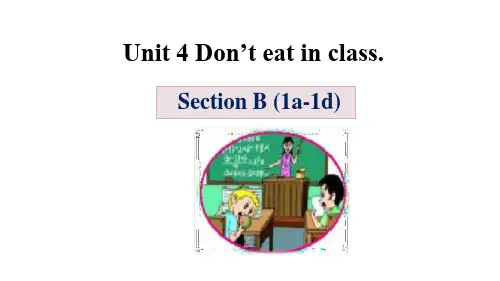
Section B (1a-1d)
Do you have family rules?
Don’t talk loudly.
Don’t watch TV late at night.
FAMILY RULES
Don’t eat in bed.
Clean the bedroom on Saturdays.
practice
表示“练习”,可用作及物或不及物动词。 如:The more you practice ,the better you get. 你练得越多,效果越好。
表示 “练习做某事”,其后只能接动名词(即用于 practise doing sth),不能接不定式。 如:Practice throwing the ball into the net. 练习投篮。 You must practice speaking English more. 你应更多地练习讲英语。
• can 可以(表示许可); 能够(表示能力), • can’t 不能够(表示没有能力); 不可以(表示不允许)
• must 必须 (表示强制性要求) • must 强调个人感受和观点
• have to, has to 不得不,必须 • have to, has to 强调外部环境的观点
on school nights every Saturday before dinner after school
on school days every morning after dinner in the evening
Talk about the rules in Dave’s house.
make the bed 铺床 make tea 泡茶 make rules 制定规则 make friends with 和…交朋友
人教版英语七年级下册Unit4Don'teatinclass.SectionB1a1d优秀教学案例
1.引导学生对所学知识进行总结,帮助他们巩固记忆,提高运用能力。
2.鼓励学生自我评价,培养他们的自我监控和自我调整能力。
3.对学生的学习过程和成果进行评价,给予及时反馈,提高他们的学习动力。
在教学过程中,我注重学生的反思与评价,通过总结和反馈,让学生在反思中成长。这样的教学策略有助于提高学生的学习效果,培养他们的自主学习能力。
(三)情感态度与价值观
1.培养学生遵守学校规则的良好习惯,使他们认识到在学校中遵守规定的重要性。
2.培养学生尊重他人、合作共事的良好品质,提高他们的人际交往能力。
3.激发学生学习英语的兴趣,让他们体验到学习英语的乐趣,建立自信心。
在教学过程中,我注重营造轻松愉快的学习氛围,让学生在愉悦的情感状态下学习。同时,我还通过鼓励、表扬等方式,激发学生的学习兴趣,帮助他们建立自信心。在课程结束后,我会对学生的表现进行总结和评价,鼓励他们继续努力,提高自己的英语水平。
在课程开始时,我通过一张图片引入话题,展示一位学生在课堂上吃东西的场景,激发学生的兴趣和好奇心。接着,我向学生提问:"你们认为在课堂上吃东西合适吗?为什么?"引导学生展开讨论,表达自己的观点。在讨论过程中,我引导学生用英语进行交流,锻炼他们的口语表达能力。
在呈现本节课的主要内容后,我组织学生进行小组活动,让他们根据学校的规定,创作一段对话。学生在小组合作过程中,不仅能够巩固所学知识,还能提高他们的团队合作能力。在活动结束后,我邀请部分学生上台展示他们的作品,并给予积极评价,提高他们的自信心。
4.总结归纳:在课程的最后,我引导学生对所学知识进行总结,帮助他们巩固记忆,提高运用能力。同时,我也强调了学校规则的重要性,培养学生的良好习惯。这种方式使得学生能更好地理解和掌握所学知识,为今后的学习打下坚实的基础。
Unit 4 第4课时(Section B 1a-1d) (课件)七年级英语下册(人教版)

1d Talk about the rules in Dave’s house.
He can’t go out on school nights.
He can’t watch TV in the evening.
1d Talk about the rules in Dave’s house.
He can’t see his friends on school days.
does his homework
Look and say
What does he often do?
practices the guitar
Look and say
What does he often do?
does the dishes
Look and say
What does he often do?
பைடு நூலகம்
every Saturday on school days every morning
before dinner after dinner
1c
Listen again. Write when Dave has to follow the rules in the chart in 1b. Choose from the phrases in the box.
Emily : Hi, Dave. Do you _w_a_n_t_t_o_w__a_tc_h__th_e__b_a_sk_e_t_b_a_ll_g_a_m__e_in the park this evening? Dave: I’d love to, but I can’ t go out_o_n_s_c_h_o_o_l_n_i_g_h_ts__. Emily: Oh, that’s too bad. Dave: Yeah, I have s_o__m_a_n_y__ru_l_e_s... Emily: Really? Dave: Yeah, I can’t __se_e__m_y__fr_i_e_n_d_s_o_n_s_c_h_o_o_l_d_a_y_s_and I have to do my homework after school.
新人教版英语七年级下册《Unit 4 Section B 1a-1d》课件
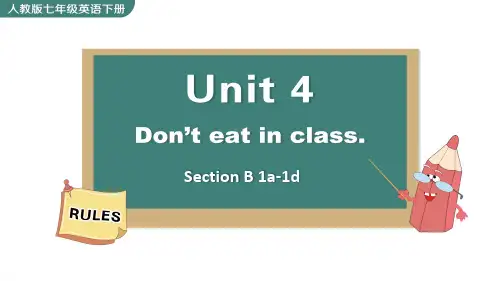
A: Can you …? B: Yes, I (we) can./No, I (we) can’t.
go out on school nights
A: Do you have to …? B: Yes, I (we) do./No, I (we) don’t.
do your homework after school
h
see friends
×
c
do his homework
√
e
practice the guitar
√
b
do the dishes
√
g
watch TV
×
d help his mom make breakfast
√
f
clean his room
√
Listen again. Write when Dave has to follow 1c the rules in the chart in 1b. Choose from the
Don’t fight.
Don’t arrive late for school.
Don’t eat in the classroom. You must eat in the dining hall.
Don’t run in the hallways.
Don’t listen to music in the classroom.
f
clean his room
√
before dinner
√
after dinner
in the evening
√
every morning
√
every Saturday
人教版英语七年级下册 Unit 4 第四课时 Section B (1a-1d)教案
Unit 4Don’t eat in class!The Fourth PeriodSection B (1a-1d)I.Teaching aims1.Key words:out,practice,dish,before2.Key phrases:go out,see friends,practice the guitar,do the dishes,on school nights3.Important sentences:—Can Dave go out on school nights?—No,he can’t.II.Important points:情态动词can,can’t和have to的用法III.Difficult points:情态动词can,can’t和have to的用法IV.Teaching processStep 1 Lead inDave is a student,he is a boy.At school,there are many school rules to follow.And at home there are also many rules.What are the rules at Dave’s home.Do you want to know?Let’s learn together and you will find the answer.Step 2 Work on 1a-1d1.先让学生仔细观察1a中的图片,指出这些制度,教师领读。
然后将1b中的短语和1a中的图片匹配,并核对答案。
2.听录音,标出Dave不能做的事情和他必须要做的事情,集体核对答案,完成1b。
3.记忆1c中的短语,然后听录音从1c中选出Dave遵守1b中这些规定的时间。
4.两人一组,仿照1d的对话形式练习对话,结合实际谈论自己的家规。
最后请学生做简短的报告。
Language points1.go outgo out意为“外出”,此处表示“参加社交活动;外出交际(或娱乐)”。
2020-2021学年人教版英语七年级下册Unit4第四课时SectionB(1a-1d)教案
今天的学习,我们了解了与动物相关的词汇和一般现在时的用法。通过实践活动和小组讨论,我们加深了对这些知识点的理解。我希望大家能够掌握这些知识点,并在日常生活中灵活运用。最后,如果有任何疑问或不明白的地方,请随时向我提问。
五、教学反思
在今天的教学过程中,我发现学生们对动物词汇的学习表现出浓厚的兴趣,他们积极参与到课堂讨论和角色扮演活动中。通过这些互动,学生们在实践中掌握了词汇和一般现在时的用法,这让我感到很欣慰。
然而,我也注意到在词汇记忆和语法运用方面,部分学生还存在一定的困难。特别是在第三人称单数动词变化规则方面,一些学生容易混淆。在今后的教学中,我需要更加关注这一点,设计更多的练习来帮助学生巩固这部分知识。
此外,小组讨论环节,学生们提出了很多有趣的观点,但在表达过程中,口语流利性和准确性还有待提高。我想在接下来的课程中,可以增加一些口语训练环节,如模仿对话、角色扮演等,让学生们有更多机会练习英语口语。
2020-2021学年人教版英语七年级下册Unit 4第四课时Section B (1a-1d)教案
一、教学内容
2020-2021学年人教版英语七年级下册Unit 4第四课时Section B (1a-1d)教案,主要包括以下内容:
1.词汇学习:巩固和拓展与动物相关的词汇,如hippo, elephant, tiger, panda, lion等。
-阅读理解的难点,教师可以通过设计问题或图表,帮助学生捕捉对话中的关键信息,如“Which animal is strong?”或“Which animal is gentle?”等,以提高学生的信息提取能力。
四、教学流程
(一)导入新课(用时5分钟)
同学们,今天我们将要学习的是Unit 4的Section B (1a-1d)。在开始之前,我想先问大家一个问题:“你们喜欢去动物园吗?有没有见过一些特别的动物?”这个问题与我们将要学习的内容密切相关。通过这个问题,我希望能够引起大家的兴趣和好奇心,让我们一同探索动物世界的奥秘。
人教版七年级下Unit4 Section B(1a-1d)课件
√
before dinner
√
after dinner
in the evening
help his mom make breakfast
clean his room
√
every morning
√
every Saturday
on school nights every Saturday before dinner in the evening
Section B(1a-1d)
Aims and language points:
Teaching aims (教学目标) 1. 学习谈论家规。 2. 学会使用时间状语。 3. 能熟练使用can,can’t和have to进行操练
。 4. 理解听力材料。
Language points (语言点) 1. 词汇:1)名词n. practice, dish 2) 副词adv. out, before 3) 短语 go out, do the dishes 2. 句型: Can Dave go out on school
Can’t (×)
×
×
×
Have to/ Must (√)
√ √ √
√ √
When on school nights
1c Listen again. Write when Dave has to follow the rules in the chart in 1b. Choose from the phrases in the box.
×
× ×
on school nights
on school days
√
after school
人教版七年级下英语说课稿《Unit4Period4SectionB(1a-1d)》
人教版七年级下英语说课稿《Unit 4 Period4 Section B (1a-1d)》一. 教材分析人教版初中英语七年级下册Unit 4 Period 4 Section B(1a-1d)主要讲述了关于日常生活中的询问时间、日期和天气的交际用语。
本节课的主要内容是让学生能够熟练运用一般现在时进行日常交流,并且能够正确回答关于时间、日期和天气的问题。
通过学习本节课,学生能够进一步提高他们的英语听、说、读、写的能力,为以后的学习打下坚实的基础。
二. 学情分析在进入七年级下册的学习之前,学生已经掌握了基本的英语语法知识和一些日常交际用语。
但是,对于一般现在时的运用和一些特殊疑问词的用法还不够熟练。
因此,在教学过程中,教师需要针对学生的实际情况进行针对性的指导,帮助学生更好地理解和运用所学知识。
三. 说教学目标1.知识目标:学生能够掌握一般现在时的基本结构和用法,能够正确地询问和回答关于时间、日期和天气的问题。
2.能力目标:学生能够熟练地运用一般现在时进行日常交流,提高他们的听、说、读、写的能力。
3.情感目标:通过学习本节课,学生能够增强对英语学习的兴趣,培养积极的学习态度。
四. 说教学重难点1.重点:学生能够掌握一般现在时的基本结构和用法,能够正确地询问和回答关于时间、日期和天气的问题。
2.难点:学生能够熟练地运用一般现在时进行日常交流,并且能够正确使用一些特殊疑问词。
五. 说教学方法与手段在本节课的教学过程中,我将采用任务型教学法和情境教学法。
通过设定一些实际的生活场景,让学生在真实的语境中学习和运用一般现在时。
同时,我还将运用多媒体教学手段,如图片、视频等,来帮助学生更好地理解和记忆所学知识。
六. 说教学过程1.导入:通过播放一段关于日常生活的视频,引导学生关注视频中的时间、日期和天气的描述,激发学生的学习兴趣。
2.呈现:向学生展示1a-1d的图片,让学生根据图片内容进行猜测和描述,引出一般现在时的基本结构。