
2018考研英语阅读历年真题练习
2018考研英语阅读历年真题练习英语真题一定要好好研究,对于阅读这个重头戏,要拿高分,真题更是要研究透了,下面是为大家整理的整体,其中规律在近5年里考得非常凶猛,希望大家多总结!英语一真题Text 1Of all the changes that have taken place in English-language newspapers during the past quarter-century, perhaps the most far-reaching has been the inexorable decline in the scope and seriousness of their arts coverage.It is difficult to the point of impossibility for the average reader under the age of forty to imagine a time when high-quality arts criticism could be found in most big-city newspapers. Yet a considerable number of the most significant collections of criticism published in the 20th century consistedin large part of newspaper reviews. To read such books today is to marvel at the fact that their learned contents were once deemed suitable for publication in general-circulation dailies.We are even farther removed from the unfocused newspaper reviews published in England between the turn of the 20th century and the eve of World War II, at a time when newsprint was dirt-cheap and stylish arts criticism was considered an ornament to the publications in which it appeared. In those far-off days, it was taken for granted that the critics of major papers wouldwrite in detail and at length about the events they covered. Theirs was a serious business, and even those reviewers who wore their learning lightly, like George Bernard Shaw and Ernest Newman, could be trusted to know what they were about. These men believed in journalism as a calling, and were proud to be published in the daily pre ss. “So few authors have brains enough orliterary gift enough to keep their own end up in journalism,” Newman wrote, “that I am tempted to define ‘journalism’ as ‘a term of contempt applied by writers who are not read to writers who are.’”Unfortunately, these critics are virtually forgotten. Neville Cardus, who wrote for the Manchester Guardian from 1917 until shortly before his death in 1975, is now known solely as a writer of essays on the game of cricket. During his lifetime, though, he was also one of England’s foremost classical-music critics, a stylist so widely admired that his Autobiography (1947) became abest-seller. He was knighted in 1967, the first music critic to be so honored. Yet only one of his books is now in print, and his vast body of writings on music is unknown save to specialists.Is there any chance that Cardus’s criticism will enjoy a revival? The prospect seems remote. Journalistic tastes had changed long before his death, and postmodern readers have little use for the richly upholstered Vicwardian prose in which he specialized. Moreover, the amateur tradition in music criticism has been in headlong retreat.21. It is indicated in Paragraphs 1 and 2 that[A] arts criticism has disappeared from big-city newspapers.[B] English-language newspapers used to carry more arts reviews.[C] high-quality newspapers retain a large body of readers.[D] young readers doubt the suitability of criticism on dailies.22. Newspaper reviews in England before World War II were characterized by[A] free themes. [B] casual style. [C] elaborate layout. [D] radical viewpoints.23. Which of the following would Shaw and Newman most probably agree on?[A] It is writers' duty to fulfill journalistic goals[B] It is contemptible for writers to be journalists.[C] Writers are likely to be tempted into journalism.[D] Not all writers are capable of journalistic writing.24. What can be learned about Cardus according to the last two paragraphs?[A] His music criticism may not appeal to readers today.[B] His reputation as a music critic has long been in dispute.[C] His style caters largely to modern specialists.[D] His writings fail to follow the amateur tradition.25. What would be the best title for the text?[A] Newspapers of the Good Old Days [B] The Lost Horizon in Newspapers[C] Mournful Decline of Journalism [D] Prominent Critics in Memory英语一真题Text 4Bankers have been blaming themselves for their troubles in public. Behind the scenes, they have been taking aim at someone else: the accountingstandard-setters. Their rules, moan the banks, have forced them to report enormous losses, and it's just not fair. These rules say they must value some assets at the price a third party would pay, not the price managers and regulators would like them to fetch.Unfortunately, banks' lobbying now seems to be working. The details may be unknowable, but the independence of standard-setters, essential to the proper functioning of capital markets, is being compromised. And, unless banks carry toxic assets at prices that attract buyers, reviving the banking system will be difficult.After a bruising encounter with Congress, America's Financial Accounting Standards Board (FASB) rushed through rule changes. These gave banks more freedom to use models to value illiquid assets and more flexibility in recognizing losses on long-term assets in their income statement. Bob Herz, the FASB's chairman, cried out against those who "question our motives." Yet bank shares rose and the changes enhance what one lobby group politely calls "the use of judgment by management."European ministers instantly demanded that the International Accounting Standards Board (IASB) do likewise. The IASB says it does not want to act without overall planning, but the pressure to fold when it completes it reconstruction of rules later this year is strong. Charlie McCreevy, a European commissioner, warned the IASB that it did "not live in a political vacuum" but "in the real word" and that Europe could yet develop different rules.It was banks that were on the wrong planet, with accounts that vastly overvalued assets. Today they argue that market prices overstate losses,because they largely reflect the temporary illiquidity of markets, not the likely extent of bad debts. The truth will not be known for years. But bank's shares trade below their book value, suggesting that investors are skeptical. And dead markets partly reflect the paralysis of banks which will not sell assets for fear of booking losses, yet are reluctant to buy all those supposed bargains.To get the system working again, losses must be recognized and dealt with. America's new plan to buy up toxic assets will not work unless banks mark assets to levels which buyers find attractive. Successful markets require independent and even combative standard-setters. The FASB and IASB have been exactly that, cleaning up rules on stock options and pensions, for example, against hostility from special interests. But by giving in to critics now they are inviting pressure to make more concessions.36. Bankers complained that they were forced to[A] follow unfavorable asset evaluation rules [B] collect payments from third parties[C] cooperate with the price managers [D] reevaluate some of their assets.37. According to the author , the rule changes of the FASB may result in[A] the diminishing role of management [B] the revival of the banking system[C] the banks' long-term asset losses [D] the weakening of its independence38. According to Paragraph 4, McCreevy objects to the IASB's attempt to[A] keep away from political influences. [B] evade the pressure from their peers.[C] act on their own in rule-setting. [D] take gradual measures in reform.39. The author thinks the banks were "on the wrong planet" in that they[A] misinterpreted market price indicators[B] exaggerated the real value of their assets[C] neglected the likely existence of bad debts.[D] denied booking losses in their sale of assets.40. The author's attitude towards standard-setters is one of[A] satisfaction. [B] skepticism. [C] objectiveness [D] sympathy英语一真题Text 4It’s no surprise that Jennifer Senior’s insightful, provocative magazine cover story, “I love My Children, I Hate My Life,” is arousing muc h chatter – nothing gets people talking like the suggestion that child rearing is anything less than a completely fulfilling, life-enriching experience. Rather than concluding that children make parents either happy or miserable, Senior suggests we need to redefine happiness: instead of thinking of it as something that can be measured by moment-to-moment joy, we should consider being happy as a past-tense condition. Even though the day-to-day experience of raising kids can be soul-crushingly hard, Senior wr ites that “the very things that in the moment dampen our moods can later be sources of intense gratification and delight.”The magazine cover showing an attractive mother holding a cute baby is hardly the only Madonna-and-child image on newsstands this week. There are also stories about newly adoptive – and newly single – mom Sandra Bullock, as well as the usual “Jennifer Aniston is pregnant” news. Practically every week features at least one celebrity mom, or mom-to-be, smiling on the newsstands.In a society that so persistently celebrates procreation, is it any wonder that admitting you regret having children is equivalent to admitting you support kitten-killing ? It doesn’t seem quite fair, then, to compare the regrets of parents to the regrets of the children. Unhappy parents rarely are provoked to wonder if they shouldn’t have had kids, but unhappy childless folks are bothered with the message that children are the single most important thing in the world: obviously their misery must be a direct result of the gaping baby-size holes in their lives.Of course, the image of parenthood that celebrity magazines like Us Weekly and People present is hugely unrealistic, especially when the parents are single mothers like Bullock. According to several studies concluding that parents are less happy than childless couples, single parents are the least happy of all. No shock there, considering how much work it is to raise a kid without a partner to lean on; yet to hear Sandra and Britney tell it, raising a kid on their “own” (read: with round-the-clock help) is a piece of cake.It’s hard to imagine that many people are dumb enough to want children just because Reese and Angelina make it look so glamorous: most adults understand that a baby is not a haircut. Bu t it’s interesting to wonder if the images we see every week of stress-free, happiness-enhancing parenthood aren’t in some small, subconscious way contributing to our own dissatisfactions with the actual experience, in the same way that a small part of us hoped getting “ the Rachel” might make us look just a little bit like Jennifer Aniston.36.Jennifer Senior suggests in her article that raising a child can bring[A]temporary delight[B]enjoyment in progress[C]happiness in retrospect[D]lasting reward37.We learn from Paragraph 2 that[A]celebrity moms are a permanent source for gossip.[B]single mothers with babies deserve greater attention.[C]news about pregnant celebrities is entertaining.[D]having children is highly valued by the public.38.It is suggested in Paragraph 3 that childless folks[A]are constantly exposed to criticism.[B]are largely ignored by the media.[C]fail to fulfill their social responsibilities.[D]are less likely to be satisfied with their life.39.According to Paragraph 4, the message conveyed by celebrity magazines is[A]soothing.[B]ambiguous.[C]compensatory.[D]misleading.40.Which of the following can be inferred from the last paragraph?[A]Having children contributes little to the glamour of celebrity moms.[B]Celebrity moms have influenced our attitude towards child rearing.[C]Having children intensifies our dissatisfaction with life.[D]We sometimes neglect the happiness from child rearing.。
18考研英语一真题阅读理解红绿蓝答案解析
18考研英语一真题阅读理解红绿蓝答案解析Among the annoying challenges facing the middleclass is one that will probably go unmentioned in the next presidentialcampaign: What happens when the robots come for their jobs?Don’t dismiss that possibility entirely. Abouthalf of U.S. jobs are at highrisk of being automated,according to a University of Oxford study, with the middle class disproportionately squeezed. Lower-incomejobs like gardening or day care don’t appeal to robots. But many middle-classoccupations—trucking, financial advice, software engineering—have aroused theirinterest, or soon will. The rich own the robots, so they will be fine.21. Who will be most threatened by automation?[A] Leading politicians.[B] Low-wage laborers.(与下划线句矛盾)[C] Robot owners.(与加粗矛盾)[D] Middle-class workers.This isn’t to be alarmist. Optimists point outthat technological upheaval has benefited workers in the past. The IndustrialRevolution didn’t go so well for Luddites whose jobs were displaced bymechanized looms, but it eventually raised living standards and created morejobs than it destroyed. Likewise, automation should eventually boostproductivity, stimulate demand by driving down prices, and free workers fromhard, boring work. But in themedium term, middle-class workers may need a lot of help adjusting.22 . Which of the following best represents theauthor’sview?[A] Worries about automation are in factgroundless.[B] Optimists’ opinions on new tech find littlesuppo rt.[C] Issues arising from automation need to be tackled.[D] Negative consequences of new tech can beavoided.The first step, as Erik Brynjolfsson and AndrewMcAfee argue in The Second Machine Age, should be rethinking education and jobtraining. Curriculums—fromgrammar school to college—shouldevolve to focus less onmemorizing facts and more on creativity and complexcommunication. Vocational schools should do a better job of fosteringproblem-solving skills and helping students work alongside robots. Onlineeducation can supplement the traditional kind. It could make extra training andinstruction affordable. Professionals trying to acquire new skills will be ableto do so without going into debt.23. Education in the age of automation should put more emphasis on _____.[A] creative potential[B] job-hunting skills[C] individual needs[D] cooperative spiritThe challenge of coping with automationunderlines the need for the U.S. to revive its fading business dynamism:Starting new companies must be made easier. In previous eras of drastictechnological change, entrepreneurs smoothed the transition by dreaming up waysto combine labor and machines. The best uses of 3D printers and virtual realityhaven’t been invented yet. The U.S. needs the new companies that will inventthem.Finally, because automation threatens to widenthe gap between capital income and labor income, taxes and the safety net willhave to be rethought. Taxeson low-wage labor need tobe cut, and wage subsidies such as the earned income tax credit should beexpanded: This would boost incomes, encourage work, reward companies for jobcreation, and reduceinequality.24. The author suggests that tax policies be aimed at _____.[A] encouraging the development of automation[B] increasing the return on capital investment[C] easing the hostility between rich and poor[D] preventing the income gap from wideningTechnology will improve society in ways big andsmall over the next few years, yet this will be little comfort to those who findtheir lives and careers upended by automation.Destroying the machines that are coming for ourjobs would be nuts. But policies to help workers adapt will be indispensable.The first step…The challenge of coping with automationunder…Finally, because automation threat…25. In this text, the author presents a problemwith _____.[A] opposing views on it[B] possible solutions to it[C] its alarming impacts[D] its major variationsText 2A new survey by Harvard University finds morethan two-thirds of young Americans disapprove of President Trump’s use ofTwitter. The implication is that Millennials prefer news from the White Houseto be filtered through other source, not a president’s social media platform.Most Americans rely on social media to checkdaily headlines. Yet as distrusthas risen toward all media, people may be starting to beef up their medialiteracy skills. Such a trend is badly needed. During the 2016 presidentialcampaign, nearly a quarter of web content shared by Twitter users in thepolitically critical state of Michigan was fake news, according to the University of Oxford.And a survey conducted by BuzzFeed News found 44 percent of Facebook users rarely or never trust newsfrom the media giant.26. According to the Paragraphs 1 and 2, many young Americans cast doubtson _____.[A] the justification of the news-filteringpractice[B] people’s preference for social mediaplatforms[C] the administrations’ ability to handleinformation[D] social media was a reliable source of newsMost Americans rely on social media to checkdaily headlines. Yet as distrust has risen toward all media, people may be starting to beef up their media literacyskills. Such a trend is badly needed. During the 2016 presidential campaign,nearly a quarter of web content shared by Twitter users in the politicallycritical state of Michigan was fake news, according to the University ofOxford. And a survey conducted by BuzzFeed News found 44 percent ofFacebookusers rarely or never trust news from the media giant.27. The phrase “beef up” (Line 2, Para. 2) i s closest in meaning to_____.[A] sharpen[B] define[C] boast[D] shareYoung people who are digital natives are indeedbecoming more skillful at separating fact from fiction in cyberspace. A Knight Foundation focus-group surveyof young people between age s 14 and 24 found they use “distributed trust” toverify stories. They cross-checksources and prefer news from different perspectives—especially those that are open about anybias. “Many young people assume a great deal of personal responsibility foreducating themselves and actively seeking out opposing viewpoints,” the surveyconcluded.28. According to the Knight Foundation survey, young people _____.[A] tend to voice their opinions in cyberspace[B] verify news by referring to diverse resources[C] have a strong sense of responsibility[D] like to exchange views on “distributedtrust”Such active research can have another effect. A2014 survey conducted in Australia, Britain, and the United States by theUniversity of Wisconsin-Madison found that young people’s reliance on socialmedia led to greater political engagement.Social media allows users to experience newsevents moreintimately and immediately while also permitting them to re-sharenews as a projection of their values and interests. This forces users to bemore conscious of their role in passing along information. A survey by Barna researchgroup found the top reasongiven by Americans for thefake news phenomenon is “readererror,” more so than made-up stories or factual mistakes in reporting.About a third say the problem of fake news lies in “misinterpretation or exaggeration of actualnews” via social media. In other words, the choice to share news on socialmedia may be the heart of the issue. “This indicates there is a real personalresponsibility in count eracting this problem,” says Roxanne Stone, editor inchief at Barna Group.29. The Barna survey found that a main cause for the fake news problem is _____.[A] readers’ outdated values[B] journalists’ biased reporting[C] readers’ misinterpretation[D] jo urnalists’ made-up storiesSo when young people are critical of anover-tweeting president, they reveal a mental discipline in thinking skills—andin their choices on when to share on social media.30. Which of the following would be the besttitle for the text?[A] A Risein Critical Skills for Sharing News Online[B] A Counteraction Against the Over-tweetingTrend[C] The Accumulation of Mutual Trust on SocialMedia[D] The Platforms for Projection of PersonalInterestsText 3Any fair-minded assessment of the dangers ofthe dealbetween Britain’s National Health Service (NHS) and DeepMind muststart by acknowledging that both sides mean well. DeepMind is one of theleading artificial intelligence (AI) companies in the world. The potential ofthis work applied to healthcare is very great, but it could also lead tofurther concentration of power in the tech giants. It is against thatbackground that the information commissioner, Elizabeth Denham, has issued herdamning verdict against the Royal Free hospital trust under the NHS, whichhanded over to DeepMind the records of 1.6 million patients in 2015 on thebasis of a vague agreementwhich took far too littleaccount of the patients’ rights and their expectations of privacy.31.What is true of the agreement between the NHS and DeepMind ?[A] It caused conflicts among tech giants.[B] It failed to pay due attention to patient’s rights.[C] It fell short of the latter’s expectations.[D] It put both sides into a dangeroussituation.DeepMind has almost apologized. The NHS trust has mended its ways. Further arrangements—andthere may be many—between the NHS and DeepMind will be carefully scrutinised to ensure that allnecessary permissions have been asked of patients and all unnecessary data hasbeen cleaned. There are lessons about informed patient consent to learn. Butprivacy is not the only angle in this case and not even the most important. MsDenham chose to concentrate the blame on the NHS trust, since under existinglaw it “controlled” the data and DeepMind merely “processed” i t. But thisdistinction misses the point that it is processing and aggregation, notthemere possession of bits, that gives the data value.32. The NHS trust responded to Denham’s verdict with _____.[A] empty promises[B] tough resistance[C] necessary adjustments[D] sincere apologiesDeepMind has almost apologized. The NHS trusthas mended its ways. Further arrangements—and there may be many—between the NHSand DeepMind will be carefully scrutinised to ensure that all necessarypermissions have been asked of patients and all unnecessary data has beencleaned. There are lessons about informed patient consent to learn. But privacyis not the only angle in this case and not even the most important. Ms Denhamchose to concentrate the blame on the NHS trust, since un der existing law it“controlled” the data and DeepMind merely “processed” it. But this distinctionmisses the point that it isprocessing and aggregation, not the mere possession of bits, that gives the data value.33.The author argues in Paragraph 2 that_____.[A] privacy protection must be secured at allcosts(无中生有)[B] leaking patients’ data is worse thanselling it(无中生有)[C] making profits from patients’ data isillegal(曲解原文)[D] the value of data comes from the processing of itThe great question is who should benefit fromthe analysis of all the data that our lives now generate. Privacy law builds onthe concept of damage to an individual from identifiable knowledge about them.That misses the way the surveillance economy works. The data of an individualthere gains its value only when it iscompared with the data of countlessmillions more.The use of privacy law to curb the tech giantsin this instance feels slightly maladapted. This practice does not address thereal worry. It is not enough to say that the algorithms DeepMind develops willbenefit patients and save lives. What matters is that they will belong to a private monopoly which developed them usingpublic resources. If software promises to save lives on the scale that drugsnow can, big data may be expected to behave as a big pharm has done. We arestill at the beginning of this revolution and small choices now may turn out tohave gigantic consequences later. A long struggle will be needed to avoid afuture of digital feudalism. Ms Denham’s report is a welcome start.34.According to the last paragraph, the real worry arising from this deal is_____.[A] the vicious rivalry among big pharmas[B] the ineffective enforcement of privacy law[C] the uncontrolled use of new software[D] the monopoly of big data by tech giantsThe use of privacy law to curb the tech giantsin this instance feels slightly maladapted. This practice does not address thereal worry. It is not enough to say that the algorithms DeepMind develops willbenefit patients and save lives. What matters is that they will belong to a privatemonopoly which developed them using public resources. If software promises tosave lives on the scale that drugs now can, big data may be expected to behaveas a big pharm has done. We are still at the beginning of this revolution andsmall choices now may turn out to have gigantic consequences later. A long struggle will be needed toavoid afuture of digital feudalism. Ms Denham’s report is a welcomestart.35.The author’s attitude toward the applicationof AI to healthcare is _____.[A] ambiguous[B] cautious[C] appreciative[D] contemptuousText 4The U.S. Postal Service (USPS) continues to bleed red ink. It reported a net loss of $5.6 billion for fiscal2016, the 10th straight year its expenses have exceeded revenue. Meanwhile, it has more than $120 billion in unfunded liabilities,mostly for employee health and retirement costs. There are many bankruptcies.Fundamentally, the USPS is in a historic squeeze between technological changethat has permanently decreased demand for its bread-and-butter product,first-class mail, and a regulatory structure that denies management the flexibility to adjust itsoperations to the new reality.36. The financial problem with the USPS is caused partly by _____.[A] its unbalanced budget[B] its rigid management[C] the cost for technical upgrading[D] the withdrawal of bank supportAnd interestgroups ranging from postal unionsto greeting-card makers exertself-interested pressureon the USPS’s ultimate overseer—Congress—insisting that whatever elsehappens to the Postal Service, aspects of the status quo theydepend on getprotected. This is why repeated attempts at reformlegislation have failed in recent years, leaving the Postal Serviceunable to pay its bills except by deferring vital modernization.37. According to Paragraph 2, the USPS fails to modernize itself due to _____.[A] the interference from interest groups[B] the inadequate funding from Congress[C] the shrinking demand for postal service[D] the incompetence of postal unionsNow comes word that everyoneinvolved—Democrats, Republicans, the Postal Service, the unions and the system’sheaviest users—has finally agreed on a plan to fix the system. Legislation ismoving through the House that would save USPS an estimated $28.6 billion overfive years, which could help pay for new vehicles, among other survivalmeasures. Most of the moneywould come from a penny-per-letter permanent rate increase and from shiftingpostal retirees into Medicare. The latter step would largely offset thefinancial burden of annually pre-funding retiree health care, thus addressing a long-standing complaint by the USPSand its union.38. The long-standing complaint by the USPS and its unions can be addressed by _____.[A] removing its burden of retiree health care.[B] making more investment in new vehicles.[C] adopting a new rate-increase mechanism.[D] attracting more first-class mail users.If it clears the House, this measure wouldstill have to getthrough the Senate—where someone is bound to point out thatit amounts to the bare, bare minimum necessary to keep the Postal Serviceafloat, not comprehensive reform. There’s no change to collective bargaining atthe USPS, a major omission considering that personnel accounts for 80 percentof the agency’s costs. Also missing is any discussion of eliminating Saturdayletter delivery. That common-sense change enjoys wide public support and wouldsave the USPS $2 billion per year. But postal special-interest groups seem tohave killed it, at least in the House. The emerging consensus around the billis a sign that legislatorsare getting frightenedabout a politically embarrassing short-term collapse at the USPS. It is not,however, a sign that they’re getting serious about transforming the postalsystem for the 21st century.39. In the last paragraph, the author seems toview legislators with_____.[A] respect[B] tolerance[C] discontent[D] gratitude40. Which of the following would be the besttitle for the text?[A] The USPS Starts to Miss Its Good Old Days[B] The Postal Service: Keep Away from MyCheese[C] The USPS: Chronic Illness Requires a QuickCure[D] The Postal Service Needs More than a Band-Aid。
2018年考研英语真题与答案解析
2018年研究生入学统一考试试题(英语二)Section I Use of EnglishDirections:Read the following text. Choose the best word (s) for each numbered blank and mark A, B, C or D on the ANSWER SHEET. (10 points)Why do people read negative Internet comments and do other things that will obviously be painful? Because humans have an inherent need to 1 uncertainty, according to a recent study in Psychological Science. The new research reveals that the need to know is so strong that people will 2 to satisfy their curiosity even when it is clear the answer will 3.In a series of four experiments, behavioral scientists at the University of Chicago and the Wisconsin School of Business tested students' willingness to 4 themselves to unpleasant stimuli in an effort to satisfy curiosity. For one 5 each participant was shown a pile of pens that the researcher claimed were from a previous experiment. The twist?Half of the pens would 6 an electric shock when clicked.Twenty-seven students were told which pens were electrified;another twenty-seven were told only that some were electrified 7 left alone in the room, the students who did not know which ones would shock them clicked more pens and incurred more shocks than the students who knew what would 8 .Subsequent experiments reproduced this effect with other stimuli, 9 the sound of fingern ails on a chalkboard and photographs of disgusting insects.The drive to 10 is deeply rooted in humans,much the same as the basic drives for 11 or shelter ,says Christopher Hsee of the University of Chicago. Curiosity is often considered a good instinct-it can 12 new scientific advances, for instance-but sometimes such 13 can backfire.The insight that curiosity can drive you to do 14 things is a profound one.Unhealthy curiosity is possible to 15 ,ho wever. In a final experiment,participants who were encouraged to 16 how they would feel after vie wing an unpleasant picture were less likely to 17 to see such an image.These results suggest that i magining the 18 of following through on one's curiosity ahead of time can help determine 19 it is worth the endeavor. Thinking about long-term 20 is key to reducing the possible negative effects o f curiosity."Hsee says.In other words,don't read online comments.1. A. resolve B. protect C. discuss D. ignore2.A. refuse B. wait C. seek D. regret3.A. rise B. last C. mislead D. hurt4.A. alert B. tie C. expose D .treat5.A. message B. trial C. review D. concept6.A. remove B. weaken C. deliver D. interrupt7. A. Unless B. If C. Though D. When8. A. happen B. continue C. disappear D. change9. A. rather than B. such as C. regardless of D. owing to10. A. disagree B. forgive C. forget D. discover11. A. pay B. marriage C. food D. schooling12.A. begin with B. rest on C. learn from D. lead to13.A. withdrawal B. inquiry C. persistence D. diligence14.A. self-destructive B. self-reliant C. self-evident D. self-deceptive15.A. resist B. define C. replace D. trace16.A. predict B. overlook C. design D. conceal17. A. remember B. choose C. promise D. pretend18. A. relief B. plan C. outcome D. duty19.A. whether B. why C. where D. how20. A .limitations B. investments C. strategies D. consequences1. A解析:句首作者提出疑问,“为什么人们会读互联网的负面评论和明显很让人伤心的其它事情呢?”随后作者给出答案,“因为人们都有___不确定性的内在需求”。
18年英语一阅读
18年英语一阅读2018年英语一阅读理解真题及答案Passage OneText 1The idea that some groups of people are more intelligent than others is one of those theories that dare not speak its name, perhaps in part because of a backlash against what the Nazis did to the Jews. This is a pity, because it is a fact.The notion that the average member of any group differs from the average member of any other group in many ways - as measures by IQ tests - is the linchpin of a lot of research in social science. Social scientists like to tell stories about the way the groups they study are similar and different. They want to explain what makes one group more successful than another in achieving particular outcomes.This has given rise to a very large literature, and intelligence is now seen as a key predictor of how individuals will perform in a range of activities, including which job they do and how well they do it, which career they choose, how they vote, and even how likely they are to get divorced or smoke.Intelligence is also seen as the major correlate of educational achievement, or lack thereof. If you have intelligence, you should do well in school. If you don't, you won't. This is the implicit message in the test scores that schools and colleges use to determine whether you are a genius or a moron, a potential Nobel Prize winner or a deadbeat.The trouble is that there is very little evidence that intelligence is undermined by lack of access to a good education or by inequality of schooling opportunities. It is well known that there is a powerful genetic component to intelligence: bright parents tend to have bright children. This means that any attempt to improve intelligence through education is doomed to failure.The only way to increase the intelligence of the population at the lower end of the bell curve is to increase the intelligence of those at the top. In the long run, if you can't increase the intelligence of the least intelligent, you can at least make sure that they don't hold you back from achieving your full potential.31. The author holds that belief about intelligence _______.A. helps explain social inequalityB. is deeply rooted in historyC. needs further investigationD. has been rejected by research results32. What does the author mean by "it is a pity" (in line 2)?A. The Nazis' treatment of Jews was cruel.B. The Nazis' belief was unfounded.C. The Nazis' extreme theory was false.D. The Nazis' policy has led to discrimination.33. What can we infer about social scientists from the text?A. They attach great importance to group differences in intelligence.B. They attach great importance to group outcomes and successes.C. They explain group behavior solely in terms of intelligence.D. They explain group behavior based on both similarities and differences.34. The author believes that _______。
2018考研英语阅读经典试题及答案
2018 考研英语阅读经典试题及答案(3)新东方在线推荐:Between the eighth and eleventh centuries A. D., the Byzantine Empire staged an almost unparalleled economic and cultural revival, a recovery that is all the more striking because it followed a long period of severe internal decline. By the early eighth century, the empire had lost roughly two-thirds of the territory it had possessed in the year 600, and its remaining area was being raided by Arabs and Bulgarians, who at times threatened to take Constantinople and extinguished the empire altogether. The wealth of the state and its subjects was greatly diminished, and artistic and literary production had virtually ceased. By the early eleventh century, however, the empire had regained almost half of its lost possessions, its new frontiers were secure, and its influence extended far beyond its borders. The economy had recovered, the treasury was full, and art and scholarship had advanced.To consider the Byzantine military, cultural, and economic advances as differentiated aspects of a single phenomenon is reasonable. After all, these three forms of progress have gone together in a number of states and civilizations. Rome under Augustus and fifth-century Athens provide the most obvious examples in antiquity. Moreover, an examination of the apparent sequential connections among military, economic, and cultural forms of progress might help explain the dynamics of historical change.The common explanation of these apparent connections in the case of Byzantium would run like this: when the empire had turned back enemy raids on its own territory and had begun to raid and conquer enemy territory, Byzantine resources naturally expanded and more money became available to patronize art and literature. Therefore, Byzantine military achievements led to economic advances, which in turn led to cultural revival.No doubt this hypothetical pattern did apply at times during the course of the recovery. Yet it is not clear that military advances invariably came first. Economic advances second, and intellectual advances third. In the 860 's the Byzantine Empire began to recoverfrom Arab incursions so that by 872 the military balance with the Abbasid Caliphate had been permanently altered in the empire 's favor. The beginning of the empire 's economic revival, however, can beplaced between 810 and 830. Finally, the Byzantine revival oflearning appears to have begun even earlier. A number of notable scholars and writers appeared by 788 and, by the last decade of the eighth century, a cultural revival was in full bloom, a revival that lasted until the fall of Constantinople in 1453. Thus the commonly expected order of military revival followed by economic andthen by cultural recovery was reversed in Byzantium. In fact, the revival of Byzantine learning may itself have influenced the subsequent economic and military expansion.1. Which of the following best states the central idea of the text?[A] The Byzantine Empire was a unique case in which the usual order of military and economic revival preceding cultural revival was reversed.[B] The economic, cultural, and military revival in the Byzantine Empire between the eighth and eleventh centuries was similar in its order to the sequence of revival in Augustan Rome and fifth-century Athens.[C] After 810 Byzantine economic recovery spurred a military and, later, cultural expansion that lasted until 1453.[D] The revival of the Byzantine Empire between the eighth and eleventh centuries shows cultural rebirth preceding economic and military revival, the reverse of the generally accepted sequence of progress.2. It can be inferred from the text that the Byzantine Empire sustained significant territorial losses[A] in 600.[B] during the seventh century.[C] a century after the cultural achievements of the Byzantine Empire had been lost.[D] soon after the revival of Byzantine learning.3. In the third paragraph, the author most probably provides an explanation of the apparent connections among economic, military, and cultural development in order to[A] suggest that the process of revival in Byzantium accords with this model.[B] set up an order of events that is then shown to be not generally applicable to the case of Byzantium.[C] cast aspersions on traditional historical scholarship about Byzantium.[D] suggest that Byzantium represents a case for which no historical precedent exists.4. Which of the following does the author mention as crucial evidence concerning the manner in which the Byzantine revival began?[A] The Byzantine military revival of the 860 ' s led to economic and cultural advances.[B] The Byzantine cultural revival lasted until 1453.[C] The Byzantine economic recovery began in the 900 's.[D] The revival of Byzantine learning began toward the end of the eighth century.5. According to the author, “ The common explanation ” (line 1,paragraph 3) of connections between economic, military, and cultural development is[A] revolutionary and too new to have been applied to the history of the Byzantine Empire.[B] reasonable, but an antiquated theory of the nature of progress.[C] not applicable to the Byzantine revival as a whole, but does perhaps accurately describe limited periods during the revival.[D] equally applicable to the Byzantine case as a whole and to the history of military, economic, and cultural advances in ancient Greece and Rome.。
2018考研英语一真题及答案

2018考研英语一真题及答案2018考研英语一真题及答案考研英语一真题中,包含了阅读理解、完成句子、阅读判断、翻译等不同类型的题目。
以下是2018考研英语一真题及答案的详细解析。
一、阅读理解这部分题目主要是测试考生对于英语文章的理解和推理能力。
具体而言,阅读理解分为多篇文章,每篇文章后面有几个问题需要回答。
考生需仔细阅读文章,抓住重点,理解作者的意图和结构,并根据文章内容回答相应问题。
以下是2018考研英语一真题中的一篇阅读理解的示例及答案解析:Passage 1【题目】According to the passage, students in ancient Greece studied logic in order to _______.A. become better writersB. improve their debating skillsC. solve complex mathematical problemsD. enter prestigious universities【答案解析】根据文章第一段的第二句话,学生在古希腊学习逻辑是为了“tobuild … i ntellectual confidence, to polish rhetorical abilities, and to sharpen logical capacities"(建立 intellecutal confidence,锤炼修辞能力和增强逻辑思维)。
据此可以推断,学生学习逻辑是为了提高辩论技巧,因此正确答案应该是B。
二、完成句子这部分需要考生根据所给的句子中缺失的单词或短语,在选项中选择最恰当的答案进行填空。
这部分重点考查考生的词汇量和理解能力。
以下是2018考研英语一真题中的一道完成句子的示例及答案解析:【题目】Cultural diversity _____ a nation's creativity and potential for innovation.A. compromisesB. enhancesC. underminesD. investigates【答案解析】根据句子的意思,"cultural diversity"对一个国家的创造力和创新潜力有积极的影响,因此,最符合句子意思的选择是B选项,enhances。
2018考研英语二真题
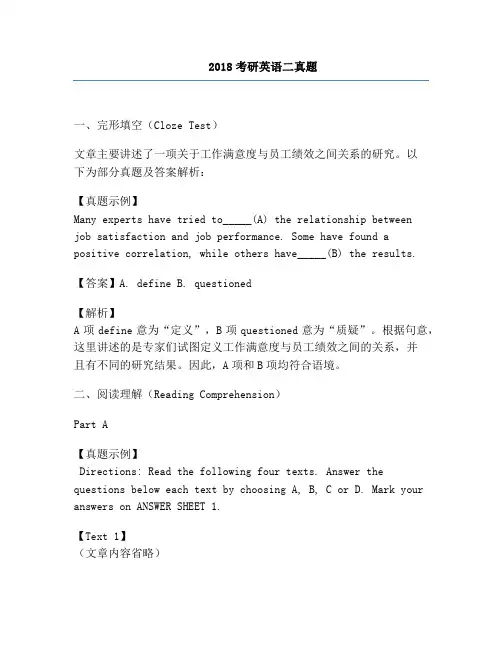
2018考研英语二真题一、完形填空(Cloze Test)文章主要讲述了一项关于工作满意度与员工绩效之间关系的研究。
以下为部分真题及答案解析:【真题示例】Many experts have tried to_____(A) the relationship betweenjob satisfaction and job performance. Some have found apositive correlation, while others have_____(B) the results.【答案】A. define B. questioned【解析】A项define意为“定义”,B项questioned意为“质疑”。
根据句意,这里讲述的是专家们试图定义工作满意度与员工绩效之间的关系,并且有不同的研究结果。
因此,A项和B项均符合语境。
二、阅读理解(Reading Comprehension)Part A【真题示例】Directions: Read the following four texts. Answer the questions below each text by choosing A, B, C or D. Mark your answers on ANSWER SHEET 1.【Text 1】(文章内容省略)21. What do we learn about the current situation in the job market?A. A new degree often helps land a job.B. Graduates are often overqualified for their jobs.C. Many graduates are not skilled workers.D. Many graduates are not employed.【答案】D【解析】这是一道细节理解题。
2018考研英语阅读理解练习题及答案
2018考研英语阅读理解练习题及答案2018考研英语阅读理解的复习,做练习题是必不可少的。
今天,店铺准备了2018考研英语阅读理解练习题,以供考生练习。
2018考研英语阅读理解练习题:【原文】When I decided to quit my full time employment it never occurredto me that I might become a part of a new international trend. A lateral movethat hurt my pride and blocked my professional progress prompted me to abandonmy relatively high profile career although, in the manner of a disgracedgovernment minister, I covered my exit by claimi ng “I wanted to spend more time with my family".Curiously, some two-and-a-half years and two novels later, myexperiment in what the Americans term "downshifting" has turned mytired excuse into an absolute reality. I have been transformed from apassionate advocate of the philosophy of “ have itall", preached by Linda Kelsey for the past seven years in the pages ofShe magazine, into a woman who is happy to settle for a bit of everything.I have discovered, as perhaps Kelsey will after hermuch-publicized resignation from the editorship of She after a build-up ofstress, that abandoning the doctrine of "juggling your life", andmaking the alternative move into “ downshifting ” brings with it far greater rewards than financial success andsocial status. Nothing could persuade me to return to the kind of life Kelseyused to advocate and I once enjoyed: 12-hour working days, pressured deadlines,the fearful strain of office politics and the limitations of being a parent on “ quality time ” .In America, the move away from juggling to a simpler, lessmaterialistic lifestyle is a well-established trend. Downshifting—also known in America as “voluntarysimplicity”—has, ironically, even bred a new area of what might be termedanti-consumerism. There are a number of best-selling downshifting self-helpbooks for people who want to simplify their lives; there are newsletters, suchas The Tightwad Gazette, that give hundreds of thousands of Americans usefultips on anything from recycling their cling-film to making their own soap;there are even support groups for those who want to achieve the mid-'90sequivalent of dropping out.While in America the trend started as a reaction to the economicdecline ― after the massredundancies caused by downsizing in the late’ 80s ― and is still link ed to the politics of thrift, in Britain, atleast among the middle-class downshifters of my acquaintance, we have differentreasons for seeking to simplify our lives.For the women of my generation who were urged to keep jugglingthrough the '80s, downshifting in the mid-'90s is not so much a search for themythical good life —growing your ownorganic vegetables, and risking turning into one —as apersonal recognition of your limitations.2018考研英语阅读理解练习题:【题目】37. Which of the following is true according to paragraph 1??[A]Full-time employment is a new international trend.[B]The writer was compelled by circumstances to leave her job.[C] “ A lateral move ” means stepping out of full-time employment.[D]The writer was only too eager to spend more time with herfamily.38. The writer's experiment shows that downshifting_________.[A]enables her to realize her dream[B]helps her mold a new philosophy of life[C]prompts her to abandon her high social status[D]leads her to accept the doctrine of She magazine39. “ Juggling one'slife ” probably meansliving a life characterized by _________.[A]non-materialistic lifestyle[B]a bit of everything[C]extreme stress[D]anti-consumerism40. According to the passage, downshifting emerged in the U.S. asa result of _________.[A]the quick pace of modern life[B]man's adventurous spirit[C]man's search for mythical experiences[D]the economic situation2018考研英语阅读理解练习题:【答案】名师解析37. Which of the following is true according to paragraph 1?根据第一段,下文哪一个是正确的?[A] Full-time employment is a new international trend.全职工作是一个新的国际趋势。
2018考研英语阅读练习题(附答案)
2018考研英语阅读练习题(附答案)Text 1Over the past decade, thousands of patents have been granted for what are called business methods. received one for its “one-click” online payment system. Merrill Lynch got legal protection for an asset allocation strategy. One inventor patented a technique for lifting a box.Now the nation’s top patent court appears completely ready to scale back on business-method patents, which have been controversial ever since they were first authorized 10 years ago. In a move that has intellectual-property lawyers abuzz the U.S. court of Appeals for the federal circuit said it would use a particular case to conduct a broad review of business-method patents. In B ilski , as the case is known , is “a very big deal”, says Dennis’D. Crouch of the University of Missouri School of law. It “has the potential to eliminate an entire class of patents.”Curbs on business-method claims would be a dramatic about-face; because it was the federal circuit itself that introduced such patents with its 1998 decision in the so-called state Street Bank case, approving a patent on a way of pooling mutual-fund assets. That ruling produced an explosion in business-method patent filings, initially by emerging internet companies trying to stake out exclusive pinhts to specific types of online transactions. Later, move established companies raced to add such patents to their files, if only as a defensive move against rivals that might bent them to the punch. In 2005, IBM noted in a court filing that it had been issued more than 300 business-method patents despite the fact that it questioned the legal basis for granting them. Similarly, some Wall Street investment films armed themselves with patents for financial products, even as they took positions in court cases opposing the practice.The Bilski case involves a claimed patent on a method for hedging risk in the energy market. The Federal circuit issued an unusual order stating that the case would be heard by all 12 of the court’s judges, rather than a typical panel of three, and that one issue it wants to evaluate is whether it should” reconsider” its state street Bank ruling.The Federal Circuit’s action comes in the wake of a series of recen t decisions by the Supreme Court that has narrowed the scope of protections for patent holders. Last April, for example the justices signaled that too many patents were being upheld for “inventions” that are obvious. The judges on the Federal circuit are “reacting to the anti-patient trend at the supreme court”, says Harole C.wegner, a patent attorney and professor at Jorge Washington University Law School.1. Business-method patents have recently aroused concern because of[A] their limited value to business[B] their connection with asset allocation[C] the possible restriction on their granting[D] the controversy over authorization选C. 细节推理题。
2018考研英语真题和答案
2018年考研英语一真题答案解读<完整版)Section I Use of English1.【答案】A【解读】第一句提到“总体而言,当人们自己做决定时,并不擅长考虑背景信息。
”第二句顺接上文,“乍一看这是一种优势”,that 引起定语从句,这种优势使人们具有一种能力,即能够做出不受外界因素影响的不带偏见的决定。
B选项submit “服从,提交”,不能与ability连用,C选项transmit “传输,发射”,也不能与ability 搭配,D选项deliver “传递”,同样不能与ability搭配。
A, C, D无论从搭配上还是意思上都不合适。
A选项grant本身具有赋予,授予的意思。
故答案选A。
oF1y4Z1Xyv2.【答案】D【解读】external外部因素和上文的background information同义复现,不考虑背景信息,不受外界因素影响。
A选项minor 次要的,B 选项objective 客观的,C选项crucial 残酷的,D选项external 外部的,故答案选D。
oF1y4Z1Xyv3.【答案】C【解读】第三题本句but引起句意转折。
“但是XX推测不考虑大局会导致决策者被日常接触的信息影响而带有偏见。
”首先注意到空前面有定冠词the,指代上文信息,即不考虑背景信息、不考虑大环境。
而大局,大环境的表达,此处选择picture是最贴切的。
A选项 issue 问题,B选项vision 想象力,美景都不合适,故答案选C。
oF1y4Z1Xyv4.【答案】A【解读】通读后面的句子,提到了法官与被告,这明显是生活当中的一个具体的实例,故答案选A。
而B选项 on average “平均,通常”,出现的话,周围往往应该要出现数字。
C选项in principle“大体上,原则上”,后面需要出现的是总结性的话语,D选项aboveall“首先”是用来列举条目,将A,B,D排除。
oF1y4Z1Xyv5.【答案】B【解读】从句意上来看“例如,他们提出理论,认为法官不敢在罪行面前表现得太软弱,如果当天已经宣判五六名被告执行缓刑,那么他很有可能将下一个人送入监狱。
2018年考研英语真题及答案
2018考研英语真题及答案(一)Directions:Read the following text. Choose the best word(s)for each numbered blank and mark [A],[B],[C] or [D] on ANSWER SHEET 1. (10 points)Ancient Greek philosopher Aristotle viewed laughter as “a bodily exercise precious to health.” But __1___some claims to the contrary,laughing probably has little influence on physical fitness Laughter does __2___short-term changes in the function of the heart and its blood vessels,___3_ heart rate and oxygen consumption But because hard laughter is difficult to __4__,a good laugh is unlikely to have __5___ benefits the way,say,walking or jogging does.__6__,instead of straining muscles to build them,as exercise does,laughter apparently accomplishes the __7__,studies dating back to the 1930‘s indicate that laughter__8___ muscles,decreasing muscle tone for up to 45 minutes after the laugh dies down.Such bodily reaction might conceivably help _9__the effects of psychological stress. Anyway,the act of laughing probably does produce other types of ___10___ feedback,that improve an individual‘s emotional state. __11____one classical theory of emotion,our feelings are partially rooted ____12___ physical reactions. It was argued at the end of the 19th century that humans do not cry ___13___they are sad but they become sad when the tears begin to flow.Although sadness also ____14___ tears,evidence suggests that emotions can flow __15___ muscular responses. In an experiment published in 1988,social psychologist Fritz Strack of the University of würzburg in Germany asked volunteers to __16___ a pen either with their teeth-thereby creating an artificial smile – or with their lips,which would produce a(n)__17___ expression. Those forced to exercise their enthusiastically to funny catoons than did those whose months were contracted in a frown,____19___ that expressions may influence emotions rather than just the other way around __20__ ,the physical act of laughter could improve mood.1.[A]among [B]except [C]despite [D]like2.[A]reflect [B]demand [C]indicate [D]produce3.[A]stabilizing [B]boosting [C]impairing [D]determining4.[A]transmit [B]sustain [C]evaluate [D]observe5.[A]measurable [B]manageable [C]affordable [D]renewable6.[A]In turn [B]In fact [C]In addition [D]In brief7.[A]opposite [B]impossible [C]average [D]expected8.[A]hardens [B]weakens [C]tightens [D]relaxes9.[A]aggravate [B]generate [C]moderate [D]enhance10.[A]physical [B]mental [C]subconscious [D]internal11.[A]Except for [B]According to [C]Due to [D]As for12.[A]with [B]on [C]in [D]at13.[A]unless [B]until [C]if [D]because14.[A]exhausts [B]follows [C]precedes [D]suppresses15.[A]into [B]from [C]towards [D]beyond16.[A]fetch [B]bite [C]pick [D]hold17.[A]disappointed [B]excited [C]joyful [D]indifferent18.[A]adapted [B]catered [C]turned [D]reacted19.[A]suggesting [B]requiring [C]mentioning [D]supposing20.[A]Eventually [B]Consequently [C]Similarly [D]ConverselySection II Reading ComprehensionPart ADirections:Read the following four texts. Answer the questions below each text by choosing [A],[B],[C] or [D]. Mark your answers on ANSWER SHEET 1. (40 points)Text 1The decision of the New York Philharmonic to hire Alan Gilbert as its next music director has been the talk of the classical-music world ever since the sudden announcement of his appointment in 2009. For the most part,the response has been favorable,to say the least. “Hooray!At last!” wrote Anthony Tommasini,a sober-sided classical-music critic.One of the reasons why the appointment came as such a surprise,however,is that Gilbert is comparatively little known. Even Tommasini,who had advocated Gilbert‘s appointment in the Times,calls him “an unpretentious musician with no air of the formidable conductor about him.” As a description of the next music director of an orchestra that has hitherto been led by musicians like Gustav Mahler and Pierre Boulez,that seems likely to have struck at least some Times readers as faint praise.For my part,I have no idea whether Gilbert is a great conductor or even a good one. To be sure,he performs an impressive variety of interesting compositions,but it is not necessary for me to visit Avery Fisher Hall,or anywhere else,to hear interesting orchestral music. All I have to do is to go to my CD shelf,or boot up my computer and download still more recorded music from iTunes.Devoted concertgoers who reply that recordings are no substitute for live performance are missing the point. For the time,attention,and money of the art-loving public,classical instrumentalists must compete not only with opera houses,dance troupes,theater companies,and museums,but also with the recorded performances of the great classical musicians of the 20th century. There recordings are cheap,available everywhere,and very often much higher in artistic quality than today‘s live performances;moreover,they can be “consumed” at a time and place of the listener’s choosing. The widespread availability of such recordings has thus brought about a crisis in the institution of the traditional classical concert.One possible response is for classical performers to program attractive new music that is not yet available on record. Gilbert‘s own interest in new music has been widely noted:Alex Ross,a classical-music critic,has described him as a man who is capable of turning the Philharmonic into “a markedly different,more vibrant organization.” But what will be the nature of that difference?Merely expan ding the orchestra’s repertoire will not be enough. If Gilbert and the Philharmonic are to succeed,they must first change the relationship between America‘s oldest orchestra and the new audience it hops to attract.21. We learn from Para.1 that Gilbert‘s appointment has[A]incurred criticism.[B]raised suspicion.[C]received acclaim.[D]aroused curiosity.22. Tommasini regards Gilbert as an artist who is[A]influential.[B]modest.[C]respectable.[D]talented.23. The author believes that the devoted concertgoers[A]ignore the expenses of live performances.[B]reject most kinds of recorded performances.[C]exaggerate the variety of live performances.[D]overestimate the value of live performances.24. According to the text,which of the following is true of recordings?[A]They are often inferior to live concerts in quality.[B]They are easily accessible to the general public.[C]They help improve the quality of music.[D]They have only covered masterpieces.25. Regarding Gilbert‘s role in revitalizing the Philharmonic,the author feels[A]doubtful.[B]enthusiastic.[C]confident.[D]puzzled.Text 2When Liam McGee departed as president of Bank of America in August,his explanation was surprisingly straight up. Rather than cloaking his exit in the usual vague excuses,he came right out and said he was leaving “to pursue my goal of running a company.” Broadcasting his ambition was “very much my decision,” McGee says. Within two weeks,he was talking for the first time with the board of Hartford Financial Services Group,which named him CEO and chairman on September 29.McGee says leaving without a position lined up gave him time to reflect on what kind of company he wanted to run. It also sent a clear message to the outside world about his aspirations. And McGee isn‘t alone. In recent weeks the No.2 executives at Avon and American Express quit with the explanation that they were looking for a CEO post. As boards scrutinize succession plans in response to shareholder pressure,executives who don’t get the nod also may wish to move on. A turbulent business environment also has senior managers cautious of letting vague pronouncements cloud their reputations.As the first signs of recovery begin to take hold,deputy chiefs may be more willing to make the jump without a net. In the third quarter,CEO turnover was down 23% from a year ago as nervous boards stuck with the leaders they had,according to Liberum Research. As the economy picks up,opportunities will abound for aspiring leaders.The decision to quit a senior position to look for a better one is unconventional. For years executives and headhunters have adhered to the rule that the most attractive CEO candidates are theones who must be poached. Says Korn/Ferry senior partner Dennis Carey:“I can‘t think of a single search I’ve done where a board has not instructed me to look at sitting CEOs first.”Those who jumped without a job haven‘t always landed in top positions quickly. Ellen Marram quit as chief of Tropicana a decade age,saying she wanted to be a CEO. It was a year before she became head of a tiny Internet-based commodities exchange. Robert Willumstad left Citigroup in 2005 with ambitions to be a CEO. He finally took that post at a major financial institution three years later.Many recruiters say the old disgrace is fading for top performers. The financial crisis has made it more acceptable to be between jobs or to leave a bad one. “The traditional rule was it‘s safer to stay where you are,but that’s been fundamentally inverted,” says one headhunter. “The people who‘ve been hurt the worst are those who’ve stayed too long.”26. When McGee announced his departure,his manner can best be described as being[A]arrogant.[B]frank.[C]self-centered.[D]impulsive.27. According to Paragraph 2,senior executives‘ quitting may be spurred by[A]their expectation of better financial status.[B]their need to reflect on their private life.[C]their strained relations with the boards.[D]their pursuit of new career goals.28. The word “poached” (Line 3,Paragraph 4)most probably means[A]approved of.[B]attended to.[C]hunted for.[D]guarded against.29. It can be inferred from the last paragraph that[A]top performers used to cling to their posts.[B]loyalty of top performers is getting out-dated.[C]top performers care more about reputations.[D]it‘s safer to stick to the traditional rules.30. Which of the following is the best title for the text?[A]CEOs:Where to Go?[B]CEOs:All the Way Up?[C]Top Managers Jump without a Net[D]The Only Way Out for Top PerformersText 3The rough guide to marketing success used to be that you got what you paid for. No longer. While traditional “paid” med ia – such as television commercials and print advertisements – still play a major role,companies today can exploit many alternative forms of media. Consumers passionate about a product may create “owned” media by sending e-mail alerts about products and sales to customers registered with its Web site. The way consumers now approach the broad range of factors beyond conventional paid media.Paid and owned media are controlled by marketers promoting their own products. For earned media ,such marketers ac t as the initiator for users‘ responses. But in some cases,one marketer’s owned media become another marketer‘s paid media – for instance,when an e-commerce retailer sells ad space on its Web site. We define such sold media as owned media whose traffic is so strong that other organizations place their content or e-commerce engines within that environment. This trend ,which we believe is still in its infancy,effectively began with retailers and travel providers such as airlines and hotels and will no doubt go further. Johnson & Johnson,for example,has created BabyCenter,a stand-alone media property that promotes complementary and even competitive products. Besides generating income,the presence of other marketers makes the site seem objective,gives companies opportunities to learn valuable information about the appeal of other companies’ marketing,and may help expand user traffic for all companies concerned.The same dramatic technological changes that have provided marketers with more (and more diverse)communications choices have also increased the risk that passionate consumers will voice their opinions in quicker,more visible,and much more damaging ways. Such hijacked media are the opposite of earned media:an asset or campaign becomes hostage to consumers,other stakeholders,or activists who make negative allegations about a brand or product. Members of social networks,for instance,are learning that they can hijack media to apply pressure on the businesses that originally created them.If that happens,passionate consumers would try to persuade others to boycott products,putting the reputation of the target company at risk. In such a case,the company‘s response may notbe sufficiently quick or thoughtful,and the learning curve has been steep. Toyota Motor,for example,alleviated some of the damage from its recall crisis earlier this year with a relatively quick and well-orchestrated social-media response campaign,which included efforts to engage with consumers directly on sites such as Twitter and the social-news site Digg.31.Consumers may create “earned” media when they are[A] obscssed with online shopping at certain Web sites.[B] inspired by product-promoting e-mails sent to them.[C] eager to help their friends promote quality products.[D] enthusiastic about recommending their favorite products.32. According to Paragraph 2,sold media feature[A] a safe business environment.[B] random competition.[C] strong user traffic.[D] flexibility in organization.33. The author indicates in Paragraph 3 that earned media[A] invite constant conflicts with passionate consumers.[B] can be used to produce negative effects in marketing.[C] may be responsible for fiercer competition.[D] deserve all the negative comments about them.34. Toyota Motor‘s experience is cited as an example of[A] responding effectively to hijacked media.[B] persuading customers into boycotting products.[C] cooperating with supportive consumers.[D] taking advantage of hijacked media.35. Which of the following is the text mainly about ?[A] Alternatives to conventional paid media.[B] Conflict between hijacked and earned media.[C] Dominance of hijacked media.[D] Popularity of owned media.Text 4It‘s no surprise that Jennifer Senior’s insightful,provocative magazine cover story,“I love My Children,I Hate My Life,” is arousing much chatter – nothing gets people talking like the suggestion that child rearing is anything less than a completely fulfilling,life-enriching experience. Rather than concluding that children make parents either happy or miserable,Senior suggests we need to redefine happiness:instead of thinking of it as something that can be measured by moment-to-moment joy,we should consider being happy as a past-tense condition. Even though the day-to-day experience of raising kids can be soul-crushingly hard,Senior writes that “the very things that in the moment dampen our moods can later be sources of intense gratific ation and delight.”The magazine cover showing an attractive mother holding a cute baby is hardly the only Madonna-and-child image on newsstands this week. There are also stories about newly adoptive –and newly single – mom Sandra Bullock,as well as t he usual “Jennifer Aniston is pregnant” news. Practically every week features at least one celebrity mom,or mom-to-be,smiling on the newsstands.In a society that so persistently celebrates procreation,is it any wonder that admitting you regret having children is equivalent to admitting you support kitten-killing ?It doesn‘t seem quite fair,then,to compare the regrets of parents to the regrets of the children. Unhappy parents rarely are provoked to wonder if they shouldn’t have had kids,but unhappy childless folks are bothered with the message that children are the single most important thing in the world:obviously their misery must be a direct result of the gaping baby-size holes in their lives.Of course,the image of parenthood that celebrity magazines like Us Weekly and People present is hugely unrealistic,especially when the parents are single mothers like Bullock. According to several studies concluding that parents are less happy than childless couples,single parents are the least happy of all. No shock there,considering how much work it is to raise a kid without a partner to lean on;yet to hear Sandra and Britney tell it,raising a kid on their “own” (read:with round-the-clock help)is a piece of cake.It‘s hard to imagine that ma ny people are dumb enough to want children just because Reese and Angelina make it look so glamorous:most adults understand that a baby is not a haircut. But it’s interesting to wonder if the images we see every week of stress-free,happiness-enhancingpa renthood aren‘t in some small,subconscious way contributing to our own dissatisfactions with the actual experience,in the same way that a small part of us hoped getting “ the Rachel” might make us look just a little bit like Jennifer Aniston.36.Jennifer Senior suggests in her article that raising a child can bring[A]temporary delight[B]enjoyment in progress[C]happiness in retrospect[D]lasting reward37.We learn from Paragraph 2 that[A]celebrity moms are a permanent source for gossip.[B]single mothers with babies deserve greater attention.[C]news about pregnant celebrities is entertaining.[D]having children is highly valued by the public.38.It is suggested in Paragraph 3 that childless folks[A]are constantly exposed to criticism.[B]are largely ignored by the media.[C]fail to fulfill their social responsibilities.[D]are less likely to be satisfied with their life.39.According to Paragraph 4,the message conveyed by celebrity magazines is[A]soothing.[B]ambiguous.[C]compensatory.[D]misleading.40.Which of the following can be inferred from the last paragraph?[A]Having children contributes little to the glamour of celebrity moms.[B]Celebrity moms have influenced our attitude towards child rearing.[C]Having children intensifies our dissatisfaction with life.[D]We sometimes neglect the happiness from child rearing.Part BDirections:The following paragraph are given in a wrong order. For Questions 41-45,you are required to reorganize these paragraphs into a coherent text by choosing from the list A-G to filling them into the numbered boxes. Paragraphs E and G have been correctly placed. Mark your answers on ANSWER SHEET 1. (10 points)[A] No disciplines have seized on professionalism with as much enthusiasm as the humanities. You can,Mr Menand points out,became a lawyer in three years and a medical doctor in four. But the regular time it takes to get a doctoral degree in the humanities is nine years. Not surprisingly,up to half of all doctoral students in English drop out before getting their degrees.[B] His concern is mainly with the humanities:Literature,languages,philosophy and so on. These are disciplines that are going out of style:22% of American college graduates now major in business compared with only 2% in history and 4% in English. However,many leading American universities want their undergraduates to have a grounding in the basic canon of ideas that every educated person should posses. But most find it difficult to agree on what a “general education” should look like. At Harvard,Mr Menand notes,“the great books are read because they have been read”-they form a sort of social glue.[C] Equally unsurprisingly,only about half end up with professorships for which they entered graduate school. There are simply too few posts. This is partly because universities continue to produce ever more PhDs. But fewer students want to study humanities subjects:English departments awarded more bache lor‘s degrees in 1970-71 than they did 20 years later. Fewer students requires fewer teachers. So,at the end of a decade of theses-writing,many humanities students leave the profession to do something for which they have not been trained.[D] One reason why it is hard to design and teach such courses is that they can cut across the insistence by top American universities that liberal-arts educations and professional education should be kept separate,taught in different schools. Many students experience both varieties. Although more than half of Harvard undergraduates end up in law,medicine or business,future doctors and lawyers must study a non-specialist liberal-arts degree before embarking on a professional qualification. [E] Besides professionalizing the professions by this separation,top American universities have professionalised the professor. The growth in public money for academic research has speeded the process:federal research grants rose fourfold between 1960and 1990,but faculty teaching hours fell by half as research took its toll. Professionalism has turned the acquisition of a doctoral degree into a prerequisite for a successful academic career:as late as 1969a third of American professors did not possess one. But the key idea behind professionalisation,argues Mr Menand,is that “the knowledge and skills needed for a particular specialization are transmissible but not transferable.”So disciplines acquire a monopoly not just over the production of knowledge,but also over the production of the producers of knowledge.[F] The key to reforming higher education,concludes Mr Menand,is to alter the way in which “the producers of knowledge are produced.”Otherwise,academics will continue to think dangerously alike,increasingly detached from the societies which they study,investigate andcriticize.“Academic inquiry,at least in some fields,may need to become less exclusionary and more holistic.”Yet quite how that happens,Mr Menand dose not say.[G] The subtle and intelligent little book The Marketplace of Ideas:Reform and Resistance in the American University should be read by every student thinking of applying to take a doctoral degree. They may then decide to go elsewhere. For something curious has been happening in American Universities,and Louis Menand,a professor of English at Harvard University,captured it skillfully.G → 41. →42. → E →43. →44. →45.Part CDirections:Read the following text carefully and then translate the underlined segments into Chinese. Your translation should be written carefully on ANSWER SHEET 2. (10 points)With its theme that “Mind is the master weaver,” creating our inner character and outer circumstances,the book As a Man Thinking by James Allen is an in-depth exploration of the central idea of self-help writing.(46)Allen‘s contribution was to take an assumption we all share-that because we are not robots we therefore control our thoughts-and reveal its erroneous nature. Because most of us believe that mind is separate from matter,we think that thoughts can be hidden and made powerless;this allows us to think one way and act another. However,Allen believed that the unconscious mind generates as much action as the conscious mind,and (47)while we may be able to sustain the illusion of control through the conscious mind alone,in reality we are continually faced with a question:“Why cannot I make myself do this or achieve that?”Since desire and will are damaged by the presence of thoughts that do not accord with desire,Allen concluded :“ We do not attract what we want,but what we are.” Achievement happens because you as a person embody the external achievement;you don‘t “ get” success but become it. There is no gap between mind and matter.Part of the fame of Allen‘s book is its contention that “Circumstances do not make a person,they reveal him.” (48)This seems a justification for neglect of those in need,and a rationalization of exploitation,of the superiority of those at the top and the inferiority of those at the bottom. This ,however,would be a knee-jerk reaction to a subtle argument. Each set of circumstances,however bad,offers a unique opportunity for growth. If circumstances always determined the life and prospects of people,then humanity would never have progressed. In fat,(49)circumstances seem to be designed to bring out the best in us and if we feel that we have been “wronged” then we are unlikely to begin a conscious effort to escape from our situation .Nevertheless,as any biographer knows,a per son’s early life and its conditions are often the greatest gift to an individual.The sobering aspect of Allen‘s book is that we have no one else to blame for our present condition except ourselves. (50)The upside is the possibilities contained in knowing that everything is up to us;where before we were experts in the array of limitations,now we become authorities of what is possible.Section ⅢWritingPart A51. Directions:Write a letter to a friend of yours to1)recommend one of your favorite movies and2)give reasons for your recommendationYour should write about 100 words on ANSWER SHEET 2Do not sign your own name at the end of the leter. User “LI MING” instead.Do not writer the address.(10 points)Part B52. Directions:Write an essay of 160——200 words based on the following drawing. In your essay,you should1)describe the drawing briefly,2)explain it‘s intended meaning,and3)give your comments.Your should write neatly on ANSWER SHEET 2. (20 points)2018考研英语真题答案Section I Use of English1.C2.D3.B4.B5.A6.B7.A8.D9.C 10.A11.B 12.C 13.D 14.C 15.B 16.D 17.A 18.D 19.A 20.CSection II Reading ComprehensionPart A21.C 22.B 23.D 24.B 25.A 26.B 27.D 28.C 29.A 30.C31.D 32.C 33.B 34.A 35.A 36.C 37.D 38.A 39.D 40.B41.B 42.D 43.A 44.C 45.F翻译:46、艾伦的贡献在于提供了我们能分担和揭示错误性质的假设——因为我们不是机器人,因此我们能够控制我们的理想。