
【精选】浙江省嘉兴市秀洲区七年级英语下册Module4LifeinthefutureUnit3Languageinuse课件新版外研版
【升格点拨】 本文作者写作时按照如下思路进行: 1. 作者以“未来的生活”为主题,主要描写了未来的 生活是什么样子的。用一般将来时; 2. 开篇点题,未来的生活将会有很大不同; 3. 按照所提示的要点,逐条描述。充分发挥了想象力, 适当增加了细节; 4. 采用第一人称和第三人称,人称通篇保持一致。
【写作任务】 一百年以后,我们的生活会是什么样子的呢?请
根据以下提示,以“Life in the Future”为题,写一篇 60词左右的短文。
提示:(1)机器人帮助我们做家务;(2)夏天 很热,人们生活在海洋里;(3)人们将有很多空闲 时间、很长的假期,可以到月球去度假。
要求:字迹工整,语意连贯,无语法错误。
编后语
听课对同学们的学习有着非常重要的作用。课听得好好,直接关系到大家最终的学习成绩。如何听好课,同学们可以参考如下建议:
一、听要点。
一般来说,一节课的要点就是老师们在备课中准备的讲课大纲。许多老师在讲课正式开始之前会告诉大家,同学们对此要格外注意。例如在学习物理 课“力的三要素”这一节时,老师会先列出力的三要素——大小、方向、作用点。这就是一堂课的要点。把这三点认真听好了,这节课就基本掌握了。
四、听方法。
在课堂上不仅要听老师讲课的结论而且要认真关注老师分析、解决问题的方法。比如上语文课学习汉字,一般都是遵循着“形”、“音”、“义”的 研究方向;分析小说,一般都是从人物、环境、情节三个要素入手;写记叙文,则要从时间、地点、人物和事情发生的起因、经过、结果六个方面进行 叙述。这些都是语文学习中的一些具体方法。其他的科目也有适用的学习方法,如解数学题时,会用到反正法;换元法;待定系数法;配方法;消元法; 因式分解法等,掌握各个科目的方法是大家应该学习的核心所在。
②“be going to+动词原形”还可表示客观迹象表明 马上要发生的动作,而“will/shall+动词原形”则表 明说话者的观点、主观意愿。另外will/shall还可作 情态动词用,表达感情色彩。如:
A. Look at the clouds. There is going to b I hope it will be cool tomorrow. 我希望明天会凉爽。(主观意愿) C. I’ll open the door. 我去开门。(未经事先考虑的意图)
【话题呈现】 本模块以“未来的世界是什么样子的”为话题,
围绕这一话题学习一般将来时的用法。通过本模块 的学习,培养学生的想象力,拓展学生的思维空间, 能正确运用一般将来时对将来的学习和生活等进行 描述,从而激发学生的学习动力和对未来的憧憬。
二、听思路。
思路就是我们思考问题的步骤。例如老师在讲解一道数学题时,首先思考应该从什么地方下手,然后在思考用什么方法,通过什么样的过程来进行解 答。听课时关键应该弄清楚老师讲解问题的思路。
三、听问题。
对于自己预习中不懂的内容,上课时要重点把握。在听讲中要特别注意老师和课本中是怎么解释的。如果老师在讲课中一带而过,并没有详细解答, 大家要及时地把它们记下来,下课再向老师请教。
如: ①We will visit you tomorrow afternoon. 明天下午我们将去看你。(强调将来要发生的动作) ②It will be Spring Festival soon. 很快就是春节了。(强调将来的状态) (2)一般将来时态由“will/shall+动词原形”构成, shall一般只用于第一人称,而will用于第二、三人称, 二者均没有数的变化。口语中will可用于所有人称。
优等生经验谈:听课时应注意学习老师解决问题的思考方法。同学们如果理解了老师的思路和过程,那么后面的结论自然就出现了,学习起来才能够举 一反三,事半功倍。
2019/8/5
最新中小学教学课件
15
谢谢欣赏!
2019/8/5
最新中小学教学课件
16
④Tom will buy a computer next week. 汤姆下周将买一台电脑。 ⑤There will be many trees here in the future. 将来这里会有许多树。 ⑥In twenty years’ time, maybe there won’t be any schools! 二十年后,也许没有学校了!
Unit 3 Language in use
一般将来时:will 1. 用法 (1)一般将来时表示将来某个时间要发生的动作或 存在的状态,常与表示将来的时间状语连用,如: tomorrow(明天),tomorrow morning/afternoon/ evening(明天上午/下午/晚上),next+时间名词 (下一……),from now on(从现在开始),in+一 段时间(在……以后),in the future(在将来)等。
【佳句荟萃】 ①Will the weather be different in the future? 未来的天气将会不同吗? ②Teachers won’t use chalk on a blackboard and students won’t use pens and paper, or erasers any more! 老师们将不再使用粉笔在黑板上写字,学生们也将不 再使用钢笔、纸或橡皮了! ③Everything will be free. 一切都将是免费的。
只用于口语,科技英语几乎不用“be going to+动词 原形”来表示将来。“will/shall+动词原形”表示没 有经过事先思考或没有计划在将来的时间里要发生 的动作,而是在说话时做出的决定。如: A. We are going to do some sightseeing in two weeks. 我们打算两周后去观光。(表示现在的打算) B. We will learn that English song tomorrow afternoon. 我们要明天下午学那首英语歌。(强调将来要发生 的动作)
2. 结构 (1)肯定句:主语+will/shall+动词原形+其他。 否定句:主语+will/shall+not+动词原形+其他。 一般疑问句:Will/Shall+主语+动词原形+其他? 特殊疑问句:疑问词+will/shall+主语+动词原形+其 他? 如: ①They will learn English with me from now on. 从现在开始他们要和我一起学英语。
Life in the Future
. . . . .
【范文展示】 Life in the Future
Life in the future will be very different. We will have robots in our homes. They will do all housework for us. We will live in the sea in summer, because the weather in the future will be very hot. We will have long holidays and much free time. We can travel everywhere by plane. People can go to the moon for their holidays. I’m looking forward to life in the future.
②They won’t learn English with me from now on. 从现在开始他们不和我一起学英语了。 ③Will they learn English with you from now on? 从现在开始他们要和你一起学英语吗? ④When will they learn English with you? 他们要什么时候和你一起学英语? (2)“be going to+动词原形”与“will/shall+动词 原形”的区别: ①“be going to+动词原形”表示打算、计划在将来 的时间里要发生的动作。
⑦In the future, a change of weather won’t mean a change of clothes. 未来人们将不用随天气变化而变换衣服。 ⑧There will be no more light rain and cold wind in spring. 春天将不再有小雨和冷风。 ⑨We won’t travel by bus or bike any more. 我们将不再坐公交车或骑自行车旅行。
初中英语《Module4Lifeinthefuture》单元教学设计以及思维导图
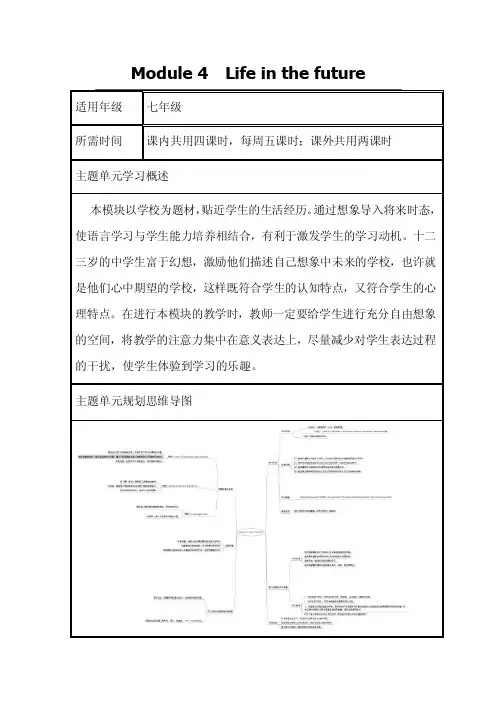
主题单元学习目标(说明:依据新课程标准要求描述学生在本主题单元 学习中所要达到的主要目标)
知识与技能:1.语法:一般将来时:will + 原形动词。 2.词汇:cable TV, calculator, cell phone, computer, education,
comfortable 等。 3.功能:预测与想象的表达。
Step 1. 创设情境导入 看图片,在小组内描述图片。
Step 2. 展示学习目标 Step 3. 出示提纲学生自学(讲评课出示学案、训练课出示练习题)
自主完成教材上的习题,巩固所学的知识。 Step 4. 师生互动合作探究(讲评课、训练课:自我纠错、合作合作探究)
1.We won’t travel by bus or bike any more.我们将不再乘公交车或自 行车旅行。
专题划分
(说明:除了说明主题单元将划分成几个专题以及每个专
题所用的课时外,还应说明哪一个专题或专题中的哪一个
活动将以研究性学习活动的形式来开展学习活动。)
专题一:Everyone will study at home. ( 一 课时)
专题二:Everyone will have a small car. ( 一 课时)
专题二
Everyone will have a small car.
所需课时 课内共用一课时,每周五课时;课外共用二课时
专题学习目标 (说明:描述学生在本专题学习中所要达到的学习目标, 注意与主题单元的学习目标呼应)
பைடு நூலகம்
To get necessary information from the reading material.
(浙江专版)七年英语下册Module4LifeinthefuturePeriod4Unit2Ever
________7 trees and flowers in it.
( A ) 6. A. will be
B. will have
C. is going to have
Байду номын сангаасD. has
( D ) 7. A. little
B. a little
C. much
D. many
There will be a cable TV (有线电视) in our classroom and we
( D ) 9. A. radio B. TV C. calculator D. computer
( D ) 10. A. in
B. near C. at
D. on
The lessons will be _______11. We _______12 use pens or
pencils.
( C ) 11. A. interest
一、 短文填空。 Tom and Fred are ___ta_l_k_in__g__1 (谈论) about the year 2050.
“Will our life be different in the future? ” asks Tom. “ _C_e_r_t_a_in_l_y_2 (当然) , ” says Fred. “What do you think? ” “Well, no one __k_n_o_w__s_3 (知道) , but I'm sure there will ____b_e___4 (有) more changes. ” “In the year 2050, everyone will __c_a_r_r_y__5 (携带) a pocket computer.
七下英语 WY 课文原文Module 4 Life in the future
Module 4 Life in the futureUnit 1 Everyone will study at home.Ms Li: Will schools be different in the future, Daming?Daming: Yes, there will! In twenty years time, maybe there won’t be any schools! Ms Li: How will students learn then?Daming: Everyone will study at home. Students will use computers and get information on the Internet. They can ask their teachers by Internet,telephone or email.Betty: Well, I’m not sure. Yes, students will use computers, but school is good fun, and you can make friends there. And teachers can check thestudents’ level and will help them. Computers won’t do that.Tony: Yes. Teachers won’t use on a blackboard and students won’t use pens and paper, or erasers any more!Lingling: Great! Will students have a lot of homework to do?Tony: No, they won’t. They’ll have a lot of free time!Daming: That’ll be great!Unit 2 Every family will have a small plane.What will life be like in the future? How will things change? Here are some ideas. Which ones will come true?AIn the future, a change of weather won’t mean a change of clothes. We’ll wear a new kind of clothes. They’ll be warm when we’re cold, and cool when we’re hot.BThere’ll be no more light rain and cold wind in spring. The weath er will be quite warm or even hot all year, with heavy rain and wind. The sea level will rise as well.CWe won’t travel by bus or bike any more. Every family will have a small plane. No more expensive cars - it’ll be cheap to travel everywhere by pl ane, not only over land, but also over the sea or even into space. Maybe there’ll be traffic jams in the air. DDo you like long holidays? Well, you’re going to like the future because machines and robots will do all the heavy and difficult jobs, an d we’ll only do light and easy work. Working hours will be short so people will have long holidays.。
(浙江专版)七年英语下册Module4LifeinthefuturePeriod1Unit1Ever
our life will be like in the future. As a song goes, “My future is
not just a dream. I will work hard. ”
( D ) 1. A. how
B. when
C. why
D. what
________2 ten years, I will be twenty-four years old and
4. 三天以后, 小女孩就能够走路了。 The little girl ___w_i_ll__ ___b_e___ __a_b_l_e__ ___t_o___ walk in three days.
5. 将来, 我们将不再使用钢笔做作业。 We __w__o_n_'t__ use the pen to do our homework ___a_n_y___ __m__o_r_e__ in the future.
I don't like living alone.
( C ) 7. A. so
B. but
C. because
D. or
I like ________8 very much, so I will have many different pets.
___a_s_k_s__2(问) Tom.
“Well, no one knows, ” says Fred. “I think in the year 2060, everyone will __c_a_r_r_y__3(带) a small computer. The computer will give people the answers to all their _q_u__es_t_i_o_n_s_4 (问题). A lot of people will live and work in the sea. _M__a_y_b_e_5 (或许) there will be big towns, factories and __f_a_r_m_s__6 (农场) in the sea, too.
七年级英语下册:Module_4_Life_in_the_future全模块课件_初中英语(外研版) (2) - 副本
Try to describe it with your own words. Students will:
study at home use computers use the Internet send homework to the teachers by email talk to the teachers on the computers have a computer on the desk read books or use the Internet use books write on a blackboard with chalk use paper, pencils and pens
精讲点拨
1.
send sb. sth 把某物发送给某人 send sth. to sb. Example: 请发给我一封邮件。 send me Please ______ _____an email. send to me Please ______an email ______ _____. 2. by email 用/通过电子邮件. by 在此处是介词,表示方法,手段, 或方式,是 “用…, 靠…, 通过…”之意。如by bus/by train. Eg: 他们将通过电子邮件发送作业。 will send by email They ____ _____ their homework____ ______. 3. talk to sb. 和某人交谈。 Eg: 我要和你爸爸谈谈。 will talk to Tomorrow I ____ _____ ____your father. 4. with chalk , 用粉笔, 跟使用的工具. He cut an apple with a knife. feet 我们用脚走路。 We walk with our______. _____
七年级英语下册:Module_4_Life_in_the_future全模块课件
1.Will they study at home?
Yes, they will./ No, they won’t.
2.Will everyone send their homework by email? Yes, they will./ No, they won’t.
3.Will there be teachers? Yes, there will./ No, there won’t.
学生在前一模块中已学习了一般将来时的肯定、 否定与一般疑问的表达方式,也掌握了如何表 达自己将要做什么,没做什么,也学会了如何 问别人将来是否要做某事。本单元则是在前 面的基础上引入到谈论将来生活这个话题上, 这是学生很熟悉也是较感兴趣的话题。在教 师预设的任务中,引导学生在交际中动态生 成,学生有话可说,乐于合作分享。这样就 有利于他们更好的运用课本知识,达到提高 综合运用语言能力的目的.
cell phone
Cell phones will be cheap in the future.
New words
blackboard 黑板 dictionary 字典
cable TV 有线电视 email 邮件
calculator 计算机 Internet 互联网
cell phone 手机 paper 纸
Example
No one uses________ to learn Chinese.
Listen and check( √ ) the true sentences for Daming and Betty.
Betty
1.Everyone will study at home in the future.
blackboard cable TV calculator cell phone chalk computer dictionary email Internet paper pen pencil radio ruler satellite TV
七年级英语下册Module4LifeinthefutureUnit1Everyonewillstud
Module 4 Life in the future Unit 1 Everyone will study at home教学目标1.Knowledge and Ability Objects1) Key vocabulary:chalk; ruler;carry; change; future; need; will; level; be able to ;not...any more; free 2) Key structures:Will you use books in the future?Yes, we will.No, we won’t. ( will not= won’t)Teachers will write on the blackboard with chalk in the future.Teachers will not write on the blackboard with chalk in the future..3)To train students’listen ing skill and commu nicative competence.2.Method Objects in Teaching1)Listening,speaking , reading and writing methods.2)Discussion method.3)Pairwork.3.Sensibility and ValueTo be interested in learning English and to insert imagination by predicting the future.教学重点1.Key vocabulary in this unit2.Key structures:Will you use books in the future?Yes, we will./No,we won’t.1word格式支持编辑,如有帮助欢迎下载支持。
七年级英语下册同步测试:Module4LifeinthefutureUnit2.
浙江省嘉兴市秀洲区高照实验学校外研版七年级英语下册同步测试:Module4LifeinthefutureUnit2Everyfamilywillhaveasmallplane.学校:___________姓名:___________班级:___________考号:___________一、根据音标写单词根据音标写单词。
1./kɑ:/_______________2./tru:/______________3./wInd/______________4./ʃɔ:t/____________5./'wɜːkɪŋ/__________二、根据首字母填空根据句意及汉语提示完成句子6.I will show you how to start the___________(机器).7.It is___________(下雨)outside now.8.Fresh vegetables are very___________(便宜的)in summer.9.They work eight___________(小时)a day.10.Let me put the book___________(进入……里面)the bag.11.The bag is very___________(轻的)for him.12.This___________(机器人)can do a lot of housework.13.Is the elephant the biggest animal on___________(陆地)?14.I think English is___________(容易的)and I can learn it well.15.Will there be many interesting things in_____________(太空)?三、用所给单词的正确形式填空用所给词的适当形式填空16.Every family______________(have) a small plane in the future.17.In the future, every family will use a robot in the house __________(do) many jobs.18.Here___________(be) some ideas for you.19.The weather___________(be) warm all year in the future.20.Tony is able___________(fly) a kite.四、句型转换句型转换21.Mike will come to China next week. (对画线部分提问)___________ __________Mike come to China?22.Robots will do everything for us. (改为一般疑问句)_________robots ____________ _____________for you?23.We’ll have long holidays and lots of free time. (改为否定句)We___________have long holidays___________lots of free time.24.There is lots of rain at this time of each summer in the south of China. (改为同义句)It______________________at this time of each summer in the south of China.25.The weather will get hot. We will wear light clothes. (用so合并为一句)The weather will get hot____________we will wear light clothes.五、完型填空What will life be like in 3000 years? Different people have 26 answers. Here is my answer.I think life will be very different in 3000 years. Every family will have 27 robot. The robot can do everything for people. 28 people won’t have to do heavy and 29 work. And they 30 more free time to enjoy the things they like.People will wear special(特殊的)31 in 3000 years. They don’t have to 32 clothes because they won’t get dirty(脏的). There will be more kinds of food for people to enjoy. And they are all healthy food.People will use energy(能量)from the sun and the wind. So there 33 be any pollution(污染) problems. People will use a special car to travel. It can run on the road and 34 in the air. It will be very 35 for people to travel to the moon and other plane ts (行星). Some people will live in other planets. It will be a happy world in 3000. 26.A.same B.different C.many D.some 27.A.a B.an C.the D./28.A.With B.So C.But D.Since 29.A.light B.funny C.interesting D.difficult 30.A.have B.don’t have C.will have D.won’t have 31.A.jacket B.dress C.pants D.clothes 32.A.have B.wear C.wash D.make 33.A.is B.isn’t C.will D.won’t 34.A.walk B.fly C.climb D.sleep 35.A.easy B.difficult C.hard D.far六、用单词的正确形式完成句子用方框中所给单词的适当形式填空heavy machine cheap everywhere traffic36.There will be much____________in the street.37.She is looking for her pen_____________ .38.The box is too___________. Can you help me, please?39._____________ will do the hard work for us in the future.40.I don’t have much money, so I want to buy a____________one.七、语法填空阅读下面短文,按照句子结构的语法性和上下文连贯的要求,在空格处填入一个适当的词或使用括号中词语的正确形式填空(每空不多于2个单词)。
初中英语《Module4Lifeinthefuture》单元教学设计以及思维导图
易,将知识不断内化和外延。 情感态度与价值观: 1. 通过本模块相关内容的学习,培养学生做事要有计划的好习 惯,并抱有对未来的生活充满希望的好心态。 2. 通过教材中有关未来生活的描述,让学生了解未来生活的巨大 变化,引导学生努力学习,为实现美好生活的目标而奋斗。 3. 通过用一般将来时来谈论未来生活,培养学生与他人合作的意识。
过程与方法: 利用多媒体展示图片,带领学生描述未来的教室和学习 情况, 通过听录音、模仿对话、提问、小组合作等方式来学习短文。 情感态度与价值观:开拓学生思维,启发学生发挥想象,培养学生的 合作意识。
1. 专题问
2. 题设计
3.
Will schools be different in the future? How will students learn then? Will students have a lot of homework to do?
专 题 一 : Everyone will study at
home.
( 1 课时)
专 题 二 : Every family will have a small
plane.
( 2 课时)
专题三:Language in use
(1课
时)
„„„„
其中,专题 一 中的活动三和四作为研究性学习)
专题一 Everyone will study at home.
主题单
1. 元问题
2. 设计
What will schools be like in the future? What will life be like in the future?
专 题 划 (说明:除了说明主题单元将划分成几个专题以及每个专
浙江省嘉兴市秀洲区七年级英语下册词法语法手册Module4Lifeinthefuture复习素材新版外研版
浙江省嘉兴市秀洲区七年级英语下册词法语法手册Module4Lifeinthefuture复习素材语法精选1. need 需要need意为“需要”,既可用作实义动词,也可用作情态动词。
need用作实义动词时,它的单数第三人称形式为needs,后面可跟名词、代词和带to的不定式等作宾语。
如:The boy doesn’t need help.这个男孩不需要帮助。
need用作情态动词时,后面跟动词原形。
如:They needn’t water the flowers again.他们不再需要浇花。
2. in twenty years’ time二十年之后“in+一段时间”表示“一段时间之后”,常用于将来时。
可以用 how soon 来提问。
如:—How soon will you be back?你多久回来?—In a week.一个星期之后。
3. not only...but also... 不仅……而且……not only...but also...是一个连词词组,意为“不仅……而且……”,连接两个并列成分。
当连接两个并列的主语时,谓语动词要和邻近的主语在人称和数上保持一致。
如:①H e can not only dance but also sing.他不仅会跳舞而且会唱歌。
②Not only John but also his parents are going to watch the basketball match tomorrow.不仅是约翰,而且他的父母也将去看明天的篮球赛。
4. as well 也as well表示“也;又”,常用于句尾。
如:The little girl sings, and plays the piano as well.这个小女孩既会唱歌,也会弹钢琴。
句法精析1. They can ask their teachers questions by Internet, telephone or email.他们可以通过互联网、电话或电子邮件向老师提问。