
(外研版)四年级英语下册教案Module6
Module 6 Music本模块由Unit 1 This girl is good.和Unit 2 Lingling is better than Daming.两部分组成,它的目的是向我们介绍进行评价和比较,同时讲解了一些与音乐相关的背景知识,例如:‘Pop music’中的‘pop’是‘popular’的缩写,意思是‘流行的’;‘Chinese music’在这里指的是‘Chinese traditional music’,演奏这类音乐常用的乐器有二胡、古筝等;‘classical music’比较严肃而正统;‘jazz music’是爵士乐,发源于美国南部,节奏感强,含有大量即兴成分。
Unit 1 Tthis girl is good.Teaching aims: This girl is good.This boy is better than the girls.This picture is bad.This picture is worse.Teaching Importance and difficulties:Teaching tools:RecorderTeaching steps:step1: Warm up1)Sing a song2)This unit introduces some of the irregular comparatives. Write the following adjectives atrandom on the board:big small good bad fat thin3)Get individual students to call out one of the adjectives and you say the comparative form.4)Ask the students what is different about'good'and'bad'compared to the other adjectives in the list( they don't add '-er'to make the compatative).Explain that these are adjectives that have irregular(meaating 'not the usual')comparatives.5)Now get the students to work in pairs and continue to do the activity. They must take turns to say the adjective.Step 2 : Learning and practising1)Tell the students to close their books. Say that they are going to listen to the tape and tell you which comparatives they hear.2)Play the passage once and let the students listen.They should hear both'better'and 'worse'.3)Point and sayTell the students to try and bring the following magazine pictures to class:a holiday place,a car,a house,a stereo,a room. If they can't find magazinepictures,they can draw these places and objects.In the next lesson, invite two studenta to the frontand get them to hold up their pictures of houses.The students have to say which one is better and which one is worse.Now have another pair come to the front. Theyshould hold up their pictures of cars and the restof the class says which one is better and which one is worse.Step 3 : HomeworkUnit 2 Lingling is better than DamingTeaching aims:Lingling is better than Daming.Amy is worse than Sam.Teaching Importance and difficulties:Teaching tools:RecorderTeaching steps:step1: Warm up1)Sing a song2)On the board write the following words:pop music Chinese music jazz3) If you have a tape with examples of the differentmusic,play it for the students. Say,'This is[adjective] music \jazz.'Have the students repeat the sentence. If the students can't listen to these types of music,you will have to explain in Chinese what they are ,i.e.pop music(short for 'popular',modern),Chinese music(it means'traditional Chinese music' here, serious and traditional,played by traditional Chinese instruments),jazz(music which originated in the American south;it has stong rhythm and a lot ofimprovisation).4)Tell the students that you are going to call out the names of different types of music . If they like that music,they should stand up.5)If you have extracts of music on tape,play them and let the students identify the type of music.Step 2 : Learning and Practising1)You may want to remind the students of the different kinds of music.e.g.pop music,Chinese music,jazz,dance music,rap music. You can extend this by teaching'rock music' (modern popular music with a strong beat;often played loudly) and 'folk music'(traditional style).2)Put the students into groups of three and get them to look at the book. Have them read the example dialogue in their groups.3)Do an example. Choose two competent students and say to the first one,'What music do you like?'Prompt the students to answer,'I like [type of music].'The second students should either agree or say which type of music he\she prefers.(now have the students continue the activity in their groups.)4)Tell the students that you are going to play the tape so they can listen to the melody.Now have the students look at the words of the song.Play the tapeof the words and have the students repeat.5)Explain to the students that they should mime playing the instruments as they sing the names ofthose instruments.6)Play the tape again and have the students sing and also mime playing each instrument.7)Have the students work in pairs.Student A mimesplaying an instrument and says,'Whaat am I playing ?'Student B has to respond by saying the name of the instrument.Then the students should swap roles.They can mimeplaying all the instruments they know.8)Game:Bring in different pictures of objects,animals or places.Then write the following structure on theboard:This\That...is better\worse.Hold up pictures of two similar objects,e.g.two rooms . Ask individual studentsto talk about therooms using the structure on the board.(do more examples with other pictures.)Step: Homework。
四年级下册英语教案 Module 6 Unit 1 Were you at home yesterday 外研社(三起)
1. Today we’ve learned how to use“was/ were”to ask questions about yesterday. Do you remember the key words?
今天我们学习了如何用“was/were”询问昨天发生的事情。你还记得这节课的关键词汇吗?
通过图片提示的信请看图片熊猫和机器人在谈论昨天的天气情分步训练息巩固所学词句实现况而大明在询问to昨天在什么地方
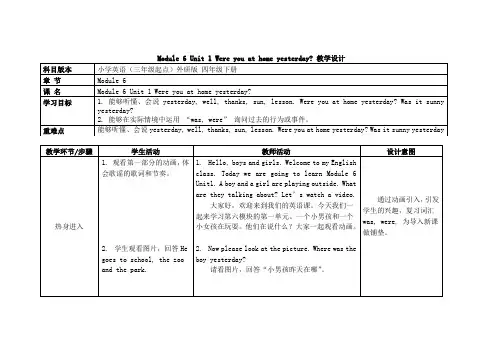
Module 6 Unit 1 Were you at home yesterday?教学设计
科目版本
小学英语(三年级起点)外研版四年级下册
章节
Module 6
课名
Module 6 Unit 1Were you at home yesterday?
小男孩昨天在学校、动物园和公园。现在请跟随动画,用手指着词汇,自己唱出歌谣。
通过动画引入,引发学生的兴趣,复习词汇was, were,为导入新课做铺垫。
新知呈现
1.学生回答He is calling his grandma.
2.学生回答:
①Is it sunny in London?
②Was it sunny in London yesterday?
教学环节/步骤
学生活动
教师活动
设计意图
热身进入
1.观看第一部分的动画,体会歌谣的歌词和节奏。
2.学生观看图片,回答He goes to school, the zoo and the park.
3.跟随动画说唱完整的歌谣。
1.Hello, boys and girls. Welcome to my English class. Today we are going to learn Module 6 Unit1. A boy and a girl are playing outside. What are they talking about? Let’s watch a video.
外研版英语四年级下册 Module6 全单元教案

Unit1 Were you at home yesterday? 教学目标:1、能听、说、认读本课的重点单词:yesterday、out,well,thanks, sun, lesson2、学生能学会运用句型:Were you at home yesterday?3、感知一般疑问句的语音语调特质。
教学重点:1、能听、说、认读本课的重点单词:yesterday、out,well,thanks, sun, lesson, village2、学生能运用Were you at home yesterday?谈论过去事物或人物的特征和状态。
教学难点:感知一般疑问句的语音语调特质。
教学准备:多媒体、图片、单词卡教学过程:Step 1: Warm upThe teacher greets the whole class, and then greets individual students. : T: Hello, everyone! How are you?S: I’m fine, thank you. And how are you?T: I’m very we ll.Step 2: Presentation1、学习新单词T: Boys and girls, just now I said I’m very well, now look at this card how to read this word “well”yeah very good! (呈现单词卡片) 反复纠正发音.Take the new words in sentences and to learn2、教授句型: Were you at home yesterday?问: Were you at home yesterday?答:Yes I was / No, I wasn’t.3、课文内容学习(1) First time underline the words “was/were”.(2) Second time read after the tape.(3) Third time answer the following questions.Q1、Is it sunny in London?Q2、Was Grandma at home yesterday?Step 3: Teacher-student interaction1、课文教学听说训练Work in pairs to read this dialogue and show us.(1) Read the text together.(2) Divided the roles to read the dialogue.2、呈现三组图片,展示问句并进行问答。
Module6Unit1Wereyouathomeyesterday?(教案)-英语四年级下册
外研版四年级下册英语Module 6《Unit 1 Were you at home yesterday?》教案一、教材分析:本单元的教材主要围绕着过去的时间进行了讨论。
学生将学习如何用英语描述过去发生的事情,并使用句型“Were you... yesterday? Yes, I was./No, I wasn't.”和“Was it... yesterday? Yes, it was./No, it wasn't.”进行问答。
通过课文和对话的学习,学生将提高他们的听说能力,以及对过去时间的理解。
二、教学目标:1. 能听、说、认读单元中的词汇,如"yesterday","out","well","sun"和"lesson"。
2. 能听懂课文的大意,正确朗读课文并表演对话。
3. 能在情景中灵活运用句型“Were you... yesterday? Yes, I was./No, I wasn't.”和“Was it... yesterday? Yes, it was./No, it wasn't.”进行问答。
三、教学重难点教学重点:1. 能用正确的语音语调朗读对话。
2. 理解并能正确运用句型“Were you... yesterday? Yes, I was./No, I wasn't.”和“Was it... yesterday? Yes, it was./No, it wasn't.”教学难点:句型操练:1. "Were you... yesterday? Yes, I was./No, I wasn't."2. "Was it... yesterday? Yes, it was./No, it wasn't."四、学情分析:学生是四年级的学生,他们已经学习了一些基础的英语知识,如基本的问候语和日常用语。
小学英语四年级(下)-外研版(三年级起点)-Module 6教案(2个课时)
小学英语四年级(下)-外研版(三年级起点)-Module 6教案(2个课时)课程概述本教案是针对小学四年级学生的英语课教案,属于外研版英语教材的Module 6教案,共分为两个课时。
本教案旨在帮助学生学习有关“吃饭”的单词、短语和句子,通过阅读材料并参与交流活动,提高学生的英语口语和阅读能力。
同时,本教案也包含了一些与生活相关的内容,帮助学生更好地了解英语国家文化。
第一课时教学目标•学习有关“吃饭”的单词、短语和句子。
•学会询问和回答有关“吃饭”的问题。
•提高学生的英语口语和阅读能力。
教学重点•学习有关“吃饭”的单词、短语和句子。
•学会询问和回答有关“吃饭”的问题。
教学难点•学习有关“吃饭”的短语和句子。
•学会运用所学知识进行交流。
教学过程Step 1 自我介绍(5分钟)老师与学生进行自我介绍,然后与学生谈论吃饭的习惯。
Step 2 讲解(15分钟)老师通过幻灯片和短片,向学生介绍有关“吃饭”的单词、短语和句子,让学生理解并记忆。
Step 3 读物(20分钟)老师向学生发放读物,让学生自行阅读。
在阅读过程中,学生可以在书的旁边标注自己不理解的单词并在阅读结束后与同桌讨论。
老师向学生播放“英国的家庭饮食习惯”有关的视频,并与学生一起观看和解析。
Step 5 交流(20分钟)老师与学生进行口语交流和互动练习,学生可以与同桌或老师进行对话,之后在班级中展示一下交流内容。
Step 6 总结(10分钟)总结本堂课所学习的内容,让学生归纳并记忆。
课后作业•复习本节课所学习的内容并记忆有关“吃饭”的单词、短语和句子。
•与家人谈论英国和中国的饮食文化差异,并写一篇50字左右的小作文,阐述你的观点。
第二课时教学目标•学习有关“吃饭”的单词、短语和句子。
•学会询问和回答有关食品品质和文化的问题。
•提高学生的英语口语和阅读能力。
教学重点•学习有关食品品质和文化的单词、短语和句子。
•学会询问和回答有关食品品质和文化的问题。
四年级下册英语教学设计-Module 6-外研社(一起)
四年级下册英语教学设计-Module 6-外研社(一起)教学目标1.听懂并能理解日常生活中的有关饮食方面的基本交流。
2.能够运用所学词汇和简单的句型表述出自己的饮食喜好和不喜好。
3.通过与同伴的合作学习和互动交流,提高口语表达能力和自信心。
教学重点1.词汇和句型的掌握与应用。
2.听力和口语能力的提高。
3.学习方法的培养和习惯的养成。
教学难点1.能够运用所学词汇和句型表述出自己的饮食喜好和不喜好。
2.能够在交流中灵活运用所学内容,进行有效沟通和合作。
教学方式1.听说读写并重的教学方式。
2.以学生为中心,团队合作为主要方式的课堂教学。
3.多媒体与语言交流相结合的教学方式。
教学内容本单元的教学内容主要涵盖以下几个方面:词汇及表达方式•food, vegetables, fruits, meat, chicken, beef, fish, egg, soup, salad, water, milk, juice, tea, coffee, like / don’t like, eat / drink, what do you like / want, I like / want…句型•What do you like / want?•I like / want…•Do you like…?•Yes, I do. / No, I don’t.对话•A: What do you want to eat / drink?•B: I want some vegetable soup / an apple juice.•A: Do you like chicken?•B: Yes, I do. / No, I don’t.教学步骤第一步:新课导入(20分钟)1.教师用课件或实物向学生展示一些食物、饮料的图片,向学生介绍一些新的单词,并示范如何用。
四年级英语下册 Module6教案 外研版

Module 6 Music本模块由Unit 1 This girl is good.和Unit 2 Lingling is better than Daming.两部分组成,它的目的是向我们介绍进行评价和比较,同时讲解了一些与音乐相关的背景知识,例如:‘Pop music’中的‘pop’是‘popular’的缩写,意思是‘流行的’;‘Chinese music’在这里指的是‘Chinese traditional music’,演奏这类音乐常用的乐器有二胡、古筝等;‘classical music’比较严肃而正统;‘jazz music’是爵士乐,发源于美国南部,节奏感强,含有大量即兴成分。
Unit 1 Tthis girl is good.Teaching aims: This girl is good.This boy is better than the girls.This picture is bad.This picture is worse.Teaching Importance and difficulties:Teaching tools:RecorderTeaching steps:step1: Warm up1)Sing a song2)This unit introduces some of the irregular comparatives. Write the following adjectives atrandom on the board:big small good bad fat thin3)Get individual students to call out one of the adjectives and you say the comparative form.4)Ask the students what is different about'good'and'bad'compared to the other adjectives in the list( they don't add '-er'to make the compatative).Explain that these are adjectives that have irregular(meaating 'not the usual')comparatives.5)Now get the students to work in pairs and continue to do the activity. They must take turns to say the adjective.Step 2 : Learning and practising1)Tell the students to close their books. Say that they are going to listen to the tape and tell you which comparatives they hear.2)Play the passage once and let the students listen.They should hear both'better'and 'worse'.3)Point and sayTell the students to try and bring the following magazine pictures to class:a holiday place,a car,a house,a stereo,a room. If they can't find magazinepictures,they can draw these places and objects.In the next lesson, invite two studenta to the frontand get them to hold up their pictures of houses.The students have to say which one is better and which one is worse.Now have another pair come to the front. Theyshould hold up their pictures of carsand the restof the class says which one is better and which one is worse.Step 3 : HomeworkUnit 2 Lingling is better than DamingTeaching aims:Lingling is better than Daming.Amy is worse than Sam.Teaching Importance and difficulties:Teaching tools:RecorderTeaching steps:step1: Warm up1)Sing a song2)On the board write the following words:pop music Chinese music jazz3) If you have a tape with examples of the differentmusic,play it for the students. Say,'This is[adjective] music \jazz.'Have the students repeat the sentence. If the students can't listen to these types of music,you will have to explain in Chinese what they are ,i.e.pop music(short for 'popular',modern),Chinese music(it means'traditional Chinese music' here, serious and traditional,played by traditional Chinese instruments),jazz(music which originated in the American south;it has stong rhythm and a lot ofimprovisation).4)Tell the students that you are going to call out the names of different types of music . If they like that music,they should stand up.5)If you have extracts of music on tape,play them and let the students identify the type of music.Step 2 : Learning and Practising1)You may want to remind the students of the different kinds of music.e.g.pop music,Chinese music,jazz,dance music,rap music. You can extend this by teaching'rock music' (modern popular music with a strong beat;often played loudly) and 'folk music'(traditional style).2)Put the students into groups of three and get them to look at the book. Have them read the example dialogue in their groups.3)Do an example. Choose two competent students and say to the first one,'What music do you like?'Prompt the students to answer,'I like [type of music].'The second students should either agree or say which type of music he\she prefers.(now have the students continue the activity in their groups.)4)Tell the students that you are going to play the tape so they can listen to the melody.Now have the students look at the words of the song.Play the tapeof the words and have the students repeat.5)Explain to the students that they should mime playing the instruments as they sing the names ofthose instruments.6)Play the tape again and have the students sing and also mime playing each instrument.7)Have the students work in pairs.Student A mimesplaying an instrument and says,'Whaat am I playing ?'Student B has to respond by saying the name of the instrument.Then the students should swap roles.They can mime playing all the instruments they know.8)Game:Bring in different pictures of objects,animals or places.Then write the following structure on theboard:This\That...is better\worse.Hold up pictures of two similar objects,e.g.two rooms . Ask individual studentsto talk about therooms using the structure on the board.(do more examples with other pictures.) Step: Homework。
英语外研新标准(一起)四年级下册-Module 6 Unit 1 I'll draw the pic
英语外研新标准(一起)四年级下册-Module 6 Unit 1 I’lldraw the pictures一、教学目标1.知识与能力:•进一步学习并掌握数字的写法和读法;•学习表达“我会画……”的句子;•学会听懂并朗读有关画画的对话。
2.情感态度价值观:通过本课的学习,培养学生的兴趣爱好,运用语言表达自己的想法和作品,并激发学生对绘画的兴趣,培养其对美的敏感和欣赏能力。
二、教学重难点1.教学重点•学会表达“我会画……”的句子;•学会听懂并朗读有关画画的对话。
2.教学难点•学习数字的写法和读法;•对话中新词汇及掌握句型的运用。
三、教学流程1.引入(5分钟)1.教师和学生用英语自我介绍。
2.学生看图说话,简单介绍一下图片中的内容。
2.学习重点(30分钟)1.听力训练(1)播放录音,让学生跟读对话,并帮助学生识别对话中的新词汇和重点句子。
(2)采用角色扮演的形式,让学生进行对话练习。
其中老师可以起到指导和辅助作用,为学生提供必要的帮助。
2.句型训练引导学生学习句型“I can draw…”、“I’ ll draw…”等,并通过练习让学生运用到生活中。
3.数字的学习对数字的读法和书写法进行认真解释和讲解,通过实践操作的方式巩固学生的记忆。
3.练习和小结(15分钟)1.让学生参与分组口语练习,模拟各种场景下的日常对话,提高学生的口语表达能力。
2.老师总结本节课的重难点,并让学生列出本节课的学习收获。
4.作业布置(5分钟)1.给学生布置家庭作业,让每个学生回家练习口语和书写。
2.检查学生的出勤率和参与度,鼓励他们发挥自己的优势和才能。
四、教学亮点与创新在教学过程中,我们要注重充分发挥学生的想象力和创造力,鼓励他们尝试创造与自己有关的事物,并将这些事物用英语进行描述,从而达到提高学生的英语运用能力的目的。
同时还要注重线上线下结合的教学模式,将课程内容与互联网资源深度结合,让学生在互动、娱乐、探索的氛围中学习英语,提高学生的学习积极性。
外研版英语四年级下册Module 6 《Were you at home yesterday》教案
最新外研版英语四年级下册Module 6Unit 1《Were you at home yesterday》精美教学设计一、学习目标1)基本能够听懂,会说,会读词汇:yesterday, out, well, thanks, sun, lesson 2)学会用“Were you…?”及相应的答语”Yes, I was./ No, I wasn’t.”。
3)复习词汇:was, were, wasn’t, weren’t2技能目标:能够讨论过去事物或人物的特征或状态,感知一般疑问句的语音语调特质。
3情感目标:巩固英语中的称谓语和问候语,使学生乐于感知和积极尝试使用英语,鼓励学生积极合作学习。
二、教学重点:能够对过去发生的事情进行提问并回答。
三、教学难点:1.听懂运用句型Were you…?并回答。
2.Thanks的发音。
四、教学准备:教学卡片、磁带、录音机,挂图。
五、教学方法:直观教学法、游戏法、听说法。
Teaching StepsStep1. Warmer1.通过对比was, were分别对应的人称,复习上节课所学内容。
2.Say the chant and do the actions.Step2: Presentation呈现新单词:1)通过出示一个太阳,教读”sun”的发音,并将”I want to play in the sun.”渗入其中。
2)通过对比伦敦今天与昨天的天气情况,引出”yesterday”与”now”进行对比。
Step3:PracticeRead and answer the questions.展示问题,进行回答。
Step4:讲解课文1.Look at the CD-Rom,整体感知。
2.Listen and follow.3.Group work1:1)小组内熟读课文。
(小组长领读,分角色读,展示自己认为有趣的句子)2)小组在规定时间内完成题目。
4.边出示图片,边讲解thanks, well,及打电话时的礼貌规范用语。
Module6Unit2Wasitabigcitythen(教学设计)外研版(三起)英语四年级下册
教学设计:外研版英语四年级下册Module 6 Unit 2 Was it abig city then?教学目标:1. 能够听懂、会说、会读本课的生词和重点句子。
2. 能够运用一般过去时描述过去和现在的不同。
3. 能够通过图片和文字资料,了解过去和现在的城市变化。
4. 培养学生的观察能力、思维能力和表达能力。
教学内容:1. 生词:big, small, city, road, house, shop, school, hospital, factory, then, now。
2. 重点句子:Was it a big city then?No, it wasn't. It was small.Was there a road?No, there wasn't.Was there a hospital?Yes, there was. It was small.How is the city now?It's big now.教学重点与难点:1. 重点:能够听懂、会说、会读本课的生词和重点句子,能够运用一般过去时描述过去和现在的不同。
2. 难点:一般过去时的运用,以及能够通过图片和文字资料,了解过去和现在的城市变化。
教具与学具准备:1. 教具:PPT、图片、文字资料。
2. 学具:课本、练习本、文具。
教学过程:Step 1: 热身(5分钟)1. 教师与学生用英语进行简单的交流,营造轻松的课堂氛围。
2. 学生听录音,模仿语音语调。
Step 2: 引入(10分钟)1. 教师通过PPT展示两张城市的老照片和新照片,引导学生观察并思考:“Can you guess which one is the city then and which one is the city now?”2. 学生回答问题,教师引导学生用一般过去时描述过去和现在的不同。
Step 3: 生词教学(10分钟)1. 教师通过PPT展示本课的生词,引导学生跟读,强调发音和语调。
(外研版 三起)四年级英语下册Module 6《Music》Unit 1 教案
外研版三起四年级英语下册Module 6《Music》Unit 1 教案教学目标1.学生能够听懂、学会并唱好歌曲《How are you》。
2.学生能够理解并应用单词和短语,如music、sing、dance、song、by the way、today等。
3.学生能够在正确的语音和语调下用英语介绍自己喜欢的音乐。
教学重点1.歌曲《How are you》的学习。
2.单词和短语的理解和应用。
3.自我介绍及喜好音乐等方面的能力。
教学难点1.学生学会歌曲《How are you》的发音、语调和语音。
2.学生能够在正确的情境下使用单词和短语。
3.学生能够用英语简单自我介绍及表达自己喜欢的音乐。
教学内容及过程教学内容1.用歌曲《How are you》来学习英语发音、语调和语音,并加入舞蹈动作,让学生在欢快的氛围中学习英文。
2.学习单词和短语,如music、sing、dance、song、by the way、today等。
3.教学生用英语简单自我介绍,并表达自己喜欢的音乐类型。
教学过程歌曲学习1.首先,播放歌曲《How are you》,让学生先听一遍,感受歌曲的意境。
2.然后,再放一遍歌曲,让学生一起跟唱,并加入相应的动作。
如哼唱、拍手、跳舞等。
3.学生分组进行唱歌对抗,为增加他们的表现欲望,让他们选一个代表进行比赛,得分最高的一组获胜,并给予一定的奖励。
单词和短语学习1.首先,教师以图片或实物形式教授单词和短语的基本含义,并进行操练。
2.创建一些情境,鼓励学生进行语言互动,让他们在裁判或模拟情境中进行模拟对话,运用单词和短语。
3.以教师和学生、学生和学生之间的互动方式进行教学,让学生在真实的情境中学习单词和短语。
自我介绍及喜好音乐方面的能力1.教师向学生展示一份自我介绍的范文,并让学生模仿并编写自己的自我介绍。
2.教师引导学生就自己喜欢的音乐类型进行表述,并让他们提前准备好,以便在课堂上进行展示。
3.分组进行音乐比较,让学生较量自己喜爱的音乐类型,并就自己的喜好进行表述。