
2014年人教版九年级英语第十一单元知识点
角色扮演1. I’d rather go to the Blue Ocean Restaurant because I like to listen to quiet music while I’m eating. would rather do sth.,意为―宁可,宁愿还是……好些‖。
e.g. I’d rather play tennis than swim. 比起游泳我宁愿去打台球。
2. Yes, she was, and waiting for her drove me crazy.drive v. 迫使drive sb.+adj.,使某人怎样drive sb. crazy/mad 使某人发疯/发狂e.g. That thing almost drive me crazy. 那件事几乎要使我发狂了。
You’ll drive mum mad one of these days.你这样总有一天会把妈妈急疯了的。
3. What happened?happen 发生,不及物动词,常见的用法有(1) ―sth.+happen+地点/时间‖,―某地/某时发生了某事‖e.g. What’s happening outside? 外面发生什么事了?(2) ―sth.+happen to+sb.‖意为―某人出了某事(常指不好的事发生在某人身上)‖。
e.g. A car accident happened to him yesterday. 昨天他发生了交通事故。
(3) ―sb.+happen+to do sth.‖意为―某人碰巧做某事‖e.g. I happened to meet her in the street. 我碰巧在街上遇见她。
4. The more I got to know Julie, the more I’ve realized that we have a lot in common.the+比较级+从句,the +比较级+从句―越……, 越……‖e.g. The harder you work, the greater progress you will make. 你越用功,进步就越大。
5. Why don’t you ask Alice to join you each time you do something with Julie?Why don’t +sb.+do sth.?=Why not + do sth.? 为何不……?用来提出建议或劝告。
e.g. Why don’t you go with us?Why not go with us? 你为什么不和我们一起去呢?6. Then she won’t feel left out.to be/feel left out 表示―被遗忘;被忽略;被冷落‖之类的意思。
e.g. No one speaks to him, he always feels left out.没人跟他讲话,他总是觉得被人冷落。
翻译练习1) 一直等她让我很生气。
2) 我宁愿待在家里也不愿去公园。
3) 为什么不去看电影呢?4) 汶川在2008年发生了一场大地震。
5) 我们在一起越多,我们就越开心。
Keys: Waiting for her drove me angry.I’d rather stay at home than go to the park.Why don’t you/not go to the movies?A big earthquake happened in Wenchuan in 2008.The more we get together, the happier we are.阅读Language points.1.He slept badly and didn’t feel like eating. 他的睡眠很糟糕,他也不想吃东西。
feel like doing 想做某事e.g. I feel like having a drink. 我想喝点酒。
2. His face was always pale as chalk. 他总是面色苍白。
(as) pale as chalk是一种明喻修辞结构,虽然英语把苍白比作chalk(白垩,一种白色石灰岩),但汉语不可真译,相当于我们说的―惨白;苍白‖。
e.g. You look as pale as chalk today. What’s wrong?今天你看着面色苍白,哪里不舒服?另外值得注意的是,汉语描述不健康的人的面部颜色时常用―白‖字,如―煞白;苍白;灰白‖等等,英语常用pale来表达。
e.g. He suddenly went pale. 他突然面色苍白。
3. One day, a doctor was called in to examine the king. 一天,医生被传唤去给国王检查身体。
call in 召来,叫来e.g. He only waited two minutes before he was called in. 他只等了两分钟就被叫了进去。
Call in the doctor at once. 马上去请医生来。
call短语归纳call back 唤回,叫回;回电话,再打电话call up (给……)打电话;想起,回忆起call away 叫走,叫开4. Neither medicine nor rest can help him. 药物和休息对他都无帮助。
neither 表示―两者都不‖;常用词组:neither…nor 既不……也不,谓语动词跟最近的主语一致e.g. Neither he nor I am from Beijing. 他和我都不在北京。
both, either & neither★neither表示―两者都不‖,作主语时,谓语动词常用单数形式。
e.g. Neither of his parents is a doctor. 他的父母都不是医生。
★both表示―两者都‖,作主语时,谓语动词用复数形式。
e.g. Both of his parents are doctors. 他的父母都是医生。
★either表示―两者中的任何一个‖,作主语时,谓语动词常用单数形式。
e.g. Either of his parents is a doctor. 他的父母中有一个是医生。
【链接】both ... and ... 连接主语时,谓语动词用复数形式;either ... or ... 与neither ... nor ... 连接主语时,谓语动词常与离它最近的主语在人称和数上保持一致。
e.g. Both my sister and my mother are teachers.Either Tom or I have to clean the room.Neither the twins nor John knows how to spell the word.将下列句子翻译成英语。
1) 那两个双胞胎女孩都有礼貌。
2) 她的两个哥哥都不喜欢垃圾食品。
3) 他或者我准备去参加会议。
Keys: Both of the twin girls are polite.Neither of her brothers likes junk food.Either he or I am going to the meeting.5. I’m always worried about losing my power. Many people are trying to take my position.我总在担心失去我的权力。
很多人都想要取代我的位置。
1) be worried about =worry about 担心e.g. We are all worried about my grandpa’s health. 我们总是担心我爷爷的健康。
2) take one’s position 取代某人的位置同义词组:take one’s placee.g. He takes my position/place. 他取代了我的位置。
6. It’s true that I’m famous and everyone loves my songs. 我很有名气,每个人都喜欢我的歌曲,这是事实。
It’s+ adj. +that 从句某事/做某事是怎样的e.g. It is important that we all should attend the meeting. 重要的是我们每个人都应该参加这个会议。
7. I’m always worried about being followed by others. 我总是担心被人跟随。
be followed by 被跟随e.g. Lightning was quickly followed by heavy thunder. 闪电过后,很快就是雷声滚滚(打雷跟在闪电之后)8. …find a happy man in three day’s time. in three days’time 3天的时间in+时间段在一段时间内,用于将来时e.g. I will be back in three days. 我三天之内回来。
翻译练习1. 我今天不想打篮球。
2. 她的爸爸和妈妈都不喜欢看足球。
3. 父母总是很担心我们的学习。
4. 学生们应该学好英语,这很重要。
5. 一个星期后他会去北京。
Keys: I don’t feel like playing basketball today.Neither her father nor her mother likes watching football game.Parents are always worried about our study.It’s important that students should learn English well.He will go to Beijing in a week.make的使役用法:make作使役动词,意为―使;迫使‖,其常用结构如下:◆make + sb. + adj. 意为―使得某人……‖。
如:The news made him happy. 这个消息让他很开心。
可用到的形容词有:happy,pleased,surprised,angry,annoyed,sad,upset,unhappy,worried,anxious,excited,relaxed,stressed out,tense,calm,scared,comfortable,sick …◆make + sb. + do sth.意为―使得某人做某事‖。
人教版九年级上册英语第十一单元笔记
第十一单元:Unit 11 Our Life主题:我们的生活1. 介绍单元主题本单元主题为Our Life(我们的生活),主要介绍日常生活中的各种活动和场景,包括居住环境、家庭成员、日常活动等内容。
2. 单词和短语本单元涉及的单词和短语包括:- neighbor(邻居)- garden(花园)- pic(野餐)- cousin(堂兄/堂姐)- supermarket(超市)- visit(拜访)- cook(烹饪)3. 重点句型本单元的重点句型有:- What's your hometown like?(你的家乡是什么样子的?)- What's the weather like in Sanya?(三亚的天气怎么样?)- I usually spend the weekend with my family.(我通常和家人度过周末。
)- We often go to the park for a pic.(我们经常去公园野餐。
)4. 阅读理解本单元的阅读理解内容介绍了一家人的周末活动,包括购物、烹饪和野餐等。
5. 语法知识本单元的语法知识主要包括:- 现在进行时的构成和用法- 询问地点及回答的表达方式6. 学习方法在学习本单元内容时,可以通过观看相关的英语电影或纪录片,以加深对日常生活场景的理解,并提高语言表达能力。
7. 听力训练本单元的听力训练内容涉及到日常生活中的对话和情景,可以通过模拟真实情景的方式进行训练。
8. 口语练习在口语练习中,可以通过描述自己的家乡或家庭活动,以及讨论日常生活中的话题,来加强口语表达能力。
9. 写作练习本单元的写作练习可以从描述家庭成员、家乡风景或者周末活动等角度展开,提高学生的书面表达能力。
10. 总结通过学习本单元的内容,学生可以更好地了解日常生活中的各种场景和活动,掌握相关的词汇和句型,从而提高自己的英语表达能力。
11. 课堂活动在本单元的教学过程中,老师可以设计一些课堂活动,例如让学生进行分组讨论家乡的特点和风土人情,进行口头汇报;组织学生模拟购物场景或野餐活动,通过角色扮演的方式提高学生的语言表达能力。
人教版九年级英语第十一单元A部分知识点
人教版九年级英语第十一单元A部分知识点人教版九年级英语第十一单元A部分是关于“爱好”的内容。
在这一部分,我们将学习如何表达自己的爱好和对他人的爱好进行提问。
同时,我们也会了解一些关于别人的爱好的信息。
首先,我们将学习如何表达自己的爱好。
在英语里,表示爱好的动词有很多,比如“like”、“love”、“enjoy”等。
当我们要表达自己喜欢某样东西时,可以用这些动词加上-ing形式的动词来构成句子。
比如,如果我喜欢唱歌,我可以说“I like singing.”(我喜欢唱歌)。
如果我喜欢打篮球,我可以说“I love playing basketball.”(我喜欢打篮球)。
通过这样的表达,我们可以向别人介绍自己的爱好,也可以与别人分享共同的兴趣。
其次,我们将学习如何问别人的爱好。
当我们想要询问他人的爱好时,可以使用一些特定的疑问词来构成疑问句。
比如,如果我想问某人喜不喜欢读书,我可以问:“Do you like reading?”(你喜欢读书吗?)。
如果我想问某人喜不喜欢听音乐,我可以问:“Do you enjoy listening to music?”(你喜欢听音乐吗?)。
通过这样的问题,我们可以更好地了解他人,拉近与他人的距离。
最后,我们还将学习一些关于别人的爱好的信息。
在英语里,当我们要表达别人的爱好时,可以使用“he/she likes...”(他/她喜欢...)这样的句子来进行描述。
比如,如果我想表达某人喜欢打乒乓球,我可以说“He likes playing table tennis.”(他喜欢打乒乓球)。
如果我想表达某人喜欢唱歌,我可以说“She enjoys singing.”(她喜欢唱歌)。
通过这样的描述,我们可以分享更多关于他人的信息,尊重他人的爱好。
总之,人教版九年级英语第十一单元A部分是关于“爱好”的学习内容。
通过学习这一部分,我们可以有效地表达自己的爱好,了解他人的爱好,并且借此机会与他人分享共同的兴趣。
人教版九年级英语第十一单元重要知识点总结
人教版九年级英语第十一单元重要知识点
总结
本单元主要涉及以下内容:
1. 怎样向别人请教关于研究的建议
2. 怎样表达自己对某个科目的看法
3. 介绍“研究方法”、“功课量”、“时间分配”等方面的建议和经验
4. 如何以正确的方式接受和提出建议
为了在单元研究中取得成功,我们需要掌握以下重要知识点:请求建议
1. 你能给我一些建议吗?
2. 你觉得我应该怎样研究?
3. 请问你有没有一些好的建议可以分享?
表达自己的想法
1. 我喜欢英语因为它让我感到有趣。
2. 我不擅长数学,但是我会尽力去提高我的成绩。
3. 我觉得历史很有趣,因为可以了解过去。
经验和建议
1. 研究方法
- 制定研究计划
- 多做练题来提升自己的能力
- 多听多读多写多说
2. 功课量
- 不要研究过度
- 不要因为拖延症而太放松自己
- 遵守时间安排
3. 时间分配
- 提高研究效率
- 睡眠时间要充足
- 休息时间要适量
接受和提出建议
1. 接受建议
- 聆听建议者的想法
- 给予建议者合适的反馈
- 态度要开放
2. 提出建议
- 了解别人的处境
- 适当地措辞
- 提出真诚的建议
以上是本单元的重点知识点总结,希望能对您的学习有所帮助。
人教版英语九年级Unit11单词+课文+知识梳理
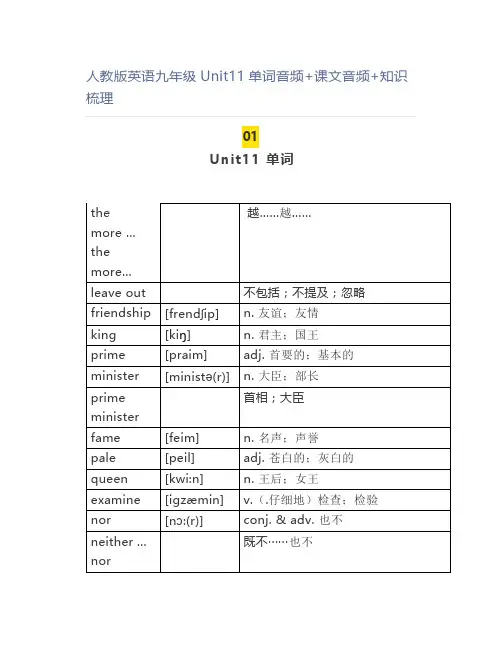
人教版英语九年级Unit11单词音频+课文音频+知识梳理03U n i t11知识梳理【重点短语】1. make me sleepy 使我困倦2. drive sb. crazy 使……发疯3. the more…, the more 越……越……4. yes and no 好坏参半5. be friends with sb. 是某人的朋友6. feel left out 感觉被忽视7. sleep badly 睡眠很差8. don’t feel like eating 不想吃东西9. for no reason 毫无理由10. neither…nor… 既不……也不……11. let …down 使…...失望12. take one’s position 替代我的职位13. to start with 起初14. get the exam result back 取考试成绩单15. find out 发现16. remain unhappy forever 仍旧永远不幸福17. a shirt of a happy person 一件快乐人的衬衫【重点句型】1. --I’d rather go to Blue Ocean because I like to listen to quiet music while I’m eating.--But that music make me sleepy.--更愿意到蓝海洋餐厅,因为我喜欢在吃饭时听轻音乐。
--但那种音乐使我困倦。
2. Waiting for Amy drove Tina crazy.等候艾米使蒂娜发狂。
3.The movie was so sad that it made Tina and Amy cry.这部电影是如此悲伤以致使蒂娜和艾米都哭了。
4.Sad movies don’t make John cry. They just make him want to leave quickly.悲伤的电影没有让约翰哭他们只能使他想尽快离开。
人教版英语九年级全册Unit11单元重点知识和短语梳理讲解

人教版英语九年级全册Unit11单元重点知识和短语梳理讲解重点知识讲解温故feel like★feel like意为“想要”时,后面跟名词、代词或动词-ing形式。
★feel like doing sth.的同义短语是would like to do sth.或want to do sth.。
【运用】汉译英今天下午我妹妹想看电影。
_____________________________________________知新1. would rather★would rather 意为“宁愿;宁可”,主语为人称代词时,常缩写为“'d rather”,后接动词原形。
否定结构为would rather not do sth.,意为“宁愿不做某事”。
如:She would / She'd rather do some reading at home.Matt would rather not buy the car.★would rather常与than连用,构成would rather do sth. than do sth.结构,意为“宁愿做某事而不愿做某事”;如果would rather后面的(短语)动词与than后面的相同,那么than 后面的(短语)动词可以省略。
如:Kevin would rather read books than go to the cinema tonight.Mr. Trent would rather go to the park by bus than (go to the park) by car.【运用】Ⅰ. 单项选择1. —Are you going swimming this afternoon?—I'd rather _______ with you.A. to go shoppingB. go shopingC. to go shopingD. go shopping(2016 甘肃兰州)2. His uncle would rather _______ in the countryside than _______ to the city.A. stay; movingB. to stay; moveC. stay; moveD. to stay; to move(2015 山东烟台) Ⅱ. 汉译英1. 本(Ben)宁愿不搬到一所更大的房子里。
人教版九年级的英语第十一单元学习的知识点的复习模板计划总结计划.doc
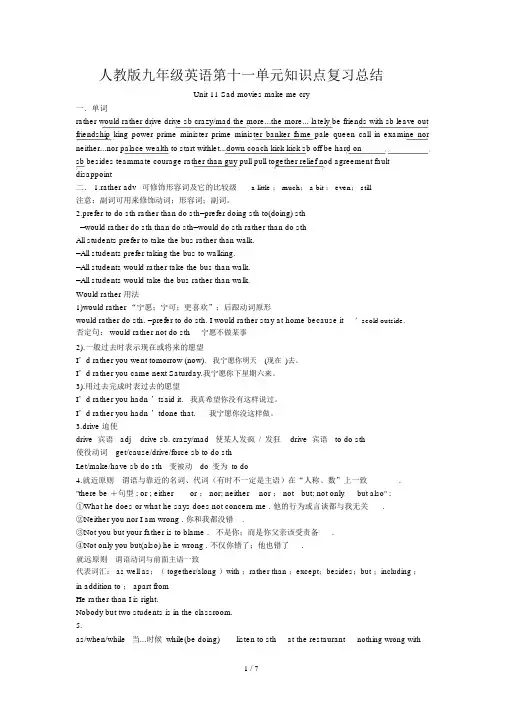
人教版九年级英语第十一单元知识点复习总结Unit 11 Sad movies make me cry一.单词rather would rather drive drive sb crazy/mad the more...the more... lately be friends with sb leave out friendship king power prime minister prime minister banker fame pale queen call in examine nor neither...nor palace wealth to start withlet...down coach kick kick sb off be hard onsb besides teammate courage rather than guy pull pull together relief nod agreement fault disappoint二. 1.rather adv可修饰形容词及它的比较级 a little ; much; a bit ; even; still注意:副词可用来修饰动词;形容词;副词。
2.prefer to do sth rather than do sth=prefer doing sth to(doing) sth=would rather do sth than do sth=would do sth rather than do sthAll students prefer to take the bus rather than walk.=All students prefer taking the bus to walking.=All students would rather take the bus than walk.=All students would take the bus rather than walk.Would rather 用法1)would rather “宁愿;宁可;更喜欢”;后跟动词原形would rather do sth. =prefer to do sth. I would rather stay at home because it’scold outside.否定句: would rather not do sth宁愿不做某事2).一般过去时表示现在或将来的愿望I’d rather you went tomorrow (now).我宁愿你明天(现在)去。
九年级英语第十一单元核心知识总结(整理打印版)
九年级英语第十一单元核心知识总结(整理打印版)九年级英语第十一单元核心知识总结1. Grammar Points本单元的语法重点主要包括:1. 一般过去时:描述过去发生的动作或状态,常与表示过去的时间状语连用。
2. 带有how的感叹句:用于强调某种感受或情况,通常使用“What + a/an + adj. + 名词+ 主语 + 动词!”的结构。
3. 形容词比较级和最高级:用于表示不同级别的比较,形容词比较级结构为“主语+谓语动词+形容词比较级+than+被比较词”,最高级结构为“主语+谓语动词+the+最高级+ 名词”。
2. Vocabulary本单元的重点词汇主要包括:1. Pollution - 污染2. Environment - 环境3. Renewable - 可再生的4. Disappear - 消失5. Damage - 损害6. Species - 物种7. Global warming - 全球变暖8. Warning - 警告9. Protect - 保护10. Reduce - 减少本单元的阅读理解主要讲述了不同环境问题,并提出了解决方法,如减少使用塑料袋、推广可再生能源等。
4. Listening Practice本单元的听力练主要围绕环保话题展开,包括对话、短文等形式。
通过听力练,学生可以提高对于不同口语表达的理解能力。
5. Speaking and Writing本单元的口语和写作练主要聚焦于环保话题,学生需要就某一问题进行讨论,并展开写作练,如写一封信表达对环境污染的担忧和提出改善措施等。
6. Summary九年级英语第十一单元主要以环境保护为主题,包括语法、词汇、阅读、听力、口语和写作练等内容。
通过研究本单元的知识和练,学生可以提高对于环境问题的认识和表达能力,以及培养环境保护意识。
Note: 以上为简要总结,具体内容请参考教材或课堂笔记。
人教版九年级英语Unit11知识点
人教版九年级英语Unit11知识点Unit 11: Science and technologyTechnology has become an integral part of our daily lives, permeating various aspects of society and transforming the way we live, work, and communicate. In the ninth-grade English textbook, we explore the topic of science and technology in Unit 11. This unit not only introduces students to key vocabulary and grammar related to this subject but also encourages critical thinking about the impact of technology on our world.The unit begins by introducing various technological inventions and advancements. Students learn about important inventions such as the telephone, computer, and television. They also explore the concepts of artificial intelligence, virtual reality, and nanotechnology. By studying these inventions, students gain a historical perspective on the development of technology and its influence on society.One important aspect of technology discussed in this unit is communication. In today's interconnected world, the ability to communicate effectively is crucial. The unit emphasizes the importance of developing both verbal and written communication skills in the context of technological advancements. Students learn new vocabularyand phrases related to communication, such as "send an email," "make a phone call," and "compose a text message." They also practice using grammar structures like the present continuous tense to describe ongoing actions, for example, "I am texting my friend."Furthermore, Unit 11 explores the impact of technology on the workplace. With the advent of computers and automation, the job market has undergone significant changes. Traditional jobs have been replaced by machines, requiring individuals to acquire new skills and adapt to the evolving work environment. The unit encourages students to think critically about the future of work and the importance of continuous learning.Another interesting topic covered in this unit is the influence of technology on entertainment and leisure activities. Students learn about various forms of entertainment, such as video games, movies, and music, and how technology has revolutionized these industries. They also discuss the advantages and disadvantages of technology in terms of its impact on personal relationships and mental well-being.Lastly, the unit delves into the ethical considerations surrounding technology. Students are encouraged to think about the potential dangers and ethical dilemmas associated with technologicaladvancements. Questions like "Is it ethical to clone animals?" and "Should robots have legal rights?" challenge students to consider the societal implications of technology and develop their own opinions on these complex issues.In conclusion, Unit 11 of the ninth-grade English textbook offers an in-depth exploration of science and technology. By examining various aspects of technology, from its historical development to its impact on communication, work, and entertainment, students gain a comprehensive understanding of this important subject. The unit not only enhances students' English language skills but also encourages critical thinking and reflection on the role of technology in our lives.。
人教版九年级英语第11单元知识点
人教版九年级英语第11单元知识点1.宾语从句宾语从句在复合句中作主句的宾语。
①由连接词+主语+谓语构成常由下面的一些连接词引导:②由that引导表示陈述意义that可省略He says (that) he is at home.他说他在家里。
③由if。
whether引导表示一般疑问意义(带有是否、已否、对否等)I don’t know if / whether Wei Hua likes fish.我不知道XXX是否喜欢鱼。
④由连接代词、连接副词(疑问词)引导表示特殊疑问意义Do you know what he wants to buy?你知道他想要买什么吗?⑤从句时态要与主句一致当主句是一般现在时,从句根据情况使用任何时态He says (that ) he is at home.他说他在家里。
I don’t know (that) she is singing now.我不知道她正在唱歌。
She wants to know if I have XXX.她想要知道我是否已经完成了我的作业。
Do you know when he will be back?你知道他将会什么时候回来?当主句是普通曩昔时,从句应使用曩昔某时态(普通过去时,过去进行时,过去将来时,过去完成时)He said (that) he was at home.他说他在家里。
I XXX’t know that she was singing now.我不知道她正在唱歌。
XXX to know if I had XXX.她想要知道我是否已经完成了我的作业。
Did you know when he would be back?你晓得他将会甚么时分回来?2.getv.获得、买、抵达3.make a XXX call打电话4.save money省钱、存钱5.①问路常用的句子:Do you know where…is。
Can you tell me how can I get to…?Could you tell me how to get to…?②Can/Could/Will/Would you please tell me sth.表示十分客气地询问事情③Could you tell mehow to get to the park?请你告诉我怎么才能去邮局好吗?中的how to get to the park是疑问词与动词不定式连用,用作宾语,但不是宾语从句,可是相称于how I can get to the park(宾语从句)如:I don’t know how to solve the problem.==Idon’tknow how I can solve the problem.我不知道如何解决这个问题Can you tell me when to leave?==Can you tell me when I ill leave?你能告诉我什么时候离开?6.日常交际用语:take the XXX主动扶梯到…楼turn left / right === take a left / right向左/右转go past颠末go XXX向前直走7.next to旁边、紧接着如:Lily is next to Ann.莉莉就在安的旁边。
人教版英语九年级全册单元unit11知识点+测试卷+思维导图
⼈教版英语九年级全册单元unit11知识点+测试卷+思维导图Unit 11 Sad movies make me cry.1.重点词汇:friendship, king, queen, palace, power, wealth, lemon, weight, shoulder, goal, coach, courage, agreement, examine, kick, pull, nod, disappoint, pale, grey...2. 短语归纳:1. make me sleepy 使我困倦2. drive sb. crazy 使……发疯3. yes and no好坏参半4. be hard on sb. 对某⼈苛刻;对某⼈要求严厉5. be friends with sb. 是某⼈的朋友6. feel left out 感觉被忽视7. feel like doing sth. 想要……8. for no reason毫⽆理由9. neither…nor…既不……也不……10. take one’s position/place 替代某⼈的职位11. search for 搜寻,寻找12. let...down 使……失望13. kick sb. off 开除某⼈14. support each other 相互⽀持15. rather than 并⾮,⽽不是16. pull together齐⼼协⼒,团结⼀致17. nod in agreement 点头同意18. lose the competition 输了竞赛3. 必背典句:1. The loud music makes me nervous. ⼤声的⾳乐使我紧张。
2. Money and fame don’t always make people happy. ⾦钱和名誉并不总是让⼈快乐。
3. She said that the sad movie made her cry. 她说那部悲伤的电影让她哭了。