
人教版高一必修二UNit3Reading
hard disk
2 6
screen
3 CD-ROM
5
mouse
4
keyboard
1. Look at these pictures. In pairs discuss what they have in common. 2. What do they tell you about the development of computers? 3. What do you think will be the next development?
9. Who was the first person to devise the first computer?
Charles Babbage invented an
analytical machine in 1822. 10. Who was the computers’ real father?
2) My real father, Alan Turing, …
3) I was always lonely standing there by
myself, until in early 1960s they gave me a family connected by a network.
1. Where were you in 1642?
人教课标 高一 必修 2 Unit 3
Heavy!
Difficult!
Hard!
Tired!
Easy!
Fast! Free!
keyboard
mouse speaker
monitor
modem
scanner hard disc printer USB flash disc
Label each part.
1. What is PC? Speak the name on the
whole. It means: personal computer.
2. What is IT?
Information Technology.
3. What is CD-ROM? Compact disc read-only memory.
4. What is PDA?
Personal digital assistant.
5. What is W.W.W? World wide web. 6. 科学技术。 Science and technology. 7. 人工智能。 Artificial intelligence. 8. 笔记本电脑。 Notebook computer.
ห้องสมุดไป่ตู้
What’s next?
我是谁
随着时间的推移我被改变了很多。在1642年 的法国,我是作为一个计算机器而开始的。 虽然我很年轻我可以简化一些计算题。在我 被Charles Babbage改造成分析机器之前我 很慢的发展了接近两百年。之后我被一个操 作员用带洞的卡调制成了可以合逻辑地思考 并且比任何人都快地得出一些问题的答案。 那是一个被成为技术改革的时候并且开始了 我的人造智能。
1970s Computers were used in offices and homes. now Computers connect people all
over the world together.
Read the passage again and complete the chart below.
Homework
Retell the text according to the following clues and then write down your retelling.
Changes of the machine
Calculating machine Analytica l machine
The first generation (1945-1956)
The history of computers
the second generation (1956-1963)
the fourth generation (1971- )
the third generation (1964-1971)
从1970年起很多新的应用为我而被
发明。我在交流,金融和贸易方面 变得重要。我同样被放进遥控装置 中被用来制造移动电话也帮助医学 手术。我已经被放进太空火箭并被 送去探测月亮和火星。即使如此, 我的目的是为人们提供高质量的生 活。我现在充满快乐应为我成为了 人类种族中的一个忠心的朋友和帮 助者。
1822 The analytical machine was
1936
The computer grew rapidly both in size and in brainpower.
Computers had grown as large as 1940s a room. The first family of computers was 1960s connected to each other.
Paragraph 1 Topic
Paragraph 2 These changes only became
Over time I changed quite
a lot.
sentence have been
possible as my
memory
improved.
Paragraph 1 Calculating Support machine ing Analytical machine details Universal machine PC laptop
这些变化只因为我记忆力的增强。 开始记忆被存放于电子管里,然后 是晶体管和后来更小的晶片。因此 我改变了我的整个外型。随着我慢 慢变老我也慢慢的变小。随着时间 推移我的记忆力发展的那么快,像 头大象,我不会忘记任何我曾被告 知的东西!
而且我的记忆力变得如此的大以至
于我都不敢相信!不过我总是自己那 么孤单的站在那里,直到1960年他 们通过网络给了我一个家庭关系。 我能够通过万维网和其他的电脑分 享我的知识。
Alan Turing.
How computers have
changed our lives?
List of uses of
computers emails
What people did before
computers write letters typewriter
word processing write by hand or search for information look in encyclopedia, library, etc
4. What happened to you in the 1970s?
I have been used in offices and homes.
Read the passage and finish the timeline.
1642
The computer began as a calculating machine. made by Charles Babbage.
In France. 2. What happened to you after nearly two hundred years? I was built as an Analytical Machine by Babbage.
3. What were you called in 1936?
A universal machine.
在1936年我真正的父亲Alan Turing写了一 本关于我如何像普遍的机器一样去解决任何 困难的数学问题的书。从那起,我在体积和 智能方面快速的发展。在1940年我变得像一 个房间一样大,并且我想知道我是否还能变 得更大。然而,事实也在困扰着我的设计者。 随着时间的推移,我被制的更小。首先是个 人电脑再到后来的手提电脑,在1970年我已 经开始被用在办公室和家里。
List of uses of
What people did before
computers
watch DVDs
computers
go to the cinema and put into files and folders
store information write everything down
Paragraph 2 tubes transistors chips network World Wide Web
Paragraph 3
Topic sentence Since the 1970s many new applications have been found for me.
* communications *finance * trade *robots Supporting * mobile phones details * medical operations * space rockets * providing a life of high quality
Network times Tubes Large ____________ Transistors Small Small chips Develo _____________ Narrow Communication pment __________ Finance Applications ________ Trade Robots Wide Mobile phones Medical operations _______________ Space rockets Memory ________ stored in
新人教版高一英语必修二Unit3 Reading(课堂PPT)
Computers
Reading
1
Learning Aims
1. To learn about something about computers.
2. Reading and understanding, catching the history and information of the passage“who am I ?”.
9
Careful reading
10
Match the main ideas and the paragraphs.
Para 1:
These changes only became possible as my memory
Para 2:
improved. Since the 1970s many new
6. the part of computer that we can put a CD in
screen keyboard mouse monitor DVD-ROM hard disk
5
Reading
WHO AM I?
6
Skimming to get
general ideas
7
Skimming
8
Skimming
Reading Comprehension II
Look at these inventions. Can you put them in an order according to the time when they appeared?
( 2 ) analytical machine ( 5 ) laptop ( 1 ) calculating machine ( 6 ) robot ( 4 ) PC ( 3 ) universal machine
21新人教高中英语必修二Unit3ReadingforWriting-Writeablogpost
Read through three topics on page 33 and choose one topic to write about.
Introduction
Tell the reader about yourself and what you know about the topic.
Version 2 Hello, everyone. I’m a senior high school student. Today I want to blog about something that I think is very important. Unfortunately, I know about the topic well because I made a silly mistake. That was to make my email password “password123”! About six months ago, someone hacked my email account. That means they found out my password, then tried to use my account to take money from me and sent viruses to all my contacts! Luckily my friend told me when she got a strange email from me, so I changed my password immediately. I read about how to make a good password. A good one should have a mixture of both upper case (large capital) letters and lower case (small) letters, numbers and other characters. It also should not be a name or date or anything someone can guess. It should be completely random, that is, it shouldn’t make sense! Although it can be hard to remember lots of complicated passwords, it is worth it! These days you can also use a password manager. This is a special program that helps you manage passwords for all your different accounts. Although I hope nothing similar has happened to my readers, please comment if you have had a similar experience or if you have any more good ideas about making your passwords super safe! Catch your later!
人教版高一英语必修二Unit3 Reading课件
2. Quesቤተ መጻሕፍቲ ባይዱions
Q1: How did the computer work as an Analytical Machine? The computer followed instructions from cards with holes.
Q2: In how many ways do we say the computer changed? What are they? • Size: smaller
1970s Computers were used in offices and homes.
now Computers connect people all over the world
together.
True or False
1. Alan Turing built an Analytical Machine to
1936 Alan Turing wrote a book to describe how
computers could be made to work.
1940s Computers had grown as large as a room.
1960s The first family of computers was connected to each other.
Sample questions:
……
➢ What do you like to eat? ➢ What are your hobbies? ➢ What is your newest
function(功能)? ➢ Can you say something
about your future plan? etc.
人教版高中英语必修二教案:Unit3+Reading
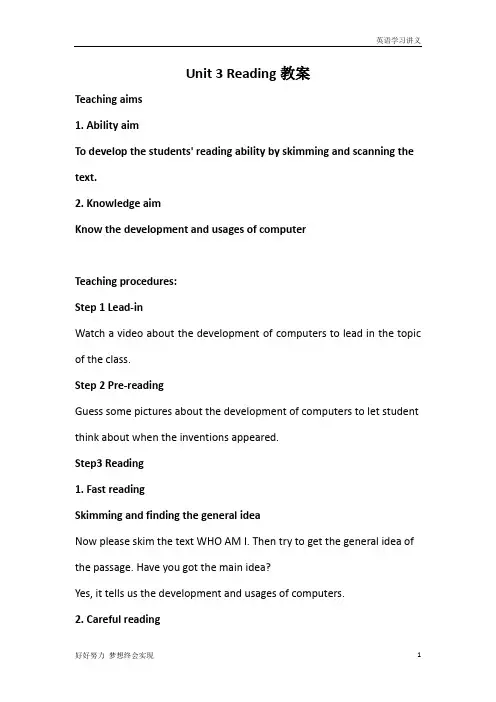
Unit 3 Reading教案Teaching aims1. Ability aimTo develop the students' reading ability by skimming and scanning the text.2. Knowledge aimKnow the development and usages of computerTeaching procedures:Step 1 Lead-inWatch a video about the development of computers to lead in the topic of the class.Step 2 Pre-readingGuess some pictures about the development of computers to let student think about when the inventions appeared.Step3 Reading1. Fast readingSkimming and finding the general ideaNow please skim the text WHO AM I. Then try to get the general idea of the passage. Have you got the main idea?Yes, it tells us the development and usages of computers.2. Careful readingListening to the tape and scanning the passageTo know the content of the interview and finish task 2, 3, 4, 5. Each group finishes a task.Task 2 Choose the best answer and fill in the chart1. “I” in the passage refers to _____.A. A TV setB. A computerC. A radioD. The internet2.When was the biggest computer?A.In 1642B. In 1936C. In the 1940sD. In the 1970s3. Who was the first person to make the earliest computer?A. Alan TuringB. Charles BabbageC. Charles TuringD. Charles Alan.4.When was the universal machine built?A.In 1822.B. In 1642.C. In 1936 .D. In 1940.Task 3 Decide whether they are true or false and fill in the chart1. After I got my new transistors in the 1960s, I became smaller but cleverer and quicker.2. My shape wasn't changed.3. Since the 1970s, the first family of computers was connected to each other.Task 4 Read Para 3 and then answer the following questions and fill in the chart1. What are the new applications of the computer?2. What roles do computers play in the life of human beings?Task 5 Summary of the passageRead and finish the timeline below.Step 4 Post reading1. DiscussionWhat are the advantages and disadvantages of computers nowadays?3.Make a conversationTo use the passage in a practical way to improve students’ pronunciation, stress, rhythm and intonation.Please talk about the advantages and disadvantages of the computers with your partner.Step 5 Summary1Know more knowledge about the development and usages of computers.2Know the advantages and disadvantages of computers.Step 6 Homework1. Review the text and the new expressions.2. Pick out the sentences with the present perfect passive voice in the text.。
人教版高中英语必修二课件:Unit3 Reading
4. How old is the computer? A A. About 370 years old B About 270 years old. C. About 170 years old. D. About 470 years old.
5. What can you infer from the text? B
3. After I got my new transistors, I became smaller but cleverer and quicker. T
4. I was brought into people’s homes in the 1970s. T
5. Since my birth I have been built to take the place of human race. F
network. C. It began to be put into space rockets D. It began to be used in the offices.
9. Which is the right order? D a. The computer was connected with other computers. b. Alan Turing wrote a book about the computer. c. The computer has been sent to explore the Moon and Mars. d. The computer began to simplify difficult sums. A. a, b, c, d. B. b, c, a, d. C. d, a, c, b. D. d, b, a, c.
7. When was the universal machine built? A. In 1822. B. In 1642. C C. In 1936 . D. In 1940.
新人教版高一英语必修二Unit3-Reading
applications have been found
Para 3:
for me. Over time I have been
changed quite a lot.
Scanning to get
detail information
Scanning
Reading Comprehension III
Scanning
5. I began as a calculating machine in Japan in 1642.
6. In 1936, I grew rapidly both in size and in brainpower.
7. As time went by, I was made bigger. 8. Since the 1970s many new
3.Functional item, how to tell the history about the computer.
Warming up
Can you give me the English names of a computer components (组件) Tips: 1. We can use a computer to …
Scanning
Reading Comprehension V
Finish the timeline below.
The computer began as a calculating machine.
1936
The computer grew rapidly both in size and in brainpower.
2. It is made up of some parts, such as…
高一英语必修二Unit3Reading课件
总结词
掌握时态、语态和语气等语法点
详细描述
学生需要掌握英语中常用的时态,如现在时、过去时、将来时等,以及语态(主动语态和被动语态)和语气(陈述语气、祈使语气和虚拟语气)的用法。这些语法点在英语句子中起着重要的意义和作用。
VS
能够分析复杂句子的结构
详细描述
学生需要具备分析复杂句子的能力,能够识别出主句、从句以及从句的类型(名词性从句、定语性从句、状语性从句),理解句子中的主次关系以及各成分在句子中的作用。这种能力有助于提高学生的阅读理解能力和写作表达能力。
1. in particular
used to refer to the whole group or category; on the whole.
2. in general
1. It is no exaggeration to say that ...
used to emphasize that what is being said is true or accurate, even though it may seem extreme or exaggerated.
03
To develop reading comprehension and critical thinking skills through close reading and analysis of selected texts.
04
To apply the knowledge gained to personal and academic contexts, making connections between theory and practice.
The article is divided into five main sections: introduction, reading strategies, vocabulary development, application and conclusion.
高一英语必修二Unit3Reading课件
故事最终如何收尾,有没有给我们带来一些启 示和教训?
阅读技巧和策略
1 预览文本
在阅读前,预览文本的标 题、段落和插图,了解大 致内容。
2 关注重要信息
在阅读过程中,关注并标 记重要信息,如关键词、 主题句和关联词。
3 提炼主旨
通过理解每个段落和主要 细节,提炼出文章的主旨 和核心观点。
主要文章内容总结
背景介绍
• 文章讲述了一个真实的 故事。
• 情节发生在一个小镇上。
人物介绍
• 主人公是一位年轻的女 学生。
• 她和一位老人之间建立 了特殊的关系克服了困难。
• 她从老人身上学到了重 要的生活经验。
课文的语言点和主题
1
语言点
课文中使用了丰富的词汇,如比喻和隐喻。
2
主题
主题涉及成长、友谊和人生价值观。
3
探索
通过课文可以引导学生思考生活中的重要问题。
课堂练习及作业要求
1 小组讨论
学生可以分组讨论课文中的问题和观点。
2 口头表达
学生可以准备课堂演讲,分享自己对课文的理解和看法。
3 书面作业
学生需要完成与课文相关的书面作业。
高一英语必修二 Unit3Reading课件
本课件旨在帮助高一学生更好地理解Unit 3 Reading的内容,包括阅读技巧和 策略,课文分析和解读,以及课文的语言点和主题。
课文分析和解读
标题
课文的标题是什么,给我们什么提示?
情节发展
课文的情节如何发展,有哪些关键事件和转折 点?
主要人物
主要人物有哪些,他们的特点和关系是怎样的?
2019人教版高中英语必修二Unit3 Reading and Thinking 教学设计
文本解读
该文本是叙事性语篇,讲述了英国伯明翰一位叫简的老师,因为突发疾病被迫辞职后失业在家,借助互联网摆脱了孤独和无聊,并得到了网友的支持和帮助。受到网友激励的简,又主动帮助像她一样急需帮助的人。从表层意义上讲,文本向读者讲述了互联网是如何改变人们生活的;从深层意义来看,该文本想进一步表达互联网带给人与人之间的“连锁反应”。全文共5段,结构清晰。
Activity3: Read for detailed information
Para1:What benefits do the Internet bring us?
Q1: What benefits do the Internet bring us?We no longer….we can…we can….
Q3. What is the function of the last sentence “People's lives have been changed by online communities and social networks?What might be written in the followingparagraph?
Q2. But the Internet has done much more for people than simply make life more convenient. What does “but” imply? Pay attention tosignpost such as“but”while reading a passage.
2. make out Jan’s changes incareers, feelings andsocial roles and even change other people’s lives;
高一【英语(人教版)】Unit3 The Internet Reading Thinking(1)
高中英语
Think and share
1. What do you usually do online? 2. Have you experienced anything interesting while surfing the Internet? If so, share it with others.
Look at the title and predict
Stronger Together: How We Have Been Changed by the Internet
main title subtitle
1. What do you think the text will say? I think the text will say that we have been
高中英语
Much has been written about the wonders of the World Wide Web. There are countless articles telling us ... But the Internet has done much more for people than simply make life more convenient. People’s lives have been changed by online communities and social networks. (Paragraph 1)
高中英语
Read and find
2. How did the people in the online community help her?
Jan…suddenly developed a serious illness and had to quit her job. … She also joined an online group where she could talk about her problems and get support and advice from others. … (Paragraph 2)