
外研版五年级下册英语重点句(3起)
五年级下册英语重点句
班级____________ 姓名____________
1.Life was very different in China many years ago.
2.How was it different?
There weren’t any buses. we lived in a small house.
3.How about now?
There are lots of buses and cars. We live in a big house.
4.She didn’t have a television or a radio.
5.Why is she wearing these clothes? Because she was a dancer .
She danced in lots of Chinese city.
6.Did your grandma learn English? Yes ,she learned English.
7.He’s learning English now.
8.Ten years ago ,Mr. Li was a teacher .
Now ,Chen Hai is teaching Mr. Li.
9.What did she have for breakfast? She had eggs and sausages .
10.And what did she have for dinner? She had fish and chips.
11.What are you going to drink tonight? I’m going to drink milk.
12.Sam ate six hamburgers.
13.Where are the books about computers ,please? They’re on Shelf C.
14.Can I have your library card ,please? Yes ,here you are.
15.Please bring back the book in two weeks’ time. Yes ,we will.
16.Let’s go to the library .we can find a book about computers there.
17.Where can you find out about animals? In the library.
18.You can find out about train information in this time table.
19.This blue one is big and light. It’ll be easy for her to take.
20.It’s got two pockets.
21.Have you got a small one ,please?
22.This is Xinjiang. It’s in the west of China.
23.I went there last year.
24.When did you go to Xinjiang? We went there in July.
25.Did you go with your mother and father? Yes ,I did.
26.We stayed with my grandmother for a week in July.
27.He lives there with his three children.
28.It’s in the north of China. It’s in the south of China.
29.Where did you go for your holidays? I went to Yinchuan.
30.What’s an email, Amy? It’s a computer message.
It goes from one computer to another computer.
31.Let’s send an email to Dad.
32.Click on “Email”. Click on “Write” .
Write your message . Click on “Send”.
33.I will be home at seven o’clock.
34.I want to buy a present for my brother.
35.What do you suggest?
What about chopsticks?
Why don’t you give him a kite?
How about a dragon kite?
36.Is line A the same as line B?
st week we went to children’s theatre.
38.We are going to see you in three weeks.
39.The men wore women’s clothes.
40.The actors told lots of jokes. We laughed a lot.
41.Where are you going to go?
42.What are you going to take?
43.When are you going to go to the airport?
44.Who’s going to go to the airport?
45.I’m in New York now.。
2023外研版五年级英语下册(三起)3It's big and light

At the department store
1. How many bags do they see?
They see three bags.
2. What colours are the bags?
They are black, green and blue.
3. Which one do they take?
It’s hard to fly a kite. It’s nice to ride a bike.
Her bag is broken .
broken
Department Store
At the department store.
1. How many bags do they see? 2. What colours are the bags? 3. Which one do they take?
《英语》(新标准)(小学三起) 五年级下册M5U1
Unit 1
It’s big and light.
Tom is flying a kite.
Amy is riding a bike.
It’s big. It’s light.
It’s blue. It’s white.
Let’s watch and fill.
4
green
red
The green bag is heavy.
The red bag is light.
Try to describe your bags.源自13 24
5
6
My bag is… (black, white, pink, blue…) It’s… (big, small, light, heavy, broken, old, new… ) It’s got… (pockets, wheels, books, bike, cat…)
2023外研版五年级英语下册(三起)4We lived in a small house

Module 1 Unit 1 We lived in a small house.
Let's Learn the Words!
programme 节目
eg: The programme is amazing!这个节目令人惊叹不已!eg: I want to watch the programme about the Great Wall.我想看那个关于 长城的节目。
Check Now!
1. pr_gramme2. diff_rent3. intervie_er4. eno_gh5. sm_ll6. l_fe7. a_o
Answers:
1. programme2. different3. interviewer4. enough5. small6. life7. ago
2. How many cats were there on the chair then.
There is only one.
There were two cats.
Read and answer.
listen and repeat.
Lingling is still in the UK with Sam and Amy. Amy: Look, Lingling! It's a programme about China. Come and watch! Lingling: I'm coming! Old lady: Life was very different in China many years ago.Interviewer: How was it different? Old lady: We lived in a small house. We didn't have enough food. There weren't many buses. There weren't any televisions.
小学英语外研版(三起)五年级下册知识点整理
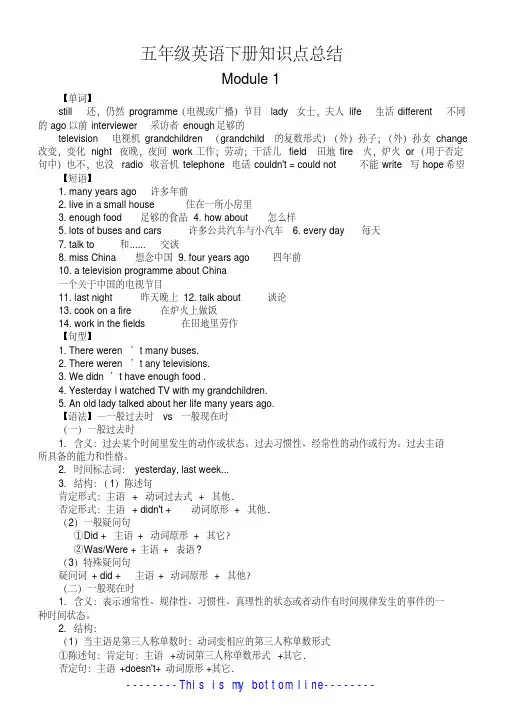
五年级英语下册知识点总结Module 1【单词】still还,仍然 programme(电视或广播)节目 lady女士,夫人 life生活different不同的ago以前interviewer采访者enough足够的television电视机grandchildren(grandchild的复数形式)(外)孙子;(外)孙女change 改变,变化night夜晚,夜间work工作;劳动;干活儿field田地fire火,炉火or(用于否定句中)也不,也没radio收音机telephone电话couldn't = could not不能write写hope希望【短语】1. many years ago 许多年前2. live in a small house 住在一所小房里3. enough food 足够的食品4. how about 怎么样5. lots of buses and cars许多公共汽车与小汽车6. every day 每天7. talk to 和......交谈8. miss China 想念中国 9. four years ago 四年前10. a television programme about China一个关于中国的电视节目11. last night 昨天晚上 12. talk about 谈论13. cook on a fire 在炉火上做饭14. work in the fields 在田地里劳作【句型】1. There weren’t many buses.2. There weren’t any televisions.3. We didn’t have enough food .4. Yesterday I watched TV with my grandchildren.5. An old lady talked about her life many years ago.【语法】—一般过去时 vs 一般现在时(一)一般过去时1. 含义:过去某个时间里发生的动作或状态。
(三起)外研版五年级下英语Module4重点句型和短语
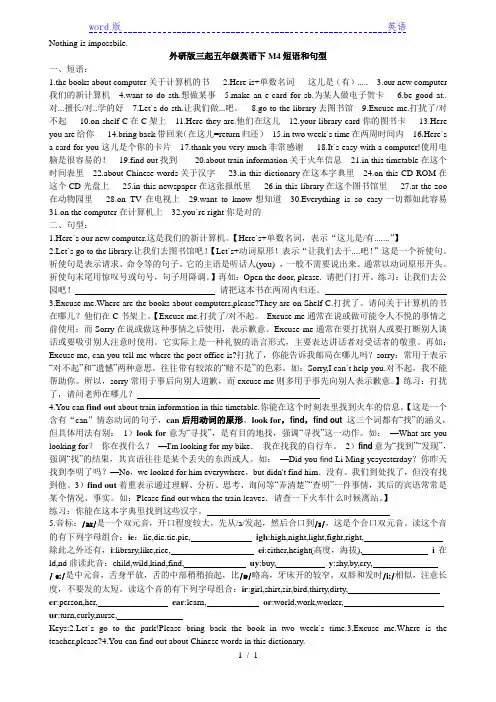
word版英语Nothing is impossbile.外研版三起五年级英语下M4短语和句型一、短语:1.the books about computer关于计算机的书2.Here is+单数名词这儿是(有).....3.our new computer 我们的新计算机4.want to do sth.想做某事5.make an e-card for sb.为某人做电子贺卡6.be good at..对...擅长/对..学的好7.Let`s do sth.让我们做...吧。
8.go to the library去图书馆9.Excuse me.打扰了/对不起10.on shelf C在C架上11.Here they are.他们在这儿12.your library card你的图书卡13.Here you are给你14.bring back带回来(在这儿=return归还)15.in two week`s time在两周时间内16.Here`s a card for you这儿是个你的卡片17.thank you very much非常感谢18.It`s easy with a computer!使用电脑是很容易的!19.find out找到20.about train information关于火车信息21.in this timetable在这个时间表里22.about Chinese words关于汉字23.in this dictionary在这本字典里24.on this CD-ROM在这个CD光盘上25.in this newspaper在这张报纸里26.in this library在这个图书馆里27.at the zoo 在动物园里28.on TV在电视上29.want to know想知道30.Everything is so easy一切都如此容易31.on the computer在计算机上32.you`re right你是对的二、句型:1.Here`s our new computer.这是我们的新计算机。
(完整版)外研版小学英语五年级下册知识点梳理

外研版(三年级起)新标准英语五年级下册知识点梳理Module 1单词:still /stɪl/ 还,仍然programme /’prəʊgræm/ (电视或广播)节目lady /’leidi/女士,夫人life /l aɪf/ 生活(knife wife wide kite nine nice)different /’dɪfrənt/ 不同的(difference)ago /ə’gəʊ/ 以前(about arrive)interviewer /,ɪntə’vj U:ə/ 采访者enough /ɪ’nʌf/ 足够的(country )television /,telɪ’vɪʒən/ 电视机change /tʃændʒ/ 改变,变化night /n aɪt/ 夜晚,夜间(light high)work /wɜ:k/ 工作;劳动;干活儿field /f i:ld/ 田地fire /f aɪə/ 火,炉火(tired retired)or /ɔ: /(用于否定句中) 也不,也没radio /’r eɪd ɪəʊ/ 收音机telephone /’telɪfəʊn/ 电话couldn`t=could not /kʊndt/ 不能write /r aɪt/ 写(right)hope /həʊp/ 希望短语:1. many years ago 许多年前2. live in a small house 住在一所小房里3. enough food 足够的食品4. how about 怎么样5. lots of buses and cars许多公共汽车与小汽车6. every day 每天7. talk to 和……交谈8. last night 昨天晚上9. talk about 谈论10. cook on a fire 在炉火上做饭句子:1.There was(were)+某人或某物+某地2.过去式:We didn’t have enough food .肯定句:主语+动词过去式+其他否定句:主语+be动词过去式+not+其他或主语+did not+动词原形+其他Module 2单词:learnt(learn的过去式)/lɜ:nt/ 学习taught (teach的过去式) /tɔ:t/ 教,讲授language /’læŋgwɪdʒ/ 语言wrote (write) /rəʊt/ 写dancer /’dɑ:nsə/舞蹈演员foreign /’fɔ:rɪn/ 外国的studied (study的过去式) /’stʌdi/ 学习hard /hɑ:d/努力地(park dark card)短语:1. in lots of Chinese cities在许多中国城市2. foreign language 外语3. learn English 学习英语4. in his class 在他的班级5. study hard 努力学习6. an English teacher 一位英语老师7. walk to school 走路去学校8. by school bus 乘坐校车句子:1. 询问他人做过某事的句型及回答Did+主语+动词原形+其他Did she learn any foreign languages? Yes ,人称代词主格+did.No ,人称代词主格+didn’t.2. 描述他人做过某事:She learnt English.3.描述他们现在在做某事:主语+be+动词ing+其他He is learning English now .Module 3单词:hamburger /’hæmbəgə/ 汉堡English /’ɪŋglɪʃ/ 英国(式)的breakfast /’brekfəst/早餐,早饭lunch /lʌntʃ/ 午餐,午饭sandwich /’sændwɪtʃ/ 三明治fish and chips/fɪʃtʃɪps/ 炸鱼加炸薯条traditional /trə’dɪʃənəl/ 传统的dish /dɪʃ/ 食品;菜肴gave(give的过去式)/g eɪv/ 给tonight /tə’naɪt/ 今夜,今晚短语:1. very much 很,非常2. an e-mail from Lingling一封来自玲玲的电子邮件4. about English food 关于英国食物5. have an English breakfast吃了一顿英式早餐6. have …for lunch 吃…作为午餐7. a traditional English dinner一顿传统的英式晚餐8. give …to … 把……给……9. at school 在学校句子:1.描述吃过某些食物:主语+ had + 食物名称+ 其他2.询问他人打算吃/喝什么:What are you going to eat/drink ? 3.询问他人三餐吃了什么:What + did + 主语+have+for breakfast / lunch / dinner ?Module 4单词:library /’l aɪbrəri/ 图书馆student /’stj U:dənt/ 学生sent(send的过去式) /sent/ 发送,寄idea /aɪ’dɪə/ 主意,想法put /put/ 放,安放heavy /’hevi/重的,沉的dictionary /’dɪk ʃənəri/ 词典;字典card /kɑ:d/卡片ask /ɑ:sk/邀请wrong /rɒŋ/错误的dear /dɪə/ 哎呀information /,ɪnfə’meɪʃən/ 信息project /’prɒdʒekt/ 项目guide /g aɪd/ 介绍,指南,手册film /fɪlm/ 电影way /w eɪ/方法,方式on关于短语:1. library card 图书卡,借书证2. on Shelf C 在C架上3. as well /æs wel/ 又,还,也句型:1.询问某物在何处及回答的句型:Where are the …about…, please?Where can you find out about …?You can find out … in / on …Module 5单词:light /l aɪt/ 轻的hard /hɑ:d/困难的,费力的department store /dɪ’pɑ:tm əntst ɔ:/百货商店pocket /’pɒkɪt/ 口袋,兜umbrella /ʌm’brelə/ 雨伞sales assistant /s eɪlzə’sɪstənt/售货员,营业员wheel /w i:l/ 轮子easy / i:zi/ 容易的,不费力的take /t eɪk/ 选择要,选择购买too /t U:/ 太,过于try /tr aɪ/ 试,尝试lovely /’lʌli/ 美丽的,可爱的;令人愉快的短语:1. at the department store 在百货商店2. buy you a new one 给你买一个新的3. be easy for you 对你来说很容易4. be too…for…对…来说太…5. take…to… 把…带到…句型:1. 描述事物特征的句型:It’s get……(big反义small,heavy反义light,easy反义hard)2. 表达看法:It’s + 形容词+ for +人称代词宾格Module 6单词:moon /m U:n/ 月亮,月球get /get/ 到达west /west/ 西,西部,西方;向西方parent /p eərənt/ 母亲;父亲;家长stay /st eɪ/ 停留(play day say)July /dʒʊ’laɪ/ 七月south /s aʊθ/南,南部,南方;向南方remember /rɪ’membə/ 记得June / dʒ U:n/ 六月east / i:st/ 东,东部,东方;向东方best /best/ 最好的north /nɔ:θ/北,北部,北方;向北方rest /rest/ 休息rode(ride的过去式)/rəʊd/ 骑短语:1. have a rest 休息一下2. of course 当然3. in the west of China 在中国的西部4. go there 去那儿5. last year 去年6. stay with 和……呆在一起7. in July 在七月8. every year 每年9. Li people 黎族人10. ride a horse 骑马句型:1.用方位词表达地点:It’s in the north / south / east / west of…Module 7单词:evening /‘ɪvənɪŋ/傍晚,晚上late /l eɪt/近日暮的;近深夜的;时间不早的worker /’wɜ:kə/ 工人factory /’f æktəri/ 制造厂;工厂early /’ɜ:li/ 早的taxi /’t æksɪ/ 出租车,计程车quarter /’kwɔ:tə/ 一刻钟to(距整点)差......worry /’wʌri/ 焦虑,担心短语:1. go to work 上班2. be home 在家句型:1. My father goes to work at eight o’clock every morning.2. What does he do?He’s a policeman/worker.3. What does she do?She’s a taxi driver.4.Will you be home at seven o’clock? Yes, I will. I’ll be home at seven o’clock.5. What time will you be home?I’ll be home at seven o’clock.6.英语时间的表达法:1)整点:8:00——eight o’clock2)分钟小于或等于30,就用past来表示,结构:分钟+ past + 该点钟12:05—— five past twelve9:30——half past nine3)分钟大于30,就用to来表示,结构:分钟+ to + 下一点钟8:40——twenty to nine4)分钟是15,一般用a quarter 来代替fifteen。
完整版)外研版五年级英语下册重点句型和短语

完整版)外研版五年级英语下册重点句型和短语Module 1:重点短语:1.Many years ago - Many years ago。
2.Live in a small house - Lived in a small house。
3.Enough food - Enough food to eat。
4.How about - How about you。
5.Lots of buses and cars - Many buses and cars。
6.Every day - Every day。
7.Talk to - Talked to。
8.Miss China - Missed China。
9.Four years ago - Four years ago。
st night - Last night。
11.Talk about - Talked about。
12.Cook on a fire - Cooked on a fire。
13.Work in the fields - Worked in the fields。
14.Lots of - Many。
15.An old lady - An elderly woman。
16.A programme about China - A program about China.重点句型:1.There was(were)+某人或某物+某地 - There was(were)+ XXX(即there be句型的过去式)如:There XXX’t any buses。
There were no buses。
(any意为“一些”用于否定句)2.XXX food。
- We didn't have enough food to eat.这里的didn’t为助动词,后接动词原形)3.Thank you for talking to us。
- Thank you for talking with us.for是介词,后接动词的ing形式。
外研版(三起)小学英语五年级下册知识点归纳总结
外研版(三起)小学英语五年级下册知识点归纳总结Module 1一、音标ai——[eɪ] ——rain, main, waital——[ɔ:] ——walk, talk, tallar——[eɪ] ——farmer, far, park, partyay——[eɪ] ——play, may, day, sayau ——[ɔ:] ——autumn, August, authorar ——[ɔː] ——warm, quarter, war二、单词still 还,仍旧programme 〔电视或播送〕节目lady 女士,夫人different 不同的ago 以前interviewer 采访者enough 足够的television 电视机grandchildren 〔grandchild 的复数形式〕〔外〕孙子;〔外〕孙女change 转变,变化night 夜晚,夜间work 工作;劳动;干活儿field 田地fire 火,炉火or 〔用于否认句中〕也不,也没radio 收音机telephonecouldn”t = could not 不能hope 期望三、固定搭配live in 住在......watch TV 看电视a small village 一个小村庄talk about 谈论in the fields 在田地里last night 昨天晚上every day 每天enough food 足够的食物lots of 很多a television programme 一个电视节目四、句子1.There are two beautiful cats on the chair. 有两只秀丽的小猫在椅子上。
2.Life was very different in China many years ago. 在很多年前中国的生活对于现在有着很大的区分。
3.We lived in a small house. We didn’t have enough food. There weren’t many buses. There weren’t any televisions. 我们住在小房子里。
外研版(三起)英语五年级下册 全册知识点归纳
Module 1 一、语音知识ai一一一[el]一一-rain, main, waitar一一一[eI]一一一farmer,far, park, part y -play, ma y, day,au一一一[::>: ]一一-autumn, August, author -warm, quait缸,二、动词原形R对应的过去式al一一[::>: ]一一-walk, talk, tall a y一一[e I]一ar一一[:): ]一1.am/is”was2.are-weree -came4.watch -watched5.live-lived6.do-did7.get -get8.talk talked9.飞w ork-worked IO.can-could II.cook-cook巳d12.hav巳-had 13.read-read14.write =wrote IS.miss-missed16扣mp-jumped 三‘词汇still还,仍然programme (电视或广播)节目l ady女士,人life生活different不同的巳nough足够的television电视机式)(外)孙子;(外)孙女闰work工作;劳动;干活儿ago 以前interviewer采访者grandchildren ( grandchild的复数形change改变,变化night夜晚,夜field田地fire火,炉火or (用于否定句中)也不,也没radio收音机1巳lephone电话hope希望couldn’t = could not不能writ巳写四、短i吾Ii v e in住在......watch TV看电视on the chair在椅子上a small village一个小忖庄talk about谈论onl y one只有一个in the fields在田地里last night昨天晚上last night昨天晚上巳very day每天lots of =a lot of 大量,许多enough food足够的食物be different from与......不同on a fir巳在火上on foot步行a pr吨ramme about一个关于....节目thank you for. ..谢谢你......五、句子l.There are two beautiful cats on the chair.高两只漂亮的小猫在椅子上。
外研版新标准-五年级下册-6-10模块重点知识
外研版(三起点)五年级下学期复习重点第六模块学习目标:1.能够表述过去做过的事情。
2.复习描述方位的表达方式。
3.掌握主要语言结构:It’s in the west/south of China.This is Xinjiang.I went there last year.Did you go with your parents?Yes, I did.一、重点单词:get 到达stay停留remember 记得ride (过去式)rode骑(马)best 最好的rest 休息parent父亲,母亲(复数直接加-s)north June 六月w est east July 七月south二、重点短语及知识点:重点短语:st year去年2.of course 当然3. in the west of China在中国的西部4. in July在七月(月份前面用介词in)5. every year每年6. stay with 和…待在一起7. ride a horse骑马8. go swimming去游泳9. live there 住在那里10. go with 和…一起去11. have a rest 休息一下12. climb the mountain 爬山13.have a lovely time 玩得愉快14. Li people 黎族人词形转换:1.go(过去式)went2. do(过去式)did3. stay(过去式)stayed4. ride(过去式)rode5. have(过去式)had6. photo(复数)photos7. live(第三人称单数)lives e(过去式)used9. they(宾格形式)them10. live(第三人称单数)lives11. stay(过去式)stayed12. real(副词)really13. parent(复数) parents14. you(形容词性物主代词)your重点句子:1. How did you get there? 你们是怎么到的那里?2. They are photos of me and my family in China. 他们是我和我的家人在中国的照片。
小学英语外研版五年级下册模块知识点
小学英语外研版五年级下册模块知识点公司内部档案编码:[OPPTR-OPPT28-OPPTL98-OPPNN08]Module 1 Unit 1重点句子:1.She was young in this picture.她在这张照片里很年轻.否定句:She wasn’t young in this picture.一般疑问句:Was she young in this picture2. She was a driver before.她以前是一个司机.否定句:She wasn’t a driver before.一般疑问句:Was she a driver before肯定回答:Yes, she was. / No, she wasn’t.就划线部分提问:What was she before3.He played Chinese music.他演奏中国音乐.否定句:He didn’t play Chinese music.一般疑问句:Did he play Chinese music肯定回答:Yes, he did. / No, he didn’t.就划线部分提问:What music did he play4.I can play the flute, too. = I can also play the flute.我也会演奏笛子.5. She drove a bus.她开公共汽车.就划线部分提问:What did she drive6. He teaches us English.他教我们英语.就划线部分提问:What does he teach us7. She helped children.她帮助了孩子们.就划线部分提问:What did she do重点单词:1. grandma2. picture祖母,奶奶图片,照片3. player 玩家,演奏者,运动员,演员Module 1 Unit 2重点句子:1.My grandpa worked in an office.他在办公室工作.否定句:My grandpa didn’t work in an office.一般疑问句:Did your grandpa work in an office肯定回答:Yes, he did. / No, he didn’t.就划线部分提问:Where did your grandpa work2.My mother works in a hospital.我(de)妈妈在医院上班.否定句:My mother doesn’t work in a hospital.一般疑问句:Does your mother work in a hospital 肯定回答:Yes, she does. / No, she doesn’t.就划线部分提问:Where does your mother work3.My parents work in a factory否定句:My parents don’t work in a factory.一般疑问句:Do your parents work in a factory肯定回答:Yes, they do. / No, they don’t.就划线部分提问:Where do your parents work4.There were no computers like there are today.过去不像今天这样,有电脑.5. I was a teacher before.就划线部分提问:What were you before重点单词和短语:1. office2. factory3. hospital办公室工厂医院4. parents 6. shop 7. in the sun父母商店在阳光下very hard工作非常努力Module 2 Unit 1重点句子:1.I’ve got an email from Lingling. 我收到玲玲发(de)一封电子邮件.2.It’s about English food. 它是关于英国食物(de).3.Yesterday she had an English breakfast. 昨天她吃了一顿英国式早餐.4.She had eggs and sausages for breakfast. 她早餐吃了鸡蛋和香肠.否定句:She didn’t have eggs and sausages.一般疑问句:Did she have eggs and sausages肯定回答:Yes, she did. / No, she didn’t.就划线部分提问:What did she have for breakfast5.It’s a traditional English dinner. 它是一顿传统(de)英国式晚餐.6.She says it’s delicious.否定句:She doesn’t say it’s delicious.一般疑问句:Does she say it’s delicious肯定回答:Yes, she does. / No, she doesn’t.就划线部分提问:What does she say重点单词:1. email2. food3. breakfast4. lunch电子邮件食物(不可数)早餐午餐5. dinner6. sausages7. sandwiches8. chips晚餐香肠三明治薯条9. traditional 10. delicious 11. different传统(de)好吃(de)不同(de)Module 2 Unit 2重点句子:1.English people usually have breakfast at seven o’clock. 英国人通常在7点钟吃早餐.就划线部分提问:What time do English people usually have breakfast2.Sundays are special in England. 在英国每周日是很特别(de).3.Families usually eat lunch together. 家人们通常一起吃午餐.4.They eat chicken, potatoes and vegetables. 他们吃鸡肉,土豆和蔬菜.5.On Fridays, many people eat fish. 在每个周五,许多人吃鱼.6.He has dinner at half past twelve.就划线部分提问:What time does he have dinner7.She has biscuits and noodles.What did she have重点单词:1. England2. usually3. special4. families英国通常特别(de) family(de)复数5. together6. chicken7. potatoes8. vegetable一起鸡,鸡肉 potato(de)负数蔬菜9. want to do sth.想要做某事.10.food食物/ meat肉/ fish鱼肉/ chicken鸡肉这几个词都是不可数名词.Module 3 Unit 1Wordsreturn 归还 computer计算机,电脑 like 喜欢card 卡片,名片 week 星期,周video 录像,视频 shelf架子library 图书馆favourite 特别喜欢(de) return 归还Phrasein China 在中国 on the computer 在电脑上at the library 在图书馆in two weeks 在两周内 library card 借书卡 on shelf 在书架上lend…to… 把…借给…borrow…from… 从…借入本课语法点1. have got/haven’t gothave got是表示“有”(de)意思;什么时候用have got,什么时候用has got 取决于主语,如果主语是第三人称单数,就用has got,其它(de)就用have got.如果要对have/has got表示否定,只须在have/has后加上not即可,have not可以缩写成haven’t;has not可以缩写成hasn‘t.2.Have…got /Yes/NoHave got(de)—般疑问句是: Have/Has sb got…如: Have you got a sandwich你有一块三明治吗具体是用have还是用has就由sb(de)人称决定. Have you got…是—般疑问句,回答要用yes和no.Module 3 Unit 2Wordsborrow 借入;借来zoo动物园 wear 穿着bookshop 书店 school 学校 talk 谈话,讲话hear 听说,听到park 公园 friend 朋友type n.类型,品种 v.打字Phraselots of 很多,大量 talk to sb. 对某人说话use the computer 使用电脑 borrow books借书do your homework 做你(de)家庭作业English libraries 英国(de)图书馆in a library 在一个图书馆 so much 如此多talk to your friends 和你(de)朋友们交谈lots of stories 很多故事本课语法点1. can/can’tcan是情态动词,这里表示“能,会”(de)意思,用来表示能力,后面接上动词原形,这一点同学们要记住哦.情态动词“can“可以用来表示“会……”,can‘t表示“不会……”(de)意思.2. 学习部分介词(de)用法with是介词,可以表示“用”(de)意思;with还有“和…一起”(de)意思.with后面可以加工具类(de)名词,例如:Cut it with a knife.(用刀切开它.)工具、器具、材料类(de)名词都和with这个介词搭配,表示“用(某种工具)……”.介词for后面接某人,表示动作(de)对象或者接受者,意思是“给……”、“对……(而言)”.当我们表达几点钟(de)时候,我们必须用at.“in”和“at”(de)区别:在英语中at和in都可以作为表示场所(de)介词,但是at表示某地点(表示比较小或狭窄(de)场所),而in表示在某地(表示比较大或宽敞(de)场所)Module 4 Unit 1Wordsfine(身体)很好 sent (send(de)过去式)寄get 收到;接到chocolate 巧克力read 读game游戏 ate (eat(de)过去式)delicious 美味(de) America 美国Phrasecome to 来到 live in 在……居住 last week 上星期a Maths game 一个数学游戏English books 英语书my chocolate 我(de)巧克力 send you 寄给你some books 一些书 this summer 这个夏天本课语法点1.Did…一般过去时(de)一般疑问句.一般疑问句中要用到助动词did,把did提至句首,其他句子结构保持不变.另外,一般疑问句中(de)行为动词也要用原形表示.—般过去时一般疑问句(de)回答.用Yes,…/N0,…来回答,助动词要用did,以保证问句答句时态一致.2.宾格it/them人称代词(de)宾格有:me,us,you,her,him,it,them等.宾格用在动词和介词之后.Module 4 Unit 2Wordsseason 季节 birthday 生日 winter冬天spring 春天 summer 夏天July七月August 八月leaf 树叶 temperature温度,体温 autumn 秋天 sandal 凉鞋 wood 木头,木材glove手套 breeze 微风Phrasefavourite season 最喜爱(de)季节smell good 闻起来味道很好 in the sky 在天空中go swimming 去游泳 play with玩…..,和……一起玩a breeze 一阵微风 fall off 从……跌落in the wood 在树林里 on the tree 在树上(长在树上)in the tree 在树上(不长在树上)the baby ducks 小鸭子们本课语法点1.What is…favorite…What’s your favorite… 这个句型可以用来询问别人最喜欢(de)东西是什么. 2.季节(de)学习3.When…when是特殊疑问词,等于what time,是用来提问时间.what time只用于询问钟点,而when可以用来询问日期、钟点、星期几等.Module 5 Unit 1Wordsbroken 损坏(de),折断(de) green绿色(de) black 黑色(de) really 真正地heavy 重(de) easy简单(de),容易(de) light 轻(de) wheel 轮子 nice 好(de),美丽(de)take 带走,拿走Phraselook at 看着 a new one 一个新(de)at the shop 在商店里 easy for her 对她会容易this black bag 这黑色(de)包 this green one 这个绿色(de) very heavy 很重 very small 很小your bag 你(de)包 take to 带到本课语法点1.学习形容词broken/new/heavy/light2.学习颜色类(de)词汇3. Be + adj.for sb.good for sb(de)两个解释:l.对某人有好处.2.(表示祝贺)干得好.sth is good/bad for sb:某事物对某人有好/坏处.Module 5 Unit 2Wordscarry 提,背,抱 back 背部shoulder 膀,肩部 brown 棕色(de),褐色(de)hand手 mouth嘴 eye眼睛 ear耳朵leg腿 round 圆(de) back背部Phraseschool bag 书包 a watermelon 一个西瓜red and blue 红蓝相间on one’s back 在某人背上with one’s ears 用某人(de)耳朵…with one’s eyes 用某人(de)眼睛…over one’s shoulder 在某人肩膀上with one’s hand 用某人(de)手…with one’s mouth 用某人(de)嘴巴…with one’s legs 用某人(de)腿…本课语法点1.感官动词2. see/hear/eat/walk with…表示听觉(de)时候,我们通常用到(de)动词是listen和hear,它们都是“听”(de)意思.表示触觉(de)时候我们主要用到feel和touch这两个动词,它们都是“触摸”(de)意思.表示嗅觉(de)时候,我们通常用smell这个动词,它(de)意思是“闻”.表示味觉(de)时候,我们常用taste这个动词,它(de)意思是“品尝”.表示视觉(de)单词主要是look和see,这两个单词都是“看”(de)意思.表示感觉(de)感官动词:see(看见),hear(听见)等,这些词是没有进行时态(de).with后面(de)名词可以是身体上(de)某个部位,通常和感官动词连用.Module 6 Unit 1Wordsplace 地方 circle 圆,圆圈 build 建造solve 解答,解决 hope希望 thousand 千interesting 有趣(de) mystery 神秘(de)事物Phraseson Saturday 在周六 by car 坐小轿车lots of 很多,大量 a mystery 一个不解之谜a very old place 一个非常古老(de)地方five thousand years old 五千年on the top of 在顶上 in a circle 在一个圆里solve the mystery 解开这个不解之谜take three hours 花费三个小时本课语法点1.一般将来时willwill作动词,意思是“将”,表示将来发生(de)事情.一般将来时(de)结构为:主语+will+动词原形,其中当主语为第一人称时也可以表达为: I/we+shall+动词原形.一般将来时(de)否定句是在will后面加not,will not=won‘t 有will(de)一般将来时(de)句子,常常与表示将来(de)时间状语连用,例如:tomorrow明天, next time下一次,this Sunday这个周日等.there be句型是“有,存在”(de)意思.它(de)一般将来时可以用there will be来表示.2. be going to/will3. will(de)特殊疑问句一般将来时(de)疑问句是把Will/shall放在主语前面. Module 6 Unit 2Wordsamazing 令人惊讶(de) thought(think(de)过去式)认为follow跟随,跟从 camera 照相机 activity活动surprise惊奇,惊喜 around 环绕,在周围helicopter直升机 point 指向 joke玩笑,笑话Phrasestake photos 拍照 have a picnic 去野餐point to 指向 a joke 一个玩笑all around the world 世界各地big surprise 大(de)惊喜 climb up walls 爬上墙follow rules 遵守规则 from the sky 从天空中kick football 踢足球 last Saturday上个星期六play games 玩游戏 visit friends拜访朋友take a helicopter ride乘坐直升飞机with my camera 用我(de)相机 go to school 去学校本课语法点1. all around the world2.介词(de)学习“think about”,意思是思考,考虑.over可以作为方位介词使用,它(de)意思是“在……上面(但不接触到)”.on表示“在……上面”,强调与某物体有接触.over也可以表示方位,强调在某人或某物(de)正上方,而且两物体表面没有接触.up有向上(de)含义.来看表示处所方位(de)介词:at/in/on都表示“在…”,at 表示“在…内”,用于内部;on意为“在…上面”,用于表面接触.表示在某地时,at后接小地方,in后接大地方.with后面可以加工具类(de)名词,例如:Cut it with a knife.(用刀切开它.)工具、器具、材料类(de)名词都和with 这个介词搭配,表示“用(某种工具)……”.Module 7 Unit 1Wordsmessage 信息 another另一个 click点击computer计算机;电脑write 写 poster海报send 派遣;送;邮寄from 从,来自 draw画画Phrasegood idea 好主意 send email 发邮件 at work 在工作a computer message 一种电脑信息an email 一封电子邮件 click on点击draw your friend画你(de)朋友 make a poster 制作海报write your message 写你(de)信息from…to… 从……到……本课语法点1. give sth to sbgive意思是“给”,表示给某人时,要加介词to.2. another(de)用法another是“另一个,再一个”(de)意思.one表示“一个”,another泛指“另一个”;两个中(de)“另一个”是the other;不定数目中(de)“另一个”是another.3.from…to…from…to…,是从……到……(de)意思.Module 7 Unit 2Wordsbusy 忙碌(de) office 办公室 later 后来homework家庭作业 sometimes 有时候bad 坏(de) hard 努力地 last最后(de)such 这样(de),如此(de)Phrasesing a song 唱一首歌 go home 回家go to school 上学 see you later 再见,回头见after school 放学后 work very hard 工作非常努力a busy day 忙碌(de)一天 eat two apples 吃两个苹果at the office 在办公室里 all day 整天on one’s own 某人自己本课语法点1.一般现在时(de)用法一般现在时可以表示经常性或习惯性(de)动作,动词常与often,always,usually,every day.sometimes,now and then等时间状语连用.瞬间动词find(找到),wake(醒),die(死)等,这些表示一瞬间发生(de)动作(de)词语是没有进行时态(de).表示态度、感情和心理状态等(de)动词.like(喜欢),love(爱),know(知道),hate(恨这些词都是没有进行时态(de).2. it is time for sb to doIt’s time to do sth/It’s time for sth=是做某事(de)时候了.3. so(de)用法so可以用作程度副词,意思是“很,非常”.Thank you so much. 非常感谢.Module 8 Unit 1Wordspresent 礼物 dragon 龙 windy 多风make 制作,做 great 杰出(de),了不起(de)cousin 堂(表)兄弟/妹 chopsticks 筷子so 这么,那么PhraseOf course. 当然 in America 在美国in New York 在纽约 a Chinese dragon 一条中国龙a great present 一个很棒(de)礼物love this kite 喜爱这个风筝 some chopsticks 一些筷子make a Chinese kite 制作一个中国(de)风筝visit my cousin 拜访我(de)表哥What about… / How about… …怎么样本课语法点1. Will(de)一般疑问句及问答一般将来时(de)疑问句把will/shall放在主语前面.“will the rabbit+动词原形…(……将会……)”肯定回答“Yes,it will.”;否定回答“N0, it won’t.”2.think / I think…I think后面是一个完整(de)句子作宾语,这样(de)句子称为宾语从句.Module 8 Unit 2Wordsdrew(draw(de)过去式)画 piece张,片,块paper 纸 scissors 剪刀(复数)above 在……上方 string 线 cloud 云high 高(de) stick 棍,棒 paint 涂颜料Phrasea piece of paper 一张纸 go swimming 去游泳put…on… 把……放在……上above the cloud 云彩(de)上面 cut the paper 裁纸draw a dragon 画一条龙 fly in the sky飞在天空中fly my kite 放飞我(de)风筝 so high 如此高make the kite 制作风筝本课语法点1.介词above(de)用法above是介词,意思是.在…上面.above强调位置在某物体(de)上方,并不一定是正上方,而且两物体表面也没有接触.above/over/on表示“在…上面”.“above”(de)意思是“在…之上”,表示相对高度,不一定是在正上方,其反义词below.2.疑问词how(de)学习how引导疑问旬时意为“怎样,如何”等,是询问方式.比如.可以用how来询问对方或他人如何到达某地.A:How do you get to school你是怎么到校(de)B:I walk to school我不行到校(de).How也可以用来询问天气.How is the weather today / What’s the weather like today今天(de)天气怎么样。