
精读雅思阅读的方法你
精读雅思阅读的方法你
认真选择精读雅思阅读文章,只需10篇剑桥文章,你的成绩就可以在7.5以上。
(前提是你不是流于形式,而是走心的)。
喜欢挑战的学霸可以精读个30篇,8.5以上妥妥的。
雅思阅读精读最大的目的在于四点:
1、生词+学科核心生词
2、每道题涉及解题的同义替换
3、长难句的不回读训练
4、段落中心句位置+文章构架的积累训练与开悟体验
1、生词+学科核心生词
学生公认精读来扫清阅读单词死角是再合适不过的了,尤其精读了几篇雅思阅读生物类文章,再答生物类全都认识了。
比如C7蚂蚁智能里面的forage/scout/bearing/odour等词,精读过少量生物类文章,再去做OG上的swarm之类的文章就非常easy了,通篇可以快速读懂,准确定位,正确率超高。
再如精读过C9的金星凌日,天文类词汇基底你就get到了,什么日食月食轨道运行太阳黑子与光斑,只要考试出了天文类,百分之75以上的基底词汇你都是认识的,答题就自如多了。
2、每道题涉及解题的同义替换
刚好写了个回答关于:
雅思阅读每次大概定位准确了,但是精准的定位总是偏差一点,怎么破?!? - 刘季陶的回答:
粗定位一个定位词,全文没准儿30多处,俗话说:两点定一线,你的关键词/定位词,至少要画两个以上还要全都找到。
我一般建议学生“抓三点”“抓四点”“抓五点”,题配句,词换词,细定位就是要找至少两三个换的词。
说到底,同义替换词这个事情,还是要多多积累的,比积累词汇量在雅思阅读中,还要重要。
所以单词量达到瓶颈以后,要做的是背”同义替换词表“
3、长难句的不回读训练
忘了是那个老师跟我说过:三行以上必出题。
新通教育
N个学生的反馈都是:长难句读到后半句,前面就忘了度过了什么。
OR 单词都认识,就是读文章速度太慢。
当年考GMAT看过一本《GMAT长难句练习》,里面提到了”打死我也不回读”这个方法,一直分享给学生,效果反馈很棒。
里面说:
只要每天练习五个长难句不回读训练,看到大长句子,习惯性切割主谓宾,一周就会看到效果。
本来想着不就是主谓宾嘛,结果练了十多天,读题速度有了飞跃性的提升。
长难句再也不是问题,看到就自动读主谓宾,这就可以轻松记住意思,读下面句子的时候,逻辑就形成了非常舒服的衔接。
如果有题在句子中,再去精读也不迟。
4、段落中心句位置+文章构架的积累训练与开悟体验
LOH和段落信息配对,怎么做,主要靠精读的这个步骤。
LOH做多了,自然有了feel,首句中心句?末句中心句?转折中心句?这就不细说了,做多了就知道。
段落信息配对题,因为无序且恶心,同义替换幅度较大,有时候需要通读全文。
我却始终坚信“预测乃解决断子绝孙题的直通车”。
只要精读了,你就会发现,原来文章各个部位都有暗示你过,那么下次如果你没读原文直接做MATCHING你要怎么“蒙题”,精读多了你就懂了……
BTW,精读雅思阅读之前,务必掐着时间做题,剑桥文章有限珍贵,不能上来直接精读,不要浪费掐时间的机会!!!
新通教育。
雅思阅读评分标准及3大答题技巧分享

雅思阅读评分标准及3大答题技巧分享雅思阅读评分标准及3大答题技巧分享雅思阅读答题技巧之一.一揽众山法适用人群:英语词汇量大,平时经常阅读英语文章或浏览英语网站,语法基础扎实,短期记忆力强,对自己的英语能力非常有信心的考生.操作方法:拿到阅读试卷后浏览文章标题,然后选定一篇文章开始做题.选定文章后先阅读所有的题目,即_-_道题目,把每一道题目的关键词划出来并进行短期记忆.(注:关键词包括定位词和考点,定位词多以名词为主,考点则多以谓语动词和形容词副词为主)重点记忆一些定位性强的名词.看完题目之后去看文章,从头开始看,按文章的顺序和段落去理解,边看边回忆之前记忆中的定位词,看到了就用笔做一个记号.注意在看的过程中是要以理解文章为主,不要过多的去想题目的内容,主要是看懂文章.看完以后再去看题目,根据文章的内容去做题.如果有文章的内容记不清,就可以利用之前读文章时划出的定位词再回原文看一下然后确定答案.雅思阅读答题技巧之二. 各个击破法适用人群:英语基础不是非常好,词汇量缺乏,文章对其来说基本看不太懂的考生.操作方法:拿到阅读试卷后浏览文章标题,然后选定一篇文章开始做题.但是选择的时候要注意题材的熟悉度,可以挑选自己相对还比较熟悉的题材先做.选定后就开始审题.审题则是按照题型来看.首选是填空题和判断题,其次是选择和配对题.例如说文章后题型搭配为判断题+选择题+填空题,那么先审判断题这一部分题目,一题一题做,根据判断题的做题方法去做,而且可以利用顺序性去看文章找答案.做完判断题以后再做填空题,利用填空题的标题或第一句话中的名词去做定位,然后用填空题的做题方法去把填空题做完.最后去做选择题,因为选择题对于文章的理解要求比较高,对于程度不太好的考生来说会比较难做.优点:能尽量保证填空题的正确率,在能得分的题目中保证得分.对于基础不是很好的考生来说是一个既能保证正确率又能相对节约时间的方法缺陷:时间花费比较多,而且会多次重复阅读文章.雅思阅读答题技巧之三. 融会贯通法适用人群:有一定的英语词汇量,并参加过培训班,掌握了基础语法知识.操作方法:拿到阅读试卷后浏览文章标题和文章后的题型,选择自己最熟悉的话题或者有自己最擅长的题型的那篇文章.然后浏览一下题型,确定下题型关注的先后顺序,也是先填空判断,后配对选择.但这种先后并不是绝对的,而是交替的,也就是在重点做填空判断之前已经将判断选择的定位词和关键词划出并记忆,然后在做填空判断时顺带着看看有没有出现配对题和选择题的定位词出现.如果程度稍好的同学则可以看一段文章,把这段文章中涉及到的各种题型的题目都完成,一段一段解决问题.但是用这种方法的时候要注意时间的把握.优点:可以相对合理的安排时间去做题,也能保证容易做的题型的正确率.缺陷:需要考生能随机应变,对不同的题型搭配要有合理的时间分配,可能会造成审题或看文章内容的混乱.附雅思阅读听力评分标准镇楼雅思阅读小范围预测文章题目Undergraduate students study dramas重复年份__31 _1_8题材人文社科题型暂无文章大意文学专业学生的课程指南,提到了让学生观看英国不同时期剧院中的戏剧, 并列举了不同时期四种剧院的特点.参考阅读:Medieval periodMain article: Medieval theatreBy the medieval period, the mummers plays had developed, a form of earlystreet theatre associated with the Morris dance, concentrating on themes such asSaint George and the Dragon and Robin Hood. These were folk tales re-telling oldstories, and the actors travelled from town to town performing these for theiraudiences in return for money and hospitality.Renaissance: Elizabethan and Jacobean periodsThe period known as the English Renaissance, appro_imately _00—_60, saw aflowering of the drama and all the arts. The two candidates for the earliestcomedy in English Nicholas Udall s Ralph Roister Doister (c. _52) and theanonymous Gammer Gurton s Needle (c. _66), belong to the _th century. Duringthe reign of Elizabeth I (_58–__) and then James I (__–25), in the late_th and early _th century, a London-centred culture, that was both courtly andpopular, produced great poetry and drama. The English playwrights were intriguedby Italian model: a conspicuous community of Italian actors had settled inLondon. The linguist and le_icographer John Florio (_53–_25), whose father wasItalian, was a royal language tutor at the Court of James I, and a possiblefriend of and influence on William Shakespeare, had brought much of the Italianlanguage and culture to England. He was also the translator of Montaigne intoEnglish. The earliest Elizabethan plays includes Gorboduc (_61) by Sackvilleand Norton and Thomas Kyd s (_58–94) revenge tragedy The Spanish Tragedy(_92), that influenced Shakespeare s Hamlet._th and _th centuriesAphra Behn was the first professional English woman playwright.During the Interregnum _49—_60, English theatres were kept closed by thePuritans for religious and ideological reasons. When the London theatres openedagain with the Restoration of the monarchy in _60, they flourished under thepersonal interest and support of Charles II. Wide and socially mi_ed audienceswere attracted by topical writing and by the introduction of the firstprofessionalactresses (in Shakespeare s time, all female roles had been played by boys).New genres of the Restoration were heroic drama, pathetic drama, and Restorationcomedy. Notable heroic tragedies of this period include John Dryden s All forLove (_77) and Aureng-zebe (_75), and Thomas Otway s Venice Preserved (_82).The Restoration plays that have best retained the interest of producers andaudiences today are the comedies, such as George Etherege s The Man of Mode(_76), William Wycherley s The Country Wife (_76), John Vanbrugh s The Relapse(_96), and William Congreve s The Way of the World (_00). This period saw thefirst professional woman playwright, Aphra Behn, author of many comediesincluding The Rover (_77). Restoration comedy is famous or notorious for itsse_ual e_plicitness, a quality encouraged by Charles II (_60–_85) personallyand by the rakish aristocratic ethos of his court.Victorian eraA change came in the Victorian era with a profusion on the London stage offarces, musical burlesques, e_travaganzas and comic operas that competed withShakespeare productions and serious drama by the likes of James Planché andThomas William Robertson. In _55, the German Reed Entertainments began aprocess of elevating the le vel of (formerly risqué) musical theatre in Britainthat culminated in the famous series of comic operas by Gilbert and Sullivan andwere followed by the _90s with the first Edwardian musical comedies. W. S.Gilbert and Oscar Wilde were leading poets and dramatists of the late Victorianperiod.[_] Wilde s plays, in particular, stand apart from the many nowforgotten plays of Victorian times and have a much closer relationship to thoseof the Edwardian dramatists such as Irishman George Bernard Shaw and NorwegianHenrik Ibsen.文章题目Unique golden te_tile重复年份___ ___题材工业题型小标题 6+人名配对 4+填空 3文章大意蜘蛛丝与纺织品.文章讲述了 golden spider 是如何在体内把Liquid silk转化为 solid silk 的过程,文章中提到了一些科学家针对蜘蛛做的实验,如何提高 capacity.在结尾两段讲述了关于 spider silk的医学应用及市场的积极前景.参考答案:小标题:i e_periment of an old ideaii lifecycle of Madagascar spidersiii advances in te_tile industryiv resources to meet demandsv physical property of spider silkvi scientific analysis spider silkvii work of artviii importance of silk te_tilei_ difficult to raise spider in capacity_. Paragraph A viii_. Paragraph B v_. Paragraph C i__. Paragraph Di_. Paragraph E iv_. Paragraph F vii人名配对 4:A. Simon PeersB. Nicholas GodlleyC. Blackledge20. need tremendous spider to make a small amount of spider silk B _ Scientists want qualities of spider silk for medical use A_ Scientists make progress to manufacture spider silk C23 spider silk materials are be of strength A填空 3:24. grow silk by introduce genetic material into bacteria and animals25. Silk come from liquid protein made in a gland inside of bodies.26. Spider silk spins cause force to make liquid turn to solid silk.文章题目 British Woodlands重复年份 __30 ___题材自然环境题型段落细节配对 7+选词填空 7文章大意讲的是英国森林的演变利用和最后的管理,大致文章脉络是在人类的入侵之前英国的植被覆盖情况,工业革命之后,人们对森林的掠夺从以燃烧原料和建筑材料为目的到了以工业发展为目的,后来人们意识到保护森林的重要, 开始投入人力物力进行保护.部分答案参考:段落细节配对:27 a desc ription of careless working practices that harm woodland F28 details of landscape prior to human intervention B29 arguments against cash rewards H30 a botanical source of evidence for the appearance of primitive woodlandB31 reasons for reduced economic importance of woodland E32 a reason for recent improvements of woodland management G33 an implication for people of unhealthy tree A选词填空:Evolution of British WoodlandWhen woodland started to grow after last Ice Age. certain 34. speciesnaturallydominated certain regions of Britain. People then intervened to reduce thewoodland by using grazing animals and methods such as 35. burning and coppicing.An increasing number of trees have been grown to meet the demand of 36.IndustrySituations of woodland in Britain deteriorated due to the use of 37.I andthe rigid38. planting patterns of woodland. Such practices also destroyed the39.habits Gof animals and other wildlife.However, in the twentieth century, the state of woodland in Britain has beenimproved. 40.grants available for fund encourage people to plant trees in goodquality.雅思阅读小范围预测题目:the nature of yawning内容:关于打哈欠传染的研究题型:段落细节匹配5道+特殊词匹配4道+填空4道题号:___文章大意:讲关于打呵欠传染的研究,主要有三个研究机构开展的研究.第一个机构研究发现打呵欠是人类冷却大脑的一种方式.后面两个研究发现打呵欠和个人的性格.同情心.专业背景有关,和性别无关.最后讲了呵欠产生的过程,提到有一种理论讲的是呵欠可能是人类交流的一种方式,用于提醒同伴你累了需要休息,从而要求对方打起精神应对危险.部分答案回忆:_. C imagining leads to yawning_. D occupation and inclination to yawning_. A overview of research_. B body temperature and yawning_. B disapprove of a theory_. B not difference in gender20. C mental disorder 文中定位:autism_. A the way we breathe 文中定位:inhale_. B trained yawn more than the untrained23. bond用来联系人类情感24 danger危险的时候警示别人rest特别是需要休息的时候non-verbal是人类肢体语言的一种题目:the nature of music内容:对音乐的研究,介绍音乐历史和音乐对人类的影响题型:选择4道+段落信息匹配5道+判断5道参考答案:25. C定位词:第一段中的 nature of music ,答案:many elements26. D 定位词:language and music ,答案:STEVE27. A 定位词:Neanderthals 答案:show reactions28. C定位词:Neanderthals and homo sapiens 答案:for partners31 . D 定位词:feature and music ,答案:change in all cultures32. C 定位词:Mithen ,答案:reference for other people33. A定位词:precious research ,答案:limited in the range of research34. E 定位词:power of emotion ,答案:long history35. B 定位词:reviewer disagrees with Mithen ,答案:modem speech 影响音乐36. TRUE most discussion ignore physical factors37. TRUE shared features/small societies/remote areas38. NOT GIVEN people talk to babies/similar to/Neandethals music39. FALSE Mithen support Steve40. NOT GIVEN modem people depend heavily on electronic music题目:Thomas Young ~The Last True Know一It一All题材:人物传记题型:判断7+填空6参考文章:A Thomas Young(_73一_29)contributed 63 articles to the EncyclopediaBritannica, Including 46 Biographical entries(mostly on scientists andclassicists) and substantial essays on Bridge, Chromatics, Egypt, Languages,and Tides Was someone who could write authoritatively about so many subjects apolymath, a genius or a dilettante? In an ambitious new biography, Andrew Robinson argues that Young is a good contender for the epitaph the lastman whoknew everything〞 Young has competition, however: The phrase, which Robinsontakes for his title, also serves as the subtitle of two other recentbiographies: Leonard Warren s _98 life of paleontologist Joseph Leidy(_23一_91) and Paula Findlen s _ book on Athanasius Kircher (__一_80),another polymath.B Young, of course, did more than write encyclopedia entries . He presentedhid first paper to the Royal Society of London at the age of 2O and was electeda Fellow a week after his 2lst birthday. In the paper, Young e_plained theprocess of accommodation in the human eye一on how the eye focuses properly onobjects at varying distances. Young hypothesized that this was achieved bychanges in the shape of the lens. Young also theorized that light traveled inwaves and he believed that, to account for the ability to see in color, theremust be three receptors in the eye corresponding to the three principal colorsto which the retina could respond: red, green, violet. All these hypotheses weresubsequently proved to be correct.C Later in his life, when he was in his forties, Young was instrumental incracking the code that Unlocked the unknown sc ript on the Rosetta Stone,atablet that was found in Egypt by the Napo leonic army in_99.The stonecontains te_t in three alphabets: Greek, something Unrecognizable and Egyptianhieroglyphs. The unrecognizable sc ript is now known as demotic and, as Youngdeduced, is related directly to hieroglyphic. His initial work on this appearedin his Britannica entry on Egypt. In another entry, he coined the termIndo一European to describe the family of languages spoken throughout most ofEurope and northern India. These are the landmark achievements of a man who wasa child prodigy and who,unlike many remarkable children, did not disappear intooblivion as an adult.D Bom in _73 in Somerset in England, Young lived from an early age with hismaternal Grandfather ,eventually leaving to attend boarding school. He haddevoured books from the age of two, and through his own initiative hee_celledat Latin, Greek, mathematics and natural philosophy. After leaving school , hewas greatly encouraged by his mother s uncle, Richard Brocklesby, a physicianand Fellow of the Royal Society. Following Brocklesby lead, Young decided topursue a career in medicine. He studied in London, following the medicalcircuit, and then moved on to more formal education in Edinburgh, G6ttingen andCambridge. After completing his medical training at the University of Cambridgein __, Young set up practice as a physician in London. He soon became a Fellowof the Royal College of Physicians and a few years later was appointed physicianat St. George’s Hospital.E Young’s skill as a physician, however, did not equal his skill as a scholarof natural philosophy or linguistics. Earlier, in __, he had been appointed toa professorship of natural philosophy at the Royal Institution, where hedelivered as many as 60 lectures in a year. These were published in two volumesin __. In __ Young had become secretary to the Royal Society, a post hewould hold until his death. His opinions were sought on civic and nationalmatters, such as the introduction of gas lighting to London and methods of shipconstruction. From __ he was superintendent of the Nautical Almanac andsecretary to the Board of Longitude. From _24 to _29 he was physician to andinspector of calculations for the Palladian Insurance Company. Between __ and_25 he contributed his many and various entries to the Encyclopedia Britannica,and throughout his career he authored numerous books, essays and papers.F Young is a perfect subject for a biography - perfect, but dauntitianhieroglyphs). Some readers of this book will, like Robinson, find Young’saccomplishments impressive; others will see him as some historians have - as adilettante. Yet despite the rich material presented in this book, readers willnot end up knowing Young personally. We catch glimpses of a playful Young,doodling Greek and Latin phrases in his notes on medical lectures and translating the verses that a young lady had written on the walls of a summerhouse into Greek elegiaes. Young was introduced into elite society,attended the theatre and learned to dance and play the flute. In addition, hewas an accomplished horseman. However, his personal life looks pale ne_t to hisvibrant career and studies.G Young married Eliza Ma_well in __, and according to Robinson, theirmarriage was a happy one and she appreciated his work_ Almost all we know abouther is that she sustained her husband through some rancorous disputes aboutoptics and that she worried about money when his medical career was slow to takeoff. Veiy little evidence survives about the comple_ities of Young5s relationships with his mother and father. Robinson does not credit them,oranyone else, with shaping Young5 s e_traordinary mind. Despite the lack ofdetails concerning Young5 s relationships, however, anyone interested in what itmeans to be a genius should read this book.参考答案:Questions 1-7Do the following statements agree with the information given in ReadingPassage 1 ?In bo_es 1 -7 on your answer sheet, write TRUE if the statement is true FALSEif the statement is falseNOT GIVEN if the information is not given in the passage1 The last man who knew everything’ has also been claimed to other people.True2 All Young articles were published in Encyclopedia Britannica. False3 Like others, Young wasn’t so brilliant when grew up. False4 Young talents as a tor are surpassing his other skills. NG5 Young advice was sought by people responsible for local and nationalissues. True6 Young was interested in various social pastimes. True7 Young suffered from a disease in his later years. NGQuestions 8-_Answer the questions below.Choose NO MORE THAN THREE WORDS AND/OR A NUMBER from the passage for eachanswer.8 How many life stories did Young write for Encyclopedia Britannica?469 What aspect of scientific research did Young do in his first academicpaper? Human eye accommodation10 What name did Young introduce to refer to a group of languages?Indo-European_ Who inspired Young to start the medical studies? Richard Brocklesby _ Where did Young get a teaching position? Royal Institution_ What contribution did Young make to London? Gas lighting 雅思阅读评分标准及3大答题技巧分享。
雅思阅读之精读文章步骤
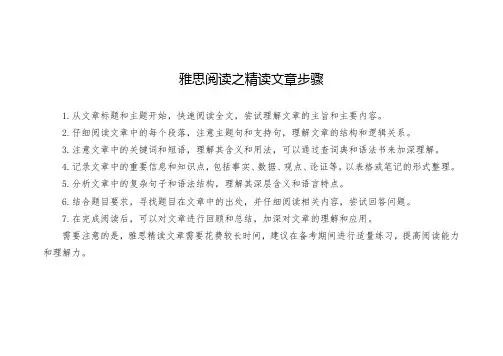
雅思阅读之精读文章步骤
1.从文章标题和主题开始,快速阅读全文,尝试理解文章的主旨和主要内容。
2.仔细阅读文章中的每个段落,注意主题句和支持句,理解文章的结构和逻辑关系。
3.注意文章中的关键词和短语,理解其含义和用法,可以通过查词典和语法书来加深理解。
4.记录文章中的重要信息和知识点,包括事实、数据、观点、论证等,以表格或笔记的形式整理。
5.分析文章中的复杂句子和语法结构,理解其深层含义和语言特点。
6.结合题目要求,寻找题目在文章中的出处,并仔细阅读相关内容,尝试回答问题。
7.在完成阅读后,可以对文章进行回顾和总结,加深对文章的理解和应用。
需要注意的是,雅思精读文章需要花费较长时间,建议在备考期间进行适量练习,提高阅读能力和理解力。
2023年雅思阅读想提速又提分?快来学学这些阅读技巧吧!整理

2023年雅思阅读想提速又提分?快来学学这些阅读技巧吧!整理雅思阅读想提速又提分?快来学学这些阅读技巧吧!3篇文章、40道题、60分钟、3000单词左右的英文阅读量,这是体现雅思阅读特点最直观的数据。
雅思阅读时间紧任务重,能在规定时间内完整做完40道题的考生并不多。
那么阅读应当如何提速呢?主要从如下三个方面来说。
1、题型不同,节奏不同雅思阅读对细节考察比较多,所以题干中的词往往能够供应定位,大家可以在文章中把所对应的句子或者段落找出来。
例如:In the first paragraph the writer makes the point that blind people(剑4 Test 1 Q27)这道题目中,明显有两处定位:一处是first paragraph ,另一处是blind people ,故只需要在第一段找到blind people ,就能找出题目所对应的句子了。
再以一道多项选择题的为例:The list below gives some of the tasks of an archaeologist.(剑4 Test4 Q22-23)很明显,这里的定位词是tasks of an archaeologist ,通过略读文章每段的首句,就很简单找到题目所在的段落范围。
但并不是全部的多项选择题都会明确地告知范围。
比如:Which THREE of the following statements are true of Johnsons Dictionary?(剑5 Test 1 Q1-3)以为文章的题目就叫Johnsons Dictionary ,故这道题目根本没有定位词。
那么这种题目很难下手,建议放到最终来做。
把其它的题目都做完之后,再依据其选项大致推想出所在文章的范围。
2、结构阅读法那么雅思文章该怎么读呢?首先,我们来看看雅思权威考官Vanessa Jakeman和Clare McDowell两位专家是怎么说的:“When you go to university or college you may be overwhelmed by the amount of reading you are expected to do. You will have to do a lot of this reading on your own and you will need to be able to read discriminatingly. This means you will need to have the skills required to focus in on the information that is important to you and to skim through the information that isnt.”根据他们的说法,雅思阅读就是考察同学在读长文章时筛选信息的力量,即read discriminately,知道哪些是重要信息必需细读,哪些是无用的,可以忽视。
雅思阅读教学方法
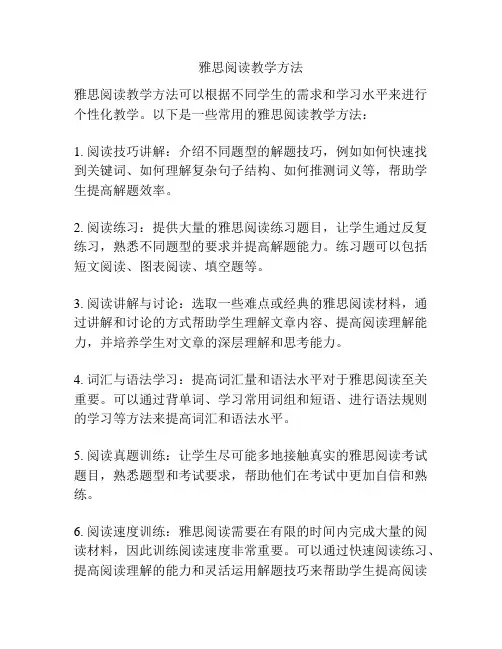
雅思阅读教学方法
雅思阅读教学方法可以根据不同学生的需求和学习水平来进行个性化教学。
以下是一些常用的雅思阅读教学方法:
1. 阅读技巧讲解:介绍不同题型的解题技巧,例如如何快速找到关键词、如何理解复杂句子结构、如何推测词义等,帮助学生提高解题效率。
2. 阅读练习:提供大量的雅思阅读练习题目,让学生通过反复练习,熟悉不同题型的要求并提高解题能力。
练习题可以包括短文阅读、图表阅读、填空题等。
3. 阅读讲解与讨论:选取一些难点或经典的雅思阅读材料,通过讲解和讨论的方式帮助学生理解文章内容、提高阅读理解能力,并培养学生对文章的深层理解和思考能力。
4. 词汇与语法学习:提高词汇量和语法水平对于雅思阅读至关重要。
可以通过背单词、学习常用词组和短语、进行语法规则的学习等方法来提高词汇和语法水平。
5. 阅读真题训练:让学生尽可能多地接触真实的雅思阅读考试题目,熟悉题型和考试要求,帮助他们在考试中更加自信和熟练。
6. 阅读速度训练:雅思阅读需要在有限的时间内完成大量的阅读材料,因此训练阅读速度非常重要。
可以通过快速阅读练习、提高阅读理解的能力和灵活运用解题技巧来帮助学生提高阅读
速度。
7. 参考资料推荐:向学生推荐一些优秀的阅读资料,如英语报纸、杂志、学术论文等,以扩大他们的阅读广度和提高阅读能力。
需要注意的是,教学过程中要注意培养学生的主动学习能力和解决问题的能力,引导学生进行独立阅读和自主学习,通过不断的实践和反馈来提高阅读能力。
刘洪波雅思阅读课技巧

刘洪波雅思阅读课技巧
刘洪波是一位雅思阅读课程的教师,下面是他分享的一些雅思阅读技巧:
1. 认识不同题型:了解不同的题型可以帮助你更好地理解和解答问题。
常见的题型包括填空题、选择题、判断题、配对题等。
2. 阅读题干先:在阅读文章之前,先阅读问题和题干。
这样可以帮助你有针对性地寻找答案,节省时间。
3. 找关键词:在阅读文章时,要注意找到关键词。
这些关键词可以帮助你定位到答案所在的句子或段落。
4. 预测答案:在阅读文章之前,尝试预测一下答案。
这样可以帮助你在阅读过程中保持集中注意力,并更好地理解文章。
5. 理解上下文:在答题时,要注意理解文章的上下文。
有时答案可能不在同一句子中,而是需要整体理解上下文来找到。
6. 多做练习题:通过做更多的练习题,可以熟悉不同题型的解答方法,并提高解题速度和准确性。
7. 增强词汇量:扩大自己的词汇量可以帮助你更好地理解文章,也可以更准确地找到答案。
8. 注意时间管理:在考试中,要注意控制时间。
不要花太多时间在某个问题上,可以先跳过,然后再回来解答。
9. 注重细节:在阅读文章时,要注意细节。
有时候答案可能藏在文章的细节当中。
10. 多练习阅读技巧:不断练习阅读技巧可以帮助你提高解题能力和阅读能力。
总的来说,刘洪波建议学生们在练习雅思阅读时要有计划地学习和练习,同时要保持积极的学习态度和信心。
雅思17套第三篇阅读解析
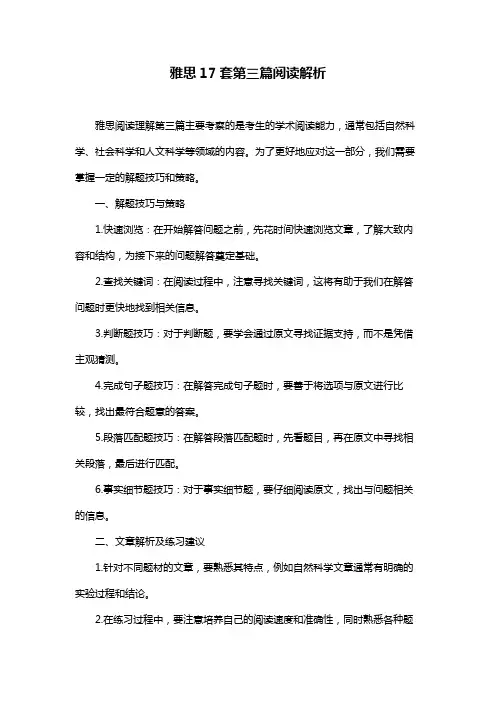
雅思17套第三篇阅读解析
雅思阅读理解第三篇主要考察的是考生的学术阅读能力,通常包括自然科学、社会科学和人文科学等领域的内容。
为了更好地应对这一部分,我们需要掌握一定的解题技巧和策略。
一、解题技巧与策略
1.快速浏览:在开始解答问题之前,先花时间快速浏览文章,了解大致内容和结构,为接下来的问题解答奠定基础。
2.查找关键词:在阅读过程中,注意寻找关键词,这将有助于我们在解答问题时更快地找到相关信息。
3.判断题技巧:对于判断题,要学会通过原文寻找证据支持,而不是凭借主观猜测。
4.完成句子题技巧:在解答完成句子题时,要善于将选项与原文进行比较,找出最符合题意的答案。
5.段落匹配题技巧:在解答段落匹配题时,先看题目,再在原文中寻找相关段落,最后进行匹配。
6.事实细节题技巧:对于事实细节题,要仔细阅读原文,找出与问题相关的信息。
二、文章解析及练习建议
1.针对不同题材的文章,要熟悉其特点,例如自然科学文章通常有明确的实验过程和结论。
2.在练习过程中,要注意培养自己的阅读速度和准确性,同时熟悉各种题
型的解题技巧。
3.分析自己的错误原因,并针对性地进行改进。
4.定期进行模拟测试,以检验自己的学习成果。
总之,要想在雅思阅读理解第三篇取得好成绩,关键是要掌握解题技巧,不断提高自己的阅读能力。
雅思阅读全“True”法
雅思阅读全“True”法一、概述在雅思阅读考试中,全“True”法是一种有效的答题策略。
该方法的核心思想是利用题目和原文中的信息,准确地判断每个题目中的陈述是否与原文内容相符。
通过采用这种方法,考生可以更加准确地完成阅读题目,提高阅读理解能力和分数。
二、全“True”法的步骤1.仔细阅读题目,明确题目要求。
在开始阅读文章之前,先仔细阅读题目,明确题目要求。
这有助于考生了解文章的主题和内容,为后续的阅读和答题做好准备。
2.快速浏览文章,把握文章结构。
在阅读文章之前,快速浏览文章标题、小标题和首尾段落,了解文章的整体结构和内容。
这有助于考生更好地理解文章,为后续的答题提供帮助。
3.仔细阅读题目中的陈述,找出关键词。
对于每个题目中的陈述,考生需要仔细阅读,并找出关键词。
这些关键词通常是与文章内容相关的词汇,能够帮助考生定位答案所在的位置。
4.在文章中寻找与关键词相关的信息。
根据关键词,在文章中寻找与关键词相关的信息。
这些信息通常是答案所在的位置。
考生需要仔细阅读这些信息,并理解其含义。
5.比较题目中的陈述和文章中的信息,判断是否相符。
将题目中的陈述与文章中的信息进行比较,判断是否相符。
如果两者内容一致,则可以判断该陈述为“True”;如果内容不一致,则可以判断该陈述为“False”。
6.根据判断结果,选择正确的答案。
根据判断结果,选择正确的答案。
如果陈述为“True”,则选择“TRUE”作为答案;如果陈述为“False”,则选择“FALSE”作为答案。
三、注意事项1.准确理解题目和文章内容。
在采用全“True”法时,考生需要准确理解题目和文章内容。
如果对题目或文章的理解有误,可能会影响判断结果的准确性。
因此,考生需要加强自己的词汇和语法知识,提高阅读理解能力。
2.注意细节和关键词的把握。
在阅读文章和题目时,考生需要注意细节和关键词的把握。
这些细节和关键词是定位答案的重要线索,能够帮助考生更准确地判断陈述是否与文章内容相符。
雅思考试阅读理解基本技巧(一篇)
雅思考试阅读理解基本技巧(一篇)雅思考试阅读理解基本技巧 1首先,针对阅读的Heading题,先略读文章的段落是很重要的。
因为这样能快速获取文章的大意,而且有的文章有小标题的,也可以通过各段的主题句来获取段落的大意。
对于选段落标题的题目,我们最不应该的就是先看选项了,因为选项往往会出现多余的题目,而且有的很相近,等考生看完也不能分清什么。
然后再去看文章段落。
回来再看选项就会发现,把刚刚看的东西都忘记了。
略读技巧的一个突出应用,属于对于各段内容的略读。
除此之外,雅思阅读考试当中还有一种选择全文大意的选择题。
这样的选择题要求考生为全文选择一个合适的标题,需要的是考生对于全文略读的能力。
除去直接应用于题型之外,其实在雅思阅读考试中,略读这一技能是贯穿在每一篇文章当中的。
在进行每篇文章的答题之前,考生都需要通过这个方法来对于文章的大致结构及各段的'内容有个基本的了解。
再次,就是扫读在雅思阅读中的重要性了。
扫读是对细节信息的定位过程。
它的目的是快速找到文章的出题点。
这种方法在考试中尤其重要。
建议考生先要看雅思题目中的题干,找出关键词(通常都是名词,动词和形容词),然后再回到原文中找相应的位置,扫读通常都一目三四行,要求考生有一定的词汇量,因为有些关键词,在题干中是一个词,而在文章中却被替换掉了,如果被替换的单词考生不认识的话,就很难在扫读过程中找到出题点。
从而找到正确答案就更困难了。
我们从题干入手找题目中的定位词,忽略与题目要求不相关的信息,然后回到原文迅速找到定位词所在的地方,即答案可能出现的地方。
最合适的定位词最好是形式稳定且比较容易被扫到。
比如说,雅思阅读定位词有人名、地名、机构名称等,还有数词、特殊印刷字体的词,建议考生遇到这些词的时候一定要用笔把它们画出来,这样在做题的时候找定位词就容易多了。
掌握了上面两种方法之后,就要看考生的词汇量和语法的掌握程度了。
因为雅思阅读是精读和泛读相结合的。
冲高分必备,雅思阅读超实用技巧!
【原创实用版4篇】编辑人:_______________审核人:_______________审批人:_______________编辑单位:_______________编辑时间:_______________序言Download Note: This document is original and carefully arranged by our store. After downloading, you can adjust and use it according to your actual needs. We hope that this can help you, thank you!(4篇)《冲高分必备,雅思阅读超实用技巧!》篇1雅思阅读是备考中的重要部分,以下是一些实用的技巧:1. 熟悉考试格式和题型:了解雅思阅读考试的格式和题型,包括文章类型、题目类型和答案类型等,可以帮助你更好地应对考试。
2. 培养以获取信息为目的的阅读习惯:雅思阅读是一个语言知识和能力为工具达到获取有用信息的过程,所以要注重培养以获取信息为目的的阅读习惯。
3. 提高阅读速度和理解能力:雅思阅读要求在一个小时能阅读三篇文章,完成四十道题目,对阅读速度和对文章的理解能力是有着较高要求的,因此要平时多练习,提高阅读速度和理解能力。
4. 做题技巧:对于不同类型的题目,要有相应的做题技巧,如填空题要认真判断答案词的词性和各种特征,选择题要注意题目中的关键词和句子结构等。
5. 练习同替整理:同替整理是指将同一类型的题目进行分类整理,从而更好地理解和记忆题目的解题方法。
6. 多做真题:多做雅思阅读真题,可以更好地了解考试的难度和题型,提高答题效率和准确率。
《冲高分必备,雅思阅读超实用技巧!》篇2雅思阅读是备考中的重要部分,以下是一些实用的技巧:1. 熟悉考试格式和题型:了解雅思阅读考试的格式和题型,包括文章类型、题目类型和答案类型等,可以帮助你更好地应对考试。
雅思阅读之技巧归纳
雅思阅读之技巧归纳
1.时间把控:合理分配时间,根据文章长度和难度调整阅读速度。
对于较长的文章,可采用略读和精读结合的方式,先读完第一段和最后一段,了解文章大意,再逐段深入阅读。
2.主题句识别:主题句是文章的核心,可以帮助考生快速了解文章主旨。
考生可以通过识别主题句来提高阅读效率。
3.词汇积累:掌握一定数量的词汇是提高阅读速度和理解能力的基础。
考生可以通过背单词、阅读英文文章等方式积累词汇。
4.推理判断:在阅读过程中,考生可以通过推理判断来理解文章中的隐含意义和深层含义。
5.细节把握:对于一些细节题,考生可以通过定位关键词、排除法等方式快速找到答案。
6.略读和扫读:略读是指快速浏览文章,抓住文章大意和结构,不需深入理解细节信息。
扫读是指寻找特定信息时,忽略无关信息,快速找到所需内容。
7.语法分析:掌握语法知识可以帮助考生更好地理解文章中的句子结构和含义。
8.背景知识:了解相关背景知识可以帮助考生更好地理解文章内容。