
高考英语语法-虚拟语气详解-练习精讲
虚拟语气陈述语气:表示动作或状态是现实的、确定的或符合事实的,用于陈述句、疑问句和某些感叹句。
如:0-0There are two sides to every question./ 0-1Were you busy all day yesterday?祈使语气:表示说话人对对方的请求或命令。
如:0-2Never be late again!/ 0-3Don’t forget to turn off the light.虚拟语气:表示动作或状态不是客观存在的事实,而是说话人的主观愿望、假设或推测等。
如:0-4If I were a bird, I could fly in the air.一真实条件与非现实条件真实条件表示现实情况中可能实现的情况而非真实条件表示与现实情况相反的假想。
1-1 If the working conditions are not too bad, I will accept the job.如果工作条件不太差,我会接受这项工作。
(真实条件)1-2 If the working conditions were not too bad, I would accept the job.如果工作条件不太差,我就接受这项工作了。
(非真实条件)(事实是The working conditions are too bad,、I won't accept the job)1-3 He said if he failed, he would have another try.他说他如果失败,他还会再试一次。
(真实条件)1-4 If he had failed, he would have had another try.如果他失败的话,他会再试一次的。
(非真实条件)(事实是He didn't fail and he didn't have another try.)二非真实条件句以被would所代替。
2.2 混合虚拟结构2.2.1不同时间的虚拟If he had listened to me, he would not be in trouble now.(从句与过去事实相反,主句与现在事实相反)If he had told me yesterday, I should know what to do now. (从句与过去事实相反,主句与现在事实相反)If I were you, I would have gone to her birthday party. (从句与现在事实相反,主句与过去事实相反)2.2.2 虚拟与陈述的混合He could have passed the exam, but he wasn’t careful enough.You should have come earlier. The bus left a moment ago.例题解析:The tree looked as if it ______ for a long time.A. hasn't wateredB. didn't waterC. hadn't bee wateredD. wasn't watered那棵树看上去好象很久没人给浇水了。
(答案是c)三含蓄条件句非真实条件句中的条件从句不出现if,假想条件只暗含在上下文中,这种句子叫做含蓄条件句。
What would I have done without you? 如没有你,我会怎么办呢?(条件暗含在分词短语without you中)It would be easier to do it this way. 这样做会比较容易。
(条件暗含在不定式短语to do it this way中)I would appreciate a little of your time. 谢谢你给我一点时间吧。
(可能暗含if you were so kind as to give me a little of your time)3.1 without/but for/in the absence of 表示“要不是”,“如果没有”(相当于if it were not for)表示条件时,句中一般用虚拟语气。
(也可用陈述语气)Without your help, I couldn' t finish my work on time.In the absence of water and air, nothing could live.But for your assistance, we could not accomplish it.要不是你的帮忙,我们是难有成就的。
3.2句中含有or, or else, otherwise, but等词语,暗示句子的某一部分(前句或后句)需用虚拟语气。
He was on business in Beijing at that ti me; otherwise he might have helped us。
Luckily Mary telephoned to inform me of the meeting, or would have been I absent。
I should have attended my friend’s wed ding ceremony, but I couldn’t afford the time。
四非真实条件句倒装省略连词if。
在书面语中,如果虚拟条件从句中有were,had 或should,可以把if省略,把这几个词放到主语之前,构成主谓倒装。
If he had seen you yesterday,he would have asked you about it. →Had he seen you yesterday,he would have asked you about it.If I were you,I would do it at once. →Were I you,I would do it at once.Should he come (If he should come), tell him to ring me up.Were I you (If I were you), I would not do it. 我要是你,就不做这事。
Had he had lunch (If he had had lunch), he would not have eaten so many cookies.五宾语从句中的虚拟语气5.1下列动词后的宾语从句中insist(坚持),urge (催促),order(命令),command(命令),request(请求,要求),demand(要求),require(要求,需要)suggest(建议),advise(建议),propose(建议) , recommend(建议,推荐) 用(should ) +动词原形He suggested that we (should) save money for the future.The undergraduate insisted that he (should) go to work in the south.注意:当suggest表示暗示,insist表示坚持观点,事实时,后接的宾语从句应当用真实语气。
His silence suggested that he agreed with my decision.He insists that doing morning exercises does well to people’s health.例题详解:(1) “Shall I come tomorrow?” “I’d rather you _________.”A. won’tB. didn’tC. don’tD. wouldn’t(2) “I’ve told him about it.” “But I’d rather you _________.”A. didn’tB. hadn’tC. don’tD. wouldn’t(3) “He will take you as well.” “But I’d rather he _________.”A. won’tB. didn’tC. doesn’tD. wouldn’tB5.2 wish后接that宾语从句表示一种假想情况,实现可能性较小5.2.1对现在情况的虚拟,假想的情况与主句主语的愿望同时发生:宾语从句动词用过去式,谓语be用were。
例:I wish I knew the answer to the question.我希望知道这个答案。
(事实上是不知道)I wish it were spring in my hometown all the year around. 但愿我的家乡四季如春。
(事实上不可能)Now that he is in China, he wishes he understood Chinese.(wishes,过去虚拟动词understood)现在他在中国,他希望能懂得中文。
(事实上并不懂)5.2.2假想的情况在主句主语愿望前发生:宾语从句的谓语用过去完成时,例:I wish I hadn't wasted so much time.我后悔不该浪费这么多时间。
(事实上已浪费了)He wishes he hadn't lost the chance.他真希望没有失去机会。
(其实已失去)We wished he had spoken to us. (事实上他并没同我们讲)例题分析:I wish I ______ longer this morning, but I had to get up and come to class.A. could have sleptB. sleptC. might have sleptD. have slept动词wish后面接从句,表达不可能实现或与事实相反的情况时,谓语动词要用虚拟语气,即用过去式(表示现在发生的动作)或过去完成式(表示过去发生的动作)。
本题后半句谓语动词have用的是过去时had to get up and come, 所以前面要用过去完成时表示过去发生的动作。
所以, 选项A)could have slept是答案5.2.3假想的情况在主句主语愿望之后发生:从句谓语动词用would+原形动词I wish it would stop raining. 我希望雨能停止I wish you would be quiet. 我希望你安静一些。
高考英语虚拟语气语法总结及练习
高考英语虚拟语气语法总结及练习
英语的动词有三种语气形式,即陈述语气、祈使语气和虚拟语气。
虚拟
语气是谓语动词的一种特殊形式,用来表达假设、主观愿望、猜测、建议、
可能或空想等非真实情况。
1英语虚拟语气语法总结第一类
虚拟语气在条件句中的用法:
条件句有真实条件句和虚拟条件句两种。
真实条件句所表示的假设是有可
能发生的,此时主句不用虚拟语气;而虚拟条件句则表示一种假想,与事实
相反或不大可能会发生,此时用虚拟语气。
第二类
使用虚拟语气的常见结构或从句:
1.*wish与hope接宾语从句的区别在于:hope表示一般可以实现的希望,
宾语从句用陈述语气。
wish表示很难或不大可能实现的希望,宾语从句用虚拟
语气。
2.ifonly与Iwish一样,也用于表示与事实相反的愿望,其后所虚拟语气的
时态与wish后所接时态的情况相同
3.lwouldrather后句子用虚拟语气只分现在和过去
在wouldrather,wouldsooner,wouldjustassoon后的that从句中,句子谓语习惯上要用虚拟语气,表示”宁愿做什幺”
sif(though)从句用虚拟语气
以asif(asthough)引导的方式状语从句或表语从句,有时用虚拟语气,则与。
高考英语语法专题虚拟语气详解

高考英语一轮总复习精选语法专题虚拟语气①If it were Sunday today, I ________ go to school.1.shan’t B.would notC.can’tD.won’t①If he ________ here, he would agree with you.A.wasB.isC.wereD.will be①关于“主将从现”的问题:“在时间、条件状语从句中,如果主句中是一般将来时,从句中则用一般现在时。
”从句主句一般现在时---------------------------一般将来时一般过去时---------------------------过去将来时现在完成时---------------------------将来完成时ΔIf you ______, I _______ you up at the station.1.will come; will pick B.came; will pickC.will come; picke; pick助动词------will do(一般将来时)will情态动词“意愿”----will do“愿意做....”①关于“倒装”的问题:“从句中省略if,要使用半倒装的结构,即把should / had / were提到从句的主语之前。
”If I were you, I would go at once.如果我是你的话,我立刻就离开。
→Were I you, I would go at once.If he had hurried, he could have caught the early bus.如果他快点的话,他就能赶上早班车的。
→Had he hurried, he could have caught the early bus.①关于“主、从句中的谓语动词所表示的动作发生的时间不一致”的问题:If you had followed my advice, you would be better now.如果你听从我的建议的话,你现在就会痊愈了。
高考英语复习语法知识专题讲解10---虚拟语气(解析版)
引导的让步和方式状语从 as if/though
He looks as if he were an artist.
句
He talked about the accident as if he had seen it.
in order that, so that, in case, for fear that
提前,即 故填 were/should/had
Were/Should/Had I..., Were
4. have fallen 解析:句意:要是没有政府和科学家的合作,与艾滋病相关的死亡人数就不会从 2005 年的 最高值降下来。从句“Had...not worked together”是对过去情况的假设,所以主句谓语要用 wouldn't have done.
necessary, natural, strange, important,
等 用 于 句 型 surprising, vital
“It
中, 引导的主语从 is+adj.+that...” that
句中谓语动词常用“(should)do”形式
It is necessary that he(should)sort out the information for my reference.
高考英语复习语法知识专题讲解 专题十 虚拟语气
一.虚拟语气在 if 非真实条件句中的应用
虚拟条件从句(if)
主句
与现在事实相反的 主语+did/were
假设
与过去事实相反的 主语+had done
假设
与将来事实相反的 主语+ 1.did/were
假设
2.should do
虚拟语气用法详解
河高高三英语语法专题讲练——虚拟语气用法一、条件句中的虚拟语气(1)现在时的条件句中的虚拟语气。
如:If he were free, he would help us.。
If he studied at this school, he would know you well.(2)过去时的条件句中的虚拟语气。
如:If I had seen the film, I would have told you about it.If I had got there earlier, I would have met Mr. Li. 假如(3)将来时的条件句中的虚拟语气。
如:If he should go to Qing Hua University, he would make full use of his time.If he were to come here, he would tell us about it.注意:1.当虚拟条件句的谓语动词含有were, should, had 时,if 可省略,而将were, should, had等词置于句首。
如:Should he agree to go there, we would send him there.Were she here, she would agree with us.Had he learnt about computers, we would have hired him to work here.2. 错综时间虚拟语气当条件状语从句表示的行为和主句表示的行为所发生的时间不一致时,被称为“错综时间条件句”,动词的形式要根据它所表示的时间作出相对应的调整。
If I were you, I would have gone to the theatre last night.If you had followed my advice just now, you would be better now.二、宾语从句中的虚拟语气1.表示请求、要求、命令或建议等意义的动词所接的宾语从句一般用虚拟语气,其虚拟语气的结构为:(should) + 原形动词。
高考英语二轮专题语法系列--虚拟语气讲义
虚拟语气虚拟语气表示说话人的主观愿望、猜测、建议或与事实不符的假设等,也可以表示可能性较小的情况或不可能发生的情况,而不是客观存在的事实(表示客观事实要用陈述语气)。
虚拟语气是由句中谓语动词的特殊形式表现出来的。
虚拟语气常用于复合句中,也可用于简单句。
比较:If she asks me tomorrow,I shall do it.如果她明天请求我,我会做的。
(陈述语气,说话人认为请求的可能性大)If she asked me tomorrow, I should do it. 假如她明天请求我,我会做的。
(虚拟语气,说话人认为请求的可能性小或不可能请求)1 虚拟语气的用法1-1 虚拟语气用于条件状语从句中1)表示与现在事实相反的情况If I were/was not busy today, I should go with you.如果我今天有空,我会同你一起去的。
If he were/was here,he might talk with you.如果他在这里,他可能会同你谈谈。
If I were you,I wouldn't accept her suggestion.如果我是你,我不会接受她的建议。
If I knew the answer to the question,I should/ would tell you.如果我知道问题的答案,我当然会告诉你。
If we left now, we should/would arrive there in time.如果我们现在就动身,我们会准时到达那里。
If he didn't do exercise every day,he wouldn't be so strong.如果他不每天锻炼,他不会那样强壮的。
If it weren't raining, we would go fishing.要是现在不下雨,我们就去钓鱼了。
高中语法虚拟语气和it用法含习题
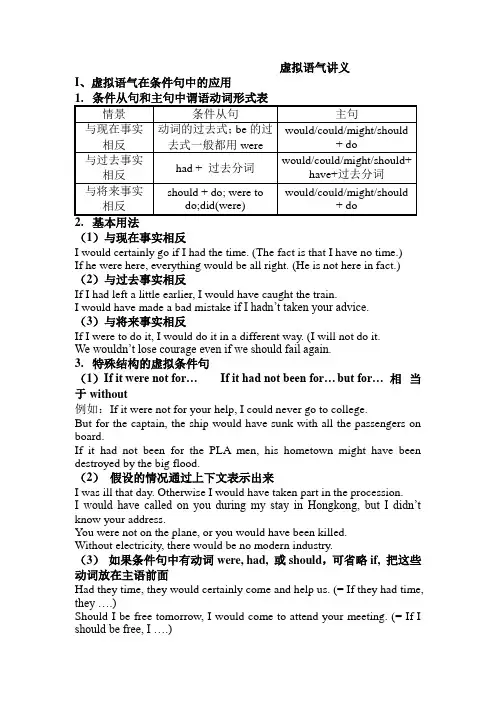
虚拟语气讲义I、虚拟语气在条件句中的应用(1)与现在事实相反I would certainly go if I had the time. (The fact is that I have no time.)If he were here, everything would be all right. (He is not here in fact.) (2)与过去事实相反If I had left a little earlier, I would have caught the train.I would have made a bad mistake if I hadn‟t taken your advice.(3)与将来事实相反If I were to do it, I would do it in a different way. (I will not do it.We wouldn‟t lose courage even if we should fail again.3.特殊结构的虚拟条件句(1)If it were not for…If it had not been for…but for…相当于without例如:If it were not for your help, I could never go to college.But for the captain, the ship would have sunk with all the passengers on board.If it had not been for the PLA men, his hometown might have been destroyed by the big flood.(2)假设的情况通过上下文表示出来I was ill that day. Otherwise I would have taken part in the procession.I would have called on you during my stay in Hongkong, but I didn‟t know your address.You were not on the plane, or you would have been killed.Without electricity, there would be no modern industry.(3)如果条件句中有动词were, had, 或should,可省略if, 把这些动词放在主语前面Had they time, they would certainly come and help us. (= If they had time, they ….)Should I be free tomorrow, I would come to attend your meeting. (= If I should be free, I ….)Were I in your position, I wouldn‟t let him go there.(4)错综条件句、混合条件句在有些虚拟条件句中,虚拟的主句动作与从句动作并不在同一时间发生,这种从句与主句动作发生时间不一致的虚拟条件句称为错综时间条件句或叫混合条件句。
高考英语(第八讲 情态动词和虚拟语气)语法精讲精练 学生版
情态动词表示说话人的语气和情绪,本身词义不全,不能单独作谓语,后面必须与动词原形一起构成谓语。
情态动词没有人称和数的变化,有的情态动词有过去式。
常见的情态动词有can, could, may, might, must, have to, shall, should, will, would, ought to, need, dare等。
(一)can和could1.表示体力或脑力(知识、技能)所产生的能力。
He could read books in English when he was only five.他只有五岁的时候就会读英文书籍了。
2.表示客观的可能性Anybody can make mistakes.任何一个人都有可能犯错误。
3.表示请求建议,用could 比 can语气更委婉 (回答用原形)Could you be here at eight o’clock tomorrow morning?你可不可以明天上午8点钟来这儿呢?4.表示允许、许可,用could 比 can更委婉客气。
Could/Can I borrow your reference books?我可以借用一下你的参考书吗?1.否定句、疑问句和感叹句中,表示怀疑、惊异、不相信的态度。
Can it be true? 难道这是真的?You can't be serious! 你怕不是在开玩笑吧!Oh, dear, what on earth can this mean? 哎呀,亲爱的,这究竟是意味着什么?2.表示“经过努力后终于能……”用be able toThe fire spread the building quickly but everybody was able to escape.大火迅速蔓延到整幢大楼,但大家都逃了出来。
注意:be able to比can有更多的形式变化When he grows up, he will be able to support his family.他长大后就能养家了。
高中英语虚拟语气讲解及练习
虚拟语气-高中英语语法精讲精练虚拟语气表示说话人的主观愿望、猜测建议或与事实不符的假设。
虚拟语气可分为三种:(1一般虚拟(2混合虚拟(3特殊句式一.一般虚拟的构成:(省略if, 要将should/were/had 提到句首(1. 对现在的虚拟:If S. did/were sth., S. would/could/should doIf I had time, I would attend the meeting.If I were you, I would seize the chance to go abroad.(2 对过去的虚拟:If S. had p.p, S. would/could/should have p.pIf you had taken my advice, you would not have failed in the exam.(3 对将来的虚拟:If S. did/were/should do/were to do, S would/should/could do sth.If you came tomorrow, we would have the meeting.If it were to rain tomorrow, the sports meeting would be put off.If he should not come tomorrow, we should put off the meeting till next day.注意:Had we made good preparations, we might have succeeded.Had it not rained, we would have gone out for a walk.Were I you, I would not do such a thing.二.混合虚拟:(1不同时间的虚拟:If he had listened to me, he would not be in trouble now.If he had told me yesterday, I should know what to do now.(2 虚拟与陈述的混合:He could have passed the exam, but he wasnt careful enough.You should have come earlier, the bus left a moment ago.三.特殊句式:(1.suggest, advise, recommend, propose, order, command, request, require, demand that clause (should do/doHe suggested that we (should save money for the future.(insist的判断(2 It is suggested/advised/ordered/requested/required that clause(should do/do(主语从句(3 My advice/suggestion/request/requirement is that-clause (should do /do (表语从句His suggestion/advice/request/requirement that clause(should do/do is.. (同位语从句(4 It is natural/necessary/strange that-clause (should do/do表惊奇、怀疑、惋惜、不满、理应如此等。
虚拟语气精讲精练总结
What would you do if you won the lottery? If I won the lottery, I would…
If I won the lottery, I would buy an expensive car.
If I had a lot of money,
1. if only 意为:若是...那该多好啊; 真希望...; 只要, 只要...就好 表示现在的情况,应用过去式; 如果是过去的情况,应用过去完成时态
If only I had arrived in time !
If only she didn’t drive so fast.
I wish I ________ you yesterday.
His silence at the meeting suggested that he ________ to your plan.
A.didn’t agree B.hadn’t agreed
C.wouldn’t agree D.not agree
NOTES:
与现在相反
例: If I were a teacher, I would be strict with my students.
If I had HIV, I would know because I would feel sick.
had HIV
would feel
were
would be
had driven
If he more carefully, he the car accident yesterday.
would not have had
If I how to swim, I trapped in this island. had learnt would not have been
英语语法精讲:虚拟语气学案,含习题,有答案
虚拟语气语气(mood)是英文中谓语动词的一种变化形式,用来表示说话者的意图和态度。
英文中的语气可分为三种:陈述语气(indicative mood),祈使语气(imperative mood)和虚拟语气(subjunctive mood)。
一、概述(一)虚拟条件句:两类三时两类:假设条件句、事实相反句三时:将来、现在、过去e.g. 1. If I were to have the time tomorrow, I would help him. (虚拟假设)2. If I had the time now, I would help him. (虚拟假设)If I were you, I would help him. (事实相反)3. If I had had the time yesterday, I would have helped him. (事实相反)总结:假设条件句表达的是一种在将来或现在可能性不大的情形,但不是不可能的情形,表示说话人认为不可能,是一种比较主观的表达。
事实相反句表达的是一种与现在或过去的事实相违背的情形,因此是不可能发生的。
正确使用虚拟语气的“四步骤”:是否虚拟;何时虚拟;主句虚拟;从句虚拟二、将来虚拟e.g. 1. If I were to live my life over again, I would have you as my wife.2. If I should win the lottery, I would buy a house.3. What do you think would be the value of the necklace, if I were to sell it?What do you think is the value of the necklace, if I sell it to you?4. If it were to rain, I would stay home.If it rains, I will stay home.总结:对于很多将来的情况,选择用虚拟还是不用虚拟,完全取决于说话人对所述事件的态度,或者说虚拟语气能表明说话人的态度。