
人教新目标七年级英语上册unit2 A(2a-3c)
Section A (2a-3c)
2a Listen and circle the words you hear.
parents brother friend
mother
father
sister
grandmother grandfatheat 3. is 4. he 5. she 6. it 7. you 8. I 9. book 10. brother 11. parent 12. friend
复数 these those are they they they you (你们) we (我们) books brothers parents friends
The end
Grammar Focus
This is my friend Jane. That’s my grandfather.
These are my brothers.
Who’s she? Who’s he? Who’re they?
Those are my parents.
She’s my sister. He’s my brother. They’re my grandparents.
Attention!
that’s = that is Who’re = who are Who’s = Who is
They’re = they are
this
these
brother brothers
that
that
those
is are
is (单数)
are(复数)
is = that ’ s
写 出 这 些 单 词 的 复 数 形 式
This is my daughter. They are cousins.
This is my nephew(侄子). /ˈnefju:/ He is my brother’s son.
3c Bring some family photos to class. Take turns to ask and answer questions.
( B )1. Hello, Tom. _________my new friend. A. He is B. This is C. She is ( C )2. —_________their names? —They are Lucy and Lily. A. What’s B. Who are C. What are ( B )3. My father is a teacher. _______name is Mr. Green. A. He’s B. His C. Him D. It’s
Who’s she? She’s my grandmother.
1. This is his sister.
介绍别人用句型:This is….
That’s ….
辨认某人用句型:Is this…? Is that…?
①当第三者给双方做介绍时, 通常用“this is +姓名”这个句型, 在这种场合不说she is …/he is … 如:
2c Ask and answer questions about the photo in 2b.
The end
2d Role-play the conversation.
Sally: Good morning, Jane. Jane: Good morning, Sally. Sally: Oh, Jane, this is my sister Kate. Kate, this is my friend Jane. Kate: Nice to meet you, Jane. Jane: Nice to meet you, too. Are those your parents? Kate: Yes, they are. Jane: And who’s he? Sally: He’s my brother, Paul. Jane: Oh, I see. Well, have a good day! Sally/Kate : Thanks! You, too.
④--Is he your friend?
--Yes, he is. 肯定的简略答语中, 不能用缩写形式。 即 Yes, he is. 不能写成 Yes, he’s.
Attention!
单数 this that it/he/she is
复数 these those they are
Ⅰ. Choose the correct answer.
(C )7. My family _________all at home. A. am B. is C. are D. be 解析: My family显然是第三人称, 所以首先
可排除干扰项A,D。当family作为一个整体时,
应为单数,动词要用单数形式;若family指家庭 成员时, 谓语动词用复数形式。本题句中有all 暗示三人或三人以上,排除B。
Tom, this is my brother.
②向别人介绍第三者,并指远处的人时,
应用that’s…, 意思为“那位是„„”。如:
---- Who’s that?
---- It’s my brother.
③-- Is Guo Peng your brother?
--No, he isn’t. he 是人称代词, 用来代替“男他”, 句中用来代替上句中的Guopeng。 在英语的简略回答句中, 要用代词代 替上句中的名词, 不可让名词出现在 简略答语中。
Ⅱ. 改错题
I and you are in the same class.
解析: 英语中, 表示“我和××”时为了表示 礼貌, 通常将“我(I)”放在最后, 如: Jim and I…, My sister and I…。但是在承担责任 或承认错误时, 则习惯把I放在最前面。如: I and she are wrong. (我和她都错了) 答案: 调换I和 you的位置并大写you的第一个 字母。
3a Complete the conversation and practice it with your partner. A: That is my family. That’s my mother. B: Who’s he? A: He’s my father. she B: Who’s ? my A: She’s sister. are they? B: And who They’re my grandparents. A:
3b Look at the picture. Make sentences with the words in the three boxes.
this
that these those my
Father parents
mother grandfather
your
brother
sister
This is my niece(侄女). /ni:s/ She is my brother’s daughter.
( C )4. These are _________ parents. A. he B. she C. her ( A )5. Look! _________is your brother, Guo Peng. A. that B. these C. she ( B )6. —Who’s that? —I think _______is Mrs. Green. A. he B. she C. it D. this 解析:it 通常用于指时间、天气、距离 和不知性别的婴幼儿等。但在表示猜测时, 也可用it指代人。
2b Listen again. Match the names with the people in the picture.
1. Jennyd 4. Bob b _ _ 2. Jack c 5. Linda _ _
3. Tom
e _ 6. Mary _ a f
Listening
•A: Cindy, is this your family photo? •B: Yes, it is, Li Lan. •A: Are these your parents? •B: Yes, they are. This is my mother Jenny. And this is my father Tom. •A: Oh, who’s she? •B: She’s my sister Mary. •A: Who’re they? •B: They’re my grandparents, Linda and Bob. •A: And who’s he? •B: He’s my brother Jack.
Unit2SectionA2d3c课件人教版七年级英语上册
2d Language points
3. have a good day 祝你们玩的开心
Have a good day! 用于表达祝愿,祝愿对方一天里有好的心情和运气。 =Have a good time!/ Have fun!
2d Read and answer my questions.
Sally: Good morning, Jane. Jane: Good morning, Sally. Sally: Oh, Jane, this is my sister
Kate. Kate, this is my friend Jane. Kate: Nice to meet you, Jane. Jane: Nice to meet you, too.
3、在简短对话中,当人称代词单独使用多用 宾格.
— I like Ee C. Me
1. --Who is the girl ? --___is my cousin . A. He B. She C. His D. Her 2. Who is _h_e__(him) ? 3. __I__(me) can say my ABCs . 4. _W__e_(us) are good students . 5. Are_t_h_e_y(them)your friends ? 9. Can you help__h_e_r(she) ?
Are those your parents? Kate: Yes, they are. Jane: And who’s he? Sally: He’s my brother, Paul. Jane: Oh, I see. Well, have a good day! Sally/Kate: Thanks! You, too. Bye!
新目标英语七年级上册 (2)
新目标英语七年级上册Unit 1:GreetingsLesson 1: Greetings and Introductions1.1 Warm-upTo start the English learning journey, it’s essential to learn how to greet and introduce oneself in English. In this lesson, we will explore some basic greetings and simple introductory phrases.1.2 GreetingsEnglish greetings are an important aspect of daily communication. Let’s learn a few common English greetings:•Hello! - a versatile greeting used in both formal and informal situations.•Hi! - a friendly and informal greeting, often used among friends.•Good morning! - a formal greeting used in the morning until around noon.•Good afternoon! - a formal greeting used from around noon until the evening.•Good evening! - a formal greeting used in the evening and at night.1.3 IntroductionsNext, let’s learn how to introduce ourselves in English. Here’s an example of a basic self-introduction:•A: Hello! My name is Alice. What’s your name?•B: Hi Alice! Nice to meet you. I’m Bob.In English, when introducing oneself, it is essential to include your name and greet the other person. It’s also customary to respond by offering a pleasant response when someone introduces themselves to you.1.4 PracticeTo reinforce the learning, let’s practice greetings and introductions. Role-play different scenarios with your classmates or use the following questions as prompts:•What’s your name?•How old are you?•Where are you from?Remember to use appropriate greetings and polite language during these interactions.1.5 Speaking ChallengeFor the speaking challenge, choose a partner and practice exchanging introductions. Make sure to greet each other and ask questions using the phrases you have learned.Lesson 2: Classroom English2.1 Warm-upIn this lesson, we will learn essential classroom English phrases that will help you communicate effectively with your teachers and peers.2.2 Classroom InstructionsTo ensure smooth classroom activities, teachers often use specific instructions in English. Let’s familiarize ourselves with some common classroom instructions:•Please sit down.•Raise your hand.•Stand up.•Open your book.•Close your book.•Pay attention.•Take out your pen/pencil.•Put away your belongings.2.3 Expressing NeedsWhen you need something in the classroom, it’s important to know how to express your needs. Here are some useful phrases:•Can I borrow a pen, please?•May I go to the restroom?•I need a piece of paper.•Can you help me, please?•I don’t understand.2.4 PracticeTo practice classroom English, engage in role-playing activities with your classmates. Act out different classroom scenarios and use the classroom instructions and phrases you have learned.2.5 Speaking ChallengeFor the speaking challenge, pair up with a classmate and take turns giving instructions or expressing needs. Practice using the phrases from this lesson and respond accordingly.Unit 2: My School LifeLesson 3: Daily Routines3.1 Warm-upIn this lesson, you will learn how to talk about your daily routines in English. Daily routines refer to the regular activities you engage in every day, such as waking up, eating breakfast, going to school, etc.3.2 Talking about Daily RoutinesTo talk about daily routines, we use time expressions and action verbs. Here are some examples:•I wake up at 7 am.•I brush my teeth.•I have breakfast at 7:30 am.•I go to school at 8 am.3.3 Adverbs of FrequencyWhen discussing daily routines, we often mention how frequently we perform certain actions. Adverbs of frequency help us express this. Here are some common adverbs of frequency:•Always•Usually•Often•Sometimes•Rarely•Never3.4 PracticeTo practice talking about daily routines, create a schedule for an average school day. Include the time and actions you typically perform. Share your schedule with a partner and discuss similarities and differences.3.5 Speaking ChallengeFor the speaking challenge, create a dialogue with a classmate where you discuss your daily routines. Incorporate the adverbs of frequency and time expressions into your conversation.Unit 3: My FamilyLesson 4: My Family4.1 Warm-upIn this lesson, we will learn vocabulary related to family members and how to describe them in English.4.2 Family VocabularyLet’s start by learning some common family member vocabulary:•Mother•Father•Sister•Brother•Grandmother•Grandfather•Aunt•Uncle•Cousin4.3 Describing Family MembersOnce you have learned the family member vocabulary, practice describing your family members using simple sentences. For example:•My mother is kind and caring.•My sister is funny and creative.•My grandfather likes to tell stories.4.4 PracticeTo reinforce your understanding and vocabulary, create a family tree. Include the names of your family members and describe their characteristics using adjectives.4.5 Speaking ChallengeFor the speaking challenge, create a presentation about your family. Introduce each family member and describe their personality traits. Use the vocabulary and sentence structures you have learned in this lesson.ConclusionIn this document, we have covered the first three units of the New Target English Grade 7 textbook. These units focused on greetings, classroom English, daily routines, and family vocabulary. By practicing these essential topics, you will be equipped with basic English communication skills that will serve as a foundation for further learning. Keep practicing and exploring the English language!。
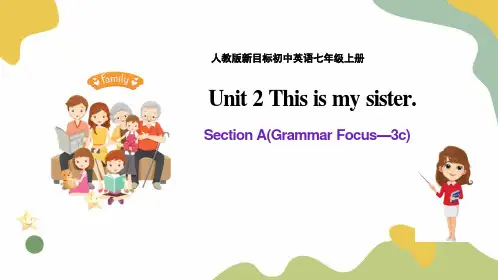
Unit2SectionA(GrammarFocus3c)课件人教版英语七年级上册
grandfather father
brother friend sister mother
grandmother
一、句式结构
1. 你的名字叫什么?_W__h_a_t_’syour _n_a_m__e__? 2. 我的名字叫艾伦。__M__y_n_a_m__e_’sAlan. 3. 他的名字叫什么?_W__h_a_t_’s_ _h_i_s_ name? 4. 他的名字叫埃里克。_H__is_n_a_m_e_’_s Eric. 5. 她的名字叫什么?_W__h_a_t_’s_h_e_r_ name?
物主 my 代词
we you you he she our your your his her
it they its their
同学们表现真棒!赶快一起交流一下吧!
Complete the conversation and practice it with your partner.
补全对话并与同伴练习。
人教版新目标初中英语七年级上册
Unit 2 This is my sister.
Section A(Grammar Focus—3c)
Do you knowthis cartoon(卡通片)?
Happy
family.
What is it about(关于)?
Let's enjoy a video. What words about family members have you heard?
A: That iS
my family. That's my mother.
B:
Who's h e ?
A: He's my father.
人教版英语七年级上册教案:Unit2 SectionA(Grammar Focus-3c)

评价:让学生们对自己的表现及语言表达能力进行自我评价,在小组内评价,然后进行评出最优秀的小组。并鼓励学生们下一次争取做最优秀的小组及个人。
通过自我及家人介绍,检查学生是否能够通过目标词汇、句型,结合话题及要求在小组活动中完成“调查报告”
6
句型转换。
1. . (变为复数句)
.
2. a . (变为复数句)
【教材内容拆分分析】A能够用英语向朋友介绍自己的家人,从而让他们了解自己的家庭。
【通过本单元的学习学生需掌握哪些综合技能】通过本单元的学习使学生学会谈论自己喜好的学科或自己喜好的其它事情并给出理由;学会说出一周的七天;学会合理地安排自己的作息时间。
教学目标
1.语言知识目标:
1)通过不同方式的练习继续熟练掌握对家庭成员的称呼的词汇。
2)继续练习运用以下句型来介绍自己的家庭成员。
①— …
②— ….
③— 's …?
— ''s…
④— …?
— , …, …
⑤— …?
— , , 't.
3)能运用所学的词汇及句型完成不同的交际练习。
2.情感态度价值观目标:
通过学习对这部分的学习使学生对自己的家庭成员会有更清晰的印象,并学会与家庭成员和睦相处,从而激发起他们对家人的热爱。
2.通过句型填空,练习书写规范,及缩写形式。
1.通过规律总结,学生是否正确完成句型填空
2.通过语法练习,检查学生是否熟练掌握运用一般疑问句来提问问题并能肯否回答。
4
3b.
1. T: 's 3b. .
2. S1 , :
… …
… …
3. S2 S1's :
… …
… …
人教版初一英语上Unit2 Section A 2d—3c

Unit 2 This is my sister
Section A 第2课时(2d~3c)环节1 课前自学准备
步骤1 明确课标要求
步骤2 课前自主学习
那是我的家庭。
那是我妈妈。
That is my family. That's my mother.
环节2 课堂教学展示
步骤3 课堂互动探究
课
S: They are my parents.
Who's J ane?
they're=they are
中图片,从方框中选词造句,看谁造的句子最多,给优胜者奖励。
these意为“这些”
these
,特殊不规则变化需要特殊记忆。
人称代词主格复数步骤4 课堂学以致用
1.This ______ my brother and those ______ my friends.
2.ends? these B. m
y friends C. those D. they 环节3 课后反馈总结
步骤5 课后达标检测
布置作业:教师引导学生课后完成本课时对应练习,并预习下一课时内容。
步骤6 课后教学反思。
人教新目标七年级英语上册Unit 2 Section A (Grammar Focus-3c)教学课件
—Yes,it is.
—No,they aren’t.
语法拓展
二、who引导的特殊疑问句
who引导的特殊疑问句通常用来询问人的姓名和身份,可以用来询问男性、
女性、单数或者复数的人。常用句型“Who is+人称代词主格单数+?
/Who are +人称代词主格复数+?”。 【注意】回答形式应为“人称代词主格+is/are+ ...”,不能回答为“It is/That is/ These are/Those are”。 三、人称代词(主格) 人称代词分为主格和宾格两种形式,主格在句中作主语,位于动词之前, 宾格在句中作动词或介词的宾语,放在动词或介词之后。(本单元主要学
语法拓展
3.这四个指示代ቤተ መጻሕፍቲ ባይዱ用于疑问句时,要注意其答语。当this,that作问句的主
语时,回答时指物用it 代替this,that,指人用he或she代替;当these,
those作问句的主语时,回答时用they代替 these,those。
—Is this your pen?
He’s my cousin. —Are those your students?
2.Introduce a picture of your family using the
following sentences:
This/That is...
These/Those are...
Thank you !
this that these my your father mother grandfather grandmother parents grandparents
those
brother sister
人教版七年级英语上册《Unit-2--Section-A-Grammar-focus-3c》课件
This is my mother. This is my father. Who is he?
He is my brother.
Who is she?
That is my grandfather. That is my grandmother.
She is me.
Those are my grandparents.
Unit 2 This is my sister. Period2 Grammar focus-3c
语法课优质课
人教新目标版 七年级(上)
LeaPrrenseinntagtioan ims
1.在听说活动中复习、巩固、掌握下列单词: father ,mother ,parents ,grandfather ,grandmother ,grandparents ,sister ,br
探究一:指示代词用法
1. 用来指示人或事物的代词称为指示代词。指示代词有:this, that, these, those
等 。翻译下列单词 这,这个 _t_h_is__ 那,那个_t_h_a_t_ 这些 t_h_e_s_e_ 那些 _th__o_s_e
this, that 用来代替单数名词;those, these用来代替复数名词 This is a pen. These are pens.
—Is he your brother?
—Yes, he is.
—Are they your grandparents?
—Yes, they are.
— Is it your dog?
— Yes, it is.
GramPremseanrtaFtiooncus While-grammar Look and translate. Read the sentences and translate them.
人教版(2023)英语七年级上第二单元:Section A (2a-3c)(含答案)【可编辑可打印】
Section A(2a-3c)知能演练提升Ⅰ.根据句意及首字母提示完成单词1.This is my s Lily.2.My p are workers.3.Meimei is my f, but we aren’t in the same school.4.My mother’s mother is my g.Ⅱ.根据汉语意思完成句子,每空一词1.那是你的哥哥吗?your brother?2.这是安娜, 那是保罗。
Anna and Paul.3.祝你过得愉快!a !4.他们是谁?are ?5.那两个男孩不是我的弟弟。
Those two boys my .Ⅲ.单项选择1.—Is she your friend?—Yes, .A.it isB.it isn’tC.she isD.she isn’t2.—Have a good day, Jack!—A.I’m Jack.B.Oh, I see.C.I’m fine.D.Thanks. You, too.3.Are Mary’s ?A.this; bookB.that; bookC.these; booksD.those; book4.—?—He is my brother.A.Is he your brotherB.Is he your friendC.Who’s sheD.Who’s he5.Tom’s sister.A.He’sB.HisC.That’sD.Those are知能演练·提升Ⅰ.1.sister2.parents3.friend4.grandmotherⅡ.1.Is that2.This is; that is3.Have; good day/time4.Who; they5.aren’t; brothers Ⅲ.1.C2.D3.C4.D5.C。
人教版七年级英语上册Unit 2 Section A Grammar Focus-3c课件
this
指代距离说话人较近的人或物, 复数形式为these。
指代距离说话人较远的人或物, that 复数形式为those。
指性别不明的婴儿、身份不明的 it 人或是只闻其声未见其人,或代
替前文中所提到的事物。
例: This is an apple tree.这是一棵苹果树。 That is an orange tree. 那是一棵桔子树。 —It’ s a nice picture. Who’s in it?
➢ Emotional Goal
Learn to use demonstrative pronouns and personal pronouns to introduce your family members.
➢Warming-up
my family photo
Who is he? He is ...
I
This is my sister. That is my brother. That is my father. Those are my parents.
I
3c Ask and answer questions about the photos.
Who’s he?
He’s my grandfather.
That’ s my grandfather. Those are my parents. She’ s my sister. He’ s my brother. They’re my grandparents.
This is an apple.
That is an apple, too.
Those are cherries.
_T_h_e_y _ar_e_ nice pictures. 3. Are these your sisters? (变为单数句)
人教新目标英语七年级上册Unit2SectionA(2d3c)说课稿
(三)学习动机
为了激发学生的学习兴趣和动机,我将采取以下策略或活动:
1.利用多媒体教学,如播放英文歌曲、动画片段等,以生动形象的方式引入新词汇和句型。
2.设计互动游戏,如角色扮演、猜谜游戏等,让学生在轻松愉快的氛围中学习。
3.创设真实语境,如模拟人物介绍的场景,让学生在实际情境中运用所学知识。
(二)学习障碍
在学习本节课之前,学生可能已经掌握了基本的英语字母和简单词汇,能够进行简单的自我介绍。然而,他们可能对描述人物特征的词汇和句型还不够熟悉,也可能会在语法结构上存在混淆。学习障碍可能包括:
1.对新词汇的记忆和发音可能存在困难。
2.在构造特殊疑问句时可能会出现语法错误。
3.对英语听力的理解能力有限,可能会影响对对话的理解。
(二)媒体资源
我将使用以下教具和多媒体资源来辅助教学:人物图片、身高体重测量工具模型、电子白板、PPT演示文稿和音频资料。人物图片可以帮助学生直观地理解新词汇;测量工具模型可以让学生在实践中学习如何描述身高和体重;电子白板和PPT演示文稿用于展示教学内容和引导课堂活动;音频资料用于提供真实的语言环境,帮助学生提高听力理解能力。这些媒体资源的使用旨在提供多样化的学习材料,增强学生的学习兴趣,提高教学效率。
3.语法:学习一般疑问句及其回答,以及特殊疑问句的构成。
(二)教学目标
1.知识与技能:
(1)学生能够听懂、会说、会读、会写本节课所学的词汇和句型。
(2)学生能够正确运用所学的词汇和句型进行简单的对话,描述人物的身高、体重和年龄。
(3)学生能够理解并运用一般疑问句及其回答,以及特殊疑问句的构成。
2.过程与方法:
四、教学过程设计