
牛津英语上海版六年级上册Module 2 Unit 6 Going to school 3课时英文教案
Unit 6 Going to school一.知识与技能掌握单词:almost, travel, church, hawker, take, travel, underground, too, total, spend, restaurant…理解词组:quite near, quite far away from, not too far away from…应用句型:It takes sb. some time to do sth. Spend some time on doing sth. How long…?二. 过程与方法感受:请学生自己动手制作一张图表来计划一次出行,从中感受一次成功的旅行离不开周全的安排。
三.情感态度,价值观感悟:制作一张图表,表述学生上学的路上看到些什么,以及周末去了些什么地方,通过回忆这些内容复习文章句型。
Period OneLanguage focus:1Using prepositions/prepositional phrases to indicate place2Using adverbs/adverbials to express degree3Asking ‘How’ questions to find out the length of a period of tim eMaterials:1Student’s Book 6B page 522Photocopiable page 54Pre-task preparation:1Warming up2Teacher makes a short dialogue with one or two Ss to elicit today’s topic, for Revision of different ways of travelling to school.While-task procedure1Look and read on Page 52a)Play the recording: Look and read. Ss listen and follow in their books.b)Play the recording again. Ss listen and repeat sentence by sentence.c)Ss do the soft reading.2Look and saySs look at the pictures and say sentences about Eddie and Miss. Guo.Eddie lives near school.It takes him only 5 minutes to get to school.Miss Guo lives not too far away from school.It takes her about half an hour to get to school.3Writea)Look and writeSs look at the pictures and complete the information about Simon and Jack.Simon goes to school on foot, then by underground, then by bus.It takes him more than forty minutes to get to school.Simon lives quite far away from school.Jack goes to school by ferry, then by bus, then by underground.It takes him about/almost an hour to get to school.Jack lives far away from school.b)Listen and writeSs listen to the information about the four teachers: Miss Li, Miss Tan, Miss Chen and Miss Fang once.Post-task activity:Draw a bar charta)Invite 2 more able Ss to come to the front to be the hosts. Ask them to fill in the tablewith right information in the class.b)Distribute a copy of Photocopiable 54 (It is shown on the ppt) to each student anddivide Ss into groups of 4.c)In groups, Ss draw a bar chart to show the same information as teacher has shown inthe table on the paper.Consolidation:Grammar Practice Book 6B pages 41&42.Period TwoLanguage focus1Using adverbs to indicate position2Asking ‘How’ questions to find out the length of a period of time3Using nouns/noun phrases to indicate timeMaterials1Student's Book 6B pages 52&532Workbook 6B, page ?3Grammar Practice Book 6B, page 12-13?Pre-task preparationRevision of near ,quite near, … and “How” questions to find out the length of a period of timeWhile-task procedure1 Look and read on page 53a)Play the recording : Look and read. Ss listen and follow in their books.b)Play the recording again. Ss listen and repeat.c)Ask students to do the soft reading.d)Invite pairs to role-play the short dialogue.e)Teacher asks questions about what they have read2Look and saySs look at the pictures and complete the dialogues:Look and writeSs look at the pictures and take out a piece of paper to write down the information in the blanks to complete the dialogues.a)How long does it take Mr. Liu to get to Pudong International Airport?It takes him an hour and a half to get there.b)How long does it take Superwoman to get to London Tower Bridge?It takes her only 10 minutes to get there.c)S1: Where are they going?S2: They are going to Tian’an Men Square .S1: How long does it take them to get there?S2: It takes them almost an hour to get there.3 The table shows the time Mark’s family members spent on travelling on 1 April.a)Ss count how much time all members of Mark’s family spent that day.b) Listen and writec) Ss listen to what Ivy saidonce, and try to count thetime her family spent ontravelling that day.d) Then tell by whattransportation her familymembers go out.Hi, my name is Ivy. I live in ahousing estate in North Point. Ilive with my mother, father andsister. Our home is quite nearschool. My sister and I walk toschool every day. It takes us tenminutes to get to school and thesame to come back. My dad’soffice is far away from home. Hegoes to work by underground,then by ferry. It takes himalmost an hour to get to work and 50 minutes back. My mum usually buys our food from a supermarket opposite our estate.She always walks there because it is very near. It takes her only 5 minutes to go and 5minutes to come back.Time her family spends on travelling is 2 hours and 40 minutes.Hours minutes0 100 100 100 101 00 500 50 51 100+1 -602 40Post-task activityA survey---Find out and writea)Distribute a copy of Photocopiable Page 55 (It is shown on the ppt.) to eachstudent.b)Ss find out how much time their family members spend on travelling in one day.Complete the table and work out their family’s total travelling time. Consolidation1Grammar Practice Book 6B page42Finish the survey in Post-taskPeriod ThreeLanguage focusUsing connectives to show the time relationship between two actions.Materials1Student’s book 6B page s 54&552Practice and Assessment Series 6B page 323Photocopiable page 56Pre-task preparation1Warming-up ---What ‘I’ see on ‘my’ way to schoolLet Ss watch the picture about ‘my’ way to school. Tell Ss what ‘I’ see on the way to school.2Look and learn on Page 54Ss learn the new vocabulary:a)Play the recording: Look and learn. Ss listen and follow in their books.b)Play the recording again. Ss listen and repeat.While-task procedure1Look and read on page 54a)Play the recording: Look and read. Ss listen. Teacher asks Ss: How does Simon goto school? (Simon goes to school on foot, then by underground, then by bus, then onfoot.)b)Play the recording: Look and read. Ss listen and follow in their books. Play therecording again. Ss listen and repeat.2Look, ask and answer on page 54Ss do pair work, take turns to ask and answer questions about Simon’s journey to school and what Simon sees on the way to school.S1: How does Simon go to school?S2: He goes to school on foot, then…S1: What does Simon see when he iswalking to the underground station?on the underground?on the bus?walking to school?S2: Simon sees … when he is….3Ss do more oral practice:a)Ask and answerWhat does Kitty see when she is in the park?What does Alice see when …?What does Eddie see when…?b)Look, read and say (words and pictures)Ben goes to the City Hall Library every Saturday. He goes_____, then _____, then _____. He sees many _____ when he is walking to theunderground station. He sees a lot of _____ when he is on the underground. He seesa few _____ when he is _____. He sees a _____ when he is walking to the _____. Post-task activityAbout you“What do you see on the way to school?”c)Distribute a copy of Photocopiable page 56(It is shown in the ppt.) to eachstudent.d)Ss draw simple pictures about what they see on the way to school in the fourboxes.e)When they have finished, invite different Ss to show their drawings at the frontof the class and to read their sentences aloud.Consolidation1Workbook 6B page 30. Grammar Practice Book 6B pages 43&46。
上海市小学六年级第一学期英语(牛津上海版)教材教案课堂单词记忆课件(例句版)Unit 6 Going to school
来源:lot源自中古英语的hlot,意为抽签用的木片。
词组:a lot of cars 很多车 a lot of sheep 一群羊
例句:They make a lot of money. She gets a lot of information.
来源:源自古英语的hwenne,意为何时。
例句:When are we leaving? When are you going home?
词组: five star hotel 五星级宾馆 stay at/in a hotel 住宾馆
例句:I’ve booked the flights and the hotel. The hotel is now open to guests.
构成: ad+vert+ise+ment=advertisement
构成:fer+ry=ferry fer-: 词根:带来 -ry: 名词后缀 “带来带去的东西”→“渡船”
词组: by ferry 乘渡船,乘渡轮
ferry terminal 渡轮码头 例句:When does the next ferry leave? You can cross the river by ferry.
来源:源自中古英语的fewe;最初源自古英语的feawa, 意为少,少的。
词组:a few minutes 几分钟 a few of people 几个人
例句:He found a few coins in the car. I only know a few Chinese characters.
提示:本演示文稿采用Microsoft office PowerPoint 2013 制作,PPT动画特效在其他软件播放可能出现失真。
六年级英语上册(牛津上海版) Unit6 going to school 知识点总结
沪教(一起)6A Unit 6 Going to school 知识点总结1.traveling time to school 去学校行走时间2.it takes sb. some time to do sth. 某人花一段时间做某事3.It takes him about ten minutes. 他花大约十分钟。
4.half an hour 半小时5.go to sp. by ferry 乘渡船去某地6.go to school on foot=walk to school 步行去学校7.how long 多久8.get to sp. 到达某地9.get to the supermarket 到达超市10.g et there/here/home 到达那儿/这儿/家里11.a restaurant 一个饭店12.a hotel 一个旅馆13.a n advertisement board 一块广告牌14.a few + c.n. 几个;一些(后跟可数名词复数)15.a lot of + c.n. & u.n. 许多(后跟可数名词复数或不可数名词)16.o n one’s way to school 在某人去某地的路上17.o n my way to school 在我去学校的路上18.b y light rail 乘轻轨19.d epartment stores 百货商店20.g o to kindergarten 上幼儿园语言点1. near 离…很近后面直接接地点I live near school.=My home is near school.我家离学校很近。
2. far away from=far from离…很远He lives far away from school.=His home is far from school.他家离学校很远3.by bus/bike/car/underground/train/ferry动词短语:take a bus/bike/car/underground/train/ferry ride a bikeHe goes to school by bus.=He takes a bus to school.4. on foot 动词:walkShe goes to work on foot every day.=She walks to work every day.5. It takes sb. some time to do sth. 花费某人多少时间做某事。
六年级上册英语试题- Unit6 Going to school 练习 牛津上海版(含答案及解析)
六年级上册英语试题- Unit6 Going to school 练习牛津上海版(含答案及解析)一、单选题(共10题)1.I am hungry. Give me ________ biscuits to eat, please.A.a few ofB.a littleC.muchD.some2.—________ do you go to your office every day?—By underground.A.WhenB.WhereC.WhoD.How3.Peter lives ________school. He always walks to school.A.nearB.near fromC.farD.far away from4.They are talking about ________ advertisement.A.anB./C.aD.some5.It________ him about 2 hours to get to the hall yesterday.A.takesB.tookC.takeD.will take6.—________ do you often surf the Internet?—For about forty minutes.A.How longB.How soonC.How oftenD.How far7.My uncle's daughter is my ________.C.cousinD.brother8.—What does that sign mean?—________.A.It means you must keep from the grassB.It means you must keep off the grassC.They mean you shouldn't keep off the grassD.They mean you should keep from the grass9.It takes me one and a half ________ to get there.A.hourB./C.hoursD.an hour10.We can see ________ advertisement board over there.A.aB.anC.theD./二、阅读理解(共1题)11.根据短文内容,选择最恰当的答案。
牛津上海版英语六年级上册Unit6Goingtoschoolperiod4教学设计
(3)针对学生的错误,进行针对性讲解和巩固练习。
(五)总结归纳
1.教学活动设计:对本节课的内容进行总结,巩固所学知识,并强调重难点。
2.教学方法:采用归纳总结法,帮助学生梳理知识点,形成知识体系。
3.教学步骤:
(1)教师引导学生回顾本节课所学的新词汇和句型。
(2)总结一般现在时态的用法,并强调在不同情境中的应用。
(3)鼓励学生课后观察和了解其他同学的上学方式,为下一节课做好准备。
五、作业布置
为了巩固本节课的学习内容,加强学生对不同上学方式的表达能力,以及一般现在时态的运用,特布置以下作业:
1.书面作业:
(1)完成教材中的练习题,包括填空、选择和简答题,重点加强对本节课所学的词汇和句型的掌握。
2.重点:培养学生的小组合作能力和口语表达能力。
难点:如何引导学生在小组活动中,有效分享信息,提高沟通效率,以及如何帮助学生克服口语表达时的紧张和拘束。
(二)教学设想
1.针对教学重点和难点,设计以下教学活动:
(1)热身活动:通过歌曲、游戏等形式,让学生在轻松愉快的氛围中复习和巩固本单元所学的词汇和句型。
2.能够理解并运用一般现在时态描述自己和他人日常上学的交通方式。
3.能够听懂并准确回答关于上学方式的问题,提高听力水平。
4.能够运用地图、图标等非语言信息进行简单的信息传递和交流。
5.提高学生的合作能力,培养团队精神,学会在小组活动中分享和倾听。
(二)过程与方法
在本节课的过程中,教师将采用以下方法帮助学生达成教学目标:
(2)根据课堂所学,编写一段关于自己和同学上学方式的对话,要求使用一般现在时态,不少于五行。
2.口语作业:
牛津上海版英语六上 Module 2 Unit 6 Going to school 综合能力训练
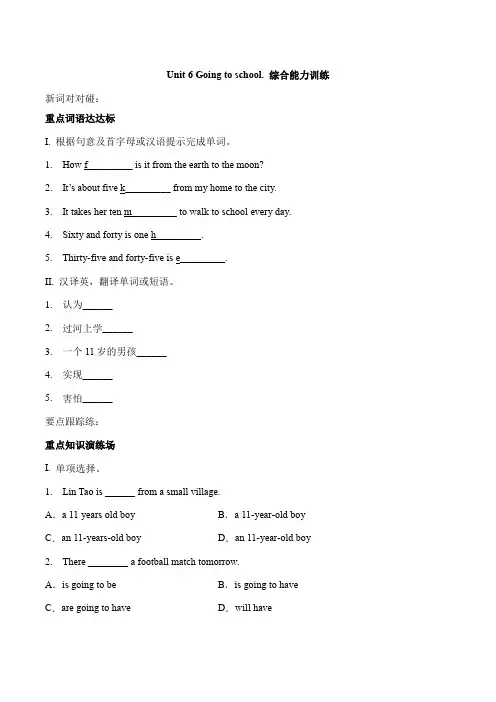
Unit 6 Going to school. 综合能力训练新词对对碰:重点词语达达标I. 根据句意及首字母或汉语提示完成单词。
1.How f_________ is it from the earth to the moon?2.It’s about five k_________ from my home to the city.3.It takes her ten m_________ to walk to school every day.4.Sixty and forty is one h_________.5.Thirty-five and forty-five is e_________.II. 汉译英,翻译单词或短语。
1.认为______2.过河上学______3.一个11岁的男孩______4.实现______5.害怕______要点跟踪练:重点知识演练场I. 单项选择。
1.Lin Tao is ______ from a small village.A.a 11 years old boy B.a 11-year-old boy C.an 11-years-old boy D.an 11-year-old boy 2.There ________ a football match tomorrow.A.is going to be B.is going to have C.are going to have D.will have3.Jill sees ___________supermarkets on the way to her school.A.a lot B.some of C.a few D.a little4.-__________do you go to your office every day? -By underground.A.When B.Where C.Who D.How5.What do you see ________?A.on the way to there B.on the way to backC.on your way back home D.on your way back to homeII. 补全对话。
2020年牛津上海版英语六年级上册M2 Unit 6 Going to school同步检测卷(含答案)
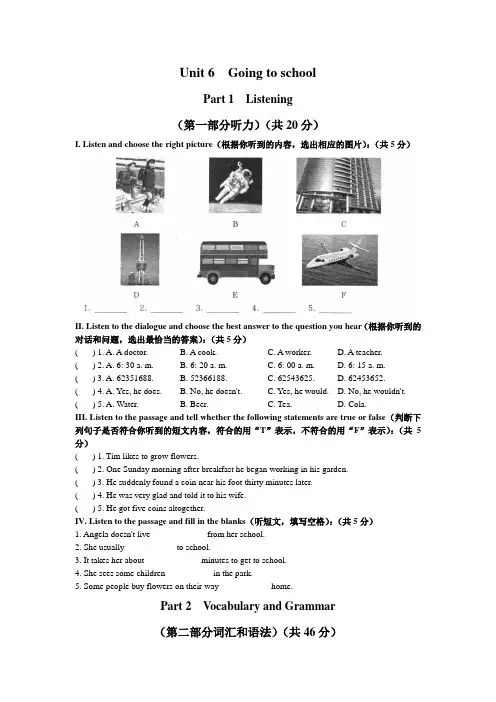
Unit 6 Going to schoolPart 1 Listening(第一部分听力)(共20分)I. Listen and choose the right picture(根据你听到的内容,选出相应的图片):(共5分)II. Listen to the dialogue and choose the best answer to the question you hear(根据你听到的对话和问题,选出最恰当的答案):(共5分)( ) 1. A. A doctor. B. A cook. C. A worker. D. A teacher.( ) 2. A. 6: 30 a. m. B. 6: 20 a. m. C. 6: 00 a. m. D. 6: 15 a. m.( ) 3. A. 62351688. B. 52366188. C. 62543625. D. 62453652.( ) 4. A. Yes, he does. B. No, he doesn't. C. Yes, he would. D. No, he wouldn't. ( ) 5. A. Water. B. Beer. C. Tea. D. Cola.III. Listen to the passage and tell whether the following statements are true or false(判断下列句子是否符合你听到的短文内容,符合的用“T”表示,不符合的用“F”表示):(共5分)( ) 1. Tim likes to grow flowers.( ) 2. One Sunday morning after breakfast he began working in his garden.( ) 3. He suddenly found a coin near his foot thirty minutes later.( ) 4. He was very glad and told it to his wife.( ) 5. He got five coins altogether.IV. Listen to the passage and fill in the blanks(听短文,填写空格):(共5分)1. Angela doesn't live ____________ from her school.2. She usually ___________ to school.3. It takes her about ____________ minutes to get to school.4. She sees some children __________ in the park.5. Some people buy flowers on their way ___________ home.Part 2 Vocabulary and Grammar(第二部分词汇和语法)(共46分)I. Fill in the blanks according to the phonetic transcriptions(根据所给音标,完成句子)(共5分)1. Mr. Edwards likes to ____________ [ˈtrævl] around the world.2.____________ [wen] I am walking, to the cinema, I see a lot of film stars.3. You can see the ____________[laɪt] rail station on Green Market Road.4. There are a few___________ [ˈrestrɒnt] in the new housing estate.5. We will go to the ____________ [ˈsɪnəmə] to watch a film.II. Complete the sentence according to the picture(根据图片提示,完成句子):(共5分)1. Don't worry. We can get there by _______________.2. Look at that ____________board. How big it is!3. Children usually go to ___________ before they go to primary school.4. Nowadays, there are not many ___________ on Huangpu River.5. Wilson sometimes goes to school by _________.III. Choose the best answer (选择最恰当的答案):(共15分)( ) 1. Can you see ________ boy over there? He likes playing ________ basketball very much.A. a;/B. a; theC. the; theD. the;/( ) 2. -Have you seen ____________ pen?- No, but you can use ______________.A. my; myB. mine; mineC. my; mineD. mine; my ( ) 3. We should help _____________.A. othersB. the otherC. otherD. another people ( ) 4. Jill lives ___________ school.A. near toB. far awayC. farawayD. far from ( ) 5. She usually goes to work ____________ big car.A. byB. in aC. on aD. by a( ) 6. We like to make friends with him because he never gets ____________.A. angryB. angerC. angrilyD. more angry ( ) 7. They are helping the old man cross the street ______________.A. safeB. safelyC. saveD. safety( ) 8. About at least _________the people took part in the activities of Expo 2010 in Shanghai.A. millions ofB. 16 million ofC. 16 millions ofD. 16 million ( ) 9. ___________he felt ill, __________ he didn't go to school.A. Because; /B. Because; soC. Because; andD./; but ( ) 10. Would you like ___________ skiing this Sunday?A. goB. goingC. to goD. goes( ) 11.- _________ you ___________ to America?- Not yet.A. Have; beenB. Have; goneC. Did; goD. Do; go ( ) 12. There is ________ milk in the fridge. I have to go and buy ___________.A. a little; littleB. a few; a fewC. little; a littleD. little; a little( ) 13. It takes Mary about one hour ___________ school by bus.A. to get toB. getting toC. get toD. got to( ) 14. I have lent a lot of money to him. But so far has returned ___________.A. littleB. someC. a littleD. much( ) 15. -Thank you very much.-_________________.A. It doesn't matterB. You are welcomeC. That's rightD. All rightIV. True or False(判断下列句子是否符合短文内容,符合的用“T”表示,不符合的用“F”表示):(共6分)All students need to have good study habits. When you have good studyhabits, you learn things quickly, and you also remember them easily.Do you like to study in the living room? This is not a good place, becauseit is usually too noisy. You need to study in a quiet place, like your bedroom. Aquiet place will help you only to think about one thing at one time.When you study, do not listen to music or think about other things at thesame time. Only focus(专注于) on your homework. If you do this, you will doyour homework more quickly and you will make fewer mistakes.Good study habits are very important. If you do not have them, try to learn them. If yours are already good, try to make them better.Good study habits are very important. If you do not have them, try to learn them. If yours are already good, try to make them better.( ) 1. A good study habit can help us learn things quickly and remember them easily.( ) 2. A living room is a good place for us to study.( ) 3. A quiet place may help us only to think about one thing.( ) 4. We will make few mistakes if we listen to music when we study.( ) 5. Good study habits are really important to us.( ) 6. Ann studies well. She doesn't need to keep the good habits any longer.V. Complete the sentences with the given words in their proper forms(用括号中所给单词的适当形式完成下列句子):(共5分)1. We live in the same ___________ (house) estate.2. We can see a lot of tall ___________ (build) in Shanghai.3. Let me tell something about ____________(I).4. The bank is only five ___________ (minute) walk.5. There is a coffee ____________ (shopping) at the street corner.VI. Rewrite the following sentences as required(根据所给要求,改写下列句子。
沪教版牛津英语六年级上册知识要点总结
Module 1 Family and friendsUnit 1 Family and relatives1.family and relatives 家庭和亲戚2. a family tree 一个家谱3.grandsons and granddaughters 孙子和孙女们/外孙和外孙女们4.get a lot of presents 得到许多礼物5.Happy Birthday (to sb.) ! 生日快乐!6.get a birthday card from sb. 从某人那儿得到一张生日卡7.one of my family members 我的家庭成员之一8.only have one aunt 仅仅有一个阿姨9.my classmates 我的同班同学10.go shopping 去购物11.what else 其他什么12.play badminton 打羽毛球13.go cycling 去骑自行车14.go swimming 去游泳15.two cousins 两个堂/表兄弟/妹16.how many + 名词复数多少……语言点1. This is my grandfather.这是我的(外)祖父。
These are my family and relatives.这些是我的家人和亲戚。
注意句中各成分保持单复数同形。
2. I‟m their son.. 我是他们的儿子。
We‟re their sons.我们是他们的儿子。
3. How many uncles do you have?你有多少个叔叔?How many后面接可数名词的复数形式。
4. What do you do with your…?你和你的…干什么?5. What else do you do with your…?你和你的…还干什么?6. What else do you do with your…?你和你的…还干什么?With是个介词,后面接人称代词时,要用宾格的形式。
牛津上海版六年级上册Module2 Unit 6 Going to school课时练习题
Module 2 Places and activitiesUnit6 Going to school知识点梳理1. by bus/ferry/underground乘公共汽车/渡船/地铁2. It takes sb. some time to do sth. = sb. spend some time on sth. = sb, spend some time (in) doing sth. 做某事花费某人多少时间e. g. It took us thirty minutes to finish our English homework.We spent thirty minutes on our English homework.3. half an hour半个小时one and half an hour 一个半个小时4. go to school on foot=walk to school步行去上学e. g, Tom goes to school on foot every day.5. go to school by bus=take a bus to school乘车去学校e. g. We usually go to school by bus.6. live far away from school住得离学校远e. g. Most students live far away from school.7. ask sb. about sth. 询问某人关于某事e. g. The boy asked his father about his toy car.e. g. a lot of people许多人,a lot of可以修饰可数名词,也可以修饰不可数名词9. a few shops 一些商店,a few修饰可数名词10. on one's way to school在某人上学的路上11. … when he is…当他……时,when连接时间状语从句e. g. We can see a lot of students playing ball game when the school is over.Exercise OneI. Translate the following phrases into English. (翻译下列词组)1. 乘公共汽车_____________________2. 步行去上学_____________________3. 住得离学校远__________________4. 半个小时________________________5. 乘车去学校___________________6. 大约五分钟_______________________7. 乘轮渡_________________________ 8. 到达超市_________________________Ⅱ. Choose the best answer. (选择最适当的答案)( ) 1. Alice goes to the office _________ underground and comes back _________foot.A. by the, on theB. by, onC. by the, onD. by, on the( ) 2. The library is far_________ here, but it's __________ my home.A. away, near toB. away from, near toC. from, nearD. away, near( ) 3. - __________do you stay on the train?-I stay on it for about six hours.A. How longB. How muchC. How farD. How soon( ) 4. My mother spends one hour in __________ some cleaning every day.A. to doB. doC. doingD. did( ) 5. It takes him about forty-five minutes ____________his bedroom.A. cleaningB. cleansC. to cleanD. cleaned( ) 6. How long does it take you _________ there?A. to getB. to get toC. get toD. get( ) 7. Lucy, Jim and Li Lei _________good friends.A. is allB. are allC. all isD. all are( ) 8. How delicious the _____________ is!A. pieces of breadB. cakesC. breadD. orangesII. Rewrite the sentences as required. (根据要求改写句子)1. Tom will spend two hours in going to Hangzhou. (改为同义句)It will _________Tom two hours ___________go to Hangzhou.2. Joe goes to school by underground then on foot. (就画线部分提问)__________ __________ Joe go to school?3. Kitty sees a few shops and a lot of people. Kitty is going to the park.(合并为一句)Kitty sees a few shops and a lot of people _______ ______ is going to the park.4. It takes Jill about forty minutes to go to school.(改为同义句)Jill ____________ about forty minutes __________ to school.5. They had tea and cakes at half past four. (改为否定句)They ________ _________tea __________ cakes at half past four.Exercise TwoI. Translate the following phrases into English. (翻译下列词组)1. 住在学校附近_________________2. 住得离学校很远___________________3. 乘公交车上学_________________4. 一个广告板________________________5. 乘地铁_______________________6. 走路上学________________________7. 到达邮局_____________________8. 许多人__________________________ Ⅱ. Choose the best answer. (选择最适当的答案)( ) 1. Peter lives ____________ school. He always walks to school.A. nearB. near fromC. farD. far away from ( ) 2. A postman usually sends letters ____________.A. by bikeB. by planeC. by ferryD. by car( ) 3. They are talking about ____________ advertisement.A. anB. /C. aD. some( ) 4. There aren't ___________people in the hall.A. muchB. manyC. a lot ofD. a little( ) 5. There are only ___________ toys in the shop.A. a littleB. a fewC. fewD. little( ) 6. There is _____________ water in the pond. You can swim there.A. a lotB. manyC. a lot ofD. a few( ) 7. There is ___________ information board in our school.A. aB. anC. the D/( ) 8. There is _________litter on the beach. So it looks dirty.A. muchB. manyC. a lotD. a fewⅢ. Rewrite the sentences as required. (根据要求改写句子)1. She goes to school on foot. (改为同义句)She _________ _________ ____________.2. We spent two hours doing the class project. (就画线部分提问)__________ __________ did you ___________ doing the class project?3. Alice will come at seven.(改为否定句)Alice _________ __________ at seven.4. Sam lives on the fifth floor in this building.(就画线部分提问)____________ lives on the fifth floor in this building?5. We had a nice open day. (改为一般疑问句)___________ you ______________a nice open day?Exercise ThreeI. Fill in the blanks with the given words in their proper forms.(用所给单词适当形式填空)1. There are three ____________(ferry) in the river.2. The bank is three ___________ (minute) walk from here.3. Everyone has two ______________(foot).4. We live in the same ______________ (house).5.____________ (travel) is very interesting.Ⅱ. Choose the best answer.(选择最适当的答案)( ) 1. Does Kitty go to work by ferry _________ by underground?A. andB. orC. soD. with( ) 2. You can eat nice food in a _____________.A. schoolB. hospitalC. shopD. restaurant( ) 3. Alice gets to the library by bus, __________on foot.A. thanB. thenC. afterD. before( ) 4. There is _____________water in the pool.A. manyB. fewC. a fewD. a lot of( ) 5. The bank clerk sees many students when he ____________ to work.A. walkB. walksC. is walkingD. walked( ) 6. It took _________25 minutes to finish _________ homework,A. he, hisB. him, hisC. her, hisD. him, her( ) 7. The teacher is talking _______ my mother _________ my study.A. to, withB. with, aboutC. with, toD. to, toⅢ. Rewrite the sentences as required. (根据要求改写句子)1. I see some offices on my way home. (改为否定句)I _________ see ___________offices on my way home.2. It takes him about an hour to draw the picture. (就画线部分提问)___________ ____________ does it take him to draw the picture?3. Samuel Han drove to the station. (就画线部分提问)_________ __________ Samuel Han go to the station?4. The news is on the advertisement board. (就画线部分提问)__________ ___________ the news?5. The road is quite noisy. (改为感叹句)__________ _____________ the road is!Exercise FourReading comprehension. (阅读理解)(A)One day a rich man met Fred. The rich man asked, " I heard you are very clever and nothing is difficult to you. Can you tell me why you are so clever?"Fred said with a smile, "I'm not clever. Instead you are very stupid. " The rich man got angry.Fred said, "Don't be angry, please. If you don't believe what I said, now let me ask you a question. If you have a group of sheep, I give you another group, then how many groups of sheep do you have?""Why? That's the easiest question in the world. One and one is two. Anybody knows that.I have two groups of sheep. "Fred laughed and said, "You're wrong. Two groups of sheep put together is still one group. That's the easiest question in the world ! "True or False (判断下列句子是否符合短文内容,符合的用“F”表示,不符合的用“F”表示)( ) 1. The rich man is much cleverer than Fred.( ) 2. The rich man thought he was clever.( ) 3. "STUPID" means foolish.( ) 4. In life, sometimes one and one is still one.( ) 5. Fred's answer is wrong.(B)Few people like staying at home on holidays if the weather is fine. Last National Day we decided to spend the holiday in Hangzhou. We hoped we would have a good time there. But thousands of other people had the same idea, We left home at six o'clock in the morning on that day. It was cool and fine. The wind blew gently(轻轻地吹). When we got to the entrance of Huhang highway, we saw a lot of cars. We moved out of Shanghai slowly behind a long line of cars. Generally(通常来说), it takes about two hours to drive to Hangzhou. However, we got to Hangzhou at ten o'clock. We visited the West Lake and other beautiful places. These places were crowded with (挤满了) people. We were very tired when we came back home.Choose the best answer.(根据短文内容,选择最恰当的答案)( ) 1. Most people don't like ______________.A. going out on holidaysB. staying at home on holidaysC. going to HangzhouD. staying in Hangzhou( ) 2. When did they go to Hangzhou for holiday?A. On l October9 last year.B. On l October, this year.C. On l October9 every year.D. On l October, next year.( ) 3. Why were there a long line of cars?A. People were busy going to work at the same time.B. The writer and his family decided to go out too.C. Many people were going out to spend the holiday.D. The cars couldn't move fast enough in the street.( ) 4. It took them __________ to drive to Hangzhou.A. two hoursB. three hoursC. four hoursD. five hours( ) 5. Did they get a good rest on that day?A. Yes, they did.B. No, they didn't.C. Yes, they do.D. No, they don't.(C)Every weekend is important to the Franklin's family. During the week they don't have very much time together, but they spend a lot of time together on the weekend. Mr. Franklin works at the shoe store downtown during the week, but he doesn't work there on the weekend.Mrs. Franklin works at the city hospital during the week, but she doesn't work there on the weekend.Bobby and Sally Franklin go to the junior high school during the week, but they don't go there on the weekend.And the Franklin's dog Rover stays at home alone during the week, but he doesn't stay at home alone on the weekend.Answer the questions. (回答下列问题)1. How many children are there in the family?____________________________________________________________________2. Where does Mr. Franklin work?_______________________________________________________________________3. On what day don't Bobby and Sally go to school?_______________________________________________________________________4. Who stays at home alone during the week?_________________________________________________________________________5. How many people are there in this family?_____________________________________________________________________(D)Ann is l English girl. She is fifteen. She is a middle school student. Her teacher is Miss White. Ann is helping her to put 2 book and ruler on the desk. They have a new classroom. You can see 40 desks and chairs in it. A blackboard, a clock and a map are 3the wall. There are some pens on the desks. The red 4 is Ann's. Others are Kate's. Kate is Ann's good friend. She isn't 5 here today. She is ill. Look at the clock. It's about four o'clock. It's time to come and play games.Choose the words or expressions and complete the passage. (选择最恰当的答案)( ) 1. A. a B. an C. the D. /( ) 2. A. my B. your C. his D. her( ) 3. A. on B. in C. at D. to( ) 4. A. pens B. pencil C. one D. ones( ) 5. A. / B. at C. on D. ofUnit 6 Going to schoolExercise OneI. 1. by bus 2. walk to school 3. live far from school 4. half an hour 5. go toschool by car 6. about five minutes 7. by ferry 8. get to the supermarketII. 1. B 2. C 3. A 4. C 5. C 6. A7. B 8. CIII. 1. take, to 2. How does 3. when she 4. spends, going 5.didn't have, orExercise TwoI. 1. live near school 2. live far away from school 3. go to school by bus4. an advertisement board5. by underground6. walk to school7. get to the post office8. a lot of peopleII. 1. A 2. A 3. A 4. B 5. B 6. C 7. B 8. AIII. 1. walks to school 2. How long, spend 3. won't come 4. Wh0 5. Did, haveExercise ThreeI. 1. ferries 2. minutes' 3. feet 4. house 5. TravellingⅡ. 1. B 2. D 3. B 4. D 5. C 6. B 7. BIII. 1. don't, any 2. How long 3. How did 4. Where is 5. How noisyExercise FourA: 1. F 2. T 3. T 4. T 5. FB: 1. B 2, A 3. D 4. C 5. BC: 1. Two. 2. Mr. Franklin works at the shoe store. 3. On the weekend.4. The Franklin's dog, Rover. 5, Four.D: 1. B 2. D 3. A 4. C 5. A。
牛津上海版英语六年级上册《Unit 6 Going to school》说课稿
牛津上海版英语六年级上册《Unit 6 Going to school》说课稿一. 教材分析《牛津上海版英语六年级上册》的Unit 6 “Going to school” 以学生日常生活为背景,通过描述不同人物的上学方式,让学生在实际情境中学习英语。
教材内容丰富,插图生动,富有生活气息,有利于激发学生的学习兴趣。
二. 学情分析六年级的学生已经具备了一定的英语基础,对于日常生活中的基本表达和简单句型已经能够熟练运用。
但是,对于一些复杂的交通方式表达和语法结构可能还不太熟悉,需要通过教师的引导和学生的合作来完成学习任务。
三. 说教学目标1.知识目标:学生能够掌握描述上学方式的词汇和句型,如“I go toschool by bus.” 和“She goes to school on foot.”。
2.能力目标:学生能够在真实情境中运用所学语言进行交流,提高运用英语进行实际生活的能力。
3.情感目标:通过学习,学生能够培养对学校生活的热爱,增强团结合作的意识。
四. 说教学重难点1.重点:学生能够准确地使用所学生词和句型描述上学方式。
2.难点:学生能够正确运用一般现在时表达习惯性动作,并能在实际情境中灵活运用。
五. 说教学方法与手段1.采用任务型教学法,通过设置不同的学习任务,让学生在实践中学习和运用英语。
2.利用多媒体教学手段,如图片、视频等,为学生提供丰富的学习资源,增强课堂趣味性。
3.采用分组合作学习的方式,培养学生团队合作精神,提高学生的语言实践能力。
六. 说教学过程1.导入:通过提问学生上学的方式,引出本课主题,激发学生的学习兴趣。
2.新课呈现:通过展示图片和视频,引导学生学习描述上学方式的词汇和句型。
3.操练:学生进行分组练习,模拟不同人物的上学方式,教师进行指导和纠正。
4.拓展:学生分角色扮演,编写对话,展示所学内容。
5.总结:教师带领学生回顾本节课所学内容,加深记忆。
七. 说板书设计板书设计要简洁明了,突出重点。
上海牛津版本六年级上册Module 2Unit6笔记知识整理
上海牛津版本六年级上册Module 2Unit6笔记知识整理U6 P391.be / live near school 是/住得离学校近的be / live far away from school 是/住得离学校远的be/ live 2 kilometres (away) from 是/住得离学校两公里远的2.He goes to school by bus. = He takes a bus to school.他乘公车去上学3.She goes to school by ferry. = She takes a ferry to school.她乘渡船去上学4.He goes to school by underground. = He takes an underground to school. 他乘地铁去上学5.They go to school on foot. = They walk to school. 他们步行去上学6.five minutes’ walk/ How far 五分钟的步行路程/多远for two days/ How long 两天/多久once/ twice/ three times/ four times/… 一次/两次/三次/四次/ … 次数/ How many times 提问always, usually, often, sometimes, seldom(极少), never(从不), every day, once a day ---频率/ How often7.travelling time to school 去学校的行走时间go travelling 去旅行/ travel to Beijing 旅行去北京8.It took me an hour to do my homework yesterday.昨天它花了我一个小时去做我的家作I spent an hour (in) doing my homework yesterday.昨天我花了一个小时在做我的家作上The book cost me 20 yuan. 这本书花了我20 元I spent 20 yuan on the book. 我花了20 元在这本书上I paid 20 yuan for the book. 我付了20 元为这本书take—took—taken, spend—spent—spent,cost—cost—cost, pay—paid—paid9.Find out how your classmates go to school. 查明你的同学是怎么去上学的How do your classmates go to school?10.the amount of time they spend travelling to school 他们花在上学路上的时间11.Do you live near or far away from school? 你住得离学校近还是远呢12.How do you go to school? 你是怎么去上学的13.How long does it take? 它要花费多少时间14.draw a chart 画一张图表15.transport (n. v.) 交通16.an hour thirty minutes an/ one hour and a half one and a half hours一个半小时P401.go to different places / the same place 去不同的地方/ 同样的地方2.ask / tell/ want / promise 承诺/ would like sb (not) to do sthmake / let/ have/ would rather 宁愿/ had better 最好sb (not) do sth要某人做某事3.ask sb about sth 问某人关于某事4.get to the supermarket 到达这超市5.get to your office 到达你的办公室6.go to 去/ get to 到达/ walk to 走到/ run to 跑到/ hurry to 匆忙到the cinema 电影院go there 去那儿/ get there 到达那儿/ walk there 走到那里run there 跑到那里/ hurry there 匆忙到那里on the way to the school 在去学校的路上on the way there 在去那里的路上/ on my way there 在我去那里的路上/ take a bus there 坐一辆公车去那里on his way to school , on his way home / here / there副词前面不加to, 常见副词home/ here/ there/ upstairs 楼上/ downstairs 楼下7.get to the park 到达公园8.get to the post office 到达邮局9.get to the library / libraries 到达图书馆/复数10.the following places 这以下的地方11.report ( n./ v. ) 报告P411.a hotel 一个宾馆2.an advertisement board 一块广告板3.our English Club noticeboard 我们的英语俱乐部的布告栏4.some restaurants 一些饭店/ go to the restaurant 去饭店5.a few shops 一些商店6.a lot of people 许多人7.a person/ two persons/ two people 一个人/ 两个人8.Simon’s way to school Simon 的去上学的路上9.go to school by bus = take a bus to school 乘公车去上学10.go to school on foot = walk to school 步行去上学11.few/ a few 加可数名词复数,little/ a little 加不可数名词a few/ a little 一些,few/ little 几乎没有12.a lot of = lots of = plenty of / some, any, enough + 可数名词复数,不可数名词13.…when I’m on the underground 当我在地铁上的时候14.…when I’m on the bus 当我在公车上的时候15.…when I’m walking to school 当我正步行去学校的时候16.few/ a few 加可数名词复数,little/ a little 加不可数名词a few/ a little 一些,few/ little 几乎没有17.There’s little water , is there? There’re few people, are there?She’s never late for school, is she?She’s never been late for school, has she?18.否定词no/ not/ never/little/ few/ seldom 极少地/ hardly 几乎不/ rarely 极少地19.a lot of = lots of = plenty of / some, any, enough + 可数名词复数,不可数名词/任何名词20.in pairs 一对对地/ in groups 一组组地21.Talk about what Simon sees on his way to school. 谈论关于Simon看见了什么在上学路上What does Simon see on his way to school?P421.discuss = talk about 讨论discuss sth with sb = talk about sth to/ with sb 和= talk to/ with sb about sth 和某人谈论关于某事discuss the things with a classmate = talk about the things to / with a classmate = talk to / with a classmate about the things 和一个同学讨论这些东西discuss it with your classmates 和你的同学们讨论它discuss—discussed—discussed --discusses2.on the/your way to school 在这/你的去上学的路上3.a school bus/ an underground/ a light rail/ a ferry一个校车/地铁/轻轨/渡船4.a department store 一个百货商店/a kindergarten 幼儿园/a housing estate 居民区/an advertisement board 广告版/a garden 花园/a factory, two factories 工厂/a police station 警局/a swimming pool 游泳池/a temple 庙宇/an office 办公室/a bank 银行/a market 市场5.flowers and grass 花花草草作文:On my way to schoolI live far away from school. I go to school by bus, then on foot. It takes me about half an hour to get to school. I see some restaurants, a few shops and a lot of people when I’m on the bus. I see a few parents, some teachers and o lot of students when I’m walking to school. How happy I am every day.。