
最新人教版八年级英语上册 Unit_2_How_often_do_you_exercise_Section_A_1a-1c课件_(新版)人教新目标版
usually often sometimes hardly ever never(0%)
______________ watch TV
help with homework ______________ go shopping ______________ watch TV ______________ go shopping ______________
skateboard: v. 踩滑板;做滑板运动 = go skateboarding: 踩滑板;做滑板运动
What do doesyou she usually do on weekends?
I usually She … surfs surf the Internet on weekends.
What do doesyou she usually do on weekends?
SheI usually … does her homework do my on weekends.
What do you does he usually do on weekends?
I usually He … watches watch TV on weekends.
I usually She … goes go shopping on weekends.
go shopping: 购物 = do some shopping = shop
What do you does he usually do on weekends?
I usually He skateboards … skateboard on weekends.
hard 也用副词,意为“努力地、刻苦 地”,“猛烈地” 。 e.g. He works hard only before exams. 他只在考试前努力学习。
e.g. It’s always interesting to watch other people show their talents. Why do people usually make resolutions? When we watch movies about the future, we sometimes see robots. They hardly ever watch TV.
watch TV 4. __________________
go shopping 5. __________________
1b Listen and write the letters from the picture above on the lines below.
exercise, read always(100%) ______________
Language points
1. Exercise exercise v. 锻炼; exercise n. [U]运动; [C]练习 如: Let’s do our exercises. 让我们做练习吧。 Walking is a good exercise. 散步是很好的运动。
频率副词
• always意为 “总是”, 表示动作的重复或状态的 延续。 • usually意为 “通常”, 表示很少有例外。 • often意为 “经常”, 表示动作的重复, 但不如 usually那么频繁, 中间有间断。 • sometimes意为 “有时”, 表示动作偶尔发生。 • hardly意为 “几乎不”, 常和ever连用表示强调。 • never意为 “从未”。
What do doesyou she usually do on weekends?
I usually She … reads read books on weekends.
read books: 读书 = do some reading
What do doesyou she usually do on weekends?
Unit 2
How often do you exercise?
I often play soccer.
What do you do on weekends?
What does Alice do on weekends?
She often helps with housework.
What do you usually do on weekends?
surf: v. 冲浪 Internet: 因特网 surf the Internet: 上网
What do doesyou she usually do on weekends?
I usually She … exercises exercise on weekends.
exercise: v. 做运动
ቤተ መጻሕፍቲ ባይዱ
1a. Look at the picture. Make a list of the weekend activities. help with housework 1. __________________
2. __________________ red
3. __________________ exercise
never
hardly ever sometimes
0%
从不, 从未
很少, 几乎不 有时 经常, 常常 通常, 一般 总是
often usually always
100%
1. hardly 只用作副词,其意思是“几乎 不”,表示否定概念。 e.g. He can hardly speak English. 他不太会说英语。 hardly ever 几乎从不 e.g. Peter is hardly ever late. 彼得几乎从不迟到。
Practice the conversation in the 1c picture above. Then make your own conversations about what you do on weekends. I usually
What do you do on weekends?
人教版英语八年级上册Unit2Howoftendoyouexercise
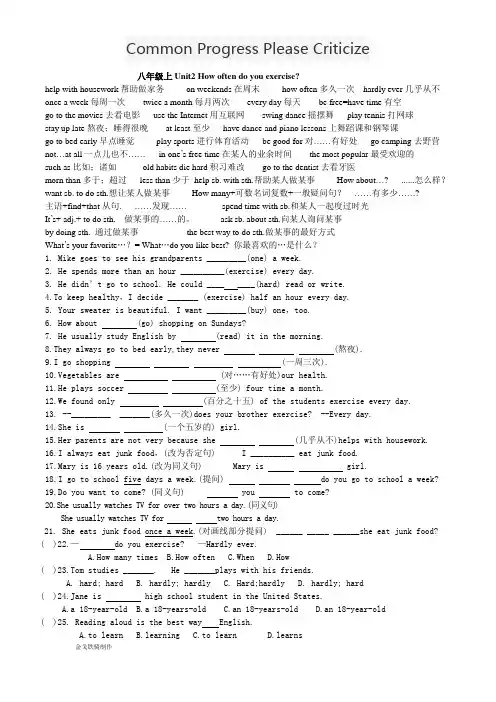
Common Progress Please Criticize金戈铁骑制作八年级上Unit2 How often do you exercise?help with housework帮助做家务on weekends在周末how often多久一次hardly ever几乎从不once a week每周一次twice a month每月两次every day每天be free=have time有空go to the movies去看电影use the Internet用互联网swing dance摇摆舞play tennis打网球stay up late熬夜;睡得很晚at least至少have dance and piano lessons上舞蹈课和钢琴课go to bed early早点睡觉play sports进行体育活动be good for对……有好处go camping去野营not…at all一点儿也不……in one’s free time在某人的业余时间the most popular最受欢迎的such as比如;诸如old habits die hard积习难改go to the dentist去看牙医morn than多于;超过less than少于help sb. with sth.帮助某人做某事How about…? ......怎么样?want sb. to do sth.想让某人做某事How many+可数名词复数+一般疑问句?……有多少……?主语+find+that从句. ……发现……spend time with sb.和某人一起度过时光It’s+ adj.+ to do sth. 做某事的……的。
ask sb. about sth.向某人询问某事by doing sth. 通过做某事the best way to do sth.做某事的最好方式What’s your favorite…?= What…do you like best? 你最喜欢的…是什么?1. Mike goes to see his grandparents _________(one) a week.2. He spends more than an hour __________(exercise) every day.3. He didn’t go to school. He could ____ ____(hard) read or write.4.To keep healthy,I decide _______ (exercise) half an hour every day.5. Your sweater is beautiful. I want _________(buy) one,too.6. How about (go) shopping on Sundays?7. He usually study English by (read) it in the morning.8.They always go to bed early,they never (熬夜).9.I go shopping (一周三次).10.Vegetables are (对……有好处)our health.11.He plays soccer (至少) four time a month.12.We found only (百分之十五) of the students exercise every day.13. --_________ _______(多久一次)does your brother exercise? --Every day.14.She is (一个五岁的) girl.15.Her parents are not very because she (几乎从不)helps with housework.16.I always eat junk food,(改为否定句) I __________ eat junk food.17.Mary is 16 years old.(改为同义句) Mary is girl.18.I go to school five days a week.(提问) do you go to school a week?19.Do you want to come? (同义句) you to come?20.She usually watches TV for over two hours a day.(同义句)She usually watches TV for two hours a day.21. She eats junk food once a week.(对画线部分提问) ______ _____ ______she eat junk food? ( )22.— do you exercise? —Hardly ever.A.How many timesB.How oftenC.WhenD.How( )23.Tom studies _______. He _______plays with his friends.A. hard; hardB. hardly; hardlyC. Hard;hardlyD. hardly; hard( )24.Jane is high school student in the United States.A.a 18-year-oldB.a 18-years-oldC.an 18-years-oldD.an 18-year-old( )25. Reading aloud is the best way English.A.to learnB.learningC.to learnD.learns。
人教版初中八年级上册英语《Unit-2-How-often-do-you-exercise》课件
(2)twice a week 意为“一周两次”。在英语中,once表 示“一次”,twice表示“两次”,“三次及以上”要 用“基数词+times”表示。
e.g. three times 三次
中考对接: (山东潍坊中考)——______do you go to Weifang Theatre?
——Once a month.
我有时候玩电脑游戏。
辨析:sometimes, some times, sometime与some time
sometimes:是频度副词,意为“有时”,表示动作 发生的不经常性,多与一般现在时连用,它可位于 句首、句中或句末,对它提问用how often。
some times是名词短语,意为“几次;几倍”, 其中time是可数名词,对它提问用how many times。
twice adv. 两次;两倍 Internet n. (国际)互联网;因特网 Program n. 节目
full adj. 忙的;满的;充满的 swing n. 摆动;秋千 v. (使)摆动;摇摆 swing dance 摇摆舞
Lead-in
What do you usually do on weekends?
A . How soon
B . How often
C . How much
D . How long
2d Role-play the conversation.
Jack: Hi, Claire, are you free next week? Claire: Hmm…next week is quite full for me, Jack. Jack: Really? How come? Claire: I have dance and piano lessons. Jack: what kind of dance are you learning? Claire: Oh, swing dance. It’s fun! I have class once a week,
最新人教版八年级上册英语第二单元作文范文总结
Unit 2 How often do you exercise?作文写作与范文本单元的主要话题是空闲时间的活动及健康的习惯,可以介绍自己的活动和健康习惯,也可以描写朋友、家人的活动和健康习惯,叙述完之后还可以谈谈自己对这些活动和健康习惯的看法和感受。
⑴ 那么首先要审题,确定时态为一般现在时,人称为第一人称或第三人称,开头要总述调查内容。
如:Here are the results of the survey about ……⑴ 正文要分项列出调查结果。
并分别写出健康的好习惯与坏习惯。
注意频度副词的使用⑶结尾要着重表达自己对结果的看法。
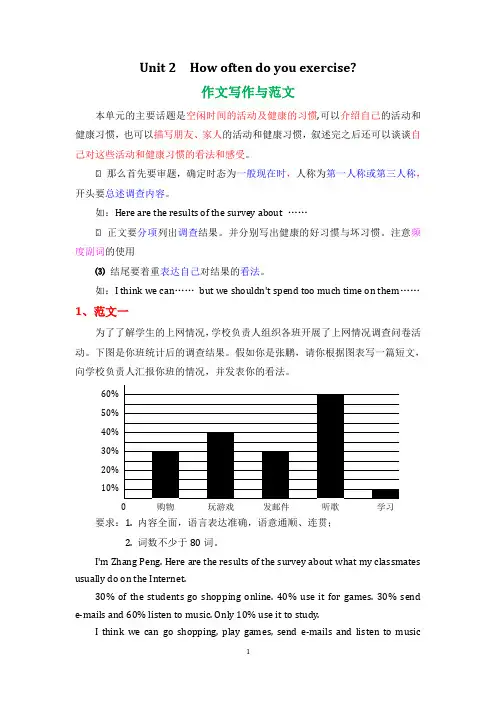
如:I think we can……but we shouldn't spend too much time on them……1、范文一为了了解学生的上网情况,学校负责人组织各班开展了上网情况调查问卷活动。
下图是你班统计后的调查结果。
假如你是张鹏,请你根据图表写一篇短文,向学校负责人汇报你班的情况,并发表你的看法。
60%50%40%30%20%10%0购物玩游戏发邮件听歌学习要求:1. 内容全面,语言表达准确,语意通顺、连贯;2. 词数不少于80词。
I'm Zhang Peng. Here are the results of the survey about what my classmates usually do on the Internet.30% of the students go shopping online. 40% use it for games. 30% send e-mails and 60% listen to music. Only 10% use it to study.I think we can go shopping, play games, send e-mails and listen to musiconline, but we shouldn't spend too much time on them. As students, we should make good use of the Internet to study. I usually learn English through online dictionaries. I get a lot from them.我叫张鹏。
人教版英语八年级上册Unit 2《How often do you exerciseol》教学设计

人教版英语八年级上册Unit 2《How often do you exerciseol》教学设计一. 教材分析人教版英语八年级上册Unit 2《How often do you exercise》主要讲述了关于频率疑问词how often的用法,以及一般现在时的表达方式。
通过本节课的学习,学生能够掌握频率疑问词how often,并能用一般现在时表达自己的生活习惯。
教材中包含了丰富的语言实践活动,如听力、口语、阅读和写作,有助于学生全面提高英语水平。
二. 学情分析八年级的学生已经具备了一定的英语基础,能够听懂并运用一般现在时。
但部分学生对频率疑问词how often的用法还不够熟练,因此在教学中需要重点强调。
此外,学生对生活话题的讨论感兴趣,有利于激发学习积极性。
三. 教学目标1.知识目标:–能够正确使用频率疑问词how often。
–能够用一般现在时表达自己的生活习惯。
2.能力目标:–提高学生的听说读写能力,熟练运用本节课所学知识进行交流。
3.情感目标:–培养学生热爱生活、注重锻炼的良好习惯。
四. 教学重难点•频率疑问词how often的用法。
•一般现在时的表达方式。
•正确运用频率疑问词how often进行提问和回答。
•如何运用一般现在时表达自己的生活习惯。
五. 教学方法1.情境教学法:通过设定生活场景,让学生在实际语境中练习英语。
2.交际教学法:鼓励学生积极参与课堂互动,提高口语表达能力。
3.任务型教学法:通过完成小组任务,培养学生的合作精神和团队意识。
4.反馈评价法:及时给予学生反馈,鼓励学生自主发现问题并改正。
六. 教学准备1.教材:人教版英语八年级上册。
2.课件:制作与本节课相关的内容,包括图片、视频等。
3.练习题:针对本节课的内容,设计听、说、读、写等方面的练习。
4.教学设备:投影仪、音响等。
七. 教学过程1.导入(5分钟)–教师通过提问学生日常生活中喜欢的事物,引出本节课的主题——生活习惯。
新人教版八年级英语上册Unit_2_How__often_do_you_exercise_Section_A1

Internet: 因特网 use the Internet: 上网
What do doesyou she usually do on weekends?
I usually She … exercises exercise on weekends.
exercise: v. 做运动
更多新版课件请加 Q2606367404
once: adv. 一次 once a week: 一周一次
Mon. a week
Tues.
Wed.
Thur.
Fri.
Sat.
Sun.
How often do you go skateboarding? twice a week. I go skateboarding …
twice: adv. 两次 twice a week: 一周两次
Mon. A week
Tues.
Wed.
Thur.
Fri.
Sat.
Sun.
How often do you exercise? I exercise… three times a week.
time: n. 次数(可数) three times a week: 一周三次
_____________ How often do you surf the Internet?
What do doesyou she usually do on weekends?
I usually She … goes go shopping on weekends.
go shopping: 购物 = do some shopping = shop
What do you does he usually do on weekends?
How often do you exercise 知识详解-英语八年级上册(人教版)

Unit 2 How often do you exercise?你多久锻炼一次?单元知识详解Section Ahelp with housework 帮忙做家务(教材P9 1a) ①help with 帮助讲help with +表示事物的名词help with +宾格代词»My sister is only six, but she can already help with some housework.我的妹妹只有6岁,但她已经可以帮忙做一些家务了.»The task is so difficult. I need someone to help with it.这项任务很难.我需要有人来帮忙.拓help作动词时,还有以下用法:help oneself(to sth.)随便吃/喝(某物)can't/couldn't help doing sth.忍不住做某事help sb. with sth.=help sb.(to)do sth.帮助某人做某事»Dinner is ready. Help yourself, please!晚餐准备好了.请自便!»Hearing the good news, I can't help jumping.听到那个好消息,我忍不住跳了起来.»Joe helped us(to) organize the party.乔帮助我们筹备了聚会.典例1根据汉语意思完成句子,每空一词.(怀化中考改编)我经常在星期天帮助父母做家务.I often_______ my parents_________ housework on Sundays.答案:help; with/do② housework/'haʊswɜː (r) k/ n.家务劳动;家务事讲[不可数名词]是由”house + work"构成的合成词.do housework 做家务housework 前还可加the、some、much、a lot of、little等限定词.»Teenagers should do some housework after they finish their homework.青少年应该在完成家庭作业后做一些家务.拓与housework 类似的合成词还有:homework"家庭作业";schoolwork"课堂作业".sometimes 有时(教材P9 1b)③sometimes adv.有时辨sometimes, some times, sometime 与some time»Everybody needs a shoulder to cry on sometimes in life, my dear.亲爱的,在生活中,有时每个人都需要一个倾诉的对象.»I've read the article some times. It's educational.我已经把这篇文章读了几遍,它很有教育意义.»We must get together sometime.我们一定要找个时间聚一下.»After hearing that news, he remained silent for some time.听到那个消息后,他沉默了一段时间.hardly ever 几乎从不(教材P9 1b) ④ hardly ever 几乎从不讲表示频率.其中ever为副词,意为"在任何时候,从来;曾经",起强调作用.»She lives in Spain, so we hardly ever(=almost never)see her.她住在西班牙,所以我们几乎见不到她.典例2 (2023·石家庄市桥西区期中)My brother has a good habit. He_______ stays up late and he often gets up early.A. usuallyB. alwaysC. hardly everD. often解析:句意:我哥哥有一个好习惯.他几乎从不熬夜,而且经常早起.usually"通常";always"总是";hardly ever"几乎从不";often"经常".根据"My brother has a good habit"可知,此处是说"他几乎从不熬夜",故选C.⑤ hardly/'ha:(r)dli/adv.几乎不;几乎没有讲[副词]表示否定含义.谚Without accumulating, we can hardly achieve anything.不积跬步,无以至千里.辨hardly与hard语境串记I can hardly believe he is practicing hard in the yard. It's hard to exercise outside when it blows hard. 我几乎不能相信他正在院子里努力训练.当风刮得很猛烈的时候,在户外训练是很困难的.-How often do you watch TV?你多久看一次电视?-Twice a week.一周两次. (教材P10 2a) ⑥how often 多久一次讲用来提问动作发生的频率,常用表示频率的词或短语作答.»-How often do you visit your grandparents, Simon?西蒙,你多久去看望一次你的祖父母?»-Twice a month.一个月两次.拓由how构成的其他疑问短语的用法:典例3 (2022·连云港中考)-________ do you play volleyball, Amy?-Three days a week.A. How longB. How soonC. How oftenD. How much解析;由答语"Three days a week"可知,问句问的是打排球的频率,故选C. how long"多长(时间)",用于询问长度或时间;how soon"多久以后",用于询问时间,常用于一般将来时;how often"多久一次",用于询问频率;how much"多少(钱)",用于询问不可数名词的量或价格.⑦ twice/twais/adv.两次;两倍讲(1)[副词]两次(此处用法)twice a week/month/year一周/月/年两次表示频率.»I play chess at least twice a week.每周我至少下两次国际象棋.»We visited them twice in 10 years.我们十年里拜访过他们两次.(2)[副词]两倍»Cats sleep twice as much as people.猫睡觉的时间是人的两倍.拓英语中表示"三次或三次以上"用"基数词+times"结构,如:three times"三次",ten times"十次".典例4 用括号中所给词的适当形式填空.(2022·龙东中考)You'd better brush your teeth at least_______ (two) a day.解析:句意:你最好一天至少刷两次牙."一天两次"应用"twice a day",故填twice.once a week 一周一次(教材P10 2a) ⑧ once/wans/adv.一次;曾经讲(1)[副词]一次(此处用法)once a week/month/year一周/月/年一次»-How often do you play basketball with your friends?你多久与你的朋友打一次篮球?-Only once a week.一周仅一次.(扬州中考)(2)[副词]曾经表示过去不确定的时间,常与一般过去时连用.一般位于行为动词之前、系动词之后.»He once lived in Hangzhou.他曾经住在杭州.»This book was once famous, but now nobody reads it.这本书曾名噪一时,但现在却无人问津.巧学妙记次数表达法表示次数应注意,基数词后加times;一次两次很特殊,once、twice单独记.Hi, Claire, are you free next week?嗨,克莱尔,下周你有空吗? (教材P10 2d) ⑨free adj.空闲的讲[形容词]空闲的反义词为busy"忙碌的".in one's free time 在某人的空闲时间»Are you free in July?你七月份有空吗?»Free time is a good chance for teenagers to have fun.空闲时间是青少年玩乐的好机会.»Andrew often does DIY in his free time. 安德鲁在空闲时间经常自己做东西.拓[形容词]自由的;免费的»You are free to make your own choice.你可以自由做出自己的选择.»Visiting this museum is free.参观这座博物馆是免费的.Hmm...next week is quite full for me, Jack.嗯······我下周相当忙,杰克. (教材P10 2d) ⑩ full/ful/adj.忙的;满的;充满的(1)[形容词]忙的(此处用法)相当于busy,其反义词是free"空闲的".»Next week is full for me. I have lots of meetings to attend.我下周很忙,有很多会议要参加.(2)[形容词]满的;充满的其反义词是empty“空的”.be full of 充满»All in all, life is always full of beauty as long as you watch carefully,总而言之,只要你留心观察,生活总是充满美好.(宜昌中考)拓[形容词]吃饱了的其反义词是hungry"感到饿的;饥饿的".»Thank you for your delicious cake, but I am really full.谢谢你美味的蛋糕,但是我真的吃饱了.How come?怎么会呢? (教材P10 2d) ⑪ How come?怎么会呢?讲常用于英语口语中,既可独立使用,也可在其后接句子,用来询问事情的缘由或状况.»-Tom didn't come to school today.汤姆今天没有来上学.-Really? How come?真的吗?怎么会呢?»How come the sky is so blue today? 今天的天怎么会这么蓝呢?辨why 与how come两者都可意为"为什么",具体区别如下:Oh, I have to play tennis with my friends. 噢,我得跟我的朋友打网球. (教材P10 2d) ⑫have to 不得不,必须讲have to的用法:①后跟动词原形②有人称、数和时态的变化③变否定句或疑问句时要借助助动词do的适当形式»I had to finish my homework first yesterday.昨天我必须先完成我的家庭作业.»She has to look after her little brother.她不得不照顾她的弟弟.»Do I have to do the dishes now?我必须现在洗碗吗?辨have to 与must»We have to put off the sports meeting because of the bad weather.由于天气恶劣,我们不得不推迟运动会. (强调客观需要)»I must wash my hands before eating.吃饭前我必须洗手.(强调主观意识,无人强迫)典例5(2022·荆州中考)-Mike, I can't stop playing computer games.-For your eyes, my dear friend, I'm afraid you________.A. couldB. mayC. wouldD. have to解析:句意:"迈克,我玩电脑游戏停不下来.”"我亲爱的朋友,为了你的眼睛,恐怕你必须停下来."could"能够";may"可能,也许";would"将要";have to"必须,不得不".根据句意可知,此处是说"必须"停止玩电脑游戏,故选D.⑬play tennis 打网球讲play和球类运动/棋类名词连用时,球类运动/棋类名词前不加任何冠词.拓play和乐器类名词连用时,乐器类名词前通常要加定冠词the.典例6 (2022·齐齐哈尔中考)My brother Tom can play________ ping-pong well, but he can't play_______ violin.A. the;/B. the; theC./;the解析:句意;我弟弟汤姆乒乓球打得很好,但他不会拉小提琴.play后接球类运动名词时,球类运动名词前不加冠词;play后接乐器类名词时,乐器类名词前要加定冠词the.故选C.I go to the movies maybe once a month.我可能一个月去看一次电影. (教材P11 Grammar Focus) ⑭maybe /'meibi/adv.大概;或许;可能辨maybe与may beHow often do they stay up late? 他们多久熬一次夜? (教材P11 3a) ⑮ stay up 熬夜讲常与late、all night等连用.»Don't always stay up late. An unhealthy lifestyle can lead to illnesses.不要总是熬夜.不健康的生活方式会导致疾病.拓"动词+up"型的其他短语:look up查阅; 向上看make up 编造;组成put up 张贴set up 建立pick up 捡起; (开车)接人take up占据;开始从事典例7完成句子,每空一词.(2022,重庆中考B卷)学生不应该熬夜,因为他们需要充足的睡眠.Students should not________ _________ because they need enough sleep.解析:表示"熬夜"应用stay up;由空前的should not 可知,此处应用动词原形.故填stay up.He plays at least twice a week.他每周至少踢两次(足球). (教材P11 3a) ⑯16 at least 至少;不少于;起码讲其反义短语是at most"至多;不超过".»You should sleep for at least eight hours every day.你每天应该至少睡八个小时.»You can borrow at most three books once. 你一次最多可以借三本书.⑰least/li:st/ adv.最小;最少adj.& pron.最小的;最少的讲(1)[副词]最小;最少(此处用法)»Blood type AB is the least common among the four types of blood.四种血型中,AB型血最不常见.(2)[形容词]&[代词]最小的;最少的»He made the least trash in our family.在我们家,他制造垃圾最少.Section BShe says it's good for my health.她说那对我的健康有益. (教材P12 1b) ① be good for 对······有益讲后接名词、代词或动词-ing形式,其反义短语为be bad for"对······有害".语境串记Eating too much is bad for your health. You should do more exercise. It is good for your health.吃太多对你的健康有害.你应该多运动.那对你的健康有益.拓其他常见的由"be good+介词”构成的短语:»Our head teacher is good to all of us.我们的校长对我们都很好.»Tom is very good at telling stories. 汤姆很擅长讲故事.»He's very good with children.他对孩子很有一套.典例1 (滨州中考改编)-I think washing hands every day is good________ our health.-Yes, I agree with you.A. toB. withC. forD. at解析:be good to"对······友好";be good with"善于应付····";be good for"对······有益";be good at"擅长”.根据空后的our health 可知,此处表示"有利于我们的健康",故用be good for,选C.②health/hel0/n.健康;人的身体(或精神)状态讲[不可数名词]be in good/poor health 身体好/差»Smoking does harm to health.吸烟有害健康.»My grandma is in good health.我祖母身体很好.Here are the results.这是(调查的)结果. (教材P13 2b) ③ here/there 开头的倒装句讲here/there开头的倒装句+主语:名词here/there开头的倒装句+谓语动词:be/come/go等»Here is your pen.这是你的钢笔.»Here comes the bus.公共汽车来了.特别提醒here/there位于句首时,若句子主语为人称代词,主谓不用倒装.»Here he comes.他来了.④result/ri'zalt/n.结果;后果讲[名词]结果;后果常用短语有:as a result 结果;因此as a result of 由于the result of······的结果»As a result, my speech was a success.结果,我的演讲很成功.»As a result of money shortage, many small companies closed down.由于资金短缺,许多小公司倒闭了.»This book is the result of 25 years' research.这本书是25年研究的结果.拓[名词]得分,成绩When do you get your exam results? 你什么时候知道考试成绩?典例2 (孝感中考)-Do you know Liu Hui finally entered a top school?-Certainly. That's the________ of his hard work.A. habitB. suggestionC. resultD. decision解析:habit"习惯";suggestion"建议";result"结果";decision"决定".根据语境可知,刘辉最终进入了一所顶尖学校,那是他努力学习的"结果",故所缺的词是result,选C.We found that only fifteen percent of our students exercise every day.我们发现只有15%的学生每天锻炼.(教材P13 2b) ⑤ percent/pə(r)'sent/n.百分之······单复数同形,如:»one percent 百分之一»thirty percent百分之三十拓"基数词+percent+ of +(限定词+)名词/代词"结构作主语时,谓语动词的单复数由of后名词或代词的单复数决定.»Twenty percent of the students agree with you.百分之二十的学生赞同你的看法.»Thirty percent of the time has passed.百分之三十的时间已经过去了.典例3用括号中所给词的适当形式填空.Almost fifty percent of the students in our class________ (be)born in 2010.解析:句意;我们班几乎百分之五十的学生出生于2010年.students是可数名词复数,谓语动词应用复数形式;由时间状语"in2010"可知,时态为一般过去时.故填were.And twenty percent do not exercise at all!另外20%的学生根本不锻炼!(教材P13 2b) ⑥ not.,. at all 根本不;一点儿也不讲表示强烈的否定,not常位于连系动词be、助动词或情态动词之后,at all通常位于句尾.»We don't know each other at all, but the bright smiles bring us closer.我们根本不认识彼此,但是灿烂的笑容让我们更加亲密.拓not at all 不用谢;没关系,一点也不介意常用来回答道歉或感谢.»-Thank you for your kindness.非常感谢你的好意.-Not at all.不客气.»-Would you mind if I sit here?你介意我坐在这里吗?-Not at all.一点也不介意.We all know that many students often go online...我们都知道许多学生经常上网······(教材P13 2b)⑦ online/on'lain/,/a:n'lain/ adj.& adv.在线(的);联网(的)(1)[副词]在线;联网(此处用法)»It is faster if you apply online.如果你在网上申请的话会更快一些.(2)[形容词]在线的;联网的»We plan to build an online database.我们打算建立一个在线数据库.语境串记Online shopping is both cheap and convenient, so many people like shopping online.网上购物既便宜又方便,因此许多人喜欢在网上购物.The answers to our questions about watching television were also interesting.我们提出的关于看电视这个问题的回答也很有趣. (教材P13 2b) ⑧the answer to........·的答案/回答讲此处to意为"(表示两人或事物之间的关系)属于,关于",还常用于以下短语:the key to...······的钥匙/答案/关键the solution to...·····的解决办法/答案the ticket to...·····的票»Your answer to the question is quite right.你对这个问题的回答相当正确.»Can you find the key to the door?你能找到门的钥匙吗?⑨interesting adj.有意思的,有趣的辨interesting 与interested语境串记The interesting little girl is interested in the interesting book.这个有趣的小女孩对这本有趣的书感兴趣. Although many students like to watch sports, game shows are the most popular.尽管很多学生喜欢看体育节目,但是游戏类节目却是最受欢迎的. (教材P13 2b) ⑩ although/o:l'ðəu/conj.虽然;尽管;即使讲[连词]相当于though,引导让步状语从句.»Although the story was simple, it was educational.尽管这个故事很简单,但它很有教育意义.特别提醒在英语中,表示“虽然······但是·····."时,although/though不能和but同在一个句子中使用.»尽管这台机器老旧了,但是它依然运转得很好.Although the machine is old, it still runs well. =The machine is old, but it still runs well.典例4 (2023·石家庄市新华区期中)_______ the children were tired, they still kept walking up to the top of the mountain.A. AlthoughB. BecauseC. SoD. However解析:句意:尽管孩子们累了,但是他们仍然继续向山顶走去.although"尽管";because"因为";s"因此";however"无论,然而".根据"they still kept walking up to the top of the mountain"可知,此处表示"尽管累了,但仍然继续向山顶走去",应用although 引导让步状语从句.故选A.It is good to relax by using the Internet or watching game shows, but we think the best way to relax is through exercise.通过使用互联网或看游戏类节目来放松很好,但是我们认为最好的放松方式是通过锻炼.(教材P13 2b)⑪by prep.通过讲[介词]表示方式,后可接名词、代词或动词-ing形式.»She made the toy by hand.她手工制作了这个玩具.»In class, you can discuss problems by working in groups.在课堂上,你们可以通过小组活动讨论问题.典例5 (2022·云南中考)-How do you relax in your free time?-_______ doing sports and listening to music.A. AtB. OnC. InD. By解析:句意;"你在空闲时间怎么放松?""通过做运动和听音乐."根据答语可知,问句问的是空闲时间的放松方式,故设空处应用By,选D.常在单项选择、完形填空中考查through与其他介词的辨析⑫ through/θru:/ prep.以;凭借;穿过(1)[介词]以;凭借(此处用法)表示方式.»I knew the news through the Internet.我是从互联网上知道这个消息的.(2)[介词]穿过;通过多指穿过门、窗、洞、森林、城市、隧道等.»The River Thames flows through London.泰晤士河流经伦敦.辨across, through, over 与cross拓[介词]自始至终,从头到尾»He acted so well that people just couldn't stop laughing through the movie.他演得如此好,以至于人们看电影时从头到尾笑个不停.典例6 (2022·武汉中考)You can only achieve success_______ hard work.A. acrossB. aboveC. throughD. into解析:句意;你只有努力工作才能取得成功. through"以,凭借"符合题意,故选C. across“从····一边到另一边,横过",above"在·····.上面",into"到·····里面",均与语境不符.⑬ the best way to do sth.做某事最好的方式»A handmade gift is the best way to show your love.手工制作的礼物是表达爱意的最佳方式.It is healthy for the mind and the body.它对身心健康有益. (教材P13 2b)⑭mind/maind/n.头脑;心智»There were all kinds of thoughts running through my mind.各种念头在我脑海中闪过.»He has a quick mind. 他思维敏捷.拓(1)[名词]富有才智的人»She was one of the greatest minds in her time.她是她那个时代最富有才智的人之一.(2)mind作名词时的相关短语:change one's mind 改变某人的主意make up one's mind 下定决心;决定keep...in one's mind 牢记······Exercise such as playing sports is fun, and you can spend time with your friends and family as you play together.像做体育运动这样的锻炼是很有趣的,并且当你和朋友、家人一起运动的时候,你们可以共度时光.(教材P13 2b) ⑮such as 例如;像······这样辨such as 与for example»She does well in many subjects, such as math, physics and chemistry.她很多学科都学得好,例如数学、物理学和化学.»I'd like to keep a pet, for example, a cat.我想养个宠物,比如一只猫.⑯spend v.度过;花费讲[及物动词]度过(此处用法)还可表示"花费(金钱)".常用于以下结构:spend time with sb.和某人共度时光sb. spends time/money on sth.某人在某物上花费时间/金钱sb. spends time/money doing sth.某人花费时间/金钱做某事»I like to spend time with my friends on weekends.我喜欢周末和朋友待在一起.»It's clear that our students spend a lot of time on screens.很明显,我们的学生在屏幕上花了很多时间.»The young player spends four hours practicing volleyball every day.这位年轻的运动员每天花四个小时练习排球.⑰ together/tə'geðə(r)/adv.在一起;共同»We grew up together.我们是一起长大的.拓together with 和······一起,连同当主语后跟together with 短语时,谓语动词应与该短语前的主语在人称和数上保持一致.»Mr. Green together with his children goes to the park every Sunday.格林先生和他的孩子每周日去公园.So start exercising before it's too late!所以不要等到太晚才开始锻炼!(教材P13 2b) ⑱before 引导的时间状语从句讲before[连词]在·····之前引导时间状语从句.»Before I left, I asked her to give it to anyone else in need of the umbrella.在我离开之前,我让她把雨伞送给其他需要它的人.»Let's take action before it is too late.趁还来得及,咱们采取行动吧.拓before[介词]在······以前其后可接名词或代词.»In China, people usually clean up their houses to sweep away bad luck before the SpringFestival.在中国,人们通常在春节前打扫房子以扫除厄运.典例7 Please make sure the news is true_________ you spread(传播)it.A. beforeB. afterC. untilD. because解析:句意:在传播之前,请确保消息是真实的.before"在······之前";after"在······之后";until"直到······为止";because"因为".结合常识可知,应该是传播之前确保消息真实,故此处应用before,选A.Go to the dentist 去看牙医(教材P15 3a) ⑲go to the dentist 去看牙医讲相当于go to the dentist's或see a dentist.»You'd better go to the dentist('s) if you have a toothache.如果你牙疼,你最好去看牙医.拓在英语中,表示职业的名词后加-'s,可以表示地点.»go to the doctor's去看医生»go to the baker's 去面包店»go to the barber's 去理发店Jane is a 16-year-old high school student in the United States.简是一名16岁的美国中学生. (教材P15 3a)⑳复合形容词讲由两个或两个以上的单词构成,词与词之间常加连字符"-".此处,16-year-old是由"基数词-可数名词单数-形容词"构成的复合形容词,意为“十六岁的”,常用在名词前作定语,而16 years old 常用作表语.»I have a 16-year-old sister.我有一个16岁的姐姐.»My sister is 16 years old.我姐姐16岁了.典例8 (绥化中考)Liu Yu, a________ boy from Shandong, is a running star.A. fifteen-years-oldB. fifteen years oldC. fifteen-year-old解析:句意;刘宇,一个来自山东的15岁男孩,是一个跑步明星.空处作定语修饰boy,应用复合形容词,其结构为"基数词-可数名词单数-形容词".故选C。
八年级英语上册Unit-2-How-often-do-you-exercise知识点归纳
八年级英语上册Unit 2 How often do you exercise知识点归纳八年级英语上册Unit 2 How often do you exercise知识点归纳一、词组、短语:1、help with housework 帮助做家务活,2、go shopping 购物,3、on weekends 在周末,4、how often 多久一次,5、hardly ever几乎不,6、once a week 每周一次,7、twice a month每月二次,8、go to the movies去看电影,9、every day 每天,10、use the Internet上网/用网,11、be free有空,12、have dance and piano lessons 上舞蹈钢琴课,13、swing dance摇摆舞14、play tennis 打网球,15、stay up late熬夜,16、at least至少,17、go to bed early 早睡,18、 play sports 锻炼身体,19、be good for 对…有好处,20、go camping去野营,21、in one’s free time 在某人的空闲时间,22、not….at all 根本不,23、the most popular 最流行,24、such as例如,25、go to the dentist去看牙医,26、more than 超过/多于,27、Old habits die hard.旧习惯难改。
28、 hard=difficult 困难的,29、less than 少于/不到二、重要句子(语法):What do you usually do on weekends你周末通常做什么 I always exercise.总是锻炼身体。
What do they do on weekends他们周末干什么 They often help with housework.他们经常帮助干家务活。
人教版八年级上册英语Unit2How often do you exercise知识点
Unit2 How often do you exercise? Section A1.How often do you exercise? 你多久做一次运动?2.how often多久一次,对频率提问,如:always,everyday ,once a weekhow long多长时间,对“for+一段时间”或”,“since+时间段+ago”等时间短语提问how far 多远,对距离提问how soon 多久,对“in+一段时间“提问3.exercise v 锻炼exercise n.锻炼(不可数);体操,练习题(可数)do exercise =do sports= play sports做运动do morning exercises 做早操do eye exercises 做眼保健操4.What do you usually do on weekends? 你在周末做什么?5.频度副词always总是,一直>usually通常,经常>often常常,经常>sometimes 有时>hardly ever= almost not几乎从不>never 从不,决不【注】:频度副词用在实义动词之前,系动词、助动词、情态动词之后。
6.(1)some time一段时间,做时间状语It takes sb some time to do sth 做某事花费某人多长时间(2)sometime adv 在某个时候I hope to visit the USA sometime in the future.(3) some times 名词词组,“几次,几倍”(4)sometimes=at times 有时(一般现在时的标志词)7.on weekends =on the weekend= on Saturday and Sunday 在周末on weekdays= from Monday to Friday 在工作日8.hardly ever 几乎从不hard (1)adv 努力地,猛烈地work hard 努力工作study hard 努力学习(2) adj. 困难的,艰难的=difficult◆It’s hard/difficult for sb to do sth 做某事对某人来说是困难的【拓展】hardly adv “几乎不,从来不”,表否定意义9.twice a week 一周两次once = one time一次twice= two times两次三次或三次以上用:“基数词+times”three times 三次four times 四次three or four times 三到四次10.go shopping 去购物do some shopping 购物11.help with housework帮助做家务(1)help sb. (to) do sth=help sb. with sth 帮助某人做某事(2)help oneself to…请随便吃/喝(3)can’t help doing sth 情不自禁做某事12.go to the movies = go to the cinema = see the film 去看电影13. at least = not less than至少;不少于at most至多14. use the Internet 上网15.What’s your favorite program?=What program do you like best?你最喜欢的节目是什么?16.every day 每天= each day 做状语,放在句末,对其提问用how ofteneveryday = daily adj. 每天的,作定语,修饰名词,放在名词之前He exercises every day. 他每天都锻炼。
新人教版英语八年级上Unit2Howoftendoyouexercise教学笔记
新人教版英语八年级上Unit2Howoftendoyouexercise教学笔记Unit 2 How often do you exercise?学习目标:1、询问日常活动;2、频度副词;3、重点短语和句型:1)短语:how often, on weekends, go to the movies, go shopping, do some reading, watch TV,hardly ever, once a week, twice a week, use the Internet, Animal World, be full of, how come, what kind of, swing dance, stay up late, at least, play sports, junk food, be good for, how many, play computer games, go camping, in the country, high school, ask sb about sth, four to six times a week, not at all, go online, the answer to the question, the best way to do sth, such as, more than, be afraid, worry about, be like2)句型:◇--How often do you exercise? --twice a week.◇--What does she do o weekends? –She sometimes goes shopping.◇--How many hours do you usually sleep at night? --Eight or more.知识讲解:1.英语中的频度:单位时间内发生的次数多少称“频度”。
人教版英语八年级上册unit2:How-often-do-you-exercise教案
Unit2 How often do you exercise?Period OneTeaching Aims:1.Learn to talk about how often do you do things2.To learn the words of the adverbs of frequency.1.Mater the words and phrases in this period2.Sentence patterns: What does she /he do on weekend ? She often goes to the movies .How often do you shop ? Once a week / Twice a week ??? .Teaching Procedures:Step 1 : Greeting.1.Welcome back: Talk about their holidays.2.Encourage Ss to share their holidays with the whole class.Step 2: Leading–in1. Do you like watching TV?Yes ,I do.Do you watch TV every day?Yes, I do.2.Introduce the key vocabulary.3. Name each activity.Repeat reading the following: watch TV, read, shop, go skateboarding, exercise, draw4.Look at each picture in 1c.Tell what the person does on weekends.Check the Ss orally.1) Make sure what they will hear and do .2) Read these adverbs and explain.5.Play the tape twice .Write the letters on the line. AskSs: Well, do you still remember your last vacation?How did you spend it?Was it the same as this summer vacation?So what do you often do in your summer vacation?Then show some phrases for Ss to practice.Then present as following:always>usually>often>sometimes>hardly ever( 几乎没有 ) >neverand let them understand their differences at the first time.Step 3 : Guessing Presentation and Practice.always, usually, often, sometimes, hardly ever( 几乎没有 ) or never.And during this part, present surf the net exercise and go skateboarding.Step4 : .Do a survey:Activities How oftenTake a showerWash your hairexerciseClean your roomAsk and answer: How often do you take a shower?How often does he take a shower?Let Ss ask and answer in pairs, using always, usually, often, sometimes, hardly ever(几乎没有) or never.Step 5: HomeworkPeriod Two ( Section A2a-2b)Teaching Aims:1.Students can learn to talk about activities and how often to each other2.Students can listen, talk, read and write these words correctlyTeaching Difficulties:1.Words: once, twice, internet, program, full, swing2.Phrases: swing dance3.Sentence patterns: How often do you shop? I shop once a month.How often does Cheng watch TV? He watches TV ..Teaching Aids:Tape recorder; Multi-Media.Teaching Procedures:Step 1 : Greeting.Step 2 : RevisionWhat do you usually do on weekends?What does he usually do on weekends?What do they usually do on weekends?Step 3 : PresentationShow a calendar to students .T:What ’ s this ? Can you name it ?Ss : It ’ s a calendar .T : Very good . Look , this is the weekend . Saturday and Sunday are the weekends .What do you do on weekends ? First have students discuss and answer the question like this .A : What do you do on weekends ?B : I often play football.Then direct out“ how often⋯?”A : What do you usually watch TV on weekends ?B : I usually watch TV on weekends .A : How often do you watch TV ?B : I watch TV once a week/three times a month/every day( 告学生是表率的)⋯(The teacher must help students answer the question.因能够加学生言的感知,用个法频频两三句子,学生自然就会种言的表达了)Step 4 Listening and writingFirst have students listen listen to the tape once .At the same time , tell students the conversation about Cheng is talking how often he does different avtivities .First number the activities they hear (1-5) . Then have students listen again andtyr to match his activities with the number of times he does them .Step 5 PairworkHave students talk about what they do on weekends and How often do they do something each other ?Eg :A : What do you do sth on weekends ?B : I often do sth .A : How often do you do sth ?B : I do sth every .Then have some pairs to act out their conversations.Step5 Practise in writing .First help students finish“ question for underlined part”Eg: He goes to the movies three times a month .How often does he go to the movies ?Then have students finish the following evercises .1 . I often go to the movies . ( 划部分提)2 .他每周看一次。