
Unit 3 The million pound bank note using language
The waiter: Conflict 2 The hostess:
He eats like a wolf.
manner
The waiter: in a rude
Conflict 3
What’s there to wait for?
Millionaire
Read part 2 and find the evidence to show Henry was well treated
What did they do What did they say
Conflict 1
The owner: Seeing Henry’s poor appearance
This one was reserved
I’m afraid it’ll cost a large amount of money.
stage direction 舞台说明
Homework
• 1. finish 优化设计 and 课时训练 • 2. prepare dictation for the last ten expressions.
Can I help you? I’ll take your order in a minute. Are you ready to order, sir/ madam? What would you like…? Enjoy our meal! Here’s your bill. Here you are.
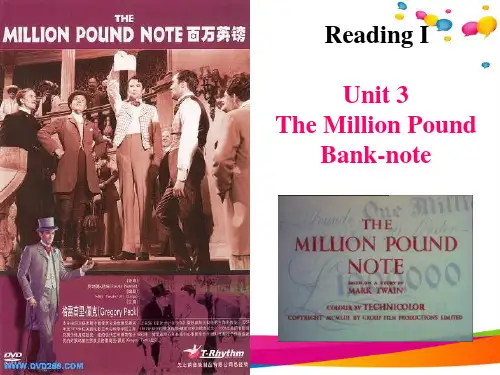
Unit 3 The Million Pound Bank Note
Period 4 using language Reading, acting and speaking
Lead in
5
Which seat will you choose to sit if you are to eat in a restaurant?
Lead in
Have ever been badly treated at any shops, restaurants, hotels …? How id you think of the owner?
skimming
Background information
Conflict 5
Conflict 6
bow
Further discussion
Whose behaviour changes most during the scene? rudely First he treated Henry ____________. well Later he behaved too _________ to Henry. What kind of person is the owner of the restaurant? He judges a person only from_____________, and he appearance loves____________ most. money How do you understand this sentence: Well, we’ll have to take a chance. Why do you think the owner of the restaurant gave Henry a free meal at last?
25
Where Who
In a restaurant
Henry Adams Owner Hostess Waiter
scanning
Read the dialogue quickly and divide it into 2 parts
27 1 Part 1 line___----line____: badly The owner treated Henry__________.
What did this story trying to tell us? Did the owner, the hostess, and the waiter trust Henry at first? At last did they trust Henry?
This story tells us The man who do small business that___________________________________
Structure of drama
Act I, Scene 3 NARRATOR(叙述者): Conflict 1 ACTOR A: (stare at what is left of the brothers’ dinner) Thanks. Conflict 2 … ACTOR B: ( happily) What luck! Show us the feeling of Conflict 3 ACTOR C: the actor …
Imagine you are having a good meal in a restaurant. Make a dialogue with your partner, who acts as a waiter/waitress. Don’t forget the structure of drama…
What did they do What did they say
Conflict 4 The owner: This one is reserved shocked and nervous The hostess: scream But he is in rags! hits her husband’s Go and see him at arm once. The owner: I’m so sorry, sir, so sorry.… … The three of them:
Post-reading Making a dialogue
WAITER/WAITRESS
8
CUSTOMER
I’d like … I’ll have Do you have…? What do you suggest? I’ll have that. The bill, please. Can I have the check, please?
28 50 Part 2 line___----line____: well The owner treated Henry__________.
Detail-reading
Poor man
Read part 1 and find the evidence to show Henry was badly treated
doesn’t trust others, they only trust money but can’t make a lot of money.
But real businessmen like the Brothers, they trust others after careful observation That is why they can make large amount of money.
unit3 the million pound bank note Reading_
竞选州长
2. The Million Pound
Bank-note
ACT
二、逐步深入,文章探究
1
SCENE
(1)A brief introduction to the story
1&2
Characters (人物):
Henry Adams : a lost American busind “Oliver” :
Money can buy a house but not a home. Money can buy a bed but not sleep. Money can buy a clock but not time. Money can buy a book but not knowledge. Money can buy medicine but not health. You see, money is not everything.
Homework
1. Learn the new words and
expressions by heart.
2. Finish the revelant exercises in the
Best Design.
Well, it may seem luck to you but not to me. If this is your idea of some kind of joke, I don’t think it’s very funny. Now, if you’ll excuse me, I think I’ll be on my way.
two brothers and rich
Englishmen
高中英语 Unit3 The Million Pound Bank Note课件 新人教版必修3
2. How many characters are ? Who are they? And
who’s the hero(main character)?
Four.
Henry, Roderick, Oliver, Servant. 3.Where did Henry e from?
Henry
San Francisco of the US.
12.What was Mark Twain’s life like in the last years of his life?
The last years of his life were filled with sad events, loneliness, and the loss if much money.
Careless
didn’t sail his boat well and might have died if the ship had not seen him.
The characteristics of the two
brothers:
some servants and a big house
working as an unpaid hand.
GroGurpouwp owrokrk
Character’s lines(台词) tell us what they are like. We can know more about the main characters only after we study their lines carefully.
The Million Pound Bank-Note
Fast-reading: answer the following questions.
Unit 3 The Million Pound Bank-Note教案

Unit 3 The Million Pound Bank-Note教案Unit 3 The illin Pund Ban-NteI.单元教学目标技能目标Sill GalsTal abut shrt stries and draasLearn h t at ut a plaLearn h t request and rder fdLearn Nun lauses as the bet and prediative rite a pla r draaII.目标语言功能句式Request(请求)uld u please e in?uld u ind aiting ust a fe inutes?a I as u h uh ne u have?— ell, t be hnest, I have nneuld u ffer e se ind f r?I nder, r Adas, if u ind us asing a fe questins? — G right aheadrdering fd (点餐)I’d lie se ha and eggs and a nie big steaI’ll have a nie lng glass f beer词汇1 四会词汇bet, sene, tale, servant, perit, ba, stare, spt, passage, aunt, appearane, patiene, sill, ealus, unbelievable, stea, tin, lf, dessert, rude, anner, srea,shulder, rag, indeed, b, deade, pilt, huur, nvel, harater, diretr, barber2 认读词汇narratr, inredible, Rderi, liver, nightfall, unpaid, harit, illingness, sipl, leens, issue, fae, bhd, Hannibal, issuri, ississippi, fath, ntest, ale, lneliness, plaright, sript3 固定词组ae a bet, g ahead, b aident, aunt fr, t be hnest, in rags, even if, get int truble4 重点词汇bet, ae a bet, perit, g ahead, b aident, stare, aunt fr, t be hnest, ealus, inrags, indeed, even if, get int truble 语法Nun lauses as the bet (宾语从句)I an’t sa that I have an plansand he des nt n hat he shuld dI did nt n hether I uld survive until rning Nun lauses as the prediative (表语从句) That’s h e’ve given u the letter重点句子1 Have u ever ade a bet ith a friend? If s, hat did u bet n?2 He is lst in Lndn3 Perit e t lead the a, sir4 As a atter f fat, I landed in Britain b aidentHis ees stare at hat is left f the brthers’dinner n the table6 I nder, r Adas, if u’d ind us asing a fe questins7 I earned passage b ring as an unpaid hand, hih aunts fr appearane8 ell, e ill have t tae a hane9 (in a rude anner) hat’s there t ait fr?10 He’s in rags!III.教材分析与教材重组1 教材分析本单元的主要内容是根据马克·吐温的名著《百万英镑》改编而成的剧本中的几个片段。
(完整版)新人教版Book3Unit3TheMillionPoundBankNote课文
Book 3 Unit 3 The Million Pound Bank NoteAct I, Scene 3NARRATOR:It is the summer of 1903, Two old and wealthy brothers, Roderick and Oliver, have made a bet. Oliver believes that with a billion pound bank note a man could survive amonth in London. His brother Roderick doubt s it. At this moment, they see apenniless young man wander ing on the pavement outside their house. It is HenryAdams, an American businessman, who is lost in London and does not know whathe should do.RODERICK:Young man, would you step inside a moment, please?HENRY:Who? Me, sir?RODERICK:Yes, you.OLIVER:Through the front door on your left.HENRY:(a servant opens a door) Thanks.SERVANT:Good morning, sir, would you please come in? Permit me to lead the way, sir. OLIVER:(Henry enter s) Thank you, James. That will be all.RODERICK:How do you do, Mr…er…?HENRY:Adams, Henry Adams.OLIVER:Come and sit down, Mr Adams.HENRY:Thank you.RODERICK:You’re an American?HENRY:That’s right, from San Francisco.RODERICK:How well do you know London?HENRY:Not at all. It’s my first trip here.RODERICK:I wonder, Mr Adams, if you’d mind us asking a few questions.HENRY:Not at all. Go right ahead.RODERICK:May we ask what you’re doing in this country and what your plans are?HENRY:Well, I can’t say that I have any plans. I’m hoping to find work. As a matter of fact, I land ed in Britain by accident.OLIVER:How is that possible?HENRY:Well, you see, back home I had my own boat. About a month ago I was sail ing out of the bay…(his eyes stare at what is left of the brother’s dinner on the table)RODERICK:Well, go on.HENRY:Oh, yes. Well, towards nightfall I found myself carried out to sea by a strong wind. It was all my fault. I did not know whether I could survive until morning. The nextmorning I’d just about given myself up for lost when I was spot ted by a ship. OLIVER:And it was the ship that brought you to England.HENRY:Yes. The fact is that I earn ed my passage by working as an unpaid hand, which account s for my appearance. I went to the American embassy to seek help, but…(the brothers smile at each other)RODERICK:Well, you mustn’t worry about that. It’s an advantage.HENRY:I’m afraid I don’t quite follow you, sir.RODERICK:Tell us, Mr Adams, what sort of work did you do in America?HENRY:I worked for a mining company. Could you offer me some kind of work here? RODERICK:Patience, Mr Adams. If you don’t mind, may I ask you how much money you have? HENRY:Well, to be honest, I have none.OLIVER:(happily) What luck! Brother, what luck! (clap s his hands together)HENRY:Well, it may seem lucky to you but not to me. On the contrary, in fact. If this is your idea of some kind of joke, I don’t think it’s very funny. (Henry stands up to leave)Now, if you’ll excuse me, I think I’ll be on my way.RODERICK:Please don’t go, Mr Adams. You mustn’t think we don’t care about you. Oliver, give him the letter.OLIVER:Yes, the letter. (gets it from a desk and gives it to Henry like a gift) The letter. HENRY:(taking it carefully) For me?RODERICK:For you. (Henry starts to open it) Oh, no, you mustn’t open it. Not yet. You can’t open it until two o’clock.HENRY:Oh, this is silly.RODERICK:Not silly. There’s money in it. (calls to the servant) James.HENRY:Oh, no, I don’t want your charity. I just want an honest job.RODERICK:We know you’re hard-working. That’s why we’ve given you the letter. James, show Mr Adams out.OLIVER:Good luck, Mr Adams.HENRY:Well, why don’t you explain what this is all about?RODERICK:You’ll soon know. (looks at the clock) In exactly an hour and a half.SERVANT:This way, sir.RODERICK:Mr Adams, not until 2 o’clock. Promise?HENRY:Promise. Good-bye.Act I, Scene 4(Outside a restaurant Henry looks at the envelope without opening it and decide s to go in. He sits down at a table next to the front window.)OWNER:(seeing Henry’s poor appearance) That one’s reserve d. This way, please. (to the waiter) take this gentleman’s order, Horace.HENRY:(after sitting down and putting the letter on the table) I’d like some ham and eggs anda nice big steak. And make it extra thick. I’d also like a cup of coffee and apineapple dessert.WAITER:Right, sir. I’m afraid it’ll cost a large amount of money.HENRY:I understand. And I’ll have a large glass of beer.WAITER:OK. ( the waiter leaves and soon returns with all the food)HOSTESS:My goodness! Why, look at him. He eats like a wolf.OWNER:We’ll see if he’s clever as a wolf, eh?HENRY:(having just finished every bit of food) Ah, waiter. (waiter returns) same thing again, please. Oh, and another beer.WAITER:Again, everything?HENRY:Yes, that’s right. (sees the look on the waiter’s face) Anything wrong?WAITER:No, Not at all. (to the restaurant owner) He’s asked for more of the same.OWNER:Well, it is well-known that Americans like to eat a lot. Well, we’ll have to take a chance.Go ahead and let him have it.WAITER:(reading the bill after the meal) All right. That’s two orders of ham and eggs, two extra thick steaks, two large glasses of beer, two cups of coffee and two desserts. HENRY:(looking at the clock on the wall) would you mind waiting just a few minutes? WAITER:(in a rude manner) What’s there to wait for?OWNER:All right, Horace, I’ll take care of this.HENRY:(to owner) That was a wonderful meal. It’s amazing how much pleasure you get out ofthe simple things in life, especially if you can’t have them for a while.OWNER:Yes, very interesting. Now perhaps, sir, if you pay your bill I can help the other customers.HENRY:(looking at the clock on the wall again) Well, I see it’s two o’clock. (he opens the envelope and hold s a million pound bank note in his hands. Henry is surprised but theowner and the waiter are shocked) I’m very sorry. But … I … I don’t have anythingsmaller.OWNER:(still shocked and nervous) Well, er … just one moment. Maggie, look! (the hostess scream s, the other customers look at her and she puts a hand to her mouth). Do youthink it’s genuine?HOSTESS:Oh, dear, I don’t know. I simply don’t know.OWNER:Well, I did hear that the Bank of England had issue d two notes in this amount …Anyway, I don’t think it can be a fake. People would pay too much attention to a banknote of this amount. No thief would want that to happen.HOSTESS:But he’s in rag s.OWNER:Perhaps he’s a very strange, rich man. (as if he has discover ed something for the first time) Why, yes! That must be it!HOSTESS:(hit s her husband’s arm) And you put him in the back of the restaurant! Go and see him at once!OWNER:(to Henry) I’m so sorry, sir, so sorry, but I cannot change this bank note.HENRY:But it’s all I have on me.OWNER:Oh, please, don’t worry, sir. Doesn’t matter at all. We are so glad that you even entered our little eating place. Indeed, sir, I hope you’ll come here whenever you like. HENRY:Well, that’s very kind of you.OWNER:Kind, sir? No, it’s kind of you, sir. You must come whenever you want and have whatever you like. Just having you sit here is a great honour! As for the bill, sir,please forget it.HENRY:Forget it? Well … thank you very much. That’s very nice of you.OWNER:Oh, it’s for us to thank you, sir and I do, sir, from the bottom of my heart. (the owner, hostess and waiter all bow as Henry leaves)。
Unit 3 The Million Pound Bank Note
Unit 3 The Million Pound Bank Note Unit3ThemillionPoundBankNote核心单词.scenen.现场;情景;景色;发生地点;(戏剧)一场ourreporterwasthefirstpersononthescene.我们的记者是最先到达出事地点的。
Isawthescenewithmyowneyes.我亲眼目睹了那一幕。
Therockingboatsalongtheriverbankmakeabeautifulscene.河边晃晃悠悠的船只构成了一道美丽的风景。
易混辨析scene/scenery/sight/viewscene指某一处的自然风光;情形,情景。
scenery(总称)自然景物,天然风光,是由多个scenes 构成的自然风景。
sight景象,风景,名胜,侧重指值得看的事物或很难看的东西;很可笑的事物。
view景色,风景,侧重指从人所处的角度用肉眼所看到的景色。
高手过招单项填空Seeingthehappyofthechildrenplayinginthepark,I’mfullofjoyandconfidenceinthefutureofourcountry.A.SightB.viewc.lookD.scene选词填空(原创)①Guilinisfamousforitsbeautiful.②Theisaperfectdreamwhenyouseethesunrisingslowlyintheeas t.③youcangetawonderfulatthetopofthetower.④Theflowersarealovelyinspring.⑤Hebegantolosehissixyearsago.解析:选D。
句意为:看到孩子们在公园里玩耍的幸福一幕,我对我们国家的未来充满了自信和喜悦。
scene表示包括人及其活动的“景色”。
①scenery②scene③view④sight⑤sight2.permitvt.&vi.许可;允许;准许n.通行证;许可证;执照Hishealthdoesn’tpermithistravellingwithus.他的健康状况不允许他同我们一起旅行。
Unit 3 The Million Pound Bank-Note教案
Unit 3 The Million Pound Bank-Note教案Unit 3 The Million Pound Bank-Note锛╋紟鎶€鑳界洰鏍嘢kill GoalsTalk about short stories and dramas.Learn how to act out a play.Learn how to request and order food.Learn Noun clauses as the object and predicative.Write a play or drama.II锛?鍔?鑳?鍙?寮?RequestWould you please come in?Would you mind waiting just a few minutes?May I ask you how much money you have?鈥?Well, to be honest, I have none.Could you offer me some kind of work?I wonder, Mr. Adams, if you mind us asking a few questions? 鈥?Go right ahead.Ordering food ()I鈥檇like some ham and eggs and a nice big steak.I鈥檒l have a nice long glass of beer.璇?姹?1. 鍥涗細璇嶆眹bet, scene, tale, servant, permit, bay, stare, spot, passage, account, appearance, patience, silly, jealous, unbelievable, steak, tiny, wolf, dessert, rude, manner, scream, shoulder, rag, indeed, bow, decade, pilot, humour, novel, character, director, barber2.narrator, incredible, Roderick, Oliver, nightfall, unpaid, charity, willingness, simply, Clemens, issue, fake, boyhood, Hannibal, Missouri, Mississippi, fathom, contest, Yale, loneliness, playwright, script3. 鍥哄畾璇嶇粍make a bet, go ahead, by accident, account for, to be honest, in rags, even if, get into trouble4. 閲嶇偣璇嶆眹bet, make a bet, permit, go ahead, by accident, stare, account for, to be honest, jealous, in rags, indeed, even if, get into trouble璇?娉?Noun clauses as the object ()I can鈥檛say that I have any plans....and he does not know what he should do.I did not know whether I could survive until morning.Noun clauses as the predicative ()That鈥檚why we鈥檝e given you the letter.閲?鐐?鍙?瀛?1. Have you ever made a bet with a friend? If so, what did you bet on?2. He is lost in London.3. Permit me to lead the way, sir.4. As a matter of fact, I landed in Britain by accident.5. His eyes stare at what is left of the brothers鈥?dinner on the table.6. I wonder, Mr Adams, if you鈥檇mind us asking a few questions.7. I earned my passage by working as an unpaid hand, which accounts for myappearance.8. Well, we will have to take a chance.9. (in a rude manner) What鈥檚there to wait for?10. He鈥檚in rags!III锛?鏁欐潗鍒嗘瀽涓庢暀鏉愰噸缁?1. 鏁欐潗鍒嗘瀽?1.1 WARMING UP朵綔鍝? ?1.2 PRE-READING瑕佹眰瀛︾敓灞曞紑鎯宠薄锛屽亣濡傝嚜宸辨湁浜嗕竴寮犵櫨€嬭繖閮ㄧ數褰辩殑璇勪环銆?1.3 READINGenry Adams銆傛暀甯В銆佹劅鍙楁垙鍓хф?1.4 COMPREHENDING 涓璅act or OpinionВ鍜岃繍鐢ㄣ€?1.5 LEARNING ABOUT LANGUAGEВ?骞堕€氳繃鍏堝彂鐜板啀绠€鍗曡В銆佹帉鎻℃湰鍗曞?1.6 USING LANGUAGE Reading and actingenry Adams, 鍏堥伃鍒板喎閬囷紝鑰屽悗鐢变簬鎷垮嚭浜嗕竴寮犵櫨涓囪嫳闀戠殑澶ч挒,鍙堝€嶅彈鍏崇収鐨勬湁瓒f晠浜嬨€備綔鑰呯敤磋劯銆?1.6.1 READING && ACTING ?1.6.2 LISTENING &&WRITING竴姝ュ嵃璇佷簡Henry Adams 璇氬疄姝g洿鐨勫搧鏍笺€?1.6.3 READING ?1.6.4 WRITING?--€?1.7 SUMMING UP?1.8 LEARNING TIP ?2. 鏁欐潗閲嶇粍2.1,Warming up, Pre-reading, Reading, Comprehending鍜孶sing language Reading (about Mark Twain)鐩€?2.2 灏哃earning about language Words and expressions, Using language涓Useful structures涓嶹orkbook Using structures, Using words and expressions??2.3 灏哢sing language listening 锛圓CT ONE Scene 5锛夛紝Workbook涓Listening锛圓CT TWO Scene 2?2.4 灏哤orkbook Talking (ACT TWO Scene 1), Speaking Task (ACT TWO Scene3)鍜孲peaking Task (ACT TWO Scene 4)?2.5灏哢sing language Reading and acting (ACT ONE Scene 4)涓婃垚涓€鑺傗€滈槄璇诲拰琛ㄦ紨璇锯€濄€?2.6灏哢sing language Writing (ACT ONE Scene 5)涓嶹orkbookWriting Task 鍜孋hecking yourself, Learning Tips濄€?3. ?(缁忓垎鏋愭暀鏉??1st period Intensive Reading2nd period Grammar3rd period Listening4th period Speaking5th period Extensive Reading and Acting6th period Writing鈪? ?The First Period Intensive ReadingTeaching goals1. Target languagea. 閲嶇偣璇嶆眹鍜岀煭璇?bet, make a bet, permit, go ahead, by accident, stare, account for, to be honest, jealousb.Expressions on request:Would you step inside a moment, please?Would you please come in?May we ask what you鈥檙e doing in this country and what your plans are?Well, why don鈥檛you explain what this is all about?c. 閲嶇偣鍙ュ瀷1) Have you ever made a bet with a friend? If so, what did you bet on?2) He is lost in London.3) Permit me to lead the way, sir.4) As a matter of fact, I landed in Britain by accident.5) His eyes stare at what is left of the brothers鈥?dinner on the table.6) I wonder, Mr Adams, if you鈥檇mind us asking a few questions.7) I earned my passage by working as an unpaid hand, which accounts for my appearance.2. Ability goalsa. Enable students to read and hear natural language in a dramatic context and increase their self-confidence in using English, which will increase their overall motivation to learn English.b. Enable students to sum up the main idea of ACT ONE Scene 3.c. Enable students to understand the details about the whole scene.d. Retell the scene using the key words of the whole scene.e. Express their opinions by answering the following questions:1) Do you think money is everything? Why?2) Do you agree that only money can bring people happiness?3. Learning ability goalsa. Help students to understand natural language in the dramatic context and increase their self-confidence in using English.b. Help students to sum up the main idea of ACT ONE Scene3.c. Help students to understand the details of the whole scene.d. Get students to retell the whole scene.e. Help them to answer the following questions:1) Do you think money is everything?2) Do you agree that only money can bring people happiness?Teaching important pointsa. How to interpret language through tone of voice and body language, gaining a greater appreciation of the various verbal and non-verbal ways in which language works.b. Discuss the questions:1) Do you think money is everything?2) Do you agree that only money can bring people happiness?Teaching difficult pointsDiscuss the questions:1) Do you think money is everything?2) Do you agree that only money can bring people happiness?Teaching methodsElicitation, discussion, listening, reading and pair work.Teaching aidsA computer, a projector and a tape recorder.Teaching procedures and ways?Step I Warming upMark Twain is probably one of the few American writers with whom students are already familiar. This exercise makes the teacher find out how much the studentsknow about this writer and decide how much they need to know more about the auther before they read the play.T: Morning, everyone! Look at the screen, please. I will show you some pictures of a famous play. Talk about them in your own words. (The teacher shows them some pictures of THE MILLION POUND BANK-NOTE.)Picture one: I just need a suit.Picture tw I know that gentlemen like you carry only large notes.Picture three: Godness me! Six zeros.(Students discuss the three pictures)T: Ok, class. After watching and discussing the pictures, can you guess what the famous play is?Ss: Yes. It is called THE MILLION POUND BANK-NOTE.T: Then, do you know the writer of the play?Ss: Yes. He is Mark Twain.T: Do you want to know about the American writer Mark Twain? Next, read 鈥淎BOUT MARK TWAIN鈥?on Page23 so that you can know more about him.2. Students read this passage about Mark Twain and answer the questions given in the form on Page23.T: What鈥檚the real name of Mark Twain?Ss: Samuel Langhorne Clemens.T: When was he born and when did he die?Ss: He was born in 1835 and died in 1910.T: Do you know all the places where he lived?Ss: He was raised in Hannibal, Missouri, along the Mississippi River, but traveled much of the US, and also lived for a time in Europe.T: Can you name three of his famous stories?Ss: The Adventures of Tom Sawyer, The Adventures of Huckleberry Finn, A Connecticut Yankee in King Arthur鈥檚Court, The Notorious Jumping Frog of Calaveras County, etc.T: Why did you forget this one鈥昑HE MILLION POUND BANK-NOTE? As we know, Mark Twain is known as a humorist during his life. And this is reflected in THE MILLION POUND BANK-NOTE. So, today we鈥檒l learn some parts of this famousplay. Of course, if you want to read more about this great writer, you can go to the library or surf the Internet to find more about him.Step 鈪?Pre-readingGet the students to discuss the question with their partners and then ask them to report their work. Encourage them to express their opinions freely.T: If a rich person gives you a large amount of money to use as you like, for example, one million pound, what will you do? Why? (The teacher draws a picture on the blackboard.)锟?,000.000Money Flied to me from the sky. Everything changed from A to Z.(Students have a discussion on this question. Whatever choice students make here, they should be ready to offer their classmates a good reason for it.)S1: I鈥檒l buy a big house, a new car of my own and get married with a beautiful girl. In my opinion, the most important thing for a person is to enjoy the life. So, if I have a lot of money, I鈥檒l make full use of it to meet my needs for a rich life.S2: I鈥檒l give some money of the one million pound to the poor people in the western part of our country to help them live a happy life, especially the children. Because they really need help and they can learn more knowledge in order to develop the western part of our country. This way of spending money is meaningful.S3: ...T: I think all of you have a good idea. Do you want to know what happened to Henry Adams in THE MILLION POUND BANK-NOTE written by Mark Twain? Have you ever read the story? Have you seen the movie? If so, what do you think of it? So, this class we鈥檒l learn the story together.Step 鈪?While-readingFirst reading: scanningGet the students to comprehend the whole scene quickly and accurately and meanwhile help the students to form a good habit of reading. Teachers give the students a couple of minutes to look through the whole scene. Tell the students to read the text silently and then ask some detail questions about the text on the slide show with their partners. Teacher encourages the students to express their ideas.T: Now we are going to learn ACT ONE Scene 3. Read the whole scene quickly and find out the answers to the four questions here.Teacher shows the questions on the screen:1) How did Henry Adams come to England?2) Where did Henry work before? How much did he have?3) What did the two gentlemen give Henry?4) When can Henry open the letter?Students read the whole scene (ACT ONE Scene 3) for three minutes and try to answer the questions.T: Well, class, have you finished reading the whole scene?Ss: Yes.T: Ok, who can answer the first question? How did Henry Adams come to England?S1: It was the ship that brought him to England.T: Very good. You did a good job. Next, where did Henry work? How much did he have?S2: He worked for a mining company before and he had no money at all.T: Very good. Then what did the two gentlemen give him?S3: They gave him a letter.T: When can Henry open the letter?S4: He can鈥檛open it until two o鈥檆lock.T: Ok, great.Second reading: reading aloudIn this part, students will read the text again and try to understand the sentences and the main ideas of the whole scene.ListeningAfter that the students discuss the questions and then the teacher checks the answers with the whole class.T: Please listen to the tape and try to find the characteristics of the whole scene.(Students listen to the tape.)T: Well. Can you tell me the characteristics of the passage?Ss: Yes. This is part of a play. So, the narration is written in the present tense.T: Ok, all of you did a good job. Next, let鈥檚read the scene again and do some exercises.Step 鈪?Post-readingDo comprehending exercises.T: Read the scene again and do some comprehending exercises.The students begin to prepare for these two exercises. After a while, the teacher starts to check the answers. Later the teacher gives the answers. using a slide projector.Exercise 1T: Have you found out the answers?Ss: Yes.T: Ok! Let鈥檚check the answers. Who鈥檇like to tell us which of the statements are opinions?S1: I think statement 3, 4 and 5 are opinions.T: Very good. Now who will tell us which of the statements are facts?S2: I think statement 1 and 2 are facts.Exercise 2Get the students to do this exercise by themselves, and then ask them to check their answers with the whole class.(Later the teacher gives the answers, using a slide projector.)Explain language points.T: Well, class. What do you think of the scene? Do you think it is difficult to understand some sentences?Ss: Yes.T: Now, please look at the screen and let me explain some sentences.The following are the language points that the teacher will explain:1) a large amount of: a large quantity of; a great deal ofe.g. They bought a large amount of furniture before they moved their new house.2) make a bet: make an arrangement to risk money, etc. on an event of which the result is doubtful.e.g. We made a bet on the result of the match.3) permit somebody to do something: allow somebody to do somethinge.g. My mother doesn鈥檛permit me to ride in the street after it rained.4) by accident: as a result of chance.e.g. I only found it by accident.5) stare at: look at somebody or something with the eyes wide open in a fixed gaze ( in astonishment, wonder, fear, etc)e.g. Do you like being stared at?6) to be honest: to tell you the truth; to be franke.g. To be honest, I don鈥檛think we have a chance of winning.Students read the whole scene again and again and try to retell it.T: Well, class, have you got the main idea?Ss: Yes.T: What鈥檚the main idea? And can you retell it?(Then the students begin to prepare for retelling the whole scene.)Step 鈪?RetellingShow the key words and relevant pictures on the screen, using the computer.Ask the students to retell the whole scene, according to the following key words: summer, 1903, Henry Adams, American businessman, rescued, British ship, London, without money, lost, walk down, street, led to, two rich brothers, made a bet, a letter, a million-pound bank-note, open, two o鈥檆lock.T: Now, look at the key words and pictures, who can retell the reading?S1: It was the summer of 1903, and Henry Adams, an American businessman, had some very luck. He was rescued at sea by a British ship that takes him to London where he finds himself without money, friends and the prospect of a good job. He was lost and alone in London. He had no money and did not know what he should do. Walking down the street, he heard someone calling him. Then he came in and was led to two rich brothers, Roderick and Oliver, who made a secret bet and gave him a letter in which there was a one-million-pound bank-note. He was asked to open the letter until two o鈥檆lock in the afternoon. Roderick believes that a man can鈥檛survive in the city for a month with only a million pound bank-note in his possession but Oliver believes he can. (The play takes us along Henry鈥檚misadventures with humor and surprise to discover who will win the bet.)T: Good, the next one, who wants to try?(Then another student retells the whole scene.)T: You鈥檝e done a good job. Now let鈥檚retell the whole scene together.Step 鈪?Summary and HomeworkT: Ok, class, what do you think of this play? Is money so important?Ss: No.T: Some people say that money is everything. What do you think of this opinion?S1: I don鈥檛think so. Yes, money is very important in some occasion. But that doesn鈥檛mean it is everything. For example, when your hometown is flooded and you are trapped in the water, can you save yourself even if you have a lot of money with you? No! So, we should not regard money as everything.T: Great! But some people still think that money can bring them happiness. What do think of this?S2: I don鈥檛agree with this. Since money doesn鈥檛mean everything, so it can 鈥檛bring happiness to us. For example, you have a lot of money but you haven鈥檛a happy family, can鈥檛you say that you are happy?T: So, class, we should have a correct attitude towards money. Now, let鈥檚look at today鈥檚homework.1. Review the key sentences in this part.2. Preview the words in the second period.。
新人教2023年高考英语复习Unit3 The Million Pound Bank Note
m_a_n_n_e_r__ . 6.Hot and cold are c_o_n_t_r_a_r_y_ terms. 7.The man stood there, s_t_a_r_i_n_g___ me up and down. 8.—Is this __i_n_d_e_e_d__(真正地;确实) a Ming Dynasty vase?
Unit 3 │ 课前热身
课前热身
Ⅰ.单词拼写 1.A few years later,his hard work and patience
a_c_c_o_u_n_t_e_d___for his unbelievable success eventually.
2.My little brother is so naughty that I begin to run out
behind the scenes on the scene set the scene come on the scene
在后台;在幕后 在现场 提供条件 登场
Unit 3 │ 单词点睛
【活学活用】 (1)这场戏的最后一幕给人留下了深刻的印象。
_T_h_e__l_a_s_tl_a_y_was very impressive.
然风景。
Unit 3 │ 单词点睛
(3)sight景象、风景、名胜,侧重值得看的事物或很难看到的东西 或很可笑的事物;也可指视力、眼界。
(4)view 景色、风景,侧重从人所处的角度(从远处或高处)用眼所 看到的景色。 用scene,sight,view,scenery 的适当形式完成句子
教学设计6:Unit 3 The Million Pound Bank Note
Unit 3 The Million Pound Bank-Note I.教学内容分析本单元的主要内容是根据马克·吐温的名著《百万英镑》改编而成的剧本中的几个片断以及马克·吐温的生平简介。
Warming Up通过对马克·吐温及其作品的讨论引发学生学习兴趣,使学生对马克·吐温及其作品有个初步的了解。
Pre-reading首先要求学生回答几个相关的问题,并让他们展开想象,借助讨论引入到《百万英镑》的情节。
Reading部分是详细介绍富商兄弟俩打赌把一张百万英镑的钞票给一个一无所有、诚实可靠的穷人,想看看会发生什么事。
最后他们物色到一个穷困潦倒、流落伦敦街头的美国小伙子Henry Adams。
本部分可以通过先熟读后改编的形式,让学生登台表演,培养学生的调控能力和交际能力,然后再利用多种形式的练习让学生深入理解课文。
Learning about Language部分突出了词汇和语法的学习与训练。
本单元的语法是名词性从句中的宾语从句和表语从句的具体用法。
Using Language部分中包括了听、读、写三个部分的内容,是本单元主要篇章的延伸。
学生通过感受百万英镑给亨利带来什么样的待遇而进一步理解作者诙谐讽刺的写作风格。
该部分比较连贯,提出的一些问题有利于培养学生独立思考的能力和文学素养。
其中写作部分是训练学生选取和组织材料的能力,通过前面的学习,结合独立的思考,写出形象鲜明且语言流畅的戏剧。
Learning Tip指导学生掌握对话的技巧,了解如何使用相应的语音和语调来编排戏剧,提高学生的写作水平。
II.教学重点和难点1. 教学重点(1) 本单元教学目的和要求中的生词和短语;(2) 掌握名词性从句中的宾语从句和表语从句的具体用法;(3)了解戏剧(剧本)语言的特点,如舞台说明(stage directions)用一般现在时态,台词中有很多的省略句等。
2. 教学难点(1)了解《百万英镑》及其作者马克·吐温的时代背景,提高学生的文学修养和培养学生的跨文化意识;(2) 学习语言交际中委婉请求、请求允许和点餐的表达法;(3) 学习怎样去写或编一个短剧和更难的比较长的戏剧。
课件13:Unit 3 The Million Pound Bank Note
in a...way 以……的方式 in large amounts 大量地(作
large amounts of 大量的;a large amount 状语用)
of 大量的
句法新天地——重点句型
find后接复合宾语
[教材原句] Well,towards nightfall I found myself carried out to sea by a strong wind.
词法新图谱——核心词汇
●灵活多变的动词
词汇 词性
意义
permit v. 许可;允许;准许
stare vi.
凝视;盯着看
spot vt.
发现;认出
account v. 认为;说明;总计有
seek v. 寻找;探索;寻求
scream vi.
尖声叫
wander vi. 漫游;漫步;漂泊
现在分词 permitting
提出
长大。
动副
I don't mind your smoking here.Just go
go ahead 前进;(用于祈使
ahead.
句)可以;往下说
我不介意你在这里吸烟,你吸就是了。
take a chance 冒险(= take a risk) 动名 find fault with ... 对……不 满;挑剔
嗯,傍晚时分我发现自己被一阵大风刮到海上去了。 find 后接复合宾语,carried out 为过去分词短语,在句中作宾语补足语,表 被动。find 的复合宾语结构如下:
现在分词(表示主动、进行) 过去分词(表示被动、完成) find+宾语+形容词 介词短语
必修三Unit 3 The Million Pound Bank Note Period 6 Usi
Unit 3The Million Pound Bank NotePeriod 6Using language: Listening, reading and writing整体设计教材分析This is the sixth teaching period of this unit. The teacher can fir st check the homework, let students review what they learned in the last lesson and then lead in the new lesson.In this period, the teaching activities will focus on Listening task, Reading and speaking task, and Writing task. Listening task and Reading and speaking task offer the students the opportunity to enjoy Act Ⅱ, Scene 3 and Act Ⅱ, Scene 4 of this play.For Listening task, the teacher should first ask students to make a list of all the changes that Henry has made to his life and discuss with their partner what difference this will make to the way people treat him. Then let students listen carefully to Act Ⅱ, Scene 3 and write down the main idea. Next, they listen to the tape again for detailed information, make notes as they listen and check their answers with their partner.As to Reading and speaking task, first let students discuss the two questions in pairs (1. What will Henry and Portia tell each other about themselves? 2. What will they keep a secret from each other? ), and thenhave them listen to th e tape and read the play aloud, paying attention to the rhythm, pronunciation and intonation so as to act out the play in the end.Writing task is more challenging, for it involves a higher level of interpretive skill. So the teacher should give them enough encouragement and necessary help. Before they can write their dialogue between Henry and Portia, help them evaluate these characters as presented in the play by letting them discussing the related questions with their partner and give them as much advice as possible on how to finish their task. Writing is a higher stage of language learning. The teacher should frequently give students some assignments of writing. Only in this way can students use what they have learned more freely.教学重点1. Develop students’ integrative ability.2. Let students listen to Act Ⅱ, Scene3.3. Have st udents read Act Ⅱ, Scene4.4. Ask students to make a dialogue between Henry and Portia.教学难点1. Get students to listen to and understand Act Ⅱ, Scene 3.2. Let students make a dialogue between Henry and Portia.三维目标知识目标1. Get students to learn some useful new words and expressions in this part.2. Get students to listen to Act Ⅱ, Scene 3 and read Act Ⅱ, Scene 4 of the play.能力目标1. Develop students’ integrative ability.2. Enable students to listen to and understand Act Ⅱ, Scene3.3. Enable students t o read and understand Act Ⅱ, Scene4.4. Enable students to make a dialogue between Henry and Portia.情感目标1. Stimulate students’interest of learning English by enjoying this play.2. Develop students’ sense of group cooperation and teamwork.教学过程→Step 1 Revision1. Check the h omework exercises.2. Ask some groups of students to Act Ⅱ, Scene 1 or Act Ⅱ, Scene 2.→Step 2 Warming up1. Ask students t o make a list of all the changes that Henry has made to his life.2. Have them in pairs discuss what difference they think this will make to the way people treat him and report their ideas to the class.→Step 3 Listening task1. Tell students: Turn to Page 58. We are going to listen to Act Ⅱ, Scene 3.2. Let them listen carefully and w rite down the main idea.3. Have them go through the chart and make sure they know what to do. The things Portia knows about Henry Henry’s response1. 2. 3.1. 2. 3.4. Play the tape again for them to listen to and let them make notes.5. Two or three minutes for them to discuss and share their notes with another pair.6. Play the tape a third time for them to check and have the correct answers.→Step 4 Reading and speaking task1. Ask students to discuss the following questions in pairs.1)What will Henry and Portia tell each other about themselves?2)What will they keep a secret from each other?2. Let some of them report their ideas to the class.3. Tell them: Turn to Page 58. We are going to read Act Ⅱ, Scene4.4. Let them read the play fast to get the main idea.5. Have them read the play carefully and retell the story in their own words.6. Let them listen to the tape and read the play aloud, paying close attention to the rhythm, pronunciation and intonation.7. Give them enough time for them to try to learn the end of the play by heart and then act it out. Make sure they speak with expression.→Step 5 Writing task1. Suppose the situation: Imagine that after Henry marries Portia, he has bad luck in business and becomes poor again. Now he must tell his wife the bad news. With a partner write a short dialogue between these two characters.2. Let students discuss the questions with their partner.(Show the following on the screen. )1)How do you think Portia feels when she hears the bad news?2)What do you think Henry plans to do to solve the crisis?3)Do you think Portia will leave Henry?4)Do you think they will get help from the two brothers or anybody else? Give reasons.5)What will they finally do?6)How do you think people’s attitudes will change towards Henry and Portia?3. Give them the following advice.(Show the following on the screen. )1)Read the questions and brainstorm some ideas.2)Write down your ideas.3)Share your ideas with another pair and ask them for advice.4)Organize the ideas into an order suitable for writing.5)Make up a dialogue and write it down.4. They begin to write their dialogue.5. Invite as many pairs as possible to perform their dialogue to the class. The teacher and others should give comments.Sample dialogue:Portia: Oh, Henry. It’s nice to see you home so early!Henry: Erm, aah.Portia: (looking worried)What’s happened?Henry: I can’t hide much from you, can I, dear? We have lost all our money. The railway company in Brazil has collapsed and all our money has disappeared. But I have a plan to help us. We can go back to America and start again. I can become a gold miner and we can make our fortune that way.Portia: Leave London? Leave my stepfather? Oh no, Henry, please!Henry: I think it might be better for us. We should stand on our ownfeet.Portia: (crying)I shall have to go home. You cannot love me if you want to do this dreadful thing.Henry: (putting his arms around her)Of course I do. It is for our sake that I suggest this. It will be an adventure. We will be able to travel where we like and I will be able to show you so many lovely places.Portia: As long as you love me I shall be happy.Henry: And I shall always do that!→Step 6 Homework1. Finish off the Workbook exercises.2. Suppose that Henry feels tricked by Portia when he finds out that Oliver is her stepfather. How might the play end differently under these circumstances? Please rewrite the end of the play on the basis of the question.3. Review the contents of the unit and complete Summing Up on Page 24.板书设计Unit 3 The Million Pound Bank NoteListening, reading and writingQuestions to discuss beforewriting:1. How do you think Portia feelswhen she hears the bad news?2. What do you think Henry plansto do t o solve the crisis?3. Do you think Portia willleave Henry?4. Do you think they will gethelp from the two brothers oranybody else? Give reasons.5. What will they finally do?6. How do you think people’s attitudes will change towards Henryand Portia?Advice on writing:1. Read the questions andbrainstorm some ideas.2. Write down your ideas.3. Share your ideas with another pair and ask them for advice.4. Organize the ideas into an order suitable for writing.5. Make up a dialogue and writeit down.活动与探究Reading, watching and performingWork in groups. Go to the library to find out the whole play and take roles to read it carefully. Try to recite most of the lines. Surf the Internet to find out the film and watch it again and again. Pay attention to the characters’looks and words. Then be well prepared to perform the whole play with the help of your teacher. Finally present it to the class or to the school.。