
外研版七年级上册英语Module 5Unit 2
Unit 2 We start work ai ninme and talk about the pictures.
6:30
7:00
get up
have breakfast
For example:
I get up at half past six. I ....... at .......
a
b
c
d
e
f
7:30 am __e__ 10:00 pm __c__ 11:00 am __d__ 12:30 pm __a__ 3:30 pm __b__ 9:00 am __f__
Activity 3-Underline the correct expressions.
1 I get up / start work at half past seven. 2 We have a break / have lunch at half past twelve. 3 I go home / watch TV in the evening. 4 I do my homework / see my friends in the evening. 5 I go home / go to sleep at ten o’clock.
watch TV
I’m Alex. I go to school on weekdays. I get up at half past seven…….
10:00
do my homework and go to bed
1.Write some sentences about yourself.
I get up at…
go home是一个固定搭配,意为“回家”。 因为home在这里作副词, 故home的前面不能 加介词to。 关于 go的短语:
go to school “去上学” go to work “去上班” go to bed表示“去睡觉”
3. We start lessons in the afternoon at half past one. start, 意为"开始;着手",
In the afternoon, we have lessons, and then we play football in the playground.
3. In the evening, I have dinner. I do my homework.
I the evening, I have dinner, and then do my homework. 4. In the evening, I do my homework. I go to bed. In the evening, I do my homework, and then go to bed.
Look at the sentences:
1. I get up at seven o’clock. I go to school at eight o’clock. I get up at seven o’clock, and then go to school at eight o’clock.
Now join these sentences with and then. 1. In the morning, we get up. We go to school.
In the morning, we get up, and then go to school.
2. In the afternoon, we have lessons. We play football in the playground.
2.Work in pairs. Use the sentences to talk about your school day. I get up at half past seven.
We start work at nine o’clock.
We have lunch at half past twelve.
Summary: 短语
Chinese
English
起床
get up
吃早餐 上学 上课 休息
have breakfast go to school have lessons have a break
活动 吃午餐
回家 做作业 吃晚餐
睡觉
(英文)
have lunch go home
do homework have dinner go to bed
get up:“起床” 。如:
What time do you__g_e_t_u__p___?
你几点起床?
e.g.
have breakfast. 吃早餐
have lessons 上课 have dinner 吃饭
have a look 看一看
2. Then we go home at half past three.
Get to know about "have"
For example: I get up at half past seven in the morning, and then have breakfast.
吃早餐
have lessons have dinner have a rest have a good time have a look
We start lessons in the afternoon at half past one.
Post-reading:
Find out these sentences from the passage.
1. I get up at half past seven in the morning, and then have breakfast.
Activity 4
• Read paragraph 1-3 and finish the task.
• 判断正误 (T,F)
• 1、I go to school on Saturwdeaey kadndaySsunday.( F)
• 2、We start lessons at hnailnfepaos'tceloigchkt.(F) • 3、We have a break at eleven o’clockT.( )
7:30 go to school
11:00 have lunch
8:00 start lessons
12:00 have a break
4:00 go home
5:30 have dinner
9:00 7:30
do homework
go to bed
Pre-reading: Match the pictures.
sleep go have have
have play
home lunch breakfast lessons football
While-reading:
Activity 1-Read the passage and put the pictures in order.
a
b
c
4
5
6
d
e
f
3
1
2
Activity 2-Match the times with the pictures.
• Read paragraph 4-6 and answer the questions.
• 1、Where do we have lunch? We have lunch in the dining hall.
• 2、When do we start lessons in the afternoon?
start + sth.
start+ to do sth.
start+doing sth.
start也可用作名词, 意为“开始;开端”。如: The start of the film is very interesting. 电影的开头非常有趣。
[Practice]
用所给单词的适当形式填空。 1. The first class __s_t_a_rt_s___(start) at eight o’clock. 2. My brother started __p_la_y_i_n_g__/ _to__p_l_a_y__ (play) football when he was ten years old.
上课 吃饭 休息 玩的愉快
看一看
Write a passage about Chinese school days, write sentences like: I/We get up at … I/We go home at … I/We homework at …
Post-reading: Speaking activity--Retelling
7:30 8:30
9:00 11:00 12:30
1:30 3:30
in the evening
get up go to school start work have a break have lunch start lessons go home
Module5Unit2教案-外研版七年级上册英语

-在对话理解方面,教师可放慢语速,分段播放听力材料,指导学生抓住关键信息,并设计相关练习帮助学生巩固。
-关于文化差异,教师可以引入一些不同国家的天气预报视频,让学生了解并对比不同文化背景下的天气表达方式。
四、教学流程
3.重点难点解析:在讲授过程中,我会特别强调天气词汇和现在进行时态这两个重点。对于难点部分,我会通过对比和实际例子来帮助大家理解。
(三)实践活动(用时10分钟)
1.分组讨论:学生们将分成若干小组,每组讨论一个与天气相关的实际问题,如“如何在不同的天气下安排户外活动?”
2.实验操作:为了加深对现在进行时态的理解,我们将进行一个简单的角色扮演活动。学生模拟天气预报员,使用现在进行时描述天气情况。
小组讨论环节,学生们围绕天气对日常生活的影响展开了热烈的讨论。他们提出了很多有见地的观点,但也有一些小组在讨论过程中出现了偏题的情况。我意识到,在引导学生讨论时,需要更明确地设定讨论的主题和方向,同时加强课堂监控,确保讨论的效率和质量。
此外,我发现学生们对于天气文化的兴趣非常浓厚。在讲解不同国家和地区对天气描述的差异时,他们表现出了极大的好奇心。这让我想到,在未来的课程设计中,可以更多地融入跨文化元素,让学生在学习语言的同时,也能够了解和尊重不同的文化。
(二)新课讲授(用时10分钟)
1.理论介绍:首先,我们要了解天气的基本词汇和句型。天气是指大气层在短时间内的状态和变化,它是我们日常生活中经常讨论的话题。我们要学会用英语询问和描述天气。
2.案例分析:接下来,我们来看一个具体的案例。课文中的人物是如何谈论天气的?这个案例展示了如何在实际对话中使用我们今天要学习的词汇和句型。
外研版英语七年级上册Module 5 Unit 2 课件
Listen and fill in the blanks
At eleven o’ clock, we _h_a_v_e__a_b_r_e_a_k___ in the playground and I __ta_l_k_t_o______ my friends. They go to the playground and ___p_la_y__f_o_o_tb_a_l_l__, but I don’t like football.
Activity 6
Look at the sentences.
I get up at seven o’clock. I go to school at eight o’clock.
I get up at seven o’clock, and then go to school at eight o’clock.
1.Alex gets up at_h_a_lf_p_a_s_t_s_ev_e_n____. 2. Alex’s favourite subject is__ar_t_______. 3.There are ___f_iv_e____ lessons one day. 4.Alex goes to bed at_te_n__o’_c_lo_c_k__.
A:When is your…lesson? B: We have …lesson at…
初中英语外研版七年级上册《Unit 2 What’s your number》课件PPT
1
2
3
one two three
4
5
four
five
6
7
six
seven
8
9
10
eight
nine ten
Game 1 用英语快速大声读出你所见到的数字
1
8
3
9
zero
6
2
0
7
5
4
10
02 新知讲解
新的 学生 这里 在…里面 电话 号码
new student here in number
telephone
Unit 2 What’s your number?
Module 2 My English lesson
外研版初中英语七年级上册课件
CONTENT
复习巩固
教学重点
新知讲解
拓展练习
01 复习巩固
课前回顾
1.C_lo_s_e_your book. 2.O_p_e_n_your book. 3.S_it__down. 4.L_is_t_e_n_to your teacher. 5.P_u_t_up your hand. 6.S_ta_n_d__up. 7.D_r_a_w__a picture.
04 拓展练习
Make a survey about your classmates' phone number.
Names 1 2 3 4
Student numbers
Unit 2 What’s your number?
Module 2 My English lesson
外研版初中英语七年级பைடு நூலகம்册课件
课文导航 1 one 2 two 3 three 4 nine
外研版七年级上册英语Unit 2 Can you help me, please 优秀课件

课堂小结
归纳
• Structure —Can you help me?—Yes; —Can you see that again?—Yes; —Thank you.—You are welcome. • Key Words help, of course, classroom, know, say, that, again, welcome • Key sentences —Can you help me,please,Lingling? —Yes,of course— Can you say that again,please? —Yes. It's C-L-A-S-S-R-O-O-M. • Expressions
A:How do you spell it? B:... A:Thank you. B:You're welcome.
新课讲解 6 Write.
A: Can
you help me,please?
B:Yes, of
course
.
A:How do
you spell “
B:It's DESK.
desk ”?
—You're welcome.不用谢。
新课讲解
例
欢迎来北京。
_W__e_l_c_o_m_e__ ____t_o___Beijing.
【解析】“欢迎到……”用 “Welcome to ...”。
新课讲解 2 Listen and point.
新课讲解
3 Read and match.
1. Can you help me,please? 2. How do you spell “desk”? 3. Can you say that again, please? 4. Thank you. Now listen and check.
2022外研版英语七年级上册 正式篇 Module 5 Unit 1 ---3同步测试题附答案

Module 5 Unit 1 I l ove history.一、根据语境及所给汉语提示语写出所缺单词。
1. I ________(爱) my family.2. Science is __________(有趣的) for me.3. English is my favourite ________(科目).4. I like spring ________(因为) it is warm.二、短语翻译1. 擅长……2. 与某人交谈3. 在上午/ 下午/ 晚上三、根据语境及所给图片提示写出所缺单词。
1. It is twenty ________ seven.2. This is my ________ book.3. —What’s your favourite subject?—It’s ________.4. Ms Smith is our ________ teacher.5. All of the stud ents like the ________ lesson.四、用所给词汇的正确形式填空History is Betty’s (1) ________ subject. She likes it (2) _______ it’s very (3) __________. Tony’s favorite (4) _______ is Chinese. There are Chinese, science, IT and maths (5) _______ on Monday morning, but for Tony, maths is (6) ________.五、根据汉语意思完成英语句子,每空一词(含缩略形式)。
1. 几点了?________ the ________?2. 现在是9点50分。
It is ________ ________ ________ now.3. 你的体育课在什么时候上?________ ________ your PE lesson?4. 我经常和爸爸妈妈交谈。
外研版七年级英语上册Unit 2 Can you help me,please(教学课件)
kite
bike
clock
crayon
car
desk
5.Work in pairs. Ask and answer.
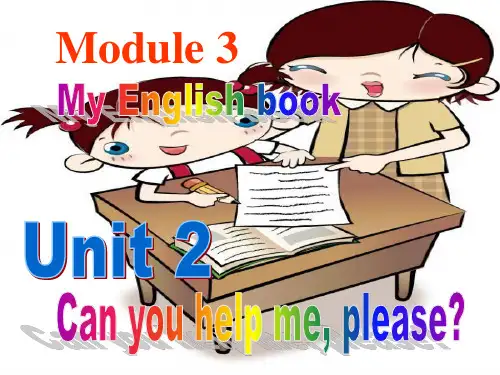
A: Can you help me, please? B: Yes, of course. A: What’s this in English? B: It’s a _c_ra_y_o_n__. A: How do you spell it? B: _C_-_R_-_A_-_Y_-O__-N__, _c_ra_y_o_n_. A: Thank you. B: You’re welcome.
Can you spell it, please? Yes, P-A-N-D-A.
Can you say that again, please? Yes. It’s P-A-N-D-A. 请你能再说一遍吗?
What’s this in English? It’s …a c. hicken
Can you spell it, please? Yes, C-H-I-C-K-E-N.
( A ) 4. ——What’s this in English? —— _________.
A. It’s a book B. This is a book C. That’s OK
( C)5. ——Thank you, Lucy? —— __________.
A. I am sorry B. Of course C. You’re welcome
a ) You’ re welcome. b) Yes, D-E-S-K. c) It’s D-E-S-K. d) Yes. Of course.
Now listen and check.
外研版英语(新标准)七年级上册M5《Unit 2 We start work at nine o'clock》A同步试题及答案
M5 Unit 2一、单项选择1.I like tea ________ sugar in it.A.in B.of C.with D.from2.We have ________ breakfast at home every day.A./ B.a C.the D.an3.It is a good habit (习惯) to go to ________ bed early and get up early.A.a B.an C.the D./4.Let's start ________,boys and girls.A.have our class B.having our classC.had our class D.to having our class5.I'm very tired. Let's ________.A.have break B.have the breakC.have a break D.to have a break6.I ________ my homework in my bedroom.A.have B.do C.eat D.talk7.I sit on the chair and talk ________my mother.A.in B.at C.on D.to8.—________is your house?—It's next to the park.A.What B.Where C.How D.When9.We often ________ football matches on TV on Sunday.A.see B.look at C.watch D.read10.—When do you have breakfast?—________7:15 ________the morning.A.At;in B.In;atC.In;in D.On;on二、用方框中所给单词或短语的适当形式填空11.The students play football in the________after class.12.I am very tired,so I want to____________now.13.I don't________ TV on weekdays.14.—It's 7:30 in the morning.Let's____________.—OK.15.—Do you____________ with your parents at home in the evening?—Yes,I do.三、用介词at,in,on,with或to填空,每词限用一次16.The school library is next________our classroom.17.The boys play football________the playground.18.They don't work________ Saturdays and Sundays.19.I like books________ pictures.20.My parents go to work________ eight in the morning.四、句型转换21.We do our homework after school.(改为一般疑问句并作肯定回答)—________ you ________ ________ homework after school?—________,we do.22.Mary's parents go to work at weekends.(改为否定句)Mary's parents ________ ________ to work at weekends.23.I go to school at seven o'clock.(对画线部分提问)________ ________ you go to school?24.We have a break in the playground.(对画线部分提问)________ ________ you ________ in the playground?25.We have three lessons on Friday afternoon.(对画线部分提问) ________ ________ lessons do you have on Friday afternoon?五、原创阅读(词数:约110建议用时:5分钟)We are students. We go to school (A) Mondays (B) ridays. We have no classes on Saturdays and Sundays.We usually get up at sixo'clock.Classes start (D)at eight.We have four lessons in the morning and two in the afternoon.(E)我们在12:15吃午饭。
外研版七年级英语上册(课件):Module 5
Unit 1 I love history.
第一课时 Getting ready & vocabulary
课前导学
核心单词
1. ________ n. 一半 half past 2. ________ prep. 晚于,过(几点) 3. ________ o'clock adv. ……点钟 4. geography ________ n. 地理 5. ________ lesson n. (一节)课 6. difficult ________ adj. 困难的,难懂的 7. ________ because conj. 因为 8.interesting ________ adj. 有趣的 9. ________ v. 谈论,说话 talk 10. ________ adv. 什么时候,何时 when
常用句型精讲 句型“What's the time?”的用法 【教材例句】What's the time? 现在几点了?(教材第
26页)
【用法】句型“What's the time?”用来询问当前的时间,
等于“What time is it?”。答语:It's+时间.
【举例】—What time is it now? 现在几点了?
【应用】 ( A )1. Daming is talking ________ Lingling. A. with B. on C. in D. of ( A )2. They are talking ________ the festivals
in America.
A. about B. to C. with D. /
易混词 (组) 辨析
外研版七年级上册英语M5 Unit 2 We start work at nine o'clock
haveabreakat11:00andhavelunchinthedininghallat12:30
My school day
get up at 7:30 and thenbrheaakvfeast _________1
go to school at 8:30 and see my
In the friends
【点拨】一日三餐前不用冠词。
9. Wehavea____B_betweentwolessons. A. lessonB. break C. dayD. lunch
10. [易错题] Selina, gotobednow.
B
Youshould_____beforesixo’clocktomorrow.
29. 在④处填上合适的短语。 ShewatchesTV④_________six_________(从……
fromto 到……) sevenintheevening.
washhands tostoptheCOVID-19 (新冠肺炎) fromspreading (传播).
五、完形填空。 MynameisAliceGreen. I’m______16. I’mfromLondon,
England. 16. A. AmericanB. English CB. ChineseD. French
_________________________________________ iendsateleveno’clock.
4.
DoesAlexwatchTVandhavedinnerwithhisfamilyinthee
vening?
_________________________________________ Yes, hedoes.
外研版七年级英语上册同步习题课件:Module 5 My school day Unit2
课堂导学
◆have和不同的词搭配有不同的意思。如:
have lessons 上课
have dinner 吃饭
have a break / rest 休息
have a meeting
开会
have a good time
玩得愉快
have a look 看一看
课堂导学
2. We start work at nine o’clock. 我们9点钟开始学习。 ◆work 意为“工作”,是不可数名词,没有复数也 不能用冠词a修饰。job是可数名词。 ◆start 意为“开始”,相当于begin,后接名词、v. -ing或不定式。
课堂导学
但三餐前有形容词修饰时,要加冠词a / an, 如:have a good breakfast吃一顿好的早餐。 表示“一日三餐吃什么”, 用have…for breakfast / lunch / supper。
课堂导学
【学以致用】 (1)I _h_a_v_e__b_r_e_a_k_fa_s_t at 7 every morning. 我每天早上7点吃早餐。 (2)We usually _h__a_v_e____ meat and rice _f_o_r_l_u_n_c_h____. 我们午饭通常吃肉和米饭。
课文理解
We have lunch in the dining hall at 4. __h_a_l_f __ past twelve. Lessons start in the afternoon at 1:30. We have two lessons in the afternoon. And I go 5. __h_o_m__e___ at half past three. In the evening,I do my homework and go to bed at ten o’clock.