
人教版八年级英语下册期末复习知识点总结归纳大全
人教版八年级英语下册复习知识点

人教版八年级英语下册复习知识点八年级英语下册复习知识1Whatwereyoudoingwhentherainstormcame?arriveat到达(小地方)arrivein到达(大地方)reach到达getto到达IarrivedinBeijinglastnight.=IreachedBeijinglastnight.=IgottoBeijinglastnight.如果宾语是副词here,there,home,要把at/in/to省略。
arrivehere/there/homegethere/there/homeinfrontof…在…的前面(某一范围外的前面)inthefrontof…在…的前面(某一范围内的前面)Therearesomebigtreesinfrontoftheclassroombuilding.在教室的前面有一些大树。
Ilikesittinginthefrontofthetaxi.我喜欢坐在出租车的前排位置。
takeoff(1)起飞Whendidtheplanetakeoffyesterday?飞机什么时候起飞?(2)脱下(衣帽等)Hetookoffhiscoatassoonashewentintotheroom.他一进房间就脱掉了外套。
(3)取消Theywilltakeoffthe5amtrain.他们取消了早上5点的火车。
getout(of)…从……离开/出去/下来Acarstoppedandagirlgotoutofit.但从汽车/火车/船/飞机/马匹上下来,用getoff…follow跟随Ifollowedhimuphehill.我跟着他上了山.沿着……前进Followthisroaduntilyougettothepostoffice.顺着这条路一直到邮局.(3)听懂,理解Couldyouspeakmoreslowly?Ican’tfollowyou.你能说慢点吗?我听不(4)followsb.todosth.跟着某人做某事Pleasefollowmetoreadthestory.请跟我读这个。
八年级下册英语知识点总结人教版

千里之行,始于足下。
八年级下册英语知识点总结人教版
下面是八年级下册英语知识点的总结:
1. 时态:复习一般现在时、现在进行时、一般过去时、过去进行时、一般将来时等各种时态的用法。
2. 从句:复习宾语从句、定语从句、状语从句的构成和用法。
3. 被动语态:学习被动语态的构成和用法,并能够灵活运用。
4. 语法:学习陈述句、疑问句、祈使句等句型的特点和用法,能够正确运用。
5. 词汇:积累并巩固八年级下册的词汇,包括形容词、副词、动词、名词、介词等。
6. 语音:学习英语的语音规则和方法,发音准确,能够正确区分音标。
7. 阅读理解:提高阅读理解的能力,掌握快速阅读和精读的技巧,并能够正确回答相关问题。
8. 写作:复习和提高写作能力,学习不同类型的写作,如书信、日记、说明文等,能够用英语进行简单的写作。
9. 口语交际:通过对话练习和角色扮演,提高口语交际能力,培养表达自己观点的能力。
第1页/共2页
锲而不舍,金石可镂。
以上是八年级下册英语知识点的总结,希望对你有帮助。
人教版八年级英语下册各知识点归纳总结

人教版八年级英语下册各知识点归纳总结Knowledge Summary of People's Education Edition Eighth Grade English TextbookUnit 1 Dream JobsIn this unit, students learn about different occupations and career paths. They practice talking about their dream jobs and discussing the pros and cons of different professions. Vocabulary includes words related to jobs, such as lawyer, engineer, chef, etc. Grammar points include the present simple tense for expressing routines and habits, as well as future forms for talking about future plans.Unit 2 Healthy EatingThis unit focuses on the importance of a balanced diet and healthy eating habits. Students learn about different food groups, nutrients, and the benefits of eating a variety of foods. Vocabulary includes words related to food, such as carbohydrates, proteins, vitamins, etc. Grammar points include using countable and uncountable nouns, as well as quantifiers such as some, any, much, and many.Unit 3 Travel PlansIn this unit, students learn how to talk about their travel plans and experiences. They practice using travel vocabulary and expressions, as well as giving recommendations for places to visit. Vocabulary includes words related to travel, such as destination, itinerary, accommodation, etc. Grammar points include present perfect tense for talking about past experiences and future forms for making predictions and plans.Unit 4 Environmental ProtectionThis unit focuses on the importance of protecting the environment and taking action to preserve natural resources. Students learn about environmental issues and discuss ways to reduce waste and pollution. Vocabulary includes words related to the environment, such as recycling, renewable energy, pollution, etc. Grammar points include modals of obligation and necessity for giving advice and making suggestions.Unit 5 Festivals around the WorldIn this unit, students learn about different festivals and celebrations from around the world. They practice talking about cultural traditions, customs, and rituals. Vocabulary includes words related to festivals, such as celebrations, traditions, customs, etc. Grammar points include using the present perfecttense to talk about past experiences and cultural differences in expressing gratitude and apologies.Overall, the eighth grade English textbook covers a wide range of topics and language skills, including vocabulary, grammar, speaking, listening, reading, and writing. Students are exposed to a variety of real-life situations and authentic materials to help them develop their language proficiency and communication skills. By the end of the school year, students should feel more confident and competent in using English in different contexts and situations.。
(完整版)最新人教版八年级下册英语全册知识点大全

最新人教版八年级下册英语全册知识点大全Unit 1重点短语:have a stomachache have a cold lie downtake one’s temperature have a fever go to a doctorto one’s surprise agree to (do sth.)get into troublebe used to take risks run out (of)cut off get out of be in control ofkeep on ( doing sth.)give up语言知识归纳:1. What’s the matter (w ith you)?此句用来询问别人的病情。
类似的句子还有:What’s wrong with you?/ What’s the trouble?matter作动词用,意为“要紧”“有关系”,主要用于疑问句和否定句。
What does it matter? It doesn’t matter.【例题】Does it ________ if we can’t finish it today?A. mindB. mindsC. matterD. matters2. I have a sore throat.have “患病”,常用“have a /an+ 名词”.have a cold have a fever have a sore backhave a stomachache have a cough【例题】( )---Does he often have ______ cold? ---Yes. He also _____a cough and a sore throat.A. a; hasB. /; hasC. a; haveD. /; have3.Lie down and rest! 躺下休息lie down 躺下4.That’s probably why. 那可能就是原因。
期末知识点复习课件2022-2023学年人教版英语八年级下册
• 不定式 • learn to do sth 学会做某事 • encourage sb to do sth 鼓励某人做某事 • tell sb to do sth 告诉某人要做某事 • tell sb not to do sth 告诉某人不要做某事 • invite sb to do sth 邀请某人做某事 • invite sb not to do sth 邀请某人不做某事 • decide to do sth 决定做某事 • decide not to do sth 决定不做某事 • have to 必须don’t have to 不必 • try to do sth 尽力做某事 • try not to do sth 尽力不做某事
• so/such:如此…… • 用法如下: • such+名词短语 • so +形容词 • so many/much/few/little
• 一点儿 • a little 一点儿(修饰不可数名词和形容词) • a bit 一点儿(后接形容词) •
•
• put • put out 熄灭 • put on 穿上 • put off 下车 • put up 挂起、张贴 • put down 放下
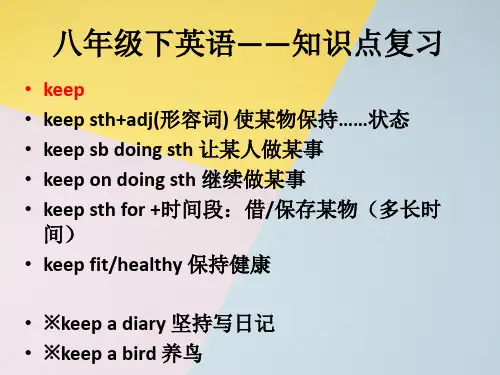
八年级下英语——知识点复习
• keep • keep sth+adj(形容词) 使某物保持……状态 • keep sb doing sth 让某人做某事 • keep on doing sth 继续做某事 • keep sth for +时间段:借/保存某物(多长时
间) • keep fit/healthy 保持健康
• either…or…或者……或者……,连接两个主语时,谓 语动词在数的方面与or后面的主语保持一致。
人教版八年级英语下册各知识点归纳总结(最新最全)
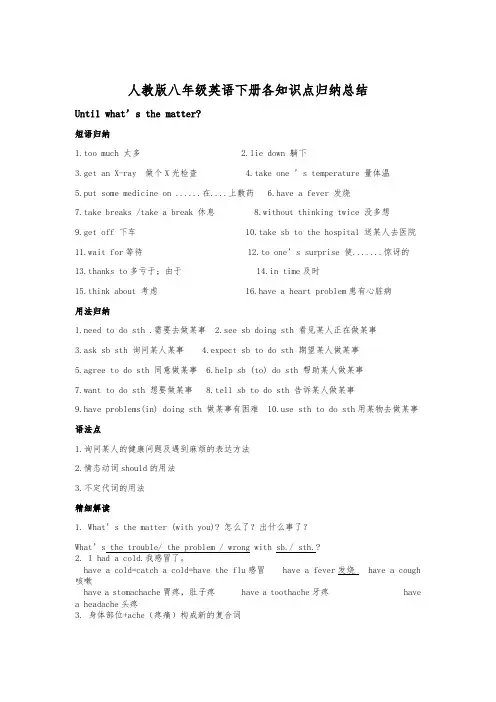
人教版八年级英语下册各知识点归纳总结Unti1 what’s the matter?短语归纳1.too much 太多2.lie down 躺下3.get an X-ray 做个X光检查4.take one ’s temperature 量体温5.put some medicine on ......在....上敷药6.have a fever 发烧7.take breaks /take a break 休息 8.without thinking twice 没多想9.get off 下车 10.take sb to the hospital 送某人去医院11.wait for等待 12.to one’s surprise 使.......惊讶的13.thanks to多亏于;由于 14.in time及时15.think about 考虑 16.have a heart problem患有心脏病用法归纳1.need to do sth .需要去做某事2.see sb doing sth 看见某人正在做某事3.ask sb sth 询问某人某事4.expect sb to do sth 期望某人做某事5.agree to do sth 同意做某事6.help sb (to) do sth 帮助某人做某事7.want to do sth 想要做某事 8.tell sb to do sth 告诉某人做某事9.have problems(in) doing sth 做某事有困难 e sth to do sth用某物去做某事语法点1.询问某人的健康问题及遇到麻烦的表达方法2.情态动词should的用法3.不定代词的用法精细解读1. What’s the matter (with you)? 怎么了?出什么事了?What’s the trouble/ the problem / wrong with sb./ sth.?2. I had a cold.我感冒了。
期末Units1-10单元知识点总结 人教版八年级英语下册
Unit 1 What’s the matter?一、词形变化1.stomach 名词胃;腹部——stomachache 名词胃痛2.lie 躺lie—lay—lain lying; 说谎lie—lied—lied3.hurt 动词(使)疼痛;受伤hurt—hurt—hurt4.hit 动词击;打hit—hit—hit5.反身代词(oneself):myself 我自己—ourselves 我们自己himself 他自己—herself 她自己—themselves 他们自己yourself 你自己—yourselves 你们自己enjoy oneself 玩得开心hurt oneself 伤害自己by oneself 独自6.climb 动词登;爬——climber 名词登山者7.knife 名词小刀——复数:knives8.mean 动词意思是;打算mean—meant—meant9.important 形容词重要的—importance 名词重要性10.decide 动词决定——decision 名词11.die 动词死——death 名词死亡——dead形容词死亡的die—died—died dying二、短语归纳1.lie down 躺下to one’s (my/his/her...) surprise 令某人惊讶的是2.take one’s (my/your/his/her..) temperature 量体温3.take a break = take breaks 休息take a risk = take risks冒险4.run out 物做主语:The money ran out. 钱用光了。
run out of 人做主语:I ran out of money. 我用光了钱。
5.make a decision = make decisions 做决定6.be in control of 掌管He is in control of the company. 他掌管公司。
人教版八年级下册英语期末复习知识点总结用法默写(含答案)
八下英语期末知识点用法默写(含答案版)Unit 11. What’s the matter with sb.? 怎么了?2. to one’s surprise 令人惊奇的是……3.expect to do sth. 期待做某事4. the importance of doing sth.做某事的重要性5. used to do sth. 过去常常做某事6. be used to doing sth. 习惯于做某事7. agree to do sth. 同意做某事8. be ready to do sth.准备好做某事9. before/after doing sth.在做某事之前/之后10. keep on doing sth. 继续做某事11. run out 与run out of人+ run out of They have run out of the water.物+ run out (不可用于被动语态)The money is running out.12.Unit 21. come up with 想出2. need to do sth. 需要做某事3. help sb. do/to do sth. 帮助某人做某事4. decide to do sth.决定做某事5. at the same time 同时6. be able to do sth. 能够做某事7. be excited about ... 对……兴奋8. thank you for doing sth. 感谢某人做某事9. be worried about doing sth. 对做某事感到担忧10. make a big difference to对……产生影响11. take after 与look liketake after意为“长得像,行为、性格等像”,尤其是像自己的长辈。
The boy takes after his father. 这个男孩长得像他爸爸。
初中英语 人教版八年级下册期末总复习(讲练+习题含答案,共104张PPT)
3. I think there will be more / less pollution. 我认为将会有更多/更少的污染。
fewer与less及more表数量的用法。
(3)many“许多”,修饰可数名词。 much“许多”,修饰不可数名词。
many / much比较级、最高级为不规则变化:many / much-more-most
“a few”表示“一些”+可数名词
例:a few days ago, for a few weeks, He has few friends here. There will be fewer trees.
3. I think there will be more / less pollution. 我认为将会有更多/更少的污染。
He went home after two days. 他两天后回家了。 Three years later,she had a baby. 三年后,她生了一个婴儿。
fall in love with 爱上… fall in love with a girl 爱上一个女孩 fall in love with a country 爱上一个国家
例:I have many magazines. She has more magazines. But he has the most. There will be more people on the earth in future. More and more students start to exercise more every day to keep fit.
典例展示 2.About Pollution
Tina: There is much pollution around us.
人教版八年级下册英语期末复习:重要语法知识点+重点词汇用法辨析
人教版八年级下册英语期末复习:重要语法知识点+重点词汇用法辨析重要语法知识点have表示“患(病);遭受(病痛)”等含义时,常用短语为:have a fever 发烧have a cold=catch a cold 患感冒have a toothache 牙痛have a headache 头痛have a backache 背痛agree的用法give up的用法(1)give up意为“放弃”,既可单独使用,也可后接名词、代词(置于up之前)或动词-ing形式。
(2)give 词组小结give out 分发;放出(气味、光、热等)give away 捐赠;赠送give in让步;屈服give back 归还make it+adj.+for sb.to do sth.句型make it+adj.+for sb.to do sth.表示“使得某人做某事……”。
其中,it是形式宾语,真正的宾语是to do sth.。
The Internet makes it possible for many people to shop at home.互联网使得很多人在家购物成为可能。
put off的用法put off意为“推迟”,既可单独使用,也可后接名词、代词(置于off之前)或动词-ing形式。
We may put off going to the park.我们可能推迟去公园。
拓展put的相关短语put out熄灭;伸出put down 记下;写下put up 张贴;举起put through 完成put on 穿上put away 收起来语法点1-动词不定式语法点2-动词短语情态动词could的用法neither的用法-Mary doesn't like action movies.玛丽不喜欢动作片。
-Me neither./Neither do I.我也不喜欢。
Neither of us is wrong.我们两个都没错。