
外研版七年级英语下unit1课件
Play a game. Write parts of the sentences.
ABCFra bibliotekThe boy+ is eating+ in the sky.
Homework: 1. Read the words and the dialogue frequently. Try to act out the dialogue. 2. Bring your favourite photo and talk about it next time.
She is singing.
She is dancing.
drink drinking
The girl is drinking juice.
eat eating
He is eating.
play playing
They are playing football.
wait waiting
He is waiting for a bus.
Module 1 People and places We’re Unit 1 We re having a great time!
Guess who they are.
He’s ….
She’s ....
He is running.
He is playing basketball.
He is talking.
buy buying shop shopping
They are buying some food. They are shopping.
Listen and answer the questions. 1. Where is Betty calling? She is on the Great Wall of China. 2. Why is she there?
talk talking
They are talking.
call calling
He’s calling.
drive driving
The boy is driving a car.
take taking
He is taking a photo.
lie lying
She is lying on the grass.
Goodbye!
Write full sentences for your answers in Activity 4. Use names.
Betty is talking to her mother. Lingling is shopping for presents. Daming is lying in the sun. Tony is eating an ice cream. Lingling and Betty are writing postcards. Wang Hui is taking photos. The children are enjoying the school trip.
Read these words.
buy call enjoy play stand talk tell wait walk buying calling enjoying playing standing talking telling waiting walking have drive like take write run shop sit lie having driving liking taking writing running shopping sitting lying
Because she is on a school trip.
Match the people with the actions, and say what people are doing. a. He’s lying in the sun. b. She’s talking to her mother. 3.Daming c. They’re enjoying the school trip. 4. Tony d. She’s shopping for presents. 5. Lingling and Betty e. He’s eating an ice cream. 6. Wang Hui f. They’re writing postcards. 7. The children g. He’s taking photos. 1. Betty 2. Lingling
合集下载
外研版七年级下Module7 Unit1课件(共26张PPT)
5.Who was your first teacher?
6.What was he/she like?
Tips:1. When we talk about our past life, we should use the Past Tense(一般过去时)
2.am/is-was
are- were
Where were you born ?
Unit 1 I was born in a small village.
【wɔz】
A: When were you born? B: I was born in 1987. A: Where were you born? B: I was born in a small village/city/town in Zhejiang Province.
in He was born __1942.
Yuan Longping (1930 –
[„saɪəntɪst] 科学家 Chinese scientist born in Beijing
Yuan Longping is a famous scientist.
be born
primary school
first teacher
What were they like ?
first fey were friendly and naughty.
Bill Gates (1955[‘faʊndə]创始人
founder of Microsoft born in Seattle, USA
“never grow old”
I had a _______ dream In this dream it seems day It was my perfect _____ Open my eyes ____ I realize this is my perfect day Hope you _____ never grow old Hope you never grow old Hope you never grow old Hope you never grow old 长大,
2023~2024 学年外研版七年级下册英语 Module 1 Unit 1课件

Is the eraser Betty’s?
Ms Li — gloves
No, it’s not hers. It’s Lingling’s.
Complete the passage with proper words.
Ms Li _w__e_lc_o_m__es_ her students back to school. First of all, she asks her students to come and __lo_o_k___ in the lost and found box. There are a lot of things in it. Lingling __f_i_n_d_s__ her bag, __cr_a_y_o_n_s__ and eraser in the box. There are some_t_ap_e_s_ and they are Daming’s. Here is a purple _w__a_ll_e_t ___ and it’s Tony’s because here is his name “Tony”. Look at this ___n_ic_e___ watch. Daming thinks it’s Betty’s. And Lingling says it’s __h_e_r_s___. Ms Li tells __ev_e_r_y_o_n_e_ to __b_e_c_a_r_ef_u_l_w__it_h_ their things from _n_o_w__o_n__. _W__h_o_s_e__ gloves are they? Oh, they are Ms Li’s.
3. — Jim’s bike is here. Where is __y_o_u_r_s__, Tom? —It’s in the room.
外研版英语七年级下册Module1Unit 1 Whose bag is this 课件 (共15张PPT)
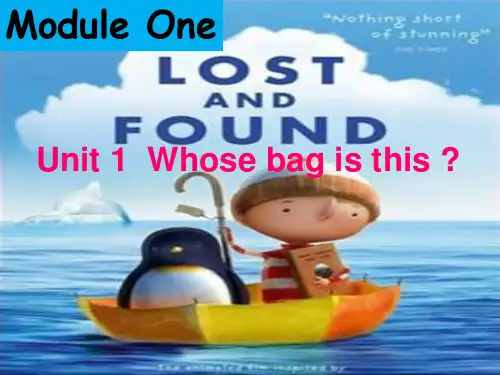
Module One
Unit 1 Whose bag is this ?
Listening and vocabulary
bag
crayons
[`kreiənz]
eraser
[ɪ`reɪzə]
football
watch
wallet
[`wɔlit]
gloves
[ɡlʌvz]
Listen and repeat.
hers 她的) It’s_____.(
Betty
T: Whose basketball is it ?
our S: It’s _____basketball. ours (我们的) It’s____.
T: Whose football is it ? Daming and Tony’s S: It’s __________________football.
Work in groups of three or four. Put four or five school things on the desk. Ask and answer.
A: Is this your pen? B: Yes, it’s mine. A: Whose pencil is it? C: It’s …
It’s their football. It’s theirs.(他们的)
Daming anቤተ መጻሕፍቲ ባይዱ Tony
Let’s talk:
Whose isthis? this? Whosetable … is It’s our tableIt’s . It’s… ours. . It’s ….
balloon[bə'lu:n]
a purple wallet a bag, an eraser and crayons
Unit 1 Whose bag is this ?
Listening and vocabulary
bag
crayons
[`kreiənz]
eraser
[ɪ`reɪzə]
football
watch
wallet
[`wɔlit]
gloves
[ɡlʌvz]
Listen and repeat.
hers 她的) It’s_____.(
Betty
T: Whose basketball is it ?
our S: It’s _____basketball. ours (我们的) It’s____.
T: Whose football is it ? Daming and Tony’s S: It’s __________________football.
Work in groups of three or four. Put four or five school things on the desk. Ask and answer.
A: Is this your pen? B: Yes, it’s mine. A: Whose pencil is it? C: It’s …
It’s their football. It’s theirs.(他们的)
Daming anቤተ መጻሕፍቲ ባይዱ Tony
Let’s talk:
Whose isthis? this? Whosetable … is It’s our tableIt’s . It’s… ours. . It’s ….
balloon[bə'lu:n]
a purple wallet a bag, an eraser and crayons
外研版英语七年级下册Module_12_Unit_1课件PPT

Fill in the blanks with the right forms.
1.What
___ you __ on your last holiday? (do) did do 2. I went to Hollywood two years ago. (go) ____ 3. How did Betty _____ there yesterday? spend (spend) 4. Where did you often _____? (swim ) swim 5. My mother met at the station last weekend. ___ (meet)
Read and answer the questions.
1. When did Betty go to Los Angeles on holiday? She went two years ago. 2. How long did it take her ? It took her about nine hours. 3. Where did she go ? She went to Disneyland then Hollywood and finally Santa Monica.
Do you like them?
Mickey Mouse
Donald Duck
Where can you see them?
Disneyland
California
Which country is it?
The United States of America
Listen and answer.
4. How long did Betty spend in Disneyland? She spent two days in Disneyland. 5. What did Betty do or see at Santa Monica? She swam in the Pacific Ocean. 6. What was Santa Monica like? She thought it was great.
外研版英语课件七下Unit1Icanplaythepiano
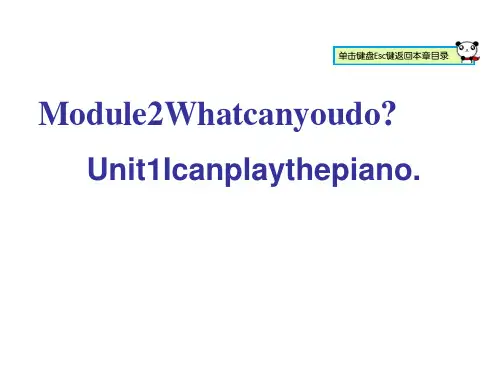
wouldlike=want想要,想做 wouldliketodosth.=wanttodosth. wouldlikesth.=wantsth. join多指加入某组织、党派或社会团体,成 为其中的一个成员。如: HejoinedtheLeaguein2013. 他在2013年入团。
takepartin指参加活动、群众性活动或会议, 并在其中起一定作用。如: TheoldmantookpartintheLongMarch. 这位老人参加过长征。
choose
1.Wecan’tcatchthebus_______wearelate. B A.becauseB.so 2.Lilycandancereally____. A AwellB.good A 3.Thebookisreally____,weshouldreadagain. AgoodB.well 4.Idon’tthinkyouareright.(英译汉)
worryabout是一个动词+介词结构的短语,表 示“担心……”。 Heworriesabouthishistoryexam. 他很担心自己的历史考试。
Ifyoufollowtheschoolrules,you’vegotnothi ngtoworryabout. 如果你遵守学校规定,你就没有什么可担 心的。
Review
Wordsandexpressions
Wordsandexpressions play tennis piano ride club term board v.演奏;弹奏 n.网球 n.钢琴 v.骑;乘 n.俱乐部 n.学期 n.布告板
Wordsandexpressions wouldlike well all that’sall worry worryabout teach then 想要;希望 int.噢;喔 adj.所有的;没有例外的 仅此而已 v.焦虑;担心 担心…… v.教;讲授 adv.那么;就
外研版七年级下册英语精品教学课件 Module 11 Body language Unit 1

2. That’s because people do different things in different countries. (教材P66)
That’s because….. 是一个常用句式,意为“那是因为……”其中,that 表示刚刚谈到的内容。 注意,这里要用that,而不能用 this , 因为this 表示将要谈及的内容。 e.g. ---Mum, why do I always make the same mistake?
India kiss Russia together touch visitor
In China, people shake hands and smile
American people shake hands and sometimes (1) ____k_i_ss_
In (2) ____I_n_d,iapeople put their hands (3) ___t_o_g_e_t_her and nod their heads
bow kiss shake shake hands smile British German Japanese
v. 鞠躬,弯腰
v. & n. 吻,亲吻
v.
摇晃
握手
v. & n. 微笑
adj. 英国的,英国人的
n. 德国人;德语 adj. 德国(人)的;德语的
n. 日本人;日语 adj. 日本(人)的;日语的
5. Work in pairs. Talk about what you do and say when you meet:
• your teacher • your head teacher • your parents after school • your best friend • your best friend’s parents • your favourite film star • a visitor to your school • an American • a Russian
英语外研版七年级下册Unit1课件
W/'ru:lə/ /'kæ rI/ /tʃeIndʒ/ /'evrIθIŋ/ /'fju:tʃə/
粉笔n.
chalk
直尺n.
ruler
拿;带v.
carry
改变;变化v.&n. change
每样事物
everything
将来;未来n. future
Heisn’tachildanymore.他不再是小孩子了。 Iwon’tdothatanymore.我再也不那样做了。
Homework
Reviewandrecitetheimportant pointsofUnit1. 复习并记忆Unit1重点内容。
Teacherswon’tusechalkonablackboardands tudentswon’tusepenandpaper,orerasersany more!老师们将不再用粉笔在黑板上写字, 学生们也将不再使用钢笔、纸或橡皮!
句中的“not...anymore”的意思是“不再”。 例如:
/mɔ:/
水平n.
能够…的adj. 能够做…
更加;更adv. 更多的adj.
level able
beableto more
不再… notanymore /fri:/ (时间)空闲的;空余的adj. free
chalkn.粉笔 rulern.尺子 questionn.问题
lifen.生活; 生命
leveln.水平
Listenandrepeat.
// futurestudentuse // butfunstudyus // ruler // put
Askandanswerthequestions. 1.Willschoolsbedifferentinthefuture? 2.Willstudentsusebooksinthefuture?
外研版七年级英语下册同步教学课件Unit 1 Whose bag is this?
I 5 a good friend at school. 6 name is Zhang Liang.He 7 English and now he can say “How are you?”,“What’s 8 name?” or “What’s this in English?” He is nice to me 9 I like him very much.
Unit 1 Whose bag is this?
外研社版
七年级英语下册
教学目录
1.课前导学 2.课堂基础训练 3.培优提高训练
◆ 课前导学 ◆
一、根据汉语提示写出英语短语,做到会运用。
1.首先;第一 2.失物招领箱 3.别客气。
_f_ir_s_t_o_f_a_l_l __________ _l_o_s_t_a_n_d__fo_u_n__d_b_o_x____ _Y_o__u_’r_e_w__e_lc_o_m__e_._____
A.in the end
B.all the time C.first of all
D.as a result
( B )6.—Do you eat fruit and vegetables every day?
—Yes,I like them .
A.a lot;a lot of
B.a lot of;a lot C.a lot of;a lot of D.a lot;a
C.his
D.him
( A )4.—Excuse me,how can I get to the restaurant?
— ,you need to go to the park.And then you can find it.
A.First of all B.At last
Unit 1 Whose bag is this?
外研社版
七年级英语下册
教学目录
1.课前导学 2.课堂基础训练 3.培优提高训练
◆ 课前导学 ◆
一、根据汉语提示写出英语短语,做到会运用。
1.首先;第一 2.失物招领箱 3.别客气。
_f_ir_s_t_o_f_a_l_l __________ _l_o_s_t_a_n_d__fo_u_n__d_b_o_x____ _Y_o__u_’r_e_w__e_lc_o_m__e_._____
A.in the end
B.all the time C.first of all
D.as a result
( B )6.—Do you eat fruit and vegetables every day?
—Yes,I like them .
A.a lot;a lot of
B.a lot of;a lot C.a lot of;a lot of D.a lot;a
C.his
D.him
( A )4.—Excuse me,how can I get to the restaurant?
— ,you need to go to the park.And then you can find it.
A.First of all B.At last
外研版七年级英语下册Module1 Unit1 Whose bag is this优课件
本句为there be 句型,意为“某处有某物” ①如果there be 后为可数名词单数或不可数
名词,be用is,若为可数名词复数,be用 are。
There is some food in the fridge. 冰箱里有一些食物。
②如果there be后的主语包含两者或两者以上, be的形式适用于就近原则,故be与离它最 近的主语在数上保持一致。
• 1. This is _____(my ,mine) sister. • 2. _____(She, Her) name is Lisa. • 3. Lily’s mother is a worker and _____(he, she )
works in a factory. • 4. That is my cat. _____(It, Its) name is Mimi. • 5. This is ________(our, ours) classroom and it is big. • 6. The girl is Linda. _____(Her, Hers) bike is green. • 7. The football is ________(Tom, Tom’s). • 8. —Is this your computer?
❖ 4. I don’t want to _lo__s_e (失去)you.
❖ You are my good friend.
❖ 5. My sister is _c_a_r_e_fu__l _(认真的)and she works hard. ❖ 6. I have got some _c_ra__y_o_n_s_ (蜡笔). ❖ 7. Is this __a_n_____ _e__ra_s_e__r _(一块橡皮)?
外研版七年级下册英语精品教学课件 Module 3 Making plans Unit 1
be a fantastic weekend!
Would you like to join us? Don’t be silly!
Now answer the questions. 1. What's Daming going to do on Saturday morning? He is going to check his email and do his homework and then help with the housework. 2.What's Betty going to do on Saturday afternoon? She is going to see a movie.
e.g. The student likes reading English in the morning.
e.g. See you on Sunday morning.
辨析on/in/at
on 表示在具体的某一天,如:日 on Monday
期、星期、节日等
on my birthday
on Teachers’ Day
表示在某一天的上午/下午/ 晚 on a cold winter morning
上
on the afternoon of Sunday
in 表示在较长时间内,如:年份 in Spring
/ 月份/ 季节/实际等
in July
用于某些固定搭配
in the morning/afternoon/evening
this afternoon / evening, tonight tomorrow (morning / afternoon / evening ) the day after tomorrow next Sunday / week / month / year...
Would you like to join us? Don’t be silly!
Now answer the questions. 1. What's Daming going to do on Saturday morning? He is going to check his email and do his homework and then help with the housework. 2.What's Betty going to do on Saturday afternoon? She is going to see a movie.
e.g. The student likes reading English in the morning.
e.g. See you on Sunday morning.
辨析on/in/at
on 表示在具体的某一天,如:日 on Monday
期、星期、节日等
on my birthday
on Teachers’ Day
表示在某一天的上午/下午/ 晚 on a cold winter morning
上
on the afternoon of Sunday
in 表示在较长时间内,如:年份 in Spring
/ 月份/ 季节/实际等
in July
用于某些固定搭配
in the morning/afternoon/evening
this afternoon / evening, tonight tomorrow (morning / afternoon / evening ) the day after tomorrow next Sunday / week / month / year...