
牛津译林版八年级英语下册Unit4知识点归纳汇总
牛津译林版八年级英语下册Unit4知识点归纳汇总<重点短语>1.a good read一本好的读物2.what to do with 怎样处理。
3.in your spare time 在你的空闲时间里4.crash against 撞到5.be tired out 筋疲力尽6.the same size as与...一样大7.fall over摔倒8.continue moving across my body 继续在我身上走动9.manage to break the ropes 设法弄断了绳索10.a huge army of一大群....12.hand in 上交,递交13.and so on.....等等14.on time 准时15.refuse to publish it拒绝出版它16.at a time每次,依次17,give sb.lots of advice 给某人许多建议18.open up开启;开创:开辟<重点句型>1.-Have you decided what to do with these books,Hobo?霍波,你已决定怎么处理这些书了吗?-Not yet.还没有。
2.I have to use therm to reach the box on the fridge.我得用它们去够冰箱上的盒子,3.By the time I finally felt the land under my feet,I was tired out.当我终于感觉到我脚下的陆地时,我筋疲力尽了。
4.It moved up over my stomach and neck until it was standing near my face, 它向上移动到我的肚子和脖子,直到它站在离我的脸很近的地方。
5.I did not know what to say either.我也不知道说什么。
6.When I lifted my left hand into the air,the small men began to shout.当我把我的左手举向空中时,小人们开始大叫。
6.Could you tell me how to renew them?你可以告诉我如何续借它们吗?7.I spend over seven hours a week reading different types of books.我一周花超过七小时看不同类型的书。
<Comic strip>1.read n. “读物”,常用单数形式。
如:A good read is like a great friend.一本好读物像一个好朋友。
v. “阅读,读书” 常用于看书、看报等。
reader n. “读者;读本”2.do with “对付,处理”与what 搭配使用,强调处理的对象。
deal with “对付,处理”与how 搭配使用,强调处理的放式、方法。
如:What did you do with that camera you found?你是怎么处置你发现的那个照相机的?I don’t know how to deal with the problem.我不知道怎样处理这个问题。
<Welcome to the unit>1.Germany n. “德国”German adj. “德国人的;德语的;德国的”n“德国人;德语”复数形式Germans.2.know ledge n. “知识”【u】后接of短语作定语。
如:She has a wide knowledge of Chinese history.她对中国历史了解很深。
knowledge 与get搭配,表示“获得知识”,不与learn连用。
3.spare adj. “空闲的;多余的”=free,常作定语。
短语:in one’s spare time “在某人的空闲时间”4.touch v. “感动;触动”语气比move弱。
touched adj. “受感动的”touchi ng adj. “动人的;感人的”如:His sad story touched our heart. 他悲惨的故事触动了我们的心。
拓展:touch v. “触摸,碰”如:Touch it and feel if it is hot. 摸一摸,看它热不热。
<Reading>1.against prep. 1)“紧靠,碰,撞”如:The desk is against the wall.书桌靠墙放着。
He stood leaning against the tree just now.刚才他斜靠在树上站着。
prep. 2) “反对;与...相对”后接名词,代词或动名词。
如:He fought against the disease for a long time.他同疾病做了长时间的斗争。
注意:against是介词,不是动词,将其用作动词是错误的。
如:【译】我斜靠在墙上。
【正】I leaned against the wall.【误】I against the wall.【译】我反对他的意见。
【正】I'm against his idea.【误】I against his idea.2.be tired out “筋疲力尽”=be worn out如:The master was tired out. = The master was worn out.这位大师精疲力尽。
拓展:be tired of (doing) something “厌倦(做)某事”如:She is tired of watching TV at home all day.她厌倦了整天在家看电视。
3.tie v.“捆,绑”,过去式和过去分词为tied,现在分词为tying.固定结构:tie sb./sth. to “把某人某物绑到...上”其被动结构为sb./sth. be tied to.如:She used a rubber band to tie her hair.她用一根橡皮筋扎头发。
. They tied the boat to a tree.他们将船绑到一棵树上。
拓展:tie n. “领带”如:Just a minute!Let me put your tie straight.等一下!让我帮你正正领带。
4.over prep. “从一边到另一边”表示位置变化。
如:Instead of opening the door, we climbed over it.我们没有开门,而是(从门顶上)爬过去的。
5.stomach. n. “腹部;胃” 复数形式为stomachs.固定短语:an empty stomach空腹turn sb's stomach 使某人反胃lie on one's stomach 趴着如:I hit him in the stomach.我击中他的肚子。
The sight of the blood turns her stomach.她一见到血就会反胃。
stomachache “胃疼”如:I have a headache,and she has a stomachache.我头疼,她胃疼。
6.until conj. “直到...为止”, 表示某一种行为一直持续到某一时间。
not ...until “直到...才” 表示直到某一时间,某一行为才发生,之前该行为并没有发生。
注意:用在肯定句中,句子的谓语动词必须是延续性动词,在否定句中,主句中的谓语动词通常是非延续性动词。
如:I studied English until nine o'clock last night.我昨晚学英语一直到九点钟。
(表示九点前一直在学。
)I didn't leave until nine o'clock last night.我昨晚直到九点钟才离开。
(表示九点才离开。
)拓展:till和until一般情况下在肯定句中可以互换,但until可用于句首,而till不用于句首。
如:I worked until/ till he came back.我工作到他回来为止。
7.fall v. “摔下,倒下;降落,落下”。
fall over “摔倒”,强调的是摔倒的动作,而不是状态.如:She fell over and broke her leg.她跌倒并把腿摔断了。
Apples fall from the tree.苹果从树上落下。
拓展:fall in 生病fall behind 落后fall in love with sb. 爱上某人fall down 落下,倒塌fall asleep 睡着fall off 从...掉下来8.continue v. “继续”continue doing sth.表示中止一段时间后接着做同一件事continue to do sth. 表示做完一件事后接着做另一件事如:He continued the boring work day after day.他日复一日的继续着这个乏味的工作。
After a short rest,he continued reading the book.稍作休息后,他继续看书。
She looked up for a moment, then continued to draw.她抬头看了一会儿,然后继续画画。
9.either adv. “也”,只用于否定句,通常置于句末。
如:I don’t like the red shirt and I don’t like the green one either.我不喜欢这件红衬衫,我也不喜欢这件绿衬衫。
10.manage v. “设法完成;管理”,作及物动词,接名词,代词或不定式作宾语。
固定结构:manage to do sth. “设法做成某事”强调结果是成功的。
try to do sth. “尽力做某事”强调过程,结果不一定成功。
11.lift v. “举起,抬高;提高” 宾语可以是具体事物,也可以是抽象事物,指克服重力“提升”某物。
如:The low clouds began to lift.低空的云开始上升。
He was too weak to lift his hand.他太虚弱以至于连手都抬不起来。
n.“电梯”如:He took the lift to the 14th floor.他乘电梯到了15楼。
12.army n. “大批,大群”固定短语:an (huge) army of “一群”+可数名词复数,谓语动词用单数。
Unit 4【单元知识复习】八年级英语下册单元复习(牛津译林版)
④当名词同位语 例如∶ Tom had no idea which book to choose at the bookstore. The question whether to study abroad troubled the girl.
doing sth. different types of
books on weekdays
be interested in
the four great classical Chinese novels
7. 在我家对面 8. 给我许多书籍方面的建议 9.讨论读什么 10.帮助我在忙碌的一天后放
松 11.为我开启一个全新的世界
三、按照英语语法的习惯,疑问副词why 后不直接跟动词不定式 误∶I don't know why to choose that bag. 正∶ I don't know why you must choose that bag. 但它可以接不带to的动词不定式,即动词原形,构成why do sth./
(二)have to表示“必须”、“不得不”, 表示的是客观需要。
例如∶He has to stay at home for 3 or 4 days.
We will have to get up early tomorrow.
(三) must一般只有现在时,而have to有更多的形式。 例如∶I must go now. He must stay at home. His mother is ill, so he has to look after her. It was late. The girl had to go home.
译林版八年级英语下册Unit4知识点归纳整理
译林版八年级英语下册Unit4知识点归纳整理译林版八年级英语下册Unit4知识点归纳整理译林版八年级英语下册Unit4 知识点归纳整理Unit4 A gd readA. i Strip &ap ele t the unit1.短语及固定搭配1.reah the bx n the fridge 够冰箱上的盒子2.iprve y knwledge f the past 提高我对过去的认知补充:t ne’s knwledge 据某人所知3.in yu spare/free tie 在你的空闲时间译林版英语(8下)知识整理与归纳4.Frenh writer 法国作家5. hat t d with ……怎么处理……Hw t deal with ……如何处理……6.tuh sb 打动某人2.句子1.hat t d with these bks?怎么处理这些书?2.I didn’t knw yu like d bks!我原不知道你喜欢书!B .Reading1.短语及固定搭配*1.an extrat fr the bk 这本书的一个节选2.rash against =hit 撞rash against the rks触礁(即撞到岩石)补充:against作介词还有反对的意思against +名词/代词反对……against +V-ing反对做某事3.swi as far as I an 尽我可能游得远4.fall dwn n the beah and g t sleep 倒在沙滩上,睡着了5.wake up醒wake sb up 叫某人醒6.be tied t the grund 被绑在地上(被动语态)7.lk dwn 向下看lk up 向上看8.the sae size as y little finger 和我的小指一样大9.lib all ver e 爬到我身上10.fall dwn 摔倒11.what t say说什么12.pull the hand free 挣脱一只手13.break the rpes 挣断绳索14.lift y left hand int the air 向空中举起我的左手15.a huge ary f the tiny peple 一大群小人16.e straight twards e 直直地向我走18.hw t get away 如何逃跑19.be tired ut 筋疲力尽20. be able t =an 能be unable t = annt 不能21. tie……t……把……绑在…………be tied t…………被绑在……(被动语态)22.begin t d sth=begin ding sth = start t d sth =start ding sth 开始做某事23.shut at sb 朝……大喊24.ntinue ding sth =ntinue t d sth =g n t d sth =keep ding sth 继续做某事25.anage t d sth 设法完成某事. Graara 疑问词+动词不定式疑问词+动词不定式的结构,也称为不定时短语【注意】只有why 不可以与动词不定式连用1.疑问词+动词不定式作句中主语(谓语动词用第三人称单数)e.g. Hw t use puter is really a questin 如何使用电脑真是一个问题2.疑问词+动词不定式作句中表语e.g. The questin is where t get a puter 问题是在哪儿买一台电脑3.疑问词+动词不定式作句中宾语①动词的宾语e.g. I haven’t deided where t spend the hliday 我还没有决定去哪儿度假②介词的宾语e.g. iss ang wants t write a bk n hw t swi 王小姐想写一本关于如何游泳的书③与宾语从句的转换e.g. I dn’t knw whih bk t hse = I dn’t knw whih bk I shuld hse我不知道该选择哪一本书4.疑问词+动词不定式作句中宾语补足语e.g. He will advise yu whether t d it 是否要这么做他会给你注意的【注意】①疑问代词what,whih,wh(wh的宾格形式)后面如果加不及物动词要加上相应的介词e.g. He wants t knw wh t wrk with 他想知道将和谁一起工作②疑问副词 when,where, hw 后面如果加及物动词,须有自己的宾语e.g. D yu knw hw t d the exerise?你知道怎样做这个练习吗b ust和have t 的用法ust 表示主观上的义务和必要(意思是必须),主要用于肯定句和疑问句e.g. yu ust finish yur hewrk tday 你今天必须完成家庭作业【注意】ust nt 表示禁止的意思回答ust 的问句时,否定形式常用needn’t或dn’t have t,而不用ust nthave t 表示一种客观的需要(意思是不得不)e.g. It is getting dark. He has t g he nw. 天快黑了。
Unit4知识归纳牛津译林版八年级英语下册
Unit4知识点归纳一.重点单词、短语、句子icReading1.Have you decided what to do with these books, Hobo?(P48)(1)拓展:what to do with sth =_______________________________Eg: 你应当在如何处理这件事上作个决定。
______________________________________________________________________2.I have to use them to reach the box on the fridge.(P48)(1) “have to”有时态的变化,客观意义上的“不得不”,否定形式用于“must”的否定回答。
Eg:因为糟糕的天气,我不得不随身带上雨伞。
_____________________________________________________________________.(2) “reach”,意为“够得着,伸手取”,及物动词。
意为“到达,抵达”时,自我回顾。
3.What do you like to read in your spare time? (P49)(1)“spare”作形容词,意为“空闲的,多余的”,常用短语:__________________________“spare”作动词,意为“分出,腾出”常用的结构:_____________________________________ Eg: It is the most time I can spare ___________(help) you.Jack spends as much time as he can spare ___________(play) puter games.4.After our ship crashed against the rocks, I swam as far as I could.(P50)(1)补充:crash意为“猛撞,撞击”,常用短语:_______________ 撞毁,撞上(2)against 意为“紧靠,碰,撞”, 更重要的含义:反对,不同意,对抗,对立常用的结构:反对做某事________________________, 和…对抗_____________________ Eg: 如果你做违法犯罪的事,迟早你会受到惩罚。
牛津译林版八年级英语下册8B Unit 4单元知识点归纳总结
牛津译林版八年级英语下册8B Unit 4一.【精选词汇】㈠重点短语1. hold a microphone拿着麦克风→比较:The host came on stage with a microphone in his hand.2. Congratulations!祝贺你!congratulations在向别人表示祝贺、祝福时常用复数。
(p60)3. be chosen to be/as the host of a charity show →be chosen to be/as…被选作…〈知识链接〉be chosen to do sth被选做某事,e.g. Hepburn was chosen to play the lead role.4. fund-raising activities for charities为慈善机构筹款的活动,advertise on the Internet在网上做广告→advertise on TV/in the newspaper/in the magazine在电视上/报纸上/杂志上做广告,organize a charity show 组织慈善演出,sell books to raise money卖书来筹款(p61)5. give out leaflets发传单→give…out分发,动词+副词结构,give it/them out。
6. return to school重返学校→return ⑴回到return to+地点⑵return sth to sb把某物归还某人〈知识链接〉⑴return to…=go back to…回到…⑵return sth to sb=give sth back to sb归还…①Hong Kong returned to China in1997. ②I remembered returning the book to the library.7. help protect rivers and lakes in China帮助保护中国的河流和湖泊→help (to) do sth帮助做…8. host a charity show主持慈善演出,start working on the show开始着手演出工作(p62)9. have a lot of support from local businesses得到当地企业的许多支持〈知识链接〉have support from sb=have sb’s support得到某人的支持,e.g. have my parents’ support.business n.⑴企业;商行⑵事情①Mind your own business.=It’s none of your business.不关你的事。
牛津译林版八年级下册Unit 4 单元知识重点
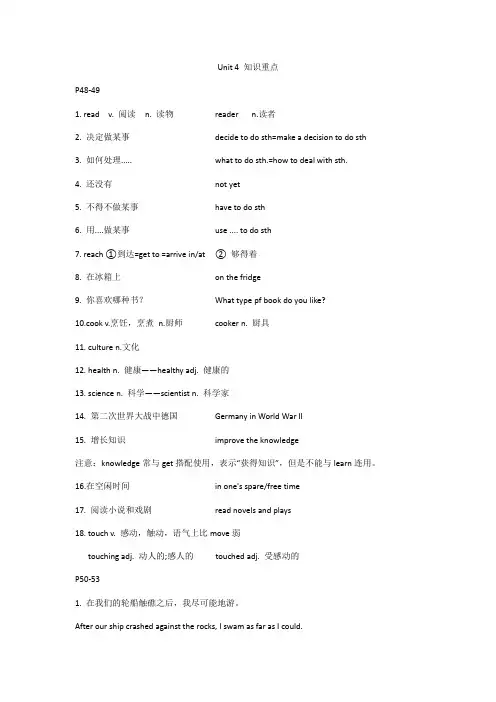
Unit 4 知识重点P48-491. read v. 阅读n. 读物reader n.读者2. 决定做某事decide to do sth=make a decision to do sth3. 如何处理.....what to do sth.=how to deal with sth.4. 还没有not yet5. 不得不做某事have to do sth6. 用....做某事use .... to do sth7. reach ①到达=get to =arrive in/at② 够得着8. 在冰箱上on the fridge9. 你喜欢哪种书?What type pf book do you like?10.cook v.烹饪,烹煮n.厨师cooker n. 厨具11. culture n.文化12. health n. 健康——healthy adj. 健康的13. science n. 科学——scientist n. 科学家14. 第二次世界大战中德国Germany in World War II15. 增长知识improve the knowledge注意:knowledge常与get搭配使用,表示“获得知识”,但是不能与learn连用。
16.在空闲时间in one's spare/free time17. 阅读小说和戏剧read novels and plays18. touch v. 感动,触动,语气上比move弱touching adj. 动人的;感人的touched adj. 受感动的P50-531. 在我们的轮船触礁之后,我尽可能地游。
After our ship crashed against the rocks, I swam as far as I could.1) against 介词①撞击,碰着,与…相撞:e.g.: I pushed against the door and the door opened at last.② 相反;反对;违反;违背;逆:e.g.: We all should fight against evil.③ 逆行,逆……方向,对着;跟……反方向:e.g.: Don't drive against the traffic.不要逆向行车。
Unit4知识点复习牛津译林版八年级英语下册

U4 A good read【ic strip&wele to the unit】1.Have you decided what to do with these books,Hobo?[decide] vt.决定decide to do sth 决定做某事[decision]n.决定make a decision to do sth.决定做某事[ do with ]处理;处置;对待与what 连用what...do with= deal with 与how连用how....deal with2.I have to use them to reach the box on the fridge.[reach] vt.①能伸到;够得着②到达,抵达reach spl = arrive in/at spl. = get to spl3.I’m reading a book about Germany in World War.[ Germany ] 德国→German n.德国人(复数:German s)不可数名词“德语”adj.“德国的,德国人的”4.They improve my knowledge of the past.[knowledge] 不可数名词“知识,学时;理解,认识”Knowledge is power.知识就是力量。
5.What do you like to read in your spare time.[spare] adj. “空闲的;空余的;多余的”in one's spare/free time在某人空闲时间= when sb be free6.[French] ①adj. “法国,法国人的”法国人:Frenchman(Frenchm e n), Frenchwoman(Frenchwom e n)②不可数名词“法语”→France n.法国7.The story of the ugly man Quasimodo really touched me.[touch] vt.“感动,触动”touching adj.感人的touched adj.受感动的【Reading】1.After our ship crashed against the rocks, I swam as far as I could.●[against] prep. “紧靠,碰,撞,反对”crash against... 撞到...against the war反对战争●as......as one can/could 尽某人所能...... (相当于as ...as possible)2.By the time I finally felt the land under my feet, I was tired out.be tired out 筋疲力尽be tired of sth/doing sth 对某事/做某事感到厌烦,厌倦3.I woke up as the sun was rising.[rise]roserisen 不及物动词“升起,上升”指太阳、月亮、星星等升起,也指水位、价格等上涨●rise by上升了...4.My arms, legs and hair were tied to the ground.[tie] ①vt.“捆、绑、系、打结”tietyingtie...to... 把...栓到...上②n.领带tiesIt moved up over my stomach and neck until it was standing near my face. [until]①连词“直到...为止”●用于肯定句时主句谓语应为延续性动词指主句的动作一直持续到until后的动作发生为止We walked until it got dark.我们一直走到天黑●not ... until... 直到...才...主句动词通常为非延续动词指主句的动作一直到until后的动作发生时才发生The little girl didn’t stop to relax until she finished her work.②prep. “直到...为止”Marry didn’t receive the email until last night.6.He was the same size as my little finger.the same size as.... 和...一样尺寸,与...一样大小= as big asthe same as... 和...一样the same..(lenghth长度、weight重量、width宽度、depth深度)..as.... 和...一样....7.the loud noise made them all fall over.fall over摔倒fall off... 从...上摔下fall down摔倒,落下;倒塌fall behind落后fall asleep睡着fall ill生病8.【continue】v.“继续”+名词、代词、动词不定式、动词ingcontinue one’s education继续求学continue doing sth继续做某事9.I did not know what to say either.[either] adv.也常用于否定句句末,其前可有逗号,也可没有逗号10....finally managed to break the ropes.[manage] vt. ①设法完成manage to do sth.设法完成某事②管理,经营+ 名词/代词→manager n.管理者11.When I lifted my left hand into the air...[lift] ①vt.举起,抬高;提高②可数名词“电梯”12.... a huge army of tiny people.[army ]n. ①大批,大群an army of....一群...②军队(尤指陆军)13.I must run away from them.......how to get away.run away from... 逃离...get away逃跑,跑开14.keep doing sth一直做某事,不断地做某事keep on doing sth.反复/继续做某事keep sb from doing sth阻止某人做某事15.【unable】adj. “不能的,不会的”be unable to do sth = be not able to do sth.不能做某事【Grammar】1.Mr Wu advised us which to choose as afterschool activities. [advise] vt.建议,劝告advise sb (not) to do sth.建议某人(不)做某事advise doing sth建议做某事2.hand in上交,递交代词放中间hand it in反义词:hand out/give out 分发3....what you think of it and so on.and so on等等用在举例的末尾,表示举例未完。
Unit 4 单元复习课件-八年级英语下册(牛津译林版)
2. _s_ta_r_t_/_b_e_g_in_ doing 开始做
3. ___a_l_l_ over 到处
4. ___s_h_o_u_t_ at 对……大喊
7. ___r_u_n___ aw短ay语逃辨跑析
right away 立刻
8.
___g_e_t__
away 逃脱 go away
走开
9. talk _w_i_tht_h_r和ow…a…wa交y谈扔掉
Unit 4
A good read
单元复习课件
牛津译林版 八年级下册
Unit 4
知识点 语法
重点单词 重点短语 重点句子
疑问词+不定式 must 和 have to
Part 1 知识点回顾
踩地雷
玩法:任意读出一个单词,如果出
现魔法棒加1分,出现炸弹扣1分。
目标:检验新学单词的认读情况。
+1
-1
novel spare
Germany knowledge
French writer
消失的字母
u_gly _e _i the_r
玩法:说出以下单词所缺字母。 目标:检验新学单词中较难记的。
s_er_i _es Ca_na_d_i a_n
su_cc_ess ma_na_ge
音标拼读
玩法:说出以下音标相对应的单词。 目标:检验新学单词中较难记的。
2. It is ____n_o_t_ ___a_s___ _d_if_f_ic_u_l_t ___a_s___ I thought. 这没有我想象得那么困难。
3. He was __th_e____ ___s_a_m__e ___s_i_z_e_ ___a_s___ my little finger. 他和我的小手指一样大。
牛津译林版八年级英语下册Unit4重点知识点汇总
牛津译林版八年级英语下册Unit4重点知识点汇总1.使学生掌握本单元掌握Comic strip—Task 重要的短语搭配与重点词汇的意思与运用;2.对单元重点句型能够细致的理解,并能模仿句型进行写作;3.能够将每个知识点灵活地运用到单项选择和词汇运用等基础题型当中。
Comic strip —W elcome to the unit 教材知识详解1. Have you decided what to do with these books, Hobo?霍波,你决定怎样处理这些书了吗?decide 此处用作及物动词,意为“决定”,后跟名词、代词、不定式或从句等。
decide 的名词形式是decision ,意为“决定”。
make a decision (to do sth.)意为“做决定(去做某事)”。
如:She decided to live in London.她决定住在伦敦。
do with 意为“处理;处置;对待”等,常与疑问词what 连用。
如:What did you do with those newspapers?你把那些报纸怎么处理了?do with 的同义词组是deal with ,但deal with 常与疑问词how 连用。
What will you do with those books?= How will you deal with those books?你将怎样处理那些书?2. I have to use them to reach the box on the fridge.我必须用它们来够电冰箱上的盒子。
reach 此处用作及物动词,意为“接触,拿到”。
reach 作及物动词,还意为“到达,抵达”,后面跟表示地点的名词。
如:I’m too short. I can’t reach the apple.我太低了,够不着那个苹果。
They reached London last night.他们昨天晚上到达了伦敦。
Unit4知识点牛津译林版八年级英语下册
牛津译林版八下Unit 4 知识点1.read/watch/look/seeread,看书、报纸、杂志等。
watch,看电视、电影、比赛等。
look,“看”,侧重过程,look at。
see,“看见”,侧重结果。
2.decide v. “决定”n. decision “决定”decide to do sth. = make a decision3.do with “处理;对待”(= deal with)what to dohow to deal with it4.宾语从句引导词:that;if/whether;疑问词语序:陈述句语序5.reach v. “够得着”“到达”reach the bookreach Shanghai6.interested/interesting/interestinterested:be interested in 表示人对物感兴趣,是人的感受,常作表语。
interesting:常说明物,表示某物具有令人感兴趣的特征。
interest:n. “兴趣”have/rake interest in = be interested inv. “使感兴趣,使关注”,事或物作主语,宾语常为人。
7.in one’s spare time “在某人的空闲时间”= in one’s free time8.French adj. “法国的,法国人的”n. “法语”France n. “法国”9.crash v. “装上,倒下”n. “碰撞;碰撞声”10.against prep. “靠着,碰”“反对”against the wall 靠在墙上11.as... as one can/could “尽某人所能……”= as... as possible12.by the time “到……为止”引导时间状语从句13.be tired out “筋疲力尽”be tired of “对……感到厌烦”14.stomach n. “胃”复数:stomachs15.as,when,whileas,引导从句的谓语动词可以是延续性动词,也可以是非延续性动词。
牛津译林版八年级英语下册Unit4重点知识点汇总 (2)
牛津译林版八年级英语下册Unit4重点知识点汇总Unit 4 A good read1.使学生掌握本单元掌握Comic strip—Task重要的短语搭配与重点词汇的意思与运用;2.对单元重点句型能够细致的理解,并能模仿句型进行写作;3.能够将每个知识点灵活地运用到单项选择和词汇运用等基础题型当中。
【聚焦中考】:Unit4 必考知识点汇编考点一:考查情态动词的用法I have to use them to reach the box on the fridge.我必须用它们来够到电冰箱上的盒子。
(教材第48页)➢中考链接—Must we take out the trash now?—______. You can do it after class.A. Yes, you mustB. No, you can’tC. Yes, you mayD. No, you needn’t【答案】D【解析】考查情态动词的用法。
句意为“我们必须现在倒垃圾吗?”“不,你们不必。
可以下课后”。
以must开头的一般疑问句,否定回答用needn’t。
考点二:考查about的用法I'm reading a book about Germany in World War II.我在看一本关于第二次世界大战中的德国的书。
(教材第49页)➢中考链接Robert Hunt sometimes advises the students _____ common problems.A. inB. aboutC. withD. for【答案】B【解析】句意:罗伯特•亨特有时就学生的常见问题提出建议。
advise sb about/on sth. 向某人就某事提出建议。
用介词on或about引出建议的具体方面。
故选B。
考点三:考查名词辨析I shouted at them—the loud noise made them all fall over.我朝他们大喊——响亮的声音使他们都摔倒了。