
人教版八年级英语上册导学案(全册)
【课题】Unit5 Can you come to my party? Section A 1a-1c(1)(1课时)【学习目标】1.学会邀请别人并根据自己的安排欣然接受别人的邀请或礼貌拒绝别人的邀请。
2.能给出不能接受别人邀请的具体理由。
3.提高自己的听、说能力。
【重点,难点】掌握做出、接受和拒绝邀请的习惯用句;使用“have/has to”给出不能接受邀请的原因。
【导学指导】温故知新一、阅读课本94页“1.动词的种类”及95页上“2情态动词”,完成下列问题。
1.请在横线上罗列5个情态动词。
______________________________________________________________________________2.“must”表示“必须”,否定式缩写为________,其含义为_____________。
若表示“不必,没必要”应该使用_______________或______________。
3.He can play the piano very well.(变为否定句)He _______ play the piano very well.4.I must finish my homework today.(变为疑问句)—______ I finish my homework today?—No, you ________./____________________.二、完成1a的要求(将图片和短语匹配起来)。
然后大声朗读它们。
自主互助学习一、合上课本,试着翻译下列词组。
看看你是不是个健忘的家伙,这些短语可都是曾经的“老熟人”啊!1. 拜访我的阿姨_______________;2. 去看医生________________;3. 帮助我的父母_________;4. 上钢琴课___________________;5. 为考试学习_______________;6.在星期六下午______________。
二、小组讨论:要准确无误完成1b要求,需要注意些什么?三、师生共同讨论各自结果,然后听磁带,完成1b题目要求。
四、核对答案并针对自己听不清的句子主动向老师提出重复播放的要求。
【课堂练习】一、大声朗读1c中的对话并模仿它依据下列图表与搭档制作自己的对话。
1. Come to my party √e to my party ×3.Go to the movies with me ×4.Play basketball with us this afternoon √e to my house to watch NB A×games on Sunday morning二、争取机会向你的老师和同学们展示你们的对话。
注意:不要觉得这样的对话太简单而懒于去说,这种做法只能让你错过锻炼自己的机会。
三、使用正确的单词完成对话。
A: you go to the concert?B:I’ m sorry, I . I__________ study for the test.C: ____he go to the concert?D: No, he _____. He ____ ____study for the test.四、选择填空。
1.—Can you come to my party?—Sure, _________.A.I like it very muchB. I’d loveC. I’d like itD. I’d love to2.—Must I hand in my math homework this afternoon?— No, you _________. You can do that tomorrow.A. mustn’tB. don’t haveC. doesn’t have toD. needn’t3.—Could you please help your parents with some housework on weedends?—Yes, I ______.A. couldB. couldn’tC. canD. sure.【要点归纳】口译所学重要词组;回顾做出、接受和拒绝邀请的习惯用句。
【拓展练习】1.In my opinion, you needn’t go to see the doctor.(变为同义句)In my opinion, you _______ _________ _________ go to see the doctor.2.I have to study ______ the test so I can’t go with you ______ Sunday morning.(用介词填空)3.Their teacher ________(have) to stay up late to get ready for the classes next morning.(用所给词的正确形式填空)4.When you are ill, you need _________(go) to see the doctor.(用所给词的正确形式填空)5.How do you like this game?(变为同义句)______ do you ______ ______ this game?6. How about ________(visit) our grandparents this summer holiday?(用所给词的正确形式填空)7. What about going skateboarding this weekend?(变为同义句)________ ________ go skateboarding this weekend?【总结反思】【课题】Unit5 Can you come to my party? Section A 2a-2c(2)(1课时)【学习目标】1.熟练邀请别人并根据自己的安排欣然接受别人的邀请或礼貌拒绝别人的邀请。
2.能交叉使用“have/has to”和“be+ doing”给出不能接受别人邀请的具体理由。
3.提高自己的听、说能力。
【重点,难点】交叉使用“have/has to”和“be+ doing”给出不能接受别人邀请的具体理由。
【导学指导】温故知新一、请回忆昨天所学的短语,充分发挥你的想象力,在下列图片对应的横线上写出合适的短语。
1._____________2._____________3._______________4.______________5.___________二、罗列至少5个情态动词并讲述它们的使用特点。
知识链接“too many”、“too much”、“much too”的区别。
too many+可数名词too much+不可数名词much too+形容词/副词自主互助学习一、浏览2a、2b,完成下列各题。
1. 写出2a中涉及到的5个人名并大声朗读它们。
_________________________________________________________________________________2. 在2b中,编者除了使用了“have/has to + 动词原形” 这一结构来表达不能接受邀请的具体理由外,还使用了_______________这一结构。
这里的这个结构是用来表示动词正在发生的吗?如果不是,它是用来表示_________________.。
3. 请使用上述两种结构将2b中的句子对换。
For example: a: I’m sorry. I have to help my mom.I’m sorry. I’m helping my mom.b: I’m sorry. I’m playing soccer.I’m sorry. I _________________________________.c: I’m sorry. I have to go to my guitar lesson.I’m sorry. I __________________________________.d: I’m sorry. I’m going to the movies.I’m sorry. I __________________________________.e: I’m sorry. I have to visit my aunt.I’m s orry. I ___________________________________.二、根据2a、2b题目要求,完成听力。
做听力最基本的一个技巧就是注意力高度集中。
三、核对答案。
对于不清楚的地方向老师提出再听、精听的要求。
四、写出更多拒绝别人邀请理由的短语。
For example: do too much homework (做太多的家庭作业);relax at home because ……too tired.(在家放松因为太累了);take part in the English club activity.(参加英语俱乐部的活动);go to the airport to see my best friends off.(到机场送我最好的朋友);_______________________________________________________________________;_______________________________________________________________________;_______________________________________________________________________;_______________________________________________________________________;_______________________________________________________________________;_______________________________________________________________________五、两人一组,按所给Model Conversation制作属于你们自己的对话。
Model conversation:A:Hey,Dave, can you go to the movies on Sunday?B: I’m sorry I can’t. I have to do too much homework this weekend.A: That’s too bad./ What a pity!/ Really? It’s terrible. Maybe/Perhaps another time/ next time.B: Sure. Joe. Thanks for asking!/ Thanks for your invitation. / Thanks for inviting me.你可使用下边的邀请:1. Come to my party 2.Go to the movies with me 3.Play basketball with us this afternoon e to my house to watch NBA games on Sunday morning。
新人教版 八年级英语上册 精品导学案 全册合集(含同步习题及答案)

新人教版八年级英语上册精品导学案全册合集(含同步习题及答案)Unit1 Where did you go on vacation?第1课时Section A (1a-2c)知识目标1. 口、笔头掌握以下句型-Where did you go on vacation? -I went to the mountains.-Where did Tina go on vacation? -She went to the mountains.-Did you go with anyone? -Yes, I went with my mother.2.熟练掌握以下词汇:vacation, mountain, special, anyone技能目标:复习并掌握动词一般过去式的构成规律; 能用一般过去式叙述假期所做的事。
通过对过去事情的谈论,增进同学的相互了解。
1. 你能用英语写出下列短语吗?呆在家里_________ 去纽约市_________ 拜访我的叔叔_________去夏令营_________ 去爬山_________ 去海滩_________参观博物馆_________ 买特别的东西_________ 遇见有趣的的人_________做有趣的事情_________II. 回忆并默写出规则动词过去式的变化规则:1.______________2. ______________3. ______________4. ______________III. 做调查,问问你的同伴上个暑假都去了哪儿?Before listening1. 小组内交流课前准备1中的短语,并大声朗读三遍2. 两人一组,用课前准备III的内容对话。
3. Do 1a.观察与复习:1a 中用的动词是______时态。
规则动词过去式的变化规则是:(课前准备II)______________________练习:写出下列动词的过去式While listening1. 1b listen twice and number the people in the picture.2. 1c Pairwork. Make conversations about the people in the picture.3. 2a Listen twice and complete the chart.4. 2b Listen twice again and check Yes or No for each question.5. 模仿秀:听录音中的重点句段,反复跟读,模仿语音语调。
人教版八年级英语上册导学案(全册)
always从不,决不★
often几乎不☆(no star)
2.小组交流学习成果并讨论下列按频率高低顺序排列的表达是否正确(正确写T,错误写F)?若不正确,给出正确表达。
always>often>usually>sometimes>hardly ever>never.____
______>______>_____>______>_______>____.
5.Pair Work Show(展示对话)。
【课堂练习】
一、口译“自主学习一”所列词汇。
二、用所给词的适当形式填空。
1.Do you know Zhang Yining?Her ______(one)name is Yining and she surfs the Internet ______(one) a week.
【课题】Unit1 How often do you exercise? Section A1a-1c(1)(1课时)
【学习目标】
1.识记周末活动的词汇和6个频度副词(always, usually, often , sometimes , hardly ever ,never)。
2.运用周末活动的词汇、频度副词及一般现在时简单谈论周末活动情况。
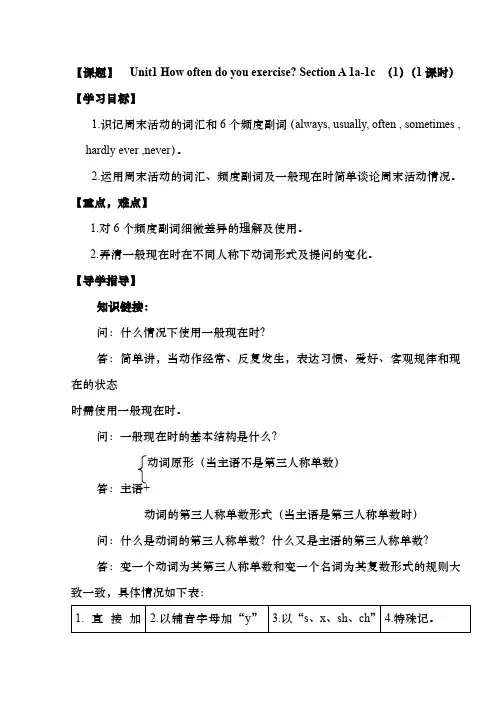
知识链接:
一、将一个句子变为否定句的三个步骤:1、在要求变为否定句的句子中寻找be动词am、is、are、was、were,若有其中某个的话,在其后边加not即可(也可将其两个词缩写:is not=isn’t;are not=aren’t;was not=wasn’t;were not=weren’t)。2、若在要求变为否定句的句子中找不到am、is、are、was、were,就在其中寻找情态动词can、may、must、should、will、would、could、shall等,若有其中某个的话,就在其后加not即可(也可根据需要将其缩写:can not=can’t,must not=mustn’t, will not=won’t)。3、若在要求变为否定句的句子也找不到情态动词,就借助助动词do、does、did,第三人称单数借助does,不是第三人称单数借助do,一般过去时借助did,并在其后加not(分别可缩写成don’t、doesn’t、didn’t)后边的动词打回原形。
八年级上册英语全册导学案(人教版)
八年级上册英语全册导学案(人教版)学习目标:知识目标:.熟练掌握词汇:watermelon,shake,pour,pour..intoturnon,cutup,yogurt,honey,need2熟练掌握以下句型:(1)cutupthebananas(2)pourthemilkintotheblender(3)Howdoyoumake…?Howmuch…doyouneed?技能目标:,会用本节新词和短语,能听说读写;2能听懂,读懂描述程序的听力材料,能就某个操作程序对话,初步书面编写这样的对话;情感目标:培养学生热爱劳动和独立自主的生活态度。
学习过程:一、自主学习(做学习的主人!)(一)Previewstepsandmethods(预习步骤及方法):(新知识,早知道)课前预习Ⅰ.回顾你所学过的有关食物的单词,并将其分类,比一比谁写的多。
Drink:_______________________________Fruit:_______________________________Vegetables:__________________________Food:________________________________Ⅱ.和同伴合作,把这些食物按可数和不可数名词分类。
可数名词:___________________________不可数名词:__________ 课堂学习Beforelistening1.结合课前准备Ⅰ的内容,完成1a。
2.运用生活常识,依据图画提示,通过和伙伴的探讨,了解制作水果奶昔的步骤。
(二)听力练习1b,2a,2b,并完成相应任务.二、合作交流:co-operation.小组练习对话1c,2c。
三、展示点拨:DisplayRoleplaytheconversationsin1cand2c.Showtotheclasses.四、巩固提升:Exerciseinclass(别低估了自己的潜力!)根据首字母提示补全单词,使句子完整通顺。
八年级英语导学案答案
八年级英语导学案答案【篇一:人教版八年级英语上册导学案(全册)】exercise? section a 1a-1c (1)(1课时)【学习目标】1.识记周末活动的词汇和6个频度副词(always, usually, often , sometimes , hardly ever ,never)。
2.运用周末活动的词汇、频度副词及一般现在时简单谈论周末活动情况。
【重点,难点】1.对6个频度副词细微差异的理解及使用。
2.弄清一般现在时在不同人称下动词形式及提问的变化。
【导学指导】知识链接:问:什么情况下使用一般现在时?答:简单讲,当动作经常、反复发生,表达习惯、爱好、客观规律和现在的状态时需使用一般现在时。
问:一般现在时的基本结构是什么?动词原形(当主语不是第三人称单数)动词的第三人称单数形式(当主语是第三人称单数时)问:什么是动词的第三人称单数?什么又是主语的第三人称单数?答:变一个动词为其第三人称单数和变一个名词为其复数形式的规则大致一致,具体情况如下表:而主语的第三人称单数形式是指除了“you(你)、i(我)”以外的所有单个的人或物或者不可数的事物。
自主互助学习一、自学:1.仔细观察课本第一页图片,根据所给例子填写下列空格。
例:picture a(图a):picture b______________________________picture c:________________________________________?________________________________.________________________________.picture e:________ ______________________________________?________________________________.2.根据汉语提示,完成下列其他weekend activity (周末活动)短语。
人教版八年级英语上册导学案全册-图文
人教版八年级英语上册导学案全册-图文【课题】Unit1Howoftendoyoue某ercieSectionA1a-1c(1)(1课时)【学习目标】1.对6个频度副词细微差异的理解及使用。
2.弄清一般现在时在不同人称下动词形式及提问的变化。
【导学指导】知识链接:问:什么情况下使用一般现在时?答:简单讲,当动作经常、反复发生,表达习惯、爱好、客观规律和现在的状态时需使用一般现在时。
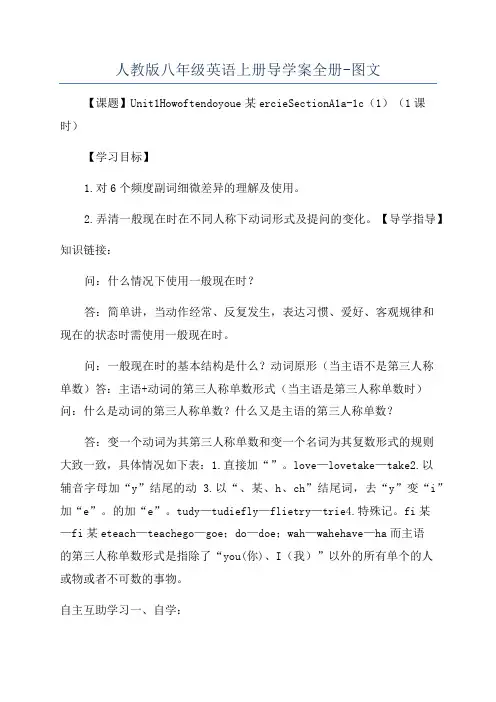
问:一般现在时的基本结构是什么?动词原形(当主语不是第三人称单数)答:主语+动词的第三人称单数形式(当主语是第三人称单数时)问:什么是动词的第三人称单数?什么又是主语的第三人称单数?答:变一个动词为其第三人称单数和变一个名词为其复数形式的规则大致一致,具体情况如下表:1.直接加“”。
love—lovetake—take2.以辅音字母加“y”结尾的动 3.以“、某、h、ch”结尾词,去“y”变“i”加“e”。
的加“e”。
tudy—tudiefly—flietry—trie4.特殊记。
fi某—fi某eteach—teachego—goe;do—doe;wah—wahehave—ha而主语的第三人称单数形式是指除了“you(你)、I(我)”以外的所有单个的人或物或者不可数的事物。
自主互助学习一、自学:1.仔细观察课本第一页图片,根据所给例子填写下列空格。
例:Picturea(图a):hop________________________________.WhatithegirlinPictureadoi ngSheihopping.Pictured:_________________________________________ _____Pictureb:_______abook________________________________.Whati thegirlinPicturebdoingPicturee:____________________________________________________________________________Picturec:____________________ ____________________.________________________________2.根据汉语提示,完成下列其他weekendactivity(周末活动)短语去购物_______________;去钓鱼_______________;去徒步旅行_______________;去看电影______________;去踩滑板_______________;去滑冰________________;去游泳__________________;打篮球__________________;弹钢琴______________;看望外祖父母__________________;为考试学习______________;帮父母做家务__________。
人教版八年级英语上册_上册全册教案教学设计导学案
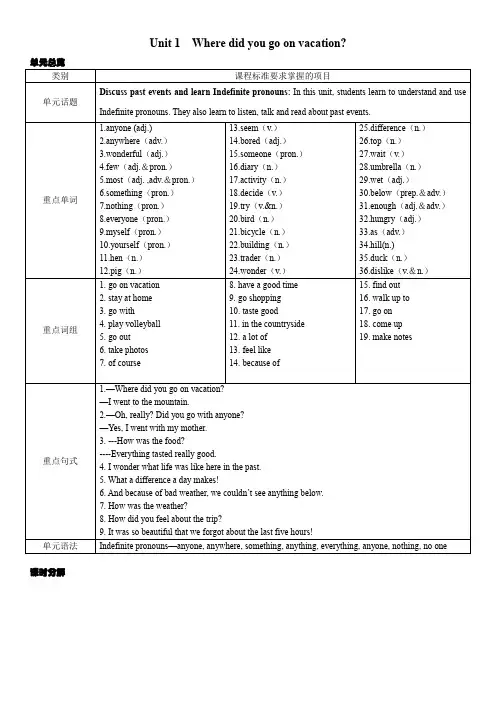
Unit 1 Where did you go on vacation? 单元总览课时分解第一课时 Section A (1a ~ 2d )§自主学习方案学生自学新单词(教材P 的单词),看谁记得又快根据首字母及汉语提示完成句子。
1. He told her not to tell anyone.2. There had never been such a beautiful woman anywhere in the world.3. This world is a wonderful place.4.Only a few people here know his name.5. On Sunday, I like staying at home most of the time to watch TV .6. Quite a few (相当多)students were late this morning.§课堂导学方案Step 1 情景导入 参考案例Teacher: What did you do last Sunday? Students: …Teacher: Today we are going to learn how to talk about past events.环节说明:从询问全班学生的度假情况入手,让学生初步理解对过去事情的谈论,以及其基本结构。
激发学生学习本单元的兴趣,自然地导入新课。
Step 2 完成教材1a-1c 的任务 【操作案例】1. 要求学生翻开课本P1,理解1a 中单词或短语的意思,并按要求完成课本上相应的任务。
(1分钟) Teacher: What at can you see ?Each picture shows something a person did in the past .Now, please match each phrase with one of the pictures .2. 检查答案,先要求几名同学给出他们的不同意见,并全班一起讨论。
人教版八年级英语上册导学案(全册)
全册导学案Section A【学习目标】1、学会谈论过去发生的事件—学习一般过去时的用法2、掌握规则动词的变换规则3、熟记一些常用的不规则动词【学习重点、难点】1.复习一般过去时态的构成及用法;2.进一步学习一般过去时态针对地点的提问及回答;【学法指导】1、能向小组成员用英语介绍生活中的日常活动,如:stay at home , go to the beach, do my home work,watch TV, visit my uncle, go to New York, etc.2、运用一般过去时谈论过去的一天或一次旅行。
3.不规则动词过去式的归类记忆【教学过程】一、导入(启发探究 3分钟)StepA、试一试你能写出下列各词的过去式吗?stay_________ do_________ stop_________play_________is_________ go_______ buy_______ have _______like_________ visit_________ are_________ carry_________StepB、快乐译一译stay at home_________ go to summer camp_________go to New York city______ go to the mountains_________visit my uncle_________ go to the beach_________visit museums _______Step C、考考你的迁移能力1. Lucy usually______to school early. But today she ______to school late. (go)2一What___________you__________(do) on your vacation last year?--–We___________(play) on the beach.3.I______ (call) you just now. But there_______ (be) no answer.4.Where __________you(study) at home las night? 一No, I__________(help)my mother__________(clean) the room.5. The students of Class One go to see the old woman __________ (one) a month.Step D、answer the questions:How was your summer vacation ?Where did you go on vacation?Who did you go there with ?What did you do there ?二、自学(自主探究 6分钟)Step 1c师生、生生操练Where did you go on vacation? I went to New York City.Did you go out with anyone? No, No one was here. Everyone was on vacation. Did you buy anything special? Yes, I bought something for my father. How was the food? Everything tasted really good.Did everyone have a good time? Oh,yes. Everything was excellent. 三、交流(合作探究 10分钟)Step 1a Reciting1.Read the phrases and know their meanings.stay at home_________ go to summer camp_________go to New York city______ go to the mountains_________visit my uncle_________ go to the beach_________visit museums _______2.finish the task:match the activities with the pictures.3.check the answers.4. students read and remember the phrases.Step 1b Listening1.students read the names.2. students guess their activities.3. finish the task:4. check the answers.5. students read and know the mmeaning of this passage.四、总结(引深探究 15分钟)I、语法:一般过去时态的运用1.带有确定的过去时间状语时,要用过去时如:two days ago…、last yearin the old days just nowwhen I was 8 years old yesterdayyesterday?2 表示过去连续发生的动作时,要用过去时这种情况下,往往没有表示过去的时间状语,而通过上下文来表示。
人教版八年级英语全册导学案
人教版八年级英语全册导学案一、Unit 1 Friendship1.1 基础知识点- [ ] 单词:friendship, trust, honest, support, loyalty- [ ] 句型:What does friendship mean to you? Friendship means...1.2 课前预- [ ] 阅读课本第1课时的课文,了解友谊的定义和重要性。
- [ ] 预课本第1课时的单词和句型,熟悉它们的意思和用法。
1.3 课堂活动- [ ] 教师引导学生讨论友谊的意义和特点。
- [ ] 学生们进行小组讨论,分享自己的友谊经历和看法。
1.4 课后作业- [ ] 完成课本第1课时的练题。
- [ ] 以"Friendship means..."为题写一篇短文,介绍你对友谊的理解和看法。
二、Unit 2 Family2.1 基础知识点- [ ] 单词:family, member, value, support, care- [ ] 句型:What does family mean to you? Family means...2.2 课前预- [ ] 阅读课本第2课时的课文,了解家庭的定义和重要性。
- [ ] 预课本第2课时的单词和句型,熟悉它们的意思和用法。
2.3 课堂活动- [ ] 教师讲解家庭的定义和重要性,并引导学生进行课堂讨论。
- [ ] 学生们根据所学知识,从自身角度描述家庭的意义和作用。
2.4 课后作业- [ ] 完成课本第2课时的练题。
- [ ] 以"Family means..."为题写一篇短文,介绍你对家庭的理解和看法。
...(继续编写其他单元的导学案)八、总结与反思- [ ] 回顾本学期所学内容,总结并思考其中的重要概念和关键词。
- [ ] 以"我的英语研究感悟"为题,写一篇短文,总结自己对英语研究的认识和体会。
人教版英语八年级上册全册导学案(12页)
八年级上册英语导学案Unit1 Where did you go on vacation?Period 1 Section A (1a-2c)知识目标1. 口、笔头掌握以下句型-Where did you go on vacation? -I went to the mountains.-Where did Tina go on vacation? -She went to the mountains.-Did you go with anyone? -Yes, I went with my mother.2.熟练掌握以下词汇:vacation, mountain, special, anyone技能目标:复习并掌握动词一般过去式的构成规律; 能用一般过去式叙述假期所做的事。
通过对过去事情的谈论,增进同学的相互了解。
1. 你能用英语写出下列短语吗?呆在家里_________ 去纽约市_________ 拜访我的叔叔_________去夏令营_________ 去爬山_________ 去海滩_________参观博物馆_________ 买特别的东西_________ 遇见有趣的的人_________做有趣的事情_________II. 回忆并默写出规则动词过去式的变化规则:1.______________2. ______________3. ______________4. ______________III. 做调查,问问你的同伴上个暑假都去了哪儿?Before listening1. 小组内交流课前准备1中的短语,并大声朗读三遍2. 两人一组,用课前准备III的内容对话。
3. Do 1a.观察与复习:1a 中用的动词是______时态。
规则动词过去式的变化规则是:(课前准备II)______________________While listening1. 1b listen twice and number the people in the picture.2. 1c Pairwork. Make conversations about the people in the picture.3. 2a Listen twice and complete the chart.4. 2b Listen twice again and check Yes or No for each question.5. 模仿秀:听录音中的重点句段,反复跟读,模仿语音语调。
人教版八年级英语(上册)导学案(全册)知识分享
人教版八年级英语上册导学案全册备注:本文档包括整册书10个单元的导学案,环节齐全,思路清晰,练习到位,是教师备课的助手,更是学生自主学习英语的必备资料!Unit1 Where did you go on vacation?(Section A)课时:第1-2课时学习目标:1.学会谈论过去的事2.学会谈论节假日的活动学习重点:1.一般过去时的陈述句,一般疑问句及回答和特殊疑问句学习难点:熟练使用本单元重点句型,进行日常交流。
一、课前尝试:(一)写出下列动词的单三,现在分词和过去式(go goes going went)1.be _____ ______ _____2.study _____ ______ _____3.watch _____ ______ _____4.eat _____ ______ _____5.have _____ ______ _____6.sit _____ ______ _____7.see _____ ______ _____ e _____ ______ _____(二)词汇知识先知道:1.dear(同义词)________2.guide(名词)_____ _3. friendly(反义词)_______4.friendly (名词)_____5.activity(复数)__6.dislike (反义词) ____7.like(反义词)_____ 8.decide(名词)___________ 9.make(过去式)____10.building(动词) ________ 11.visit(名词)____________ 12.go(过去式)______13.wait (名词) ___________ 14.difference(形容词)____ 15.cry(现在分词)___ (三) 短语互译:1.呆在家里__________2.由于__________3.看望我叔叔_________4.去夏令营___________5.去爬山________6.去海滩__________二、课堂探究(一)Do you know how to talk about past events? 你知道如何谈论过去发生的事吗?(二)How to ask the weather?1. What’s the weather like today ? 同义句____________________翻译___________________2. What was the weather like yesterday? 同义句________________翻译___________________(三)T o talk about“What did you do on vacation?”(四)用所给词的适当形式填空1. Jim and Bob ___________ (come) to China last month.2. LiLei _________________(not go) to bed until 12 o’clock last night.So he ______ (get ) up late.3. Anna __________ (read) English yesterday morning.4. There _________ (be) no one here a moment ago.5. I ___________ (call) Lucy this morning.6. I listened but ___________ (hear) nothing.7. Mary ___________ (begin) to learn Chinese last year.8. Last week we _________ (pick) many apples on the farm.三、课后检测:(一)用所给词的适当形式填空1. Jack ______ (be) often late for school last term.2. It was ______ (rain) yesterday but it is sunny today.3. We have great fun _______ (learn) English.4. The dog made the baby ________ (cry).5. Can you help me ________ (study) English?6. What ______ you _______last night? (do)7. We ______(go) to the museum yesterday. It was _____(crowd).8. Lucy _______(write) two letters to her friends two days ago.(二)认真阅读下列句子, 选出最佳答案.( )1.How __________ your vacation? - It was pretty good.A. wasB. wereC. didD. is( )2.Where __________ they go yesterday? They went to the Summer Palace.A. areB. doC. didD. were( )3. --- Where did you go on vacation? I __________ my grandma.A. visitB. visitedC. visitsD. am visiting( )4.Betty stayed at home and __________ for the test last weekend.A. studyB. studyedC. studied D studies四、作业设计:单项选择()1.The boys are having great fun ______ in the waves.A.play B.to play C.played D.playing()2.Thank you very much for _________us so well.A.teachB. teachingC. teachesD. taught()3. How’s the weather in Shanghai ? _________.A. It raining.B. It is rain C .It is rainy. D. It rainy.()4.It has five _______ years of history.A. thousand B.thousands C.thousand of D.thousands of ()5.—When _______ a sports meeting? ---Last Monday.A. had you B.do you have C.did you have D.will you have()6. How is it going? ______.A. It's sunny. B.It's hot. C.It's right. D.It's pretty good()7.Listen! Who ________?A. sings so wellB. is sing so wellC. is singing so wellD. singing so well( ) 8. “You are a very beautiful girl.” “________”A. No, I’m not.B. Sorry, I don’t.C. Thank you.D. Yes, I do.( ) 9 He didn’t have_____ money for a taxi, ______ he walked back to the hotel.A. any, andB. much, becauseC. any, soD. some, so( ) 10. On Sunday morning I helped my mother ____ the cooking.A. doB. to doingC. doesD. doing( ) 11.---__________ ? ---He did some reading at home.A. What does your father do yesterday eveningB .What does your brother do in the schoolC. What did your brother do over the weekendD. Where did your brother go last SundayUnit 1 Where did you go on vacation?(Section B)课时:第3-4课时学习目标:1.学会如何用一般过去时谈论发生在过去的事情学习重点:一般过去时学习难点:How to use keep,enough and such…that correctly学习过程:一、课前尝试:(一)英汉互译:(一)熟读Section B 3a,然后完成下列英汉互译1.发现某人正在做某事_______________2.丢失,失踪, 迷路____________________3.帮助某人做某事__________________4.使得某人……做某事__________________5.决定去做某事___________________6.走回某地_______________________7. 打排球______________________ 8.干……事很愉快__________________9.记日记_______ 10.the Palace Museum_________(一)enough的用法(二)1.so +形容词或者副词+that+从句意思是:如此...以致于结果状语从句2.such +a /an + 形容词+名词+that+从句,当名次是不可数或者复数时,用such +形容词+不可数名词或者复数+that+从句Those are such beautiful flowers that we all like them.3.too+形容词或者副词+to do sth 意思是:太...而不能The boy is too young to carry the box.4.形容词/副词+enough +to do sth 意思是:...足够去做某事The boy is old enough to go to school.实战演练: 同义句转换1.This is so heavy a box that I can't carry it2.This is a heavy box I can't carry it3.This box is heavy me carry4.This box isn't carry三、课后检测:(一)根据所给句意及首字母提示完成下列单词拼写使句意通顺完整。