
六年级英语下第二课时《Lesson_2_What_would you like
two bottles of water
a cup of tea
two cups of tea
a piece of bread
three pieces of bread
Practise:
• Kitty: I’d like a bottle of water. Kevin! • Kevin: I’d like two pieces of beef. Su Nan. • Su Nan: I’d like three plates of fish. Wu Chen ! • Wu Chen: I’d like four bowls of rice. Kitty . • Kitty: I’d like five …
南教场小学 张晓莉
a bowl of noodles
two bowls of noodles
two bowls of rice
a plate of beef
two/three … plates of beef
a glass of juice
three glasses of juice
a bottle of water
Let’s talk
• Waitress: Welcome to Noodle House. What would you like to eat? • Mom: We’d like to bowls of noodles. • Waitress : What kind of noodles would you like, beef noodles or tomato noodles or tomato noodles ? • Mom :A bowl of beef noodles and a bowl of tomato noodles, please. • Waitress : Ok. Would you like something to drink? • Su Nan: May I have some juice, Mom? • Mom: Sure. A glass of juice and a cup of tea, please. • Waitress : Anything else? • Mom : No, thanks . • Waitress : Ok. A bowl of beef noodles, a bowl of tomato noodles, a glass of juice and a cup of tea. Please wait a minute.
• You are what you eat.
ons:
• • • • • T: Where are they? T: Who are they? T: Why are they there? Ss: They are in a noodle house. Ss: They are Su Nan and his mom. They are sitting at the table. • Ss: They are hungry.
六年级下册英语unit2,Wantwouldyoulike知识点
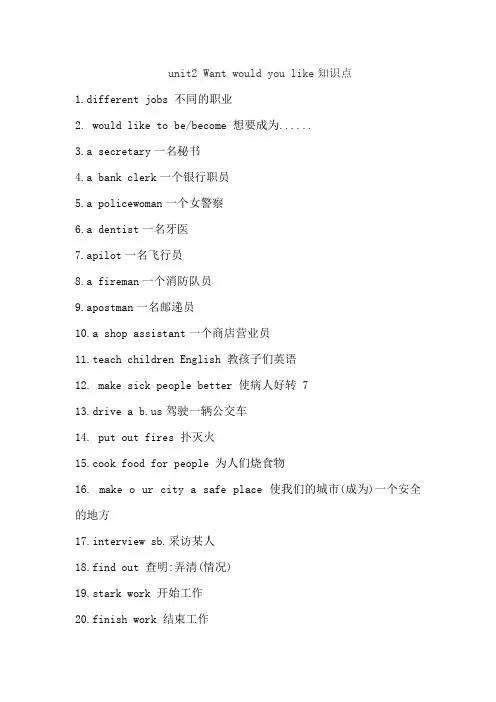
unit2 Want would you like知识点1.different jobs 不同的职业2. would like to be/become 想要成为......3.a secretary一名秘书4.a bank clerk一个银行职员5.a policewoman一个女警察6.a dentist一名牙医7.apilot一名飞行员8.a fireman一个消防队员9.apostman一名邮递员10.a shop assistant一个商店营业员11.teach children English 教孩子们英语12. make sick people better 使病人好转 713.drive a 驾驶一辆公交车14. put out fires 扑灭火15.cook food for people 为人们烧食物16. make o ur city a safe place 使我们的城市(成为)一个安全的地方17.interview sb.采访某人18.find out 查明:弄清(情况)19.stark work 开始工作20.finish work 结束工作21. in the morning/afternoon/evening 在早上/下午/晚上22.Why not?为什么不呢?1. would like to do/be=want to do/be 想要做/想要成为(1)Iwould 缩写为I'd: would not 缩写为 wouidn't,例如,Iwould like to have coffee.我想要喝咖啡。
Iwould like fish.我想要鱼。
--- Would you li ke to be a driver?.你想成为一名司机吗?--Yes,Iwould./No,I wouldn't是的,我想。
"不,我不想。
注意:like 用作实意动词时翻译为“喜欢”like sth.o like doing sth. like to do sth.o其用法是例如,He likes to draw./He likes drawing.他喜欢画画。
六年级英语下册Unit2WhatWouldYouLike课件2陕旅版

a cup of tea
a cup of tea
two cups of coffee
a piece of bread
a piece of bread
two pieces of paper
three pieces of cake
New worlds
a bowl of noodles a plate of beef a glass of juice a bottle of water a cup of tea a piece of bread
二、英 汉 互 译
1.一杯绿茶 a cup of tea 2.三瓶牛奶 three bottles of milk 3.两碗米饭 two bowls of noodles 4.四盘牛肉 four plates of beef 5.三片面包 three pieces of bread 6.two bowls of noodles 两碗面条 7. a glass of orange juice 一杯橙汁 8. three cups of hot coffee 三杯热咖啡 9. a piece of chicken 一块鸡肉 10. three plates of fish 三盘鱼肉
It’s time for dinner.
Let’s play
Kitty: I’d like a bottle of water. Kevin! Kevin: I’d like two pieces of beef. Su Nan! Su Nan: I’d like three plates of fish. Wu Chen! Wu Chen: I’d like four bowls of rice. Kitty! Kitty: I’d like five …
六年级英语下册Unit2WhatWouldYouLike课件1陕旅版

2019/9/11
最新中小学教学课件
26
谢谢欣赏!
2019/9/11
最新中小学教gflwasasteorf
juice
a bottle of water
two bottles of juice
a bottle of water
a cup of tea
two cups of coffee
a cup of tea
a piece of bread
--What would you like to drink? --I`d like...
Look and match
dumplings hamburgers salad
soup
drinks
noodles
fruit
a bowl of noodles
Bowl
Snow
Grow
thro w
a bowl of noodles
It’s time for dinner.
Practice
一、看图补全下列短语。
1.
2.
3.
ab_o__w__lof noodles a g__l_a__s_sof water a _p__la__teof
4.
5.
6d. umplings
ac_u__p_ of tea a b__o__t_t_l_eof juice a __p__ie__coef bread
a
a cup of
bowl
tea
of
noodles,
a pbleaetfe, oafgblaesestffow,uooarfbpojlguawtlielcasseosofs,fnbaooeoefbdfljoeusttilcee, a bottle of water,
陕旅版六年级下册英语课件Unit 2 What would you like 第二课时课件ppt(完美版)
重点句型二
What kind of noodles would you like,beef noodles or tomato noodles?
您想来哪种面条呢?牛肉面还是西红柿面?
【详解】在英语中,当你询问对方是哪一种类时,可用“What kind
of...?”。
11
What kind of fruits would you like,apples,grapes or bananas?
Unit 1 What Would You like?
陕旅版(三年级起点)六年级下册
Part A Let's talk Part B Ask and answer
2/17/2020
1
Warm-up/Revision Presentation
● Let's talk ● Ask and answer
7
1.Where are they ? Answer:They are in a Noodle House. 2.Who are they? Answer:Su Nan and his Mom. 3.Why are they there? Answer:They want to eat something.
drink?
21
Homework
1.背诵本课所学Let's talk 内容。 2.表演给家人看。
22
2020/2/17
23
麦老师 优秀教研组长 学科带头人 优秀辅导奖
附送
(五大类课堂用语)
可右键删除
1.这么难的题你能回答得很完整,真是了不起! 2.这节课你发言了好几次,看得出来你是个善于思考的好孩子。 3.你的想法很有创意,看来你是认真思考了。 4.你真爱动脑筋,这么难的题你都能解决! 5.你好厉害!敢于对课本提出疑问,你的勇气令人羡慕! 6.通过你的发言,老师觉得你不仅认真听,而且积极动脑思考了,继续加油! 7.你预习得可真全面,自主学习的能力很强,课下把你的学习方法介绍给同学们好不好? 8.你的进步可真大,老师为你感到高兴! 9.你虽然没有完整地回答这个问题,但你能大胆发言就是好样的! 10.老师真想在下节课看到你更出色的表现! 11.你们不仅说得好,而且乐于听取别人的意见,其他人应该向你们学习。 12.听你们的朗读是一种享受,你们不但读出了声,而且读出了情,我很感谢你们。 13.你太棒了!不随波逐流,能从相反的角度思考问题。你怎么会想到这一点的? 14.咱们班的小歌手今天回答问题的声音怎么这么小呢?同学们还想多听听你那清脆的声音呢!再大声回答一遍问题好吗? 15.虽然课文中有许多你不认识的字,但你一直努力把课文读完,你是个有毅力的孩子。有了这种毅力,还有什么事情能难倒你呢? 16.请你来谈谈这个问题。我从你的眼中看出来,你的心中一定是有了与其他同学不一样的看法。勇敢地站起来说一说吧! 17.你们是老师心目中最棒的孩子,现在老师需要你们的帮助! 18.这个问题你处理得太棒了,连老师也自愧不如,继续努力,你一定会更出色! 19.你真了不起,竟能想出如此独特的方法,很有新意,大家用掌声鼓励他。 20.你真是一个知识渊博的孩子,懂得比老师还多,老师都有些羡慕了,继续努力啊! 21.你的语言组织得这么好,可见你的语言表达能力非常强。 22.你是个爱动脑、会提问的好孩子,掌声送给你。 23.你真行!一次比一次有进步!
六年级英语下册Unit2WhatWouldYouLike课件1陕旅版 精品文档
what would you like?
I would like…… 一碗面,一盘牛肉, 一杯果汁,三片面 包
I would like…… 六碗面,三盘牛肉, 两杯果汁,四杯茶, 八片面包。
A: Welcome to ……. Can I help you? What would you like to eat/ drink?
a bottle of water
a bowl of noodles a cup of tea
a plate of beef a piece of bread
a glass of juice
a +量词 +of
a bowl of a plate of a glass of a bottle of a cup of a piece of
noodles
a bowl of noodles
a plate
late make take mate
beef
a plate of beef
a glass of juice
water
bottle
a bottle of water
a cup
tea
a cup of tea
bread
piece
a piece of bread
Unit2 What Would You Like?
what are they?
hamburger
1.People in China usually eat with__ a.forks and knives b.chopsticks
2.People in the USAnd knives b.chopsticks
六年级英语下册Unit2WhatWouldYouLike教案2陕旅版
Unit2 What Would You Like【单元总目标】本单元教学重点是就餐用语,其中难点是用餐时根本会话。
其主要功能语句有:What would you like to eat We’d like ... What kind of ...would you like, ... or ... ..., please.要求学生能在日常生活中准确运用这些就餐时根本用语。
本单元词汇多为过去学过食物、饮品类单词,新参加了量词词组相搭配短语。
如:a bowl of noodles, a plate of beef, a glass of juice, a bottle of water, a cup of tea, a piece of bread要求学生在掌握如何表达这些食物、饮品数量同时,能把量词词组灵活运用于功能语言之中。
教师应结合学生生活经历,尽可能地创设生活化情景组织教学活动,并鼓励学生共同合作参与进展交际实践。
从而,使学生比拟顺利地掌握在外就餐时用语。
本单元教学分为4个课时。
第一课时以Part A中Let’s learn 局部量词词组教学为主,并借助Part B Let’s play局部进展稳固;第二课时学习Part A中Let’s talk局部对话,理解并会模仿使用点餐用语,同时完成课本Part B Ask and answer局部练习;第三课时以Part B中Let’s learn more局部为主,进一步学习拓展运用本单元功能语言;第四课时主要是Part B Read the words局部语音教学及本单元Part C局部其余练习。
【单元具体目标】知识目标一、能听、说、读、写以下词汇:a bowl of noodles, a plate of beef, a glass of juice, a bottle of water, a cup of tea, a piece of bread。
陕旅版英语六年级下册_Unit2_What_Would_You_Like_第1课时教学设计
Unit2 What Would You Like 第1课时教学设计【内容来源】陕旅教育出版社六年级下册Unit2【主题】Warming-up: Look and match, Let’s learn, Let’s play【课时】第1课时一、教学目标1. 能听、说、读、写词汇:a bowl of noodles, a plate of beef, a glass of juice, a bottle of water, a cup of tea, a piece of bread。
2. 能灵活运用上述词汇。
二、教学准备1. 教师准备Let’s learn部分的词汇教学卡片。
2. 教师准备PPT教学课件(一张餐桌,餐桌上有各种食物、饮品、水果)。
3. 教师准备Let’s learn部分的教学音频。
三、教学方法建议课程导入(Leading In)(1)课前问答T: Morning, everyone!Ss: Morning, Mr. / Miss ...!T: Do you often have breakfast?Ss: Yes.T: What did you have for breakfast this morning?S1: ...S2: ...(2)新课导入1. Part A Warming-up: Look and match一段会话之后,教师顺势引入Warming-up的第一个活动。
T: Look at the pictures on P9. What are these?先让学生说一说这件图片分別是什么,然后让他们自己读一读本部分的词汇,并将图文连线匹配。
2. 猜一猜教师向学生展示一副餐桌的PPT图画,先让学生判断出它是有张桌子(table)。
接着让学生猜一猜桌面上都会摆放哪些吃的东西。
采用头脑风暴的方式让学生说出曾经学过的有关食物、饮品、水果之类的词汇。
随后,教师展示出餐桌上的食物、饮品的画面。
六年级英语下册Unit2WhatWouldYouLike(第2课时)教案陕旅版
六年级英语下册Unit2WhatWouldYouLike(第2课时)教案陕旅版教学目标:1.能听懂并理解Let’s talk部分的对话内容。
2.能流畅的朗读对话,并能在日常生活中灵活准确地运用以下功能结构:(1)——What would you like to eat?——We’d like…——What kind of…would you like,…or…?——…,please.(2)——Would you like something to drink?——May I have…?——Sure.(3)——Anything else?——No,thanks.教学准备:1.教师准备PPT教学课件。
2.教师准备Let’s talk部分的教学挂图。
3.教师准备录音机以及Let’s talk部分的录音磁带。
教学过程:一、课程导入(一)课前问答(二)新课导入1.读一读,拼一拼教师展示所准备的PPT课件,让学生看图说出相应的量词词组,如:aplate of beef,a glass of juice,a bowl of noodles等等。
2.导入新课教师承接上一环节,和学生就面条(noodles)进行交流:T: Do you like noodles? What kind of noodles do you like?引导学生作答后,教师继续提出问题,导入新课:T:What kind of noodles does Su Nan like?Do you know?Let’s havea look.二、课程展示(一)新课展示Part A Let’s talk1.出示本部分的教学挂图,让学生仔细观察并尝试回答以下问题:Where are they? Who are they? Why are they there?学生通过之前的观察及教师的引导,大概了解到对话的场所、人物和事件后,通过简单的对话对挂图做简单分析:2.教师播放Let’s talk部分的录音,让学生结合挂图情景,边听录音边理解对话内容。
易县二小六年级英语下册Unit2WhatWouldYouLike教学内容与目标教案陕旅版三起
Unit2 What Would You Like 教学内容与目标【内容来源】陕旅教育出版社六年级下册 Unit2【单元总目标】本单元的教学重点是就餐用语,其中难点是用餐时的基本会话。
其主要的功能语句有:What would you like to eat? We’d like ... What kind of ...would you like, ... or ...? ..., please.要求学生能在日常生活中准确运用这些就餐时的基本用语。
本单元的词汇多为过去学过的食物、饮品类单词,新加入了量词词组相搭配的短语。
如:a bowl of noodles, a plate of beef, a glass of juice, a bottle of water, a cup of tea, a piece of bread要求学生在掌握如何表达这些食物、饮品的数量的同时,能把量词词组灵活运用于功能语言之中。
教师应结合学生的生活经验,尽可能地创设生活化情景组织教学活动,并鼓励学生共同合作参与进行交际实践。
从而,使学生比较顺利地掌握在外就餐时的用语。
本单元的教学分为4个课时。
第一课时以Part A中Let’s learn部分的量词词组教学为主,并借助Part B Let’s play部分进行巩固;第二课时学习Part A中Let’s talk 部分的对话,理解并会模仿使用点餐用语,同时完成课本Part B Ask and answer部分的练习;第三课时以Part B中的Let’s learn more部分为主,进一步学习拓展运用本单元功能语言;第四课时主要是Part B Read the words部分的语音教学及本单元Part C部分的其余练习。
【单元具体目标】知识目标一、能听、说、读、写以下词汇:a bowl of noodles, a plate of beef, a glass of juice, a bottle of water, a cup of tea, a piece of bread。
陕旅版六年级英语下册Unit 2 What Would You Like单元教案与反思
Unit 2 What Would You Like?原创不容易,为有更多动力,请【关注、关注、关注】,谢谢!师者,所以传道,授业,解惑也。
韩愈单元总目标:本单元的教学重点是就餐用语,其中难点是用餐时的基本会话。
其主要的功能语句有:What would you like to eat? We’d like… What kind of… would you like, … or …? …, Please. 要求学生能在日常生活中准确运用这些就餐时的基本用语。
本单元的词汇多为过去学过食物、饮品类单词,新加入了量词词组相搭配的短语。
要求学生在掌握如何表达这些食物、饮品数量的同时,能把量词词组灵活运用于功能语言之中。
课时安排:本单元的教学共分4课时。
第一课时Part A、 B。
第二课时Part A、B 。
第三课时Part A 、B、C第四课时Part B、C。
知识目标:一、能听、说、读、写词汇:a bowl of noodles, a plate of beef, a glass of juice, a bottle of water,a cup of tea, a piece of bread。
二、能听懂、会说、会读、会用下列句型:1. --- What would you like to eat?--- We’d like…--- What kind of… would you like,… or …?--- …, Please.2.--- Would you like something to drink?--- May I have …?--- Sure.3. --- Anything else?--- Yes,… /No, thanks.情感目标:一、挖掘话题的趣味性,激发学生学习英语的兴趣,培养其学习英语的积极态度,使学生乐于参与、勇于交际实践的精神。
二、引导学生注重合作学习,培养其合作意识。