
人教版四年级英语上册第六单元教案
课堂教学设计方案
课堂教学设计方案
Unit 6第2 课时总计6课时主备人:投放日期2020.12.8
课堂教学设计方案
Unit 6第3课时总计6课时主备人: 投放日期2020年12月8日
课堂教学设计方案
Unit 6第4课时总计6课时主备人: 投放日期2020年12月8日
课堂教学设计方案
Unit 6第5课时总计6课时主备人: 投放日期2020年12月8日
2. 再次播放课文录音,学生跟读。
Step 4 Practice
1. 游戏:我来指,你来说。
老师指向黑板上的单词,请学生快速地读出单词。
2. 出示单词图卡,请学生快速说出单词。
3. 乱序呈现组成单词的字母,请学生猜出单词并拼写。
4. 呈现不同职业的人物图片,请学生快速说出其职业。
5.完成Let’s play活动,请学生表演某一种职业,让其他学生猜出职业名称。
6. 小组活动,调查组内同学家人的职业。
Step 5 Summary
1. 同时展示家人和职业类单词,请学生组成对话。
板书设计
Unit Six Meet my family
B. Let’s learn
driver nurse farmer cook doctor
What’s his job?
He is a _______.
What’s her job?
She is a _______.
教
学
反
思
课堂教学设计方案
Unit 6第6课时总计6课时主备人: 投放日期2020年12月8日
猜猜我是谁作文
【篇一】
大家好,我是谁你们知道吗?什么?不知道?那就让我来说说吧,仔细听哟!
我是李xx,李子的“李”,“柄”把柄的柄,熠熠生辉的“熠”。
我长着一头短而密的头发,立在头上,一双炯炯有神的眼睛,挂在高高的鼻梁上。
一个葡萄似的小嘴镶嵌在脸上,最有特点的是我那,尖尖的向后斜着长长的耳朵。
我喜欢穿一件很长很长的黑白相间的衣服,那件衣服已经盖住了我的膝盖,穿上很像绅士。
我喜欢自己做机器人,并编写程序。
说实话我还真做出来了呢!我还喜欢踢足球,跑步……
我是南充市出生的孩子,南充的特点是木偶戏可别小看它。
曾经,我们南充的大木偶还在奥运会上,被表扬了八分钟呢!因此我为南充感到骄傲。
南充还有丝绸女神、北湖公园、中心花园、玉屏公园、南充市政府公园、西山烈士陵园。
南充还是丝绸之路。
春天,我和爸妈观景。
夏天,我和爸妈游玩。
秋天,我和爸妈作画。
冬天,我和爸妈写诗。
南充也是个果城。
怎样?南充是个美丽的城市吧!
我长大了相当一名科学家,发明长生不老药和起死回生之药。
如果发明成功,我会去贫穷的地方免费赠送,让穷人也能起死回生和长生不老。
我现在知道要让大脑细胞存活才能这样,可不知要用什么植物来做药水,所以我还要好好学习才行啊!
你们认识我了吗?
【篇二】
我长着一双和小猫一样大小的眼睛,嘴巴有一点纯红色。
鼻子有两个小小的孔,耳朵长长的,脚像爪子一样大。
我的脸又长又圆,最大的特点是数学好,语文差。
我还喜欢看动漫书。
我的爱好是踢足球,因为足球能让我锻炼身体,我喜欢穿黑色的衣服裤子,喜欢穿黄色的。
我家住在嘉陵区祥瑞小区,小区的周围有一排排茂盛的参天大树,还有一家洗衣店,外面还有一辆辆小车子。
小区里跳绳还在小区里摘桃子、李子、苹果。
还在小区里收包裹。
春天,我我们在小区里捉蝴蝶。
夏天,我和小朋友们大在大树下乘凉。
秋天,树上挂满了各种成熟的水果。
冬天,我们在小区里打雪仗。
长大的梦想是当一名医生,为国家做一份贡献。
现在的我应该好好学习,以后才能实现我当医生的梦想。
我是爸爸的儿子,家里面有爸爸妈妈、爷爷、哥哥、弟弟、奶奶和妹妹、姐姐。
人教版四年级英语上册unit 6讲义(知识点归纳与练习)
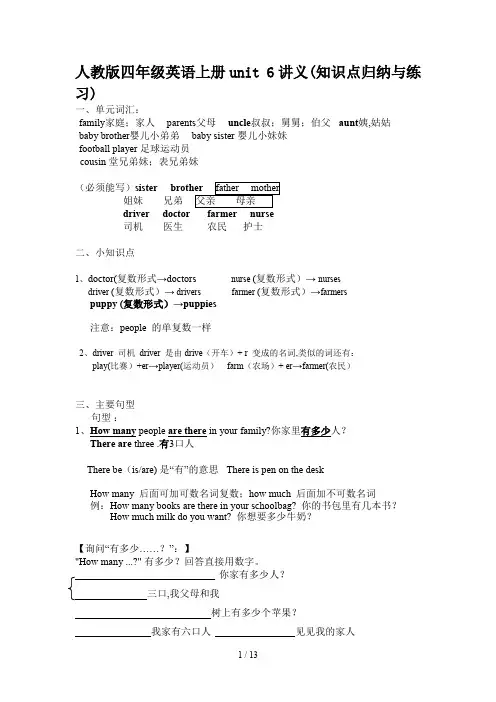
人教版四年级英语上册unit 6讲义(知识点归纳与练习)一、单元词汇:family家庭;家人parents父母uncle叔叔;舅舅;伯父aunt姨,姑姑baby brother婴儿小弟弟baby sister 婴儿小妹妹football player 足球运动员cousin 堂兄弟妹;表兄弟妹(必须能写)sister姐妹兄弟driver doctor司机医生农民护士二、小知识点1、doctor(复数形式→doctors nurse (复数形式)→nursesdriver (复数形式)→ drivers farmer (复数形式)→farmerspuppy (复数形式)→puppies注意:people 的单复数一样2、driver 司机driver 是由drive(开车)+ r 变成的名词,类似的词还有:play(比赛)+er→player(运动员)farm(农场)+ er→farmer(农民)三、主要句型句型:1、How many people are there in your family?你家里有多少人?There are three .有3口人There be(is/are) 是“有”的意思There is pen on the deskHow many 后面可加可数名词复数;how much 后面加不可数名词例:How many books are there in your schoolbag? 你的书包里有几本书?How much milk do you want? 你想要多少牛奶?【询问“有多少……?”:】"How many ...?" 有多少?回答直接用数字。
你家有多少人?树上有多少个苹果?我家有六口人见见我的家人2、My family has three people. 我家有三口人。
Who are they ?他们是谁?They are my parents and me .他们是我的父母和我句中family 为 “家,家庭”,谓语动词用第三人称单数形式family 作 “家庭成员”讲时,谓语动词用复数形式例:All my family like fish. 我们全家人都喜欢鱼肉3、Meet my family!见见我的家人4、This is my uncle. 这是我的叔叔He’s tall and strong.他又高又壮5、What’s your aunt’s job ?你姨是干什么的?此句是由what引导的特殊疑问句,其结构为“What+be+sb’s+job(s)?”用来询问某(些)人的职业是什么,其同义句为“What+be+sb?”.例:What’s your mother’s job? = What’s your mother? 你妈妈是做什么工作的【询问别人爸爸妈妈的职业】她是干什么的?她是一个厨师6、Is this your uncle?这是你的叔叔吗?Yes, it is.(肯定)是的,他是。
PEP人教版四年级英语上册全册教案(教学设计)

Unit 1 My classroom单元整体教案本单元是本册教材的第一单元。
从教材的整体来看,本单元讨论的话题是上学期内容的延伸和拓展。
本单元与三年级教材在知识编排上紧密衔接,起到了承上启下的作用。
从内容上主要是围绕“我的教室”以及“教室中的活动”这两个话题展开的。
单元内容分为A、B、C 三部分。
学生通过学习能够听懂、会说、会认读并拼写单词:window,desk,chair,floor,wall,door。
能够认读单词:classroom,blackboard ,light ,picture ,teacher ,computer,fan,能够按照图片提示,按要求写句子:Where is the...? It’s in/on/under/near the. .. 这部分内容的学习也对之前学过的介词和颜色类单词进行了进一步训练。
了解字母a 在开闭音节单词中的发音规律,并能够根据发音规律听音写出相应的单词。
了解let 引导的祈使句,并能够根据实际情况发出指令或作出适当回应。
单元C 部分是拓展了解部分,它以英文小故事的形式将A、B 两部分的内容巧妙地联系起来,通过阅读使学生的英语素养在语言技能、语言知识、情感态度,学习策略和文化意识等方面得到整体发展和提升提高学生的阅读能力,通过对故事情节中幽默环节的体会,感受语言文化的魅力。
本单元的教学重点是学习教室中出现的基本设施名称,并能够利用曾经学过的介词对其位置加以介绍和解说。
本单元的教学难点是认识和使用let 引导的祈使句。
这个单元的话题是与学生日常学习生活紧密相关的,教师在设计本单元教学活动的时侯可以充分利用教室中的各种实物及场景,创设灵活多样的教学活动,突出教学重点、突破教学难点,让学生易学易接受。
学生对贴近生活的内容非常感兴趣,舍积极主动地参与其中。
这样做可以活跃课堂气氛,激发学生的学习热情,教室中随处可见的生活场景能在教学中起到良好的教学效果。
此外在设计教学的时候教师一方面要充分考虑到到本单元内容与三年级教材的衔接,及时复习巩固;另一方面也要充分考虑学生的英语学习特点及其已有的智力水平和生活经验,充分激发学生的英语学习兴趣,使其爱学英语,积极参与教学活动。
人教版四年级英语上册Unit 6 单元教案
Unit6Meetmyfamily!知己知彼,百战不殆。
《孙子兵法·谋攻》原创不容易,【关注】,不迷路!第一课时一、教学内容PartALet’stalk&Let'scount二、教学目标1.能够在图片和教师的帮助下理解对话大意。
2.能够用正确的语音、语调朗读对话并能进行角色表演。
3.能够在情景中运用句型anypeoplearetily?询问他人家中有几位家庭成员;能在情景中恰当运用句子:Myfamilyanypeoplearetany…aret ing-up 教师播放歌曲Comeandseemyfamily,鼓励学生边唱边演。
Step2Presentation1.学习Let'stalk(1)教师出示一幅全家福照片的课件,说:Tyfamily.anypeoplearetyfamily?Wyfatymotyaunt…(2)猜一猜:教师分别请几名学生拿着自己的家庭照片提问:anypeoplearetyfamily?Wy….来回答。
小组里进行猜一猜的活动。
(3)教师让学生猜一猜自己的照片:(把照片在孩子面前晃一下)问:anypeoplearetyfamily?学生说:Tily.教师说:Myfamilyembers.(4)教师提问一些学生anypeoplearetyfamilyembers.的句型说一说。
(5)学生在小组中进行问答练习。
教师指着人数较少的家庭说:Tanyapplesaretanypeoplearetily?Wyfamilyembers小组活动时更换自己的同伴,跟新同伴对话。
Step4Summary六、课后反思第二课时一、教学内容PartALet’slearn&Let'splay二、教学目标1.能够听、说、认读5个有关家庭成员的单词或词组:parents,cousin,uncle,aunt,babybroty…ily,parents,uncle,aunt,baby,brot ing-up1.播放第二册学生用书Unit2中Fatotilytree,请学生把fatotilytree相应的位置上,大声读一读。
PEP(人教版) 小学四年级上册英语 Unit 6 Part A Let's spell教案
(1)教师带领学生拼读该部分的单词,再让学生两两互读并相互纠正读音,遇到读音有分歧的可以问教师。
(2)教师播放该部分的录音,学生根据录音内容圈出所听到的单词。再次播放录音,师生一起核对答案。
2.Listen atences.
朗读包含新单词的较难的句子。
3. 情感目标:懂得学习语音的重要性,乐于学习语音。
教学重点
根据发音规则,正确朗读新单词和难句子。
教学难点
能区分各发音规则间的不同。
教学准备
课件;字母卡片
教学过程
批注
Step 1 Warm-up& Revision
利用歌曲复习5个元音字母的发音,既活跃课堂气氛,又为接下来
2.Homework.
(1)熟读本课时chant。
(2)完成本课时配套练习。
板书设计
Unit 6 Meet my family! 第三课时
a
e
i
o
u
/æ/
/e/
/ɪ/
/ɒ/
/ʌ/
cat bag
pen bed
big pig
dog hot
but cut
a-e
-e
i-e
o-e
u-e
/eɪ/
/ɪː/
/aɪ/
① 教师依次出示该部分的句子和图片,学生接龙读句子。学生读完一句,教师播放该句的音频,其他学生判断该名学生是否读得正确。如不正确,接龙的下一位学生继续读出该句子。
② 教师依次播放每句的音频,学生跟读句子,教师帮助学生理解歌谣的意思,可以做动作来表演。
(2)Listen and chant.
① 播放该部分的录音,学生先静听一遍,感受歌谣的旋律。稍后,教师带领学生边听录音边唱歌谣。可采取“教师唱前一句,学生唱后一句”的形式进行。
人教版四年级英语上册第六单元教案

第六单元教案:My Family一、教学目标1. 知识目标(1)掌握家庭成员的英文表达:father, mother, brother, sister, grandpa, grandma。
(2)掌握句型“He/She is my...”,并能够正确运用。
2. 能力目标能够用英文介绍自己的家庭成员,提高学生的英文口语表达能力。
3. 情感目标培养学生对家庭的情感,懂得关爱和尊重家人。
二、教学重难点1. 教学重点掌握家庭成员的英文表达,能够用英文介绍自己的家庭成员。
2. 教学难点句型“He/She is my...”的运用,以及在实际情境中正确运用英文介绍家庭成员。
三、教学准备1. 教材:教师用书、学生用书、单词卡片。
2. 教具:图片、家庭成员人物头像图片、录音机。
四、教学过程1. Warm-up(1)通过图片和动作引导学生说出家庭成员的名称:father, mother, brother, sister, grandpa, grandma。
(2)和学生一起复习上一单元学过的单词和句型。
2. Presentation(1)教师出示家庭成员的图片,介绍每个成员,并让学生跟读,注意发音。
(2)教师示范句型:“He/She is my...”,并通过实际情境让学生理解并模仿。
3. Practice(1)学生分组进行对话练习,介绍自己的家庭成员。
(2)教师指导学生用英文介绍自己的家庭成员,并给予及时的反馈和纠正。
4. Production(1)学生利用图片和句型进行创作,用英文介绍自己的家庭成员。
(2)学生相互展示自己的作品,并进行互动交流。
5. Summary(1)教师引导学生总结本节课所学内容,加深记忆。
(2)回顾句型和单词,并做相关拓展练习。
6. Homework(1)布置家庭作业:用英文描述自己家庭成员并写成小作文。
(2)复习本节课所学内容,准备进行听写和口语练习。
五、教学后记这节课主要通过图片、互动对话的形式教授了家庭成员的英文表达,并加深了学生对家庭的情感认知。
人教版四年级英语上册第六单元教案
⼈教版四年级英语上册第六单元教案Unit Six Meet my family!单元整体分析本单元是义务教育⼈教版(pep)⼩学英语教科书四年级上册第六单元。
单元主题为Meet my family(认识我的家⼈)。
主情景图中,孩⼦们在观看Sarah⼀家演出的《绿野仙踪》,不断谈论Sarah家⼈的⾝份和职业情况,揭⽰出了本单元的主题:了解他⼈或介绍⾃⼰的家庭情况。
A部分共三页,分三课时。
第⼀课时为情景对话和练习部分。
Let’s talk部分Amy 和Chen Jie在谈论各⾃的家庭情况。
引出询问家庭成员数量的主要句式:How many people are there in your family?以及回答:Three. My parents and me. My family has six people 在对话中还出现了parents, people, little, puppy等需要掌握或了解的词汇。
Let’s count部分呈现了⼀幅图,⽤来练习句式:How many...? 第⼆课时为词汇学习课时,Let’s learn中介绍了家庭成员类词汇:parents, uncle, aunt, cousin, baby, brother。
Let’s play以⼿指画的形式来介绍⾃⼰家⼈的外貌特征。
第三课时为语⾳与字母学习课时,通过读⼀读,听⼀听,圈⼀圈;听⼀听、唱⼀唱;唱⼀唱,写⼀写三个活动,让学⽣复习区分字母a, e, i, o, u在开⾳节及闭⾳节⾥的发⾳。
B部分共四页,分两课时。
第⼀课时呈现情景对话和练习。
Let’s talk中Zhang Peng 拿着家庭相册问Sarah的家⼈的情况,呈现询问亲属关系的句式:Is this your...? 以及询问他⼈职业的句式:What’s your aunt’s job? 及回答。
Draw and say活动以画画介绍家⼈的⽅式来练习重点句式。
第⼆课时中Chen Jie询问Sarah她家⼈的职业,引出职业类词汇:doctor, cook, driver, farmer, nurse. 之后通过⼀个Let’s play的演⼀演,猜职业游戏来进⼀步熟悉新授词汇。
四年级上册英语教案-Unit6 第3课时∣人教新起点
四年级上册英语教案-Unit6 第3课时人教新起点一、教学目标1.能听懂、会说、会读、会写以下单词:inside, outside, match, play, hide, seek。
2.能理解并运用以下句型:Where’s/are…? They’re/It’s…3.能在老师教学的情境下进行简单的口语交流,表达自己的想法。
二、教学重点1.学习并掌握新单词及相关句型。
2.进行口语交流,表达自己的想法。
三、教学难点运用新单词和句型进行情境表达。
四、教学过程1. 观察图片,学习新单词。
教师出示课件或手绘图片,让学生观察并理解以下新单词:•inside•outside•match•play•hide•seek循序渐进,让学生逐个单词进行学习和练习,教师可采用图片和动作等形式进行单个单词的教学。
2. 讲解句型教师引导学生注意观察下面的句子:•Where’s the ball?•It’s outside.•Where are the keys?•They’re inside.教师解释“Where’s/are…?”的用法,引导学生使用相应的句型进行提问。
3. 朗读练习教师让学生跟随自己的发音,朗读新单词和句型,加深学生对英语语言的理解。
4. 情境口语训练教师根据教学用书提供的对话或鼓励学生提供自己的想法,让学生练习使用新单词和句型进行简单的口语交流。
例如:教师示范句子“Where’s the ball? It’s outside.”,然后提出“Where’s the book?” 的问题,引导学生进行答题:“It’s inside.”。
5. 扩展练习教师根据学生的情况,进行相关的扩展训练和巩固。
例如:教师出示一张图片,上面有几个人在玩游戏,其中一个人在把球踢到了小花园里,让学生描述这张图片上面的情境并进行交流。
6. 课堂小结教师对本节课进行回顾和总结,帮助学生梳理所学知识,加深印象。
五、课后作业1.完成电子课本上相应单元的习题。
四年级上册英语教案人教版
四年级上册英语教案人教版第一章:Unit 1 My school1.1 Teaching objectives:(1) Knowledge objectives:Students can understand and use key words: school, classroom, teacher, student, library, playground, puter room, dining room.Students can understand and use sentence patterns: What's this? It'sWhat's that? It'sWhere is the? It's in/on/under(2) Ability objectives:Students can listen, speak, read and write the key words and sentence patterns.Students can describe the layout of their school.1.2 Teaching key and difficult points:The correct pronunciation and usage of key words and sentence patterns.The description of the layout of the school.1.3 Teaching procedures:Step 1: Warm-upReview previous knowledge: introduce oneself and askquestions.Step 2: PresentationShow pictures of a school and introduce the key words and sentence patterns.Practice asking and answering questions with the class.Step 3: PracticeGroup activity: students work in groups to describe the layout of their school.Step 4: ProductionStudents role-play the conversation between a teacher and students in a school.1.4 Homework:Copy the key words and sentence patterns.Practice describing the layout of their school with their parents.第二章:Unit 2 My family2.1 Teaching objectives:(1) Knowledge objectives:Students can understand and use key words: family, mother, father, sister, brother, grandmother, grandfather.Students can understand and use sentence patterns: This is my She/He is my(2) Ability objectives:Students can listen, speak, read and write the key words and sentence patterns.Students can introduce their family members.2.2 Teaching key and difficult points:The correct pronunciation and usage of key words and sentence patterns.Introducing family members correctly.2.3 Teaching procedures:Step 1: Warm-upReview previous knowledge: introduce oneself and ask questions.Step 2: PresentationShow pictures of a family and introduce the key words and sentence patterns.Practice asking and answering questions with the class.Step 3: PracticeGroup activity: students work in groups to introduce their family members.Step 4: ProductionStudents role-play the conversation between a person and their family members.2.4 Homework:Copy the key words and sentence patterns.Practice introducing their family members to their friends.第三章:Unit 3 My friends3.1 Teaching objectives:(1) Knowledge objectives:Students can understand and use key words: friend, like, have, fun, play, happy.Students can understand and use sentence patterns: Do you have any friends? Yes, I do. They are(2) Ability objectives:Students can listen, speak, read and write the key words and sentence patterns.Students can introduce their friends.3.2 Teaching key and difficult points:The correct pronunciation and usage of key words and sentence patterns.Introducing friends correctly.3.3 Teaching procedures:Step 1: Warm-upReview previous knowledge: introduce oneself and ask questions.Step 2: PresentationShow pictures of friends and introduce the key words and sentence patterns.Practice asking and answering questions with the class.Step 3: PracticeGroup activity: students work in groups to introduce their friends.Step 4: ProductionStudents role-play the conversation between a person and their friends.3.4 Homework:Copy the key words and sentence patterns.Practice introducing their friends to their parents.第四章:Unit 4 My home4.1 Teaching objectives:(1) Knowledge objectives:Students can understand and use key words: home, bedroom, living room, kitchen, bathroom, dining room.Students can understand and use sentence patterns: What's this? It'sWhere is the? It's in/on/under(2) Ability objectives:sentence patterns.Students can describe the layout of their home.4.2 Teaching key and difficult points:The correct pronunciation and usage of key words and sentence patterns.第四章:Unit 4 My home (续)4.3 Teaching procedures (continued):Step 5: ProductionStudents role-play the conversation between a person and their family member about their home.4.4 Homework:Copy the key words and sentence patterns.Practice describing the layout of their home with their parents. 第五章:Unit 5 My schoolbag5.1 Teaching objectives:(1) Knowledge objectives:Students can understand and use key words: schoolbag, pen, pencil, ruler, eraser, book, notebook.Students can understand and use sentence patterns: What's in your schoolbag? I have(2) Ability objectives:sentence patterns.Students can describe the contents of their schoolbag.5.2 Teaching key and difficult points:The correct pronunciation and usage of key words and sentence patterns.Describing the contents of the schoolbag correctly.5.3 Teaching procedures:Step 1: Warm-upReview previous knowledge: introduce oneself and ask questions.Step 2: PresentationShow pictures of a schoolbag and introduce the key words and sentence patterns.Practice asking and answering questions with the class.Step 3: PracticeGroup activity: students work in groups to describe the contents of their schoolbags.Step 4: ProductionStudents role-play the conversation between a person and their friend about their schoolbags.5.4 Homework:Copy the key words and sentence patterns.Practice describing the contents of their schoolbag to their parents.第六章:Unit 6 Clothes6.1 Teaching objectives:(1) Knowledge objectives:Students can understand and use key words: clothes, shirt, pants, dress, skirt, shoes, hat, coat.Students can understand and use sentence patterns: What's this? It'sDo you like? Yes, I do./No, I don't.(2) Ability objectives:Students can listen, speak, read and write the key words and sentence patterns.Students can describe the clothes they like.6.2 Teaching key and difficult points:The correct pronunciation and usage of key words and sentence patterns.Describing the clothes correctly.6.3 Teaching procedures:Step 1: Warm-upReview previous knowledge: introduce oneself and askquestions.Step 2: PresentationShow pictures of clothes and introduce the key words and sentence patterns.Practice asking and answering questions with the class.Step 3: PracticeGroup activity: students work in groups to describe the clothes they like.Step 4: ProductionStudents role-play the conversation between a person and their friend about their clothes.6.4 Homework:Copy the key words and sentence patterns.Practice describing the clothes they like to their parents.第七章:Unit 7 Food7.1 Teaching objectives:(1) Knowledge objectives:Students can understand and use key words: food, rice, noodles, bread, meat, fish, vegetable, fruit.Students can understand and use sentence patterns: Do you like? Yes, I do./No, I don't.What's your favorite food? My favorite food is(2) Ability objectives:Students can listen, speak, read and write the key words and sentence patterns.Students can talk about their favorite food.7.2 Teaching key and difficult points:The correct pronunciation and usage of key words and sentence patterns.Talking about favorite food correctly.7.3 Teaching procedures:Step 1: Warm-upReview previous knowledge: introduce oneself and ask questions.Step 2: PresentationShow pictures of food and introduce the key words and sentence patterns.Practice asking and answering questions with the class.Step 3: PracticeGroup activity: students work in groups to talk about their favorite food.Step 4: ProductionStudents role-play the conversation between a person and their friend about their favorite food.7.4 Homework:Copy the key words and sentence patterns.Practice talking about their favorite food to their parents.第八章:Unit 8 Animals8.1 Teaching objectives:(1) Knowledge objectives:Students can understand and use key words: animal, cat, dog, fish, bird, elephant, tiger, lion.Students can understand and use sentence patterns: What's this? It'sDo you like? Yes, I do./No, I don't.(2) Ability objectives:Students can listen, speak, read and write the key words and sentence patterns.Students can describe the animals they like.8.2 Teaching key and difficult points:The correct pronunciation and usage of key words and sentence patterns.Describing animals correctly.8.3 Teaching procedures:Step 1: Warm-upReview previous knowledge: introduce oneself and askquestions.Step 2: PresentationShow pictures of animals and introduce the key words and sentence patterns.Practice asking and answering questions with the class.Step 3: PracticeGroup activity: students work in groups to describe the animals they like.Step 4: ProductionStudents role-play the conversation between a person and their friend about their favorite animal.8.4 Homework:Copy the key words and sentence patterns.Practice describing the animals they like to their parents.第九章:Unit 9 Colors9.1 Teaching objectives:(1) Knowledge objectives:Students can understand and use key words: color, red, yellow, blue, green, purple, orange, black, white.Students can understand and use sentence patterns: What color is it? It'sI likecolor.(2) Ability objectives:Students can listen, speak, read and write the key words and sentence patterns.Students can talk about colors.9.2 Teaching key and difficult points:The correct pronunciation and usage of key words and sentence patterns.Talking about colors correctly.9.3 Teaching procedures:Step 1: Warm-upReview previous knowledge: introduce oneself and ask questions.Step 2: PresentationShow pictures of colors and introduce the key words and sentence patterns.Practice asking and answering questions with the class.Step 3: PracticeGroup activity: students work in groups to talk about their favorite color.Step 4: ProductionStudents role-play the conversation between a person and their friend about their favorite color.9.4 Homework:Copy the key words and sentence patterns.Practice talking about their favorite color to their parents.第十章:Unit 10 At the farm10.1 Teaching objectives:(1) Knowledge objectives:Students can understand and use key words: farm, cow, horse, chicken, sheep, pig, tractor.Students can understand and use sentence patterns: What's this? It'sLook! There are(2) Ability objectives:Students can listen, speak, read and write the key words and sentence patterns.Students can describe what they see at the farm.10.2 Teaching key and difficult points:The correct pronunciation and usage of key words and sentence patterns.Describing the farm correctly.10.3 Teaching procedures:Step 1: Warm-upReview previous knowledge: introduce oneself and askquestions.Step 2: PresentationShow pictures of a farm and introduce the key words and sentence patterns.Practice asking and answering questions with the class.Step 3: PracticeGroup activity: students work in groups to describe what they see at the farm.Step 4: ProductionStudents role-play the conversation between a person and their friend at the farm.10.4 Homework:Copy the key words and sentence patterns.Practice describing what they see at the farm to their parents. 重点和难点解析第一章:Unit 1 My school重点:学校相关词汇和句型的学习和使用。
PEP小学英语四年级上册第六单元教案讲解
PEP小学英语四年级上册第六单元教案讲解PEP小学英语四年级上册第六单元教案讲解,主要涵盖了学生们在英语学习过程中所需要掌握的知识点、技能以及能力。
本单元的教学内容主要包括了“课堂用语”、“情感态度”、“语言知识”、“阅读”、“写作”和“评价”等六个方面,下面将逐一进行讲解。
一、课堂用语在课堂学习中,学生们需要熟练掌握一些基本的课堂用语,如问候语、道谢语、请示语、对话语、指示语等。
学生们需要注意在语境中恰当使用这些课堂用语,并与老师、同学积极互动,发表自己的观点。
二、情感态度语言学习不仅是技能的学习,还涉及到学生们情感态度的培养。
语言学习要学生们树立正确的学习态度、积极进取的精神、团结合作的意识以及自信勇敢的心态。
只有具备这些素质,学生们才能够更好的完成语言学习目标,取得更好的学习成绩。
三、语言知识语言知识是学生们在英语学习过程中必须要掌握的知识点,包括丰富的词汇量、语法知识、句型结构等。
在学习阶段,学生们需要不断地积累语言知识,并且能够运用于实际的场景之中。
四、阅读阅读是语言学习中不可或缺的一部分。
在阅读中,学生们需要理解文章的主旨、推理、归纳等能力。
同时还需要学生们开展阅读问答活动,通过阅读来锻炼自己的语言表达能力。
五、写作写作是英语学习中重要的环节。
学生们需要学会搜集、整理自己的思维,将想法通过英语语言表达出来。
同时,在写作过程中也需要注意一些语言书写技巧,如标点符号的应用、句子结构的合理组合等。
六、评价评价是教学活动中的重要一环,通过对学生们的学习表现进行评价,可以帮助学生们发现自身的学习不足,及时进行改进。
同时也可以提高学生们的学习积极性,让他们在继续学习英语的路上迈向更高的台阶。
PEP小学英语四年级上册第六单元教案讲解,是帮助学生们在英语学习中掌握基本技能和语言知识的重要环节。
学生们需要认真听取老师的讲解,积极参加课堂活动,努力学习,提高自己得语言水平。
个性化PEP小学英语四年级上册第六单元阅读理解教案
本次阅读理解教案结合了个性化PEP小学英语四年级上册第六单元的课程内容,旨在提高学生的阅读理解能力,并通过个性化教育的方式,满足学生不同的学习需求。
在教案的设计中,采用了多样化的教学方法和教学资源,从而帮助学生全面提高英语读写能力。
教案中采用了推理的教学方法,通过给出问题,让学生根据之前所学的知识和推理能力进行思考和回答。
例如,在第三篇阅读材料中,提出了“Why does Sarah like rabbits?”的问题,学生需要通过阅读全文来得出结论,从而提高他们的推理能力。
教案还采用了游戏的形式,激发学生的兴趣和参与度。
比如,在阅读材料结束后,通过课堂游戏的形式来检验学生的阅读理解能力。
这不仅能够让学生感到轻松有趣,同时也有助于加深他们对所学知识的记忆。
此外,教案中还融入了多媒体资源和互动式教学,让学生通过视听的方式更加深入地理解课程内容。
比如,在学习第一个阅读材料时,老师可以通过图示或视频的方式帮助孩子们更好地理解黑猫的颜色和特征,从而更加生动地呈现教学内容。
在个性化教育方面,教案中注重了对每个学生的差异性和特殊需求的关注。
例如,对于一些学习困难的学生,老师可以采用分步骤讲解的方式,帮助他们更好地理解课程内容。
而对于一些学习积极的学生,则可以适当地加大课程难度,让他们挑战更高的阅读难度,从而更好地提高他们的英语水平。
次个性化PEP小学英语四年级上册第六单元阅读理解教案充分考虑了学生的差异性和特殊需求,通过多样化的教学方式和教学资源,旨在提高学生的英语读写能力和阅读理解能力。
相信在这样的教育环境下,每个学生都能展现自己的潜力,并取得更好的学习成绩。