
2014新目标八年级英语上unit 9 Section A-2 (1)
To learn to use ―Would you like to…?” to make invitations To use the following structure to talk about obligations: I might have to/must…
受对方的邀请时, 常用Sure, I’d love to. /
Certainly. /Of course.等来回答;若不接受,
常用Sorry等来有礼貌地拒绝, 一般情况下 需要说明不能接受邀请的原因以表示歉意。
—Can you come to my birthday party tomorrow? 明天你来参加我的生日聚会,好吗? —Sorry, I can’t. I am going to visit my
Can she…
Can she come to the party?
Yes,she can.
Can he go to the baseball game?
No,he can’t. He has to study.
Can he…
Can they come to the party?
No ,they can’t. They have to study for the math test.
Do you know week?
星期一 星期二 星期三 星期四 星期五 星期六 星期日 Monday Tuesday Wednesday Thursday Friday Saturday Sunday
colorful weekend activities
go go shopping skateboarding
Can they…
A: Can he come to my party?
B: Sure, he’d love to.
He can’t. He has to…
Grammar Focus Can you come to my Sure, I’d love to. party on Saturday? Sorry, I must study for a math test. Can you go to the Sure. That sounds great. movies tomorrow night? I’m afraid not. I have the flu. Can he go to the party? No, he can’t. He has to help his parents. Can she go to the No. she’s not available. She baseball game? must go to the doctor. Can they go to the No, they’re not free. They movies? might have to meet their friends.
Wang Wei can be really stubborn.
(有时或偶然可能会)(=could)
否定句
This news may not be true. (也许不, =might not ) This news can’t be true. (不可能, =couldn’t)
疑问句
Can this news be true?(=Could)
go to the doctor
visit his aunt
go to a baseball game/ have baseball training
What do you usually do on weekends?
What activities do you do on weekends?
What weekend activities do you do?
≠May this news be true?
(4) can 还可表示“能力”、“能够” —You can swim, can’t you? —No, I can’t. I can’t promise anything, but I’ll do what
I can.
Tickets can be bought from the Tourist
3. A: When will you finish the science homework? On the weekend B: ____________________________________ 4. A: Who are you going to the movies with? My cousin B:____________________________________ 5. A: Are you free to come to my place on Saturday?
Information Center.
2. might/could
(1) 分别为may和can的一般过去时,分别表示 过去的“许可”、“可能”和“能力” 、 “能够”等。 The children asked whether they could/might go for a swim.(过去许可) I was afraid it might rain that afternoon. (过去可能) He asked if the news could be true. (过去可能)(Can the news be true?)
3a Complete the answers with might and one of the phrases in the box. watch TV on the weekend my cousin visit grandparents practice the violin 1. A: What are you going to do on Saturday?
________________________________________________
Can you come to play tennis?
Sure, that sounds great. Accepting:________________________
2. Inviting: (would like to/ go to the movies)
The policeman says you can’t park here.
(2) May/Can I/we…? 表示征询对方许可。
Can you…? 表示请求。 ① — May I use your phone? — Yes, you may./Yes, please. /No, you may not.
grandpa.
很抱歉,我来不了,我要去看我爷爷。
1. can/may
(1) 都可表示“许可” 。may用于较正式、客 气的场合,而can比较随便(口语)。 You may/can smoke here. Borrowers may not take out of the
library more than two books at a time.
Reason: (might have to) would you like to go to the movies? ______________________________ Refusing : I’m afraid not. I have too much
______________________________ homework to do. 3. Inviting: (can/hang out with us tonight)
/No, you mustn’t.
/No, you’d better not.
/I’m afraid not.
/I’m sorry. I’d rather you didn’t. ② — Can I go out and play, Mum? —Yes/Certainly, you can. /No, you can’t. ③ — Can you help me with this bag? —With pleasure./Sorry, I can’t. (3) 都可表示“可能性”
No. I might visit grandparents . B: ____________________________________
3b Complete the sentences below. Use the words in brackets to help you. 1. Inviting: (can / play tennis)
3c Write down everything you have to do next week. Choose a day and time to have a party. Then invite classmates to your party.
A: Can you come to my party? B: When is it? A: Next week, on Thursday night. B: I’m sorry. I have to study for a math test.
play basketball
go to the cinema
climb mountains
surf the Internet go fishing
go to a party
Weekend Activities
go to the concert
study for a test
have a piano lesson
B: I’m not sure. I might______________ practice the violin.
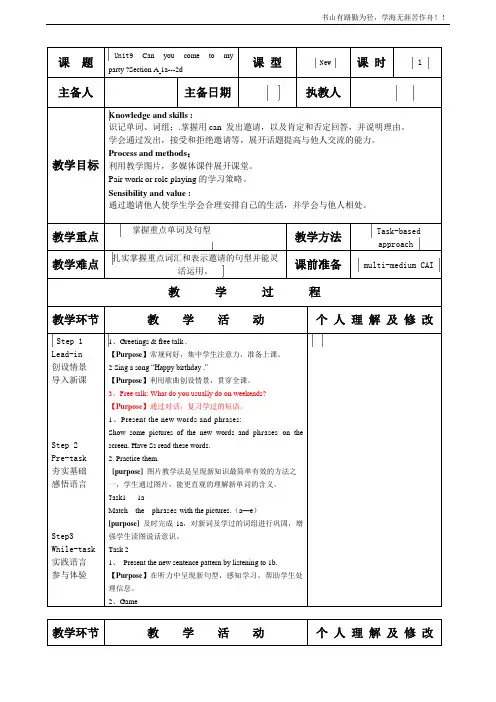
人教版新目标八年级上册Unit 9

人教版新目标八年级上册Unit 9 Can you come to my party?Section A(1a-2d)一.教材分析本单元教学以发出邀请、接受邀请、拒绝邀请为话题,主要应掌握句型:Can you …? Sure, I’d love/like to.I’m sorry, I can’t. I have to…/I’d love to, but I must…学习情态动词can, can’t的用法。
这个话题与学生实际生活联系非常密切,贴近实际生活,学生在学习语言知识时容易激起共鸣。
二.学情分析大部分初二学生已经具备了一定的英语知识运用和表达能力,乐于运用所学知识来和同伴在较为真实的语境中进行交流。
三.教学目标知识目标掌握本课的大纲词汇和情态动词can/can’t/have to/must的用法。
能力目标(1)能得体地用英语邀请他人,如Can you come to my party?(2)能得体地接受邀请,如Sure ,I’d love to.(3)能礼貌地拒绝邀请并陈述原因:Thank you for asking. I’m sorry, I can’t. I have to study for a test./I must go to the doctor.情感态度目标通过活动的开展,引导学生学会用英语礼貌得体地提出邀请, 营造积极乐观的人际氛围,表达自己的意愿,培养学生良好的人际关系和较高的文化修养。
文化意识目标了解邀请的礼仪,以及如何接受邀请和委婉拒绝邀请,用适当的方式表达自己的意愿。
学习策略目标(1)通过对话和调查, 用得体的语言提出邀请,在完成任务的同时,培养学生与他人的沟通合作能力。
(2)通过谈论活动,引导学生在体验、实践、参与、合作和交流中学会用英语礼貌、得体地提出邀请。
(建议:把教学目标的设计的更具体,更有可操作性)四.教学内容1.词汇prepare for/exam/flu/available//another time/until/hang out/catch2.句型Can you …?Yes/ sure, I’d love/like to.Sorry, I can’t. I have to…/I must…I’d love to. But I have to…五.教学重点、难点使用can来发出邀请;使用I have to …/I must句型来说明拒绝的原因。
人教版新目标八年级上课件、教案Unit9八英上Unit9SectionA1
提高初二英语学习成绩的方法首先要教会科学的学习方法,就是“三习”学习法。
即:课前预先,课上学习,课后复习。
预先发现重点.难点和疑点。
学习时认真听讲.认真思考.复习时要归纳分析知识点使之形成知识版块,从而形成为自己头脑中的知识的一部分。
学好语音和单词,用音形结合记忆法,拼读规则记忆法,分类记忆法,归纳记忆法,搭配记忆法,联想记忆法,卡片记忆法等。
对话与课文要读准意群和句子。
翻译要准确通顺,然后要背诵。
听力要坚持每天抽时间读,听,说练习,并且有针对性地做些练习巩固。
关于语法,初二英语的语法点在初一的基础上有所深入,随着句型和词汇的扩展,语法似乎显得更加复杂。
分散开来好像更加繁杂琐碎,半个学期下来好像突然出现很多个小点,记忆起来很麻烦。
其实不然。
初二的每一个知识点都是初一的稍加拓展,而且知识本身也是相互关联的。
☆比如人称代词,这时的重点已经不是主格和宾格的区分,而是形容词形物主代词、名词性无主代词、反身代词在情景对话以及写作中的应用。
还会涉及到形容词和副词的比较级、高级以及辨析名词的数、各种介词、基数词、序数词☆存在句、祈使句☆比如一般现在时,这时的重点已经不是表达习惯性动作,而是平率副词的使用规则。
还有现在进行、过去进行等等时态的综合训练☆这时也开始深入了解引语的使用、宾语从句、条件状语从句。
其实它们都是我们以前就见过的,甚至很早就见过了,现在我们只是通过更加深入系统的学习使自己在面对这些题时更加从容地得分,提高学习效率。
其实语法是得分的方法,学习语法就是学习得分的方法:比如你看到了某个标志词,你就知道用什么时态;你认识了某个句型,你就知道该填哪个关键词。
其实很快你就会知道语法比你想象得要简单。
学习英语要脚踏实地,没有捷径,但死记硬背也不是好方法。
要大声朗读,反复训练发音器官和耳朵,这样既可以提高听力,又可以改进口语发音,还记了单词。
利用一些好的方法能够让你更好地学习英语。
祝大家早日取得好成绩,加油吧!。
2014年秋人教版新目标八年级上Unit9-Section-B1-1a-1e课件

第14页,共29页。
Role play: Vince and Andy
Andy: Hi,Vince,can you play tennis with me?
Vince:__W__h_en____?
Andy: Today.
have to go the doctor
Vince: Sorry , I can’t . I___a_n__d_s_t_u_d_y__f_o_r_a__te_s_t____.
第16页,共29页。
Vince: Uh, no, sorry, I can’t. I have to go to the doctor and study
for a test today. Andy: How about tomorrow?
Vince: Sorry, tomorrow I’m playing
第5页,共29页。
合作探究
2.询问“星期” 的句型:
What day is (it) today? It’s Monday. 在英语中表示“星期”的词有:
Monday 星期一; Tuesday 星期二;
Wednesday 星期三; Thursday 星期四; Friday 星期五; Saturday 星期六; Sunday 星期日
第2页,共29页。
calendar[英] [`kælində]
[美] [`kæləndɚ]
第3页,共29页。
calendar
What’s today?
Today is Monday the 11th.
What’s the day after tomorrow?
It is Wednesday the 13th .
人教新目标英语八年级上册《Unit 9 Can you come to my party》(sectionA1a-2c)教学设计

评价方法 教师课上及时口头鼓励,表扬同学们的精彩表现,并配五角星实物图和鼓掌给与小
组合作竞争的评价。课后布置口头练习或布置任务,利用得分制对活动效果或任务的完 成情况进行评价。 练习
Ⅰ.单项选择
( )1.—Can you go to the movies with us tomorrow night?
6.教学评价设计
评价内容: 本课我是以任务教学法为主体,以小组活动,游戏,听力,动手练习和笔头练习为
载体展开教学。并对学生的语言、行为、回答问题、小组竞争给予及时评价。从以下 几个方面来考查学生的学习情况,并将学生的学习评价融入到教学过程中: 1、学生的课堂参与情况,积极主动,声音响亮,能较流畅地表达想要说的话; 2、小组合作学习情况,小组成员共同努力较好的完成学习任务; 3、知识的掌握能力,是否很好的掌握所学,并且能学以致用; 4、少数学困生的学习态度,学生中的两极分化现象比较严重,尤其是中等及中等偏下 的学生对英语学习兴趣不浓,信心不足。
2、以 What do you usually do on weekends? 来提问,这样既可复习旧的句型,也可
以图片呈现方式引处新的短语:study for a test, go to the doctor, have a piano
lesson, help my parents, visit my friends.
2014新目标八年级英语上unit 9 Section A-2 (2)

2a. Listen and circle can or can’t.
1. Jeff can/ can’t go to the party.
2. Mary can/ can’t go to the party. 3. May can/ can’t go to the party.
4. Mei Ling can/ can’t go to the party.
Mei Ling
She must study for a math test.
2c Look at the reasons in the chart in 2b. Write some more. Then, Student A, invite your partner to do something. Student B, say you can’t go and why. Reasons:
Can you…
Sure,I’d love to. Can you come to my party?
Can you…
Can you…
Can you come to my party?
Sorry ,I can’t. I have to go to the doctor.
A:Can you come to my party?
Sure, Joe. Thanks for asking.
Hey, Tom. Can you go to the movies on Saturday?
I’m sorry, I’m not available. I have to take part in the football match
That’s too bad. Maybe another time.
人教版(新目标)英语八年级上Unit9教案
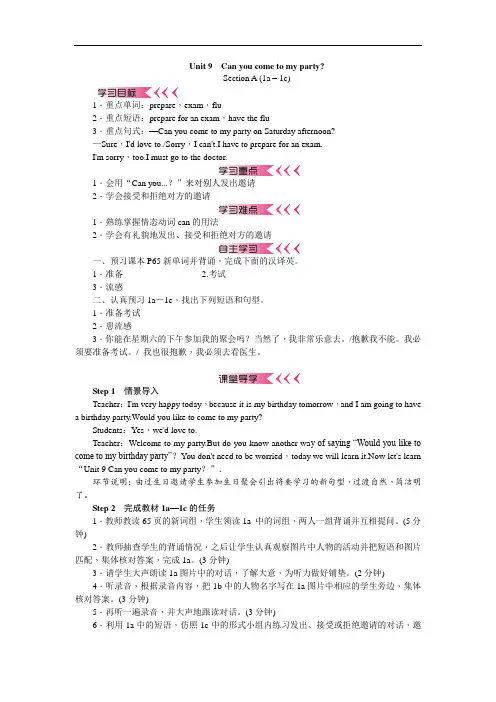
Unit 9Can you come to my party?Section A (1a-1c)1.重点单词:prepare,exam,flu2.重点短语:prepare for an exam,have the flu3.重点句式:—Can you come to my party on Saturday afternoon?—Sure,I'd love to./Sorry,I can't.I have to prepare for an exam.I'm sorry,too.I must go to the doctor.1.会用“Can you...?”来对别人发出邀请2.学会接受和拒绝对方的邀请1.熟练掌握情态动词can的用法2.学会有礼貌地发出、接受和拒绝对方的邀请一、预习课本P65新单词并背诵,完成下面的汉译英。
1.准备____________ 2.考试____________3.流感____________二、认真预习1a-1c,找出下列短语和句型。
1.准备考试____________________2.患流感____________________3.你能在星期六的下午参加我的聚会吗?当然了,我非常乐意去。
/抱歉我不能。
我必须要准备考试。
/ 我也很抱歉,我必须去看医生。
________________________________________________________________________Step 1情景导入Teacher:I'm very happy today,because it is my birthday tomorrow,and I am going to have a birthday party.Would you like to come to my party?Students:Yes,we'd love to.Teacher:Welcome to my party.But do you know another wa y of saying “Would you like to come to my birthday party”?You don't need to be worried,today we will learn it.Now let's learn “Unit 9 Can you come to my party?”.环节说明:由过生日邀请学生参加生日聚会引出将要学习的新句型,过渡自然,简洁明了。
人教新目标八年级上册英语Unit9课文翻译
⼈教新⽬标⼋年级上册英语Unit9课⽂翻译⼈教新⽬标⼋年级上册英语Unit 9 课⽂翻译Unit 9 Section A 1a 部分翻译Language Goal: Make, accept and decline invitations; Talk about obligations语⾔⽬标:发出邀请、接受邀请和拒绝邀请;谈论责任义务Jenny, can you come to my party on Saturday afternoon?珍妮,你星期六下午能来参加我的派对吗?Sure,I'd love to.当然可以,我很愿意参加。
How about you,Ted? Can you come to my party?你呢,特德?你能来我的派对吗?I'm sorry,I can't. I have to help my parents.不好意思,我不能参加了。
我得帮助⽗母做事。
1a Match the phrases with the pictures[a-e].1a把短语和图⽚[a-e]搭配。
1. prepare for an exam1.准备考试2. help my parents2.帮助⽗母做事3. go to the doctor3.去看医⽣4. meet my friend4.去见朋友5. have the flu5.得了流感Unit 9 Section A 1c部分课⽂翻译You are the students in the picture. Student A, invite three students to your party. Students B, C and D,give answers.扮演图⽚中的学⽣。
学⽣A邀请三位同学参加你的派对。
学⽣B、C 和D作出回答。
A: Can you come to my party on Saturday afternoon?A:你星期六下午能来参加我的派对吗?B:Sure,I'd love to.B:当然可以,我很愿意参加。
新目标英语八年级上册unit9
Can Linda hang out on Saturday afternoon?
No, she’s not available. She has to help her mom.
Can Nick and Peter go hiking tomorrow?
No, they are not free. They might have to visit their grandparents.
2. 当然,我乐意去。Sure. _I_’_d_ _lo_v_e_ _t_o_. 3. 对不起,我必须为数学考试而学习。
Sorry, I _m__u_s_t _s_t_u_d_y_ _f_o_r_ a math test. 4. 明天晚上你能去看电影吗?
C__a_n_ you _g_o__ to the movies __t_o_m__o_r_ro_w_ night?
Tomorrow is Children’s Day. The children are _p_r_e_pa_r_in_g__to__ __g_o__climbing. ③我们必须让所有的人为可能的洪水做好准备。 We must_p_r_e_pa_r_e_ all the people___f_o_r _ the
Hey, Nick, can you come to my house on Saturday? …
Oh, Sam! I remember we went bike riding last fall when …
Jeff: Hey, Nick, can you —co—me—to—m—y —ho—use—on Saturday? My cousin Sam—fr—om—Xi’an is —go—in—g t—o b—e —he—re —————.
人教新目标八年级上册Unit 9 Section A (1a-2c)(共16张)
_____p_a_rt_y_____. Mary and Paul would love to come. But Jeff _____c_a_n_’t_____.He has to _m_e_e_t _h_is__f_ri_e_n_ds_. May and Mei Ling _____c_a_n’_t_____, either. May___h_as__t_h_e_f_lu___ and Mei Ling must_s_t_ud_y__f_o_r _a__m_a_th. test
2a Listen and circle
1. Jeff (can / can’t ) go to the party. 2. Mary (can / can’t) go to the party. 3. May (can / can’t) go to the party. 4. Mei Ling (can / can’t) go to the party. 5. Paul (can / can’t) go to the party.
That sounds great.
A: Helen, can you come to my party on _____?
B:
I can’t.
Sorry, I’m afraid not. I have to / must … I’m not free.
I’m not available.
Pair work
Unit 9 Can you come to my party?
Section A (1a-2c)
Name: Helen Zhou Job: a teacher Age: 28 Birthday: November 28th
初中英语:新目标八年级上Unit9 Section A教学案(教案文本)
( 英语教案 )学校:_________________________年级:_________________________教师:_________________________教案设计 / 精品文档 / 文字可改初中英语:新目标八年级上Unit9 Section A教学案(教案Learning English is conducive to making friends, chatting or working together with foreigners, and learning English is very useful for traveling abroad.初中英语:新目标八年级上Unit9 SectionA教学案(教案文本)新目标八年级英语(上)unit9 when was he born?teaching goals:1. learn to use “be born” to ask sb sth2.掌握一般过去时态的以how long , when , where 等疑问词开头的特殊疑问句.3.能用有关的形容词来描述人,并能用一般过去时来谈论熟知的、敬佩的人物4. key words:achievement, record, brazilian skater, violinist, pianist, sneezing, hiccuppingstart, stop, first went, first had, learned, talented,loving, creative, outstanding, unusual recycling: japanese, ping-pong player, basketball player, tennis player, soccer player, champion, great, born, star, golfer, music, musician, sports, bicycle, movie, party, beautiful, kind, famous, who is…? when questionsperiod onestep1 warming upwrite the word born on the blackboard and tell students we are going to talk about when some students were born. let’s find out when some of you born.when is your birthday? april the first.when were you born? in 1990.then ask students to think of some famous sports stars, or athletes, and write their names under international sports stars.step2 listeningget the students listen carefully and write the date under each person was born. play the recording twice and get the students to listen and write down the answers to each picture.martin hingis: 1980michael jordan : 1963david beckham: 1975step3 pair workpoint out the conversation in the box in activity 1c. ask two students to read it to the class. ask the students work with a partner. make your own conversations about the people in the picture. then ask several pairs to say their conversations to the class.(1c) first ask a pair of students to read the example conversation ,the other students repeat. then ask the students to work in pairs.(first one person asks a question and then the other person takes a turn.)demonstrate the activity.t: who is that?s: that is deng ya ping. she is a great chinese ping-pong player.t: when was she born? s: she was born in 1973ask the students to work in pairs. then ask some pairs to act it out .step4 2a and 2b listening(2a)get the students look at the picture and teach them the words hiccup and sneeze. and point out the columns in the chart and read the column headings to the class. then explain the meaning of the words at the top of each column.let the students say some of the world’s recorded. then finish the chart on the book(2b) play the recording twice and then ask the students repeat the sentences one by one.step5. (2c) demonstrate the activity.t: how long did charles smith hiccup?s1: he hiccupped for 69 years and ? months.t: when did he start hiccuppings2: he started in -----t: when did he stop hiccupping?s3: he stopped in-----then ask the students to work in pairs.homework:1. make sentences with the words on page 532. make conversations with sentences: who is thst…? when was she born…?period twostep1.greet the class as usual and check the homework. step2 .new words learninggolf brazilian professional achievement performstep 3, students try to find out some phrases in the text.invite one student read the little passage then the others read them togetherthen finish the chart belowstep4.conversation makingstudents work in pairs to make conversation with the information on 3astep 5.3b.tell the students the three pairs are all in the big picture above. please find them in the picture. make sure the students understand the questions. then ask them to write the answers according to the picture.4a, interviewhow old were you when you started doing the things below? interview your classmates and fill in the chart.write this sample question on the blackboard:when did you learn to ride a bike? then ask two students ask and answer question.then students ask each other this questionhomework:1. make sentences with the words on 4amake two conversations after the conversation in 3a..period 3. (section b 1a—3a)step 1.teach the words:talented loving outstanding unusual creativegrandchild violinist skating skater becomestep2. ask students to name the places in the pictures , using the words giving to describe the picturearthur is a loving grandfather .he spends all his free time with his grandchildrenstep 3. make a conversation with one student. the student should tell the truth. then ask the students to makeconversations like this.step 4. 2a and 2b listening partplay the recording three times for the students finish 2a and 2b.step 5 2c.make a short conversation with one student.t: who is midori? s1:she is a famous violinist..t :when was she born? s2:she was born in 1971.then ask the students to practice in pairs and to take both roles.step 6. 3a.1. ask the students to read the passage silently and circle the description words.2. answer the questions students may have.3. play the tape for the students listen and repeat.4. students read the passage aloud.homework:1. make a sentence with each new word on page 562. recite 3a.3. write about a famous person.period 4.step1show the new words on the screenpianist hum piece accordion chopin receiveunit 9 when was he born?section a period i (1a-2c)导学学案☆导学目标: 07-12-4i.词汇和短语:be born, world record, start hiccup, stop sneezeii.重点句式:1.—when was she born? --she was born in 1973.她是何时出生的?她出生在1973年。