
陕旅版小学英语五年级下册教学计划
陕旅版小学英语五年级下册教学计划
一、教材分析
本册教材共8个单元、2个复习单元。
每个单元分“A、B、C”三个部分,共12页。
复习单元为6页。
A、B两部分主要教学单词和对话。
通过各种形式教学生字和单词,并培养学生的阅读能力;C部分作为扩展内容主要通过填色、画图、填充问卷以及手工制作等形式复习并适当扩展所学语言,通过听力活动,评价学生的学习效果。
二、学情分析
五年级的学生已学过两年多的英语,学生以有一定的基础,良好的听、说、读、写英语的习惯已基本养成。
但由于教材难度偏大,教学内容与课时不成比例,学生的学习兴趣难以保持,两极分化较严重,口语能力较差。
因此,本学期应注重转化后进生,因材施教,分层教学,保持学生的学习兴趣,注意加强口语、阅读能力的训练。
三、教学目标
1.养成良好的听英语、读英语、说英语的习惯。
2.初步养成良好的书写习惯。
3.能按三会与四会的要求掌握所学词语。
4.能四会要求掌握所学句型。
5.能运用所学的日常交际用语进行简单的日常交流,并做到大胆开口,积极参与,发音清楚,语调正确。
6.能在图片、手势、情景等非语言提示的帮助下,听懂简单的话语和录音材料。
7.能在任务型学习的过程中运用相关的语言知识和技能,完成某项任务。
8.能演唱已学的英语歌曲,能诵读已学过的英语歌谣。
四、教学重点难点
1.重点:
①四会句型、单词。
②在任务型学习的过程中运用相关的语言知识和技能,完成某项任务。
③运用所学的日常交际用语进行简单的日常交流,并做到大胆开口,积极参与,发音清楚,语调正确。
2.难点:养成良好的听英语、读英语、说英语的习惯。
五、主要措施
1.根据学生的年龄特征,充分利用直观教具和电教手段,创设良好的语言氛围,调动学生的学习积极性。
2.在教学过程中,采用情景教学法,让学生身临其境,积极主动地参与到课堂教学中去,调动学生的非智力因素,提高学生实际运用语言的能力。
3.活用教材,根据学生会的实际情况,将每单元各个板块重现组排降低难度。
六、教学进度表安排
单元课时周次
第一单元 4课时 1-2周
第二单元 4课时 3-4周
第三单元 4课时 5-6周
复习1 3课时 7周
第四单元 4课时 8-9周
第五单元 4课时 10-11周
第六单元 4课时 12-13周
第七单元 4课时
第八单元 4课时
复习2 3课时 14-15周
总复习 16-17周
共计 38课时 18周。
【60页精品】陕旅版小学英语五年级下册全册教案
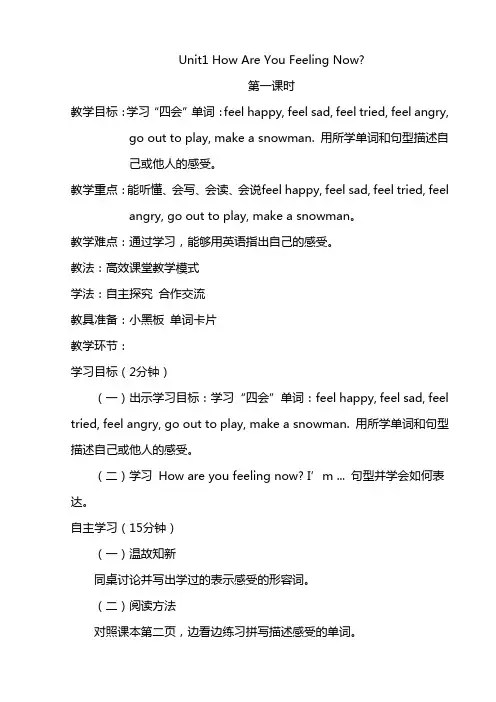
Unit1 How Are You Feeling Now?第一课时教学目标:学习“四会”单词:feel happy, feel sad, feel tried, feel angry, go out to play, make a snowman. 用所学单词和句型描述自己或他人的感受。
教学重点:能听懂、会写、会读、会说feel happy, feel sad, feel tried, feel angry, go out to play, make a snowman。
教学难点:通过学习,能够用英语指出自己的感受。
教法:高效课堂教学模式学法:自主探究合作交流教具准备:小黑板单词卡片教学环节:学习目标(2分钟)(一)出示学习目标:学习“四会”单词:feel happy, feel sad, feel tried, feel angry, go out to play, make a snowman. 用所学单词和句型描述自己或他人的感受。
(二)学习How are you feeling now? I’m ... 句型并学会如何表达。
自主学习(15分钟)(一)温故知新同桌讨论并写出学过的表示感受的形容词。
(二)阅读方法对照课本第二页,边看边练习拼写描述感受的单词。
(三)互助释疑同桌间一边做出各种表情,一边读出单词,交流不会读的单词。
(四)探究出招同桌间练习书写,可以互相检查拼写。
展示交流(10分钟)(一)小组展示小组内练习用英语描述感受(二)班级展示指名小组上讲台做游戏,用英语描述自己或者他人的感受。
点拨升华(8分钟)(一)教师放录音,学生跟读,纠正读音。
(二)学生开火车读单词。
(三)用句子How are you feeling now? I’m ... 同桌相互问答。
课堂作业(5分钟)•作业当堂清1.单词拼写feel h___ppy feel s___ d feel t_____ed feel ang___2. 英汉互译感到快乐_____________ feel sad ____________感到累______________ 感到生气_____________go out to play _______________ 堆雪人______________挑战自我How are you feeling now?I’m ...板书设计:Unit 1 How Are You Feeling Now?Happy feel sad tried, angry,go out to play, make a snowman第二课时教学目标:1、学习主系表结构的句型:主+系+表,即:人称+am/is/are+形容词2、句型学习How are you feeling now? I’m ...教学重点:熟练掌握句型,并进行简单的对话。
陕旅版五年级英语下册全册教学设计教案
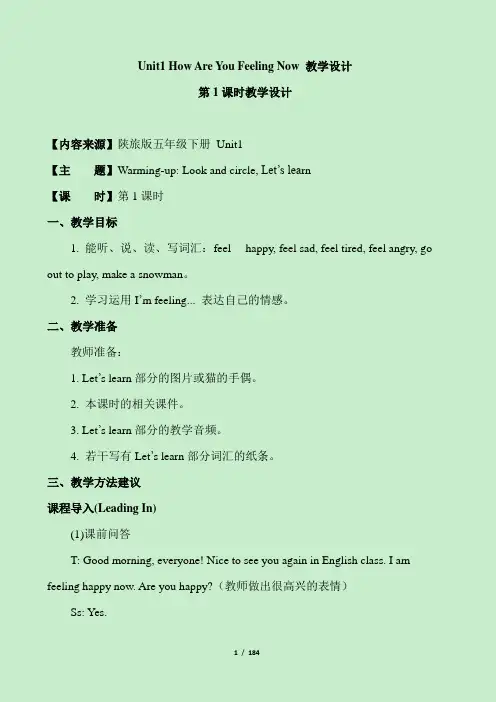
Unit1 How Are Y ou Feeling Now 教学设计第1课时教学设计【内容来源】陕旅版五年级下册Unit1【主题】Warming-up: Look and circle, Let’s lea rn【课时】第1课时一、教学目标1. 能听、说、读、写词汇:feel happy, feel sad, feel tired, feel angry, go out to play, make a snowman。
2. 学习运用I’m feeling... 表达自己的情感。
二、教学准备教师准备:1. Let’s learn部分的图片或猫的手偶。
2. 本课时的相关课件。
3. Let’s learn部分的教学音频。
4. 若干写有Let’s learn部分词汇的纸条。
三、教学方法建议课程导入(Leading In)(1)课前问答T: Good morning, everyone! Nice to see you again in English class. I am feeling happy now. Are you happy?(教师做出很高兴的表情)Ss: Yes.T: So we are feeling happy to be together again. And I hope we’ll feel happy all the time in our class.(2)新课导入Part A Warming-up: Look and circle引导学生观察本部分各图片中人物的神情,并通过图片中人物的神情推断他们的情绪:T: Now look at the girl in the pictures. How is she feeling? Which is happy? Can you circle it?之后引导学生说出各自的情感:T: What about you? How are you feeling now?通过此任务让学生提前感知本课要学习的内容,导入新课。
陕旅版五年级英语下册科务计划及进度
陕旅版五年级英语下册科务计划及进度全文共3篇示例,供读者参考篇1Five-Year English Curriculum Plan and ProgressWell, here we are in the second semester of 5th grade and it's time to really kick my English studies into high gear. Over the next few years, we've got a lot of ground to cover in mastering reading, writing, listening and speaking skills. I'm feeling motivated and ready to take on the challenge!This semester in 5th grade, the main focus is on building up our core vocabulary and getting comfortable with basic grammar and sentence structures. We're working through Unit 6 of our textbook right now, learning fun phrases about hobbies, sports, and interests. My favorites so far are "play video games" and "go camping." I can't wait until the weather gets nicer so we can have class outside sometimes.What's really helping the lessons stick is all the interactive activities, games, and music our teacher uses. English can be intimidating with so many odd spellings and pronunciations compared to Chinese. But singing silly songs about irregular verbconjugations and playing battleship with vocabulary words makes it all a lot more approachable and memorable. I'm getting much better at raising my hand to answer questions and repeating phrases out loud without feeling self-conscious.Looking ahead to the summer, we have a big project due at the end of the semester to create a short skit or presentation showcasing everything we've learned so far. I'm thinking of writing a simple play with a couple friends acting out a day at summer camp or something. It will be a good opportunity to demonstrate our reading, speaking, and listening comprehension abilities all together. I just need to make sure I keep practicing my writing skills as well so the script turns out great.Then in 6th grade, we'll transition to learning more sophisticated grammar concepts like past, present, and future verb tenses. We'll read longer passages and writemulti-paragraph essays. We're also supposed to start memorizing common idioms and slang expressions to sound more natural when speaking. It's going to be a big jump up in difficulty level for sure.Thankfully, our textbook series has a ton of visuals, puzzles, and mnemonic aids to help reinforce all the new material. Andour teacher mentioned we'll get to do more conversational practice and roleplaying activities in small groups. I'm a bit of a shy kid, so I know I'll need to push myself to speak up more and apply what we're learning in a live setting. But that's really the only way to truly improve.7th grade is when we'll start exploring non-fiction texts about science, history, and culture. We'll analyze the main ideas, make inferences, and start doing research reports. On top of that, we're expected to improve our formal writing abilities for different genres like persuasive essays and short stories. It sounds like a heavy workload, but I'm excited to finally use English for more than just simple dialogues and creative fiction.I know presentation skills will also become really important in 7th and 8th grade as we have to start getting up in front of the class frequently. I tend to get flustered when public speaking, so I've got to work on my confidence and delivery. At least we'll get to work in groups a lot, which should make it less nerve-wracking. And we'll have access to lots of multimedia tools and examples to make our presentations engaging and effective.Then finally, in 9th and 10th grade, the curriculum shifts to focus on career skills, advanced literature analysis, and overall fluency across all language domains. We'll practice interviews,debates, dramatic interpretations, you name it. At this level,we're essentially expected to reach native or near-native proficiency by the end of 10th grade. The pressure will definitely be on!There are so many possible electives and specialization tracks to explore too based on our interests and strengths. I'm intrigued by things like creative writing, journalism, linguistics, and translation studies. Who knows, I may end up discovering a passion for English that leads to a potential career path. For now though, baby steps!Looking at the big picture, this five-year journey does seem pretty daunting. Becoming truly fluent and proficient in English as a second language by 16 years old is incredibly ambitious. But our school is doing a great job of breaking it down into manageable steps and making the content as interactive and engaging as possible. As long as I stay committed, participate fully, and take advantage of all the resources available to me, I'm confident I can meet or exceed those high expectations. One semester at a time, here we go!篇2Grade 5 English Textbook Plan and ProgressHi there! My name is Emma and I'm a Grade 5 student. Today I want to share my experience and progress with the new English textbook we are using this year - the Shaanxi Travel Edition for Grade 5, Book 2.At the start of the semester, I have to admit I was a little nervous about this textbook. It has a travel theme focused on sites and scenery in Shaanxi Province. I wasn't sure how interesting that would be for learning English. However, my fears were quickly put to rest once we started the first unit.Unit 1 was called "The Terracotta Warriors" and it taught vocabulary and dialogue related to this famous archaeological site near Xi'an. Reading about how the life-sized warriors were buried with China's first emperor to protect him in the afterlife was fascinating. The unit had fun activities like mapping the location, watching videos of the excavation, and even making little terracotta warrior figures out of clay. By the end, I felt like I had learned a ton of great words and expressions I can use when traveling, like "archaeological site", "life-sized", "excavation" and more.The next unit focused on Xi'an's historic City Wall, one of the oldest and best preserved ancient military defenses in China. There were dialogues about the wall's history, structures likegates and ramparts, and even people's modern activities like cycling or walking along the walls. My favorite was learning the tongue-twister "The circular City Wall winds around ancientXi'an." I spent hours practicing that one! The unit's project was designing our own historic walled city, which helped me use vocabulary like "fortification", "perimeter" and "turret" correctly.Unit 3 took us to the fabled Huaqing Hot Springs near Xi'an. Centered around vocabulary for describing natural features and scenery, this was one of my favorite units. I loved learning about the different mineral spring pools of different colors and temperatures. The dialogues about arranging hot spring resort visits and describing the amenities were also super useful. Our task was to create a travel brochure promoting the hot springs as a vacation destination. Between the soothing scenery descriptions and interesting geological terms, that project helped me build lots of travel English skills.About halfway through the book, Unit 4 focused on the amazing Huashan Mountain, one of China's five sacred peaks. With its famous precipitous trails, steep stairs and narrow ridge paths, this definitely gave me a challenge in Englishrock-climbing and mountaineering vocabulary! Terms like "sheer cliff face", "precipice" and "summit" came up constantly. Thedialogues were all about planning mountain hikes, describing challenges on the trails, and admiring the stunning views. Our task was to film ourselves describing a difficult hike, using as much new vocabulary as possible. That helped solidify my learning in a really memorable way.The travel continued in Unit 5 with Mt. Huashan's sister peak - the misty, rainforest-covered Huangshan Mountain in nearby Anhui Province. This was such a beautiful unit full of vocabulary about lush forests, waterfalls, wildlife and more. I loved learning words like "canopy", "frondescent", "cascade" and "biosphere." The dialogues discussed things like treking through the forest, describing plants and animals, and protecting natural environments. Our project was a nature journal documenting all the flora and fauna we learned about. It really made me appreciate the diversity of amazing scenery in this part of China.Finally, Unit 6 brought us back to Xi'an for a look at its modern side as a booming technology hub. Although it had less of a travel focus, this unit introduced great vocabulary about technology, research and innovation. Terms like "entrepreneurship", "semiconductor" and "artificial intelligence" came up frequently. The dialogues were based around scenes of students touring tech campuses, interviewing employees abouttheir work, and even pitching startup ideas. It definitely opened my eyes to future English skills I may need in technology fields. For the final project, we had to create a poster displaying our dream future tech invention along with a business proposal. Certainly a challenging but rewarding way to put my English skills to use!Overall, I've been really impressed with this Shaanxi Travel Edition English textbook. Despite initially thinking the regional travel theme might be too narrow, it has actually opened my eyes to a fascinating part of China's history, scenery and culture. More importantly, I feel like I've developed a very practical and relevant set of vocabulary and communication skills for travel, outdoor activities, cultural engagement and more. Shaanxi may be just one province, but this book has prepared me with English abilities I can apply all around the world.With just a couple units left to finish the book, I already feel better equipped as an English speaker. Looking ahead to middle school, high school and beyond, I know the solid foundation I've built here will keep paying dividends. Who knows, maybe I'll even become a tour guide someday using all the awesome location words and descriptions I've learned! No matter what lies ahead, I'm grateful to this textbook for making English comealive through the incredible travel experiences in my home province. It's been an amazing journey of learning so far.篇3My Five Year English Book Term Plan and ProgressHi there! My name is Lily and I'm a 5th grader here in Shaanxi Province. This term we're using the Five Year English textbook for 5th graders, and I wanted to share my plan for getting through the book as well as track my progress. The book covers a ton of material, so having a solid plan is super important!The TextbookFirst, let me give you an overview of the textbook itself. It's a pretty big book, coming in at around 200 pages. It's divided into 8 units, with each unit covering a different theme like "My Day", "My Hobbies", "Going Shopping" and so on.Each unit has 4 smaller sections:The vocab section introduces around 20 new vocabulary words through pictures, examples and practice exercises.The dialog section has a conversation between two characters using the vocab from that unit. There are pre-readingquestions to prime us, and post-reading comprehension questions.The grammar section explicitly teaches 2-3 grammar points using the unit's vocabulary in example sentences. More practice exercises follow.The skills section has reading passages putting everything together, speaking/writing prompts, and project-based activities.There are also review units after units 4 and 8 which have cumulative tests and challenge activities. Phew! Like I said, a whole lot to cover!My PlanSo here's my basic plan for conquering this mountain of a textbook section-by-section:VocabularyPreview the vocab list and pics at the start of each unitMake digital flashcards and spend 15 mins per day reviewing themDo all the written vocab exercises in the textbookDialogsRead through the pre-reading questions to predict what the dialog will be aboutListen to the audio dialog and follow along in the bookRe-read the dialog out loud, focusing on pronunciationAnswer all comprehension questions in my notebookGrammarCarefully read the grammar explanations and example sentencesWrite down my own examples in my notebookDo all the practice exercises, checking answers with my teacher when stuckSkillsFor readings, skim the passage first, then read carefully while noting any words I don't knowFor speaking activities, practice out loud with my mom/dad and record myselfFor writing tasks, draft, revise, and make sure I'm using the unit's grammar pointsThat's the plan for each smaller section. For the units overall, I'll go through each section in order from top to bottom. I'll aim to spend roughly 2 weeks per unit so I have enough time to master everything without rushing.Once I get to the review units, I'll go back over my notebook notes from previous units, re-do exercises I got wrong, and really buckle down to prep for those big cumulative tests!My Progress So FarOkay, so that's my overall game plan for success with the textbook. But how am I actually doing so far? Let me give you a progress report!We're currently halfway through Unit 4 which is on the theme of "Free Time and Hobbies". So far I've:✅ Mastered the first 3 units on "My Day", "My Family" and "Going Shopping"✅ Earned an A on both the Unit 1 and Unit 2 tests✅ Completed all vocabulary, dialog and grammar sections for Unit 4⬜ Still need to finish the Unit 4 skills section and projectOverall, I feel pretty good about where I'm at. The material has definitely been challenging, but doing daily vocab reviews and taking detailed notes has paid off. I struggled a bit with the grammar for the past progressive tense in Unit 3, but I met with my teacher for extra help and I feel I have a solid grasp on it now.My main area for improvement is probably spoken English and pronunciation. Even though I'm practicing conversations out loud, I still stumble over some of the harder vowel sounds. But I'll just keep drilling those problem areas!With my study routine going strong, I'm confident I can maintain my A grades through these middle units. Then it'll just be a matter of buckling down extra hard for those combined review tests at the end!My main motivations for working so hard are:Gaining English fluency to explore opportunities overseas in the futureQualifying for top middle schools by keeping my overall grades highMaking my parents proud of my commitment to academicsI still have a long road ahead, but I'm determined to see this Five Year English book through to the end! Here's to a successfulsecond half of 5th grade. Thanks for reading about my humble English learning journey. Let me know if you have any other questions!。
春陕旅版小学五年级英语下册教案5篇
春陕旅版小学五年级英语下册教案5篇有人说,机灵与否,在于是否思索。
这是很关键的,我们要着重指导学生学会思索。
睡前回忆当天所学,也是一种良好的学习方法。
方法多,但要适用,易行,便于操作,还要催促学生坚持。
以下是我带来的春陕旅版小学五年级英语下册教内容,感谢您的阅读,盼望能协助到您!春陕旅版小学五年级英语下册教案1教学重点:1.词汇:season,spring,fall,summer,winter2.句型:What’s your favourite season?教学难点:1.单词发音:spring,fall2.favourite 单词的读音和拼法。
教具打算:1.教材配套课件。
2.教材相配套的教学录音带。
3.单词卡片。
4.自制课件。
教学过程:(一)热身/复习(Warm-up/Revision)活动一:说一说,做一做教学参考时间:3分钟老师播放四年级下册第四单元的歌谣,引导学生边说,边打节奏,引导学生表演出形容天气的单词cold,warm,cool,hot。
(二)呈现新课(Presentation)活动二:谈论天气教学参考时间:5分钟老师提问:What’s the weather like today? Is it cold? 学生依据实际做答:No , it’swarm.引出新词汇spring,并询问学生,哪个季节最寒冷,Which season is cold?引出词汇season,winter,询问学生,还知道哪些季节?Do you know another seasons? 引导学生说出自己知道的季节。
活动三:猜猜,读读教学参考时间:5分钟老师出示表示四个季节的图片,让孩子说说分别是哪个季节。
孩子说对后老师板书单词:spring,summer,fall,winter。
老师范读,学生跟读,学生开火车读。
活动四:说一说(Let’s learn)教学参考时间:5分钟老师再次展示表示四个季节的图片,询问学生What’s your favourite season? 学生依据实际状况答复,并进一步陈述缘由“Spring, it’s warm andsunny.”接着老师板书主句型,指导学生认读。
陕旅版五年级下册英语教案范文集锦

陕旅版五年级下册英语教案范文集锦英语教案设计是改善课堂教学的一种更高层次的探索,是提高课堂教学质量和效率的一项必要工作,它可以促进教学的系统化,使老师掌握讲课节奏。
以下是小编带来的陕旅版五年级下册英语教案内容,感谢您的阅读,希望能帮助到您!陕旅版五年级下册英语教案1Unit 1 My dayPeriod 1 Section A Let’s learn Ask and write P5教师寄语:(Always do your best.凡事都要尽力去做.)Learning aims(学习目标)1. 能听、说、读、写do morning exercises, eat breakfast, have…class, play sports, eat dinner。
2. 会说句型:“When do you do morning exercises/…?”并能回答“At…o’clock.”。
Important &difficult points(重难点)1. 掌握Let’s learn中的动词短语并能用于回答问询作息时间。
2. 掌握单词exercises的正确发音。
导学探究Step1 : 预习温故(用时5分钟)1)T: Hello , boys and girls! Welcome back to school!Ss: Hello, Miss.... Nice to see you again. T: Nice to see you ,too.2)T: What time is it? (可以课前在黑板上画一个钟面,张开手臂演示一个时间)Ss:It’s 9/10/11 o’clock.(注意给学生强调整点时间后面要用o’clock)反复操练。
3)Go over these phrases : wash my clothes, watch TV, do homework, read books, play football.Let’s do homework/read books/play football/… .I often wash my clothes/watch TV/do homework/ readbooks/… .Step 2. 新课内容展示(用时20分钟)。
陕西旅游出版社五年级下册英语教案5篇2022

陕西旅游出版社五年级下册英语教案5篇2022一份优秀的英语教学计划是根据一定的教育目的和培养目标制定的教学和教育工作的指导文件,决定了教学内容总的方向和总的结构。
教师培养学生对英语感兴趣,一定要做好前期准备工作。
以下是小编带来的陕西旅游出版社五年级下册英语教案内容,感谢您的阅读,希望能帮助到您!陕西旅游出版社五年级下册英语教案1一、班级情况分析五年级(5)、(7)班有学生94人,学生学习态度比较端正,平时上课积极开动脑筋、作业认真完成,基础知识比较扎实,能按时完成背诵、默写任务,能跟着老师的节奏进行复习。
但有少部分同学,比较懒惰,作业不做,不花时间背诵,朗读,单词默不出,句子不会写。
对于他们只能是从最基本的单词,句子着手。
二、复习目标通过系统地复习,让学生能扎实地掌握本学期的所学的单词、句型,能灵活地运用所学知识。
通过总复习,让全体学生特别是中下生能扎实地掌握本学期的知识点,全面提高班级的合格率和优秀率。
三、复习内容1、单词,词组的复习 A按词性归类复习单词B按所含元音及字母组合归类复习单词。
C 按词汇表复习单词。
2、句子的复习句子是英语学习的重点,通过各种方法帮助学生梳理学过的句子。
(1)指导学生在语境中复习句子,让学生分清日常交际用语的运用场合。
(2)根据句子类型指导学生在比较中复习句子。
(3)指导学生在表演中运用句子,使复习课同样生动有趣。
3、课文的复习(1)学生能够正确拼写Let’s learn课后单词。
(2)学生能够正确、流利地认读Let’s talk课文。
1 (3)Read and Write中的重点句学生能够达到四会 (即听、说、读、写)。
4、音标的复习。
学生能够认读所学字母组合及辅音字母在单词中的发音,并掌握其规律。
例如: ea,ee,bl,br,ow,ou,cl,or……5、指导学生阅读短文,并培养其阅读技巧和方法。
6、专项训练词组归类练习,连词成句归类练习,相应形式归类练习,选择归类练习(争对各单元的难点),交际用语配对归类联系,阅读短文强化训练,看图完成对话练习等,语音练习分解在各归类练习中,语音是难点,通过每天的训练让学生学会拆分的方法。
新陕旅版小学五年级下册英语全册教案课程
Unit1 How Are You Feeling Now?第一课时教学目标:学习“四会”单词:feel happy, feel sad, feel tried, feel angry, go out to play, make a snowman. 用所学单词和句型描述自己或他人的感受。
教学重点:能听懂、会写、会读、会说feel happy, feel sad, feel tried, feel angry, go out to play, make a snowman。
教学难点:通过学习,能够用英语指出自己的感受。
教法:高效课堂教学模式学法:自主探究合作交流教具准备:小黑板单词卡片教学环节:学习目标(2分钟)(一)出示学习目标:学习“四会”单词:feel happy, feel sad, feel tried, feel angry, go out to play, make a snowman. 用所学单词和句型描述自己或他人的感受。
(二)学习 How are you feeling now? I’m ... 句型并学会如何表达。
自主学习(15分钟)(一)温故知新同桌讨论并写出学过的表示感受的形容词。
(二)阅读方法对照课本第二页,边看边练习拼写描述感受的单词。
(三)互助释疑同桌间一边做出各种表情,一边读出单词,交流不会读的单词。
(四)探究出招同桌间练习书写,可以互相检查拼写。
展示交流(10分钟)(一)小组展示小组内练习用英语描述感受(二)班级展示指名小组上讲台做游戏,用英语描述自己或者他人的感受。
点拨升华(8分钟)(一)教师放录音,学生跟读,纠正读音。
(二)学生开火车读单词。
(三)用句子How are you feeling now? I’m ... 同桌相互问答。
课堂作业(5分钟)作业当堂清1.单词拼写feel h___ppy feel s___ d feel t_____ed feel ang___ 2. 英汉互译感到快乐 _____________ feel sad ____________感到累 ______________ 感到生气_____________go out to play _______________ 堆雪人 ______________挑战自我扮演表情完成对话How are you feeling now?I’m ...板书设计:Unit 1 How Are You Feeling Now?happyfeel sadtried,angry,go out to play, make a snowman第二课时教学目标:1、学习主系表结构的句型:主+系+表,即:人称+am/is/are+形容词2、句型学习 How are you feeling now? I’m ...教学重点:熟练掌握句型,并进行简单的对话。
陕旅版小学五年级英语教学设计(精选6篇)
陕旅版小学五年级英语教学设计(精选6篇)小学五年级英语教学设计1 本节课是单词教学。
它是在学生初步学习了A部分的单词和句型“There is…之后进行教学的。
通过学习新词,感知句子There are…本课时容量大,但难度不大,并受到学生的喜爱、学情分析学生基础差底子薄教学目标1、能够听、说、读、写单词bridge, house, road,building, tree、2、能够听、说、认读单词city, village3、能够运用句型There are / is … in the city / village、描述城市、乡村的景物。
教学重点和难点教学重点1、掌握Let’s learn中的七个有关自然景物的单词bridge, house, road, building, tree, village,city ,其中前五个单词要求听、说、读、写四方面掌握。
2、在情景中理解单词的同时掌握句型There is / are…,能恰当地用此句型简单描述城市和村庄的景物There are … in the city / village、,结合句型教师引导学生代换单词,描述周围事物,如:教室、校园等,从而进一步运用句型。
教学难点1、如何利用所提供的情景以旧引新,让学生进入运用语言的状态。
2、名词复数的运用和读音,要求老师在正确示范的基础上带领学生。
小学五年级英语教学设计2 教学内容:PartA Let s learn教学目标:1、能够听说读写单词first (1st), second (2nd),third (3rd), fourth(4th), fifth(5th)2、能够运用所学单词和句型When is?Its on询问某个节日或活动的日期。
3、能够完成Ask and answer部分活动并创编新对话。
4、能在老师的引导下正确运用in和on、重点:能够听说读写单词: first(1st), second (2nd), third (3rd), fourth(4th), fifth(5th)难点:能够运用所学单词和句型: When is ? Its on 询问某个节日或活动的日期教学过程一、Warm—up1、播放Let’s sing:When is your birthday?2、Free talk3、 Play a game4、揭题激趣引入,活跃气氛,调动孩子的积极性与参与意识。
五年级英语下册陕西旅游版教学计划
五年级英语下册教学工作计划
一、学生知识能力习惯态度分析
五年级的学生学习了两年多的英语,对英语有着较浓厚的学习兴趣,但也有少数学生由于遇到困难,学习兴趣会随之减弱。
教材难度也偏大,背诵单词部分比较枯燥,学生的学习兴趣难以保持,两极分化较严重。
因此,本学期应注重转化后进生,因材施教,分层教学,保持学生的学习兴趣。
二、教材分析
1、活动设计形式多样、活泼有趣,体现了双向性、互动性与合作性。
2、采用循环式的编排方法,较好地体现了“由浅入深、由易到难、循序渐进、逐步扩展、点面结合、不断复现”的原则。
3、在安排词语和语法项目时采用了“早渗透”和“重积累”的方法。
三、教学目的任务
1、能按四会、三会的要求掌握所学单词。
2、能按四会要求掌握所学句型。
3、能使用日常交际用语,活用四会句型,进行简单的交流,做到大胆开口,发音正确。
4、能在图片、手势、情境等非语言提示的帮助下,听懂清晰的话语和录音。
5、初步培养良好的书写习惯,能做到书写整洁、规范。
6、养成响亮清晰读英语、说英语的习惯,认真模仿语音、语调,以培养语感。
7、能在完成某个任务(如涂色,小制作)的过程中学相关的词句,并且培养动手能力。
8、能演唱已学过的英语歌曲,诵读已学过的歌谣。
陕旅英语五下单元教学计划
陕旅英语五下单元教学计划In the upcoming semester, our focus will be on enhancing students' English proficiency through a variety of engaging activities. We will explore the theme of travel,incorporating vocabulary, grammar, and cultural insights.Starting with the basics, each week will begin with a review of essential grammar rules and vocabulary related to travel. Interactive quizzes will be used to reinforce learning and ensure comprehension.The second part of our lessons will delve into reading comprehension, with short stories and articles aboutdifferent travel destinations. Students will develop their analytical skills by discussing the content and answering comprehension questions.Listening exercises will be integrated to improve students' ability to understand spoken English. We willlisten to travel podcasts and have discussions about the information presented.To encourage practical application, role-plays will be a regular feature of our classes. Students will simulate travel scenarios, such as booking a hotel or ordering food in a restaurant, to practice their conversational skills.Cultural appreciation will be a key component of ourcurriculum. We will learn about the customs and traditions of various countries, fostering a deeper understanding and respect for global diversity.In addition to classroom activities, homework assignments will be designed to encourage independent learning. Students will be tasked with researching a travel destination and presenting their findings to the class.Assessments will be conducted regularly to track progress and identify areas for improvement. Feedback will be provided to support students in their learning journey.Finally, we will conclude the unit with a creativeproject where students can showcase their knowledge and skills. This could be a travel blog, a brochure, or a presentation about their dream vacation.By the end of this unit, students will not only have improved their English language skills but will also have gained a broader perspective on the world through the lens of travel.。