
五年级英语上册(PEP):Unit4 What can you do C
人教PEP版英语五年级上册Unit 4《What can you do》教案

人教PEP版英语五年级上册Unit 4《What can you do》教案一. 教材分析《人教PEP版英语五年级上册Unit 4 What can you do》主要让学生掌握日常生活中的动词短语,如can you swim, can you ride a bike等,并能够在实际情境中进行运用。
通过本节课的学习,学生将进一步提升英语口语表达能力,同时增强团队协作意识。
二. 学情分析五年级的学生已经掌握了基本的英语语法和一定数量的词汇,具备了一定的听说读写能力。
但学生在实际运用英语进行交流时,仍存在一定的困难。
此外,部分学生对动词短语的掌握不够熟练,需要在课堂上进行针对性的训练。
三. 教学目标1.知识目标:学生能够掌握日常生活中常用的动词短语,如can youswim, can you ride a bike等。
2.能力目标:学生能够在实际情境中运用所学动词短语进行交流。
3.情感目标:学生能够积极参与课堂活动,提升团队协作意识。
四. 教学重难点1.重点:让学生掌握日常生活中常用的动词短语。
2.难点:学生在实际情境中运用所学动词短语进行交流。
五. 教学方法1.任务型教学法:通过设定各种实际情境,让学生在完成任务的过程中运用所学知识。
2.游戏教学法:通过趣味性强的游戏,激发学生的学习兴趣,提高课堂参与度。
3.合作学习法:引导学生分组进行讨论和表演,提升团队协作能力。
六. 教学准备1.教具:卡片、图片、视频等。
2.教学场地:教室。
3.教学资源:多媒体设备。
七. 教学过程1.导入(5分钟)教师通过播放一段关于人们展示各种才艺的视频,引导学生关注本节课的主题——What can you do。
2.呈现(10分钟)教师展示一组图片,包括游泳、骑自行车、跳舞等动作,引导学生用英语描述这些动作。
同时,教师教授本节课的重点词汇和短语,如can you swim, can you ride a bike等。
3.操练(10分钟)教师学生进行小组活动,让学生用英语互相询问并回答“What can you do?”的问题。
人教(PEP)2011版五年级上册小学英语《Unit 4 What can you do C》优秀教案_27

PEP小学英语五年级上册Part C story time教学设计教学内容:本课教学内容是PEP小学英语五年级上册Unit 4 What can you do? C Story time部分,教学故事Rat and Snake。
本部分表现的是田鼠如何机智地被蛇吃掉的厄运,在紧张的故事情节发展中复习巩固本单元核心词汇与句型。
What can you do? I can... Can you...? Yes, I can / No, I can't. 以及多个动词及动词词组。
教师协助学生通过图片和上下文理解句子的意思,如:Don’t throw me into the lake, please! Silly snake! 这个故事教学的目的是让学生在阅读中进一步复习和巩固本单元的知识,并得以有效拓展。
教学目标:1、知识目标:(1)词汇: rat, snake, tasty, lake, silly, away;(2)句型:基础句型What can you do? I can... Can you...? Yes, I can. / No, I can't. 拓展句型I can ... for you. There's a... Don't...2、水平目标:(1)能够理解并朗读故事;(2)能在教师的协助下表演故事。
3、情感与态度:(1)使用本单元所学核心语言讲述趣味故事,引起学生学习英语的兴趣,扩大学生阅读量。
(2)让学生了解动物与人类应是和谐、共处的关系。
教学重点:使学生在相对真实、完整的语境中接触、体验、理解语言;教学难点:能够在图片和情景的协助下,引导学生去讲故事;引导学生观察故事中主人翁和所处的环境。
教学准备:多媒体课件,PPT, flash动画。
教学过程:Step Ⅰ Warm-up1. Free talk.(略)2. Let's chant.Dog, dog, what can you do?I can run after you.Panda, panda, what can you do?I can eat so much bamboo.Mouse, mouse, what can you do?I can hide in the shoe.Mike, Mike, what can you do?I can draw animals in the zoo!【设计意图:课前的free talk环节为学生搭设了自我展示的舞台,并有效操练、巩固了旧知(句型What can you do? I can...);Let's chant既活跃了气氛又揭示了本课主题,为接下来的故事教学作好了铺垫。
人教版(PEP)五年级上册Unit4Whatcanyoudo?PALet’sspell课件

Let’s watch
爱
Lovely fruit
This is a place where you can write big headlines
Practice
Listen, circle and say
Listen and circle the words.
1 book 4 good
发音要领
/ʊ/是短元音,发音时声带振动。舌
后缩,舌后部向软腭抬起,但比发
/ʊ/ /u:/音时略低些。双唇收圆并放松些,
oo
稍向前突出。
/u:/是长元音,发音时声带振动。舌
/u:/ 后缩,舌后部向软腭高高抬起。双唇
呈小圆口形,并向前突出。
例词
good look
food zoo
Presentation
Unit 4 What can you do?
Part A Let’s spell
人教PEP版英语五年级上册
Warm up
Let’s watch
Lead-in
What can you do?
I can play football.
Lead-in
What can you do?
I can cook food.
Presentation
I’d like some noodles.
What would you like to eat?
noodles
PresenБайду номын сангаасation
Can you read more?
oo /uː/
cool too
school afternoon
Presentation
字母 发音
(PEP)五年级上册小学英语《Unit 4 What can you do C》优秀教案_14

Unit4 What can you do? C Story time
年级学科
五年级上英语
课型
小学英语教材故事课阅读与自然拼读
教学目标
通过阅读趣味故事,复习巩固五年级上册单元四的单元核心语言,增加语言的输入。
借助自然拼读,能够认读故事中的单词。
通过故事学习,了解故事背景以及故事大概且能流利有感情地朗读故事。
T:Yes , and in summer we can see many beautiful flowers.
教师用自然拼读教授summer.
2、阅读中。
1) T:Look at picture 1,what can you see?
S1:I can see some beautiful flowers.(板书some flowers)
能够提问学生“What can you do? Can you sing/dance/swim…?”“I can’t swim. Swim is dangerous for me.”“What can you see?”来给阅读做铺垫。
通过对对话的模仿,更深刻地感受蛇和老鼠的境况,了解故事内容。
多次模仿后,展示对话。
A mouse.→ rat wait ← rainy singthing
↓→I can swim away! Silly.
S2:I can see some water.(学生在这里用了池塘一词)
S3:I can see a snake .(自然拼读,学习snake)
S4:I can see a mouse.(教师这里板书rat)
2)
使用教师光盘,学习图1.自然拼读tasty。
板书并自然拼读come。
人教(PEP)2011版五年级上册小学英语《Unit 4 What can you do C》优秀教案_99

Unit 4 What can you do?Teaching planI Teaching contentsPhrases:sing songs play sports do kung fu draw cartoons use computer cook go skiing make a snowman do houseworkeat ice cream go surfing swimSentences:What can you do? I can ….. Can you …? Yes, I can. No, I can’t.II Teaching aimsEnable students to understand the meaning and grasp the pronunciation of the phrases and the sentences.Lead students to use the phrases and sentences in the right situation.Guide students to love himself, try his best to be a better man.III Teaching key pointsThe phrases and the sentencesIV Teaching difficult pointsHow to guide the students speak more about what can he do in different situation.V Teaching aidsVI. Teaching steps.Step 1 warming up1.Listen and try to Sing the song From Head to Toe(…I am penguin and I can turn my head. Can you do it? Yes, I can do it….)2.Follow teachers and do the action.turn my head bend my neck wiggle my hips clap my handsraise my shoulders3.Play the game Simon SaysT:Simon says I can turn my head. Ss:I can turn my head.T:I can turn my head. (Still there and keep silent. )Step2 PresentationT:Yes, you can do it! In our daily life people can do lots of things. What else can you do?1.What can you do at school?2.What can you do at home?3.What can you do on your winter holiday?4.What can you do on your summer holiday?Activities:1. Show the ppt and let the students try to say the activities. then follow the teacher.2. Use phonics to lead the students to say the difficult words.3. Let the Ss find out the right phrases cards and put up the relative pictures in the right place.Step 3 Practice and consolidationT:Yes, we can do many things but different people can do different things. Now I want to learn more about you. Please finish this survey. Talk with your desk mate first. Then write down the answers. If it is Yes, please say and write down Yes, I can. If it is not, please say No, I can’t.survey1.Can you play the pipa?2.Can you sing English songs?3.Can you play football?4.Can you cook for your mom?5.Can you ride a bike?6.Can you draw cartoons?7.Can you wash the clothes?8.Can you make a birthday card for your mom or dad?Activities:1. Talk with your desk mate.2. Write down the answers.3. Ask and answer.(Teacher should encourage the students and give them exact suggestions.)Step 4 expansion1.T:Now, I know more about you. But today I hope you can learnmore from a disabled person that is Nick Vujicic. First please look at the picture.T:Can you guess what he can’t do?Ss:He can’t …T:Now let’s watch more pictures about him. Can you tell me what he can do?Ss:He has no hands, arms, legs and feet but he can ____________. T:Are you surprised? How about you? You have hands, arms, legs and feet, but sometimes you can’t do the things you can do.Ss:I have …but I can’t …T:I think this man believes himself and loves himself. He tries his best to be a better man. So I hope you can believe yourself and love yourself. You can try your best to be a better man. So now please tell yourself that .T:I love me. I am the best. I can do anything.Ss:I love me. I am the best. I can do anything.2.I can also love yourself like this little pig. So today I still want toshow a picture book for you. That is I Like Me. First please watch the picture book. Then watch the picture book again and answer the following questions.(1)W atch the picture book.(2)H ow do you think about this pig?(3)What ‘s she like? Is she…?(4)What can she do? Can he..?3.(1)T:When she is sad, she can cheer herself up.So I hope when you are sad, you can cheer yourself up.Please follow me:When I am sad, I can cheer myself up.Ss:When…(2)When she falls down, she can pick herself up.So I hope when you fall down, you can pick yourself up.Please follow me:When I fall down, I can pick myself up.(3) When she makes mistakes, she can try and try again.So I hope when you make mistakes, you can try and try again.Please follow me.When I make mistakes, I can try and try again.Step 5 summaryThat’s all for today. In one word , you can do many things. Try your best to be a better man. Thank you for your listening and attention. You are good students. See you!反思本节课内容选自人教版PEP课本ABLet’s learn. 因为课本内容相对简单,所以我对本节课实行了课程整合。
Unit4Whatcanyoudo?(讲义)人教PEP版英语五年级上册
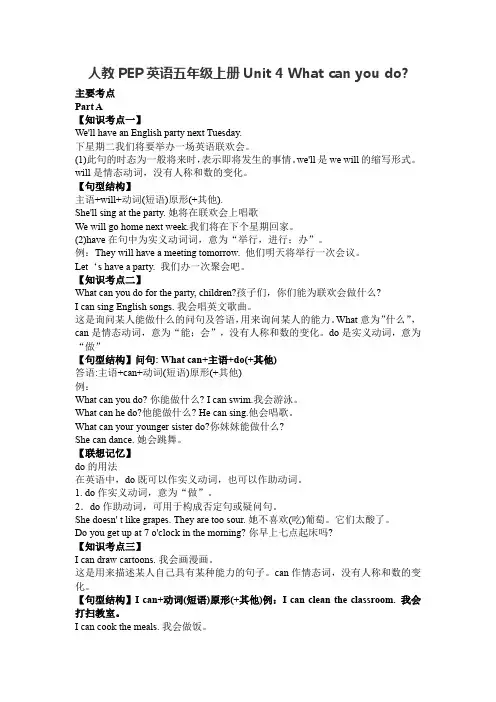
人教PEP英语五年级上册Unit 4 What can you do?主要考点Part A【知识考点一】We'll have an English party next Tuesday.下星期二我们将要举办一场英语联欢会。
(1)此句的时态为一般将来时,表示即将发生的事情。
we'll是we will的缩写形式。
will是情态动词,没有人称和数的变化。
【句型结构】主语+will+动词(短语)原形(+其他).She'll sing at the party.她将在联欢会上唱歌We will go home next week.我们将在下个星期回家。
(2)have在句中为实义动词词,意为“举行,进行;办”。
例:They will have a meeting tomorrow. 他们明天将举行一次会议。
Let‘s have a party. 我们办一次聚会吧。
【知识考点二】What can you do for the party, children?孩子们,你们能为联欢会做什么?I can sing English songs.我会唱英文歌曲。
这是询问某人能做什么的问句及答语,用来询问某人的能力。
What意为”什么”,can是情态动词,意为“能;会”,没有人称和数的变化。
do是实义动词,意为“做”【句型结构】问句: What can+主语+do(+其他)答语:主语+can+动词(短语)原形(+其他)例:What can you do?你能做什么?I can swim.我会游泳。
What can he do?他能做什么? He can sing.他会唱歌。
What can your younger sister do?你妹妹能做什么?She can dance.她会跳舞。
【联想记忆】do的用法在英语中,do既可以作实义动词,也可以作助动词。
1. do作实义动词,意为“做”。
2.do作助动词,可用于构成否定句或疑问句。
Unit 4 What can you do?Part C 教学设计-英语五年级上册-人教PEP版
人教PEP版小学英语五年级上册Unit 4 What can you do?Part C story time 教学设计教材分析:本课教学内容是《义务教育教科书英语(PEP)》(三年级起点)(2013年教育部审定)五年级上册Unit 4 What can you do?Part C story time教学故事A rat and a snake 。
这一部分主要讲述聪明的田鼠机智地摆脱被蛇吃掉的故事。
教材通过紧张的故事情节复习和巩固本单元的核心词汇与句型。
What can you do? I can … Can you …?Yes,I can .No, I can’t .这一故事教学的目的是让学生通过故事阅读进一步复习和巩固本单元的知识,使学生在情境中灵活应用,并得到有效的拓展。
如I can ...for you .Don’t throw ... There is a ... 等。
学情分析:小学五年级的学生正处于活泼好动、好表现、喜欢直观形象思维的阶段。
本班学生也具有这样的的特点,因此,采用唱歌、竞赛、表演等方式培养他们的语言口语表达能力、思维能力。
但到了五年级英语的学习能力、学习态度、兴趣等方面出现了差异,部分学生参与活动不积极、也出现自卑心理。
由于知识内容难度不断增加,学生缺少有效的学习方法和自学能力,心理压力大,导致学习有所困难。
面对如上的学生情况在课堂教学设计中要求活动有层次,让更多的学生参与进来,活动也要多样化,不拘泥于一种形式,才能调动学生的积极性。
利用生生合作形式,起到互补互助的合作意识。
创建和谐的师生关系,和谐的课堂,公平的评价,让学生们挖掘自身潜能,调整心态,端正学习态度,学有所得。
教学目标:1、能在图片和教师的引导下理解故事大意,在语境中理解rat ,snake,tasty,lake,silly,swim...away等词义.2、能熟练掌握基础句型What can ... do? 以及答语Can you/he/she ...?Yes,...can./No ,... can’t .理解拓展句型:I can ...for you.There is a ...Don’t ...3、能在图片提示下表演故事。
Unit4Whatcanyoudo?知识梳理与单元知识归纳总结(讲义)人教PEP版英语五年级上册
[文档标题]四年级秋季班✓任务单每天读一遍!✓SPEAK LOUD!宝贝儿们,要大声读哦!➢家长+老师+学校共助孩子美好未来!➢让我们的孩子快乐学习,健康成长!人教版Unit4 What can you do?1.swim 游泳【动词ing形式】swimming 【短语】go swimming 去游泳【例句】I often swim in summer .我经常在夏天游泳。
2.speak English 说英语【联想】speak Chinese 说汉语【例句】We sometimes speak English after class .我们有时在课后说英语。
3.play basketball 打篮球【联想】play football 踢足球【例句】We can play basketball . 我们会打篮球。
4.pingpong 乒乓球【短语】play pingpong打乒乓球【例句】She is a good pingpong player .她是一名优秀的乒乓球运动员。
5.sing (动词)唱,唱歌song (名词)歌曲【短语】sing English songs唱英文歌曲【例句】I can sing English songs. 我会唱英文歌。
6. kung fu 功夫,武术【短语】do kung fu练武术【例句】He can do some kung fu. 他会练武术。
7.draw 画【短语】draw cartoons 画漫画draw pictures 画画【例句】She can draw cartoons. 她会画漫画。
8. many许多【例句】There are many students in the classroom.在教室里有许多学生。
9.problem 问题【短语】no problem没问题10.wonderful 极好的,了不起的【短语】a wonderful time 一段美好的时光11. send 邮寄,发送.email电子邮件【短语】send an email 发邮件12.next 下一个的,紧接着的【短语】next weekend 下周末【例句】We will have an English party next weekend.下周末我们将举行一个英语派对。
(PEP)五年级上册小学英语《Unit 4 What can you do C》优秀教案_25
Don’t throw me into the lake, please!特别是throw的发音
Step3:While-reading
1.Read the pictures and answer the questions
Q1.Can the rat sing? Q2.Can the rat dance?
It is a kind of animal.It has a red tongue.It can walk.But it has no legs.It can make sound Sss...
2. Let’s listen
I’m hungry . Mmm...Here comes some tasty food. Now I can eat.
3.Let’s learn
Don’t throw me into the lake, please!
1.教师设计一个Guessing game,利用短语提示故事主角特征,积极启发学生思维,最终截取短语的字母表现故事的主角snake。
2.教师利用音频带领学生完成Listen and fill in引出蛇和老鼠的角色设定是a hungry snake and a tasty rat,在吸引了学生注意力和兴趣的同时,也推动了故事情节的继续发展。
a.Play a game:“Pat the rat”
b.Talk in pairs
—What can you do?
—I can...
—Can you...?
—Yes, I can. / No, I can't.
1.热身环节:
轻松活泼的歌曲导入复习Can you...的句型很快吸引住学生的注意力,让学生自然地进入学习英语的情景,同时渲染了学生学习英语的良好气氛。
人教(PEP)2011版五年级上册小学英语《Unit 4 What can you do C》教学设计_38
What Can You Do?教学案例及评析一、教学背景教学年级:教材分析:本课是人教版小学英语五年级(上)第四单元Unit 4 What Can You Do? C Story Time的第六课时。
以故事形式表现,通过讲述田鼠不小心碰到了想吃掉它的蛇,聪明的田鼠积极地开动脑筋,骗过了蛇,从蛇口逃生的一次经历,从而使学生理解故事,能够询问他人能做的事情以及对此实行回答等。
本节课通过使用所学语言联系生活实际,增强生活感受,丰富生活经验,在遇到困难时要多想办法去应对,形成积极乐观向上的生活态度。
本课语言水平培养主要包括表达对询问对方所能做的事情以及回答的表述:如What can you do? I can …. Can you...? Yes, I can. No, I can’t.本部分扩展了相关词汇和句型:Here comes some tasty food.及throw into的含义。
PEP教材为我们表现了一个个生动的故事,所以本节课在设计和实施时我按故事的发展将其分为三个部分,第一部分引导学生观看图片,使用学生已有经验,在对故事实行整体视听、分情节听的过程中结合文字、图片和声音去感受、理解和学习语言,第二部分,学生在理解学习语言之后安排了练习环节,让学生通过听音跟读,为故事配音以及表演故事来巩固学习。
第三部分是学生通过已了解故事,从而体会到当生活中遇到困难时,应积极乐观面对。
教学的重难点是通过听、理解故事,巩固核心语言,发展说的水平。
学情分析:学生在五年级时已经积累了一定的语言词汇及句型,以用英语实行简单的交际,初步建立了语用自信。
本阶段的学生,学习语言的兴趣浓厚,活泼、热爱表达,教师应尽可能为学生创设轻松的氛围,引导并鼓励学生大胆模仿、积极尝试。
学生语言基础还是相对薄弱。
教学中应多注重学生情绪,多给予学困生协助及机会,设定分层次教学目标,激发学生的参与热情及表达欲,通过理解故事,模仿故事中的语言,达成促动学生思维发展及提升综合表达水平的目标。