
新版-人教版七年级英语下册第六单元教案
Unit 6 I’m watching TV.【重点单词】___________ n. 报纸___________ v. 使用,运用____________ v. 洗___________adv. 只是,恰好___________n. 房子___________v. 喝,n.饮料___________n. 茶___________ v. 购物,n. 商店___________v.&n. 学习,研究___________ adj. 年轻的___________det. 任何的___________ adj. 另外的___________ 儿童(复数)___________ v. 怀念,思念___________ v. 希望【重点短语】看电视__________ 打电话__________ 刷盘子__________ 做晚饭__________ 打扫房子__________ 去看电影__________ 我家的全家福__________ 学习备考__________ 谈话节目__________【重点句型】1.“你正在干什么?”“我正在看电视。
”-_____ _____ you _____? -I’m _____ _____.2.“他们正在使用电脑吗?”“是的。
”-_____ they _____ the computer? -Yes,_____ _____.【重点语法】:现在进行时Ⅰ现在进行时的用法 1.表示现在(说话瞬间)正在进行或发生的动作He is reading a book2.表示当前一段时间内一直进行的动作或现阶段正在进行的动作They are working on the farm these days3.将要发生的动作They are flying to shanghai tomorrow.Ⅱ现在进行时时间状语及标志性词now 现在look 看(后面有明显的“!”)listen 听(后面有明显的“!”)Ⅲ现在分词的构成①一般在动词结尾处加ing Eg: go—going look--looking②以不发音字母e结尾的动词,去e加ing。
Eg: write—writing close--closing③以重读闭音节结尾的动词,如果末尾只有一个辅音字母,应先双写这个字母,再加ing.Eg: get—getting run—running ( swim, run, put,get,sit,begin)4.以ie结尾的动词,变ie为y,再加ing. (lie—lying, tie---tying)Ⅳ现在进行时的构成肯定句: 主语+ am/is/are+ doing +其他+时状. Eg: He is doing his homework now.否定句:主语+am/is/are +not+ doing+其他+时状. Eg: He is not doing his homework now.一般疑问句:Am/Is/Are +主语+ doing+其他+时状?Eg: Is he doing his homework now?肯定回答:Yes,主语+am/is/are Eg Yes, he is.否定回答:No, 主语+am not/isn’t/aren’t Eg: No, he isn’t.【课文重难点】1.clean作动词,意为“打扫,清除”。
作形容词,意为“干净的,清洁的”,其反义词为dirty。
e1.动词,意为“使用;运用”。
use sth. to do sth.意为“使用某物做某事”。
2.介词with与in也有“用”的意思,三者之间的区别如下:3.wash1.及物动词,意为“洗,洗涤”,后跟宾语。
wash an apple 洗一个苹果2.不及物动词,意为“洗衣,洗澡,洗手”。
wash before a meal 饭前洗手wash in cold water 洗冷水澡3.名词,意为“洗,洗澡”。
Please give the car a wash. 请把车洗一下。
4.watch1.look通常为不及物动词,强调“看”的动作,指“认真看”,在强调看某物/某人时,其后必须接介词at,才能带宾语,即look at。
Look at the map. 看地图。
2.see是及物动词,侧重于看的结果,意为“看见,看到”。
see无进行时态。
Can you see the dog over there? 你看见那儿的那只狗了吗?3.watch作动词,意为“观看,注视”,多指观看运动着的事物,如电视、比赛、表演等,指怀着一种对某物欣赏的心情或一种学习的心情,注视着别人的行为或动作。
They are watching the stars. 他们正在看星星。
4.read主要强调“读,阅读”,在汉语中常翻译成“看”,多指看书、报纸、杂志等。
read a letter 看信read the newspaper 看报纸read aloud 大声朗读5.“主系表”结构【教材原文】That sounds good. 那听起来很好。
本句是主系表结构的句子,sound为连系动词,意为“听起来”,其后常接形容词作表语。
句型“That sounds+形容词”的意思是“那听起来...”。
这一句型常用于口语中,用于对别人的提议、建议表示自己的看法。
【拓展】1.有类似用法的感官动词还有taste(尝起来),smell(闻起来),feel(摸起来),look(看起来)等。
The food tastes delicious. The meat smells bad. This cloth feels soft. You look well today.2.sound还可用作名词,意为“声音”,指各种各样的声音,泛指一切声音。
I heard a strange sound in the house. 我听见屋里有一种奇怪的声音。
6.justjust作副词,意为“只是,仅仅”,它还可意为“恰好,正好”。
He is just a child. 他只是个孩子。
That’s just what I want. 那正是我想要的。
7.时间介词at,in,on1.at表示在某一时刻或某一时间点。
Let’s meet at six. 咱们六点见。
另外,at表示时间的短语还有:at noon(在中午),at midnight(在午夜),at the age of...(在...岁),at night(在晚上)。
2.in用在某一段较长的时间之前,意为“在...之内”。
在一日中的早上、下午、晚上用in;另外,在季节、月份、年、世纪前用in。
She was born in 2003. 她出生于2003年。
3.on表示在特定的某一天,具体到某一天的上午、下午或晚上也用on。
on July 2nd 在7月2日on the morning of last Sunday 上周日早晨I will give her a present on her birthday. 在她生日那天我将给她一份礼物。
【注意】表示时间的单词(词组)前有next,last,this,that,every等修饰语时,其前常不用介词。
比较:on Sunday evening 在星期天晚上last Sunday evening 上个星期天晚上8.house,family,home1.house意为“家;房子;住宅”。
多指居住的房屋或建筑。
Jim lives in a big house. 吉姆住在一幢大房子里。
2.family意为“家庭,家庭成员”,是集合名词,与房屋及设施无关。
How many people are there in your family? 你家有几口人?【注意】family作主语时,谓语动词的单复数要视情况而定,表示整体时用单数,表示家庭成员时用复数。
Their family is a big one. 他们家是一个大家庭。
My family are very well. 我的家人身体很好。
3.home意为“家;故乡”,指一家人生活的处所,也可指一个人出生或长大的地方。
它常常带有感情色彩,有使人觉得亲切、温暖的意味。
He often comes to my home for dinner. 他经常来我家吃晚饭。
【注意】home有时用作副词,此时前面不加介词to。
He goes home at five in the afternoon. 他下午五点回家。
9.other1.用作形容词,意为“另外的,其他的”,后常跟复数名词。
Do you have any other books? 你还有别的书吗?2.用作代词,其前要加the,指“(两个中的)另一个”。
There are two rooms in the house.One is big and the other is small. 这所房子有两个房间。
一个大,另一个小。
【注意】other的复数形式是others,表示“除去一部分以后的另一些,但不是剩下的全部”。
而the others则表示除去一部分以后,剩下的全部。
【拓展】other与else都表示“其他的,别的”。
1.other通常用在名词的前面作定语。
Where are the other girls? 其他的女孩在哪里?2.else通常用在不定代词或疑问代词的后面作后置定语。
用在疑问副词后作状语。
Would you like anything else? 你还想要别的东西吗?What else can you see on the table? 在桌子上你还能看见别的什么?Where else did you go? 你还去过哪儿?10.wish与hope【练习】选择题1.We should keep our classroom _____. A.clean B.cleans C.cleaning D.cleaner2.The child is writing _____ a pencil. A.with B.in C.on D.by3.Do you often _____ your computer? e B.with C.in ing4.I’ll give my car a _____. A.washes B.to wash C.wash D.washing5.I have a large _____ today. A.wash B.washing C.washes D.to wash6._____!How many birds can you _____ in the tree? A.Look;see B.See;look C.Look;watch D.Watch;see7.He _____ a table tennis match on TV now. A.watching B.watches C.watch D.is watching8.The cake _____ good.I can’t wait to eat it. A.smell B.smells C.sound D.sounds9.He returned _____ a rainy day. A.on B.at C.in D./10.There are three _____ near the river. A.houses B.family C.home D.house11.My _____ all like watching football match. A.home B.house C.family D.homes12.What _____ books do you like? A.all B.other C.others D.the other13.-Bob,we are moving this weekend. -Congratulations!I _____ you happiness in your new flat.A.wishB.hopeC.expectD.send14.I hope _____ them in Tianjin. A.to meet B.you to meet C.you meeting D.you not to meet15._____ your room now,Xiao Ming. A.Clean B.Cleaning C.Cleans D.Cleaned16.Look!They are _____ the floor. A.clean B.cleaning C.cleans D.cleaned17.Our classroon is big and _____. A.clean B.cleans C.cleaning D.cleaner18.What’s this _____ English? A.in B.with C.for D.of19.Do you have to _____ your clothes on Sundays? A.wash B.washing C.washes D.washed20.-Do you want to have dinner with me? -That sounds _____.I’m hungry now.A.deliciousB.wellC.goodD.boring21.That _____ a good idea. A.listens B.sounds C.hears D.looks22.They often have an English party _____ Saturday evening. A.in B.on C.at D.to23.His brother arrived in Shanghai _____ 5 p.m. _____ October 15. A.at;on B.at;in C.in;on D.at;to24.You can go _____ now. A.family B.home C.house D.families25.Let’s go _____. A.shop B.shopping C.shops D.shoping26.My brother likes to go to the book store to read books after school.A.shopB.shoppingC.libraryD.house27.There are two apples.One is in my left hand,and the _____ is in my right hand.A.anotherB.othersC.otherD.the other28.Some boys are cleaning the window;some girls are sweeping the floor,and _____ are playing on the playground.A.otherB.others’C.the othersD.all29.This silk dress _____ so smooth.It’s made in China. A.feels B.smells C.sounds D.tastes30.-Which scarf do you prefer? -The red one.It _____ more comfortable.A.tastesB.feelsC.gets根据汉语提示完成句子1.I _____(只是)want to talk to you.2.I don’t like drinking _____ _____(红茶).3.It is _____(正好)half past six.4.Would you like some _____(饮料)?5.My father is _____ _____ _____ _____(正在打电话).6.Can you _____ _____ _____ _____(和我一起吃晚饭)?7. _____ _____ _____ can you see?/_____ _____ can you see?(其他什么东西)8.I _____ _____ have a good trip.我祝你旅途愉快。
人教版七年级英语下册第六单元教案

人教版七年级英语下册第六单元教案一、教学目标1.掌握本单元重点单词和短语,能够准确拼读和运用。
2.掌握基本语法知识,能够正确运用时态和语态。
3.培养学生的听说读写能力,提高英语综合运用能力。
二、教学重点和难点1.重点:掌握本单元重点单词和短语,能够准确拼读和运用;掌握基本语法知识,能够正确运用时态和语态。
2.难点:区分相似单词和短语的意义和用法;理解并运用复杂的时态和语态。
三、教学过程1.导入新课:通过展示图片、播放音频等方式,引导学生进入本单元的主题——旅游。
2.新课学习:通过单词讲解、短语辨析、语法讲解等方式,引导学生学习本单元的重点内容。
3.巩固练习:通过听力练习、口语练习、阅读练习等方式,引导学生巩固所学内容,提高听说读写能力。
4.课堂讨论:引导学生进行课堂讨论,分享旅游经历和感受,提高口语表达能力。
5.课堂小结:对本节课所学内容进行总结,加深学生对知识的理解和记忆。
四、教学方法和手段1.讲解法:通过讲解本单元的重点单词和短语,帮助学生掌握其意义和用法。
2.演示法:通过展示图片、播放音频等方式,引导学生了解本单元的主题和内容。
3.练习法:通过听力练习、口语练习、阅读练习等方式,引导学生巩固所学内容,提高听说读写能力。
4.互动法:通过课堂讨论等方式,引导学生进行互动交流,提高口语表达能力和合作学习能力。
五、课堂练习、作业与评价方式1.课堂练习:进行听力练习、口语练习、阅读练习等活动,帮助学生巩固所学内容。
2.家庭作业:布置相关单词、短语和语法的练习题,加强学生的记忆和理解。
3.评价方式:通过平时练习、家庭作业、期中考试等方式进行评估,了解学生的学习情况和进步程度。
六、辅助教学资源与工具1.教学课件:提供清晰明了的教学课件,方便学生理解和记忆。
2.教学视频:提供相关的教学视频,帮助学生更好地掌握知识点。
3.在线测试:提供在线测试平台,方便学生进行自我检测和学习进度的了解。
4.教学工具:提供录音机、投影仪等教学工具,帮助学生更好地参与到课堂中。
初中英语_人教版七年级下第6单元第1课时教学设计学情分析教材分析课后反思
英语七年级(下)第6单元第1课时教案Unit 6 I’m watching TV.Section A (1a—2d)一、教学目标:1. 知识目标:①识记理解运用下列词汇:newspaper, read a newspaper, use, soup, make soup, wash, movie, go to the movies, just, eat out②掌握运用下列句式结构:1. —What are you doing? —I’m watching TV.2. —What’s he doing? —He’s using the computer.3. —What are they doing? —They’re listening to a CD.③初步理解掌握运用语法“现在进行时”。
2. 能力目标:运用现在进行时谈论正在发生的事情。
3. 情感目标:通过谈论正在发生的事情,培养学生热爱学校生活的习惯。
二、重点难点:1. 重点:①New words and phrases ② The sentence patterns ③ The grammar2. 难点:一般现在时和现在进行时的区别三、教学方法:①情景教学法②小组合作探究③多媒体辅助教学四、教学过程:1. 学习生词,为新课做准备。
①课件出示本课时生词(newspaper, read a newspaper, use, soup, make soup, wash, movie, go to the movies, just, eat out),教师检查学生预习情况并纠正学生发音。
②教师领读生词,学生齐读,自读并记忆生词。
③教师检查学生掌握生词情况并给予评价。
2. 创设情景,整体感知。
①课件出示图片,让学生整体感知现在进行时。
—What is he doing? —What is she doing?—He is reading a newspaper. —She is exercising.—What are they doing? —What are they doing?—They’re washing the dishes. —They’re watching TV.②学生小组合作探究小组进行时的用法。
人教版七年级下册英语unit6教案
人教版七年级下册英语unit6教案全文共10篇示例,供读者参考篇1Unit 6 Lesson 1Hello everyone! Today we are going to learn about Unit 6 in our textbook. This unit is all about sports and activities, so get ready to have some fun!First, let's start with some new words. We are going to learn some words related to sports like football, basketball, and volleyball. Make sure to listen carefully and repeat after me!Next, we are going to talk about the present continuous tense. This tense is used to talk about things that are happening right now. For example, "I am playing football with my friends" or "She is swimming in the pool." Let's practice making some sentences using the present continuous tense.After that, we are going to learn about adverbs of frequency. These are words like always, usually, sometimes, and never. We use these words to talk about how often we do things. Forexample, "I always go running in the morning" or "She never eats vegetables." Let's practice using these words in sentences.Finally, we are going to do a fun activity where we talk about our favorite sports and activities. You can ask your classmates questions like "Do you like playing basketball?" or "How often do you go swimming?" Remember to use the new words and grammar we have learned today!That's all for today's lesson. I hope you enjoyed learning about sports and activities with me. See you next time!篇2Unit 6: I'm watching TVLesson 11. Learn to talk about television shows2. Practice asking and answering questions about TV shows3. Learn new words related to televisionHi everyone! Today we are going to learn about television shows. Do you like watching TV? What's your favorite show? Let's learn some new words related to television first.New words:- Program: a TV show- Channel: a TV station- News: information about what's happening in the world- Cartoon: animated TV show- Comedy: a funny TV show- Drama: a serious TV showNow let's practice asking and answering questions about TV shows. For example:Q: What's your favorite TV show?A: My favorite TV show is "Friends".Q: What type of TV show do you like?A: I like comedies.Q: What time is your favorite show on?A: It's on at 8:00 pm.Now let's talk about the TV shows we like. I'm sure we all have different preferences, so let's share with each other and learn more about the different shows we enjoy.That's all for today! Keep watching your favorite shows and have fun learning English! See you next time!Lesson 21. Learn to talk about what people are doing2. Practice using the present continuous tense3. Learn new words related to activitiesHello everyone! Today we are going to learn how to talk about what people are doing. Let's learn some new words related to activities first.New words:- Watching: looking at something on TV or in person- Reading: looking at words in a book or on a screen- Playing: doing an activity for fun- Eating: putting food in your mouth- Listening: paying attention to soundsNow let's practice using the present continuous tense to talk about what people are doing. For example:Q: What is Sarah doing?A: She is watching TV.Q: What are you doing right now?A: I am reading a book.Q: What are they doing on the playground?A: They are playing basketball.Now let's talk about what we are doing. You can use the present continuous tense to describe your actions at the moment. Let's have fun practicing and learning together.That's all for today! Keep practicing English and enjoy your favorite activities. See you next time!篇3Unit 6: What time do you go to school?Hello everyone! Today we are going to learn all about time in Unit 6. We will learn how to talk about different times in English and also how to ask and answer questions about time. Let's get started!1. Warm-up:To warm up, we are going to start by practicing telling the time. I will show you a clock and you have to say the time inEnglish. For example, if the clock shows 9:30, you will say "It's nine thirty". Are you ready? Let's begin!2. Vocabulary:Next, we are going to learn some new vocabulary related to time. We will learn words such as morning, afternoon, evening, night, hour, minute, o'clock, etc. Repeat after me and practice saying the new words out loud.3. Grammar:Now, let's talk about how to ask and answer questions about time. We will learn questions like "What time do you get up?" and "What time do you go to bed?". We will also learn how to answer these questions using the correct time. For example, "I get up at seven o'clock" or "I go to bed at ten thirty".4. Listening:For the listening activity, I will play a recording of different people talking about their daily routines. Listen carefully and try to understand what time they do different activities. After the recording, we will discuss the answers together.5. Speaking:In this activity, we will practice asking and answering questions about time. Pair up with a partner and take turns asking each other questions such as "What time do you have breakfast?" and "What time do you do your homework?". Practice speaking in complete sentences and using the correct time.6. Writing:Finally, we will do a writing activity where you have to write about your own daily routine. Write down what time you wake up, eat meals, go to school, do homework, etc. Be sure to use the correct time format and organize your sentences in a clear and logical way.That's all for today's lesson on Unit 6: What time do you go to school? I hope you enjoyed learning about time with me. Remember to practice telling the time and asking questions about time with your friends and family. See you next time! Bye bye!篇4Unit 6 Our Local AreaHello everyone! Today we are going to learn about Unit 6 "Our Local Area" in the seventh grade English textbook. Are you all ready? Let's get started!First, we will learn some new words related to our local area, such as "neighborhood", "busy", "peaceful" and so on. Make sure to remember these words because we will use them a lot in our lesson.Next, we will talk about the different places in our local area, like the park, the library, the hospital, and the supermarket. We will learn how to give directions to these places and also talk about the activities we can do there. For example, we can say "The park is on the left. We can play basketball there."After that, we will learn how to describe our neighborhood using adjectives. Is your neighborhood noisy or quiet? Is it clean or dirty? Tell me about it using words like "crowded", "beautiful", "noisy", and "clean".Finally, we will practice reading, writing, speaking, and listening using the new vocabulary and grammar we have learned. We will have quizzes, games, and group activities to help us remember everything we have studied.I hope you are all excited to learn about our local area today! Let's have fun and improve our English skills together. See you in the next class!篇5Unit 6Hello everyone! Today we are going to learn about Unit 6 in our textbook. This unit is all about vacations and we are going to have so much fun learning about different vacation activities and destinations.Learning Goals:1. To be able to talk about different vacation activities.2. To learn new vocabulary related to vacations.3. To practice speaking and writing about our dream vacations.Warm-up:Let's start by talking about our favorite vacation activities. Raise your hands and share with the class what you like to do on vacation. Do you like to go swimming, hiking, or maybe just relax on the beach?Vocabulary:Now let's learn some new words related to vacations. Let's repeat after me: beach, camping, sightseeing, snorkeling, hiking, souvenir. These words will help us talk about different vacation activities.Listening:Listen to the audio and answer the questions about different vacation destinations. Pay attention to the details and try to understand where the people in the audio are going on vacation.Speaking:Now it's time for some role play! Pair up with a classmate and imagine you are planning a vacation together. Decide on a destination, activities, and what souvenirs you want to buy. Then share your plans with the class.Writing:For our writing activity, I want you to write a short paragraph about your dream vacation. Where would you go? What activities would you do? Who would you go with? Be creative and use the vocabulary we learned today.Class Discussion:Let's end our lesson with a class discussion about our dream vacations. Raise your hand and share with the class where you would like to go on vacation and why. Let's learn from each other's ideas and maybe even get inspired to plan our own dream vacations.Homework:For homework, I want you to write a postcard to a friend, telling them about your dream vacation. Include details about the destination, activities, and souvenirs you would buy. Don't forget to use the vocabulary we learned today!That's all for today's lesson. I hope you enjoyed learning about vacations with me. Have a great day and start dreaming about your next adventure!篇6Unit 6 Animals in dangerHi everyone! Today I'm going to tell you all about Unit 6 in our English textbook. It's all about animals in danger and how we can help them.First, we will learn about different endangered animals like pandas, tigers, and elephants. We will also talk about the reasonswhy these animals are in danger, like hunting and deforestation. It's important for us to understand why these animals need our help.Next, we will learn some vocabulary words related to animals in danger. Words like endangered, extinct, habitat, and conservation. These words will help us understand more about the topic and how we can protect these animals.After that, we will read some stories about people who are helping endangered animals. We will learn about what they are doing to protect these animals and how we can do our part to help too. It's important for all of us to work together to save these animals.In our workbook, we will have some fun activities like matching the animals with their habitats, completing sentences with the correct vocabulary words, and answering questions about the stories we read. These activities will help us review what we learned in class.Finally, we will have a project where we can choose an endangered animal to research and present to the class. We can talk about why this animal is in danger and what we can do to help save it. It's a great way for us to learn more about these animals and how we can make a difference.I hope you all enjoy learning about animals in danger in Unit6. Remember, it's up to us to protect these animals and make sure they have a safe and happy home. Let's work together to save them!篇7Hello everyone! Today I'm going to share with you the lesson plan for Unit 6 in the New Curriculum Grade 7 English textbook.Title: Unit 6 - Sports and HobbiesObjectives:1. To introduce new vocabulary related to sports and hobbies2. To practice speaking and listening skills through discussions about favorite sports and hobbies3. To enhance reading comprehension skills by reading and discussing a text about different sports4. To develop writing skills by writing a short paragraph about personal interests in sports and hobbiesWarm-up:Start the lesson by asking the students what sports or hobbies they enjoy doing. This will help generate interest in the topic and also provide a basis for discussion later on.Vocabulary:Introduce new words related to sports and hobbies such as "football", "basketball", "swimming", "painting", "dancing", "singing", "reading", etc. Use flashcards or pictures to help students remember the words.Listening and Speaking:Have a class discussion on the students' favorite sports and hobbies. Encourage them to give reasons for their choices. Pair students up to discuss their preferences and share with the class.Reading Comprehension:Read a short text about different sports and hobbies. Ask questions to check understanding and encourage students to share their thoughts on the various activities mentioned in the text.Writing:Ask students to write a short paragraph about their favorite sports and hobbies. Provide prompts such as "My favorite sportis..." or "I enjoy... because...". This will help students practice expressing their interests and opinions in writing.Conclusion:To wrap up the lesson, have a class discussion about the importance of staying active and pursuing hobbies. Encourage students to continue exploring different activities and find what they enjoy doing the most.That's it for the Unit 6 lesson plan! I hope you all have fun learning about sports and hobbies. Don't forget to stay active and try out new things. See you next time!篇8Unit 6 Aliens are coming!Hello everyone! Today we are going to learn all about aliens in Unit 6 of our English textbook. Aliens are not from Earth, they are from outer space! How cool is that?In this unit, we will learn about different types of aliens, where they might live, what they look like, and what they do. We will also learn how to talk about them in English. Are you ready? Let's get started!First, we will learn some new words like "spaceship", "alien", "planet", and "UFO". These words are all related to aliens and outer space. We will also practice listening to conversations about aliens so we can understand them better.Next, we will learn how to describe aliens using adjectives like "green", "tall", "friendly", and "strange". We will also learn how to ask questions like "What do aliens eat?" and "Where do aliens come from?" so we can learn more about them.After that, we will do some fun activities like drawing pictures of aliens and writing stories about them. We can use our imagination to create all kinds of different aliens with different powers and abilities. It will be so much fun!Finally, we will have a quiz to see how much we have learned about aliens. We can work together to answer the questions and see how well we do. I'm sure we will all do great!That's all for Unit 6. I hope you are excited to learn all about aliens with me. Let's have a blast and explore the mysterious world of outer space together. See you in the next class!篇9Unit 6: My familyLesson 1: This is my familyHello everyone! Today we are going to learn about our families. Do you know who are the members of your family? Let's start with our lesson!1. Warm-up: Let's start by talking about our own families. Can you tell me who is in your family?2. Presentation: We will learn how to talk about family members in English. For example, "This is my mum, she is my mother" and "This is my dad, he is my father".3. Practice: Let's do some role play activities to practice talking about our families. You can pretend to introduce your family members to your classmates.4. Exercise: We will have a worksheet to fill in the blanks with the correct family members' names.5. Review: Let's review what we have learned today by playing a fun game. We can also ask each other questions about our families.Homework: For homework, draw a picture of your family and label each family member in English.Lesson 2: My family treeHello class! Today we are going to learn about family trees. Do you know what a family tree is? Let's find out together!1. Warm-up: Let's review the family members we learned in the previous lesson. Who can tell me the name of their family members in English?2. Presentation: We will learn how to draw a family tree and talk about our family members using the words "grandparents", "aunts", "uncles", "cousins", etc.3. Practice: Let's practice drawing our own family trees and talking about different family relationships.4. Exercise: We will have a group activity where you will work together to create a big family tree with all your classmates' families.5. Review: Let's review what we have learned by sharing our family trees with the class and talking about our family members.Homework: For homework, write a short paragraph about your family tree and include information about your grandparents, aunts, uncles, and cousins.I hope you enjoyed today's lesson about families! See you next time!篇10Unit 6 Teaching PlanHello everyone! Today we are going to talk about Unit 6 in our English textbook. This unit is all about the future, so we will learn how to talk about plans and predictions. Let's get started!1. Warm-up (5 mins)- Start the class with a fun icebreaker activity to get everyone talking in English.- Ask students about their plans for the weekend or their favorite things to do in the future.2. Vocabulary (10 mins)- Introduce new vocabulary words related to future plans, such as 'goal', 'dream', 'plan', 'predict', 'expect', etc.- Use pictures, gestures, and examples to help students understand the meanings of these words.3. Grammar (15 mins)- Teach students how to use 'be going to' to talk about future plans and intentions.- Practice forming sentences using 'be going to', such as "I am going to study English tonight" or "She is going to travel to Japan next year".4. Speaking (20 mins)- Have students work in pairs or small groups to discuss their future plans.- Encourage them to ask each other questions using 'be going to', such as "What are you going to do this weekend?" or "Where are you going to travel next summer?".5. Reading (15 mins)- Read a short passage about someone's future plans and have students answer comprehension questions.- Discuss the predictions made in the passage and whether they agree or disagree with them.6. Writing (20 mins)- Ask students to write a paragraph about their own future plans using 'be going to'.- Encourage them to be creative and describe their dreams and goals for the future.7. Review and Homework (5 mins)- Review the key points of the lesson and make sure students understand how to use 'be going to' correctly.- Assign homework tasks, such as writing a diary entry about a future event or practicing more sentences with 'be going to'.That's all for today's lesson on Unit 6! Remember to study hard and practice using English every day. See you next time! Bye bye!。
精选】人教版七年级下册英语Unit6第六单元优秀教案
精选】人教版七年级下册英语Unit6第六单元优秀教案Unit 6: I'm Watching TVLesson 1: n A (1a-1c)XXX:1.Key Vocabulary: newspaper。
use。
soup。
wash2.Key Phrases: read a newspaper。
using the computer。
making soup3.Key Sentence Structures:What's he doing?He's using the computer.What are they doing?XXX.Focus of Learning:Present Continuous XXXChallenges:1.n of Present Participle (-ing)2.XXX using Present Continuous XXXIndependent Study:1.Preview the new words on page 31 and memorize them。
Translate the following words from Chinese to English: 报纸 (newspaper)使用 (use)汤 (soup)洗 (wash)2.Preview ns 1a。
1b。
and 1c。
Identify the following phrases and sentence structures:read a newspaperusing the computermaking souptalking on the computerWhat's he doing。
He's using the computer.What are they doing。
They are XXX.Classroom Guidance:Step 1: nXXX some students to perform ns in front of the class。
2024年人教版七年级英语下册教案Unit6 I'm watching TV 第2课时
第二课时Section A (Grammar Focus—3c)
教学目标
通过本课的学习,学生能够:
1.通过观察句型和语法练习,对语法规律进行梳理和概括,提高理解能力和归纳总结能力。
2.正确理解现在进行时所表示的正在发生的事情,并学会运用。
3.区分一般现在时和现在进行时的区别。
语篇研读
What:本课围绕“日常活动”中正在做的事情而展开。
Why:通过三人在日常活动中分享正在做的事情而导入,能更好地融入到所处的情境中,激发他们的学习兴趣。
How:通过呈现图片,学习询问和回答正在做的事,学生在真实的情境中学习现在进行时。
如“—What are you doing?—I’m watching TV./ Is he reading a newspaper? Yes, he is./ No, he isn’t.”
教学过程
设计理念:以《英语课程标准》核心素养为导向,以单元主题为引领,基于语篇的育人理念,体现《英语课程标准》“学思用创”的英语学习活动观和“教—学—评”一体化设计理念。
续表
板书设计
作业设计
基础型作业:Do some exercises.
实践型作业:Write a short dialogue including the different usage of present progressive tense.
拓展型作业:Guess different countries’ people what they are doing now.
教学反思。
人教版七年级下册英语Unit6SectionA(1a2c)说课稿
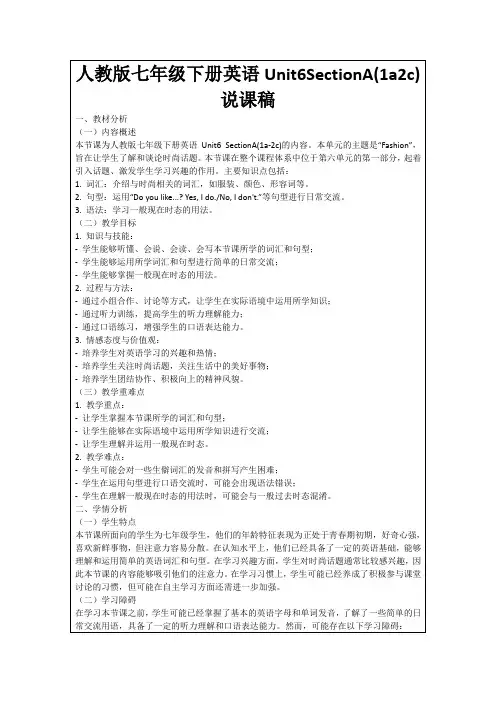
一、教材分析
(一)内容概述
本节课为人教版七年级下册英语Unit6 SectionA(1a-2c)的内容。本单元的主题是“Fashion”,旨在让学生了解和谈论时尚话题。本节课在整个课程体系中位于第六单元的第一部分,起着引入话题、激发学生学习兴趣的作用。主要知识点包括:
(二)新知讲授
在新知讲授阶段,我会按照以下步骤逐步呈现知识点:
1.词汇教学:我会先展示一些与本节课相关的时尚词汇,并使用实物或图片来帮助学生理解和记忆。通过让学生跟读、模仿,确保他们能够正确发音。
2.句型教学:接着,我会引入本节课的句型“Do you like...? Yes, I do./No, I don't.”,并通过简单的例句展示其用法。我会让学生在小组内练习使用这些句型,以增强他们的口语表达能力。
(二)媒体资源
我将使用以下教具、多媒体资源或技术工具来辅助教学:实物教具(如衣物、饰品等),多媒体课件(包括图片、视频、音频等),以及互动式白板。实物教具可以帮助学生直观地理解词汇,多媒体课件能够生动地展示时尚元素,增强视觉效果,互动式白板则提供了一个互动平台,让学生能够积极参与课堂活动。这些资源在教学中的作用是创造一个丰富的教学环境,提高学生的感官体验,从而促进学生的理解和记忆。
4.给予学生充分的肯定和鼓励,特别是对于基础较弱的学生,通过小步骤的成功体验来增强他们的自信心;
5.设计与学生的生活实际相结合的任务,让学生感受到学习英语的实用性和重要性。
三、教学方法与手段
(一)教学策略
本节课我将采用以下主要教学方法:任务型教学法、情景教学法以及合作学习法。任务型教学法强调通过完成任务来实现语言学习,这有助于学生将所学知识应用到实际情境中,提高其语言运用能力。情景教学法通过模拟真实场景,让学生在特定的语境中学习,有助于提高学生的语言理解和表达能力。合作学习法鼓励学生在小组内共同完成任务,这不仅能够增强学生的团队合作能力,还能通过同伴互助促进知识的吸收和内化。选择这些方法的理论依据在于它们能够激发学生的学习兴趣,促进学生的主动参与,同时符合语言学习的社会性和实践性特点。
人教版英语教材七年级下册unit6教案
人教版英语教材七年级下册unit6教案Unit 6 教案Grade: 7Unit: 6Theme: Sports and HobbiesObjectives:1. To enable students to talk about their favorite sports and hobbies2. To introduce new vocabulary related to sports and hobbies3. To practice speaking, listening, reading, and writing skills in the context of sports and hobbies4. To promote intercultural communication and understandingMaterials:- Textbook: English for Junior High School Students, Grade 7, Unit 6- Whiteboard and markers- Pictures of different sports and hobbies- Flashcards with new vocabulary words- Audio recordings of conversations about sports and hobbies- Worksheet for listening and reading comprehension activitiesWarm-up (10 minutes):- Begin the lesson by asking students about their favorite sports and hobbies. Encourage them to share with the class and explain why they enjoy these activities.- Show pictures of different sports and hobbies on the whiteboard and have students guess the names of each activity.- Introduce the new vocabulary words related to sports and hobbies using flashcards.Listening Activity (15 minutes):- Play audio recordings of conversations about sports and hobbies. Have students listen carefully and answer questions about the conversations.- Encourage students to take notes while listening to help them remember key details.- Discuss the conversations as a class and clarify any vocabulary or concepts that students may not have understood.Reading Activity (20 minutes):- Distribute the worksheet with a reading passage about famous athletes and their achievements.- Have students read the passage individually and then discuss it in pairs or small groups.- Ask comprehension questions to test students' understanding of the reading material.Speaking Activity (20 minutes):- Divide the class into small groups and have each group prepare a short presentation about a specific sport or hobby.- Encourage students to use the new vocabulary words and share interesting facts or personal experiences related to their chosen topic.- Allow time for each group to present their findings to the class and ask for questions or feedback from their classmates.Writing Activity (15 minutes):- Ask students to write a paragraph about their favorite sport or hobby. Remind them to use complete sentences and incorporate the new vocabulary words.- Provide feedback on students' writing and encourage them to revise their paragraphs for accuracy and clarity.Homework (5 minutes):- Assign homework tasks such as writing a short essay about the benefits of staying active, or researching a famous athlete and presenting their findings in the next class.- Remind students to review the new vocabulary words and practice speaking about sports and hobbies with their friends and family.Conclusion:Unit 6 provides students with an opportunity to explore their interests and learn how to communicate effectively about sports and hobbies in English. By engaging in a variety of activities such as listening, reading, speaking, and writing, students can improve their language skills and gain a deeper understanding of different cultures and lifestyles. This unit aims to inspirestudents to pursue their passions and stay active while building confidence and proficiency in English.。
英语人教版七年级下册unit6 教案
2a Listen and match the answers with the questions.
1. What is Steve a. He is watching TV. b. He is listening to a CD.
doing?
2. What is Jack
doing?
2b Listen again. Fill in the blanks.
newspaper newspaper newspaper
eg: my grandmother is reading a newspaper.
I like reading a newspaper.
What is he doing? He is using the computer ?
use
use
use
languagepoints我很乐意是对对方询问意见礼貌接受的回答也可以说idliketo但是语气比前者稍弱
Learning Aims(学习目标)
1)New words:
eat wash read watch drink make newspaper movie soup
2)New sentence structures:
Jack: Hello, Steve. Steve: Hi, Jack. Jack: What _____ are you ______, doing Steve? Steve: I’m ___________. watching TV What about you? Jack: I’m _______________, listening to a CD but it’s kind of _______. boring Steve: Yeah, my TV show is also not very __________. interesting Do you want to _____ go to the movies? Jack: That sounds good.
人教版初一下英语七年级第六单元教案
人教版初一下英语七年级第六单元教案人教版出一下英语七年级第6单元教案【教师寄语:Where there is life ,there is hope. 有生命必有希望!】Unit 6 I am watching TV【基础知识】一、语法讲解--现在进行时(一)、定义现在进行时表示现在(说话的瞬间)正在进行或发生的动作。
(二)、用法:A表示现在( 指说话时) 正在发生的事情。
例:We are waiting for you.B. 表示现阶段正在进行的动作,说话时未必正在进行。
例:Mr. Green is writing another novel.C.已经确定或安排好的但不确定会不会发生的将来活动。
I'm leaving for a travel in Nepal next week.(我下周要去尼泊尔旅行) We're flying to Paris tomorrow(我们明天乘飞机去巴黎)(三)、构成现在进行时的构成是:主语+be+v.ing〔现在分词〕形式第一人称单数I+am+V-ing. 第一人称复数We+are+V-ing. 第二人称单(复)数You+are+V-ing. 第三人称单数He(She,It)+is+V-ing. 第三人称复数They+are+V-ing.(四)、句型变化(1)肯定式:be+v-ing She is singing in the next room. (2)否定式:be+not+v-ing The students aren’t cleaning the room. (3)一般问句:be动词提前。
肯定答语Yes,主语+be; 否定答语No,主语+be not。
Are you playing the computer game? Yes, I am. No, I am not. (4)特殊问句:对谓语动词进行提问的:What+be +主语+doing+其他?What is the old man doing under the tree? 对其他成份进行提问的,疑问词+一般疑问句?人教版出一下英语七年级第6单元教案Where is the boy swimming? Who is she waiting for?【及时训练】1、按要求改写句子The boy is playing basketball.否定句:____________________________ 一般疑问句:_________________________肯定回答:__________________________否定回答:__________________________ 对“The boy”提问:__________________________2、把对话补充完整。
人教版七年级英语下册Unit6教学设计
一、教学目标Unit6 I’m watching TV单词:newspaper,movie,tea,house,pool,supermarket,race,wash,drink,study,miss,young,delicious. 短语:read a newspaper,eat out,talk on the phone,miss his family,wish to have zongzi.句型:What’s she doing?---She’s washing her clothes.That sounds good.语法:现在进行时二、教学重难点SectionA1.What are you doing?2.I’m watching TV.3.clean的用法。
4.That sounds good.5.Hello?This is Jenny.6.Do you want to go to the movies now?SectionB1.Supermarket2.It’s eight o’clock in the morning.3.His dad and younger brother are watching the boat races on TV.4.Other的用法。
5.Zhu Hui misses his family and wishes to have his mom’s delicious zongzi.6.Here is a picture of my family.三、教学过程SectionA1.What are you doing?你在做什么?What are you doing?是现在进行时的特殊疑问句形式,用来询问对方正在做什么。
其句式为what+be+主语+v-ing?,表示询问现在或现阶段正在进行或发生的动作。
如:What is she doing?她在干什么?What are you doing?你在干什么?What are they doing?他们在干什么?2.I’m watching TV.我在看电视。