
下学期module3unit2 外研英语
go sightseeing
go cycling
What is he going to do? He is going to …
What is he/are they going to do?
Go +Ving
go sightseeing
go cycling
go swimming
go shopping
I S1 S2 S3
Make an interview
morning afternoon evening
You can report like this: I am going to …on Sunday… My friend is going to …on Sunday
Step 2 presentation
go fishing
go go go go go go
fishing shopping sightseeing swimming boating cycling
去钓鱼 去购物 去观光游览 去游泳 去划船 去骑自行车
Have a try!
competition
Francisco. 8.Betty’s using her computer to_____her check email.
revise for 9.Tony’s going to_________his test.
Step 5
Around the world
1. What are they going to do? 2. Which two oceans are they going
Read and answer
ห้องสมุดไป่ตู้
to cross? 3. Are they going to use their engines(发动机)?
Atlantic Ocean Pacific Ocean
Task 2
Writing
Make a plan and write it down.
May Day is coming. What are you going to do during it? Why ? Key words: look forward to, be going to… because…
stay{ check{ lie{ enjoy{
do{
play{
take{
have{
Boys
Girls
Step 4
Complete the sentences with the words in the box. buy check do enjoy get up have lie like revise for stay take go
homework
As we all know, the 2008 Olympic Games will be held in Beijing, China. Are you looking forward to it? What are you going to do for it?
Thank you all!
buy check do enjoy get up have lie like revise for stay take go
5.They’re going to______a have picnic in the park. stay 6.Daming isn’t going to______in bed. get up He’s going to________early. 7.They’re going to______in stay a hotel in San
Bingo.swf
Module 3 Plans
Unit 3 Language in use
Beiyuan School Shengling Xia
Free talk
What are you going to do at the weekend?
Step 1 Guessing game
Is he/she going to … …on Saturday morning? Yes,he /she is . No,he /she isn’t.
1.We’re going to ____some sightseeing do because we____Chinese culture. like
2.They’re going to____the plane from take Beijing to Shanghai.
go 3.Betty wants to ____shopping .She’s going to____some clothes. buy have piano lesson on 4.I’m going to_____a Saturday morning.
Ask and answer
--What is / are…going to do…? --He / She is going to … They are going to …
Let’s talk!
Task 1
Work in groups of four. Ask about plans for Sunday and report it.
新外研版英语六年级下册Module 3 Unit 2教案
Module 3Unit2 The cows are drinking wat erUnit 2 She’s got an orange sweater.一、教学目标1、语言知识目标:通过学习掌握新单词:brown、orange、white、sweater、skirt.2、能力目标:通过练习,能简单的谈论搭配衣服。
懂得听和说She’s /He’s got…句型二、教学重难点重点:She’s /He’s got....句型。
难点:She’s got=She has got He’s got =He’s got三、教具准备课件、CD-ROM等。
四、教学过程Step 1、Warming up1. Warming up(1)T:Good morning, boys and girls.Ss: Good morning, teacher.T: How are you today?Ss: I’m fine. And ho w are you?T: I’m fine, too. Thank you.(2) Sing a song: A RAINBOW[以歌曲提前引入,活跃了课堂气氛,提高学习兴趣]2.Free talkT: I’ve got a green sweater .Have you got a sweater?S: Yes, I’ve got a green sweater ,too./No ,I haven’t got a sweater . 3. ElicitationT: What colour sweater has Sam got? Let’s watch the cartoon.[由此导入课题,播放SB活动1]Ask some questions:A. What colour is S am’s sweater?B. What happened (发生?Let students answer the questions.[设置问题,使学生了解课文内容,将新授单词提炼出来。
外研版(三起)-英语-三年级下册--Module 3 Unit 2 I don't like riding my bike.教案
Unit 2:1 don't like riding my bike.(第二单元:我不喜欢骑自行车。
)(教材17~19页)1.Listen,point and say.听一听,指一指,说一说o(教材第17页)课文英汉互译┏━━━━━━━━━━━━┳━━━━━━━━━┓┃I like swimming. ┃我喜欢游泳。
┃┣━━━━━━━━━━━━╋━━━━━━━━━┫┃ I don't like swimming. ┃我不喜欢游泳。
┃┗━━━━━━━━━━━━┻━━━━━━━━━┛朗读参考like 'swimming. .don't 'like swimming.新词速记swim/swIm/v.(动词)游泳短语:go swimming去游泳swimming pool游泳池例句:I can swim.我会游泳。
They swim happily in the sea.他们在海里快乐地游泳。
注意:swim的动词-ing形式必须先双写m,再加-ing,即swimming【即学即用】I like swimming.答案速查A重难点精析like的用法(二)I like swimming.我喜欢游泳。
点拨like在本句中作动词,意为“喜欢”,当它后面接动词时,有两种情况:接动词-ing形式,表示“喜欢做某事”,它侧重于经常或习惯性的爱好。
例如:I like singing.我喜欢唱歌。
接动词不定式,即“l ike +to+动词原形”,表示“喜欢做某事”,它侧重于具体的、一次性的行为或动作。
例如:It's hot today.I like to swim.今天很热。
我喜欢游泳。
【即学即用Iplaying basketball with my friends.A. likeB.like toC.likes2.Listen and say.听一听,说一说。
(教材第17页)课文英汉互译答案速查A┏━━━━━━━━━━━━━━━━━┳━━━━━━━━━━┓┃I like swimming. ┃我喜欢游泳。
外研版八年级英语下册Module3 Unit2 课件

→ found (过去式 / 过去分词)
4. travel→ travelled (过去式)
→ travelled (过去分词)
5. possible→ impossible (反义词)
序号 音 标
词性及词义
adj. 太阳的;与太阳有关
4
的
5
n. 系统;体系
自测1 自测2
6
n. 群;组
7
n. 星系
8
n. 宇宙
序号 音 标
词性及词义
自测1 自测2
9
n. 光;光线;光亮
adj. (事情)办不到的,不
10
可能的
11
adv. 在远方
12
v. 联系;交流
单词拓展
1. life→ lives (复数)
2. 然而,我们还没有在任何其他行星上发现生命。 However, we have not found life on any other planets yet. 3. 它们中没有一颗(行星)有像地球那样的环境。 None of them has an environment like that of the earth.
Module 3 Journey to space Unit 2 We have not found life on any
other planets yet.
单词自测
序号 音 标
词性及词义
自测1 自测2
pron.没有一人;没有一
1
个;一点儿也没有
2
n. 环境
pron.那,那个(指代已被
3
提及的事物)
外研版七年级英语下册 Module 3 Unit 2教案
课题:Module 3 Making plansUnit 2 We’re going to cheer the players.学习目标:掌握重点词及短语forward, look forward to, make friends, cheer, player, hope, win, enjoy oneself /myself during walk, take a walk, country, second, collect, litter, fun, summer holiday, camp, sightseeing , go sightseeing 学习重点:1、学习并能够准确运用fantastic,fan,nobody,myself等本课相关词汇2、能够初步运用be going to 结构3、能够读懂有关介绍假期计划的文章难点:1、描述自己的假期计划New words and phrases study读课文预习下列短语和句子并熟读。
一、New words1.迷,支持者_________2.球衣,男衬衫________3.为… 喝彩________ 4.选手___________ 5. 希望_________ 6.获胜_______ 7我自己____________8.在___期间_____________9.迟的_________10.乡下. ________11.第二_________ 12.收集______13.垃圾__________14.乐趣__________ 15.营地______16.澳大利亚的________ 17.观光______ 18.海滩____19.五月_______ 20.向前,面向未来的_________二、New phrases1.期盼做_________2.观看我们最喜爱________________3.足球迷____________4.为队员喝彩_______________5.五一假期_____________6.玩的开心__________________7.乡村散步_______________8.去游泳____________9.暑假_______________ 10.夏令营________________11.观光__________________ 12.野炊_________________13.在沙滩上________________ 14.打算做_________________【课堂互动】Task 1: Fast reading : Read the passage and match the people with thepictures.Task 2: Careful reading: Activity 3,read the passage and answer thequestions.Task 3 : Read paragraph by paragraph ,then finish the tasks.Paragraph A(Task 1): What is Martin going to do tomorrow?(Task 2):Read and fill in the blanks.【play win cheer fun】Martin and his friends are going to watch their favourite football team趁热打铁:Paul looks forward to _____his pen pal. ( meet ) 2.wear , dress, (be)in , put on 的区别 趁热打铁: I don’t like _____ hats. The boy can ____himself.Do you know the girl ___red? 4.It’s cold.________your coat. 3.cheer 意为______. 常见短语:cheer sb.___________ cheer sb. up___________cheer sb. on_____________注意:cheer up 和cheer on ,当代词为宾语的时候,要放在cheer 与 up/on 中间.We should cheer ourselves up ._____________ They beat drums to cheer on the players.______________ The children are cheering their running classmates.________ cheer 做名词,意为:欢呼声、喝彩声,复数为______. cheers 单独使用时意为“干杯”,是感叹词。
Module3Unit2教案-2020-2021学年外研版八年级英语下册
(一)导入新课(用时5分钟)
同学们,今天我们将要学习的是《Module 3 Unit 2》这一章节。在开始之前,我想先问大家一个问题:“你们有没有过向朋友讲述自己过去有趣经历的体验?”这个问题与我们将要学习的一般过去时态密切相关。通过这个问题,我希望能够引起大家的兴趣和好奇心,让我们一同探索一般过去时的奥秘。
Module 3 Unit 2教案-2020-2021学年外研版八年级英语下册
一、教学内容
《Module 3 Unit 2》为2020-2021学年外研版八年级英语下册的章节,主要包括以下内容:一般过去时态的运用;动词过去式的变化规则;描述过去发生的事件和活动;运用一般过去时进行对话交流。本章节通过不同场景的设置,让学生掌握一般过去时的用法,学会运用动词过去式描述过去的经历,同时提高学生的听说读写综合运用能力。教学内容与课本紧密相关,旨在帮助学生巩固所学知识,提高英语实际运用能力。
(1)动词过去式的变化规则,尤其是不规则动词的记忆。
-针对不规则动词的过去式,提供记忆技巧,如:制作动词过去式卡片,进行记忆游戏,帮助学生记忆。
(2)一般过去时态与现在时态的区分使用。
-通过对比练习,让学生明白一般过去时用于描述已经发生的、与现在无关的动作或状态,而现在时态用于描述正在发生的或经常发生的动作或状态。
三、教学难点与重点
1.教学重点
(1)掌握一般过去时态的用法,包括动词过去式的变化规则。
-通过课本中的例句和练习,让学生学会在句子中正确使用一般过去时,如:“I visited my grandparents last weekend.”
-强调动词过去式的变化规律,如:-ed结尾的规则变化,以及不规则动词的过去式形式。
(2)能够运用一般过去时描述过去的经历和活动。
外研版英语七年级下Module3_Unit2同步练习有答案AwqUwl
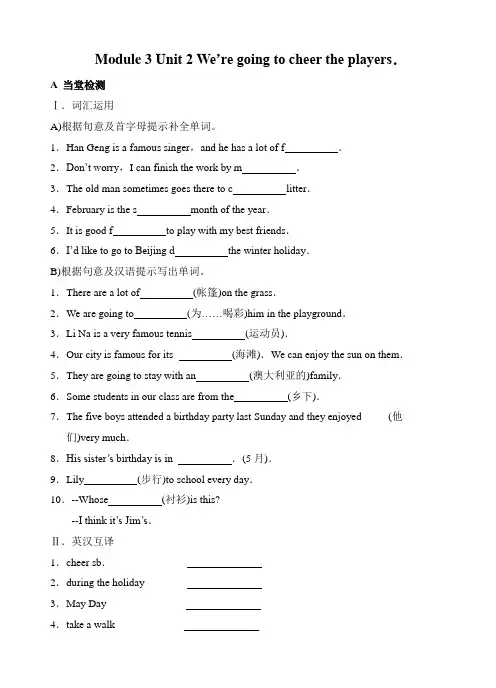
Module 3 Unit 2 We’re going to cheer the players.A 当堂检测Ⅰ.词汇运用A)根据旬意及首字母提示补全单词。
1.Han Geng is a famous singer,and he has a lot of f .2.Don’t worry,I can finish the work by m .3.The old man sometimes goes there to c litter.4.February is the s month of the year.5.It is good f to play with my best friends.6.I’d like to go to Beijing d the winter holiday.B)根据句意及汉语提示写出单词。
1.There are a lot of (帐篷)on the grass.2.We are going to (为……喝彩)him in the playground.3.Li Na is a very famous tennis (运动员).4.Our city is famous for its (海滩).We can enjoy the sun on them.5.They are going to stay with an (澳大利亚的)family.6.Some students in our class are from the (乡下).7.The five boys attended a birthday party last Sunday and they enjoyed_____(他们)very much.8.His sister’s birthday is in .(5月).9.Lily (步行)to school every day.10.--Whose (衬衫)is this?--I think it’s Jim’s.Ⅱ.英汉互译1.cheer sb.2.during the holiday3.May Day4.take a walk5.go sightseeing6.盼望7.遇见其他的球迷8.赢得比赛9.和某人交朋友10.穿着队衣Ⅲ.句型考查1.I’m the football match tomorrow.我期待着明天的足球赛。
外研版(一起)六年级英语下册《Module 3 Unit 2》教案设计
外研版(一起)六年级英语下册《Module 3 Unit 2》教案设计一、教学目标1.掌握本课时的四会单词:tool, fork, knife, spoon, bowl, cup。
2.能够听懂并理解并运用本课时的日常用语:What’s this? What’s that? This is a / an … That’s a / an…3.能够听懂并运用本课时的句型:Can I have a fork / knife / spoon, please? / Here you are. / Thank you.4.能够运用英语表达自己的饮食喜好和禁忌。
二、教学重难点1.重点:学习本课时的四会单词,掌握本课时的日常用语、句型。
2.难点:听懂、应用对自己饮食喜好和禁忌进行表达。
三、教学过程1. Lead-in•通过问候和简短介绍来引出本节课的主题:使用餐具。
2. Presentation•引入新单词:tool, fork, knife, spoon, bowl, cup。
•分别介绍和演示每个单词的意思和用法,并使用图片或实物进行展示和操作。
3. Practice•针对每个单词进行反复练习,集体学生一起说出每个单词和用法。
•运用日常用语和句型模拟对话,引导学生运用所学的单词:What’s this? What’s that? This is a / an … That’s a / an… Can I have a fork /knife / spoon, please? / Here you are. / Thank you.4. Production•小组合作,运用所学单词和句型,模拟对话询问和回答餐具;•在小组内互相分享个人的饮食习惯和我的饮食禁忌等话题,用英语进行表述。
5. Summary•进行简单的总结,再次复习所学单词、句型及相关话题。
6. Homework•教师布置有关本课时的相关作业,巩固学生学习政策,并加强应用。
外研版九年级英语下Module 3 Unit 2 I think life is better
My mum was a __fa_r_m__ girl. She didn’t go out to work. My daughter goes to __w_o_r_k___ even after getting married.
I wasn’t sent to school because my family couldn’t __a_f_fo_r_d__ it, and what’s more, because I was a __g_ir_l__. My daughter is really _l_u_c_k_y__. She has a good e_d_u_c_a_t_io_n___.
Look at the photo and answer the following questions.
1. Is the woman young or old? She is old.
2. What is she holding in her hands?
Old photos. 3. Does she look happy or sad?
work, long hours boys and girls
4. Education:
4. Education:
expensive, often good schools for
only for boys
everyone
Life in the past
Life now
5. Transport:
5. Transport:
on foot or by bike 6. Entertainment:
much easier, buses, cars and planes 6. Entertainment:
三年级下册英语教案-Module 3第三课时Unit 2 1~3 外研版(三起)
三年级下册英语教案-Module 3第三课时Unit 2 1~3 外研版(三起)一、教学目标•语言目标:学生能够听懂并理解课文内容,学会询问并回答日常活动的时间。
•情感目标:培养学生自主学习的习惯,增强学生的自信心和合作精神。
•学习策略:通过听、说和模仿等方式,激发学生的学习兴趣,提高他们的语言技能。
二、教学重点•学会用英语表述日常活动的时间。
•学会询问并回答日常活动的时间。
三、教学难点•学生能够用英语询问并回答日常活动的时间。
四、教学过程1. 导入新知识首先,教师可以跟学生们聊一聊自己的日常活动,如吃早饭、上学、午餐时间等,引出今天的主题,即学习如何询问和回答日常活动的时间。
2. 学习课文本课的主要内容是学习课文《Daily Routines》,学生可以听录音,跟读并模仿发音。
教师可以安排一些练习,帮助学生掌握一些关键的单词和句型,例如:•at half past seven:在七点半•at quarter to nine:在九点差一刻•What time do you…?: 你什么时候…•I usually…:我通常…3. 角色扮演练习教师可以安排角色扮演练习,让学生自己扮演老师或学生的角色,进行问答练习。
例如,老师可以问学生:“What time do you usually get up in the morning?”,学生可以回答:“I usually get up at seven o’clock.”4. 小组合作练习教师可以把学生分成小组,在小组内进行合作练习。
每个小组可以编写一个对话,讨论他们的日常活动,然后在全班分享。
5. 课堂作业作为课堂作业,教师可以留下一些问题,供学生进行思考和回答。
例如:•What time do you usually have breakfast?•What time do you usually go to bed?•What time do you usually do your homework?五、教学评价教学评价主要通过观察学生在教学过程中的表现进行,例如:•学生是否能够准确地理解课文内容?•学生是否能够用英语表达日常活动的时间?•学生是否能够与同学进行共同学习和合作?六、小结本课主要通过模拟对话、角色扮演、小组合作等方式,帮助学生掌握了日常活动时间的表述方法,并在练习中提高了他们的听、说能力和合作精神。
外研版八年级下册英语 Module 3 Unit 2 We have not found life
10.【中考·绥化】
ThepopulationofSuihuaismuchsmallerthan______ofHarb C
in.
A. itB. oneC. that
三、根据汉语意思完成句子,每空一词。 11. 众所周知,地球绕着太阳转。 Asweallknow, theearth________________thesun.
A. lonely; alone
B. alone;
lonely
C. lonely; lonely
D. alone;
alone
8.【天津实验中学期中】Tinagotuptogetsomewatertodrink,
butshefoundtherewas_______inthecup. B
A. everythingB. none
外研版八年级下
Module3 Journeytospace
Unit2 Wehavenotfoundlifeonanyotherplanet
syet.
词汇串新知 提示:点击 进入习题
1 planet 6 solar
课文对对碰
二
答案呈现
一 BADCE 1 B
2 around
2B
3 discovered
goesaround
12. 此刻数十亿颗星星都在看着我们呢。 Atthemoment________________starsarelookingatus.
billionsof
13. 他足够强壮,能搬动那张桌子。 Heis________________tomovethattable.
strongenough
lanet
round
Someastronautshavebeentothemoonandscientistshavesent