
Lesson 31冀教版英语八年级上册
Jenny: How do you like to travel, Danny? on foot I can walk Danny:I like to walk. I can go almost anywhere ________. to school. I can walk to the park. I can walk to your house. Brian: You can walk to the bakery to buy donuts. What about _____ going to other cities? Could you go to another city on foot? Danny:Of course not. That would be too far! Jenny: I like to take __________to a train other cities. I love riding the train. It’ my favourite type of transportation. What about you,Brain Brain: The train is good, but I couldn’t take a train to London to v my parents. London is across the ocean. hometown Danny: You could take a ship to your ______________!
1.Brian would like to take a train to London. ( F )
2.Does Danny like rapid transportation? Yes, he does 3.How does Danny like to travel? He likes to walk.
B 5.This science book_______me a lot of money. A.took B. cost C. used D.spent
一、根据句意及汉语提示写出单词: 1.Beijing is my hometown _________(家乡)。 I love it very much. 2.Tina is very quiet. She seldom ______(很少) plays football。 rapid 3.Plane are more _________( 快速的) than buses.
3. How about ______shopping with me?
going
took 4. It ________me two hours to finish the work yesterda
to travel 5. How do you like _____________?
根据汉语提示完成句子:
Brain: Of course, but it would take a long time to go from Canada to Brain. I seldom travel by ship. I like travelling by plane. It is faster. transportation Danny: I like rapid _____________,too. Could I take a plane to the bakery? Let’s go! Jenny and Brain: Danny!
4.What’s Jenny’s favourite type of transportation? Train. 5.You could take a ship to your hometown. (将这句话翻译成汉语。)
_________________________________________.
We go to the playground on foot.
(2)我们乘坐火车去北京 We take a train to Beijing. We go to Beijing by train. (3) 我乘坐公交车去公园 I take a bus to FuYang park. I go to Fuyang park by bus.
1.我姐姐步行去工作: on foot My sisiter goes to work ________ __________. walks My sister ____________to work.
2.你将乘火车去旅行吗? take ________ a train to travel? Will you _______ _________ Will you travel _________ by ___________? train 3.当你年轻时你可以去你想去的任何地方。 go anywhere you want when you are young. You can _______ ________ 4.今晚去看场电影怎么样? What about seeing a movie tonight? ________ _________ __________
链接中考:
A 1.They spend too much time________the report. A.writing B. to write C. on writing D.write
2.---What beautiful shoes you’re wearing! They must be expensive. D ---No, they only _______ me 10 yuan. A.Spent B. took C. paid D.cost A 3.----Will you _______two days reading this book , Peter? ---Sure! A. spend B. pay C. cost D.take A 4.It will _____me too much time to read this book. A.take B. cost C. spend D.pay
2. ... it would take a long time to go from Canada to Britain. take:常表示花时间, It takes sb. some time to do sth. 花费某人一些时间做某事。 e.g. It takes me two days to read this book. 花了我两天时间来读这本书。 It takes me two hours to get to Beijing. 花了我两个小时到达北京.
ride a bike to…. /go to ….. by bike 骑自行车去……
拓展连接:表示交通方式的动词短语也可以用介词 短语替换。 in a car , on a bike , in a train , in a 。 bus.......
(1) 我们步行去操场. We walk to the playground.
.
plane
bus
train bus to… go to…by take a plane train ship ship walk to…. go to ….on foot .
ride a bike to….
go to ….. by bike
1.I can go almost anywhere on foot. 2.It’s my favourite type of transportation. 3.London is across the ocean. 4.Of course, but it would take a long time to go from Canada to Britain. 5.I seldom travel by ship. 6.I like rapid transportation.
4.What’s your favourite type oftransportation _____________(交通工具).
用所给词的正确形式填空:
visit
travel
foot
go
take
foot 1. We go to school on ________. to visit 2. I take a train ________my parents every month.
你可以乘坐轮船去你的家乡.
Lanuage Points
1.walk to…. / go to ….on foot 步行去….
take a bus to…../ go to …..by bus 乘公交车去…
take a car to….. /go to …..by car 乘小汽车去….. take a train to…. / go to ….. by train 乘坐火车去……
transportation[/trænspɔ:/teɪʃn] n. 运输,交通
Hometown [həʊmtaʊn]
n.故乡,家乡
Britain[/brɪtn]
seldom[/seldəm] rapid[/ræpɪd]
英国(地名)
adv. 不常,罕见;
难得 adj. 快速的
Listen and fill
.
Unit 6
Go with Transportation
Lesson 31
How Do You Travel?
Think about it! 1.Where do you like to go on
hoildays ?
2.What’s your favourite type of
transportation?
冀教版英语八年级上册Unit6Lesson31教学设计
1.教学活动:学生分成小组,用英语讨论各自国家的节日庆祝活动,并分享给其他小组。
2.设计意图:培养学生的合作意识和跨文化意识,提高学生的英语口语表达能力。
3.操作步骤:
a.教师给出讨论话题:Talk about the festivals and celebrations in your country.
提示:注意在对话中使用一般现在时态,并尽量使用本节课所学的词汇。
3.阅读作业:推荐学生阅读一篇关于世界某一地区节日文化的英文文章。要求学生阅读后,用英语简要概括文章内容,并谈谈自己对文章中提到的节日的看法。这项作业旨在拓展学生的知识面,提高他们的阅读理解能力。
提示:教师可提供相关阅读材料,或指导学生通过网络、书籍等渠道寻找合适的内容。
(三)情感态度与价值观
1.培养学生对英语学习的兴趣和自信心,使学生乐于学习英语,主动参与课堂活动。
2.培养学生的跨文化意识,让学生尊重、包容不同国家和地区的文化差异,树立正确的价值观。
3.培养学生的国际视野,通过学习英语,了解世界各地的风土人情,拓展学生的知识面。
4.培养学生的爱国情怀,通过介绍我国的传统节日和习俗,激发学生热爱祖国、传承文化的情感。
2.利用多媒体教学资源,如图片、视频等,创设生动、有趣的课堂氛围,激发学生的学习兴趣。
3.采用任务型教学法,引导学生主动参与课堂活动,培养学生的自主学习能力。
4.通过角色扮演、小组讨论等形式,让学生在实际语境中运用所学知识,提高英语口语表达能力。
5.注重分层教学,针对不同学生的学习需求,制定个性化的教学策略,使每个学生都能在原有基础上得到提高。
提示:可以结合课文内容,思考自己国家节日氛围与其他国家的异同。
冀教版英语八年级上册Unit6Lesson31教学设计
冀教版英语八年级上册 Lesson 32 Trains Go Fast!
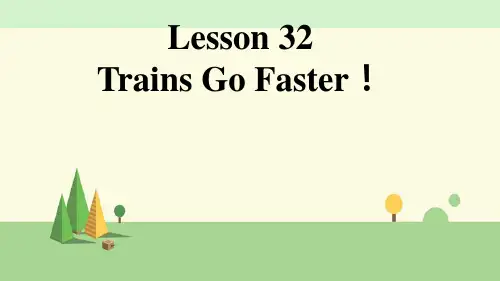
_w_a_s_b_o_r_n_i_n_ England. railways. People built many _w_h_e_e_l_s_ in the
It travelled only about train stations to help
future. That
_f_if_te_e_n__k_il_o_m_e_t_re_s__ in passengersg_e_t_o_n__a_n_d_o_f_f would be
Fill in the Speed of the Train.
the fastest trains
In 1804,the first train engine was born in England. It
500km _______t1r8a2v5el,tlhede
only about fifteen kilometres in two first passenger railway opened. The
In 1825, the first _p_a_s_se_n_g_e_r _ra_il_w_a_y_opened.
high-speed train高铁
Today’s high-speed trains can travel at about 300 kilometres per hour.
每,每一
Many countries had railways.
during the 1830s after 50 years
A scientist in England put steam and wheels together, the stream train appeared.
Countries all over the world started to build railways.
Lesson31 冀教版英语八年级上册
New Words
What’s your favourite type of transportation?
transportation n. 交通,运输 [u]
New Words
Britain is my hometown.
Britain hometown
n.英国 n.家乡
British 英国人
Languages points
工作内容回顾
1. I can go almost anywhere on foot. REVIEW OF WORK CONTENTS 我几乎可以步行去任何地方。
添加标题
adv. 用于肯定句中表示“任何地方” 点击此处添加正文,文字是您思想的提炼,请 言简意赅的阐述您的观点。根据需要您可以酌
He couldn’t _t_a_k_e_a__tr_a_i_n__ to达的L完整o信息n。don. He seldom
travels _b_y_s_h_i_p_. Because it takes a long time.
Brain enjoys travelling _b_y_p_l_a_n_e__. It’s _fa_s_t_e_r__.
seldom adv. 不常,罕见,难得 实前be后
New Words
transportation /ˌtrænspɔːrˈteɪʃn/ n. 运输,交通
hometown
/ˈhoʊmtaʊn/
n. 故乡,家乡
பைடு நூலகம்
Britain
/ˈbrɪtn/
英国
seldom
/ˈseldəm/
adv. 不常,罕见
rapid
达的完整信息。
3. Why couldn’t Brian take a train to London?
冀教版英语八年级上册电子课本+英汉对照
冀教版英语八年级上册电子课本+英汉对照Unit 1Lessons 1-6 Me and My ClassLesson 1Back to schoolYay!I am in Grade 8!Hi Danny!How are you?How was your first day of Grade 8?Great!I was happy to see my classmates after such a long holiday.I have two new classmates this term.One is Sandra and the other is Mary.We also have a new English teacher.Her name is Ms. Cox.That's exciting!You always like to make new friends.Where are Sandra and Mary from?I don't know.I wanted to talk to Sandra,but I didn't know how to begin.Well, you can introduce yourself to her.You can also ask her questions.Good idea, Li Ming!Thank you.What about you?How is Grade 8 for you?Good.It's almost the same as Grade 7.We have a new subject this term - physics.It looks interesting.Tomorrow we will make a class picture,but I don't have any good recent pictures of myself.You have a lot of good pictures, Li Ming.We took many on the Silk Road.I like the one of you on the camel.Yes. I like those pictures, too.I will look for one.See you later!See you!Good luck!第一单元1-6课我和我的班级第一课回到学校耶!我是八年级了!你好丹尼!你好吗?你八年级的第一天过得怎么样?好极了!在漫长的假期之后见到我的同学们我很高兴。
冀教版英语八年级上学期 Lesson 33 --35课后练习(含答案)

Lesson 33Life on Wheels课后练习Ⅰ.用括号内所给单词的适当形式填空1.The bird’s two (wing) were both hurt.2.Lisa can’t imagine (walk) all the way to the North Pole.3.The two men (appear) at the door suddenly just now.st Saturday the doctor (pull) the wrong tooth. He felt very sorry.5.The workers need some new (machine) to help them finish the hard work.Ⅱ.用方框中所给单词的适当形式填空6.Everyone knows the saying, “Knowledge is .”7.It is good for the to drive less.8.Tom and his mother are shopping with a in the supermarket.9.Now people can go into by spaceship.10.Bob’s father gave him a as a gift.Ⅲ.根据汉语意思完成句子,每空一词11.所有的那些小汽车使美国成了车轮上的国家。
All of those cars the U.S. a nation .12.骑自行车旅行是有趣的。
to travel by bike.13.那个箱子太重了,它里面装满了书。
The box is too heavy. It books.14.汤姆好像知道了一切。
Tom know everything.15.明年你就能理解这本英文小说了。
You’ll understand this English novel next year.Ⅳ.单项填空()16. the beginning of July, we will have an exam.A.OnB.AtC.ForD.With()17.You can see flowers in this big garden.A.thousandB.thousandsC.thousand ofD.thousands of()18.The Great Wall is a wonder(奇迹) all over the world. We can’t how ancient people built it withouttoday’s machines.A.appearB.imagineC.inventD.seem()19.Simon swim when he was five years old.A.canB.was able toC.did able toD.is able to()20.The girl is always books in the library on weekdays.A.readB.readsC.readingD.to readⅤ.完形填空There are all kinds of 21in the world. Trains can carry people, animals or things. Some trains are 22, and others are slow. They can get to most of the cities and towns. Some trains can go through the hills.In big cities, the streets are usually 23and some cars and buses often have to wait. So you can find trains under the 24and trains on a rail above the streets. They can bring people in or take them out 25.Can a train run over 26? Yes, it can. There are many bridges over the river. But 27is not easy to build the bridges. Today’s trains have dining cars for people. You may 28something in them on the way if you are hungry. Trains are useful to men, women and children. Many 29like to play with model trains. With the model trains, they can build their own rails and 30the wonderful world of trains.()21.A.cars B.buses C.trains D.bikes()22.A.cheap B.expensive C.fast D.empty()23.A.full B.dirty C.free D.busy()24.A.sea B.park C.ground D.river()25.A.friendly B.quickly C.happily D.slowly()26.A.water B.air C.sky D.mountains()27.A.they B.it C.we D.he()28.A.jump B.drink C.learn D.eat()29.A.women B.fathers C.children D.drivers()30.A.hate B.enjoy C.watch D.ride参考答案Ⅰ.1.wings 2.walking 3.appeared4.pulled5.machinesⅡ.6.power7.environment8.cart9.space10.skateboardⅢ.11.make; on wheels12.It’s interesting/fun13.is filled with/is full of14.seems to15.be able toⅣ.16.B17.D18.B19.B20.CⅤ.21.C22.C23.D24.C25.B26.A27.B句意:但是建造桥是不容易的。
冀教版八年级上Lesson 31
Go with Transportation
Lesson 31
How Do You Travel?
学习目标:
1. 知识目标 :
掌握词汇: transportation, hometown, Britain, seldom, rapid
2. 能力目标: 能够掌握运用本课单词和词组,能够用英语表达交通方式
B 5.This science book_______me a lot of money. A.took B. cost C. used D.spent
Make a dialogue
A: What’s your favourite transportation? B: My favourite transportation is…….
1.我姐姐步行去工作: on foot My sisiter goes to work ________ __________. walks My sister ____________to work.
2.你将乘火车去旅行吗? take ________ a train to travel? Will you _______ _________ Will you travel _________ by ___________? train 3.当你年轻时你可以去你想去的任何地方。 go anywhere you want when you are young. You can _______ _________ 4.今晚去看场电影怎么样? What about seeing a movie tonight? ________ _________ __________
.
4.What’s your favourite type oftransportation _____________(交通工具).
冀教版英语八年级上册Unit6第2课时教案与反思2022
第二课时 Lesson 32: Trains Go Faster! 知人者智,自知者明。
《老子》原创不容易,【关注】,不迷路!重点单词wheel n.车轮;轮子born v.出生;诞生;产生(仅用于被动语态)passenger n. 乘客railway n. 铁路most adj.(many或much的最高级)大多数的;最多的adv. (much的最高级)最n.最大量;最多数station n. 站;所;车站easily adv.容易地standard n.标准;规格speed n.速度重点短语steam engine 蒸汽机be born 出生;产生;形成get on/off 上/ 下(车、船等)重点句子1.In the 1700s,many scientists worked on steam engines.18世纪,许多科学家致力于发明蒸汽机。
2.Early trains were slow by today’s standards.按照今天的标准,早期的火车很慢。
3.Today’s high-speed trains can travel at about 300 kilometres perhour. 今天的高铁时速可达300公里。
4.Maybe trains will have no wheels in the future. 也许将来火车没有轮子。
教学难点让学生向他人介绍自己了解的火车发展史环节1 新课导入Lead in by discussing the following questions:What did many scientists do in the 1700s?When was the first railway born?What is the speed of today’s trains?Show some pictures of different trains.Let the students discuss the questions n groups.Then present their results in front of the class.The styles are different.They can be dialogues or reports.设计意图:以学生感兴趣的问题开始新课,吸引学生的兴趣。
初中八年级英语上册语冀教版Unit 6 Go with Transportation! 教学设计
初中英语冀教版八年级上册第六单元Lesson 31:How Do You Travel?一、概述本课是冀教版第三册第六单元的第一课。
本单元的话题是交通方式。
本课是一个中等长度的对话,讲的是Danny,Brian和Jenny谈论各自喜欢的交通方式。
通过本课学习可以帮助学生唤起之前学过的与交通方式相关的一些语言知识,如:交通工具及交通方式的名称、对交通方式的询问、分别用动词take, ride, drive等和介词by表达出行。
八年级的学生在七年级时已经学了与交通有关的一些基础知识,因此学习本课比较容易。
我在授课开始时先设置了几个与学生旅游相关的话题,进而引出交通方式的主题。
接着以典型图片展示的方式复习交通工具的名称及相关语言知识。
之后,通过图片创设情景教授本课新单词。
由单词引入了与课文相关的观看视频并回答问题环节,然后听教学光盘中的短文录音并连线,帮助学生初步了解课文内容。
然后,我又通过PPT出示任务,让学生读课文判断正误和角色扮演,帮助学生完成课文内容的学习。
因为课文较为简单,因此我又设置了一篇与交通方式相关的拓展阅读,参照考试中任务型阅读的方式进行阅读训练,帮助学生在本单元的第一课就最大限度地摄入信息,为之后课文的学习做好铺垫。
二、教学目标1.知识与技能(1)掌握词汇及短语:hometown, Britain, seldom, rapid, on foot。
(2)能够运用所学知识就喜欢的交通方式的话题进行对话,训练学生听说读写的技能。
2.过程与方法(1)能够通过师生说、生生说和自主听读体验交际式英语教学的一般过程,掌握英语听说的基本方法;(2)能够通过小组角色表演,体验合作学习的过程和方法;(3)能够仔细倾听老师和同学的发言,有语言表达和与同学交流的愿望。
3.情感态度与价值观鼓励学生用英语表达自己的想法,表现自己,培养学生学习英语的自信、勇气以及小组合作意识。
三、教学资源1.冀教版八年级英语教材2.网络资源;配套教学光盘四、教学重点:1. 复习常见交通工具的名称及交通方式的多种表达。
新冀教版八年级英语上册同步课件:Lesson 31 How Do You Travel
New words and expressions.
hometown n. 故乡;家乡
the place where you were born or lived as a child
rapid adj. 快速的
done or happening very quickly
New words and expressions.
take a...
Britain
seldom
rapid
2. To learn about different types of transportation.
3. To be able to talk about your favourite transportation.
Warm up ◆ How did you get to school today?
常用于提出建议或请求,也可用于引出与之前内容相关的新的话 题或观点。
Eg: What about going out with me tomorrow? My favourite color is blue. What about you?
到我家吃晚饭好不好?
___W__h_a_t _a_b_o_u_t __ dinner at my place?
Name
Transportation
2 Listen to the passage and match the people with their favourite types of transportation.
David
Roy
Jack
Tom
3 Fill in the blanks with the words from this lesson. The first letter is given.
冀教版八年级英语上册课文翻译
冀教版⼋年级英语上册课⽂翻译 英语翻译是⼀门⼗分专业的英语学问,英语作为⼀门国际性语⾔,被⼴泛应⽤于各类对外的交流活动中。
以下是店铺为⼤家整理的冀教版⼋年级英语上册的课⽂翻译,希望你们喜欢。
冀教版⼋年级英语上册课⽂翻译(⼀) [ti:UNIT 2 My Favourite School Subject Lesson 9:Don't Be Late for Class!] [0:01.102]UNIT 2 第⼆单元 [0:02.805]My Favourite School Subject 我最喜欢的科⽬ [0:06.511]Lesson 9: 第9课: [0:07.613]Don't Be Late for Class! 上课不要迟到! [0:11.118]THINK ABOUT IT! [0:12.771]·How many subjects do you study? What are they? [0:19.231]·What's your favourite subject? [0:22.787]·What subjects do Jenny and Brian like best? [0:29.147]Hi, Jenny! 你好,珍妮! [0:30.641]Hi, Brian! 你好,布赖恩! [0:31.808]What class do you have next? 你接下来要上什么课? [0:33.766]I have art next. 我接下来上美术课。
[0:35.461]It's my favourite. 这是我最喜欢的。
[0:37.080]I have painted six new pictures this week! 我这周已经画了六幅新画了! [0:39.904]I hope you'll show them to me sometime. 我希望有时间你能让我看看它们。