
译林 英语 六年级下册 Unit 1 The lionand the mouse
asked laughed said
sadly loudly quietly happily
Let’s read.
excited quiet loud
excitedly quietly loudly
sad happy
sadly happily
形容词作表语或作定语修饰名词; 副词做状语修饰动词。
Choose and read.
2. want to do sth. 想做某事 如:I want to drink tea.
Story time
“Please don’t eat me. I can help you some day,” said the
mouse quietly. “You’re so
small and weak! How can you
狮子伤心地问。
2.The mouse said __________.
老鼠平静地说。 3. He laughs __________.
quietly
他修饰动词,
且置于动词之后。
Play the game.
large from then on quietly
快速读出出现的单词,看到炸弹要说“bomb嘭”。
Unit 1 The lionand the mouse(1)
Free talk
1. What animals do you like? 2. What do you think of the lion? 3. What do you think of the mouse(老鼠)? 4. Do you think the lion and the mouse
strong 强大的,强壮的
sharp 锋利的,尖的
Let’s read.
Read the test and the new words.
Story time
There was a lion in the forest. He was very large and strong.
Story time
Story time
The next day, two men caught the lion with a large net. The lion bit the net with his sharp teeth, but that did not help. “How can I get out?” asked the lion sadly.
根据故事内容填空,然后两人进行对话表演。
Fill and say.
Lion: I’m …large and …strong Animals: Here comes the lion. Run!
Fill and say.
Lion: What are you doing here, Little Mouse? I’m going to…eat you Mouse: Please don’t…e,at me Lion. I can …help you some day. Lion: Ha! Ha! You’re so…small and weak How can you help me?
something q__u_i_e_t_l_y_.
Let’s write.
模仿例句写句子。
He’s a happy boy. He laughs happily.
Let’s write.
模仿例句写句子。
She’s a queit girl. She is sleeping queitly.
Fun time
21世纪教育网
What will he say? It doesn’t matter.
Sound time.
编写几个特殊疑问句!
--Where …? --.... --What …? --…
21世纪教育网
--Who …? --…
Unit 1 The lion and the mouse(3)
Warm-up.
The lion got out. “Thank you!”
said the lion happily.
just then
就在那时
soon
不久,很快
happily
开心地 happy—happily
Story time
From then on, the lion and the mouse became friends. from then on 从那时起
写出下列形容词的副词形式。
Answer the questions.
4. How did the mouse help the lion? He made a big hole in the net with his teeth. 5. What did the lion and the mouse become? They became friends.
excited
excitedly
When he heard the news, he was
_e__x_c_i_t_e_d__ and he shouted _e_x__c_it_e__d_l_y_.
quietly
quiet
Anna is a _q__u_i_e_t___ girl. She always does
night.
let
3. Tom’s father _______ (let) him go out to
palybebcaasmkeetball yesterday.
4. We __________ (become) friends last year.
Let’s read.
The lion
The mouse
can be friends?
Look and read
The mouse is small. mouse 老鼠
The lion is large. large 大的
Look and read
The mouse is weak. weak 弱的,软弱的
The lion is strong and has sharp teeth.
Let’s learn.
形容词转化副词
quiet---loud ---happy---sad ----
quietly loudly happily
sadly 注意:以辅音字母加-y结尾的,将y变i, 再加-ly.
Let’s learn.
1.The lion asked _______. sadly
• Everyone is good at something. 每个人都有自己的长处。 • Let’s help each other! 让我们互相帮助
Let’s watch
点击播放Story time 课文动画
Read and order.
a The lion caught the mouse. b The lion and the mouse became good friends.
A mouse walked by and woke the lion up.
Fill and read.
1. My mother _w__o_k_e___ (wake) me up at 7:00
yesterday.
2. The mouse _b__it____ (bite) my shoes last
sad—sadly the next day 第二天
net
网
bite
咬 bite--bit
Story time
Just then, the mouse saw the
lion. “I can help you,” he said.
Soon, the mouse made a big
hole in the net with his teeth.
c The lion could not get out from the net. d The mouse woke the lion up.
e The lion let the mouse go. f The mouse helped the lion get out.
d
a
e
c
f
b
Unit 1 The lion and the mouse(2)
help me?” laughed the lion
loudly. Then, he let the mouse go. some day 某一天
quietly 小声地,安静地
let sb. do sth. 让某人做某事 如:Let’s go home.
quiet—quietly
loudly 大声地 loud—loudly
Answer the questions.
6. What do you learn from the story?
• Sometimes, the strong can be weak.再高的人也有屈身 的时候。
• Sometimes, the weak can be strong. 再矮的人也有垫脚 的时候。
walk by
strong
wake up
loudly soon
bite
net
Answer the questions.
1.Who woke the lion up? A mouse woke the lion up.
2.Did the lion eat the mouse? No, he didn’t. 3. How did the men catch the lion? They caught the lion with a large net.
Unit 1 The lion and the mouse(单元解读)六年级英语下册(译林版三起)
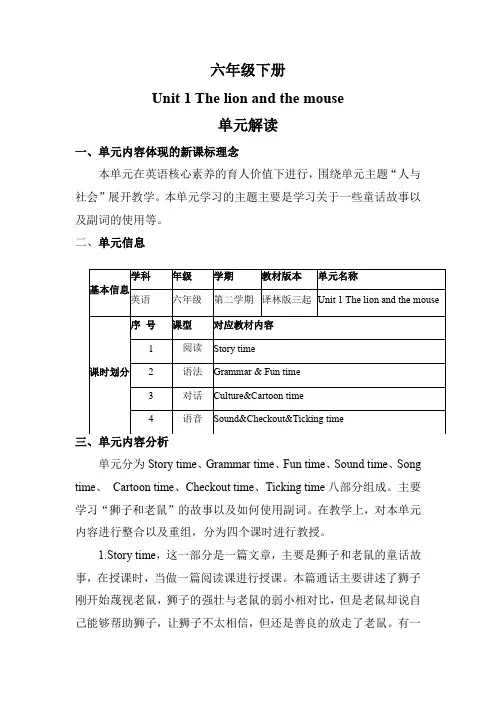
六年级下册Unit 1 The lion and the mouse单元解读一、单元内容体现的新课标理念本单元在英语核心素养的育人价值下进行,围绕单元主题“人与社会”展开教学。
本单元学习的主题主要是学习关于一些童话故事以及副词的使用等。
二、单元信息单元分为Story time、Grammar time、Fun time、Sound time、Song time、Cartoon time、Checkout time、Ticking time八部分组成。
主要学习“狮子和老鼠”的故事以及如何使用副词。
在教学上,对本单元内容进行整合以及重组,分为四个课时进行教授。
1.Story time,这一部分是一篇文章,主要是狮子和老鼠的童话故事,在授课时,当做一篇阅读课进行授课。
本篇通话主要讲述了狮子刚开始蔑视老鼠,狮子的强壮与老鼠的弱小相对比,但是老鼠却说自己能够帮助狮子,让狮子不太相信,但还是善良的放走了老鼠。
有一天狮子被猎人抓到了,弱小的老鼠真的救了狮子。
从一开始的不相信到后来的帮助,两者之间的对话语气发生了明显的变化,由此也引出来副词的用法。
另外本篇使用一般过去时叙述,也涉及了一些动词的过去式形式。
2.Grammar time&Fun time, 这两个部分作为一课时按照语法课进行教授,主要学习副词的用法,以及形容词如何变副词。
另外还涉及了一些动词的过去式形式。
Fun time主要是让学生们演绎狮子和老鼠的故事,让学生们进行表演的时候,一定要主语语气。
3.Culture&Cartoon time,这两个部分作为一课时按照对话课进行教授。
Culture time主要是区分文化的不同,在国外伊索寓言讲了许多的小故事,在中国,成语故事里面也有很多有趣的故事。
Cartoon time是一篇对话,主要讲述了Sam和Bobby打乒乓球的故事。
Sam 和Bobby在打乒乓球,由于Sam击球时太用力,把球大掉进了洞里。
译林版(三起)六年级下册英语教学设计:Unit1 The lion and the mouse(Ch
译林版(三起)六年级下册英语教学设计:Unit1 The lion and the mouse(Checkout time & Ticking time)一、教学目标1.掌握词汇:lion,mouse,roar,squeak,weak,strong,easily,quickly 等。
2.听、说、读、写本单元单词和句型,完成听力、口语、阅读、写作技能训练。
3.培养学生观察和探究形成良好的思维习惯。
4.提高语言交际能力,激发学生听、说、读、写英语的兴趣和自信心。
二、教学重点与难点1.教学重点:掌握单词lion,mouse,roar和squeak的发音与意思。
2.教学难点:让学生理解并掌握短语checkout time及ticking time的含义,并进行语境运用。
三、教学过程Part 1. Revision1.T先播放lion、mouse、roar和squeak等单词的发音,让学生跟读并说出中文的意思。
2.由教师或学生回顾上一单元的课文内容并进行简单复习。
Part 2. Presentation1.T先大声模拟狮子吼叫的动作,并向学生介绍本单元主题:The lion andthe mouse(狮子与老鼠的故事)。
2.T通过课件或图片,展示两只动物的画面,让学生观察图片并简单描述狮子和老鼠的形象、特点。
3.T介绍单词lion和mouse,并向学生分别展示狮子和老鼠的真实图片,让学生认真观察并说出单词的发音和意思。
4.T教授单词roar和squeak,并向学生演示狮子和老鼠叫的声音,让学生说出单词的发音和意思。
Part 3. Practice1.T播放学生听力材料,听取狮子的咆哮和老鼠的吱吱声,并让学生成对回答问题,如问答句:Teacher: What can you hear?(你听到了什么?)Students: I can hear the lion roar and the mouse squeak.(我听到了狮子的咆哮声和老鼠的吱吱声)2.T播放课文录音,让学生跟读,重点掌握单词和短语的发音。
六年级下册英语教案-Unit1Thelionandthemouse(Storytime)译林版
六年级下册英语教案 Unit 1 The lion and the mouse(Storytime)译林版教学目标:1. 学生能够理解并讲述故事《狮子和老鼠》的主要情节。
2. 学生能够正确拼读并使用故事中出现的关键词汇和短语。
3. 学生能够通过故事学习并运用寓言故事的基本要素和道德寓意。
4. 培养学生的合作能力、想象力和创造力。
教学内容:1. 故事《狮子和老鼠》的文本阅读与理解。
2. 故事中出现的关键词汇和短语的学习与应用。
3. 讨论故事的道德寓意,并鼓励学生发表自己的看法。
教学重点与难点:1. 教学重点:学生能够理解并讲述故事的主要情节,掌握故事中的关键词汇和短语。
2. 教学难点:学生能够理解故事的道德寓意,并能够运用所学知识进行创造性表达。
教具与学具准备:1. 教具:PPT展示故事情节,图片,视频等。
2. 学具:学生自备笔记本和文具。
教学过程:1. 导入:通过图片或视频引起学生对故事主题的兴趣,引导学生预测故事情节。
2. 阅读故事:学生跟随老师一起阅读故事,理解故事的主要情节和角色特点。
3. 学习关键词汇和短语:通过PPT展示和讲解,帮助学生学习和掌握故事中出现的关键词汇和短语。
4. 讨论故事情节:学生分组讨论故事情节,分享自己的理解和感受。
5. 道德寓意讨论:引导学生思考故事中的道德寓意,并鼓励学生发表自己的看法。
6. 创造性表达:学生分组进行角色扮演或故事改编,展示自己的理解和创造力。
板书设计:1. 故事和作者。
2. 故事的主要情节和角色特点。
3. 故事中出现的关键词汇和短语。
4. 故事的道德寓意。
作业设计:1. 写一篇关于故事《狮子和老鼠》的读后感,表达自己对故事情节和道德寓意的理解和感受。
2. 用自己的话复述故事,并尽量使用故事中出现的关键词汇和短语。
课后反思:教学重点与难点教学重点教学重点是指学生在学习过程中必须掌握的基本知识、技能和概念。
对于本课的教学重点,我们需要确保学生能够:1. 理解并讲述故事情节:学生需要能够概述《狮子和老鼠》的故事情节,包括故事的开端、发展、高潮和结局。
译林版译林英语六年级下册全册教案及教学反思
译林版译林英语六年级下册全册教案及教学反思一、教学内容1. Unit 1 The lion and the mouseStory time: 学习故事《狮子和老鼠》,理解寓意。
Grammar time: 学习一般过去时态,掌握动词过去式变化。
Fun time: 通过趣味活动,巩固一般过去时态。
2. Unit 2 What a wasteStory time: 学习故事《浪费》,了解环保重要性。
Grammar time: 学习情态动词can,理解其用法。
Fun time: 创编对话,运用情态动词can。
3. Unit 3 Who's the winner?Story time: 学习故事《谁是赢家?》,培养竞争意识。
Grammar time: 学习现在分词,掌握动词ing形式。
Fun time: 通过游戏,巩固现在分词用法。
4. Unit 4 Review and check复习前三个单元的语言点,进行听说读写综合训练。
二、教学目标1. 掌握一般过去时态,能运用动词过去式描述过去发生的事情。
2. 学会情态动词can的用法,能运用can表达能力或请求。
3. 理解现在分词,能正确使用动词ing形式描述正在进行的动作。
4. 通过故事学习,培养学生的道德品质和环保意识。
三、教学难点与重点1. 教学难点:一般过去时态、情态动词can和现在分词的运用。
2. 教学重点:动词过去式、can的用法、动词ing形式的掌握。
四、教具与学具准备1. 教具:多媒体课件、故事卡片、游戏道具。
2. 学具:英语课本、练习本、彩色笔。
五、教学过程1. 导入:通过趣味故事或游戏,引入新课。
2. 新课展示:呈现故事内容,引导学生学习。
3. 语言点讲解:详细讲解一般过去时态、情态动词can和现在分词。
4. 例题讲解:分析例题,解释解题思路。
5. 随堂练习:布置练习题,巩固所学知识。
6. 小组活动:分组讨论,创编对话或故事,运用所学语言点。
苏教译林版英语 六年级下册 Unit 1 The lion and the mouse 知识点总结

苏教译林英语 六年级下册Unit 1 The lion and the mouse 知识点一、词汇mouse 老鼠 large 大的 strong 强大的,强壮的 quietly 小声地,安静地 weak 弱的,软弱的 loudly 大声地 net 网 bite 咬 sharp 锋利的,尖的 sadly 难过地,伤心地 soon 不久,很快 happily 开心地,高兴地 hit 打,击 cheer 欢呼 deep 深的 reach 够得着 quickly 迅速地,快地 wake…up 吵醒,叫醒 some day 某一天 walk by 走过,路过 let…go 释放,放开 the next day 第二天 just then 就在那时 from then on 从那时起 pour...into 把…倒入二.句型及语法1. There was a lion in the forest. “There be…” “某处有某物”there be 句型的就近原则:be 动词后面如果跟的是不止一种物品,就根据离它最近的近的物品选用is 或are.课程中所用的是过去式,is 的过去式是was ,are 的过去式是were 。
2. large 常指面积、范围等,可表示数和量(当它直接用于人时,可表示身体大);big 常指程度、规模、重量等,亦可指人,比较口语化。
China is a large and beautiful country. He is a big man.3. walk by “经过,走过” ,此短语中by 意为“在...旁边” I sit by the window. 我坐在窗户旁边。
4. wake… up “吵醒;叫醒”; up 为副词,如果后面接的宾语是代词,则要放在wake…up 的中间;如果后面接的宾语是名词,则放在中间或后面均可。
(1)Be quiet! Don’t wake up your father. (2)It’s late. Wake him up quickly.此类的短语还有:put…on; try…on; take…off 等。
Unit1 The lion and the mouse(含听力原文+答案+重点解析)译林版
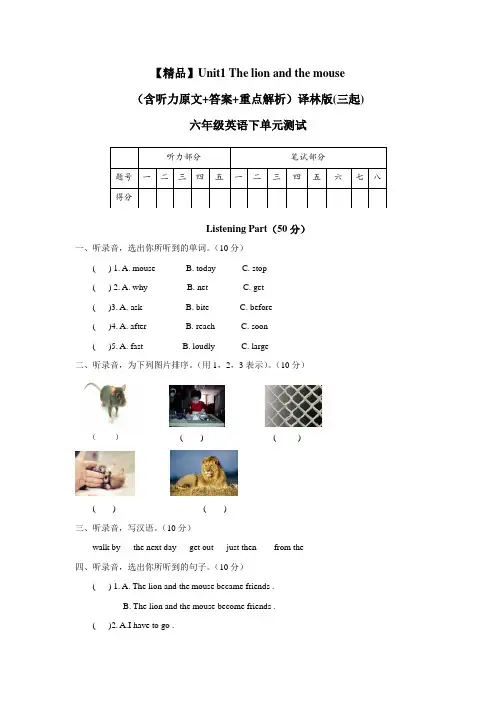
【精品】Unit1 The lion and the mouse(含听力原文+答案+重点解析)译林版(三起)六年级英语下单元测试听力部分笔试部分题号一二三四五一二三四五六七八得分Listening Part(50分)一、听录音,选出你所听到的单词。
(10分)( ) 1. A. mouse B. today C. stop( ) 2. A. why B. net C. get( )3. A. ask B. bite C. before( )4. A. after B. reach C. soon( )5. A. fast B. loudly C. large二、听录音,为下列图片排序。
(用1,2,3表示)。
(10分)()( ) ( )( ) ( )三、听录音,写汉语。
(10分)walk by the next day get out just then from the四、听录音,选出你所听到的句子。
(10分)( ) 1. A. The lion and the mouse became friends .B. The lion and the mouse become friends .( )2. A.I have to go .B. I have to go now .( ) 3. A. Is the ball in the hall ?B. Is the ball in the bag ?( ) 4. A. He can’t reach it .B. I can’t reach it .( ) 5. A .The lion let the mouse go .B. The lion let the mouse run .五、听录音,填单词。
(10分)1. A mouse walked ________and woke the lion .2. I can ________you some day.3. ________ can I get out ?4. There was a ________in the forest.5. He was very________ and strong .Writing Part(50分)一、把无序的字母组成正确的单词并译成汉语。
译林小学英语六年级下册Unit1-8知识点汇总
Unit 1 The lion and the mouse一、单词mouse老鼠large大的strong强大的, 强壮的quietly小声地, 安静地loudly大声地net网bite咬sharp锋利, 尖的ask问soon不久, 很快happily开心地, 高兴地weak弱的, 软弱的cheer欢呼, 加油hit打, 击ground地面, 地上deep深reach够得着二、词组1. in the forest 在森林里2. very large 很大3. large and strong 又大又强壮4. one day 一天5. walk by 走过6. wake the lion up 吵醒狮子7. be angry 生气8. want to eat the mouse想吃老鼠9. help you 帮助你10. some day 某一天11. say quietly 小声地说12. so small and weak 这么小而弱13. laugh loudly 大声地笑14. let the mouse go 让老鼠走15. the next day 第二天16. two men 两个男人17. catch the lion with a large net 用一张大网捉住狮子18. bite the net 咬网19. his sharp teeth 他锋利的牙齿20. get out 出去21. ask sadly 伤心地问22. just then 就在那时23. make a big hole 弄了个大洞24. in the net 在网里25. say happily 开心地说26. from then on 从那时起27. become friends 变成朋友28. get out from the net 从网里出来29. help sb. do sth. 帮助某人做某事30. a happy boy 一个开心/幸福的男孩31. talk excitedly 兴奋地交谈32. the sweet shop 糖果店33. want to buy 想要买34. a lollipop 一个棒棒糖35. Aesop’s Fables 伊索寓言36. find many animal stories找到许多动物故事37. a Chinese idiom book 一本中国成语书38. play table tennis happily 开心地打乒乓39. be good at table tennis 擅长打乒乓40. cheer for them loudly 为他们大声地欢呼41. too excited 太兴奋42. hit the ball hard 用力打球43. find the ball 找到球44. find a hole in the ground 在地上找到一个洞45. in the hole 在洞里46. too deep 太深47. can’t reach it 够不着它48. have an idea 有一个主意49. bring some water quickly很快拿来一些水50. pour it into the hole 把它倒进洞里51. so many balls 这么多球52. go to a shopping centre 去购物中心53. see a small boy 看见一个小男孩54. on the floor 在地板上55. take him to an office 带他去办公室56. give him a sweet 给他一颗糖57. become happy 变得高兴58. like helping people 喜欢帮助人们59. make a study plan 制定一个学习计划60. read quietly 安静地看书61. a weak animal 一个弱小的动物62. a sharp knife 一把锋利的刀63. walk by走过, 路过64. wake . . . up吵醒, 叫醒65. some day 某一天66. the next day第二天67. just then就在那时68. get out出来, 出去69. from then on从那时起70. pour… into把…. . . 倒入三、重点句型1. One day, a mouse walked by and woke the lion up. 一天, 一只老鼠走过, 吵醒了狮子。
译林英语六下教学设计Unit 1 The lion and the mouse 第一课时
译林英语六下教学设计Unit 1 The lion and the mouse 第一课时教学目标1.通过学习绘本《The Lion and the Mouse》,让学生进一步了解并熟练掌握故事中的词汇及短语。
2.学生能够理解故事情节,表达出注意事项并表演出来。
3.学生能够进一步了解动物的习性,并且在观察和研究过程中,进一步发现和了解自然现象,提高科学素养。
教学重难点•故事中的单词拼读和使用•理解故事情节并表达出注意事项的能力•学生能够准确描述动物的一般习性,提高科学素质。
教学准备•《The Lion and the Mouse》绘本、PPT•电脑、投影仪、音响设备•教学道具:小狮子、老鼠等道具教学步骤Step 1 Warm-up1.Greeting: 老师向学生问好并介绍第一课。
2.Introduction to animals: 和学生一起复习前几个学期学过的动物单词,如lion, mouse, tiger等。
Step 2 Pre-reading1.Ask questions: 老师向学生提问,在生活中是否曾经遇到过困难,大家是如何解决困难的?这样的情景出现后你会感到怎样?并让学生写下自己的回答。
Step 3 Reading1.在学生的感受激发之下,老师开始引入绘本,展示绘本封面,并让学生看看这只狮子和老鼠长什么样子。
2.让学生在老师的带领下,一起朗读故事,带着问题去了解故事情节。
3.提醒学生留意故事中可能出现的重要词汇并记录下来,如:lion, mouse, big, angry, kind等。
Step 4 Post-reading1.进行口语练习,让学生在小组内分享他们在阅读故事时记录下的单词,并提醒他们注意单词的发音和用法。
2.让学生利用故事来制作5幅小海报,以描述故事情节。
3.演讲:请学生就自己制作的海报来进行分享,并根据其他同学的分享,互相提出改善意见和建议。
Step 5 Art and Science1.在故事完成之后,老师放出老鼠和大狮子等道具,让学生观察此时的质量和形状。
(完整版)六年级译林英语下册翻译
六年级译林英语下册翻译Unit1 The lion and the mouse1、森林里有一只狮子.他非常大并且强壮。
2、一天,一只老鼠路过,把狮子吵醒了。
狮子很生气,想要吃了这只老鼠.“请不要吃我.某一天我能帮助你。
”老鼠小声地说.“你如此小并且弱!你怎么能帮助我?”狮子大声地笑。
然后,他让老鼠走了。
3、第二天,两个男人用一张大网抓住了狮子.狮子用它锋利的牙齿咬网,但是那没有用。
“我怎么能出去呢?”狮子悲伤地问。
4、就在那时,老鼠看见了狮子.“我能帮助你。
"他说。
很快,老鼠用它的牙齿在网上弄了一个大洞。
狮子出来了。
“谢谢你!”狮子开心地说。
5 、从那时起,狮子和老鼠成了好朋友.Cartoon time1 、萨姆和波比正在开心的打乒乓球.你真的擅长(打)乒乓球,萨姆。
谢谢.2 、比利和威利为他们大声地欢呼。
萨姆太兴奋了,他猛烈地击球。
然后,他们找不到球了。
好哇!3 、最后,萨姆和波比在地上找到一个洞。
球在洞里吗?是的,我能看见它。
但是它太深了。
我够不到它。
4 、萨姆有一个主意。
他快速地带来一些水并把它倒入洞中。
做得好,萨姆!有如此多的球.Unit 2 Good habitsStory time1、王兵是一个好男孩。
他有很多好习惯。
他在早上很早起床,从不很晚上床睡觉。
他在早上和晚上睡觉前刷牙。
在家,王兵总是把他的东西整理的井井有条。
他通常在晚饭前完成他的家庭作业。
2、刘涛也是一个好男孩。
他在学校听他的老师(的话)。
他在家也做得很好。
他保持他的房间干净和整齐。
他也帮助他的父母.但是,刘涛有一些坏习惯。
他经常在晚上很晚的时候做他的家庭作业,并且不早点儿上床睡觉。
他有时在早上感到很困。
3、王兵和刘涛是好朋友.王兵很了解刘涛。
你昨夜睡得很晚吗,刘涛?是的,但是我不困,我能走得很快。
唉吆!你不应该睡得很晚,刘涛.Cartoon time1 、蒂娜的朋友来看她。
让我带领你们参观我们的房子。
2 、他们走进客厅。
六年级下册英语教案-Unit1Thelionandthemouse译林版(三起)
六年级下册英语教案Unit 1 The lion and the mouse 译林版(三起)教学目标1. 知识与技能:学生能够理解并运用故事中的关键词汇和句型,如 "lion", "mouse", "trap", "set free" 等。
2. 过程与方法:通过阅读、讨论和角色扮演等活动,学生能够提高英语听说能力,并学会用英语复述故事。
3. 情感态度与价值观:通过故事学习,学生能够理解友谊的重要性,以及外表强大的事物不一定总是正确的。
教学内容1. 词汇:lion, mouse, forest, trap, set free 等。
2. 句型:The lion caught the mouse./ The mouse set the lion free./ They became good friends.教学重点与难点1. 重点:学生能够正确使用故事中的关键词汇和句型进行交流。
2. 难点:学生能够理解故事背后的深层含义,如友谊和外表与内心的关系。
教具与学具准备1. 教具:故事图片、PPT、角色扮演道具。
2. 学具:英语课本、笔记本、彩色笔。
教学过程1. 导入:利用图片或视频引入故事主题,激发学生兴趣。
2. 新课内容:讲解故事,引导学生理解关键词汇和句型。
3. 小组活动:学生分组,用英语讨论故事内容。
4. 角色扮演:学生选择角色,进行故事复述。
板书设计1. 关键词汇:lion, mouse, forest, trap, set free 等。
2. 句型:The lion caught the mouse./ The mouse set thelion free./ They became good friends.3. 故事情节图:用流程图或思维导图展示故事情节。
作业设计1. 书面作业:用英语写下故事的简要内容。
2. 口头作业:与家长或同学用英语分享故事。