
2019-2020学年新北师大版必修三:unit 7 art lesson 1 masterpieces 课件
高中英语 必修第三册 Unit 7 ART
◆单句语法填空 (1)We will go to Mount Tai,one of the most famous tourist spots (spot) in China. (2) The travellers finally spotted smoke coming (come) out of the houses in the distance, which made them very excited. (3) When the man was trying to break into the bank,he was caught by the police on the spot. ◆单句写作 (4) He _w_a_s__sp_o_tt_e_d_/s_e_e_n_l_y_i_n_g_ (被发现躺在) under the shade of a tree. (5) The police were __o_n__t_h_e__s_po_t/_s_c_en_e(在现场) within a few minutes after the old man’s phone call
高中英语 必修第三册 Unit 7 ART
词汇六 scream (1)n. 尖叫,尖叫声 (2)v. 高声喊出
◆教材原句
The Scream was painted by Edvard Munch in 1893.《呐喊》是爱德华·蒙克于1893 年创作的。
◆要点必记
scream in terror 吓得尖叫一声
高中英语 必修第三册 Unit 7 ART
词汇三 affect vt. (1)影响(=have an effect on) (2)(感情上)深深打动,使悲伤(或 怜悯等) (3)(疾病)侵袭,使感染
◆教材原句 His unusual use of colour has led experts to think that Van Gogh’s mental illness may have affected his sense of sight. 凡·高对色彩的运用很不寻常,专家们 认为精神疾病可能影响了他的视力。 ◆要点必记 lead to 导致;通向 lead to failure 导致失败 lead to success 通向成功 lead sb. in doing sth. 带领某人做某事 ◆学法点拨 lead to 中to 为介词,后接名词、代词或动名词作宾语。 lead to being caught 导致被抓
◆单句写作
(4) They __s_c_r_e_am__ed___w_i_th__ _l_au_g_h_t_e_r_ (尖声欢笑) at her jokes.
高中英语 必修第三册 Unit 7 ART
词汇七 let out 释放,放……出去;发出(叫喊等);放宽,放大(衣服等) ◆教材原句 What makes it striking is that it shows a thin figure with an expression of fear—the figure’s mouth is wide open and letting out powerful scream. 这幅画富有冲击力,画中有一个表情恐惧的瘦弱身影——嘴巴大张,正发出 强烈的尖叫声。 ◆要点必记 let out a scream 发出尖叫声 let alone 更不用说 let sb. alone 不干扰某人 let sb. in 让某人进来 let sth. down 把某物放下来 let sb. down 使某人失望 let go of 放开
scream with laughter 尖声欢笑
scream with excitement 兴奋地喊叫着 scream out her name 高声呼喊她的名字
scream for help 高声呼救 scream at him to go away 大声叫喊让他走开
a screaming baby 尖声哭叫的婴儿
高中英语 必修第三册 Unit 7 ART
◆单句语法填空 (1) I don’t think the experiment is a failure,because it has provided us with valuable experience for future tests. (2) The meeting was a complete failure (fail). ◆单句写作 (3) __D__o_ _n_o_t__ _l_e_t__ _a_n_y__f_ai_l_u_re_s (不要让任何失败)discourage you,for you can never tell how close you may be to victory. (4) She __fa_i_le_d__to___ (未能) recover her health. (5) I don’t think I’m a failure,__fo_r__ f_a_i_lu_r_e __i_s__ _t_h_e__ m__o_t_h_er__o_f__ s_u_c_c_e_ss(因为失败是成 功之母)
高中英语 必修第三册 Unit 7 ART
词汇二 lead sb. to do sth. 引导某人做某事 ◆教材原句 His unusual use of colour has led experts to think that Van Gogh’s mental illness may have affected his sense of sight. 凡·高对色彩的运用很不寻常,专家们认为精神疾病可能影响了他的视力。 ◆要点必记 lead to 导致;通向 lead to failure 导致失败 lead to success 通向成功 lead sb. in doing sth. 带领某人做某事 ◆学法点拨 lead to 中to 为介词,后接名词、代词或动名词作宾语。 lead to being caught 导致被抓
高中英语 必修第三册 Unit 7 ART
Unit 7 ART
LESSON 1 MASTERPIECES
高中英语 必修第三册 Unit 7 ART
题组练·领悟方法
词汇一 figure (1)n. [C]身材;人影;人物;要人;图形;插图;数字 (常用复数)(2)v. 认为;相信;计算 ◆教材原句 a thin figure 一个瘦弱身影 ◆要点必记 historical figure 历史人物 a colourful character/figure 有趣的人物 keep/lose one’s figure 保持/ 破坏身材 figure out 算出;弄清楚,弄明白 figure in 把……列入计算
高中英语 必修第三册 Unit 7 ART
词汇四 spot (1)n. (圆)点;地点,场所;斑点 (2)vt. (spotted,spotting)发现;注意到;看出
◆教材原句 He also took a drug that can make people see yellow spots,just like the stars in The Starry Night. 他还服用过一种 药物,可以让人看到黄色斑点,就像《星空》中的星星那样。 ◆要点必记 on the spot 当场,马上;在现场 dark spot 黑斑,暗点 spot sb. doing sth. 发现某人在做某事 spot that... 发现…… be spotted with 满是……斑点 ◆误区警示 spot 用作动词时,其过去式、过去分词均为spotted。spotted 也可作形容词,意为 “有花点的,有斑点的”, 如:a spotted dog (一条斑点狗)。
高中英语 必修第三册 Unit 7 ART
◆单句语法填空 (1)With the government’s aid,those affected (affect)by the earthquake have moved to the new settlements. (2)[2019·江苏常熟高一期中]If one wants to stay healthy,he should exercise instead of taking medicine,which actually affects (affect) people’s health. (3) Good books have had an effect on me since my childhood. ◆单句写作 (4) The audience __w_e_r_e__ _d_e_e_p_ly__ _a_ff_e_c_te_d_ (被深深打动) by his uplifting speech. (5) The new law has __co_m__e_i_n_to__e_ff_e_c_t_ ( 生效);surely it will __h_a_v_e _a_n___ef_f_ec_t__o_n____ (对……有影响)the industry of the country.
◆单screaming (scream) with pain.
(2) People scream
in fright,in anger,and in sudden pain.
(3) “I wish you were dead!”she screamed (scream).
高中英语 必修第三册 Unit 7 ART
◆单句语法填空 (1) He will lead the students to perform (perform) the experiment. (2) Failure often lies in laziness while hard work leads (lead) to success. (3) The discovery of new evidence led to the thief being caught(catch). ◆单句写作 (4) It is sleeping late in the morning that __l_e_a_ds__t_o__ (导致) him being late for work. (5) All roads _l_e_a_d_ __to___ (通向)Rome.
北师大版(2019)英语必修 第三册 Unit 7 Art-Lesson 3 A Musical Genius 课件(共17张PPT)

a In Germany.
b In Canada.
c In France.
3 What big challenge did Beethoven face?
a He became deaf.
b He became blind.
c He was unable to walk.
4 How many pieces of music did Beethoven write?
• Beethoven as a musician • The performance of Symphony No. 9
Activity 7
Group Work: Think and share.
1. The description of Beethoven’s behaviour in the performance shows that he was deaf. 1) Can you find the hints? “And the whole time, Umlauf stood quietly by his side, skilfully guiding the orchestra.” The music ended but Beethoven continued to conduct. “It was not until Caroline Unger took his arm and turned him to face the audience that the great man had realised his symphony was a success.”
Beethoven • General information • Composing of Symphony No. 9 • Performance of Symphony No. 9
北师大版(2019)英语必修 第三册 Unit 7 Art Lesson 3 A Musical Genius 教案
Unit 7 ArtLesson 3 A Musical Genius【教学目标】Students will be able to1. read and talk about Ludwig van Beethoven2. read for deep understanding3. summarise information4. learn about and practise word building【教学重难点】1. reading for deep understand2. summarising information【教学过程】1. What do you know about Ludwig van Beethoven?(1) Read aloud the title of the lesson and the four questions. Discuss any difficult words or terminology.(2) Students answer the questions independently as a benchmark assessment.2. Scan the story and answer questions.(1) Ask volunteer students to read the italicised paragraph and the first paragraph.(2) Give students a few moments to correct their answers in Activity 1.(3) Discuss the answers as a class.3. Read and find out.(1) Read the Skill Builder. Draw a diagram to show the main information of the passage and how the passage is structured. Let’s read the passage to find details on Symphony No. 9 and supporting sentences.(2) V olunteer students read the story.(3) In pairs, while listening, students add the details to the diagram. Support students as they complete the task.(4) Encourage students to answer the questions in the Skill Builder about the passage that theyhave just read.(5) Discuss the answers as a class.4. Take notes and answer questions.(1) Students volunteer to each read a few sentences of the text.(2) Divide students into groups based on their reading level. Allow high level readers to read independently and complete the activity alone. Encourage middle level readers to read the account quietly and work together to find the answers. Support low level readers by listening as they read the account aloud and explaining unknown terms and tricky sentence structures. If necessary, provide sentence frames for low level readers to complete in order to answer the questions.(3) Discuss the answers as a class.5. Pair Work: Choose a topic to introduce to your partner.(1) Students choose a topic and mind map information on that topic.(2) Using those ideas and the discussed vocabulary, students write at least five sentences. High level learners can research further and write more information.(3) In pairs, students read their sentences to their partner and review what they have learnt.6. Group Work: Think and share.(1) Divide students into groups to answer the questions and provide logical reasoning.(2) Discuss the answers as a class.7. Complete sentences on page 16.(1) V olunteer students can read the phrases in the box and the sentence frames. Discuss any difficult words or terms.(2) Encourage students to work independently and not to turn back to the passage, to complete the sentences by filling in the terms.(3) Students can read their sentences to a partner to hear that they sound correct.(4) Discuss the answers as a class.8. Complete the Word Builder on page 17.(1) Instruct students that they will use their dictionaries to assist with completing the table.(2) Ask students to look up one of the words in their dictionary.a. What part of speech is it? How do you know?b. What is the verb form? How do you know? What is the adjective form?c. How did the word change?(3) Divide students into groups based on their reading level. Allow high level readers to complete the activity alone. Encourage middle level readers to work together to find the answers. Support low level readers to complete the Word Builder by providing guidance with dictionary skills.(4) Discuss the answers as a class.9. Complete sentences.(1) V olunteer students read the sentence frames. Explain any difficult words or terms.(2) Divide students into groups based on their reading level. Allow high level readers to complete the activity alone. Encourage middle level readers to work together to complete the sentences. Support low level readers by providing a key with the answers that they can choose from.(3) Discuss the answers as a class.10. Pair Work: Which part of the story impressed you most? Why?(1) In pairs, students discuss what impressed them most about the passage and what they learnt.(2) Each student shares their answer with the class.。
新教材北师大版高中英语必修第三册Unit7 Art 精品教学课件
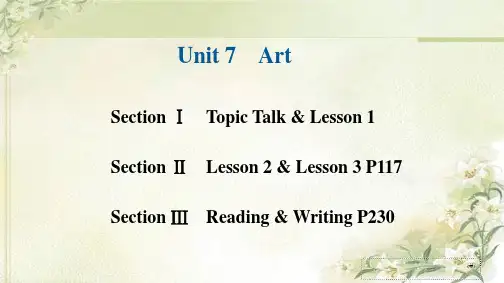
Unfortunately,Van Gogh's unique⑪ paintings weren't very popular and he only sold one painting in his lifetime.He also thought The Starry Night was a failure⑫.However,the fact remains that The Starry Night is now one of the world's most famous paintings.[2]
Ⅰ.语境填词 figure;exhibition;sight;masterpiece;atmosphere; visual;affect;striking;scream;component 1.We try and provide a very homely _a_tm__o_sp_h_e_r_e_. 2.More than seven million people have been _a_ff_e_c_te_d__ by drought.
[2]that 引导表语从句。 The Scream was painted by Edvard Munch in 1893.What makes it striking⑬ is that it shows a thin figure⑭ with an expression⑮ of fear—the figure's mouth is wide open and letting out a powerful scream ⑯.The figure covers his or her ears and looks directly at the viewer.This figure is set on a bridge above a dark,stormy⑰ sea,and against a burning⑱ orange-red⑲ sky.
Unit 7 Art Lesson 3 英语教案高中英语北师大版(2019)必修第三册

Unit 7 ArtLesson 3 A Musical GeniusLevel: Senior high schoolCoursebook:《北师大版(2019)高中英语必修第三册》Objectives:To develop students' ability to understand and use new vocabulary related to music and musicians.To enable students to read and comprehend a biography of a famous musician.To improve students' ability to infer meaning from context.To encourage students to discuss and express opinions about the impact of music on society.Materials:A copy of the Unit 7 Art Lesson 3 article "A Musical Genius" for each student.A whiteboard and markers.Audio recording of a piece of music by the featured musician.Procedures:Warm-upPlay a piece of music by the featured musician and ask students to guess who the musician is. Ask students to discuss in pairs or small groups what kind of impact music has on society.Pre-reading:Introduce new vocabulary from the article such as composer, conductor, symphony, and orchestra, using the whiteboard.Ask students to predict what the article might be about based on the vocabulary introduced.Reading:Distribute the article "A Musical Genius" to students and ask them to read it silently.In pairs or small groups, ask students to discuss what they learned about the musician from the article.Conduct a whole-class discussion, asking students to share their findings and ask any questions they may have.Post-reading:Divide the class into two groups and assign each group a role - one group will represent themusician's supporters and the other group will represent his critics.Each group should prepare a short presentation outlining their arguments for or against the musician's impact on society.Conduct a debate between the two groups, with each side presenting their arguments and responding to the other side's points.Conclusion:Summarize the key points discussed during the debate.Play another piece of music by the featured musician.Ask students to share any final thoughts on the topic of music and its impact on society.Assessment:Participation in class discussions and debate.Vocabulary quiz based on the new vocabulary introduced in the lesson.Written reflection on the impact of music on society.Homework:Write a short biography (100 words) of a famous musician of your choice. Use the vocabulary and reading comprehension skills you learned in class to describe their life and achievements. Be sure to include the following information:The musician's name and background.Their most famous works and contributions to the field of music.Any challenges or obstacles they faced in their career.The impact of their music on society.You should also use at least five new vocabulary words from the lesson and make sure to infer meaning from context when necessary.。
北师大版(2019)英语必修第三册Unit7ArtLesson1Masterpieces教案
北师⼤版(2019)英语必修第三册Unit7ArtLesson1Masterpieces教案Unit 7 ArtLesson 1 Masterpieces【教学⽬标】Students will be able to1. read and talk about paintings and masterpieces2. read for general understanding3. read for specific information and understanding words in context4. read for similarities between three different paintings5. learn about and practise noun clauses6. learn about and practise subject clauses, object clauses and predicative clauses【教学重难点】1. reading for specific information2. Using noun clauses in context【教学过程】1. Talk about paintings on page 8.(1) Discuss one painting at a time. Students can use the vocabulary under the paintings. What title would you give to each painting? Write the heading of each painting on the board; “The Starry Night”, “The Scream” and “The Empire of Light”. Ask students:a. What does the title say about the painting?b. What elements can be seen in the painting?c. What is your opinion of the painting? Explain.d. What emotion does the painting bring to mind?e. How does the painting make you feel?(2) As students are talking, write vocabulary words that they mention on the board. Make sure that every student has a chance to answer the questions and take part in the discussion.2. Read and find out what each painting is about.(1) In pairs, students read through the descriptions of the three paintings.(2) Instruct students to underline the title of each painting and the general sentence for eachparagraph.(3) Encourage students to use the context to understand unknown terms.(4) In small groups, students discuss what each painting is about.(5) Review the answers as a class.3. Read again, take notes and talk about each painting.(1) Read and discuss the diagram:a. What does the painting show?b. What may have inspired the painter?c. What did the artist think, say or write about the painting?This may be difficult for students but they can use contextual clues.(2) Allow students time to read the full article again or call on volunteers to read the passage aloud.(3) In pairs, students complete the diagram. High level students can attempt to complete the diagram independently.(4) Discuss the answers as a class.4. Pair Work: Sort and introduce.(1) Read the phrases aloud. Explain any difficult words.(2) In pairs, students complete the table while discussing each phrase and why it applies to the painting.5. Read and find out similarities.(1) Suggest that students underline and take note of the similarities in each description as they are listening.(2) Ask students to volunteer to read the first paragraph of each description.(3) Create a class discussion on the similarities that students noticed. Encourage all students to participate. Students need to explain their opinions.6. Group Work: Discuss.(1) Discussion questions:a. What’s your opinion of the three paintings after reading the descriptions?b. Do you like or dislike them more? Give your reasons.(2) Instruct students to work independently, to write a few sentences on each painting, expressing their opinion. They can use the following vocabulary words: artistic beauty, originality, emotional,atmosphere, color scheme, dramatic, contrast, highlights, the painting makes me feel uneasy/inspired, dark and troubling, failure, powerful.7. Group Work: Introduce the paintings.(1) Divide students into small groups.(2) Each group chooses one painting and selects one person to be the scribe and write down notes for the group.(3) Each student in the group describes the painting, and provides background to the painting, the artist, the inspiration behind the painting etc. The scribe can mind map this information.(4) Each group writes at least ten complete sentences about the painting using these descriptions.(5) A volunteer from the group reads this passage to the class, role playing that he or she is introducing the painting to visitors at an art gallery.(6) The class can ask questions about the painting and members from the group can help to answer the questions.8. Pair Work: Read and answer.(1) Before starting, revise the different types of noun clauses. Students can read the Grammar Summary for Unit 7, Noun Clauses on page 94. Read through the rules and examples with the class and ensure that students understand clauses in the examples.(2) Students work in pairs to answer the questions on page 10.9. Combine two expressions to make a complete sentence.(1) Divide students into pairs.(2) Explain to students that full sentences include a subject (noun), a verb and a complete thought. Show that the shorter sentences do not make sense on their own as they are incomplete thoughts. Highlight that short sentences can be full sentences but not always.(3) Instruct students to read each sentence pair aloud and decide how to join the two expressions using a subject clause, an object clause or a predicative clause. Students need to support their answers.(4) Students write the completed sentences.10. Rewrite sentences.(1) Ask volunteer students to read the passage aloud to the class. Discuss any difficult words and terminology.(2) Ask students what the passage is about to gain a deeper understanding of the passage:a. What type of art did he create?b. What inspired his art?c. What is he famous for?(3) Let students work independently. Explain to students that they will join the two independent sentences for each number, using noun clauses. The sentences need to make sense and be a complete thought.(4) Students read their constructed sentences to their partner when complete and compare answers.11. Read the quotes and discuss.(1) In small groups ask students to answer the questions:a. How can a man paint with his brain?b. Why is painting similar to poetry? Poetry involves the beauty of words while painting involves the beauty of the world.c. How can poetry speak?d. Why is painting similar to cooking?e. How can you taste painting?(2) Ask students: What are the features of a good painting? Discuss focal point, beauty, skill of the artist, inherent meaning, uniqueness and the artist’s intent. Read the information from the online resources to provide further information.。
北师大版(2019)英语必修 第三册 Unit 7 Art-Lesson 1 Masterpieces 课件(共17张PPT)
1 Van Gogh painted what he saw from his window.
b
2 What makes it striking is that it shows a thin figure with an expression of fear.
a
c
3 What is strange is that above the house and the tree, we see a daytime sky full of
Activity 9 Combine the two expressions using a subject clause, an object
clause or a predicative clause.
1 Magritte painted in this way The reason was that he wanted to challenge how people see the world The reason why Magritte painted in this way was that he wanted to challenge how people see the world. 2 Looking at the painting, we don’t know It is night or day Looking at the painting, we don’t know whether it is night or day.
a
c
brightness and soft white clouds.
4 Some feel that the paintings look dark and troubling. b
高中英语新教材北师大版必修第三册课件:UNIT 7 ART LESSON 3 A MUSICAL GENIUS
◆单句语法填空 (1) You can’t serve drinks to minors (minor). (2) Only a minority (minor)of people supported these new laws. ◆单句写作 (3)__M_i_n_o_r_ e_r_r_o_r_s(小错误)often cause some serious results. (4)We have _m_a_d__e_so__m_e___m_i_n_o_r_c_h_a_n_g_e_s(做了一些小的改变) to the program. (5) _A___s_m_a_ll___m_in__o_ri_t_y_ _o_f___st_u_d_e_n_t_s(极少数学生) are interested in the topic these days.
词汇三 note (1) n. 笔记;便条;纸币;音符;票据;注解;音调 (2)vt. 注意;记录;注解
◆教材原句 Writing the piece had taken several years, and now the final notes had been added to the score. 创作这部交响曲花了他几年的时间,现在乐谱中最后的音符终于写完了。 ◆要点必记 take note of 注意到 take/make notes 记笔记 compare notes with sb. 与某人交换意见 note down 记下
the orchestra. 剧院的音乐指挥迈克尔·奥姆洛夫也走上台和他一起指挥乐队。
◆要点必记
take charge of 负责,掌管(动词短语)
in charge of 负责,掌管(介词短语)
in the charge of sb.= in sb.’s charge 由某人负责/ 掌管
高中英语必修第三册课件Unit 7 Art Lesson 1 Masterpieces-北师大版(2019)
Questions: 1. What does the painting show? 2. What may have inspired the painter? 3. What did the artist think or say about the painting?
Painting The Starry Night
●
b 3 W h a t i s s t r a n g e i s t h a t a b o v e t h e h o u s e a n d t h e t r e e , w e s e e a d a y t i m e s k y f u l l o f b r i g h t n e s s a n d s o f t w h i t e c l o u d s .
Unit 7 Art Lesson 1 Masterpieces
ActivitWy 1hat do you see in the painting?
The Starry Night
by Van Gogh
ActivitWy 1hat do you see in the painting?
The Scream by Edvard Munch
A thin figure with an expression of fear.
His experience of Not mentioned in the walking with friends. text.
A beautiful house lit by lights from inside, surrounded by the
ActivitWy 1hat do you see in the painting?
Unit7 Art Lesson3 A Musical Genius 高中英语北师大版必修第三册
__co__m_p_o__se_r_s_ (composer) in the world. (3)The United Nations is composed of more than 190 countries. (4)The medical team,_c_o_n__si_s_t_in_g_(consist) of three experts,five doctors and eight nurses,will be sent there to help out.
(1)In Chinese culture,red is the symbol of luck and happiness.
(2) You can make a mark where you can’t understand. (3)In our class,when the bell rang and the teacher closed his
in response to 作为对……的答复 / 反应 make a response to 对……作出回应 / 反应
Exercises:
(1)Knowing basic first-aid techniques will help you respond
quickly to emergencies.
(3)abroad adv. 在国外;到国外 at home and abroad 在国内外 go abroad 去国外
新教材北师大版高中英语必修第三册 Unit 7 Art 精品教学课件(共138页)
◆单句语法填空 (1) The students in our class are lively,enthusiastic and energetic (energy). (2) He works so hard that he doesn’t have the energy to take (take) exercise. ◆单句写作 (3) You are always __f_u_ll_ o_f___en_e_rg_y___ (精力充沛的). Can you share the secret? (4) She has an assistant to help her out. Now she _h_a_s__th_e___e_ne_r_g_y__ _to___a_cc_o_m_p_a_n_y__ (有精力陪伴) her
词汇五 professional (1)adj. 专业的;职业的 (2)n. 专业人员;职业选手
◆要点必记 professional skills 专业技能 seek professional advice/help 寻求专业意见/ 帮助 a professional tennis player 职业网球运动员 ◆词语积累 profession n. 职业,行业 enter/go into/join a profession 进入某个行业 ◆单句语法填空 (1) They will build a gallery in which we will see the artworks by professional (profession)painters. (2) There will be a rise in the demand for health care professionals (professional) in the future. 单句写作 (3) But for my teacher’s help,I couldn’t have been a _p_r_o_fe_s_s_io_na_l_p_a_i_n_te_r_(专业画家)and owned my gallery. (4) You had better __se_e_k___p_rof_e_s_si_o_n_a_l_a_d_v_ic_e____ (寻求专业意见).