
《英语惯用法》xin
英语惯用法

•
•
Often and nowadays
• Do not use the word oftentimes where often will suffice (which is pretty much everywhere), or say “to include” in place of including. If all the other officers jumped off a bridge, would you do it too? • Air Force doctrine documቤተ መጻሕፍቲ ባይዱnts often include more bright colors than bright ideas. • The CINC should be given greater authority, including the right to set his own ROE. • BDCOL students LOVE the term ―nowadays‖ for ―now’ or ―today.‖ •
Feel and believe
• People feel emotions and sensations, they believe ideas and facts. At SAAS, you will often have occasion to write about what leaders and theorists believe, think, assert, maintain, argue, and predict, but rarely if ever will you need to discuss what they feel. • Clausewitz believed that the defense was the strongest form of war. • Stalin felt betrayed when Germany attacked, though it seems hard to believe. • Napoleon felt ill on the day of Waterloo, but he expected that he would win anyway. • I feel uneasy about my presentation. Will the general think it is worthless?
初中英语习惯用法大全
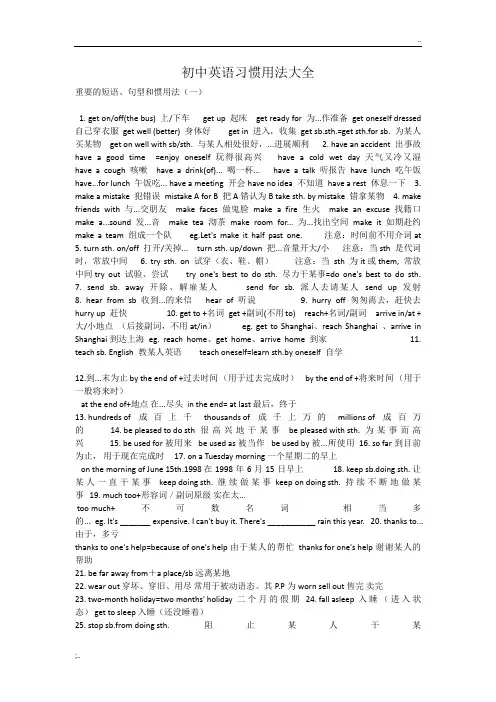
初中英语习惯用法大全重要的短语、句型和惯用法(一)1. get on/off(the bus) 上/下车get up 起床get ready for 为...作准备get oneself dressed 自己穿衣服get well (better) 身体好get in 进入,收集get sb.sth.=get sth.for sb. 为某人买某物get on well with sb/sth. 与某人相处很好,...进展顺利2. have an accident 出事故have a good time =enjoy oneself 玩得很高兴have a cold wet day 天气又冷又湿have a cough 咳嗽have a drink(of)... 喝一杯... have a talk 听报告have lunch 吃午饭have...for lunch 午饭吃... have a meeting 开会have no idea 不知道have a rest 休息一下3. make a mistake 犯错误mistake A for B 把A错认为B take sth. by mistake 错拿某物4. make friends with 与...交朋友make faces 做鬼脸make a fire 生火make an excuse 找籍口make a...sound 发...音make tea 沏茶make room for... 为...找出空间make it 如期赴约make a team 组成一个队eg.Let's make it half past one. 注意:时间前不用介词at5. turn sth. on/off 打开/关掉... turn sth. up/down 把...音量开大/小注意:当sth 是代词时,常放中间6. try sth. on 试穿(衣、鞋、帽)注意:当sth 为it或them, 常放中间try out 试验、尝试try one's best to do sth. 尽力干某事=do one's best to do sth.7. send sb. away 开除、解雇某人send for sb. 派人去请某人send up 发射8. hear from sb 收到...的来信hear of 听说9. hurry off 匆匆离去,赶快去hurry up 赶快10. get to +名词get +副词(不用to) reach+名词/副词arrive in/at +大/小地点(后接副词,不用at/in)eg. get to Shanghai、reach Shanghai 、arrive in Shanghai到达上海eg. reach home、get home、arrive home 到家11. teach sb. English 教某人英语teach oneself=learn sth.by oneself 自学12.到...末为止 by the end of +过去时间(用于过去完成时) by the end of +将来时间(用于一般将来时)at the end of+地点在...尽头 in the end= at last 最后,终于13. hundreds of 成百上千 thousands of 成千上万的 millions of 成百万的 14. be pleased to do sth 很高兴地干某事 be pleased with sth. 为某事而高兴 15. be used for 被用来 be used as 被当作 be used by 被...所使用 16. so far 到目前为止,用于现在完成时 17. on a Tuesday morning 一个星期二的早上on the morning of June 15th.1998 在1998年6月15日早上 18. keep sb.doing sth. 让某人一直干某事 keep doing sth. 继续做某事 keep on doing sth. 持续不断地做某事 19. much too+形容词/副词原级实在太...too much+不可数名词相当多的... eg. It's _______ expensive. I can't buy it. There's ___________ rain this year. 20. thanks to...由于,多亏thanks to one's help=because of one's help 由于某人的帮忙 thanks for one's help 谢谢某人的帮助21. be far away from+a place/sb 远离某地22. wear out 穿坏、穿旧、用尽常用于被动语态。
初中英语重要短语、惯用法(60组)

初中英语重要短语、惯用法(60组)初中英语重要短语、惯用法(60组)1. get on/off(the bus) 上/下车get up 起床get ready for 为...作准备get oneself dressed 自己穿衣服get in 进入,收集get sb.sth. =get sth.for sb. 为某人买某物get on/along well with sb/sth. 与某人相处很好,...进展顺利2. have an accident 出事故have a good time =enjoy oneself 玩得很高兴have a cold wet day 天气又冷又湿 have a drink(of)... 喝一杯...have a cough/fever/headache/headache 咳嗽/发烧/头痛/胃痛have a talk 听报告have a meeting 开会have lunch 吃午饭 have...for lunch 午饭吃...have no idea 不知道have a rest 休息一下3. make mistakes 犯错误 mistake A for B 把A错认为Btake sth. by mistake 错拿某物4. make friends with 与...交朋友make faces 做鬼脸make a noise制造噪音make a fire 生火 make an excuse 找籍口make a...sound 发...音 make tea 沏茶make room for... 为...找出空间 make it 如期赴约;成功make a team 组成一个队Let’s make it half past one.注意:时间前不用介词at5. turn sth. on/off 打开/关掉... turn up/down 把...音量开大;出现,露脸turn down 把...音量调小;拒绝注意:当sth 是代词时,常放中间6. try sth. on 试穿(衣、鞋、帽)注意:当sth 为it或them, 常放中间try out 试验、尝试try one’s best to do sth. 尽力干某事=do/try one’s best to do sth.try to do 尽力做try doing sth 尝试做7. send sb. away 开除、解雇某人send sb sth=send sth to sb 送给某人某物send for sb. 派人去请某人 send up 发射8. hear from sb 收到...的来信 hear of 听说9. be famous/known for 因……而出名be famous/known as 以……而出名be famous/known to sb 为某人所熟知10. get to +名词get +副词(不用to) reach+名词/副词arrive in/at +大/小地点(后接副词,不用at/in)eg. get to Shanghai/reach Shanghai /arrive in Shanghai到达上海eg. reach home、get home、arrive home 到家11. teach sb. English 教某人英语teach oneself=learn sth.by oneself 自学12.到...末为止by the end of +过去时间(用于过去完成时)by the end of +将来时间(用于一般将来时)at the end of+地点在...尽头 in the end= at last 最后,终于13. hundreds of 成百上千thousands of 成千上万的millions of 成百万的注意:当hundred、thousand、millioin前有具体的数字出现时,不加s 不带of.如:five hundred six thousand seven million14. like to do sth./like doing sth.意为“喜欢做某事”,前一种句型侧重具体的一次性的动作;后一种句型侧重习惯性的动作.试比较:Tom likes swimming, but doesn’t like to swim this afternoon.15. be used for 被用来be used as 被当作be used by 被...所使用used to do sth过去做…… be/get used to doing sth 习惯于做谋事be used to do sth 被用来做谋事16. so far 到目前为止,in the past/last few years 用于现在完成时17. on a Tuesday morning 一个星期二的早上in the morning 在上午如:on the morning of June 15th.2017 在2017年6月15日早上18. keep sb. doing sth. 让某人一直干某事keep doing sth. 继续做某事keep on doing sth. 持续不断地做某事19. much too= very +形容词/副词原级很;非常...too much+不可数名词/动词后太多...too many+可数名词复数形式太多……eg. It’s _______ expensive. I can’t buy it. There’s ___________ rain this year.20. thanks to...由于,多亏thank you for=thank for因……而感谢thanks to one’s help=because of one’s help 由于某人的帮忙thanks for one’s help 谢谢某人的帮助21. in the tree表示“在树上(非树本身所有)”;on the tree表示“在树上(为树本身所有)”。
英语语法与惯用法知识点总结.doc

英语语法与惯用法知识点总结【英语语法】一、语法与惯用法知识点:习惯上后接in doing sth的常见名词1.delay 耽搁; 延迟,拖延用于delay in doing sth,表示“在做某事方面的耽搁”。
如:Excuse me for my delay in answering your letter.迟复为歉。
My delay in going abroad is due to my illness.我推迟出国是由于我生病了。
2. delight 快乐,乐趣用于delight in doing sth,表示“做某事的乐趣”“以做某事为乐”。
如:He finds delight in giving to others.他以助人为乐。
I find a perverse delight in listening to traffic.我从听车流噪音中找到一种怪异的乐趣。
注意有用结构take delight in doing sth(喜欢做某事,从做某事中取乐)。
如:She took delight in teasing me.她老爱跟我开玩笑。
Now many people take delight in watching TV.现在许多人都喜欢看电视。
He takes great delight in proving others wrong.他的极大乐趣是证实别人错了。
3. harm 危害用于harm in doing sth,表示“做某事的危害”,尤其用于no harm in doing sth结构。
如:What’s the harm in having a little fun?开点玩笑有什么不好?He may not be able to help but there’s no harm in asking him.他可能帮不了忙,但是求他一下倒也无妨。
The problem may not arise, but there’s no harm in keeping our powder dry.问题不一定会发生,但有备无患并无害处。
英语单词惯用法(1)

英语单词惯用法(1)下列动词习惯上后接动词不定式,形成“主语+ 动词+ 不定式”这样的句子。
下面就这类动词加以归纳,并配以练习进行巩固。
1、adore 极喜欢例句:I would adore to go home. 我很想回家。
2、afford 有条件,能承担例句:We can't afford to pay such a price.我们付不起这个价钱。
3、agree 同意例句:We must agree to differ on this.我们得承认在这一问题上有分歧。
4、aim 打算例句:It aims to bring employees' potential and creativity into full play. 它旨在充分发挥员工的潜力和创造力。
5、appear 似乎;显得例句:On the surface,Sweden appears to be a feminist paradise. 从表面上看,瑞典似乎是一个女权主义的天堂。
6、apply 申请例句:He applied to join the Party. 他申请入党。
7、arrange 做安排,(事先) 筹划例句:We arranged between us to meet on Friday. 我们安排在星期五见面。
8、ask 要求例句:Did she ask to leave any message? 她提出留下什么话吗?9、bear 承受,忍受例句:I couldn't bear to spend three hours sitting in a train every day. 我不能忍受每天在火车上坐三个小时。
10、beg (正式场合的礼貌用语)请(原谅),请(允许) 例句:I beg to differ.恕我不能赞同)11、begin开始;着手例句:The leaves begin to fall when autumn comes.秋天来临时, 树叶开始落下。
英语惯用法

20. Her brother is a bell-boy.
[正」她哥哥是个侍者。
21. It's yours for the asking.
[正]只要你要,它就是你的。
22. Her husband is in the dock.
[正」汽车状况良好。
15. The girl looks like a million dollars.
[正」那个女孩很动人。
16. They all stand up to the plan.
[正]他们都反对那个计划
17. The fellow is a second-story man,
[正]我弟弟特别喜爱吃巧克力。
38. We answered yes to a man.
[正]我们全体同意了:
39. It is nice and warm in the house.
[正」这房间里很暖和。
40. She gave him the lie.
[正]那个人是个夜盗。
18. He earned very little money and could hardly keep the wolf from the door
[正]他挣的钱很少,几乎不能养家糊口:
19. Don't make a fuss of them!
56. The woman dressed up to the nines.
[正]那个妇女穿着华丽的衣服。
57. The secretary talked nineteen to the dozen.
[正」秘书滔滔不绝地讲话。
资料:初中英语重要短语、句型和惯用法
资料:初中英语重要短语、句型和惯用法实用资料:初中英语重要短语、句型和惯用法初中英语重要短语/句型/惯用法1.There be 结构a.这是英语中常见的一种结构,表示“某地有某物”其含义为“存在有”。
eg.There are twenty girls in our class.have也解释为“有”但是与there be有区别,它的含义是“所有,属有”,其主语为某人。
eg.I have a nice watch.b.There be 结构中的be动词要和后面所跟名词保持一致。
c.There is a river near our school.否:There is not a river near our school.问:Is there a river near our school.回答:Yes, there is. No, there isn’t.划⑴How many rivers are there near our school?⑵What’s near our school?d.there be 结构的一般将来时,同学们较难掌握,其正确形式为:there is going to bee.反意疑问句的构成:There is no water in the glass, is there?①There is going to _____ a football match this afternoon.A.haveB.watchC.beD.play②They were sure that they were going to ____ a rest.A.beB.haveC.be onD.on2.so,neither引导的倒装句,为了避免和前一句话的内容重复,英语中习惯用so,neither引导的倒装句。
a.So+be(助动词,情态动词)+主语。
表示某人也是如此。
eg.Mike has bought some foreign stamps.So has Bob.=Bob has bought some,too.b.Neither+be(助动词,情态动词)+主语,表示某人也不。
初中英语重要短语、惯用法
初中英语重要短语、惯用法1.get on/off(the bus) 上/下车get up 起床get ready for 为...作准备get oneself dressed 自己穿衣服get in 进入,收集get sb.sth. =get sth.for sb. 为某人买某物get on/along well with sb/sth. 与某人相处很好,...进展顺利get sth done 使...被...get in the way of挡、、、的路;妨碍get mad 大动肝火;气氛get/be used to doing sth 习惯于干某事go by (时间)逝去;过去go out of one’s way 特地;格外努力get one’s ears pierced 打耳洞2. have an accident 出事故have a good time =enjoy oneself 玩得很高兴have a cough 咳嗽have a drink(of)... 喝一杯...have a talk 听报告have lunch/breakfast/dinner 吃午饭/午饭/晚饭have...for lunch 午饭吃...have a meeting 开会have no idea 不知道have/take a rest 休息一下have sth done 使...被...3. make mistakes/a mistake犯错误mistake A for B 把A错认为Bby mistake 意外地,错误的by accident意外地,偶然地take sth. by mistake 错拿某物4. make friends with sb与...交朋友make faces 做鬼脸make a fire 生火make an excuse 找籍口make decisions/a decision 做决定make tea 沏茶make room for... 为...找出空间make it 如期赴约Let’s make it half past one. 让我们把时间定在1点半吧注意:时间前不用介词at make a team 组成一个队make it to the top 做到最好make...feel at home 使(某人)感到宾至如归make a mess 弄的一团糟,一塌糊涂make an effort 作出努力5. take action 采取行动take off 脱下(衣服、帽子等);(飞机等)起飞take part in 参加take place 发生;出现take pride in =be proud of为、、、感到自豪talk back回嘴,顶嘴turn sth. on/off 打开/关掉...turn sth. up/down 把...音量开大/小注意:当sth 是代词时,常放中间turn... into... 把...变成...6. try sth. on 试穿(衣、鞋、帽)注意:当sth 为it或them, 常放中间try out 试验、尝试try one’s best t o do sth. 尽力干某事=do one’s best to do sth.try to do sth 尽力干某事try doing sth 尝试干某事have a try 试一试7. sell out 卖光separate from 将、、、与、、、分离;隔开区别:divide into 将、、、分成几组、几份set out 出发,启程show up 感到,露面shut off关闭,停止运转shut up闭嘴stick to 坚持,固守all of a sudden 突然send sb. away 开除、解雇某人send sb sth送给某人某物send for sb. 派人去请某人send up 发射send out 发出,送出8. have a point 有道理Have a (great)influence on sb 对、、、产生(巨大的)影响hear from sb 收到...的来信hear of 听说9. hurry off 匆匆离去,赶快去hurry up 赶快10. hang out with sb 与某人闲逛11. teach sb. English 教某人英语teach oneself=learn sth.by oneself 自学in a row 连续几次in line with与、、、成一排in person亲身、亲自in public公开地in that case既然那样;假设那样的话in total 总共,合计12.by the end of +过去时间(用于过去完成时)到...末为止by the end of +将来时间(用于一般将来时)到...末为止at the end of+地点在...尽头in the end= at last 最后,终于13. hundreds of 成百上千five hundredthousands of 成千上万的six thousandmillions of 成百万的 seven million14. be pleased to do sth 很高兴地干某事be pleased with sth. 为某事而高兴15. be used for doing 被用来做、、、used to do sth过去常常做、、、be used as 被当作、、、用be used to doing sth 习惯于做某事be used by 被...所使用be used to do sth 被用来做某事16. so far 到目前为止,in the past/last few years 用于现在完成时17. on a Tuesday morning 一个星期二的早上on the morning of June 15th.1998 在1998年6月15日早上18. keep sb.doing sth. 让某人一直干某事keep doing sth. 继续做某事keep on doing sth. 持续不断地做某事keep sb away from doing sb 避免接近;远离keep off 远离,不接近keep one’s cool 沉住气;保持冷静kick sb off开除某人19. much too+形容词/副词原级实在太...too much+不可数名词too many+可数名词复数相当多的...eg. It’s _______ expensive. I can’t buy it.There’s ___________ rain this year.20. thanks to...由于,多亏thanks to one’s help=because of one’s help 由于某人的帮忙thanks for one’s help 谢谢某人的帮助21. be far away from+a place/sb 远离某地/某人22. because of + n. 因为、、、eg Because of the rain, we can’t go out.类似还有instead of sb/sth 代替、、、23.two-month holiday=two months’ holiday 二个月的假期an eight—year—old child 一个八岁的孩子24. fall asleep 入睡(进入状态)get to sleep 入睡(还没睡着)fall in love with sb 爱上某人fall over 从、、、摔倒25. stop/prevent/keep sb.from doing sth. 阻止某人干某事eg. She stopped the child from listening.stop doing sth. 停止干某事,不再干某事stop to do sth. 停止下来干另一件事。
英语单词惯用法(50)
英语单词惯用法(50)英语中有些形容词习惯上后接动词不定式,构成:主语+ be +adj + to do sth或It + be +adj + to do sth句型。
下面就这些词的用法加以归纳,并配以练习进行巩固。
1、able能够的例句:By no means was he able to handle it. 这件事他绝对没办法处理。
2、adequate足以作例句:My salary is not adequate to support our family. 我的薪水不够维持一家的生活。
3、afraid担心的;害怕的例句:That little girl is afraid to go out alone. 那个小女孩不敢一个人出去。
4、amazed吃惊的例句:I was amazed to see how readily I understood. 令我吃惊的是,我竟理解得这么透彻。
5、ambitious渴望,一心想做例句:John is ambitious to become as famous as Edison. 约翰有野心想和爱迪生一样有名。
6、amused娱乐的例句:She was amused to hear it. 听了这话她感到很有趣。
7、angry生气的;愤怒的例句:Smith was angry to hear about it. 史密斯听到这件事后很生气。
8、annoyed烦恼的例句:He was annoyed to find himself going red. 他因为发觉自己脸红而懊恼。
9、anxious 渴望的例句:My family are anxious to meet you. 我家里的人非常想见你。
10、apt易于例句:Children playing in the street are apt to meet with accident. 在街上玩耍的孩子易出事故。
英语惯用法 7
113. 裘德在乡下有一块菜地. [误] Jude has a piece of vegetable field in the countryside. [正] Jude has a piece of vegetable plot in the countryside. a paddy field 一块稻田 terraced fields 梯田等, plot 指"小块土地,小块地皮", an experimental plot of cotton(一块棉花试验田)
faceless -- 姓名不详的,匿名的,不露面的 shameless---无耻的,不要脸的(人) shameful --- 可耻的,丢脸的(行为) shameful conduct(可耻的行为) a shameless exploiter(无耻的剥削者).
111. 你们必须擦亮眼睛,弄清楚事情的真相. [误] You should wipe your eye and find out the truth. [正] You should remove the scales from your eyes and find out the truth. wipe one's eye ---"先发制人"或"使某人看到自 己 的狂妄"
[ 正 ] ---What would you like to drink? - ---A cup of weak tea, please.
light soup(清汤),a light diet(清淡的饮食) The tobacco is very mild(这烟草儿很淡). "淡茶"--- weak tea. strong drinks(烈性酒) strong tea(浓茶) thick soup(浓汤)