
英语作文范文-10 Ways to Develop Expository Writing Skills With The New York Times
英语作文范文10 Ways to Develop Expository WritingSkills With The New York Times10 Ways to Develop Expository Writing Skills With The New York Times Have you been knocking your head against the proverbial wall trying to teach – or learn –expository writing skills? New York Times models can help writers learn how to write an expository essay that is compelling, convincing and authoritative as well as engaging to read – not to mention authentic. Try a fresh approach with these 10 tips.1. Ditch the five-paragraph essay and embrace authentic essay structure. New York Times news and feature articles are excellent models for structure, including transitions and organization. Look at the guide to forms of Times news coverage to get started, and then deconstruct some articles to get a feel for how they are organized.Classic news stories like this one about conflicts over rebuilding ground zero and this one on how the case of the Russian spies is being resolved are written in the “inverted pyramid” format, starting with the most important information – the first paragraph or two answers the questions “Who?”“What?”“Where?”“When?” Why?” and “How?”– and proceeding with the most important details, filling in the less important information as the article proceeds. This can be a useful structure for, say, newspaper articles based on the events in a play or novel, or relatively short research reports.Feature stories pull the reader in with an engaging introduction and develop from there to explain a topic, issue or trend. Examples of this structure: this article on gauging the national mood by tracking popular songs, blog posts and the like, and Rob Walker’s “Consumed”column on the blankets-with-sleeves fad.A sub-genre of the feature, the personality profile, is also a useful expository writing model, as we discuss in ourlesson on Dickens, which suggests using a profile of Bernie Madoff as a model for writing a literary character profile, and this lesson on the literature Nobelist Naguib Mahfouz.To take the idea of using newspaper story structures further, try this lesson on comparing classic storylines with news reports.2. Two traditional essay writing bugaboos are introductions and conclusions (or “ledes” and “kickers”). The Times is full of creative ways to open and end a narrative, and these can help developing writers learn to avoid clichéd openings and repetitive endings. Here are some of the approaches Times writers take to begin and end their stories, together with examples of each one:Narrative lede: Telling a story that illustrates or encapsulates the issue at hand, like this story about the dangers associated with riding in a taxi when the cabby is using a phone, this one about fans paying homage to Michael Jackson and Natalie Angier’s science piece on squirrelsDescriptive lede: Describing an element that is key tothe story, like this description of a high-end coffee machine in a feature on the topic of fancy coffee makersQuestion lede: posing a rhetorical question that leads directly into the rest of the essay, like this article about popular baby namesFrame: Bringing the essay full circle by starting and ending with elements of the same story, like this article on Cuban doctors unable to practice in the U.S.Quote kicker: Ending with a quote that sums up the essence of the essay, like this one on raising chickens Future action kicker: Ending with a look toward what may or will happen in the future, as in this article on fake art in VietnamLooking for more inspiration? Read John Noble Wilford’s retrospective article about covering the 1969 moon landing, focusing on the section “Moonfall Eve,” in which he recounts trying to figure out how to start his article. The upshot: Simple is often best.3. Informing and explaining – how things work or how to do something – is part of journalism’s bread and butter. Good Times models for information/explanation essaysinclude articles on how dark energy works, why and how Twitter can be useful, how to make a soufflé and how to avoid heatstroke. To find more examples, good starting places are the recipes in the Dining section, the Science and Health sections, and many Technology section features, including posts on Gadgetwise and Pogue’s Posts.One specific type of explanation essay is analysis –an examination of why and how an issue is significant. If you’re looking for good models, The Times runs many pieces under the rubric “news analysis,” such as this article on the significance of steroid use in baseball and this one on President Obama’s remarks on the arrest of Henry Louis Gates. Read these, or other articles marked “news analysis,” and then try writing your own analysis of an event – perhaps something that happened at school, or perhaps something that happened in a piece of literature or in history.4. In addition to information and explanation, there are a few other key expository patterns. Here are the most common ones, together with a Times models of each one, each paired with a related (PDF) handout:Comparison – Technology article on Bing vs. Google; Venn diagramCause and effect – Health article on “chemo brain”; Cause and Effect OrganizerProblem and solution – Op-Ed on how schools should handle flu outbreaks; Problem-Solution OrganizerExtended definition – The On Language column, such as this column on the use of “associate”, “model” and even “the” and the Times Health Guide, a library of information on numerous health conditions; Vocabulary LogFor more fun with definitions, see the Schott’s Vocab blog.5 . Whether you’re writing a descriptive piece or incorporating description into a larger expository essay, specific details are vital, as in this piece on a city mural and this one about Michael Jackson’s signature dance moves.Of course, one of the best places to find colorful descriptions is the Times’ Sports pages, as in this article about a tennis match played by Rafael Nadal. Use ourPlay-by-Play Sports Descriptions sheet (PDF) and our lesson Getting in the Game: Modeling Descriptive Writing on Sports Reporting to get a closer look at descriptive phrases in this or other sports articles.6. “I’ve said all I have to say.”“How canI possibly write three pages on this topic?”“What do you mean, develop my ideas?” Essay writers often struggle with adequate development. Times features are perfect examples of how to fully develop ideas. For example, you might read “Drivers and Legislators Dismiss Cellphone Risks” or Michael Pollan’s polemic on cooking shows and the decline of home cooking in the Sunday Magazine. Then create a “reverse outline”to reveal how the writer developed the piece.7. Like development, smoothly incorporating supporting material and evidence – including introducing and integrating quotations – can be a challenge for young writers. Add the requirement to follow MLA or APA style for citations, and for many students the challenge is insurmountable. Part of the problem may be that most students see few articles or other texts with academic citations in their daily lives. UsingThe Times for models can help.You might suspend traditional academic style requirements, and instead try newspaper-style attribution or even the Web protocol of linking to the source of information – such as this article on digital curriculum materials, which, among many, many others, shows both approaches. Other articles, like this one about government recommendations to schools regarding swine flu, are good examples of how to integrate both partial and full quotations, as well as how to include paraphrases.8. Subject-verb and noun-pronoun agreement can trouble even established writers at the newspaper of record itself, as the After Deadline blog has more than once. Once you’ve reviewed agreement rules, test yourself by looking for errors in the daily paper. And given that Times style is to avoid using “he” as a universal pronoun, virtually any news article or feature provides examples of ways to write around the singular pronoun. Of course, it would help us all if English had an all-purpose, generic pronoun, wouldn’t it?More on agreement and other grammar and language quirks can be found on the Grammar and Usage and Reading and Writing Skills Times Topics pages.9. News briefs and summaries are models of conciseness and clarity. Read a few briefs, like the ones about the music video directed by Heath Ledger, the death of a show-biz dog, and a spate of squid attacks. And for the ultimate in brevity, look at TimesWire for one-sentence (or sentence fragment) summaries of the latest articles.10. Can’t use the first person in expository writing? No one uses second person? Third person is required, and must remain entirely neutral and objective? Pshaw! The Times regularly uses all three perspectives, in creative and effective ways. Here are examples:First person –“Watching Whales, Watching Us”, a Sunday Magazine article in which the reporter included personal experience alongside research, and “Finally, the Spleen Gets Some Respect”, Natalie Angier’s scientific report on the spleen, in which she characterizes herself as spleneticSecond person –“Party On, but No Tweets”, and the Gadgetwise blog post on a smartphone app for stargazers, which explains how the tool works, both of which repeatedly refer to “you,” avoiding the clunky and unnecessarily distancing “one”Third person with a clear voice/personality –Rob Walker’s “Consumed” column in the Sunday Magazine, such as the one on the yoga “lifestyle” shop Lululemon and the Style feature “Hair, Hair, Hair, Hair, Hair, Hair”。
Exposition说明文(英语写作指导)

Draw what the person wrote! Fold the paper so the writing is not visible!
Example from personal experience Example from observation Example from hypothetical situation
What is an exposition? An exposition is a writing whose purpose is to give information
There are various ways of accomplishing the purpose of an exposition:
Organizing the essay by examples
The first paragraph is the introduction paragraph, and it contains the thesis statement
Next, The body paragraphs will begin with the topic sentences
The topic is: Smoking in public places Write a thesis statement for this topic Remember, a thesis statement is the arguable main point of the essay.
把握每次新提升的英语作文

Seizing Every Opportunity for SelfImprovement in English CompositionWhen it comes to enhancing ones proficiency in English composition,it is crucial to recognize and capitalize on every opportunity that presents itself.Here are some strategies to make the most of these chances:1.Engage with Diverse Sources:Read a variety of materials,including books, newspapers,magazines,and online articles.This will not only improve your vocabulary but also expose you to different writing styles and perspectives.2.Practice Regularly:Consistent practice is key to improvement.Set aside time each day to write,whether its journaling,drafting essays,or composing creative pieces.3.Participate in Writing Workshops:Joining a writing workshop or a class can provide structured learning and feedback from peers and instructors.4.Seek Feedback:Dont hesitate to ask for constructive criticism from teachers,peers,or online communities.Feedback is invaluable for identifying areas of strength and areas that need improvement.5.Expand Your Vocabulary:Actively work on learning new words and e them in your writing to avoid repetition and to express your thoughts more precisely.6.Understand Grammar Rules:A strong grasp of English grammar is fundamental.Make sure to study and apply grammar rules correctly in your compositions.7.Experiment with Different Genres:Try writing in various genres such as narrative, descriptive,persuasive,and expository to develop a wellrounded writing skill set.8.Learn from the Masters:Study the works of accomplished English writers to understand how they craft sentences,develop arguments,and engage readers.e Writing Prompts:Writing prompts can stimulate creativity and help you practice writing on a variety of topics.10.Edit and Revise:Always review your work to correct errors and improve clarity.This process is crucial for refining your writing skills.11.Set Personal Goals:Establish specific,measurable goals for your writing,such as improving sentence structure or expanding your vocabulary.12.Embrace Technology:Utilize writing apps,online grammar checkers,and other tools to assist in your writing process.13.Immerse Yourself in English:Surround yourself with English as much as possible, whether through media,conversation,or travel.14.Stay Curious and OpenMinded:Be open to learning new things and exploring different cultures,as this can enrich your writing.15.Reflect on Your Progress:Periodically assess your writing to recognize your growth and identify new areas to focus on.By actively pursuing these strategies,you can continuously elevate your English composition skills and achieve a higher level of proficiency.。
英语写作Ⅱ-expository essays

Model Language and Culture
…… Once a group of Chinese were visiting the home of a fairly well-to-do American.As they were shown around the house, they commented, “you have a very nice home.It’s so beautiful.” The hostess smiled with obvious pleasure and replied in good American fashion “Thank you”—which caused surprise among some of her Chinese ter, while conversing at the dinner table, the host remarked to the Chinese interpreter, a young lady who had graduated not long ago from a Chinese university, “Your English is excellent.Really quite fluent.” To this she said, “No, no.My English is quite poor”—an answer that he had not expected and found a bit puzzling. Was the American hostess’ reply immodest, as it seemed to some of the Chinese? Was the young Chinese interpreter’s remark insincere, as it sounded to the Americans? In both cases the answer is no.……
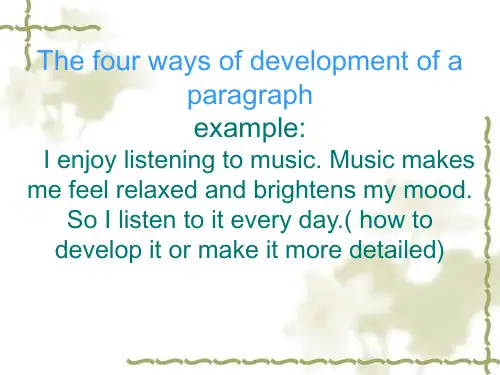
How to develop the expository paragraph
返回
Process analysis过程分析 analysis过程分析
Chronological sequence/temporal order(按时间顺序说明) order(按时间顺序说明) Locationa instructions (位置指引) (位置指引) Operational instructions (操作程 序说明) Cause and effect
How to develop it into description
“… Here is a piece of …” describe a piece of symphony or a kind of music in detail 详细描写某个乐曲的音韵、意境。
How to develop it into a narration
To develop it into an exposition
For example: pop music; rock and roll; jazz; classical music,etc. 如爱听哪些音乐,或者某日听了某个乐曲 后得到的感受和效果。
To develop it into an argumentange the tone of the para. like this: “…. But some people don’t think so. They say that listening to music makes one either too excited or rather depressed…”接着以自己的观点说服对方, depressed…”接着以自己的观点说服对方, 同时介绍一下在不同情况下选听不同音乐 的经验。
“…. In fact, I began to be interested in music at the age of four when one day my parents took me to a concert…” 然后逐步说明怎样随着年龄的增加越来越 爱好音乐。
英语作文十大模板

英语作文十大模板Ten Templates for English Writing。
As we all know, writing is an important skill that we need to master in daily life and academic study. However, writing can be challenging for many students, especially those who are not familiar with the structure and organization of different types of essays. To help you improve your writing skills, I have collected ten templates for English writing, which are commonly used in various situations. In this essay, I will introduce these templates and provide some examples to illustrate how to use them effectively.1. Introduction-Body-Conclusion (IBC) Template。
The IBC template is the most basic and commonly used structure for writing essays. It consists of three parts: introduction, body, and conclusion. In the introduction, you should provide some background information and a thesisstatement that summarizes your main argument. In the body, you should present your evidence and support your argument with examples, facts, and statistics. In the conclusion, you should summarize your main points and restate your thesis.Example: In this essay, I will argue that social media has a negative impact on our mental health. In the body, I will provide evidence from recent studies and personal experiences to support my argument. In the conclusion, I will summarize my main points and suggest some ways to reduce the negative effects of social media.2. Compare and Contrast Template。
如何开拓眼界英语作文

如何开拓眼界英语作文Expanding one's horizons is a crucial aspect of personal growth and development. When we open ourselves up to new experiences, ideas, and perspectives, we not only broaden our knowledge but also enhance our understanding of the world around us. Therefore, it is essential to find ways to constantly push our boundaries and explore beyond our comfort zones.打破常规,拓展眼界是个人增长和发展的关键方面。
当我们敞开心扉接受新的经历、思想和观点时,不仅可以扩展我们的知识,还可以增进我们对周围世界的理解。
因此,找到不断挑战自己、探索舒适区之外的方式至关重要。
One effective way to expand our horizons is through travel. By venturing to new destinations, we expose ourselves to different cultures, traditions, and ways of life. Immersing ourselves in unfamiliar environments allows us to step out of our usual routines and see the world with fresh eyes. Through travel, we can gain valuable insights and broaden our perspectives on various global issues.拓展眼界的一个有效方式是通过旅行。
英语作文范文-说明文 (Exposition)写作
英语作文范文说明文 (Exposition)写作(一) 定义说明文是用说明的表达方式来解说事物、阐明事理的文章,以解释、阐述事物的形状、特征、性质、成因、关系、功能、作用为目的。
而说明是对事物的发生、发展、结果、特征、性质、状态、功能等进行解释、介绍、阐述的一种基本表达方式。
(二) 分类可用于事物说明的写作手法很多,鉴于六级写作的趋势,这里着重介绍四种类型的说明文。
1. 举例说明文通过举例或列举阐明事理的写作方法。
为使读者弄清某一事理,或使抽象化概念形象化或具体化,作者拿出文章的较大篇幅进行举例说明,以进一步证明所述道理的真实性和可行性。
2. 知识性说明文通过解释说明来阐明事实、道理或介绍知识、信息等的写作手法。
从整篇文章看,此类作文旨在为读者提供并未知晓的知识和信息。
读者通过阅读此类文章通达事理,懂得该怎么办。
3. 对比说明文通过对两种事物进行对比或比较,找出两者之间的共同点或对立点的写作手法。
为说明某一事物在不同条件下的差异,或此事物与同类或不同类事物的差别,作者往往采用比较和对比的手法来获得分清事理的写作效果。
读者从比较或对比说明中获得教益。
4. 定义说明文通过揭示概念的内涵或下定义的方式来明确概念的写作方法。
旨在给事物的性质和特点下定义,回答“什么是……”和“怎样理解……”之类的问题。
故此,这类作文要求作者具备科学严谨的文风,定义要下得准确合理,文字说明要全面到位。
作者常常会借助举例说明的手法或比较说明的手法达到界定事物的目的。
在实际写作中,作者一般在同一篇文章中运用多种手法达到说明事物的写作目的,运用单一手段者甚少。
(三) 范文评析:Sample 1The Potential of Internet EducationInternet is getting into people’s life and becoming more and more popular. Experts are now working on setting up a national long-distance educational system in China to provide educational opportunities via Internet.In reality, the educational via Internet plan has been taking shape. Some universities have already got involved in regional long-distance education, catching the attention of many educators and computer experts worldwide. Others have just connected their campus computers for teaching andresearch, and provided more opportunities for learner.The Internet education will be developing dramatically. It’s estimated that computerized long-distance teaching networks will be available by 2010 for postgraduate education, vocational programs, teachers’training and employees’training. Moreover, it will soon cover all the corners of the globe and eventually win the worldwide popularity.评析:这是篇知识性说明文。
Exposition-英文说明文写作
Summer and Winter
3. comparison – The
author explains how
two or more things are
alike or different.
Clue words include
different, in contrast, alike, same as, or on the other hand.
Example
However,teaching is a demanding job.Only a person with rich knowledge can make a qualified teacher.In order to be a college teacher,I shall study hard not only in class,but also in daily life.Moreover, I shall train my patience,improve my handwriting, and enlarge my knowledge.
科技如何贡献作品的呈现英语作文
科技如何贡献作品的呈现英语作文Technology has revolutionized the way we create and present works of art, literature, and entertainment. It has become an integral part of the creative process, offering tools and platforms that enhance the artistry and accessibility of various forms of expression.In the realm of visual arts, digital tools have transformed the way artists create. Software like Adobe Photoshop and Illustrator have become essential for graphic designers and illustrators, allowing them to manipulate images with precision and create complex designs with ease. 3D modeling and animation software have also opened up new avenues for artists to bring their visions to life in ways that were previously unimaginable.The literary world has also embraced technology, with e-books and online publishing platforms making it easier for authors to reach a global audience. Self-publishing has become more accessible, empowering writers to share their stories without the need for traditional publishing houses. Moreover, digital platforms have facilitated the creation of interactive fiction and multimedia narratives that engage readers in new and immersive ways.In the performing arts, technology has expanded the possibilities for staging and presentation. Lighting and sound systems have become more sophisticated, enhancing theaudience's experience and allowing for more dynamic performances. Projection mapping and virtual reality are just two examples of how technology is used to create immersive environments that transport audiences to different worlds.Furthermore, technology has democratized the creation and distribution of music. Digital audio workstations (DAWs) have made it possible for musicians to compose, record, and produce their music without the need for expensive studio equipment. Streaming services and social media platforms have also made it easier for artists to share their music and connect with fans around the globe.Finally, technology has also played a significant role in the preservation and restoration of cultural heritage. High-resolution imaging and 3D scanning are used to document and reconstruct historical artifacts and sites, ensuring that future generations can appreciate and learn from our shared cultural legacy.In conclusion, technology has not only contributed to the creation and presentation of works but has also expanded the horizons of what is possible in the arts. It has provided artists with new tools and platforms, allowing them to express their creativity in innovative ways and reach audiences that were previously inaccessible. As technology continues to advance, it will undoubtedly continue to shape and influence the world of art and entertainment.。
六下二单元英语作文写作品梗概范文
全文分为作者个人简介和正文两个部分:作者个人简介:Hello everyone, I am an author dedicated to creating and sharing high-quality document templates. In this era of information overload, accurate and efficient communication has become especially important. I firmly believe that good communication can build bridges between people, playing an indispensable role in academia, career, and daily life. Therefore, I decided to invest my knowledge and skills into creating valuable documents to help people find inspiration and direction when needed.正文:六下二单元英语作文写作品梗概范文全文共3篇示例,供读者参考篇1Unit 2 English Essay OutlineI. Introduction (150 words)Hey there! It's me again, back with another English essay for Mr. Wang's class. This time we're covering Unit 2 which is allabout sports and outdoor activities. I have to admit, this is one of my favorite units because I just love being active and playing sports.For this essay, I've decided to write about the benefits of participating in team sports. I'm going to focus mainly on soccer since that's the sport I play, but a lot of what I'll discuss can apply to other team sports too. Team sports are awesome for so many reasons - they keep you fit, help you make friends, teach you important life skills, and are just super fun overall!II. Body Paragraph 1 - Physical Benefits (350 words)One of the biggest advantages of playing team sports is that they provide an awesome workout. Whenever I have a soccer practice or game, I know I'm going to get my heart rate up and be drenched in sweat by the end. All that running around the field really gets your cardiovascular system going.But team sports don't just give you a cardio workout. They also help build muscle strength and endurance. For soccer, we're constantly using our leg muscles to run, kick, jump, and change directions quickly. My calves and quads have gotten so toned from all the stop-and-go movements in the game. And don't even get me started on how ripped a soccer player's core has tobe! We're always twisting our bodies to track the ball and shield off defenders.The physical intensity of team sports pushes your fitness abilities in a way that individual exercise sometimes can't. When you're solely working out by yourself, it can be tempting to slack off a bit. But in a team environment, you have to keep pushing because your teammates are counting on you. There's nothing quite like the motivation of not wanting to let your squad down!III. Body Paragraph 2 - Social Benefits (400 words)Aside from the physical upsides, team sports are an amazing way to develop awesome friendships. The bond you form with your teammates is truly special. You're all working hard together towards a common goal, supporting and relying on each other along the way. It creates this unbreakable team spirit.Some of my closest friends are the girls I play soccer with. We've gone through so many ups and downs on the field together - tough losses, incredible comeback wins, intense practices in the scorching summer heat. Sharing those kinds of experiences forges a connection that goes far beyond just being casual classmates.My teammates know me better than I know myself sometimes! They can read my emotions from the expression on my face when I'm upset or frustrated about something. And I can do the same for them. We really are like a second family that way.The social benefits extend beyond just your core group of teammates too. Playing on a team introduces you to so many other athletes, coaches, staff members, etc. I've made friends with players from opposing teams that I never would have met otherwise. Heck, I'm even cool with some of the referees now after getting to know them over the years!Team sports have given me awesome networking opportunities and allowed me to practise key interpersonal skills like communication, cooperation, and resolving conflicts. These are all abilities that will be invaluable when I eventually enter the professional world.IV. Body Paragraph 3 - Life Skill Benefits (400 words)Speaking of preparing me for future careers, team sports have taught me so many indispensable life skills beyond just the social abilities I mentioned. At the top of the list is leadership - something that is emphasized and cultivated in every team setting.Even if you aren't one of the designated captains, you constantly need to take initiative and step up as a leader on the field. Let's say your team is losing momentum or getting flustered. As a leader, you have to quickly take charge, regroup your teammates, and motivate them to stay focused and reenergized. It's all about being vocal, making smart decisions under pressure, and setting an example for others to follow.Time management is another crucial skill that gets reinforced by participating in team sports. Between games, practices, team workouts, film study sessions, and everything else, student athletes have to carefully plan our schedules to ensure we can balance our athletic commitments with schoolwork and other obligations. Procrastination is just not an option when you have a packed calendar!Team sports have likewise helped me tremendously with goal-setting. At the start of every season, our coaches have us write down goals for what we want to achieve - both from a team perspective and an individual one. Then we spend the whole year working towards systematically checking off those goals one by one. It teaches discipline, perseverance, and a results-oriented mindset.Finally, one of the biggest life lessons I've gained is learning how to respect authority figures. Every coach I've had has been able to impart valuable wisdom about sports but also about how to be a good person and productive member of society. I've been fortunate to have such great role models.V. Conclusion (200 words)At this point, I could probably go on and on listing the awesome benefits of team sports, but I'll stop here so I don't end up writing a novel! Hopefully by now I've convinced you that getting involved with a team sport is one of the best decisions a kid can make.Team sports have enriched my life in so many ways beyond just the physical aspect. All the invaluable skills I've developed, like leadership, communication, discipline, and more, will stick with me for the rest of my life. And of course, the incredible memories and bonds I've formed with my teammates are priceless.If you aren't currently playing a team sport, what are you waiting for? Get out there and join one! Trust me, it will be one of the most rewarding experiences. Working together as a unified squad towards a shared objective...there's nothing else quite like it.Okay, I'll stop rambling now. Thanks for reading my essay, and let me know if you need any more convincing about why team sports are the GOAT!篇2Title: My Incredible Journey Learning EnglishIntroduction (200 words)Discuss how learning English has been a long but rewarding journeyMention feeling nervous at first about learning a new languageBut over time, learned to embrace the challenge and saw English as unlocking a whole new worldStudying English in Unit 2 really made me realize how valuable this skill isBody Paragraph 1: The Struggles (300 words)Discuss some of the initial challenges of learning EnglishNew alphabet to memorizeConfusing spelling and pronunciation rulesStruggling to form sentences and speak fluidlyProvide some humorous/relatable examples of language mix-upsBut emphasized determination to keep practicingShout out encouraging English teacher who never gave up on meBody Paragraph 2: Unlocking New Worlds (400 words)Discuss how learning English opened doors to:Understanding songs, movies, books from other culturesBeing able to travel and communicate in EnglishOpportunities for higher education and careersProvide personal examples of amazing experiences made possible by EnglishWatching a fascinating documentary seriesReading the Harry Potter books in their original languageMaking friends from other countries onlineEmphasize how English connected me to people and perspectives I never knew existedAllowed me to become a true global citizen of the worldBody Paragraph 3: My English Learning Strategies (400 words)Go into depth about specific strategies that really helped:Immersion through music, games, movies, social mediaReading out loud to practice pronunciationLooking for patterns in vocabulary and grammar rulesMaking vocabulary flashcards of words I struggled withFinding an English partner to practice conversational skillsProvide encouragement for other students learningIt's okay to make mistakes - that's how you learn!The more you immerse yourself, the faster you'll improveSuggest fun ways to practice like joining an English clubConclusion (300 words)Recap core ideas about English journey and how it unlocked new worldsEmphasize how proud I am of my English abilities nowBut still have so much more to learn about this rich languageEncourage others to embrace the challenge of learning EnglishOpens you up to different cultures and experiencesA powerful skill that will benefit you for lifeDon't get discouraged, you can do it if you stick with it!End on inspirational note about being global citizens through EnglishLet me know if you would like me to modify or expand any part of this English composition outline!篇3Unit 2 Writing Prompts: A Student's PerspectiveIntroduction (150 words)As a 6th grader, writing essays and stories for English class can feel like a huge challenge. The writing prompts in Unit 2 really make me think hard and get my creative juices flowing. In this unit, we've been assigned to write a narrative story, a persuasive essay, and an expository essay. Each one tests my abilities in different ways.The Narrative Story (500 words)For the narrative writing prompt, we have to write a short fictional story based on the idea of "a day I'll never forget." This one really lets our imaginations run wild! I'm tempted to write about something crazy and outlandish, like the day I got superpowers or traveled through time. But I might go for a more realistic approach and write about a life-changing event like moving to a new city or starting at a new school.No matter which storyline I choose, showing instead of just telling will be crucial. I need to vividly describe the characters, setting, and events to make the reader feel like they're right there experiencing the unforgettable day too. Adding in bits of dialogue will also help bring the story to life. Most importantly, I have to craft a clear beginning, middle, and end with a conflict that gets resolved. Mapping out the plot beforehand will keep me from getting lost in my own story!The Persuasive Essay (500 words)While the narrative gave me free rein over the content, the persuasive essay has a very specific prompt: "Should students have to wear school uniforms?" This one will require much more research and objective reasoning compared to a creative writing piece.As I start gathering facts and evidence to support my argument, I'll need to be sure I'm using reliable, up-to-date sources. I can look at existing school policies, survey data, expert opinions from educators, and more. Then I'll have to carefully analyze both sides of the issue to understand the key pros and cons of school uniforms.Once I've done my research, I'll develop a clear thesis statement that directly answers the prompt and lays out my main argument. For example, if I want to argue that school uniforms should be required, my thesis could be: "Schools should have strict uniform policies to promote school safety, improve discipline, and enhance school pride."From there, I'll organize my essay into an introduction, body paragraphs with evidence for my claims, and a strong conclusion that restates my thesis and provides a call to action. Using persuasive techniques like rhetorical questions, addressing counterarguments, and citing hard facts will really strengthen my essay.The Expository Essay (500 words)Last but not least is the expository essay prompt: "Explain the process of how a bill becomes a law in the United States."This type of essay will be all about clearly explaining a topic in a logical, straightforward way.Since I'm not arguing for or against anything, my introduction can be more direct in presenting the overall topic I'll be exploring. Something like "The process of a bill becoming a law in the U.S. has many important steps involving all three branches of government."In the body paragraphs, I'll methodically break down each stage using chronological order. Describing where a bill is first proposed, the committee process, voting procedures, veto power, and more. Helping the reader visualize using transition words like "first," "next," and "finally" will make this easier to follow.Using credible sources and citing facts will be crucial, just like the persuasive essay. But this time, I need to aim for an objective, neutral tone without obvious bias. Simple language, avoiding extra fluff, and sticking just to the key details with help me explain the process in the clearest way possible.Conclusion (150 words)Unit 2 writing prompts really run the gamut of different essay styles we need to master! From tapping into our creativesides for narrative fiction, to building a strong logical argument for persuasive writing, to clearly explaining a step-by-step process - this unit covers all the bases.While each prompt has its own challenges, the skills I'm developing through this practice will definitely make me a stronger writer. Learning how to craft an engaging story, construct a well-reasoned argument, and break down complex topics will prepare me for writing assignments in many other classes too. By the end of 6th grade English, I'm confident I'll have all the tools I need to tackle any written challenge that comes my way!。