
_六年级下册英语课件-unit2 changes in our lives- 牛津上海版(三起)
“Thank you.We're poor, but we're happy,” said Doris. “I can give you a big, new house,” said the fairy. “Thank you. Our house is small and old, but it's warm and nice,” answered Fred. “I wish you a happy life,” said the fairy.
阅读理解。 In the old days, people usually travelled by horse when
they wanted to go a long way. A man named Ming lived in the countryside. One day, his mother said to him, "Your uncle is very ill and he needs this medicine. You must take it to him quickly. Your uncle lives in the town. It's a long way from our house. It will take you two days to get there on a horse."
make a wish
Read a story
Fred Dorispoor Nhomakorabeaarmer
fairy 仙女
The happy farmer and his wife
Once upon a time,从前 there was a poor贫穷的 farmer called Fred. He and his wife Doris lived in a small, old house. One day,有一天 a fairy visited them. “Fred, I'd like to give you three wishes愿望,” said the
记忆清单
单词: life,writer,street cleaner,drive,poor, wish 句型:—In the past, she used a pen and paper to write her books. Now she uses a computer. —I'd like to give you three wishes.
______Y_e_s_,_w_e__a_r_e_. __________________________________ 16.George weighs 40 kilograms. (对划线部分提问) _______H_o_w__m__u_c_h_d__o_es__G_e_o_r_g_e_w__e_ig_h_?__________________ 17.I'd like to give you three wishes. (就划线部分提问)
Listen and say
Mr Yang is a street cleaner. In the past, he swept the streets with a broom. (扫帚[zhǒu]) Now he drives a street sweeper. 扫地车 It can clean the streets in a short time.
Read a story
3. What did Fred and his wife wish for? They did not make a wish.
4. What did the fairy wish them?
She wished them a happy life.
Do a survey
很快
Listen and fill in the table
Name Job In the past
Now
used a pen and uses a
Ms Wen writer
paper
computer
Mrs
got the crops in uses a
farmer
Hong
by hand
machine
_______W__h_a_t__w_o_u_l_d_y_o_u__li_k_e__to__g_iv_e__m_e_?________________ 18.We use a washing machine now.(改为一般疑问句) ________D__o_y_o_u__u_s_e_a__w_a_s_h_i_n_g_m__a_c_h_in__e_n_o_w_?____________
old days.
A. by horse B. by bike C. by cow
课堂总结
1.听说认读单词: life 生活,writer 作家,street cleaner 环卫工人,drive 驾驶,poor 贫穷的, wish 愿望
课堂总结
2.能听懂会说以下句型并熟练运用于学习 中:—In the past, she used a pen and paper to write her books. Now she uses a computer. —I'd like to give you three wishes. 3.掌握字母组合 o, o-e, ow, ou 的发音并 熟练运用于单词中。
课本第12页
Do a survey
课本第12页
Learn the sounds
o, o-e, ow ou, ow
/əu/ /au/
Try to read
/əu/
told smoke
/au/
house
句型转换
14.We have one craft lesson(手工课) everyweek. (对划线部分提问) ___H__o_w__m__a_n_y_c_r_a_f_t _le_s_s_o_n_s_d_o__y_o_u_h_a_v_e__e_v_e_r_y_w_e_e_k_?______ 15.Are Lisa and you going to come tomorrow? (肯定回答)
3.以“元音字母+y”结尾时,加“-ed”;
如:play-played
以“辅音字母+y”结尾时,变 y为i,再加“-ed”。
如: study-studied
4.以重读闭音节结尾,末尾只有一个辅音字母的词, 要双写这个辅音字母,然后再加ed。
如:stop-stopped
Let’s learn
wish 愿望
Read a story
1. Where did Fred and his wife live? They lived in a small, old house.
2. Who visited them? What did she say?
A fairy. She said she could give Fred three wishes.
Look and learn
street cleaner 环卫工人
Look and learn
street sweeper 扫地车
Look and learn
can see photos right away
film 胶卷
digital camera 数码相机
Listen and say
Ms Wen is a writer. In the past, 在过去 she used a pen and paper to write her books. Now she uses a computer.
Ming thought for a minute and said to himself, "One horse ...two days. I know what I can do." The he said to his mother "Don't worry, Mum. I'm clever. I think I can get there in one day." Ming ran to the market and bought two horses for his journey.
fairy仙女. I'd like to=I would like to 我想...
Fred and Doris smiled at each other互相 and said, “Thank you, but we don't need any wishes.”
smile at sb 对某人微笑
“ I can give you some gold.金子 Then you won't have to
⑴~⑷根据短文内容,选择正确答案。⑸根据短文 内容,回答问题。
(1)Ming lived with his______in the___B____ .
A.father, town
B.mother, countryside
C.uncle, countryside (2)Ming's uncle need some___C___ .
A. horses B. money C. medicine
(3)Ming thought he could get to the town in______day(s) because he had__C___ horses.
A. two, two B. two, one C. one, two
牛津上海版(三起)英语六年级下册Module 1 Unit 2 单元测试卷 (含答案)
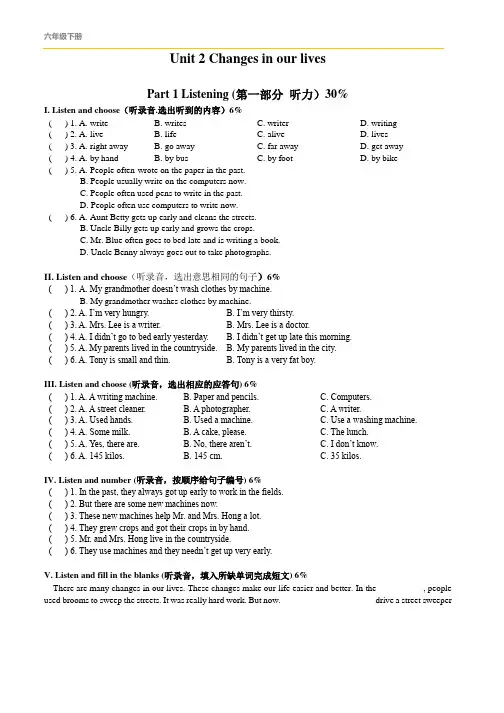
Unit 2 Changes in our livesPart 1 Listening (第一部分听力)30%I. Listen and choose(听录音.选出听到的内容)6%( ) 1. A. write B. writes C. writer D. writing( ) 2. A. live B. life C. alive D. lives( ) 3. A. right away B. go away C. far away D. get away( ) 4. A. by hand B. by bus C. by foot D. by bike( ) 5. A. People often wrote on the paper in the past.B. People usually write on the computers now.C. People often used pens to write in the past.D. People often use computers to write now.( ) 6. A. Aunt Betty gets up early and cleans the streets.B. Uncle Billy gets up early and grows the crops.C. Mr. Blue often goes to bed late and is writing a book.D. Uncle Benny always goes out to take photographs.II. Listen and choose(听录音,选出意思相同的句子)6%( ) 1. A. My grandmother doesn’t wash clothes by machine.B. My grandmother washes clothes by machine.( ) 2. A. I’m very hungry. B. I’m very thirsty.( ) 3. A. Mrs. Lee is a writer. B. Mrs. Lee is a doctor.( ) 4. A. I didn’t go to bed early yesterday. B. I didn’t get up late this morning.( ) 5. A. My parents lived in the countryside. B. My parents lived in the city.( ) 6. A. Tony is small and thin. B. Tony is a very fat boy.III. Listen and choose (听录音,选出相应的应答句) 6%( ) 1. A. A writing machine. B. Paper and pencils. C. Computers.( ) 2. A. A street cleaner. B. A photographer. C. A writer.( ) 3. A. Used hands. B. Used a machine. C. Use a washing machine.( ) 4. A. Some milk. B. A cake, please. C. The lunch.( ) 5. A. Yes, there are. B. No, there aren’t. C. I don’t know.( ) 6. A. 145 kilos. B. 145 cm. C. 35 kilos.IV. Listen and number (听录音,按顺序给句子编号) 6%( ) 1. In the past, they always got up early to work in the fields.( ) 2. But there are some new machines now.( ) 3. These new machines help Mr. and Mrs. Hong a lot.( ) 4. They grew crops and got their crops in by hand.( ) 5. Mr. and Mrs. Hong live in the countryside.( ) 6. They use machines and they needn’t get up very early.V. Listen and fill in the blanks (听录音,填入所缺单词完成短文) 6%There are many changes in our lives. These changes make our life easier and better. In the __________, people used brooms to sweep the streets. It was really hard work. But now. __________ __________ drive a street sweeperto clean the streets. I usually watched programs on TV, but now I never watch them on TV, because I can __________different programs on my __________. I’m a writer. I also write my books on it. Computers make my life fantastic. I __________in the future there will be more new things and t hey’ll help people a lot.Part 2 Reading and Writing (第二部分读写)60%I. Read and judge (判断下列各组单词划线部分的发音是否相同,相同的打“√”,不同的打“×”) 6%1. blow coat ( )2. house flower ( )3. hole crop ( )4. new grow ( )5. digital green ( )6. machine chair ( )II. Look and write (根据图意,填上适当的单词完成句子) 61. Little Match Girl is a p_____ girl. She has nothing to eat.2. The s_____ are very quiet in the early morning.3. Snow White and the seven dwarfs (矮人) had a happy 1_____4. I really like tennis. I am a tennis f_____.5. Do you want to go to the t_____ w ith me?6. My uncle d_____ a bus every day.III. Read and write (用所给单词的适当形式填空) 8%1. In the past, there __________ (be) a river near my home. Now there __________ (be) some tall buildings.2. __________ you __________ (sweep) the floor yesterday?3. __________ (farm) Wang grows vegetables.4. I’m tired. I would like to __________ (take) a rest.5. Don’t use that cup. It’s __________ (my).6. Sam usually __________ (go) to bed early, but yesterday he__________ (go) to sleep late.IV. Read and choose (选择填空) 10%( ) 1. The machine is helpful. It can clean the floor______.A. in the pastB. in a short timeC. in a long time( ) 2. I don’t like machines. I always do the washing ______.A. every dayB. by handC. by machine( ) 3. Long long ago, there ______ a lot of wild birds here.A. areB. wereC. is( ) 4. — How much do you weigh? —______A. 5 kilos.B. 500 kilos.C. 50 kilos.( ) 5. In the story, a fairy is ______.A. a beautiful ladyB. an ugly womanC. a handsome man( ) 6. — Helen, this new computer is for you. — ______A. How fun!B. How fantastic!C. How exciting( ) 7. I can’t find my broom, but it ______ here.A. wereB. wasC. is( ) 8. —How do you go to work every day? —______A. Take a bus.B. In the morning.C. On a bus.( ) 9. What do you usually do ______?A. nowB. after workC. yesterday( ) 10. I like using the digital camera, because______.A. it can take photosB. I can see the photos right awayC. it’s a good oneⅤ. Read and write(用适当的介词填空)6%1. Please take the photos ______ your new camera.2. My parents smiled ______ each other.3. I like washing my clothes ______ hand.4. We always enjoy ourselves ______ the weekend.5. My friend Peter has a house ______ a swimming pool.6. Would you like to go there ______ foot?Ⅵ. Rewrite the sentences (按要求改写下列句子) 7%1.People wrote letters on paper in the past. (改成一般疑问句)___________________________________________________________________________________________________ 2. Mr. White is a photographer. (对划线部分提问)___________________________________________________________________________________________________ 3. I was 100 days old in this photo. (对划线部分提问)___________________________________________________________________________________________________ 4. There was a lake in the village before. (对划线部分提问)___________________________________________________________________________________________________ 5. A street sweeper can clean the streets quickly. (对划线部分提问)___________________________________________________________________________________________________ 6. I would like to see a film. (另写一句,但意思不变)___________________________________________________________________________________________________ 7. Mr, apples, Lee, a, to, knife, cut, use, the (连词成句)___________________________________________________________________________________________________ VII. Read and match (读一读,把问答句配对) 6%( ) 1. Does your mother wash clothes by hand? A. I don’t know. But maybe they use a machine.( ) 2. You can make a wish on your birthday day. B. Yes. And I also take photos with my mobile (手机). ( ) 3. How does a farmer plant and get in crops? C. No. But there was a nice river outside the city.( ) 4. Was there a beautiful lake in the city? D. I don’t need any wishes, but thank you anyway.( ) 5. Do you take photographs with a camera? E. Usually. I rarely use pens and paper now.( ) 6. So you write on your computer? F. Oh, no. She used hands to wash clothes in the past. VIII. Read and choose (读一读,选择适当的句子完成对话) 5%Sam: Hi, Peter. ___1___Peter: Yes, it was a wonderful film.Sam: Really? What is the film about?Peter: ___2___Sam: Sounds interesting! So what changes did the film tell?Peter: A lot. For example, people rode horses or walked to a far place.Sam: ___3___Peter: Yes. There weren’t any mobile phones before.Sam: But now we can talk, read and watch TV on a mobile phone.Peter: ___4___ Inventions change our life.Sam: And make our life better! I want to see the film too!Peter: ___5___Sam: I think so.IX. Writing (请你写一写生活中,过去和现在有什么不一样,不少写六句) 6%In the past, people watched black and white TV. Now people watch color TV._______________________________ ___________________________________________________________________________________________________ ___________________________________________________________________________________________________ ___________________________________________________________________________________________________ ___________________________________________________________________________________________________ ___________________________________________________________________________________________________Part 3 Speaking (第三部分口语)10%I. Read aloud (朗读下列句子) 5%1. A photographer takes photos with digital cameras now.2. Fred and Doris smiled at each other and went away.3. I wish you a happy Spring Festival.4. There’s a poor farmer called Henry.5. Mrs. Hong got her crops in by hand in the past.II. Answer the question (回答问题) 5%1. Were you thin in the past?2. Do you live in the city or in the countryside?3. How does your mother wash dishes?4. What does a photographer do?5. What did people use to write in the past?Unit2 Changes in our livesPart 1 Listening (第一部分听力)I. Listen and choose (听录音, 选出听到的内容)1. In the future, I want to be a write. (C)2. There are a lot of changes and the life is better. (B)3. I will give you the book right away. (A)4. In the past, people usually went to work by bike. (D)5. People often use computers to write now. (D)6. Mr Blue often goes to bed late and is writing a book. (C)II. Listen and choose (听音,选出意思相同的句子)1. My grandmother likes washing clothes by hand. (A)2. I would like a glass of water. (B)3. Mrs Lee writes stories for children. (A)4. I went to bed very late last night. (A)5. My parents liked their old home. There were rivers and hills nearby. (A)6. Tony is 145 cm tall and weighs 60 kg. (B)III. Listen and choose (听录音,选出相应的应答)1. What did people use to write in the past? (B)2. Mr Wang drives a street sweeper. What’s his job? (A)3. How does your mother wash clothes? (C)4. What would you like to eat? (B)5. Are there many changes in our lives? (A)6. Alice is 10 years old. How much does Alice weigh? (C)IV. Listen and number (听录音,按顺序给句子编号)Mr and Mrs Hong live in the countryside. In the past, they always got up early to work in the fields. They grew crops and got their crops in by hand. But there are some new machines now. These new machines help Mr and Mrs Hong a lot. They use machines and they needn’t get up very early.(2,4,5,3,1,6)V. Listen and fill in the blanks (听录音,填入所缺单词完成短文)There are many changes in our lives. These changes make our life easier and better. In the past, people used brooms to sweep the streets. It was really hard work. But now, street cleaners drive a street sweeper to clean the streets. I usually watched programs on TV, but now I never watch them on TV, because I can watch different programs on my computer. I’m a writer.I also write my books on it. Computers make my life fantastic. I wish in the future there will be more new things and they’ll help people a lot.Part 2 Reading and writing (第二部分读写)I. 1. ✓ 2. ✓ 3. ✕ 4.✕ 5.✕ 6.✕II. 1. poor 2. streets 3. life 4. fan 5. theatre 6. drives III. 1. was, are 2. Did, sweep 3. Famer 4. take 5. mine 6. goes, went IV. 1. B 2. B 3. B 4. C 5. A 6. B7. B 8. A 9. B 10. BV. 1. with 2. at 3. by 4. at 5. with 6. onVI. 1.Did people write letters on paper in the past?2. What is Mr White?/What does Mr White do?/What is Mr White’s job?3. How old were you in this photo?4. How many lakes were there in the village before?5. What can a street sweeper do?6. I want to see a film.7. Mr Lee uses a knife to cut the apples.VII. 1. F 2. D 3. A 4. C 5. B 6. EVIII 1. E 2. A 3. D 4. B 5. C六年级下册。
Unit2第2课时Reading(课件)牛津译林版七年级英语上册
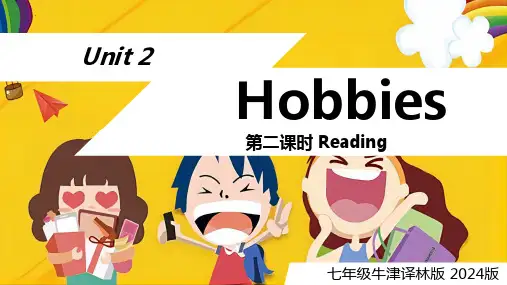
看图辩词
0123 在有限时间内说出对应照片的单词意思
和单词
change vt.使不同 vi.& n. 改变,变化
Part 4 WhileReading
the structure of the passage 凡是以大局为重,
“Always put the overall situation first”
thing
义 n.东西;事情
apart
义 adv.分开
秘 分成一个个部分a+part
形 something pron. = sth. anything pron. everything pron. nothing pron.
形 a- adv. part n.
拓 take apart 拆卸,拆开(机器等)
②Daniel is one of my new friends. Grammar: 一般现在时助动词结构的肯定句;
②一般现在时助动词结构的否定句
Be able to read about someone’s hobbies and understand how the hobbies help the
He thinks science is very cool. It is all around us. Science
两个主语,两个谓语,两个句子
changes our lives!
Main idea:Daniel likes to do something about science. Daniel often visits science museums. He gets to see all kinds of things and learns a lot. It is great fun for him. At home, he likes to take things apart and learn how they work. Now he can help fix things around the house! In his free time, Daniel reads many science books. He also goes on the internet to find answers to his endless questions.
信息技术环境下小学英语写作教学实践——以沪教版《英语》六下Unit2Changesinourlive
信息技术环境下小学英语写作教学实践 ——以沪教版《英语》六下Unit 2 Changes in our lives为例张晓荣发布时间:2023-05-31T00:34:18.966Z 来源:《教育学文摘》2023年6期作者:张晓荣[导读]山西省运城市夏县禹王中心校 044400教学目标:帮助学生了解并掌握课文《Changes in our lives》中的关键词汇和短语。
培养学生运用所学词汇和短语,描述日常生活中的变化的能力。
引导学生运用信息技术工具,进行小学英语写作实践。
教学准备:教师准备沪教版《英语》六下Unit 2的教材及教学课件。
学生准备笔记本电脑、平板电脑或其他信息技术设备。
教学过程:Step 1:导入新课(约5分钟)教师可以在课堂开始时播放一段有关科技对生活的影响的视频,引起学生对主题的兴趣,并激发他们的思考。
教师提问学生:“你们有没有注意到生活中的变化?科技对我们的生活有什么影响?”鼓励学生发表自己的观点,可以请几位学生分享他们的看法。
Step 2:预习课文(约10分钟)教师引导学生预览课文标题和图片,激发学生的想象力,引起他们对课文内容的兴趣。
学生与同伴合作,尝试猜测课文中可能出现的关键词汇和短语,并记录在笔记本电脑或平板电脑上。
教师鼓励学生分享他们的猜测,并逐个核对答案。
Step 3:学习课文(约20分钟)教师与学生一起朗读课文,并强调关键词汇和短语的发音和意义。
教师可以进行分角色朗读,让学生扮演不同的角色,增加参与度。
教师逐段解释课文内容,并利用图片、视频或其他多媒体资源帮助学生理解。
教师引导学生回答与课文内容相关的问题,帮助他们深入理解课文。
Step 4:词汇和短语练习(约10分钟)教师设计游戏或小组竞赛,帮助学生复习和巩固课文中的关键词汇和短语。
例如,可以进行卡片翻译游戏,将词汇或短语写在卡片上,学生根据教师的提示翻译并争取答题正确。
学生利用信息技术工具,如在线词汇卡片或词汇学习应用程序,进行个人练习,加强词汇记忆。
Unit 8 第2课时 课文讲解及句型拓展-六年级英语下册(牛津上海版)
5
C
5-2
Kitty: Look, our (1) __________ is flying very high.Ben: Yes. The wind blows (2) __________.Kitty: And the leaves move (3) __________.Ben: Look! The clouds move (4) __________.
careful
carefully
//
1
2
3
4
5
6
7
8
8-4
C
l
o
w
y
s
l
u
i
c
k
y
q
l
This is a __________ train. It travels __________.
This is a __________ train. It travels __________.
slow
slowly
1
2
3
4
5
watch
TV
typhoon
fiercely
falling
sinking
C
5-5
Ben: The typhoon passed very (19) __________. Let’s (20) __________ (21) __________ again!Kitty: OK. We must walk (22) __________ in the street. There is a lot of rubbish.Ben: Look! Some (23) ____________________ are cleaning the street now.
(沪教牛津版)六年级英语下册课件 MODULE2 unit2

together
Alice and Kitty are good friends. So they …
go to school together. play together. go home together. do homework together. … together.
the same or different
2. Read and recite “making new friends”.
in different blocks. Kitty lives in Block 1 and Alice lives in
Block 3.
2
Kitty and Alice usually go to school together.
Sometimes they like to eat their lunch together and share their food.
We like each other. We are good friends.
Think and write
My friend is _____.
help each other. share our lunch/breakfast/sweets/biscuits. always walk/go to school together. We usually do our homework together. sometimes ride our bicycles together. watch television together. play together after school/at the weekend.
Ocean Park
Water World
M2 Unit 2《Changes in our lives》第一课时教学设计分析
M2 Unit 2《Changes in our lives》第一课时教学设计分析【摘要】本文主要分析了M2 Unit 2《Changes in our lives》第一课时的教学设计。
在文章介绍了背景信息并明确了教学目的。
接着在正文部分分别从教学内容分析、教学方法与手段、教学步骤安排、评估方式和教学反思等方面对教学设计进行了详细的分析和阐述。
最后在文章总结了教学设计的要点,并展望了未来的发展方向。
教学效果也进行了评价和反馈。
通过对教学设计的全面分析,文章旨在提高教学效果,促进学生的学习兴趣和能力,为教学实践提供重要的借鉴和指导。
【关键词】引言、背景介绍、教学目的、教学内容分析、教学方法与手段、教学步骤安排、评估方式、教学反思、结论、教学设计总结、展望未来发展、教学效果评价。
1. 引言1.1 背景介绍M2 Unit 2《Changes in our lives》第一课时旨在帮助学生了解生活中的变化,并提供相关词汇和语法知识以便他们描述这些变化。
随着社会的快速发展和科技的不断进步,我们的生活方式也在不断发生变化。
了解这些变化对于学生来说是非常重要的,因为他们需要适应新的生活方式并且理解这些变化对他们自身生活的影响。
通过本课的学习,学生将能够更好地理解并描述生活中的变化,丰富他们的词汇和语法知识,并提高他们的口语表达能力。
本课的教学内容将涵盖生活中常见的变化情况,如技术的发展、社会的改变、生活方式的转变等,旨在引导学生探讨这些变化背后的原因以及对我们生活的影响。
通过本课的学习,学生将不仅能够提高他们的英语水平,还能够思考自身生活中的变化并积极适应这些变化。
1.2 教学目的1. 帮助学生了解生活中的变化是如何影响人们的日常生活的。
2. 引导学生思考科技发展对社会生活的影响,培养学生的创新意识和未来发展的能力。
3. 培养学生对变化的认知和适应能力,让他们能更好地适应社会的发展和变化。
2. 正文2.1 教学内容分析教学内容分析:本课程主要围绕着“Changes in our lives”这一主题展开,旨在帮助学生了解和思考人们生活中的变化。
牛津版小学六年级下册6BUnit2 Changes in our lives教案说课讲解
T:Yes, he’s a cook.A cook makes nice food.He uses a frying pan.
While-task procedures
1. 教师出示一些工具的图片,如医生用的听诊器,厨师用的锅等,让学生把工具与职业配对。加入电脑、镰刀照相机和扫帚,并利用look and learn的图片导入单词writer,farmer,photographer及street cleaner
Ican hear a car.
然后教师在黑板上写上“in the past”和“now”让学生列出过去和现在的交通方式,最后进行总结。
练习设计
Group work
Make new dialogue in groups .
作业批改
记 录
板书设计
Unit2 Changes in our lives
Life, write, street cleaner,drive,
教学难点:
●一般过去时和一般现在时在一定语境中的混合使用。
Unit2 Changes in our lives
Period 1
教学目标
[知识目标]
通过look and learn学习新词汇并复习以前学过的表示各种职业的词汇。
[能力目标]
1.通过Listen and say的短文复习一般过去时和一般现在时,对比过去和过去工作方式的不同。
2.请学生跟读新词汇,教师设计问题鼓励学生运用这些新词汇。
3.播放listen and say 的录音,学生逐句跟读。鼓励学生尽量模仿录音中人物的语音语调。
Post-task activities
1. 学生四人一组进行角色扮演。每人任选一个角色,说说自己做的事,其他人猜猜是哪些人物。
六年级英语下册六单元task 2作文
六年级英语下册六单元task 2作文全文共3篇示例,供读者参考篇1Unit 6: Living in the FutureTask 2: WritingIn the future, our lives will be very different from what they are now. There will be advanced technology, better transportation, and even changes in the way we communicate with each other. Let's take a look at what life might be like in the future.First of all, technology will play a huge role in our daily lives. We will have robots that can do all kinds of tasks for us, from cooking to cleaning to driving us around. These robots will make our lives easier and more convenient. We will also have advanced gadgets like holographic phones and flying cars that will help us get around faster and more efficiently.In terms of transportation, there will be major improvements in the future. We will have self-driving cars that can take us anywhere we want to go without us having to lift a finger. Public transportation will also be faster and more efficient, withhigh-speed trains and even hoverboards becoming common modes of transportation.Communication will also change in the future. Instead of texting or calling each other, we will be able to communicate through holograms and virtual reality. This will make it feel like we are talking to each other face-to-face, even if we are miles apart. Social media will also become more immersive, with virtual reality platforms allowing us to interact with each other in new and exciting ways.Overall, the future looks bright and full of exciting possibilities. With advanced technology, better transportation, and changes in the way we communicate, our lives will be transformed in ways we can't even imagine. It's an exciting time to be alive, and I can't wait to see what the future has in store for us.篇2Unit 6: Task 2Topic: My Favorite AnimalHello everyone, today I am going to talk about my favorite animal. My favorite animal is the tiger. Tigers are majesticcreatures that are known for their strength and beauty. They are also one of the largest species of big cats in the world.Tigers have a distinctive orange and black striped fur which helps them camouflage in the wild. They have sharp claws and teeth that they use to hunt for food. Tigers are carnivores, which means they mainly eat meat. They hunt for animals such as deer, wild pigs, and even buffaloes.One of the main reasons why I love tigers is because of their strength and agility. They are excellent hunters and can run at incredibly fast speeds. Tigers are also good swimmers and are not afraid to enter the water to catch their prey.Unfortunately, tigers are an endangered species due to habitat loss and poaching. It is estimated that there are only around 3,900 tigers left in the wild. Conservation efforts are being made to protect these beautiful animals and ensure their survival for future generations.In conclusion, tigers are amazing animals that deserve our respect and protection. I hope that we can all work together to save the tigers and ensure that they continue to roam the forests for years to come. Thank you for listening to my presentation.篇3Unit 6: Task 2My Favorite TripTraveling is one of my favorite things to do, and I have been lucky enough to go on many trips in my life. However, one trip that stands out as the most memorable is the time I went to Paris with my family.We had been planning the trip for months, and I was so excited to finally be able to see the Eiffel Tower in person. When we arrived in Paris, the first thing we did was go to the top of the tower. The view from up there was amazing! We could see the entire city spread out below us, with the River Seine winding its way through the streets.After exploring the Eiffel Tower, we spent the next few days visiting all the famous landmarks in Paris, such as the Louvre museum, Notre Dame Cathedral, and the Palace of Versailles. Each place we visited was more beautiful than the last, and I was in awe of the history and culture that surrounded me.One of the highlights of the trip was trying all the delicious French food. I had never tasted such amazing croissants and pastries before! We also went to a traditional French restaurantand tried escargot for the first time. It was a little strange at first, but I ended up loving it!Overall, my trip to Paris was an unforgettable experience. I will always remember the sights, sounds, and tastes of the city, and I can't wait to go back someday. Traveling truly opens your eyes to the world around you, and I am grateful for the opportunity to explore new places and cultures. Paris will always hold a special place in my heart as my favorite trip of all time.。
我们生活的改变英语作文六下沪教第二单元
我们生活的改变英语作文六下沪教第二单元全文共3篇示例,供读者参考篇1The Change of Our LifeLiving in the 21st century, our lives have undergone dramatic changes due to the rapid development of technology and the globalization of economies. These changes have influenced every aspect of our daily life, shaping our behaviors, values, and relationships.One significant change in our lives is the way we communicate. With the advent of the internet and social media platforms, we can now instantly connect with people from all over the world. This has revolutionized the way we interact with our friends and family, as well as how we conduct business and stay informed about global events. The ease and convenience of communication have made our world feel smaller and more interconnected than ever before.Another major change in our lives is the way we work. With the rise of technology and automation, many traditional jobs have been replaced by machines, leading to a shift in the labormarket. As a result, many of us are now working in industries that didn't even exist a decade ago, such as app development, social media marketing, and e-commerce. This has required us to constantly adapt and learn new skills in order to stay competitive in the ever-evolving job market.Furthermore, the way we consume information and entertainment has also changed significantly. With the rise of streaming services like Netflix and Spotify, we now have access to a vast amount of content at our fingertips. This has led to a decline in traditional forms of media, such as newspapers and television, as more and more people turn to online platforms for their news and entertainment needs.In addition, our shopping habits have also been transformed by the rise of e-commerce. With the convenience of online shopping, many of us now prefer to make purchases from the comfort of our own homes rather than braving the crowds at brick-and-mortar stores. This shift has not only changed the way we shop but has also had a significant impact on the retail industry, with many traditional stores struggling to compete with online giants like Amazon.Overall, the changes in our lives have been both exciting and challenging. While the advancements in technology havebrought us closer together and improved our quality of life in many ways, they have also presented us with new challenges and uncertainties. As we navigate this ever-changing landscape, it is important for us to embrace these changes, adapt to new realities, and continue to learn and grow in order to thrive in the digital age.篇2The Changes in Our LivesIn the fast-paced modern world, our lives are constantly changing and evolving. From technological advancements to cultural shifts, our daily routines and habits are often influenced by the many changes happening around us. In this essay, I will discuss some of the key changes that have impacted our lives, particularly in the context of the second unit of the Shanghai Education Curriculum for sixth graders.One of the most significant changes in our lives is the rapid advancement of technology. With the advent of smartphones, the internet, and social media, our communication and social interactions have been revolutionized. We now have instant access to information, can connect with people around the world at the touch of a button, and can even work remotely fromanywhere. This has changed the way we communicate, learn, and engage with the world around us.Another major change in our lives is the increasing focus on environmental sustainability. With growing awareness of climate change and its impact on the planet, people are becoming more conscious of their carbon footprint and are making efforts to reduce waste and conserve resources. This is reflected in the education curriculum, where students are taught about the importance of protecting the environment and taking steps to live more sustainably.In addition to technological and environmental changes, our lives have also been shaped by cultural shifts. Globalization has brought people of different backgrounds and beliefs closer together, leading to a more diverse and interconnected society. This cultural diversity is celebrated in the curriculum, where students learn about different cultures and traditions from around the world.Overall, the changes in our lives are inevitable and necessary for progress. By embracing these changes and adapting to them, we can stay resilient and thrive in the ever-evolving world. As we continue to navigate the complexities of modern life, it is important to remember the importance of resilience,adaptability, and open-mindedness in embracing change and shaping a better future for ourselves and the world.篇3Changes are a fundamental aspect of life. We experience changes in our personal lives, in our communities, and in the world at large. In the second unit of Shanghai Educational Publishing House's sixth grade English textbook, we learn about the various changes that affect our lives and how we can adapt to them.One of the main themes of the unit is the impact of technology on our daily lives. Technology has transformed the way we communicate, work, and entertain ourselves. From smartphones to social media, technology has become an integral part of our everyday routines. We can now connect with people from all over the world with the click of a button, access information instantly, and even work remotely from the comfort of our homes. However, this rapid advancement in technology also comes with challenges, such as the need to balance screen time with real-life interactions and the potential for privacy breaches.Another significant change that we explore in the unit is the importance of protecting the environment. With the rise of global warming and pollution, it has become increasingly crucial for us to make sustainable choices in our daily lives. From reducing waste to conserving energy, we can all play a part in preserving the planet for future generations. Through activities and discussions in the unit, we learn about the impact of our actions on the environment and how we can make a positive difference.Moreover, the unit also highlights the importance of adaptability and resilience in the face of change. As we navigate through life, we will inevitably encounter obstacles and setbacks. It is essential to develop the skills to cope with these challenges and bounce back stronger. By cultivating a growth mindset and being open to learning from our experiences, we can become more resilient individuals.Overall, the second unit of the sixth-grade English textbook teaches us valuable lessons about the changes that shape our lives. From the impact of technology to the importance of environmental conservation and resilience, we gain insights into how we can adapt to a rapidly changing world. As we continueour educational journey, we will carry these lessons with us and apply them to the challenges and opportunities that lie ahead.。
Unit 2 Changes in our lives(同步练习)沪教牛津版(深圳用)英语六年级下册
第1课时Listen and say & Look and learn一、根据图片和首字母提示填空。
1.My neighbour is a street c .She cleans the street.2 A w uses a computer to write books now.3. F get the crops in in autumn.4.My uncle is a photographer. He usually t photos for others.5.Tiantian's father is busy every day. He d a taxi around the city.二、从方框中选择合适的词组完成句子。
A. with a broomB. in a short timeC.take photosD.by handE.in our lives1.There are many changes .2.My grandparents grew crops. in the past.3.Longlong often sweeps the floor .4.Now few people use film to .5.The washing machine can wash clothes .三、单项选择。
( )1.The photographer used to take photos in the past.A. penB. filmC. broom( )2.Now most people like or playing on a computer.A. writeB. writesC. writing ( )3.You can see the pictures on your digital camera .A. by handB. right awayC. far away ( )4.In the factory,workers use machines to work .A.in a short timeB.have a good timeC.in a good time四、阅读短文内容,完成下面任务。