
上海市静安区2014届高三英语一模试卷(含答案及听力文字)
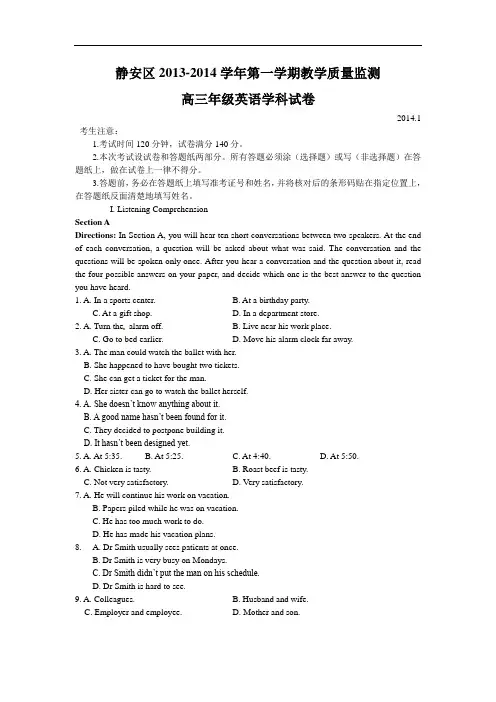
静安区2013学年第一学期高三年级模拟检测英语试卷2014. 1.第I卷(共103分)I. Listening ComprehensionSection ADirections: In Section A, you will hear ten short conversations between two speakers. At the end of each conversation, a question will be asked about what was said. The conversation and the questions will be spoken only once. After you hear a conversation and the question about it, read the four possible answers on your paper, and decide which one is the best answer to the question you have heard.1. A. In a sports center. B. At a birthday party.C. At a gift shop.D. In a department store.2. A. Turn the alarm off. B. Live near his work place.C. Go to bed earlier.D. Move his alarm clock far away.3. A. The man could watch the ballet with her. B. She happened to have bought two tickets.C. She can get a ticket for the man.D. Her sister can go to watch the ballet herself.4. A. She doesn‟t know anything about it. B. A goo d name hasn‟t been found for it.C. They decided to postpone building it.D. It hasn‟t been designed yet.5. A. At 5:35. B. At 5:25. C. At 4:40. D. At 5:50.6. A. Chicken is tasty. B. Roast beef is tasty.C. Not very satisfactory.D. Very satisfactory.7. A. He will continue his work on vacation. B. Papers piled while he was on vacation.C. He has too much work to do.D. He has made his vacation plans.8. A. Dr Smith usually sees patients at once. 小水制作B. Dr Smith is very busy on Mondays.C. Dr Smith didn‟t put the man on his schedule.D. Dr Smith is hard to see.9. A. Colleagues. B. Husband and wife.C. Employer and employee.D. Mother and son.10. A. The man should change his plan.B. The man can go camping tomorrow.C. Weather forecasts are not available.D. The man won‟t have to go camping.Section BDirections: In Section B, you will hear two short passages, and you will be asked three questions on each of the passages. The passages will be read twice, but the questions will be spoken only once. When you hear a question, read the four possible answers on your paper and decide which one would be the best answer to the question you have heard.Questions 11 through 13 are based on the following passage.11. A. The poor places are getting richer. B. The rich places are getting richer.C. The poor places are getting poorer.D. Both B and C.12. A. The poor are unemployed. B. All the poor have no land.C. The poor have no houses in big cities.D. There is no hope for the poor in the village.13. A. Rural unemployment. B. Urban unemployment.C. No housing in the villages.D. No foreign aid in the villages.Questions 14 through 16 are based on the following passage.14. A. She could never overcome difficulties.B. She had problems with other children.C. She had trouble communicating with others.D. She suffered from severe learning disability.15. A. A person whose experience can inspire others.B. A person with a remarkable memory.C. A person who has a better understanding.D. A person with special education.16. A. Always listen to doctor‟s advice. B. Never give up in face of difficulties.C. Always get encouragement from others.D. Never compare yourself with others.Section CDirections: In Section C, you will hear two longer conversations. The conversations will be read twice. After you hear each conversation, you are required to fill in the numbered blanks with information you have heard. Write your answers on your answer sheet.Blanks 17 through 20 are based on the following conversation.Complete the message. Write ONE WORD for each answer.Blanks 21 through 24 are based on the following conversation.Complete the form. Write NO MORE THAN THREE WORDS for each answer.II. Grammar and VocabularySection ADirections: After reading the passages below, fill in the blanks to make the passages coherent and grammatically correct. For the blanks with a given word, fill in each blank with the proper form of the given word; for the other blanks, use one word that best fits each blank.( A )Mother Teresa was born in Yugoslavia, on August 27, 1910. She attended the government school near her home until she was eighteen. At that time, some doctors and nurses from Yugoslavia were working in India, and they often (25)_______(write) to the school about their work. She decided to join them one day.When she left school, she first went to Britain. Then a year later she went to India, where she began(26)_______(train)to be a teacher. After training, she was sent to Calcutta, (27)_______she taught geography at a school and soon after became headmistress.However, (28)_______she loved teaching, in 1946 Mother Teresa left the school and went to work in the poor parts of Calcutta. Later she was trained to become a nurse in Patna, and then began her work helping the poor and comforting the dying in the streets of the city. Slowly, (29)_______ came to help her, and her work spread to other parts of India.Mother Teresa is now a well-known person. Many photos (30)_______ (take) of her, (31)_______ she travels around the world to open new schools and hospitals in poor countries. In 1979, she was given the Nobel Prize for the lifetime of love and service she has given to the poor.( B )On any collecting trip, obtaining the animals is, as a rule, the simplest part of the job. As soon as the local people discover that you are willing to buy live wild creatures, the stuff comes(32)_______ (pour) in; ninety percent is, of course, the more common types, but they do bring(33)_______occasional rarity. If you want the really rare stuff, you generally have to go out and find it yourself.The chief difficulty you have when you have got a newly (34)______ (catch) animal is not so much the shock it might be suffering, but the fact (35)_______being caught forces it to exist close to a creature it regards as an enemy of the (36)_______ (bad) possible sort: yourself. On many occasions an animal may take beautifully to being in a cage but (37)_______ (get) used to the idea of living with people is another matter. This is the difficulty you (38)_______only deal with by patience and kindness. For month after month an animal may try to bite you every time you approach its cage, (39)_______you despair of ever making a favorable impression on it. Then, one day, sometimes without any preliminary warning, it will trot forward and take food from your hand, or allow you to tickle it behind the ears. (40)_______ such moments you feel that all the waiting in the world was worthwhile.Section BDirections: Complete the following passage by using the words in the box. Each word can onlyIn giving advice, you must learn to understand the person‟s level of judgment. There will be some people who come to you with unconnected knowledge, talking about, say, Vitamin B12 and other modern__41__. When they ask advice, begin at that level. Unless you start at their own level, they will not be able to understand. You must explain to them in scientific terms the effects of the food they eat, and how they need to __42__it.You have to train yourself to be very__43__. Staying at one level is not being a free man. If we stay at a very high level all the time, that is not practical. A limitless person goes __44__from one level of thinking to another, according to his circumstances. To do this we must get rid of our unwillingness to change our way of thinking or behavior, become friends with everyone, and have the same loving feelings for everyone. Then we can give advice to all kinds of people. If there is someone or something you dislike, you are still__45__, and your ability to give advice is reduced. For anyone, the same. A free person acts like that.You cannot stay with a sick person all the time. You must __46__ a person‟s freedom as much as you can. If people really want to die, let them—it is their freedom. The point is never to become an authority__47__; remain a friend or advisor. People should not come back __48__for consultation; if they do, your advice has been incomplete—you did not know how to give the __49__advice about freedom. If they do not understand that, sick people become slaves; they are still afraid inside, and are__50__. That is no way to build a healthy world and help people become happy and free. 小水作品III. Reading ComprehensionSection ADirections: For each blank in the following passage there are four words or phrases marked A, B, C and D. Fill in each blank with the word or phrase that best fits the context.You‟ve now heard it so many time, you can probably repeat it in your sleep. President Obama will no doubt __51__the point publicly when he gets to Beijing: the Chinese need to __52__more; they need—believe it or not—to become more like Americans, for the sake of the global economy.And it‟s all true. __53__the other side of that equation is that the U.S. needs to save more. For the moment, American households actually are doing so. After the personal-savings rate __54__to zero in 2005, the shock of the economic __55__last year prompted people to snap __56__their wallets. In China, the household-savings rate exceeds 20%. It is partly for policy__57__. As we‟ve seen, wage earners are expected to __58__not only their children but their aging parents. And there is, to date, only the flimsiest (脆弱的) of publicly-funded health care and pension systems, which increases incentives for individuals to save __59__they are working. But China is a society that has __60__esteemed personal financial prudence (谨慎). There is no __61__that will change anytime soon, even if the government creates a better social safety net and successfully encourages greater consumer spending.Why does the U.S. need to learn a little frugality (节俭)? Because healthy savings rates are one of the surest indicators of a country‟s long-term financial health. High savings lead, over time, to increased investment, which in turn generates productivity gains, __62__and job growth. __63__, savings are the seed corn of a good economic harvest.The U.S. government thus needs to act as well. By running __64__deficits, it is dis-saving, even as households save more. Peter Orszag, Obama‟s Budget Director, __65__called the U.S. budget deficits unsustainable and he‟s r ight. To date, the U.S. has seemed unable to see the consequences of spending so much more than is taken in. That needs to change.51. A. play B. take C. make D. give52. A. concern B. process C. promote D. consume53. A. But B. Therefore C. However D. Furthermore54. A. drained B. dipped C. discounted D. dissolved55. A. issues B. crisis C. troubles D. questions56. A. cut B. put C. shut D. get57. A. reasons B. situations C. areas D. zones58. A. take off B. break out C. make up D. care for59. A. unless B. before C. after D. while60. A. long B. short C. good D. bad61. A. doubt B. wonder C. chance D. problem62. A. condition B. action C. innovation D. location63. A. In general B. In short C. In addition D. In a sense64. A. significant B. constant C. conscious D. stable65. A. occasionally B. consequently C. recently D. accidentallySection BDirections: Read the following three passages. Each passage is followed by several questions or unfinished statements. For each of them there are four choices marked A, B, C and D. Choose the one that fits best according to the information given in the passage you have just read.(A)When people think of improving their diet, they often talk about eating more fruits and vegetables. Others want to eat more fish and less red meat, in addition to reducing the amount of food they eat. But, they can improve their diets even more with just a simple addition. American researchers have found that a diet rich in spices can help reduce the harmful effects of eating high fat meals.Pennsylvania State University Associate Professor Shiela West led an investigation of the health effects of a spice-rich diet. Her team knew that a high-fat meal produces high levels of triglycerides (甘油三脂), a kind of fat, in the blood. She said, “If this happens too frequently, or if triglyceride levels are raised too much, your risk of heart disease is increased.”As part of the study, her team prepared meals on two separate days for six men between theages of 30 and 65. The men were overweight, but healthy. The researchers added about 30 milliliters of spices to each serving of the test meal, which included chicken curry, Italian herb bread and a cinnamon (肉桂树皮)biscuit. The meal for the control group was the same, but it did not include any spices.小水制作During the experiment, the researchers removed blood from the men every 30 minutes for three hours. They found that antioxidant activity (抗氧化活性) in the blood of the men who ate the spicy meal was 13 percent higher than it was for the men who did not. In addition, insulin (胰岛素) activity dropped by about 20 percent in the men who ate the spicy food.Shiela West says many scientists think that oxidative stress leads to heart disease. And what exactly is oxidative stress? Think of an apple that has been cut in half and set aside for half an hour or so. The cut side of the apple turns brown. That is a simple explanation of what happens when oxidative stress comes in contact with the inside and outside of our bodies.Professor West says, “Antioxidants, like spices, may be important in reducing oxidative stress and thus reducing the risk of chronic disease.” She adds that the level of spices used in the study provided the same amount of antioxidants found in 150 milliliters of red wine or about 38 grams of dark chocolate.66. What does the author advise people to do in their diets?A. Eating large amount of food.B. Eating less fruits and vegetables.C. Eating more vegetables and fish.D. Eating small amount of food with spices.67. What is the function of spices according to the passage?A. To help people lose weight.B. To cure chronic disease.C. To reduce the risk of heart disease.D. To cause oxidative stress.68. What happened to the men who ate the spicy meal according to the experiment?A. The antioxidant activity in their blood became increased.B. The insulin activity in their body became increased.C. The level of triglyceride in their blood was increased.D. The oxidative stress in their body was strengthened.69. What does Professor West show by citing the example of a half apple?A. The whole thing can be divided into two parts.B. It implies oxidative stress is harmful to our health.C. An apple is the only food that contains antioxidants.D. We can keep diseases away if we have an apple a day.( B )Which tablet computer should YOU be buying: They are this year's must have... and there's a style to suit everyone?more). Besides,access to the internet your child to inappropriate.Pros: The well-designed, one to choose.Pros: No otherthe near one millioncreated for specially-designedprograms) available for the iPad. Simple to use, even for thosework? No tablet can yet compete withlaptop computer, butallows you to use MicrosoftPowerpoint (they arecrisp black letteringon paper brilliantly. And yet you can still readthe words in the dark.Pros:Easylife, 180,000 free books (if you subscribe to theAmazon Prime70. The underlined phrase …stumble across‟ most probably means …___________‟.A. meet withB. quarrel withC. compare withD. compete with71. Which of the following about Surface is NOT TRUE?A. The keyboard will add to the cost.B. The keyboard can serve as a cover.C. You have to pay extra to install Microsoft Word.D. You can watch movies or surf the Internet with it.72. If you are a game lover, which tablet is least likely to be your choice?A. LeapPad Explorer 2.B. iPad 4th generation.C. Microsoft Surface.D. Amazon Kindle Paper73. If you want to add something to your prepared PPT for a presentation at a meeting, whichtablet is most helpful?A. LeapPad Explorer 2.B. iPad 4th generation.C. Microsoft Surface.D. Amazon Kindle Paper.(C )We are not who we think we are.The American self-image is suffused with the golden glow of opportunity. We think of the United States as a land of unlimited possibility, not so much a classless society but as a place where class is mutable—a place where brains, energy and ambition are what counts, not the circumstances of one's birth. 小水作品The Economic Mobility Project, an ambitious research initiative led by Pew Charitable Trusts, looked at the economic fortunes of a large group of families over time, comparing the income of parents in the late 1960s with the income of their children in the late 1990s and early 2000s. Here is the finding: "The 'rags to riches' story is much more common in Hollywood than on Main Street. Only 6 percent of children born to parents with family income at the very bottom move to the top.That is right, just 6 percent of children born to parents who ranked in the bottom fifth of the study sample, in terms of income, were able to bootstrap their way into the top fifth. Meanwhile, an incredible 42 percent of children born into that lowest quintile are still stuck at the bottom, having been unable to climb a single rung of the income ladder.It is noted that even in Britain-a nation we think of as burdened with a hidebound class system-children who are born poor have a better chance of moving up. When the three studies were released, most reporters focused on the finding that African-Americans born to middle-class or upper middle-class families are earning slightly less, in inflation-adjusted dollars, than did their parents.One of the studies indicates, in fact, that most of the financial gains white families have made in the past three decades can be attributed to the entry of white women into the labor force. This is much less true for African-Americans.The picture that emerges from all the quintiles, correlations and percentages is of a nation in which, overall, "the current generation of adults is better off than the previous one", as one of the studies notes.The median income of the families in the sample group was $55,600 in the late 1960s; their children's median family income was measured at $71,900. However, this rising tide has not lifted all boats equally. The rich have seen far greater income gains than have the poor.Even more troubling is that our notion of America as the land of opportunity gets little support from the data. Americans move fairly easily up and down the middle rungs of the ladder, but there is "stickiness at the ends" —four out of ten children who are born poor will remain poor, and four out often who are born rich will stay rich.74. What did the Economic Mobility Project find in its research?A. Children from low-income families are unable to bootstrap their way to the top.B. Hollywood actors and actresses are upwardly mobile from rags to riches.C. The rags to riches story is more fiction than reality.D. The rags to riches story is only true for a small minority of whites.75. It can be inferred from the undertone of the writer that America, as a classless society, should________.小水制作A. perfect its self-image as a land of opportunityB. have a higher level of upward mobility than BritainC. enable African-Americans to have exclusive access to well-paid employmentD. encourage the current generation to work as hard as the previous generation76. Which of the following statements is TRUE according to the passage?A. The US is a land where brains, energy and ambition are what counts.B. Inequality persists between whites and blacks in financial gains.C. Middle-class families earn slightly less with inflation considered.D. Children in lowest-income families manage to climb a single rung of the ladder.77. What might be the best title for this passage?A. Social Upward Mobility.B. Incredible Income Gains.C. Inequality in Wealth.D. America Not Land of Opportunity.Section CDirections: Read the passage carefully. Then answer the questions or complete the statements in the fewest possible words.It is 2035. You have a job, a family and you are about 40 years old! Welcome to your future life.Getting ready for work, you pause in front of the mirror. “Turn red,” you say. Your shirt changes from sky blue to deep red. Tiny preprogrammed electronics are rearranged in your shirt to change its color. Looking into the mirror, you find it hard to believe you‟re 40. You look much younger. With amazing progress in medicine, people in your generation may live to be 150 years old. You are not even middle-aged!As you go into the kitchen and prepare to pour your breakfast cereal into a bowl, you hear, “To lose weight, you shouldn‟t eat that,” from your shoes. They read the tiny electronic code on the cereal box to find out the nutrition details. You decide to listen to your shoes. “Kitchen, what can I have for breakfast?” A list of possi ble foods appears on the counter as the kitchen checks its food supplies. P.F. Productions后期制作“Ready for your trip to space?” you ask your son and daughter. In 2005 only specially trained astronauts went into space—and very few of them. Today anyone can go to space for day trips or longer vacations. Your best friend even works in space. Handing your children three strawberries each, you add, “The doctor said you need these for space travel.” Thanks to medical progress, vaccination shots (防疫针) are a thing of the past. Ordinary foods contain the vaccines. With the strawberries in their mouths, the kids head for the front door.It‟s time for you to go to work. Your car checks your fingerprints and unlocks the doors. “My office, Autopilot,” you o rder. Your car drives itself down the road and moves smoothly into trafficon the highway. You sit back and unroll your e-newspaper. The latest news downloads and fills the viewer. Looking through the pages, you watch the news as video film rather than read it. (Notes: Answer the questions or complete the statements in NO MORE THAN TWELVE WORDS.)78. What changes the color of your shirt?79. T he shoes know that you shouldn‟t eat the breakfast cereal by__________.80. What do the strawberries the children eat serve as?81. In the future, when you look through the pages in the e-newspapers, ___________.第II卷(共47分)I. TranslationDirections: Translate the following sentences into English, using the words given in the brackets.1. 这份工作这么难, 没几个人能胜任。
静安区高三英语质量检测卷

静安区2014年高三英语质量检测卷II. Grammar and VocabularySection ADirections: After reading the passages below, fill in the blanks to make the passages coherent and grammatically correct. For the blanks with a given word, fill in each blank with the proper form of the given word; for the other blanks, use one word that best fits each blank.( A )Mother Teresa was born in Yugoslavia, on August 27, 1910. She attended the government school near her home until she was eighteen. At that time, some doctors and nurses from Yugoslavia were working in India, and they often (25)_______(write) to the school about their work. She decided to join them one day.When she left school, she first went to Britain. Then a year later she went to India, where she began(26)_______(train)to be a teacher. After training, she was sent to Calcutta, (27)_______she taught geography at a school and soon after became headmistress.However, (28)_______she loved teaching, in 1946 Mother Teresa left the school and went to work in the poor parts of Calcutta. Later she was trained to become a nurse in Patna, and then began her work helping the poor and comforting the dying in the streets of the city. Slowly, (29)_______ came to help her, and her work spread to other parts of India.Mother Teresa is now a well-known person. Many photos (30)_______ (take) of her, (31)_______ she travels around the world to open new schools and hospitals in poor countries. In 1979, she was given the Nobel Prize for the lifetime of love and service she has given to the poor.( B )On any collecting trip, obtaining the animals is, as a rule, the simplest part of the job. As soon as the local people discover that you are willing to buy live wild creatures, the stuff comes(32)_______ (pour) in; ninety percent is, of course, the more common types, but they do bring(33)_______occasional rarity. If you want the really rare stuff, you generally have to go out and find it yourself.The chief difficulty you have when you have got a newly (34)______ (catch) animal is not so much the shock it might be suffering, but the fact (35)_______being caught forces it to exist close to a creature it regards as an enemy of the (36)_______ (bad) possible sort: yourself. On many occasions an animal may take beautifully to being in a cage but (37)_______ (get) used to the idea of living with people is another matter. This is the difficulty you (38)_______only deal with by patience and kindness. For month after month an animal may try to bite you every time you approach its cage, (39)_______you despair of ever making a favorable impression on it. Then, one day, sometimes without any preliminary warning, it will trot forward and take food from your hand, or allow you to tickle it behind the ears. (40)_______ such moments you feel that all the waiting in the world was worthwhile.Section BDirections: Complete the following passage by using the words in the box.Each word can only be used once. Note that there is one word more than you need.some people who come to you with unconnected knowledge, talking about, say, Vitamin B12 and other modern__41__. When they ask advice, begin at that level. Unless you start at their own level, they will not be able to understand. You must explain to them in scientific terms the effects of the food they eat, and how they need to __42__it.You have to train yourself to be very__43__. Staying at one level is not being a free man. If we stay at a very high level all the time, that is not practical. A limitless person goes __44__from one level of thinking to another, according to his circumstances. To do this we must get rid of our unwillingness to change our way of thinking or behavior, become friends with everyone, and have the same loving feelings for everyone. Then we can give advice to all kinds of people. If there is someone or something you dislike, you are still__45__, and your ability to give advice is reduced. For anyone, the same. A free person acts like that.You cannot stay with a sick person all the time. You must __46__ a person’s freedom as much as you can. If people really want to die, let them—it is their freedom. The point is never to become an authority__47__; remain a friend or advisor. People should not come back __48__for consultation; if they do, your advice has been incomplete—you did not know how to give the __49__advice about freedom. If they do not understand that, sick people become slaves; they are still afraid inside, and are__50__. That is no way to build a healthy world and help people become happy and free.III. Reading ComprehensionSection ADirections: For each blank in the following passage there are four words or phrases marked A, B, C and D. Fill in each blank with the word or phrase that best fits the context.You’ve now heard it so many time, you can probably repeat it in your sleep. President Obama will no doubt __51__the point publicly when he gets to Beijing: the Chinese need to __52__more; they need—believe it or not—to become more like Americans, for the sake of the global economy.And it’s all true. __53__the other side of that equation is tha t the U.S. needs to save more. For the moment, American households actually are doing so. After the personal-savings rate __54__to zero in 2005, the shock of the economic __55__last year prompted people to snap __56__their wallets. In China, the household-savings rate exceeds 20%. It is partly for policy__57__. As we’ve seen, wage earners are expected to __58__not only their children but their aging parents. And there is, to date, only the flimsiest (脆弱的) of publicly-funded health care and pension systems, which increases incentives for individuals to save __59__they are working. But China is a society that has __60__esteemed personal financial prudence (谨慎). There is no __61__that will change anytime soon, even if the government creates a better social safety net and successfully encourages greater consumer spending.Why does the U.S. need to learn a little frugality (节俭)?Because healthy savings rates are one of the surest indicators of a country’s long-term financial health. High savings lead, over time, to increased investment, which in turn generates productivity gains, __62__and job growth. __63__, savings are the seed corn of a good economic harvest.The U.S. government thus needs to act as well. By running __64__deficits, it is dis-saving, even as house holds save more. Peter Orszag, Obama’s Budget Director, __65__called the U.S.budget deficits unsustainable and he’s right. To date, the U.S. has seemed unable to see the consequences of spending so much more than is taken in. That needs to change.51. A. play B. take C. make D. give52. A. concern B. process C. promote D. consume53. A. But B. Therefore C. However D. Furthermore54. A. drained B. dipped C. discounted D. dissolved55. A. issues B. crisis C. troubles D. questions56. A. cut B. put C. shut D. get57. A. reasons B. situations C. areas D. zones58. A. take off B. break out C. make up D. care for59. A. unless B. before C. after D. while60. A. long B. short C. good D. bad61. A. doubt B. wonder C. chance D. problem62. A. condition B. action C. innovation D. location63. A. In general B. In short C. In addition D. In a sense64. A. significant B. constant C. conscious D. stable65. A. occasionally B. consequently C. recently D. accidentallySection BDirections: Read the following three passages. Each passage is followed by several questions or unfinished statements. For each of them there are four choices marked A, B, C and D. Choose the one that fits best according to the information given in the passage you have just read.(A)When people think of improving their diet, they often talk about eating more fruits and vegetables. Others want to eat more fish and less red meat, in addition to reducing the amount of food they eat. But, they can improve their diets even more with just a simple addition. American researchers have found that a diet rich in spices can help reduce the harmful effects of eating high fat meals.Pennsylvania State University Associate Professor Shiela West led an investigation of the health effects of a spice-rich diet. Her team knew that a high-fat meal produces high levels of triglycerides(甘油三脂), a kind of fat, in the blood. She said, “If this happens too frequently, or if triglyceride levels are r aised too much, your risk of heart disease is increased.”As part of the study, her team prepared meals on two separate days for six men between the ages of 30 and 65. The men were overweight, but healthy. The researchers added about 30 milliliters of spices to each serving of the test meal, which included chicken curry, Italian herb bread and a cinnamon(肉桂树皮)biscuit. The meal for the control group was the same, but it did not include any spices.During the experiment, the researchers removed blood from the men every 30 minutes for three hours. They found that antioxidant activity(抗氧化活性) in the blood of the men who ate the spicy meal was 13 percent higher than it was for the men who did not. In addition, insulin(胰岛素) activity dropped by about 20 percent in the men who ate the spicy food.Shiela West says many scientists think that oxidative stress leads to heart disease. And what exactly is oxidative stress? Think of an apple that has been cut in half and set aside for half an hour or so. The cut side of the apple turns brown. That is a simple explanation of what happenswhen oxidative stress comes in contact with the inside and outside of our bodies.Professor West says, “Antioxidants, like spices, may be important in reducing oxidative stress and thus redu cing the risk of chronic disease.” She adds that the level of spices used in the study provided the same amount of antioxidants found in 150 milliliters of red wine or about 38 grams of dark chocolate.66. What does the author advise people to do in their diets?A. Eating large amount of food.B. Eating less fruits and vegetables.C. Eating more vegetables and fish.D. Eating small amount of food with spices.67. What is the function of spices according to the passage?A. To help people lose weight.B. To cure chronic disease.C. To reduce the risk of heart disease.D. To cause oxidative stress.68. What happened to the men who ate the spicy meal according to the experiment?A. The antioxidant activity in their blood became increased.B. The insulin activity in their body became increased.C. The level of triglyceride in their blood was increased.D. The oxidative stress in their body was strengthened.69. What does Professor West show by citing the example of a half apple?A. The whole thing can be divided into two parts.B. It implies oxidative stress is harmful to our health.C. An apple is the only food that contains antioxidants.D. We can keep diseases away if we have an apple a day.( B )Which tablet computer should YOU be buying: They are this year's must have... andBest for young childrenLeapPad Explorer 2, £68Aimed at children betweenthree and nine (though anine-year-old might find it alittle simple), it comes in pinkor blue and with five built-ineducation games (you can buymore). Besides, the LeapPad does not allow access to the internet —so it is impossible for your child to stumble across anything inappropriate.Pros: The education games are well-designed, the built-in video camera is a fun way to play at being a film director.Cons:Some of the games are shockingly expensive. And the power adaptor is not included. Best for teenagersiPad 4th generation, £399-£659The iPad is still themarket leader, and for goodreason. If the teenager inyour house enjoys playingcomputer games, the latestoffering from Apple is theone to choose.Pros: No other tablet can compete with the near one million ‘apps’ (the name Apple created for specially-designed downloadable programs) available for the iPad. Simple to use, even for those who usually struggle with technology.Cons: Considerably more expensive than most competitors.Best for working parents Best for bookwormsMicrosoft Surface, £399-£559Tablets are brilliantfor leisure — but what ifyou want to do a bit ofwork? No tablet can yetcompete with a full-size laptop computer, but this is the only tablet that allows you to use Microsoft Word, Excel and Powerpoint (they are all pre-installed and included in the price) and you can buy a pretty lovely mini- keyboard for typing letters and emails, which also doubles up as the cover.Pros:The Surface is good for watching movies — a bonus when stuck in the airport on a business trip — and surfing the internet.Con: The keyboard is an expensive add-on —costing up to £109. It might be cheaper to buy a laptop (though a tablet is much smaller and lighter). Amazon Kindle Paperwhite, £109Nearly all tablets let youdownload books. It's a great wayto take a mountainous pile ofhardbacks on holiday withoutstuffing your suitcase.But most tablets have a shiny screen —which can be very distracting when you're trying to read. The Paperwhite is different: its matt screen and crisp black lettering imitate the look of words on paper brilliantly. And yet you can still read the words in the dark.Pros:Easy on the eye, excellent battery life, 180,000 free books (if you subscribe to the Amazon Prime customer loyalty service) plus hundreds of thousands more to buy.Cons:No TV, films, games, internet or camera.70. The underlined phrase ‘stumble across’ most probably means ‘___________’.A. meet withB. quarrel withC. compare withD. compete with71. Which of the following about Surface is NOT TRUE?A. The keyboard will add to the cost.B. The keyboard can serve as a cover.C. You have to pay extra to install Microsoft Word.D. You can watch movies or surf the Internet with it.72. If you are a game lover, which tablet is least likely to be your choice?A. LeapPad Explorer 2.B. iPad 4th generation.C. Microsoft Surface.D. Amazon Kindle Paper73. If you want to add something to your prepared PPT for a presentation at a meeting, whichtablet is most helpful?A. LeapPad Explorer 2.B. iPad 4th generation.C. Microsoft Surface.D. Amazon Kindle Paper.(C )We are not who we think we are.The American self-image is suffused with the golden glow of opportunity. We think of the United States as a land of unlimited possibility, not so much a classless society but as a place where class is mutable—a place where brains, energy and ambition are what counts, not the circumstances of one's birth.The Economic Mobility Project, an ambitious research initiative led by Pew Charitable Trusts, looked at the economic fortunes of a large group of families over time, comparing the income of parents in the late 1960s with the income of their children in the late 1990s and early 2000s. Here is the finding: "The 'rags to riches' story is much more common in Hollywood than on Main Street.Only 6 percent of children born to parents with family income at the very bottom move to the top.That is right, just 6 percent of children born to parents who ranked in the bottom fifth of the study sample, in terms of income, were able to bootstrap their way into the top fifth. Meanwhile, an incredible 42 percent of children born into that lowest quintile are still stuck at the bottom, having been unable to climb a single rung of the income ladder.It is noted that even in Britain-a nation we think of as burdened with a hidebound class system-children who are born poor have a better chance of moving up. When the three studies were released, most reporters focused on the finding that African-Americans born to middle-class or upper middle-class families are earning slightly less, in inflation-adjusted dollars, than did their parents.One of the studies indicates, in fact, that most of the financial gains white families have made in the past three decades can be attributed to the entry of white women into the labor force. This is much less true for African-Americans.The picture that emerges from all the quintiles, correlations and percentages is of a nation in which, overall, "the current generation of adults is better off than the previous one", as one of the studies notes.The median income of the families in the sample group was $55,600 in the late 1960s; their children's median family income was measured at $71,900. However, this rising tide has not lifted all boats equally. The rich have seen far greater income gains than have the poor.Even more troubling is that our notion of America as the land of opportunity gets little support from the data. Americans move fairly easily up and down the middle rungs of the ladder, but there is "stickiness at the ends" —four out of ten children who are born poor will remain poor, and four out often who are born rich will stay rich.74. What did the Economic Mobility Project find in its research?A. Children from low-income families are unable to bootstrap their way to the top.B. Hollywood actors and actresses are upwardly mobile from rags to riches.C. The rags to riches story is more fiction than reality.D. The rags to riches story is only true for a small minority of whites.75. It can be inferred from the undertone of the writer that America, as a classless society, should________.A. perfect its self-image as a land of opportunityB. have a higher level of upward mobility than BritainC. enable African-Americans to have exclusive access to well-paid employmentD. encourage the current generation to work as hard as the previous generation76. Which of the following statements is TRUE according to the passage?A. The US is a land where brains, energy and ambition are what counts.B. Inequality persists between whites and blacks in financial gains.C. Middle-class families earn slightly less with inflation considered.D. Children in lowest-income families manage to climb a single rung of the ladder.77. What might be the best title for this passage?A. Social Upward Mobility.B. Incredible Income Gains.C. Inequality in Wealth.D. America Not Land of Opportunity.Section CDirections: Read the passage carefully. Then answer the questions or complete the statements in the fewest possible words.It is 2035. You have a job, a family and you are about 40 years old! Welcome to your future life.Getting ready for work, you pause in front of the mirror. “Turn red,” you say. Your shirt changes from sky blue to deep red. Tiny preprogrammed electronics are rearranged in your shirt to change its color. Looking into the mirror, you find it hard to believe you’re 40. You look much younger. With amazing progress in medicine, people in your generation may live to be 150 years old. You are not even middle-aged!As you go into the kitchen and prepare to pour your breakfast cereal into a bowl, you hear, “To lose weight, you shouldn’t eat that,” from your shoes. They read the tiny electronic code on the cereal box to find out t he nutrition details. You decide to listen to your shoes. “Kitchen, what can I have for breakfast?” A list of possible foods appears on the counter as the kitchen checks its food supplies.“Ready for your trip to space?” you ask your son and daughter. In 2005 only specially trained astronauts went into space—and very few of them. Today anyone can go to space for day trips or longer vacations. Your best friend even works in space. Handing your children three strawberries each, you add, “The doctor said you need these for space travel.” Thanks to medical progress, vaccination shots(防疫针) are a thing of the past. Ordinary foods contain the vaccines. With the strawberries in their mouths, the kids head for the front door.It’s time for you to go to work. Your car checks your fingerprints and unlocks the doors. “My office, Autopilot,” you order. Your car drives itself down the road and moves smoothly into traffic on the highway. You sit back and unroll your e-newspaper. The latest news downloads and fills the viewer. Looking through the pages, you watch the news as video film rather than read it. (Notes: Answer the questions or complete the statements in NO MORE THAN TWELVE WORDS.)78. What changes the color of your shirt?79. The shoes know that you shouldn’t e at the breakfast cereal by__________.80. What do the strawberries the children eat serve as?81. In the future, when you look through the pages in the e-newspapers, ___________.第II卷(共47分)I. TranslationDirections: Translate the following sentences into English, using the words given in the brackets.1. 这份工作这么难, 没几个人能胜任。
上海市静安区2014年高三上学期教学质量检测(高考一模)英语试题及答案(附听力音频及文本)
静安区2013-2014学年第一学期教学质量监测高三年级英语学科试卷2014.1 考生注意:1.考试时间120分钟,试卷满分140分。
2.本次考试设试卷和答题纸两部分。
所有答题必须涂(选择题)或写(非选择题)在答题纸上,做在试卷上一律不得分。
3.答题前,务必在答题纸上填写准考证号和姓名,并将核对后的条形码贴在指定位置上,在答题纸反面清楚地填写姓名。
I. Listening ComprehensionSection ADirections: In Section A, you will hear ten short conversations between two speakers. At the end of each conversation, a question will be asked about what was said. The conversation and the questions will be spoken only once. After you hear a conversation and the question about it, read the four possible answers on your paper, and decide which one is the best answer to the question you have heard.1. A. In a sports center. B. At a birthday party.C. At a gift shop.D. In a department store.2. A. Turn the alarm off. B. Live near his work place.C. Go to bed earlier.D. Move his alarm clock far away.3. A. The man could watch the ballet with her.B. She happened to have bought two tickets.C. She can get a ticket for the man.D. Her sister can go to watch the ballet herself.4. A. She doesn’t know anything about it.B. A good name hasn’t been found for it.C. They decided to postpone building it.D. It hasn’t been designed yet.5. A. At 5:35. B. At 5:25. C. At 4:40. D. At 5:50.6. A. Chicken is tasty. B. Roast beef is tasty.C. Not very satisfactory.D. Very satisfactory.7. A. He will continue his work on vacation.B. Papers piled while he was on vacation.C. He has too much work to do.D. He has made his vacation plans.8. A. Dr Smith usually sees patients at once.B. Dr Smith is very busy on Mondays.C. Dr Smith didn’t put the man on his schedule.D. Dr Smith is hard to see.9. A. Colleagues. B. Husband and wife.C. Employer and employee.D. Mother and son.10. A. The man should change his plan.B. The man can go camping tomorrow.C. Weather forecasts are not available.D. The man won’t have to go camping.Section BDirections: In Section B, you will hear two short passages, and you will be asked three questions on each of the passages. The passages will be read twice, but the questions will be spoken only once. When you hear a question, read the four possible a nswers on your paper and decide which one would be the best answer to the question you have heard.Questions 11 through 13 are based on the following passage.11. A. The poor places are getting richer. B. The rich places are getting richer.C. The poor places are getting poorer.D. Both B and C.12. A. The poor are unemployed. B. All the poor have no land.C. The poor have no houses in big cities.D. There is no hope for the poor in the village.13. A. Rural unemployment. B. Urban unemployment.C. No housing in the villages.D. No foreign aid in the villages.Questions 14 through 16 are based on the following passage.14.A. She could never overcome difficulties.B. She had problems with other children.C. She had trouble communicating with others.D. She suffered from severe learning disability.15.A. A person whose experience can inspire others,B. A person with a remarkable memory,C. A person who has a better understanding,D. A person with special education,16.A. Always listen to doctor’s advice. B. Never give up in face of difficulties.C. Always get encouragement from others.D. Never compare yourself with others.Section CDirections: In Section C, you will hear two longer conversations. The conversations will be read twice. After you hear each conversation, you are required to fill in the numbered blanks with information you have heard. Write your answers on your answer sheet.Blanks 17 through 20 are based on the following conversa tion.The man’s problem Doesn’t know how to__17__ the numbers on.The woman’s suggestion First, press Shift F- __18__.Second, press __19__.Thirdly, print.Explanation Numbers don’t show up on the screen but they willbe on the printed __20__.Blanks 21 through 24 are based on the following conversation.Complete the form. Write NO MORE THAN THREE WORDS for each answer.What does the man complain about? The quality of ____21____.What is the problem? The screen always ___22___.Where is the repair center? On the 7th Floor, ____23____.What will the company do if there is anyTo let the customer ____24____.problem concerning the quality?II. Grammar and VocabularySection ADirections: After reading the passages below, fill in the blanks to make the passages coherent and grammatically correct. For the blanks with a given word, fill in each blank with the proper form of the given word; for the other blanks, use one word that best fits each blank.( A )Mother Teresa was born in Yugoslavia, on August 27, 1910. She attended the government school near her home until she was eighteen. At that time, some doctors and nurses from Yugoslavia were working in India, and they often (25)_______(write) to the school about their work. She decided to join them one day.When she left school, she first went to Britain. Then a year later she went to India, where she began(26)_______(train)to be a teacher. After training, she was sent to Calcutta, (27)_______she taught geography at a school and soon after became headmistress.However, (28)_______she loved teaching, in 1946 Mother Teresa left the school and went to work in the poor parts of Calcutta. Later she was trained to become a nurse in Patna, and then began her work helping the poor and comforting the dying in the streets of the city. Slowly, (29)_______ came to help her, and her work spread to other parts of India.Mother Teresa is now a well-known person. Many photos (30)_______ (take) of her, (31)_______ she travels around the world to open new schools and hospitals in poor countries. In 1979, she was given the Nobel Prize for the lifetime of love and service she has given to the poor.( B )On any collecting trip, obtaining the animals is, as a rule, the simplest part of the job. As soon as the local people discover that you are willing to buy live wild creatures, the stuff comes(32)_______ (pour) in; ninety percent is, of course, the more common types, but they do bring(33)_______occasional rarity. If you want the really rare stuff, you generally have to go out and find it yourself.The chief difficulty you have when you have got a newly (34)______ (catch) animal is not so much the shock it might be suffering, but the fact (35)_______being caught forces it to exist close to a creature it regards as an enemy of the (36)_______ (bad) possible sort: yourself. On many occasions an animal may take beautifully to being in a cage but (37)_______ (get) used to the idea of living with people is another matter. This is the difficulty you (38)_______only deal with bypatience and kindness. For month after month an animal may try to bite you every time you approach its cage, (39)_______you despair of ever making a favorable imp ression on it. Then, one day, sometimes without any preliminary warning, it will trot forward and take food from your hand, or allow you to tickle it behind the ears. (40)_______ such moments you feel that all the waiting in t he world was worthwhile.Section BDirections: Complete the following passage by using the words in the box.Each word can only be used once. Note that there is one word more than you need.A. changeB. repeatedlyC. dependentD. limitedE. flexibleF. properG. respect H. concepts I. explained J. freely K. figureIn giving advice, you must learn to understand the person’s level of judgment. There will be some people who come to you with unconnected knowledge, talking about, say, Vitamin B12 and other modern__41__. When they ask advice, begin at that level. Unless you start at their own level, they will not be able to understand. You must explain to them in scientific terms the effects of the food they eat, and how they need to __42__it.You have to train yourself to be very__43__. Staying at one level is no t being a free man. If we stay at a very high level all the time, that is not practical. A limitless person goes __44__from one level of thinking to another, according to his circumstances. To do this we must get rid of our unwillingness to change our way of thinking or behavior, become friends with everyone, and have the same loving feelings for everyone. Then we can give advice to all kinds of people. If there is someone or something you dislike, you are still__45__, and your ability to give advice is reduce d. For anyone, the same. A free person acts like that.You cannot stay with a sick person all the time. You must __46__ a person’s freedom as much as you can. If people really want to die, let them—it is their freedom. The point is never to become an authority__47__; remain a friend or advisor. People should not come back __48__for consultation; if they do, your advice has been incomplete—you did not know how to give the __49__advice about freedom. If they do not understand that, sick people become slaves; they are still afraid inside, and are__50__. That is no way to build a healthy world and help people become happy and free.III. Reading ComprehensionSection ADirections: For each blank in the following passage there are four words or phrases marked A, B, C and D. Fill in each blank with the word or phrase that best fits the context.You’ve now heard it so many time, you can probably repeat it in your sleep. President Obama will no doubt __51__the point publicly when he gets to Beijing: the Chinese need to __52__more; they need—believe it or not—to become more like Americans, for the sake of the global economy.And it’s all true. __53__the other side of that equation is that the U.S. needs to save more.For the moment, American households actually are doing so. After the personal-savings rate __54__to zero in 2005, the shock of the economic __55__last year prompted people to snap __56__their wallets. In China, the household-savings rate exceeds 20%. It is partly for policy__57__. As we’ve seen, wage earners are expected to __58__not only their children but their aging parents. And there is, to date, only the flimsiest (脆弱的) of publicly-funded health care and pension systems, which increases incentives for individuals to save__59__they are working. But China is a society that has __60__esteemed personal financial prudence (谨慎). There is no __61__that will change anytime soon, even if the government creates a better social safety net and successfully encourages greater consumer spending.Why does the U.S. need to learn a little frugality (节俭)?Because healthy savings rates are o ne of the surest indicators of a country’s long-term financial health. High savings lead, over time, to increased investment, which in turn generates productivity gains, __62__and job growth. __63__, savings are the seed corn of a good economic harvest.The U.S. government thus needs to act as well. By running __64__deficits, it is dis-saving, even as households save more. Peter Orszag, Obama’s Budget Director, __65__called the U.S. budget deficits unsustainable and he’s right. To date, the U.S. has seemed unable to see the consequences of spending so much more than is taken in. That needs to change.51. A. play B. take C. make D. give52. A. concern B. process C. promote D. consume53. A. But B. Therefore C. However D. Furthermore54. A. drained B. dipped C. discounted D. dissolved55. A. issues B. crisis C. troubles D. questions56. A. cut B. put C. sh ut D. get57. A. reasons B. situations C. areas D. zones58. A. take off B. break out C. make up D. care for59. A. unless B. before C. after D. while60. A. long B. short C. good D. bad61. A. doubt B. wonder C. chance D. problem62. A. condition B. action C. innovation D. location63. A. In general B. In short C. In addition D. In a sense64. A. significant B. constant C. conscious D. stable65. A. occasionally B. consequently C. recently D. accidentallySection BDirections: Read the following three passages. Each passage is followed by several questions or unfinished statements. For each of them there are four choices marked A, B, C and D. Choose the one that fits best according to the information given in the passage you have just read.(A)When people think of improving their diet, they often talk about eating more fruits and vegetables. Others want to eat more fish and less red meat, in addition to reducing the amount of food they eat. But, they can improve their diets even more with just a simple addition. American researchers have found that a diet rich in spices can help reduce the harmful effects of eating high fat meals.Pennsylvania State University Associate Professor Shiela West led an investigation of the health effec ts of a spice-rich diet. Her team knew that a high-fat meal produces high levels of triglycerides(甘油三脂), a kind of fat, in the blood. She said, “If this happens too frequently, or if triglyceride levels are raised too much, your risk of heart disease is increased.”As part of the study, her team prepared meals on two separate days for six men between theages of 30 and 65. The men were overweight, but healthy. The researchers added about 30 milliliters of spices to each serving of the test meal, which included chicken curry, Italian herb bread and a cinnamon(肉桂树皮)biscuit. The meal for the control group was the same, but it did not include any spices.During the experiment, the researchers removed blood from the men every 30 minutes for three hours. They found that antioxidant activity(抗氧化活性) in the blood of the men who ate the spicy meal was 13 percent higher than it was for the men who did not. In addition, insulin(胰岛素) activity dropped by about 20 percent in the men who ate the spicy food.Shiela West says many scientists think that oxidative stress leads to heart disease. And what exactly is oxidative stress? Think of an apple that has been cut in half and set aside for half an hour or so. The cut side of the apple turns brown. That is a simple explanation of what happens when oxidative stress comes in contact with the inside and outside of our bodies.Professor West says, “Antioxidants, like spices, may be important in reducing oxidative stress and thus reducing the risk of chronic disease.” She adds that the level of spi ces used in the study provided the same amount of antioxidants found in 150 milliliters of red wine or about 38 grams of dark chocolate.66. What does the author advise people to do in their diets?A. Eating large amount of food.B. Eating less fruits and vegetables.C. Eating more vegetables and fish.D. Eating small amount of food with spices.67. What is the function of spices according to the passage?A. To h elp people lose weight.B. To cure chronic disease.C. To reduce the risk of heart disease.D. To cause oxidative stress.68. What happened to the men who ate the spicy meal according to the experiment?A. The antioxidant activity in their blood became increased.B. The insulin activity in their body became increased.C. The level of triglyceride in their blood was increased.D. The oxidative stress in their body was strengthened.69. What does Professor West show by citing the example of a half apple?A. The whole thing can be divided into two parts.B. It implies oxidative stress is harmful to our health.C. An apple is the only food that contains antioxidants.D. We can keep diseases away if we have an apple a day.( B )Which tablet computer should YOU be buying: They are this year's must have... and there's a style to suit everyone?Best for young childrenLeapPad Explorer 2, £68Aimed at chil drenbetween three and nine (thougha nine-year-old might find it alittle simple), it comes in pinkor blue and with five built-ineducation games (you can buy Best for teenagersiPad 4th generation, £399-£659The iPad is still themarket leader, and for goodreason. If the teenager inyour house enjoys playingcomputer games, the latestoffering from Apple is themore). Besides, the LeapPad does not allow access to the internet —so it is impossible for your child to stumble across anything inappropriate.Pros: The education games are well-designed, the built-in video camera is a fun way to play at being a film director.Cons:Some of the games are shockingly expensive. And the power adaptor is not included. one to choose.Pros: No other tablet can compete with the near one million ‘apps’ (the name Apple created for specially-designed downloadable programs) available for the iPad. Simple to use, even for those who usually struggle with technology.Cons: Considerably more expensive than most competitors.Best for working parentsMicrosoft Surface, £399-£559Tablets are brilliantfor leisure — but what ifyou want to do a bit ofwork? No tablet can yet compete with a full-size laptop computer, but this is the only tablet that allows you to use Microsoft Word, Excel and Powerpoint (they are all pre-installed and included in the price) and you can buy a pretty lovely mini- keyboard for typing letters and emails, which also doubles up as the cover.Pros:The Surface is good for watching movies — a bonus when stuck in the airport on a business trip — and surfing the internet.Con: The keyboard is an expensive add-on —costing up to £109. It might be cheaper to buy a laptop (though a tablet is much smaller and lighter).Best for bookwormsAmazon Kindle Paperwhite, £109Nearly all tablets let you download books. It's a great way to take a mountainous pile of hardbacks on holiday without stuffing your suitcase.But most tablets have ashiny screen —which can bevery distracting when you'retrying to read. The Paperwhiteis different: its matt screen and crisp black lettering imitate the look of words on paper brilliantly. And yet you can still read the words in the dark.Pros:Easy on the eye, excellent battery life, 180,000 free books (if you subscribe to the Amazon Prime customer loyalty service) plus hundreds of thousands more to buy.Cons:No TV, films, games, internet or camera.70. The underlined phrase ‘stumble across’ most probably means ‘___________’.A. meet withB. quarrel withC. compare withD. compete with71. Which of the following about Surface is NOT TRUE?A. The keyboard will add to the cost.B. The keyboard can serve as a cover.C. You have to pay extra to install Microsoft Word.D. You can watch movies or surf the Internet with it.72. If you are a game lover, which tablet is least likely to be your choice?A. LeapPad Explorer 2.B. iPad 4th generation.C. Microsoft Surface.D. Amazon Kindle Paper73. If you want to add something to your prepared PPT for a presentation at a meeting, whichtablet is most helpful?A. LeapPad Explorer 2.B. iPad 4th generation.C. Microsoft Surface.D. Amazon Kindle Paper.(C )We are not who we think we are.The Am erican self-image is suffused with the golden glow of opportunity. We think of the United States as a land of unlimited possibility, not so much a classless society but as a place where class is mutable—a place where brains, energy and ambition are what counts, not the circumstances of one's birth.The Economic Mobility Project, an ambitious research initiative led by Pew Charitable Trusts, looked at the economic fortunes of a large group of families over time, comparing the income of parents in the late 1960s with the income of their children in the late 1990s and early 2000s. Here is the finding: "The 'rags to riches' story is much more common in Hollywood tha n on Main Street. Only 6 percent of children born to parents with family income at the very bottom move to the top.That is right, just 6 percent of children born to parents who ranked in the bottom fifth of the study sample, in terms of income, were able to bootstrap their way into the top fifth. Meanwhile, an incredible 42 percent of children born into that lowest quintile are still stuck at the bottom, having been unable to climb a single rung of the income ladder.It is noted that even in Britain-a nation we think of as burdened with a hidebound class system-children who are born poor have a better chance of moving up. When the three studies were released, most reporters focused on the finding that African-Americans born to middle-class or upper middle-class families are earning slightly less, in inflation-adjusted dollars, than did their parents.One of the studies indicates, in fact, that most of the financial gains white families have made in the past three decades can be attributed to the entry of white women into the labor force. This is much less true for African-Americans.The picture that emerges from all the quintiles, correlations and percentages is of a nation in which, overall, "the current generation of adults is better off than the previous one", as one of the studies notes.The median income of the families in the sample group was $55,600 in the late 1960s; their children's median family income was measured at $71,900. However, this rising tide has not lifted all boats equally. The rich have seen far greater income gains than have the poor.Even more troubling is that our notion of America as the land of opportunity gets little support from the data. Americans move fairly easily up and down the middle rungs of the ladder, but there is "stickiness at the ends" —four out of ten children who are born poor will remain poor, and four out often who are born rich will stay rich.74. What did the Economic Mobility Project find in its research?A. Children from low-income families are unable to bootstrap their way to the top.B. Hollywood actors and actresses are upwardly mobile from rags to riches.C. The rags to riches story is more fiction than reality.D. The rags to riches story is only true for a small minority of whites.75. It can be inferred from the undertone of the writer that America, as a classless society, should________.A. perfect its self-image as a land of opportunityB. have a higher level of upward mobility than BritainC. enable African-Americans to have exclusive access to well-paid employmentD. encourage the current generation to work as hard as the previous generation76. Which of the following statements is TRUE according to the passage?A. The US is a land where brains, energy and ambition are what counts.B. Inequality persists between whites and blacks in financial gains.C. Middle-class families earn slightly less with inflation considered.D. Children in lowest-income families manage to climb a single rung of the ladder.77. What might be the best title for this passage?A. Social Upward Mobility.B. Incredible Income Gains.C. Inequality in Wealth.D. America Not Land o f Opportunity.Section CDirections: Read the passage carefully. Then answer the questions or complete the statements in the fewest possible words.It is 2035. You have a job, a family and you are about 40 years old! Welcome to your future life.Getting ready for work, you pause in front of the mirror. “Turn red,” you say. Your shirt changes from sky blue to deep red. Tiny preprogrammed electronics are rearranged in your shirt to change its color. Looking into the mirror, you find it hard to believe you’re 40. You look much younger. With amazing progress in medicine, people in your generation may live to be 150 years old. You are not even middle-aged!As you go into the kitchen and prepare to pour your breakfast cereal into a bowl, you hear, “To lose weight, you shouldn’t eat that,” from your shoes. They read the tiny electronic code on the cereal box to find out the nutrition details. You decide to listen to your shoes. “Kitchen, what can I have for breakfast?” A li st of possible foods appears on the counter as the kitchen checks its food supplies.“Ready for your trip to space?” you ask your son and daughter. In 2005 only specially trained astronauts went into space—and very few of them. Today anyone can go to space for day trips or longer vacations. Your best friend even works in space. Handing your children three strawberries each, you add, “The doctor said you need these for space travel.” Thanks to medical progress, vaccination shots(防疫针) are a thing of the past. Ordinary foods contain the vaccines. With the strawberries in their mouths, the kids head for the front door.It’s time for you to go to work. Your car checks your fingerprints and unlocks the doors. “My office, Autopilot,” you order. Your car drives i tself down the road and moves smoothly into traffic on the highway. You sit back and unroll your e-newspaper. The latest news downloads and fills the viewer. Looking through the pages, you watch the news as video film rather than read it. (Notes: Answer the questions or complete the statements in NO MORE THAN TWELVE WORDS.)78. What changes the color of your shirt?79. The shoes know that you shouldn’t eat the breakfast cereal by__________.80. What do the strawberries the children eat serve as?81. In the future, when you look through the pages in the e-newspapers, ___________.第II卷(共47分)I. TranslationDirections: Translate the following sentences into English, using the words given in the brackets.1.这份工作这么难, 没几个人能胜任。
静安区英语一模卷
第一学期高三英语试卷2014. 12(120分钟完成; 总分:150分)第I卷(共103 分)(第I卷试题的答案请做在答题卡上)Section ADirections: In Section A, you will hear ten short conversations between two speakers. At the end of each conversation, a question will be asked about what was said. The conversations and questions will be spoken only once. After you hear a conversation and the question about it, read the four possible answers on your paper, and decide which one is the best answer to the question you have heard.1. A. At the man’s office. B. At the woman’s office.C. In a cinema.D. Outside their dormitory.2. A. She likes fruit salad. B. She eats whatever she likes.C. She prefers to be on a diet.D. She is afraid of gaining weight.3. A. 7:30. B. 7:40. C. 7:50. D.8:00.4. A. Tim’s excellent performance. B. Tim’s assignment.C. Tim’s graduation day.D. Tim’s study habit s.5. A. Husband and wife. B. Manager and customer.C. Hostess and guest.D. Teacher and student.6. A. He has no interest in wild life protection.B. He ca n’t join the group.C. He is sorry to fail in the examination.D. He’s already busy with the Student Union issue.7. A. Price of petrol. B. Bus fare.C. Traffic condition.D. Petrol shortage.8. A. They’ll have to get some more paint.B. They should get someone to help them.C. They shouldn’t delay any longer.D. They don’t have to paint the room again.9. A. Summer vacation. B. Language learning.C. Pleasure of traveling.D. Studying abroad .10. A. The woman wants to go to Toronto. B. The man wants to go to Vancouver.C. There are no flights to Toronto.D. There are two direct flights to Toronto. Section BDirections:In Section B, you will hear two short passages, and you will be asked three questions on each of the passages. The passages will be read twice, but the questions will be spoken only once. When you hear a question, read the four possible answers on your paper and decide which one would be the best answer to the question you have heard.Questions 11 through 13 are based on the following passage.11. A. She explained the functions of the BCD International.B. She described some popular singers.C. She played a new record.D. She introduced the radio program to listeners.12. A. About the Big Hits. B. The History of Pop.C. The Road to Music.D. Pop Words.13. A. To introduce new singers and songwriters.B. To provide the background with music.C. To help to understand the words to the big music hits.D. To hear from listeners’ opinions on music.Questions 14 through 16 are based on the following passage.14. A. To achieve high marks in study.B. To develop their own interests.C. To be responsible for their parents.D. To discover subjects outside class.15. A. Because there are so few rules.B. Because there are too many rules.C. Because they hate to take part in activities.D. Because they are afraid to make mistakes.16. A. Teachers show little interest in open education.B. Most traditional teachers support open education.C. Many teachers quite enjoy open education.D. Some traditional teachers do not like open education.Section CDirections:In Section C, you will hear two longer conversations. The conversations will be read twice. After you hear each conversation, you are required to fill in the numbered blanks with the information you hear. Write your answers on your answer sheet.Blanks 17 through 20 are based on the following conversation.Blanks 21 through 24 are based on the following conversation.II. Grammar and VocabularySection ADirections:After reading the passages below, fill in the blanks to make the passages coherent and grammatically correct. For the blanks with a given word, fill in each blank with the proper form of the given word; for the other blanks, use one word that best fits each blank.(A)There are 101 excuses for not writing or calling the media when you see unfair, biased or inaccurate news coverage: “I don’t know enough”; “I’m too busy”; “My computercrashed.”If media outlets get letters from a dozen people(28)_______ (raise) the same issue, they will most likely publish one or two of them. So even if your letter(29)_______ ( not get) into print, it may help another one with a similar point of view get published. Surveys of newspaper readers show that the letters page is among the most closely read parts of the paper. It’s also the page policy-makers look to as a barometer of public opinion.(30)_______ you write to journalists, be factual, not rhetorical (带修辞色彩的). Do not personally attack them; that’s more likely to convince them that they’re in the right. Address them in the language that most journalists(31)_______ (train) to understand. Call on them to be responsible, professional, balanced and inclusive of diverse sources and viewpoints.Letters(32)_______ are intended for publication should usually be drafted more carefully.(B)Westminster Abbey, the gothic church, stands in the heart of modern London overlooking the River Thames and Houses of Parliament. It started as a small monastery(修道院), (33)_______ (found) in the year 960 by King Edgar, but soon became one of the most important churches in the kingdom.King Edgar was the first monarch(34)_______ (bury) there in 1065. In the mid 13th Century, King Henry III decided to rebuild it as a great gothic cathedral to rival(与. . . . . .相匹敌)(35)_______ in France.All monarchs have been crowned there(36)_______ William the Conqueror in 1066, and many monarchs have married in the Abbey, (37)_______(recently) Prince William and Catherine Middleton.But Westminster Abbey isn’t just about royalty. Many of the greatest people in British history are buried or commemorated there—artists, scientists, thinkers—there isn’t even a “poet’s corner” built up(38)_______ the grave of 14th-century poet Geoffrey Chaucer.Westminster Abbey tells the story of ordinary British people too. Parts of the Abbey were destroyed in booming raids(空袭)during World War II(39)_______ services went on throughout the war. On May 8, 1945, the V-E(Victory in Europe)Day, a thanksgiving service was held there. Westminster Abbey stood for courage and British spirit.(40)_______ _______ you are not a Christian, it is impossible not to feel a sense of something otherworldly(超脱尘俗地) when you enter Westminster Abbey—and that goes for tourists, ordinary Londoners, or students getting ready for another Friday at school. Section BEach word can only be used once. Note that there is one word more than you need.A long red bridge stretches out across water. It runs across the Golden Gate. This is not the __41__ to some sacred land, but it is just as __42__. The Golden Gate is where San Francisco Bay __43__ the Pacific Ocean, and at night the scene of the bridge __44__ up over the water takes your breath away.Welcome to San Francisco, a place famous for its beautiful parks, hilly streets and lovely beaches. But the bridge is undoubtedly the most well-known symbol of the city. Before its completion in 1937, the bridge was considered impossible to build because of the foggy weather, powerful winds, and __45__ ocean currents in the city. However, despite the difficult conditions, the bridge was built in no more than four years. Its total length is nearly 2 kilometers.San Francisco __46__ first on Lonely Planet’s list of the best cities to visit in 2013. According to the world’s largest travel publisher, it came top as a result of its __47__ mix.According to the US 2010 census(人口普查), 21 percent of the city’s population was made up of Chinese people. San Francisco’s Chinatown is the largest outside of Asia and the oldest in North America. Two traditional festivals, the Spring Festival and Mid-Autumn Festival, are the biggest events of the year on the city’s __48__.If yellow cabs are a key part of New York city life, then the cable car is San Francisco’s equivalent. The first cable car came into public service in 1873, and the slow and noisy vehicle has been a symbol of the city ever since. The cable car network was once __49__ by a serious earthquake but, luckily, it has now recovered and provides better __50__ than the subway.Section ADirections: For each blank in the following passage there are four words or phrases marked A, B, C and D. Fill in each blank with the word or phrase that best fits the context.The draft design, to be unveiled(揭幕)on Wednesday by the London Cycling Campaign, reduces the overall height of the lorry, __53__ the driving position, and greatly __54__ the side windows of the cab, stretching them as close to road level as possible. __55__ drivers of the traditional lorry have to rely on __56__ and sensors to spot cyclists or pedestrians close to the front offside of the vehicle, if they can detect them at all, the new design all but __57__ this blind spot.It is undoubtedly a big __58__, especially in London, where lorries form about 5% of vehicle traffic __59__ are responsible for about half of all cyclist deaths, with a large __60__ of these involving construction lorries, often turning left into a cyclist. In 2011, of the 16 cyclist deaths in London, nine involved lorries, of which seven were construction vehicles.If elements of the London Cycling Campaign’s design look familiar that is __61__ they are already in use —many __62__ rubbish lorries already feature low-silled glassdoors, allowing the drivers to look out for both staff __63__ bins and other pedestrians. This demonstrated how construction companies could change if they wanted to.51. A. inaccessible B. inconvenient C. invisible D. inexact52. A. break away B. put down C. come up D. get along53. A. totally B. especially C. generally D. probably54. A. strengthens B. extends C. increases D. improves55. A. While B. Since C. However D. Before56. A. windows B. drawers C. carriages D. mirrors57. A. calculates B. disapproves C. implements D. eliminates58. A. solution B. method C. issue D. highlight59. A. so B. or C. but D. and60. A. deal B. number C. amount D. burden61. A. because B. until C. unless D. whether62. A. realistic B. domestic C. academic D. traffic63. A. participating B. associating C. assembling D. collecting64. A. released B. reflected C. motivated D. hunted65. A. differences B. problems C. factors D. measuresSection BDirections: Read the following three passages. Each passage is followed by several questions or unfinished statements. For each of them there are four choices marked A, B, C and D. Choose the one that fits best according to the information given in the passage you have just read.(A)On October 24,1929 —“Black Thursday”—a wave of panic selling of stocks swept the New York Stock Exchange. The Great Depression began. By 1932, thousands of banks and businesses had failed. Industrial production was cut in half, farm income had fallen by more than half, wages had decreased 60 percent, new investment was down 90 percent and one out of every four workers was unemployed.The Republican president, Herbert Hoover was unable to take measures to deal with the economic collapse. So in the 1932 election, he was defeated by Democrat Franklin D. Roosevelt, who promised “a New Deal for the American people”.Within the “Hundred Days”, Roosevelt rushed through Congress a number of laws to aid the recovery of the economy. The Civilian Conservation Corps put young men to work in reforestation and flood.The Federal Emergency Relief Administration aided state and local relief funds. The Agricultural Adjustment Administration paid farmers to reduce production, thus raising crop prices. The Tennessee V alley Authority built a network of dams in the Tennessee River area to generate electricity, control floods and manufacture fertilizer. The NationalRecovery Administration regulated fair competition among businesses and ensured bargaining rights and minimum wages for workers.The Social Security Act of 1935 established contributory old age and survivors’pensions, as well as a joint federal state program of unemployment insurance.The Work Progress Administration was one of the most effective of the New Deal measures. Financed by taxes collected by the federal government, the WPA created millions of jobs by undertaking the construction of roads, bridges, airports and other public buildings. It kept workers in the job, thus preserving their skills and their self-respect.The New Deal programs did not end the Depression. But the economy improved as a result of this program of government intervention.66. According to the passage, “Black Thursday” is the day ________.A. of selling stocksB. of reducing industrial productionC. the Great Depression beganD. the New Deal was implemented67. The New Deal is a number of laws ________.A. to make young people plant trees and build damsB. to aid state and local relief fundsC. to deal with workersD. to deal with economic problems68. The WPA was an effective measure because ________.A. it provided workers jobs of building roads and airportsB. it preserved workers’ skill and self-respectC. it provided financial aids to workersD. it ensured workers’ minimum wages69. Roosevelt made his New Deal programs effective through ________.A. his presidential powerB. government taxationC. congress reputationD. government intervention(B)70. If a student wants to know what the homework assignments are, __________.A. Prof. Klammer announces them in classB. the student reads the list on the next pageC. Prof. Klammer gives a list every weekD. the student goes to the professor’s office71. A student who would like to attend the course by Prof. Klammer has to stay in 363Marshall Hall ______.A. from 11:15 to 12:30 on Monday, Wednesday and FridayB. from 10:10 to 11:00 on Tuesday and ThursdayC. from 3:35 to 5:00 on Monday, Wednesday and FridayD. from 3:35 to 5:00 on Tuesday and Thursday72. According to the passage, which of the following is TRUE?A. The textbook is written by Dr. Jane Klammer.B. If you have to miss a class, be sure to say sorry to Prof. Klammer.C. The students can buy “Introduction to American History” at the College Bookstore.D. Prof. Klammer advises her students to take notes in her class.73. If a freshman thinks that he might major in history, what is the maximum length of hispaper can be?A. Fifteen pages.B. Twenty-five pages.C. Ten pages.D. No maximum.(C)On December 14, NASA (National Aeronautics and Space) blasted a small but mighty telescope into space. The telescope is called WISE and is about as wide around as a trashcan. Don't let its small size fool you: WISE has a powerful digital camera, and it will be taking pictures of some the wildest objects in the known universe, including asteroids, faint stars, blazing galaxies and giant clouds of dust where planets and stars are born."I'm very excited because we're going to be seeing parts of the universe that we haven't seen before," said Ned Wright, a scientist who directs the WISE project.Since arriving in space, the WISE telescope has been circling the Earth, held by gravity in a polar orbit(this means it crosses close to the north and south poles with each lap (一圈).Its camera is pointed outward, away from the Earth, and WISE will snap a picture of a different part of the sky every 11 minutes. After six months it will have taken pictures across the entire sky.The pictures taken by WISE won't be like everyday digital photographs, however. WISE stands for "Wide-field Infrared Survey Explorer." As its name suggests, the WISE camera takes pictures of features that give off infrared radiation (红外线辐射).Radiation is energy that travels as a wave. Visible light, including the familiar spectrum of Light(光谱) that becomes visible in a rainbow, is an example of radiation. When an ordinary digital camera takes a picture of a tree, for example, it receives the waves of visible light that are reflected off the tree. When these waves enter the camera through the lens, they're processed by the camera, which then puts the image together.Waves of infrared radiation are longer than waves of visible light, so ordinary digital cameras don't see them, and neither do the eyes of human beings. Although invisible to the eye, longer infrared radiation can be detected as warmth by the skin.That's a key idea to why WISE will be able to see things other telescopes can't. Not everything in the universe shows up in visible light. Asteroids, for example, are giant rocks that float through space—but they absorb most of the light that reaches them. They don't reflect light, so they are difficult to see. But they do give off infrared radiation, so an infrared telescope like WISE will be able to produce images of them. During its mission WISE will take pictures of hundreds of thousands of asteroids.Brown dwarfs(褐矮星)are another kind of deep-space object that will show up in WISE's pictures. These objects are "failed" stars—which means they are not massive enough to jump start the same kind of reactions that power stars such as the sun. Instead,brown dwarfs simply shrink and cool down. They're so dim that they're almost impossible to see with visible light, but in the infrared spectrum they glow.74. What is so special about WISE?A. Its digital camera can help astronomers to see the unknown space.B. It is as small as a trashcan.C. It is small in size but carries a large camera.D. Never before has a telescope carried a digital camera in space.75. The camera on WISE ________.A. is not different from an ordinary cameraB. does not see infrared radiation while the ordinary camera doesC. reflects light that human eyes can seeD. catches the infrared radiation while the ordinary camera does not76. Which of the following is NOT correct about "asteroids" according to paragraph 7?A. Asteroids do not reflect light that reaches them.B. Asteroids float through space giving off visible light.C. It is difficult to take asteroids' pictures by ordinary cameras.D. The WISE telescope can take pictures of asteroids.77. What is implied in the last paragraph?A. Brown dwarfs give off visible light.B. Brown dwarfs are power stars like the sun.C. Brown dwarfs give off infrared radiation.D. Brown dwarfs are impossible to see with the WISE telescope.Section CDirections: Read the passage carefully. Then answer the questions or complete the statements in the fewest possible words.From boy to manGrowing up on-screen for a decade as Harry Potter, 22-year-old Daniel Radellif has had to deal with typecasting(角色定位) his whole career. However, in a new release called The woman in Black, the successful child actor finally escapes J.K.Rowling’s hero by taking on the lead role in a classic ghost story.The movie, which hit Chinese cinemas on Sept. 20, tells the tale of a widowed lawyer named Arthur Kipps (Radcliffe) who is sent to a remote village in the north of England for a late client’s affairs. There, he discovers the town’s tragic past—children die after they see a mysterious woman dressed in black. To clear things up, he decides to stay alone in an oldhouse, which is completely cut off from the mainland at high tide.His fears grow when he sees a woman in black looking at him from the window and hears the sound of a pony and trap in difficulty, followed by the screams of a young child. Kipps decides he must find a way to break the cycle of horror after his son is threatened by the mysterious woman.The story pulls out every old, dark house cliché(老套路) going: demonic(恶魔的) dolls, rocking chairs, and the ghostly black-cloaked woman herself. However, it has become one of this year’s biggest box office winners in the UK when it was released there in February.British movie critic Jamie Russell thinks what makes it so different, is how character-driven it is and how Radcliffe makes it count.“The woman in Black works because of Radcliffe,not in spite of him,”he said. “Radcliffe’s face convinces you that Kipps knows what it is to have loved and lost forever.”There is not much conversation. Director James Watkins’s gambled on Radcliffe’s acting. He was not disappointed. “It’s an absolute joy doing the slow push in on Dan, reading his thoughts and letting the camera drift closer and closer into his eyes.” He told British magazine Total Film.For the former Potter star who has longed for a career away from Hogwarts, this ghost movie is a step in the right direction.“It’s mainly about working hard and proving to people you’re serious about it, and stretching (倾注全力) yourself and learning.”Radcliffe told British online newspaper The Huffington Post.And he understands fame is fleeting. “The line that has made the most lasting impression on me was by[US writer] William Goldman. He said something like, ’Stars come and go, only actors last’.” he told the news website.(Note: Answer the questions or complete the statements in NO MORE THAN TEN WORDS.)78. The movie The woman in Black is about ___________________________.79. Why does Kipps have to find a way to break the cycle of horror?80. How The woman in Black is successful is that it has been _______________________.81. What does The woman in Blackmean mean for Radclliffe, the former Harry Potter star?第II卷(共47分)I. TranslationDirections:Translate the following sentences into English, using the words given in the brackets.1. 你今晚能来参加我的生日聚会吗? (possible)2. 桌上有本最新版的英语字典。
2014年高考真题英语听力试题、原文及答案(上海卷)
英语听力部分(上海卷)I. Listening ComprehensionSection ADirections: In Section A, you will hear ten short conversations between two speakers. At the end of each conversation, a question will be asked about what was said. The conversations and the questions will bespoken only once. After you hear a conversation and the question about it, read the four possible answers on your paper, and decide which one is the best answer to the question you have heard.1. A. A policewoman. B. A judge. C. A reporter. D. A waitress.2. A. Confident. B. Puzzled. C. Satisfied. D. Worried.3. A. At a restaurant. B. At a car rental agency.C. In a bank.D. In a driving school.4. A. A disaster. B. A new roof. C. A performance. D. A TV station.5. A. Catch the train. B. Meet Jane.C. Get some stationery.D. Clean the backyard.6. A. Ask for something cheaper. B. Buy the vase she really likes.C. Protect herself from being hurt.D. Bargain with the shop assistant.7. A. Use a computer in the lab. B. Take a chemistry course.C. Help him revise his report.D. Get her computer repaired.8. A. Amused. B. Embarrassed. C. Shocked. D. Sympathetic.9. A. She doesn't plan to continue studying next year.B. She has already told the man about her plan.C. She isn't planning to leave her university.D. She recently visited a different university.10. A. It spoke highly of the mayor. B. It misinterpreted the mayor's speech.C. It made the mayor's view clearer.D. It carried the mayor's speech accurately.Section BDirections: In Section B, you will hear two short passages, and you will be asked three questions on each of the passages. The passages will be read twice, but the questions will be spoken only once. When you hear a question, read the four possible answers on your paper and decide which one would be the best answer to the question you have heard.Questions 11 through 13 are based on the following passage.11. A. 70. B. 20. C. 25. D. 75.12. A. The houses there can't be sold. B. It is a place for work and holiday.C. The cabins and facilities are shared.D. It is run by the residents themselves.13. A. A skiing resort. B. A special community.C. A splendid mountain.D. A successful businesswoman.Questions 14 through 16 are based on the following news.14. A. Those who often sent text messages. B. Those who suffered from heart disease.C. Those who did no physical exercise.D. Those who were unmarried.15. A. They responded more slowly than usual. B. They sent more messages.C. They typed 10 percent faster on average.D. They edited more passages.16. A. Why chemical therapy works.B. Why marriage helps fight cancer.C. How unmarried people survive cancer.D. How cancer is detected after marriage.Section CDirections: In Section C, you will hear two longer conversations. The conversations will be read twice. After you hear each conversation, you are required to fill in the numbered blanks with the information you have heard. Write your answers on your answer sheet.Blanks 17 through 20 are based on the following conversation.听力部分答案1. A 2.D 3.B 4.A 5.B6.D7.A8.C9.C 10.B11.C 12.D 13.B 14.C 15.A 16.B17. conference18. daylight19. moving20. overcrowded21. implications and conclusions22. reasoning23. Figures24. keep questioning附:听力原文材料见下一页(图片形式)。
2014年高考模拟英语试卷(含听力)及答案

2014年高考模拟英语试卷(含听力)本试卷分为第Ⅰ卷(选择题)和第Ⅱ卷(非选择题)两部分.共150分,考试时间120分钟.第I卷第一部分:听力(共两节,满分30分)做题时,先将答案划在试卷上。
录音内容结束后,你将有两分钟的时间将试卷上的答案转涂到答题卡上。
第一节(共5小题;每小题1.5分,满分7.5分)听下面5段对话。
每段对话后有一个小题,从题中所给的A、B、C三个选项中选出最佳选项,并标在试卷的相应位置。
听完每段对话后,你都有10秒钟的时间来回答有关小题和阅读下一小题。
每段对话仅读一遍。
1.How long has the man probably been waiting before he gets the ticket?A.Two hours.B.Three hours.C.Four hours.2.How much did the man's sister pay for her coat?A.$172.B.$43.C.$86.3.What does the man offer to do?A.Call a taxi. B.Telephone Lisa.C.Drive his car.4.What can we know about the man from the conversation?A.He is looking for a new job.B.He is being interviewed by the woman.C.He once worked in an international company.5.What time did the second baseball game finally start?A.At 3:45pm.B.At 4:45pm.C.At 5:45pm.第二节(共15小题;每题1.5分,满分22.5分)听下面5段对话或独白。
每段对话或独白后有几个小题,从题中所给的A,B,C三个选项中选出最佳选项,并标在试卷的相应位置。
2014年上海中考静安区英语一模试卷附答案
静安区2013-2014学年度第一学期期末质量抽查初三英语试卷(满分150分,考试时间100分钟)2014.01考生注意:本卷有7大题,共94小题。
试题均采用连续编号,所有答案务必按照规定在答题卡上完成,做在试卷上不给分。
Part 1 Listening (第一部分听力)I. Listening comprehension (听力理解) (共30 分)A.Listen and choose the right picture (根据你听到的内容,选出相应的图片) (6 分)1. _________2. _________3._______4._______.5._______6._______B. Listen to the dialogue and choose the best answer to the question you hear (根据你听到的对话和问题,选出最恰当的答案):(8分)7. A)15 B)18 C) 21 D) 338. A) Surprised B) Happy C) Worried D) Excited9. A)Kitty B) Gary C) Mike D) Mary10. A) A student B) A manager C) A worker D) A math teacher11. A) Shanghai B) Beijing C) Korea D) Thailand12. A) Because it is hotter B) Because it is sweeterC) Because it tastes better D) Because it looks nicer13. A) Before the meeting B) After the meetingC) In the middle of the meeting D) At the end of the meeting14. A) He‟s been away from home for a long time B) He has lost some moneyC) He works hard day and night D) He works with his wifeC.Listen to the passage and tell whether the following statements are true or false (判断下列句子是否符合你听到的短文内容,符合的用“T”表示,不符合的用“F”表示): (6分)15. Tom attended classes every evening to improve himself.16. After Tom was offered a good job, he spent more time with his family.17. With his hard work, Tom managed to get the position of manager.18. Tom decided to hire s servant to help his wife with the housework.19. Tom lived with his family in the beautiful house for the rest of his life.20. Tom was so tired that he got up very late the next day.D. Listen to the passage and fill in the blanks (听短文填空,完成下列内容。
2014年上海中考静安区英语一模试卷附答案
静安区2013-2014学年度第一学期期末质量抽查初三英语试卷初三英语试卷(满分150分,考试时间100分钟)2014.01 考生注意:本卷有7大题,共94小题。
试题均采用连续编号,所有答案务必按照规定在答题卡上完成,做在试卷上不给分。
做在试卷上不给分。
Part 1 Listening (第一部分听力)(第一部分 听力)I. Listening comprehension (听力理解) (共30 分)A.Listen and choose the right picture (根据你听到的内容,选出相应的图片根据你听到的内容,选出相应的图片) (6 分) 1. _________ 2. _________ 3._______ 4._______. 5._______ 6._______ B. Listen to the dialogue and choose the best answer to the question you hear (根据你听到的对话和问题,选出最恰当的答案):(8分) 7. A)15 B)18 C) 21 D) 33 8. A) Surprised B) Happy C) W orried D) Excited 9. A)Kitty B) Gary C) Mike D) Mary 10. A) A student B) A manager C) A worker D) A math teacher 11. A) Shanghai B) Beijing C) Korea D) Thailand 12. A) Because it is hotter B) Because it is sweeter C) Because it tastes better D) Because it looks nicer 13. A) Before the meeting B) After the meeting C) In the middle of the meeting D) At the end of the meeting 14. A) He‟s been away from home for a long time B) He has lost some money C) He works hard day and night D) He works with his wife 你听到的短文内容,符合的用“T”表示,不符合的用“F”表示): (6分) 15. Tom attended classes every evening to improve himself. 16. After Tom was offered a good job, he spent more time with his family. 17. With his hard work, Tom managed to get the position of manager. 18. Tom decided to hire s servant to help his wife with the housework. 19. Tom lived with his family in the beautiful house for the rest of his life. 20. Tom was so tired that he got up very late the next day. D. Listen to the passage and fill in the blanks (听短文填空,完成下列内容。
上海2014高三英语一模汇编·听力短文
试题分类
宝山
11. A. On Tuesday.
B. On Wednesday.
C. On Thursday.
D. On Friday.
12. A. There will be only multiple-choice questions.
B. The exam will be both multiple-choice and essay questions.
14. A. The increasing cost of living.
B. A shortage of certain goods.
C. A not-large-enough income.
D. Nothing is left over to put away.
15. A. The workers are getting lower and lower wages. B. The government makes no effort.
15. A. Because they lack money.
B. Because the bang is used for experiments.
C. Because of some technical faults. D. Because people don’t like it.
16. A. India.
B. South Africa.
C. Denmark. D. China.
闵行
11. A. The common characteristic of Hollywood films. B. The main character in action films.
上海市各区2013-2014年高三英语一模试卷分类汇编----语法填空-老师版(带答案已经校对)
Section ADirections: After reading the passage below, fill in the blanks to make the passage coherent and grammatically correct. For the blanks with a given word, fill in each blank with the proper form of the given word; for the other blanks, use one word that best fits each blank.(A)To be a successful speaker is no easy thing. It is essential for you to know why you are speaking and (25) ______ you wish to accomplish by your speech. The four most common purposes of speech are to inform, to convince, to move to action, and to entertain. Do you, like a teacher or an expert in a field, wish to illustrate your ideas in detail to people unfamiliar with your subject (26) ______ ______ they can understand your ideas clearly and thoroughly? Or, like a debater, wish to convince the judges or the audience? Or, like a fund collector for a naturalist foundation, wish to get money? Or, like a comedian or after-dinner speaker, wish to entertain? The language and tone you use (27) ______ be proper for your purpose, for your audience, and for the occasion. A speech to the graduating class will have quite different language, tone and manner from information(28) ______ (deliver) to a group of your friends.Furthermore, (29) ______ talented the speaker is, a talk without enough preparation is usually(30) ______ failure. To speak without preparing is to shoot without taking aim. Decide what your aim or objective is; then state it in a complete topic sentence. Make sure that your subject (31)______(be) definite and not too broad.(B)DC Hilton was one of the first Americans to find out that there was money to be made in the middle of the night. 47 years ago he bought a small restaurant on US highway 69, in Oklahoma. His main customers were truck drivers and traveling salesmen who drank coffee and ate cheeseburgers when they stopped (32)_______(break) their journey.It was they (33)______first tried to persuade Hilton to remain open all night. (34)______ (think) about it for a while, he suddenly made up his mind. He took the door key and threw it across the road. He hasn’t closed the door ever since.Over the years his simple burger caféhas been expanded (35)______ a 24-hour roadside empire, with a 100-seat restaurant, a petrol station, a mini shopping market, a car park for mobile homes and all-night self-help laundry.Hilton was a pioneer in a 24-hour working trend, (36)_______ has now caught on around the world. Today not only restaurants but also banks, supermarkets, mail-order firms, travel agencies and many other businesses are beginning to be open all night. But is this really a good thing?So far, a lot of research (37)_______ (do) in America on the effect of 24-hour working, and there is growing concern about the long-term dangers of a society that doesn’t sleep. Americans are said to be sleeping 20% less than (38)______ did 100 years ago, and 55% claim to suffer at least occasionally from over-tiredness. Several of the (39)______ (bad) man-made disasters happened in the last few hours before dawn, when even the most experienced night-worker has difficulty (40)______ (stay) awake.Keys: 25. what 26. so that 27. must 28. delivered 29. However 30. a 31. is 32. to break 33. who/that 34.Having thought 35. into 36. Which 37. has been done38. they 39. Worst 40. stayingSection ADirections: After reading the passage below, fill in the blanks to make the passage coherent and grammatically correct. For the blanks with a given word, fill in each blank with the proper form of the given word; for the other blanks, use one word that best fits each blank.( A )“Come in, Kim. Have a seat, please,” said Bill Williams, the manager. This was Kim’s first experience with an assessment. After only six months he was due for a raise (25) _____ this assessment was satisfactory.“Kim,” began Bill Williams, “I am very pleased with the quality of your work. My only concern is that you are not active enough in (26) _____ (put) forward your suggestions.”“But,” replied Kim, “I h ave always completed every assignment you (27) _____ (give) me, Mr. Williams.”“I know that, Kim. And please, call me Bill. But (28) _____ I expect is for you to think independently and introduce new ideas. It is more input from you (29) _____ I need –more feedback on how things are going. I don’t need a ‘yes man’. You just smile (30) ______ _____ everything is fine. I’m not asking you to tell me what to do, but what you think we (31) _____ do.To make suggestions, I employed you because I respect your exp erience in this field.”“Yes, I see. I’m not accustomed to this, but I will try to do as you say… Bill.”“Good, then, I expect (32) _____ (hear) more from you at staff meetings or at any other time you want to discuss an idea with me.”“Yes, of course. Thank you, Mr. Will… Bill.”( B )I was the middle child of the three, but there was a gap of five years on either side, and I hardly saw my father before I was eight. For this and (33) _____ reasons I was somewhat lonely. I had the lonely child’s habit of ma king up stories, and I think from the very start my literary ambitions (34) _____ (mix) up with the feeling of being isolated. I knew that I had a natural ability with words, and I felt that this created a sort of private world where I could get my own back for my failure in everyday life.However, the quantity of serious writing which I produced all (35) _____ my childhood would not add up to half a dozen pages. I wrote my first poem at the age of four or five, my mother (36) _____ (take) it down to dictation. I cannot remember anything about it except that it was about a tiger and (37) _____ tiger had “chair-like teeth”—a good enough expression. At eleven, when the war of 1914-18 broke out, I wrote a poem (38) _____ (print) in the local newspaper later. From time to time, when I was a bit (39) _____ (old), I wrote bad and usually unfinished “nature poems”. I also, about twice, attempted a short story (40) _____ was a failure. That was the total of the would-be serious work that I actually set down on paper during all those years.Keys: 25. if 26. putting 27. have given / gave/ give 28. what 29. that30. as though / as if 31. can / must / should / could 32. to hear 33.other34. were mixed 35. through 36. taking 37. the 38. printed 39. older40. which / thatSection ADirections: After reading the passage below, fill in the blanks to make the passage coherent and grammatically correct. For the blanks with a given word, fill in each blank with the proper form ofthe given word; for the other blanks, use one word that best fits each blank.(A)Alan and Linda always dreamed of living “the good life”. Both from poor working-class families, they married young and set out to fulfill their mutual goal of becoming wealthy. They both worked very hard for years. (25)_______ (earn) enough money, they finally could move from their two-bedroom home to a seven-bedroom home in a rich neighborhood. They focused their energies on trying to have (26)________ they considered important for a good life: membership in the local country club, luxury cars, designer clothing, and high-class society friends. (27)_______ much they earned, it never seemed to be enough. They were unable to remove the financial insecurity that (28)_______ (acquire) in childhood. Then the stock market crashed in 1987, and Alan and Linda lost a considerable amount of money. Alan also suffered from heart attack, (29)_______ cost the family much. One thing led to (30)_______, and they found themselves in a financial disaster. Their house needed to be sold, and eventually they lost the country club membership and the cars. It was several years (31)_______ Alan and Linda managed to land on their feet, and though they now live a life far from wealthy, they have learned a valuable lesson from their lives and felt quite blessed. Only now, as they think of what (32)_______ (remain) — a solid, loving marriage, a dependable income, and good friends —do they realize that true abundance comes not from gathering fortunes, but rather from appreciating.(B)We all hope to enjoy harmonious relationships with our parents. In real life, however, this is not always possible. The poem Those Winter Sundays by Robert Hayden expresses the speaker’s regret over the way the speaker, when he was young, (33)________ (treat) his father. It is only when he looks back on how he has grown up (34)_______ he begins to understand his father’s unselfish love.In remembering the small things his father did (35)_______ him and his family, such as lighting a fire in the morning and polishing his shoes, the speaker begins to understand an aspect of parental love that escaped (36)_______ notice in the past.As he recalls how his father warmed the house, the speaker’s coldness toward his father starts to melt away. In its place is love and gratitude. It dawns on him that love is not just hugging and kissing, or always warm and affectionate, but (37)_______ well be cold and stern in appearance.In fact, mature love often requires self-discipline and self-sacrifice.During our stressful teen years, we may find that our parents, especially our fathers, have difficulty(38)_______ (show) their love for us verbally — sometimes when we need it most. This is certainly very discouraging. However, if we remember (39)_______ (be) grateful or not so self-centered, we will see that their love has always been there, only(40)_______ (express) in ways different from what we may have expected.Keys: 25. Having earned 26. what/something 27. However 28.was required 29.which30.another 31.before 32.remains 33.treated 34.that 35.for 36.his 37.may38.showing 39.to be 40.expressedSection ADirections: After reading the passage below, fill in the blanks to make the passage coherent and grammatically correct. For the blanks with a given word, fill in each blank with the proper form of the given word; for the other blanks, use one word that best fits each blank.(A)One day I heard two girls talking about making net friends in a café. One said that she (25) ______ (meet) one of her net friends and the other told her not to because most people found their net friends (26) ______ (disappoint) in real life.We all know it is quite common now that many teenagers, especially (27) ______ from one-child families, like to make net friends and spend lots of time chatting with them because they need someone to talk with and share their sorrow and happiness. However, is it wise for them to do so?In my opinion, it is possible for you to find some real good friends with the help of new technology but you (28) ______ ______ take care. When you talk with someone unknown on the Internet, you have no idea at all what kind of person he is and (29) ______ he is telling you the truth. Besides we can’t deny that some bad guys mask themselves very well so that they can get many nice people (30) ______ (trap). So, you’re taking the risk of meeting your net friends (31) ______ you get any idea about him. In a word, you can never be too careful when meeting your net friends.(B)Perhaps one aspect of modern life which is most often considered ‘annoying’ is noise. According to some estimates, the amount of urban noise (32) ______ (double) in the past ten years, and with the increase in road and air traffic, noise is likely to increase too.Noise quite clearly affects the health of modern man. It is a health threat. Loud noise (33) ______ (say) to be a leading cause of deafness among many people over 65. It is also a major (34) ______ (contribute) factor in causing stress, (35) ______ itself causes a variety of illnesses.Noise is sometimes associated with lack of communication in the modern world. In many busy shops, factories and nightclubs, (36) ______ level and constancy of noise make conversation at a natural level difficult or impossible.Certain people in society, such as motorcyclists, seem to believe they have a right (37) ______ (make) as much noise as they like without being fined. Do they?We are so trained to noise in this modern world (38) ______ people growing up with little (39) ______ no experience of genuine peace and quiet have begun to associate silence with boredom. Isn’t it time for us to start teaching young people that silence is golden and that you can do a lot of interesting things (40) ______ the accompaniment of noise?Keys: 25. would meet/ was going to meet 26. disappointing 27. those 28. have to/ ought to29. whether/ if 30. trapped 31. before/ unless 32. has doubled 33. is said34. contributing 35. which 36. the 37. to make 38. that 39. or 40. withoutSection ADirections: After reading the passage below, fill in the blanks to make the passage coherent and grammatically correct. For the blanks with a given word, fill in each blank with the proper form of the given word; for the other blanks, use one word that best fits each blank.(A)Gordon was hungry. He opened the refrigerator, (25)_____ there used to be much food before his wife left him. There must be (26)_____ in here to eat, he thought. Now, however, there was a single hot dog.After (27)_____ (take) it out of its package, he put a small frying pan onto the stove’s gasburner. He turned on the heat. Then he poured a little bit of vegetable oil into the pan. He sliced the hot dog in half lengthwise. (28)_____ the oil got hot, he put the two halves in the pan. About (29)_____ minute later, he flipped each half over. After another minute, he took the hot dog out of the pan.Gordon put two slices of bread into the toaster. This was tasty and healthy bread. The first ingredient (30)_____ (list) was organic sprouted wheat. The first ingredient in ordinary bread is usually unbleached flour.When the toast popped up, he put mustard, mayonnaise, and ketchup on one slice. Then he added two slices of onion. (31)_____ top of the onions, he placed the hot dog. On top of the hot dog, he put a couple of slices of apple. Then he added some bits of hot green chile, and then put the top piece of toast onto the chile bits. Ahh, (32)_____ a sandwich, he thought, as he sat down(33)_____ (eat).(B)Sara needed to see the doctor. She had an upset stomach. She felt bloated, and needed to pass gas every minute or so. This was terrible. She (34)_____ hardly go anywhere in public.Her friends told her it was (35)_____ she had moved to America. The air, water, and food in America weren't agreeing with her. They said she would have to return to her home country."No way," Sara said. She didn't want to go home. She liked America. This was a minor problem, she was sure. Any good doctor would solve it in no time. Two days later, she saw her doctor. He asked her if she drank milk. She said yes, three glasses a day."Don't drink any (36)_____ (much) regular milk. Start drinking lactose-free milk, because lactose can upset your stomach."Then he asked her (37)_____ there were any big problems in her life. She said that her boyfriend was a big problem. He wanted to get married, (38)_____ she didn't. The doctor said that she should break up with her boyfriend and find (39)_____."Why?" Sara asked."Because your boyfriend (40)_____ (give) you too much stress. He is probably the main cause of your upset stomach.""I don't think my boyfriend is going to like that.""Just tell him if he really loves you, he should leave you."Keys: 25. where 27. something 28. taking 29. When/After 30. a/one 31. listed 32. On 33. what 34. to eat 35. could 36. because 37. more 37. if 38. but 39. another 40. is givingSection ADirections: After reading the passage below, fill in the blanks to make the passage coherent and grammatically correct. For the blanks with a given word, fill in each blank with the proper form of the given word; for the other blanks, use one word that best fits each blank.(A)Like many of my generation, I have a weakness for hero worship. At some point, however, we all begin to question our heroes and our need for them. This leads us to ask: What is a hero?(25)______ immense differences in cultures, heroes around the world generally share a number of characteristics that instruct and inspire people.A hero does something worth (26) ______ (talk) about. A hero has a story of adventure to tell and a community who will listen. But a hero goes beyond mere fame.Heroes serve powers or principles larger than themselves. Like high-voltage(高电压) transformers, heroes take the energy of higher powers and step it down (27) ______ ______ it can be used by ordinary people.The hero lives a life worthy of imitation. Those who imitate a genuine hero (28) ______ (experience) life with new depth, enthusiasm, and meaning. A sure test for would-be heroes is what or whom do they serve? What are they willing to live and die for? (29) ______ the answer or evidence suggests they serve only their own fame, they may be famous persons but not heroes.Madonna and Michael Jackson are famous, (30) ______ who would claim that their fans find life more abundant?Heroes are catalysts (催化剂) for change. They have a vision from the mountaintop. They have the skill and the charm to move the masses. They create new possibilities. Without Gandhi, India (31) ______ still be part of the British Empire. (32) ______ may be possible for large-scale change to occur without leaders with magnetic personalities, but the pace of change would be slow, the vision uncertain, and the committee meetings endless.(B)When young people get their real jobs, they may face a lot of new, confusing situation. They may find that everything is different from the way things (33) ______ (be) at school. It is also possible that they will feel uncomfortable in both professional and social situations. Eventually, they realize that university classes can’t be the only preparation for all of the different situations (34) ______ appear in the working world.Perhaps the best way (35) ______ (learn) how to behave in the working world is to identify a worker you admire and observe his behavior. In doing so, you’ll be able to see what it is (36) ______ you admire in this person. For example, you will observe how he acts when he is in trouble. Perhaps even (37) ______ (important), you will be able to see what his approach to everyday situations (38) ______ (be). While you are observing your colleague, you should be asking yourself whether his behavior is like (39) ______ and how you can learn from his response to different situations. By (40) ______ (learn) from a model, you will probably begin to identify and learn good working habits.Keys: 25. Despite 26.talking 27. so that 28. experience 29. If 30. but31. might / would 32. It 33. were 34. that / which 35. to learn 36. that37. more important 38.is / will be 39. yours 40. learningSection ADirections: After reading the passage below, fill in the blanks to make the passage coherent and grammatically correct. For the blanks with a given word, fill in each blank with the proper form of the given word; for the other blanks, use one word that best fits each blank.(A)When I was young I wanted to be a model, so I convinced my parents to take me for an audition (试演). I was (25) (select)and told I had potential.I imagined (26) (sign) by some famous model companies.For months, any boredom or disappointment I faced was pushed aside because I knew I (27) ( have ) the chance to be a real model soon.Of course, I wasn't signed, but (28) hurt the most was being told that if I grew to1.75 meters I could be a success.I prayed for a growth spurt (冲刺)because I didn’t want to give up my dream. I made an appointment with a local modeling agency.The agency sent me out on a few auditions, but with every day I didn't receive a call, I grew more (29) (depress). The final straw came in July (30) I had decided to focus on commercial modeling. There was an open call in New York City.We spent hours driving, only to be told that I was too short.Years later, I realize that the trip to New York was good as (31) made me notice I didn't actually love modeling, just the idea of it. I wanted to be special and I was naively determined (32) (reach) an impossible goal. The experience has made me stronger and that will help me later in the future.(B)The cold came a little bit earlier this winter. The weather has been harsh and unforgiving.Beijing witnessed the (33) (early) snowfall since the 1950s on Nov 3. Temperatures in many parts of China have hit record lows, with Inner Mongolia suffering from a killer cold of -40C. Cold weather also brought heavy snowstorms (34) the US, Russia and Europe,(35)_______(cause) deaths and forcing highways to shut down.You may not think they are related in any possible way, but scientists say that the extreme cold started in the North Pole, where the sea ice is melting rapidly (36) the burning of fossil fuels. This summer, the National Snow and Ice Data Center in the US announced that the sea ice coverage in (37) Arctic had reached its lowest level with less than half of the coverage it has four decades ago.Large amounts of sea ice loss could change (38) air circulates in the atmosphere. At the same time, melting sea ice also release more ocean water, which result in increased water vapor in the atmosphere that (39) be transferred into snow.Also, the attack of the cold came quickly and without a break this year. This left no time for the temperature to revive(回升),(40) caused the cold to accumulate.Keys: 25. was selected 26.being signed 27.would have 28.what 29. depressed30.after 31.it 32.to reach 33. earliest 34.to 35.causing 36.because of37. the 38.how 39.can 40.whichSection ADirections: After reading the passage below, fill in the blanks to make the passage coherent and grammatically correct. For the blanks with a given word, fill in each blank with the proper form of the given word; for the other blanks, use one word that best fits each blank.( A )Mother Teresa was born in Yugoslavia, on August 27, 1910. She attended the government school near her home until she was eighteen. At that time, some doctors and nurses from Yugoslavia were working in India, and they often (25)_______(write) to the school about their work. She decided to join them one day.When she left school, she first went to Britain. Then a year later she went to India, where she began(26)_______(train)to be a teacher. After training, she was sent to Calcutta, (27)_______she taught geography at a school and soon after became headmistress.However, (28)_______she loved teaching, in 1946 Mother Teresa left the school and went to work in the poor parts of Calcutta. Later she was trained to become a nurse in Patna, and then began her work helping the poor and comforting the dying in the streets of the city. Slowly, (29)_______ came to help her, and her work spread to other parts of India.Mother Teresa is now a well-known person. Many photos (30)_______ (take) of her, (31)_______ she travels around the world to open new schools and hospitals in poor countries. In 1979, she was given the Nobel Prize for the lifetime of love and service she has given to the poor.( B )On any collecting trip, obtaining the animals is, as a rule, the simplest part of the job. As soon as the local people discover that you are willing to buy live wild creatures, the stuff comes(32)_______ (pour) in; ninety percent is, of course, the more common types, but they do bring(33)_______occasional rarity. If you want the really rare stuff, you generally have to go out and find it yourself.The chief difficulty you have when you have got a newly (34)______ (catch) animal is not so much the shock it might be suffering, but the fact (35)_______being caught forces it to exist close to a creature it regards as an enemy of the (36)_______ (bad) possible sort: yourself. On many occasions an animal may take beautifully to being in a cage but (37)_______ (get) used to the idea of living with people is another matter. This is the difficulty you (38)_______only deal with bypatience and kindness. For month after month an animal may try to bite you every time you approach its cage, (39)_______you despair of ever making a favorable impression on it. Then, one day, sometimes without any preliminary warning, it will trot forward and take food from your hand, or allow you to tickle it behind the ears. (40)_______ such moments you feel that all the waiting in the world was worthwhile.Keys: 25. wrote 26. to be trained 27. where 28. although/though 29. others30. have been taken 31. as/when 32. pouring 33. an 34. caught 35. that36. worst 37, getting 38. can 39. until 40. AtSection ADirections: After reading the passage below, fill in the blanks to make the passage coherent and grammatically correct. For the blanks with a given word, fill in each blank with the proper form of the given word; for the other blanks, use one word that best fits each blank.(A)A friendly dog named Bonnie, who also happens to be deaf, is being praised by her owner for(25) _____(help) him catch a suspected intruder in their home.Dan Strasser said he heard Bonnie running around the living room at about 6 a.m. Saturday, so he got out of bed to see (26) _____ she was so excited. He said Bonnie didn’t bark or bite like a guard dog, but (27) _____ she behaved was enough to alert him.When Strasser walked into the living room, he caught the intruder (28) _____(try) to steal his computer. The man took off, but instead of running out of the back door (29) _____ he came in, he accidentally ran into the garage and (30) _____(seize) there.Strasser grabbed his gun and held the intruder in the garage while his girlfriend called 911. Police showed up and arrested the intruder, whom they later identified (31) _____ Thomas Lowell, who was accused in court Monday of burglary (入室行窃) and possession of drug. He is due back in court on Oct. 2nd.Strasser said Lowell got in through the back door, which he kept open at night so that Bonnie (32) _____ get into the backyard. He plans to keep it (33) _____(lock) from now on.(B)The first-ever American Laughing Championship is taking place in San Diego. The contest is the first national championship in the US, (34) _____ Canadian filmmaker, Albert Nerenberg, has previously organized national laughing contests in Canada and Japan and a state championship in California back in 2010. The contest requires the chosen laughers to face off against each other as the audience determines who has (35) _____(attractive) laugh. Daunte Reed is one of about twelve people competing in the contest. He is hoping to be a winner of the title of top laugher. “I’ve been told I have (36) _____ attractive laugh. (37) _____ doesn’t take much to make me laugh,” Reed said.The contest includes the belly laugh, the crazy laugh and the diabolical (魔鬼般的) laugh. The last one is the most challenging, according to Nerenberg, who said the goal is (38) _____(make) the audience laugh with your laugh. The solo (单独的) laughing requires a good voice. However, the other laugh styles require someone to get the audience laughing; a good diabolical laugh requires the laugher to infect himself and start laughing naturally,” he explained.“The person who wins isn’t always the best, but the top three people are always the best. It is more joy (39) _____ these people bring to the world. They tend to be happy types. We (40) _____(never have) a sad person win so f ar,” he added.Keys: 25. helping/having helped 26. why 27. how 28. trying 29. Where 30. was seized31. as 32. could 33. locked 34. Although 35. the most attractive36. an 37. It 38. to make 39. That 40.have never hadSection ADirections: After reading the passage below, fill in the blanks to make the passage coherent and grammatically correct. For the blanks with a given word, fill in each blank with the proper form of the given word; for the other blanks, use one word that best fits each blank.(A)Last August Susan and forty-two other students got wet and dirty while removing six tons of garbage (25)______ the river running across their city. (26)______ cleaned up the river as part of a weeklong environmental camp. Like one in three American rivers, this river is so polluted that。
2014年高考英语上海卷-答案
2014年普通高等学校招生统一考试(上海卷)英语答案解析第Ⅰ卷Ⅰ. Listening ComprehensionSection A1.【答案】A【解析】第1题属于典型的身份识别题。
通过theft和stolen很容易辨别出man是在报案,且通过woman 的询问语气就可以得出她是police woman。
2.【答案】D【解析】第2题属于情感态度题,通过take care,drive slowly,promise等词可推测出woman对man在路面结冰时驾车危险,正确的情绪为担心worried.3.【答案】B【解析】第3题是场景题,通过reservation并不能直接判断出答案,反而会让学生以为是restaurant场景而误选,还需要结合后面的driving license推测答案,所以要提醒同学们的是,在做听力题时,不要只听到一个关键词就选,还是要把题干听完整,避免误判。
4.【答案】A【解析】本题又是一道比较典型的场景题,难度在于同学们能不能听出其中的关键字,比如flood,roof,damage,如果光听到roof容易误选B,所以还是要把题听完整,一般来说听力中的场景题关键字不会只有一个,而是由多个词共同锁定某一个场景。
5.【答案】B.【解析】根据man的描述,他要先去车站接Jane,回来后再帮woman的忙。
6.【答案】D【解析】本题是非常典型的意图推测题,需要同学们通过对话中的关键词或者是对话的整体来推测说话人的意图,man说的两句话都非常重要,前一句暗示woman可以用更低的价钱买到她心仪的花瓶,后一句鼓励woman去讨价还价。
所以只要同学们认识D选项中的bargain这个词,本题的答案也就应运而生。
7.【答案】A【解析】本题依然是意图推测题,man的前一句话暗示他不愿意把自己电脑借给woman,后面暗示她可以去用图书馆中的电脑。
8.【答案】Care you kidding同学们是否都能认识,尤其是D选项意为“同情的”。