
新版PEP五年级英语下册各单元知识点
⑶ It is sunny in May in Beijing. → What is the weather like in May in Beijing?
⑷ I’d like to swim. → What would you like to do?
四.语音: br /br/ brown gr /gr/ green
3.划线提问: ⑴ I often go shopping on the weekend. → When do you go shopping ? ⑵ I often go shopping on the weekend. → What do you do on the weekend? ⑶ I go to school at 7:00. → When do you go to school?
3. 询问别人喜欢某个季节的原因的句型及回答。 句型结构:问:Why do you like+季节名称?或直接用“Why”来提问。 答:一般要用“because”引导的句子来说明理由,可以从天气相关的活动等
方面来说。 例:问:Why do you like spring?(你为什么喜欢春天?) 答:Because I can fly kites.(因为我能放风筝。) 问:Why do you like summer?(你为什么喜欢夏天?) 答:Because I can go swimming everyday.(因为我每天都能去游泳。) 问:Why do you like autumn?(你为什么喜欢秋天?) 答:Because the weather is cool.(因为天气凉爽。) 问:Why do you like winter?(你为什么喜欢冬天?) 答:Because I can make a snowman.(因为我能堆雪人。)
如果要表示某年某月某日,通常按照“月. 日. 年”的顺序。
例如:March 3rd 读法是:March third
翻译是:3 月 3 日。
June 1st,2014 读法是:June first, two thousand and fourteen
做某事。) 例:问:When do you go to bed?(你什么时候上床睡觉?) 答:I go to bed at 9:00p.m (我晚上 9 点上床睡觉。)
注意:当主语是第三人称单数(he,she,it,单个人名或单数名词)时,助动词 do 要变成 does, 句型结构是:When does+主语(第三人称单数)+动词短语原形+其他?
五. 语音: cl /kl/ clean play
clock class clever
pl /pl / plate eggplant please
第 2 页 共 11 页
Unit 2 My favourite season
一. 重点句型 1. 询问别人天气怎么样的句型及回答。
句型结构:问:What’s the weather like+时间+地点?(······天气怎么样?) 答:It’s+表示天气的形容词
六. 四会句子: When is the party ? 聚会什么时候举行? It’s in April . 在 4 月。 When is the trip this year ? 今年的(秋)游在什么时候? It’s in October . We’ll go to the Great Wall . 在 10 月。我们将去长城。
in 2015.
2. on 的后 面 +具体 的某一 天。
如 : on Monday, on April 3rd, on Friday
morning.
3. at 后面+具体的时间点或与其他词构成固定搭配。如:at six o’clock, at 12:30 at noon.
四. 重点句型。 1. 问答某个活动或节日在几月份的句型及回答。
肯定回答:Yes, I do.
否定回答:No, I don’t.
(第三人称时) He eats dinner at 6:00p.m. ↔ Does he eat dinner at 6:00p.m.?
第 1 页 共 11 页
2.肯定句↔ 否定句:I like playing the piano. ↔ I don’t like playing the piano. I can play the piano. ↔ I can’t play the piano.
句型结构:问:When is+活动或节日名称? 答:It’s in+月份。
例:问:When is Christmas?(圣诞节在什么时候?) 答:It’s in December.(在十二月。)
2. 询问别人将要做什么的句型及回答。 句型结构:问:What will you do+其他? 答:I will····=I’ll···
四. 四会句子: When do you finish class in the morning ? 你们上午的课到几点结束? We finish class at 1 o’clock . 我们一点钟结束上午的课 。 What do you do on the weekend ? 你周末做什么? I often watch TV and play ping-pong with my father .我经常看电视,也常和我爸一起打 乒乓球。
二. 四会句子: Which season do you like best , Mike ? 迈克,你最喜欢哪个季节? Winter . 冬天。 Why ? 为什么? Because I like summer vacation ! 因为我喜欢暑 假!
第 3 页 共 11 页
三. 句型转换:
1. 肯定句↔ 一般疑问句:⑴ I like summer. ↔ Do you like summer?
⒊划线提问: My birthday is in February. → When is your birthday? Amy’s birthday is Apr. 9th. → Whose birthday is Apr. 9th ? The Children’s Day is June 1st . → When is the Children’s Day?
例:问:What will you do for your mum on Mother’s Day?(母亲节你将为你妈妈做什 么?)
答:I’ll give her some flowers.(我将送给她一些花。) 3. 表达“我们将要···”的句型。
第 5 页 共 11 页
We’ll···=We will 后面+动词原形,这是一个一般将来时的句子,表示将来某个时间要 发生的动作或事情。 例:We’ll have a school trip.(我们将有一次学校旅行。)
PEP 五年级英语下册各单元知识点
Unit 1 My day
一. 频度副词。 always 总是,一直(100%)usually 通常(80%) often 经常(60%)sometimes 有时 (30%)
二. 重点句型。 1. 询问别人什么时候做某事的句型及回答。
句型结构:问:When do you+动词短语原形+其他?(你/你们什么时候做某事?) 答:I/We(+频度副词)+动词短语原形+at+具体时间 (我/我们通常在几点
2. 询问别人周末做什么的句型及回答。 句型结构:问:What do you do on the weekend?(你周末做什么?) 答:I(+频度副词)+动词(短语)+其他。 例:问:What do you do on the weekend?(你周末做什么?) 答:I usually read books. (我通常看书。)
We’ll have a singing contest.(我们将有一次歌咏比赛。) We’ll take a dancing class.(我们将要上一节舞蹈课。)
五. 句型转换:
⒈ 肯定句→一般疑问句: ①把 be 动词(am/is/are)调到句首: 第一、二人称:My birthday is in June. ↔ Is your birthday in June? 第三人称:John’s birthday is May 1st. ↔ Is John’s birthday May 1st?
(这里主要讲的是生日,因此回答一律用 it 来回答:Yes, it is. / N词(am/is/are)后+ not: His birthday is in January ↔ His birthday isn’t in January ( is not = isn’t )
肯定回答:Yes, I do.
否定回答:No, I don’t.
⑵ It is sunny and hot. ↔ Is it sunny and hot?
肯定回答:Yes, it is.
否定回答:No, it isn’t.
⑶ The sky is very blue. ↔ Is the sky very blue?
The leaves are colourful. → Are the leaves colourful?
2. 划线提问:
⑴ I like summer best. → Which season do you like best?
⑵ My favourite season is winter. → What is your favourite season?
例:问:What’s the weather like in winter in Beijing?(北京冬天的天气怎么样) 答:It’s cold and windy.(有风而且寒冷。)
PEP小学英语五年级下册各单元知识重点总结
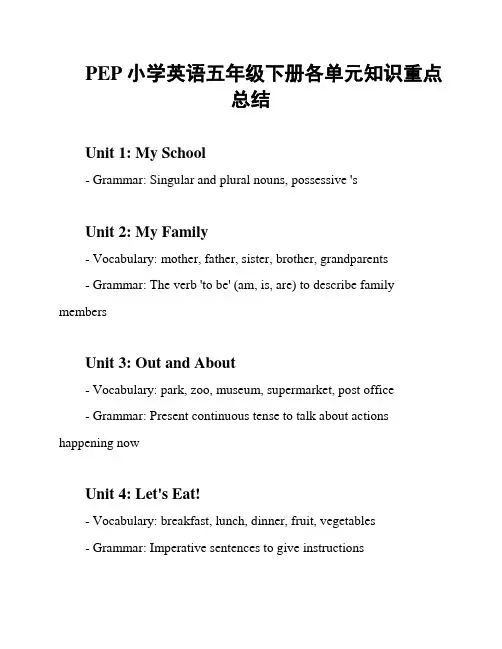
PEP小学英语五年级下册各单元知识重点总结Unit 1: My School- Grammar: Singular and plural nouns, possessive 'sUnit 2: My Family- Vocabulary: mother, father, sister, brother, grandparents- Grammar: The verb 'to be' (am, is, are) to describe family membersUnit 3: Out and About- Vocabulary: park, zoo, museum, supermarket, post office- Grammar: Present continuous tense to talk about actions happening nowUnit 4: Let's Eat!- Vocabulary: breakfast, lunch, dinner, fruit, vegetables- Grammar: Imperative sentences to give instructionsUnit 5: At the Farm- Vocabulary: farmer, barn, cow, pig, chicken- Grammar: There is/There are to talk about existenceUnit 6: Our Town- Vocabulary: street, hospital, police station, fire station, city- Grammar: Prepositions of place (in, on, under, behind, next to)Unit 7: Weather Report- Vocabulary: sunny, cloudy, rainy, snowy, windy- Grammar: Adjectives to describe weatherUnit 8: Fun with Friends- Vocabulary: play, sing, dance, swim, draw- Grammar: Simple present tense to talk about daily activitiesUnit 9: In the Ocean- Vocabulary: fish, dolphin, shark, octopus, seahorse- Grammar: Wh- questions using 'What' and 'Where'Unit 10: Happy Holidays- Vocabulary: Christmas, Easter, Halloween, New Year's Day, Thanksgiving- Grammar: Use of can for ability。
新人教版PEP 【小学五年级英语下册】 单元知识点 归纳总结

新人教版PEP 【小学五年级英语下册】单元知识点归纳总结Unit 1 My DayIn this unit。
we learn some core vocabulary words。
phrases。
and XXX.Core Vocabulary:1.Verbs: take (studying)。
go to (class)2.Nouns: dancing。
exercise。
sports3.Phrases: do morning exercises。
eat breakfast。
play sports。
eat dinner。
go for a walk。
go shopping。
clean my room。
take a dancing class。
have a classXXX Vocabulary:1.Verbs: start。
shop。
work。
need。
live。
win。
sound2.Nouns: Spain。
play。
letter。
island。
cave3.ns: after4.XXX: when。
XXX。
a.m。
p.m。
why。
last。
also。
busy5.nal Vocabulary: frequency adverbs (always。
usually。
sometimes)Phrases:watch TV。
eat lunch。
go to bed。
go swimming。
go home。
go to schoolCore Sentence Structure:When do you do morning exercises?" "At 7 o'clock."XXX phrase is "good job" to praise XXX.Which season do you like best。
I like winter best。
This sentence means "which one do you like the most" and "like。
PEP小学英语五年级下册各单元重点内容概述
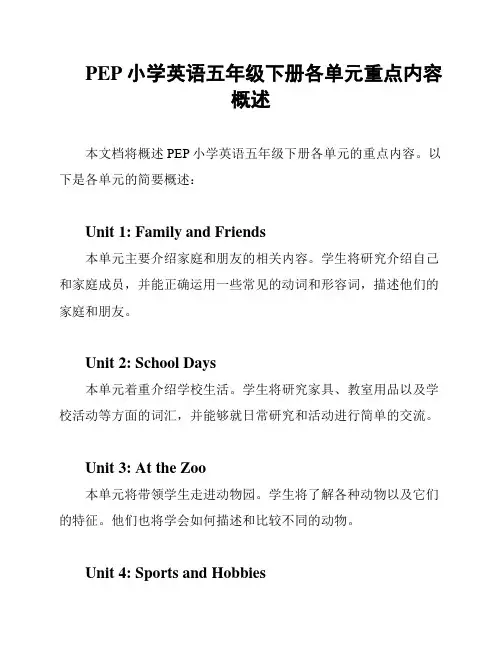
PEP小学英语五年级下册各单元重点内容概述本文档将概述PEP小学英语五年级下册各单元的重点内容。
以下是各单元的简要概述:Unit 1: Family and Friends本单元主要介绍家庭和朋友的相关内容。
学生将研究介绍自己和家庭成员,并能正确运用一些常见的动词和形容词,描述他们的家庭和朋友。
Unit 2: School Days本单元着重介绍学校生活。
学生将研究家具、教室用品以及学校活动等方面的词汇,并能够就日常研究和活动进行简单的交流。
Unit 3: At the Zoo本单元将带领学生走进动物园。
学生将了解各种动物以及它们的特征。
他们也将学会如何描述和比较不同的动物。
Unit 4: Sports and Hobbies本单元将探讨体育和爱好。
学生将研究描述不同体育运动和爱好的词汇,并能够就自己的喜好进行表达。
Unit 5: Food and Health本单元将关注食物和健康。
学生将研究各种食物的名称和描述,同时也会探讨健康和饮食惯的重要性。
Unit 6: My Neighborhood本单元将介绍学生所在的社区。
学生将研究描述自己的住所和周围环境的词汇,并能够就不同位置进行简单的指示。
Unit 7: Weather and Seasons本单元将涉及天气和季节。
学生将研究各种天气状况的词汇和描述,并了解不同季节的特点。
Unit 8: Holidays and Festivals本单元将介绍各种假期和节日。
学生将研究诸如春节、圣诞节等节日的名称和庆祝活动,并能够就个人喜好进行交流。
Unit 9: On the Farm本单元将带领学生了解农场。
学生将研究农场里各种动物和农作物的名称,并能够描述它们的特点。
Unit 10: Travel and Adventure本单元将聚焦旅行和冒险。
学生将研究描述不同交通工具以及旅行地点的词汇,并能够描述自己的旅行经历。
以上是PEP小学英语五年级下册各单元的重点内容概述。
【口袋书】人教版PEP五年级下册英语 基础知识汇总
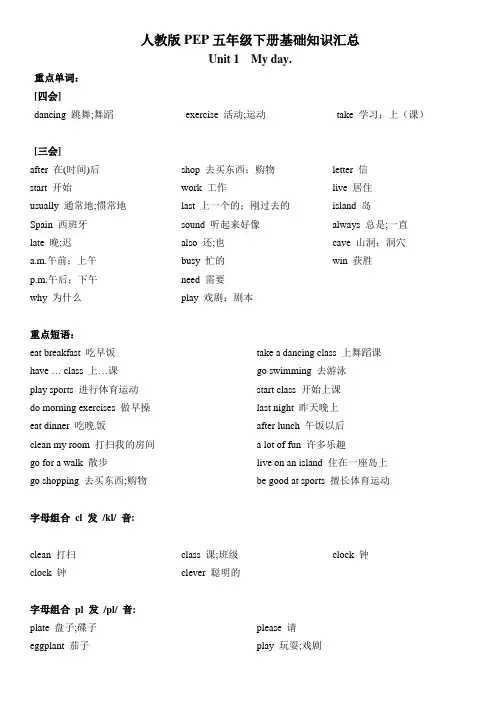
人教版PEP五年级下册基础知识汇总Unit 1 My day.重点单词:[四会]dancing 跳舞;舞蹈exercise 活动;运动take 学习;上(课)[三会]after 在(时间)后start 开始usually 通常地;惯常地Spain 西班牙late 晚;迟a.m.午前;上午p.m.午后;下午why 为什么shop 去买东西;购物work 工作last 上一个的;刚过去的sound 听起来好像also 还;也busy 忙的need 需要play 戏剧;剧本letter 信live 居住island 岛always 总是;一直cave 山洞;洞穴win 获胜重点短语:eat breakfast 吃早饭have … class 上…课play sports 进行体育运动do morning exercises 做早操eat dinner 吃晚饭clean my room 打扫我的房间go for a walk 散步go shopping 去买东西;购物take a dancing class 上舞蹈课go swimming 去游泳start class 开始上课last night 昨天晚上after lunch 午饭以后a lot of fun 许多乐趣live on an island 住在一座岛上be good at sports 擅长体育运动字母组合cl 发/kl/ 音:clean 打扫clock 钟class 课;班级clever 聪明的clock 钟字母组合pl 发/pl/ 音:plate 盘子;碟子eggplant 茄子please 请play 玩耍;戏剧重点句型:1.询问别人什么时候做某事的问句及回答:-- When do/does + 主语+ 动词(短语)原形(+ 其他)?-- 主语(+ 频度副词)+ 动词(短语)原形/ 第三人稀单数形式+ at + 具体时间/ At + 具体时间.-- When do you get up? 你什么时候起床?-- I get up at 5 o'clock. 我5点起床。
人教版PEP小学英语五年级下册知识点汇总(最新)

人教版PEP小学英语五年级下册知识点汇总(最新)Unit One: This Is My DayBasic Vocabulary:Activities: get up。
do morning exercises。
have English class。
play sports。
play the piano。
climb mountains。
go shopping。
go hiking。
visit grandparents。
eat breakfast。
eat dinner.Basic XXX Structures:1.Asking about daily routines:When do you。
(你什么时候。
)XXX I。
(我通常在。
(点钟)。
(做什么事)。
有时。
)XXX: When do you go to school。
(你每天几点去上学?)I usually go to school at 7:00.Sometimes I go to school at7:10.2.Asking about XXX:What do you do on the weekend。
(你周末做什么?)XXX I。
(我通常/经常。
有时。
)XXX: What do you do on the weekend?I often play XXX I go shopping with my mom.3.Introducing one's own habits:Every weekend。
I go hiking。
(我每个周末远足。
)Every day。
I do my homework at 8:00 in the evening。
(我每天晚上8点做作业。
)4.Asking XXX:What do you do。
(你是干什么的?)Time:morning。
afternoon。
evening。
noon。
at night。
6:00.on Sunday。
人教版PEP小学英语五年级下册知识点汇总(最新)
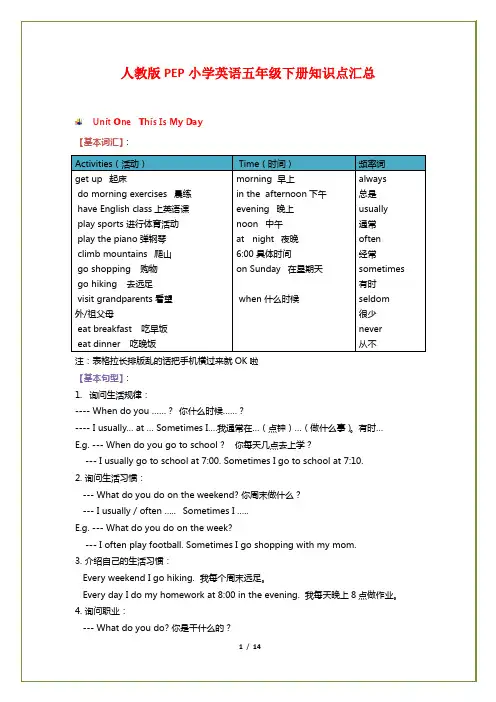
人教版PEP小学英语五年级下册知识点汇总Unit One This Is My Day【基本词汇】:Activities(活动) Time(时间)频率词get up 起床do morning exercises 晨练 have English class上英语课 play sports 进行体育活动 play the piano 弹钢琴climb mountains 爬山go shopping 购物go hiking 去远足visit grandparents 看望外/祖父母eat breakfast 吃早饭eat dinner 吃晚饭morning 早上in the afternoon下午evening 晚上noon 中午at night 夜晚6:00 具体时间on Sunday 在星期天when 什么时候always总是usually通常often经常sometimes有时seldom很少never从不注:表格拉长排版乱的话把手机横过来就OK啦【基本句型】:1. 询问生活规律:---- When do you ……?你什么时候……?---- I usually… at …Sometimes I….我通常在…(点钟)…(做什么事)。
有时…E.g. --- When do you go to school ? 你每天几点去上学?--- I usually go to school at 7:00. Sometimes I go to school at 7:10.2. 询问生活习惯:--- What do you do on the weekend? 你周末做什么?--- I usually / often ….. Sometimes I …..E.g. --- What do you do on the week?--- I often play football. Sometimes I go shopping with my mom.3. 介绍自己的生活习惯:Every weekend I go hiking. 我每个周末远足。
新人教版PEP五年级英语下册各单元知识点总结
新人教版PEP五年级英语下册各单元知识点总结Unit 1: Our Classroom- Classroom objects and their names- Sentences to describe classroom objects and their locationsUnit 2: Our Clothes- Clothing items and their names- Describing clothing using colors and patterns- How to ask and answer questions about what someone is wearingUnit 3: I Love Sports- Sports vocabulary and their names- Describing sports using adjectives (e.g., fun, exciting, tiring)- Expressing preferences for certain sportsUnit 4: My Birthday Party- Vocabulary related to birthdays and celebrations- Describing activities at a birthday party- Expressing likes and dislikes about different party elementsUnit 5: At the Farm- Vocabulary related to farm animals and their names- Describing farm animals using adjectives (e.g., big, small, noisy) - Describing activities at a farm (e.g., feeding animals, milking cows)Unit 6: A Fun Day Out- Vocabulary related to amusement park rides and activities- Describing activities and experiences at an amusement park- Expressing likes and dislikes about different rides and activitiesUnit 7: A Friendly Letter- Vocabulary related to writing a letter (e.g., greeting, closing, signature)- Structure of a friendly letter- Writing a letter to a friend, describing personal experiences or activitiesUnit 8: Our Pets- Vocabulary related to pets and their names- Describing pets using adjectives (e.g., cute, friendly, playful)- Talking about responsibilities and caring for petsUnit 9: Our Earth- Vocabulary related to the environment and nature- Describing different natural elements (e.g., mountains, rivers, plants)- Expressing concerns and suggesting actions to protect the environmentUnit 10: Fun with Art- Vocabulary related to art and artistic activities- Describing different art forms (e.g., drawing, painting, sculpting) - Talking about personal preferences for different art activitiesUnit 11: Let's Travel- Vocabulary related to travel and transportation- Describing different modes of transportation (e.g., car, train, airplane)- Talking about travel experiences and preferences for different destinationsUnit 12: Healthy Habits- Vocabulary related to health and healthy habits- Describing different healthy habits (e.g., exercise, balanced diet, enough sleep)- Talking about personal choices and habits for a healthy lifestyle。
(完整)PEP小学英语五年级下册各单元知识重点归纳-推荐文档
PEP五年级下册各单元知识重点Unit 1 This Is My Day我会背:do morning exercises晨练eat breakfast吃早饭have english class上英语课play sports进行体育运动eat dinner吃晚饭when什么时候evening夜晚;晚上get up起床at在……点钟usually通常;一般noon中午climb mountains爬山go shopping购物;买东西play the piano弹钢琴visit grandparents看望祖父母go hiking去远足weekend周末often经常sometimes有时候话题: 日常生活1. When do you do morning exercises? 你什么时候做早操?.usuall.d.mornin.exercise.a.8:00......我经常八点钟做早操。
(.usuall.ge.u.a.12:0.noo........我经常在中午十二点起床。
)2. When do you eat dinner ? 你什么时候吃晚餐?.ea.dinne.a.7:0.i.th.evening........我在晚上七点钟吃晚餐。
3.Wha.d.yo.d.o.th.weeken......... 你周末做什么?.usuall.clim.mountains. 我通常去爬山. .ofte.pla.sport..我经常经行体育锻炼。
Sometime..pla.th.pian..有时候我弹钢琴。
Unit 2 My Favourite Season我会背:spring春天summer夏天fall秋天winter冬天season季节which哪一个best最;极swim游泳fly kites放风筝skate滑冰make a snowman堆雪人plant trees种树why为什么because因为sleep睡觉favourite 最喜爱的话题: 季节1. Which season do you like best ? I like spring best.(Spring.)你最喜欢是什么季节?我最喜欢春季。
(完整版)新版PEP五年级下册知识点总结,推荐文档
in at When 新版 PEP 五年级下册知识点总结Unit 11. 吃早饭 eat/ have breakfast2. 上……课 have…class3. 进行体育运动 play/ do sports4. 做早操 do morning exercises5. 吃晚饭 eat/ have dinner6. 打扫我的房间 clean my room7. 散步 go for a walk8. 去买东西、购物 go shopping 9. 上舞蹈课 take a dancing class 10. 听起来好像 sound like11. 吃午饭 eat/ have lunch 12. 去游泳 go swimming 13. 午前,上午 a.m. 14. 午后,下午 p.m. 15. 通常 usually 16. 西班牙 Spain 17. 起床 get up18. 吃早饭 eat/have breakfast 19. 上床睡觉 go to bed 20. 有时 sometimes21. 昨晚 last night22. 打乒乓球 play ping-pong 23. 许多 a lot of/ lots of 24. 经常 often25. 做作业 do homework 26. 看电视 watch TV27. 洗衣服 wash my clothes 28. 在周末 on the weekend 29. 善于,擅长 be good at1. – When do you finish class in the morning? 你们上午的课到几点结束? – We finish class at 1 o’clock . 我们一点钟结束。
2. – When do you usually eat dinner Spain ? 在西班牙你们通常什么时候吃晚饭? – Usually 9:30 or 10 o’clock. 通常在九点三十或十点钟。
(完整版)人教版PEP五年级下册英语知识点复习总结
五年级英语下册知识点复习总结
Unit1Myday
1.询问对方何时做某事的句型
Whendoyou+动词(短语)原形+其他? (表示事件)
I(+频度副词)+动词(短语)原形+at+时间点。 注意:询问第三人称单数人称何时做某事的时候应将 do 改为 does,其 答语的主语为第三人称单数,动词部分应变为第三人称单数形式。(以下情况
同样需注意此项)
如:WhendoeshegetupHegetsupat6:00a.m. 译:他什么时候起床?他在上午六点起床。
2.询问对方周末做什么的句型
WhatdoyoudoontheweekendSaturdays. I(+频度副词)+动词(短语)原形+withsb(人)+onSundays. theweekend.
(2)在基数词后加 th:除去 first,second,third,其他基数词变序数词一般 直接在其后加 th。注意 five 与 twelve 要先把 ve 变 f,再加 th;eight 直接加 h;nine 去 e 再加 th。
(3)整十序数词以 ieth 结尾:整十位的序数词先将十位整数词尾的 y 变为 i, 再加 eth。如:twenty-twentieth。
The
注意:play-plays 因为 a 是元音 3)以 ch,sh,s,x 或 o 结尾的动词,在后面加-es; 例如 teach-teacheswash-washesdo-doesgo-goesfix-fixes
4)不规则的; 例如 have-has
5.by 的用法