
人教版七年级英语下Unit12-What-did-you-do-last-weekend单元试卷及答案
英语人教七年级下Unit12 What did you do last weekend单元测评(分数:100分时间:90分钟)第Ⅰ卷听力部分(20分)Ⅰ.听句子,选择与其意思相符的图片(有两幅多余图片)。
句子读一遍(5分)1.______2.______3.______4.______5.______Ⅱ.听句子,选择正确答语。
句子读一遍(5分)6.A.It was fantastic. B.It was small. C.I went to New York City. 7.A.She went to the beach. B.He stayed at home. C.It was really cool. 8.A.It was terrible. B.It was not bad. C.They were very friendly. 9.A.How do you go there?B.Thank you.C.Really?Did you visit the Great Wall?10.A.Yes, I did. B.Yes, I do. C.No, I wasn't.Ⅲ.听对话,选择正确答案。
对话读两遍(10分)11.Did he do his homework last night?A.No, he didn't. B.Yes, he does. C.Yes, he did.12.How was Bob's vacation?A.It was boring. B.It was pretty good. C.It was hot.13.Where did she go?A.She went to the mountains.B.She went to the beach.C.She went to summer camp.14.How wa s the weather in New York City last week?A.It was warm and humid. B.It was cold but sunny. C.It was hot. 15.Where is Jack's uncle?A.He's in Guangdong. B.He's in Fujian. C.He's in Guangxi.第Ⅱ卷笔试部分(80分)Ⅳ.单项选择(10分)16.______ did you do last weekend?A.How B.Where C.What D.When17.Did you have great fun ______ English from Mr.Green?A.learn B.learning C.learns D.learned18.The boy ______ when he was in the mountain by himself.A.lost B.loses C.is lost D.was lost19.—You look very tired.—I ______ too late to watch the basketball game last night.A.stayed up B.put up C.woke up D.called up20.The soup is very ______;I'd like some more.A.delicious B.awful C.well D.ch eap21.—Who cleaned the classroom?—Bob ______.A.does B.did C.cleaned D.was22.—______ was your weekend?—It ______ really relaxing.A.How;was B.What;were C.What;was D.How;were23.We all know that snakes have no ______.A.eyes B.mouths C.teeth D.ears24.I saw a cat ______ with a ball in the living room.A.play B.played C.plays D.playing25.The weather was terrible,and it ______ me ______ sad.A.make;feel B.made;feel C.made;felt D.makes;feelⅤ.完形填空(10分)Last Sunday we had a great trip.My father, my mother and I __26__ to summer camp.We went to a mountain.First we __27__ to the foot of the mountain __28__ bus.In the middle of the mountain there was a river.The water was clean and clear.I washed my face __29__ the water.It was warm.There __30__ some fish in the river.In the mountain there were flowers.They were __31__.At noon, many people got together, and they were very __32__.We made our meal in the mountain.The food was v ery __33__,and we liked it very much.After meal, we went on our trip.We felt __34__.It was really __35__.26.A.go B.goes C.went D.going27.A.get B.got C.got to D.arrived28.A.by B.on C.in D.took29.A.on B.with C.for D.into30.A.is B.was C.were D.are31.A.ugly B.beautiful C.awful D.delicious32.A.friendly B.friends C.busy D.tired33.A.nice B.terrible C.bad D.worse34.A.happy B.unhappy C.friendly D.unpleasant35.A.cold B.hot C.fun D.sadⅥ.阅读理解(30分)AMost American families like to have vacation in summer.Summer is a good season for v acation.It is often hot in July and August.Children do not go to school in those two months.Some like to stay at home, read books, stay with their families or watch TV.Many families take their lunch to eat at a place with many trees or near a nice lake.Some people have enough time and money to travel(旅行)to other countries like France, Japan and Australia.They usually fly to these countries.Many families travel by car or train to see interesting places in their own countries.Their favorite cities are New York, Chicago, Miami, San Francisco and Los Angeles.Not everyone likes to go to busy cities.Some families travel to mountains or beautiful valleys(山谷).36.According to the passage,______ is a good season for vacation.A.spring B.summer C.autumn D.winter37.Some children like to stay at home during their vacation.They don't ______.A.read books B.stay with their familiesC.watch TV D.go to school38.Many families like to have their lunch ______ during their vacation.A.in the office B.near a cinemaC.near a big factory D.near a nice lake39.If you have ______,you can travel to other countries.A.money and friends B.friends and timeC.money and time D.food40.Which of the following is “芝加哥” ?A.Chicago. B.New York. C.Miami. D.Los Angeles.BDear Jane,After I left Paris I spent two days in New York City and one day in Washington D.C.I got to Miami, Florida on Nov.13.The weather is wonderful here.Thismorning I went swimming and then slept on the beach.When I woke up, I foundJennifer Lopez—my favorite movie star.She was just on my right!I asked her totake a picture with me.You know, that was my dream.She agreed!I'm going to showyou!John Dear Dad,I got here at last after 18 hours on a train!It's very cold here in Moscow.It'swhite everywhere.This afternoon I went to have a look at the city.I got lost.I amglad I took Russian lessons in my university.They helped me a lot.A young girlshowed me the way back to my hotel.I think I can finish my work here and go backhome soon.I'm looking forward to the warm sunshine at home.See you soon.Max Dear Amy,I arrived in Guilin yesterday.What a beautiful place!The people here are kindand I have some new friends.Guess who I met here!Tom, my high schoolclassmate.How small the world is!He is working here as an English teacher at amiddle school.He showed me around the city.I also went to his school.His studentslike him very much.I bought a special bag made in Guilin for you and a silk tablecloth for mom.Tomorrow evening I'm going to fly to Beijing.Love,Maria 41.Each of the three had a good time.42.Maria went to see her classmate in Guilin.43.It was warmer in Max's hometown(家乡)than in Moscow.44.John was very glad that his dream of going to the beach came true.45.Max speaks a little Russian.CBob's weekendAre you often free on weekends? Bob had a busy weekend last week.(1)On Saturday morning,he went to visit his grandmother with his parents. His grandmother lives in a beautiful village.There Bob went to the mountains with his cousin.After dinner,he went shopping at Haorizi Supermarket.In the evening,he saw an interesting comedy.On Sunday morning,Bob wanted to play soccer,but(2)_it_was_rained_very_hard,so he had to stay at home.He wanted to play the guitar,but he couldn't find his guitar.So he did some reading and watched TV.In the afternoon,(3)他帮助妈妈做家务,然后和爸爸下象棋。
Unit+12+讲义 人教版七年级英语下册
Unit 12 What did you do last weekend?1.---Who visited her grandmother?---Becky did.答语中did代替句中visited her grandmother.(英语中为了避免重复,经常用does、do、did等来代替前面的动词或相关内容,且时态与问句保持一致)Eg:---Who cooks dinner for you every day?---My father does.(代替cooks dinner)---Do you like watching TV?---Yes,I do.(代替like watching TV)2.I worked as a guide at the Natural History Museum.as:(prep)当作;作为(其后常接表示职业、用途等的名词) 若放在句首,则常用逗号与语句的主体隔开Eg:She works as a giude in a company.As a player, you should do more exercise.辨析:as&likeas: 用于说明同一关系,即两者实为一体like:用于说明相似关系,并不等同Eg:He works as a teacher.(言外之意:He is a teacher.)He works like a teacher.(言外之意:He isn’t a teacher.)3.I stayed up late to watch the soccer game.stay up:熬夜stay up late:睡得很晚与stay相关的常见短语:stay at home待在家里stay away from远离stay healthy保持健康stay out 待在外面与up相关的短语call up 打电话catch up with 赶上come up with提出get up 起床give up放弃grow up 成长look up 向上看;查出make up编造;构成pick up 捡起;中途载人put up 举起;张贴set up 创建show up出现take up 占据turn up调大use up用完;耗尽4.Father mouse shouted at the cat, “Woof,woof.”辨析:shout at &shout toShout at:冲...大声叫喊(多指因生气/愤怒冲某人叫喊)Eg: He loses his temper and shouts at me.shout to:对...大声叫喊(无恶意,多因距离远)Eg: : “Can you hear me?”he shouts to Tom.5.“Well,son,that’s why it’s important to learn a second language.”(1)that’s why...这就是...的原因why引导的名词性从句在句中作表语Eg:That’s why I can pass the important exam,because I study hard. that’s because...那是因为...(表示原因)Eg:He didn’t go to school trip. That’s because he was badly ill.6.flew a kite 放风筝flew为fly的过去式fly的用法:(vi)(1)fly to乘/坐飞机=go (to)...by plane/airEg:She will fly to New York. She will go to New York by plane/air.(2)飞Eg:He hopes he can fly like a bird.(3)飞逝Eg:How time flies! (时光飞逝)(4)苍蝇Eg:Look! A fly is swimming in the porridge.7.There we put up our tents and made a fire to keep us warm and cook food on.(1)put up:搭建;张贴(动副结构)(2)keep的用法Keep sb./sth.+adj 让某人/某物保持...(强调某种状态)Eg:The coat will keep you warm.The students should keep the classroom clean.Keep sb./sth.+doing 让某人/某物一直...(强调动作的持续性)Eg:I’m sorry I’ve kept you waiting.8.The next morning,my sister and I got a terrible surprise.get a surprise 吃惊(可数名词)surprise:(不可数名词)in surprise惊奇地;惊讶地To one’s surprise 令某人惊讶的是(vt)使吃惊;使惊奇(adj)surprising surprisedEg:Her idea surprises me.9.I was so scared that I couldn’t move.(1)so...that...如此...以致于... (so后接adj/adv)Eg:The box is so heavy that I can’t carry it.He runs so fast that I can’t catch up with him.拓展:such+a/an+adj+单数可数名词+that...相当于so+adj+a/an +单数可数名词+that...Eg:Mr. Yi is such a kind teacher that we all like him. Mr. Yi is so kind a teacher that we all like him.(2)scared:惊慌的;吓坏了的=afraidbe scared of sth. 害怕做某事be scared to do sth.害怕做某事Eg:Miss Zhang is scared/afraid of the ghost.The little boy is scared/afraid to read in fornt of the others.10.感叹句(what/how )。
Unit-12-What-did-you-do-last-weekend?知识强化
Unit 12 What did you do last weekend?知识强化一、知识概述1.学习和掌握本单元出现的生单词、词组和句型。
2.继续学习和巩固动词的一般过去时用法。
3.学习一般过去时的特殊疑问句用法。
二、语音知识:Listen and read. Notice the change in the past forms.三、单元重难点解析1.词汇篇:do my homework——went to the cinemago boating——camped by the lakego to the beach——played badmintonsing and play the guitar——went to the libraryswim in a swimming pool——studied for a testhave dinner with friends——flew a kitesit under the moon——told each other storiesgo to sleep—2.What did you do last weekend, Lucy?露西,上周末你做了什么?这个句子是谓语动词是实义动词的一般过去时的特殊疑问句用法。
特殊疑问词+did+主语+动词原形+其它?e.g.What did you do last night?昨天晚上你做了什么?Where did he go last Sunday?上个星期天他去哪儿了?Who did she go with?她和谁一起去的?注意:(1)当特殊疑问词是充当主语时,则不需要使用助动词did,直接用特殊疑问词加动词的过去式来表达就可以了。
e.g.Who visited her grandma?谁拜访了她的奶奶?(2)当句子的谓语动词是be动词was/were时,特殊疑问句的结构为“特殊疑问词+ was/were +其它?”e.g.How was your weekend?你周末过得如何?How was the weather in Beijing?那时候北京天气如何?3.How interesting! [译文]多么有趣啊!这是个感叹句。
初中英语_Unit12 What did you do last weekend?教学设计学情分析教材分析课后反思
Unit12 What did you do last weekend?Section A (Grammar Focus-3c)一、教学目标:1. 语言知识目标:•To learn the new words: run away,mouse,baby,shout at,woof,language.•To review the simple past tense.•To know how to use who,what,when,where and how.2. 能力目标:1. To know how to talk about my last weekend in English.2. Improve the students’ listening , speaking and reading skills.3. 情感态度目标:Everyone should enjoy your life.二、教学重难点1. 教学重点:1) Key vocabulary, 特殊疑问句练习。
2) Talk about recent past events2. 教学难点:Talk about recent past eventsPractice students’ listening, speaking, reading and writing skills.三、教学过程Ⅰ. Learning aimsⅡ. Free talk & Leading- inWatch a video. Ask students what they did last weekend.Ⅲ. 预习展示:Words and phrasesⅣ.通过警察和小偷的对话,让学生记录听到的特殊疑问句:1、How was your weekend? It was fine.2、What did you do last weekend?3、Where did you play basketball?探究乐园:一、一般过去时态的特殊疑问句1. 特殊疑问词+ was/were + 主语+ 其他?上个周末你过得怎么样?_______ _______ your last weekend?昨天下午他们在哪里?_______ _____ they yesterday afternoon?昨天晚上谁在教室里?____ ____ in the classroom last night?昨天你为什么迟到了?_____ _____ you late yesterday?2. 特殊疑问词+ did + 动词原形+ 主语+其他?昨天他做了什么事情?_____ ____ he do yesterday?上个周末她参观了什么地方?______ ____ she _____ last weekend?你和谁一起去的动物园?____ ____ you go to the zoo _____?他们什么时候到达北京的?_____ ____ they arrive in Beijing?Ⅴ.Practice1. Look at 3a. Tell Ss to fill in the blanks with who, what, where or how. Make the studentsfinish the sentences by themselves.2. Check the answers.1 What , Who,2 How, Where 3. What, Who.3. Say, Now practice asking and answering questions like this about what the people did over the weekend. Practice in pairsHelp students find partners. Then say, First read the dialogue together. Both students read both parts.VI. Pairwork•How was your weekend?•------------•What did you do last weekend?•-----------•Where did you go last weekend?•-----------•Who did you go with?•-----------Ⅶ. Grammar Focus.1. 学生阅读Grammar Focus中的句子并完成下列填空题。
人教版新目标七年级下学期Unit-12--what-did-you-do-last-weekend--知识点
Unit 12 what did you do last weekend?Section A 知识讲解一. last(1)last形容词“最后的,最末的”或者“紧接前面的,刚过去的”。
Today is the last day in the year.最后一天。
I didn’t sleep well last night. 昨晚(2)last副词,“最后地”,I’m the last one.最后一个。
(3)last 动词,“持续,继续,维持”等,The hot weather lasted a week.持续了一周。
二. camp(1)camp 动词,“扎营,搭帐篷”。
We go camping every summer.We walked all day and camped by a river at night.(2)camp 名词,“露营地,度假营”。
Let’s go back to the camp, it’s getting dark. 让我们回营地吧,天黑下来了。
根据汉语提示填空。
(1)When did you join the ______ ______ (夏令营)?(2)I like ______ ______ (去宿营)in the open air.3)We______(宿营)in the forest last night. (4)Let’s go back to the ______(营地)三. sheepsheep 可数名词,“绵羊”,复数还是sheep;goat指山羊。
How many sheep are there on your farm? 你们农场里有多少只羊?拓展:常见的单复数同形的名词还有:deer (鹿),fish (鱼),Chinese (中国人),Japanese(日本人)等。
四. byby介词, “在……旁边”,相当于beside。
Our teacher is sitting by the window.by与交通工具名词连用时,名词前不用冠词,意为“乘、坐、用”等。
Unit-12-What-did-you-do-last-weekend-教案
Unit 12What did you do last weekend?Section A 1 (1a-2d)一、教学目标:1. 语言知识目标:1)掌握以下单词:camp, lake, beach, badminton, sheep, as, natural, butterfly, visitor, tired, stay, stay up late.能掌握以下句型:①—Where did you do last weekend, Lucy?—I went to summer camp.②—How was your weekend?—Pretty good,thanks③—I worked as a guide at the Natural History Museum.④How interesting!2) 能了解以下语法:learn to talk about recent past events.2. 情感态度价值观目标1.帮助学生树立合作学习观点。
2.讲述美好的周末,树立学生享受生活,热爱美好的大自然情感。
二、教学重难点1. 教学重点:1) Key vocabulary.2) Talk about recent past events2. 教学难点:1) Talk about recent past events2) Practice students’ listening, speaking, reading and writing skills.三、教学过程Ⅰ. Warming-up and revisionPoint to the previous Saturday and Sunday on a wall calendar and say, Saturday and Sunday are the weekend. This is last weekend. Then tell some things you did last weekend such as cleaned my house over the weekend. Use quick sketches (in theboard along with gestures to demonstrate the meaning of each activity,Ⅱ.1 a This activity introduces the key vocabulary.Focus attention on the picture. Ask students to tell what they see. Name each activity and ask students to repeat:did my homework, went to the cinema, went boating, camped by the lake, went to the beach,played badminton.Point out the numbered list of activities. Say each one again and ask students to repeat.Then ask students to match each activity with one of the pictures. Say, Write the letter of each activity next to the words. Point out the sample answer.Check the answers.Ⅲ. ListeningWork on 1bThis activity gives students practice in understanding the target language in spoken conversation.Point to the activities in the picture in activity la. Ask students to tell what the person did in each picture. For example, she played badminton, or Lucy went to the cinema. Play the recording the first time. Students only listen.Play the recording a second time. This time say. Listen to the recording and write the days and times Lucy did each thing under the pictures. Point out the sample answer under the picture of Lucy playing badminton; on Saturday morning.Correct the answers.Ⅳ. PairworkWork on 1cThis activity provides guided oral practice using the target language.Point to the example conversation. Ask two students to read the dialogue to the class.Say, now work with a partner. Student A, pretend to be Lucy. Student B, ask questions about what Lucy did on different days and times over the weekend.Talk about the activities in the picture.Students work in pairs. As they talk, move around the room monitoring their work.Offer language or pronunciation support as needed,Ⅴ. ListeningWork on 2a:This activity gives students practice in understanding the key vocabulary in spoken conversation.Point to the five sentences and ask a student to read these sentences to the class.Say, You will hear recording of a conversation. The people will talk about some of the activities and people, but they will not talk about others. Please underline the words you hear on the recording.Play the recording the first time. Students only listen.Play the recording a second time. This time, ask students to underline each word that is said on the tape. Point out the sample answer, grandmother.Correct the answers.1grandma 2 homework 3 English 4 farm 5 cowsⅥ. ListeningWork on 2b:This activity provides listening practice using the target language.Call attention to the pictures of Carol, Becky, and Jack and ask students to identify each person by name.Say, Now I will play the recording again. Listen to the students talking about what they did over the weekend. Write C for Carol, B for B Becky or J for Jack next to each statement in activity 2a. The first one has been done for you.Play the recording the first time. Students only listen.Point out the sample answer, S, in statement 1. Say, Sonia visited her grandmother.Play the recording again. Ask students to write a letter in front of each statement to show what each person did.Check the answers. B B C J JⅦ. Pair workAsk and answer in pairs.Point to the example conversation. Ask two students to read the dialogue to the class.Say, Now work with a partner. Student A, ask questions about what,who or where, Student B answers. Students work in pairs.Ⅷ.Role-play the conversation.1. Ask Ss to look at conversation in 2d. Then Ss read the dialogue by themselves andfind the answer to these questions:① What did Lisa do on her weekend?② What did Paul do on his weekend?2. Ss work in pairs and role-play the conversations.3. Have several pairs perform their conversations for the rest of the class.Homework:1. Copy new words twice.2. Write about what you did last weekend.板书设计:Section A 2 (Grammar Focus-3c)一、教学目标:1. 语言知识目标:1) 掌握以下单词:away, mouse, baby, shout ,shout at, woof, language.2) 继续练习一般过去时态能掌握以下句型:—What did you do last weekend?—I did my homework.—Who visited her grandma?—Becky did.—Where did she go last weekend?—She went to a farm.—Who did she go with?—She went with her classmates.2. 情感态度价值观目标:1.提高学生独立学习能力。
初中英语 七年级下册 Unit12 What did you do last weekend
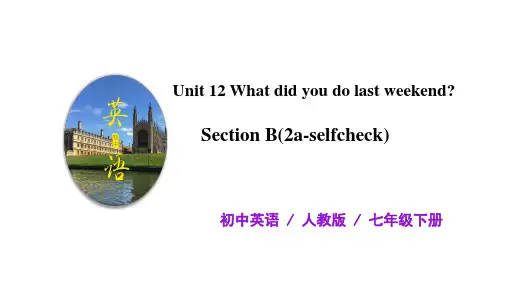
2c Put the phrases in order according to the passage. Then use them to retell the story.
__6__ snake went into the forest __2__ put up our tests and cooked food __8__ learned a useful lesson __4__ saw a snake and shouted to parents for help __7__ snakes can’t hear but can feel things moving __5__ my dad jumped up and down in his tent __1__ took a bus to a small village in India __3__ told stories under the moon, then went to sleep
Language points
1. There we put up our tents and make a fire to keep us warm and cook food on. put up 在句中意为“搭起,搭建”;另外还 有“张贴;举起(手)”之意。
他们在这里盖了一栋新房子。 They put up a new house here. 迈克正把一张地图贴到墙上。 Mike is putting up a map on the wall. 谁知道答案?请举手。 Who knows the answer? Put up your hand.
surprise还可作不可数名词,意为“惊奇;吃 惊”。其常用短语有:
in surprise to one’s surprise
人教版七年级下册英语Unit12 What did you do last weekend教材听力原文及译文
Unit 12 What did you do last weekend? Section A1b Listen and write the day,morning,afternoon or night below each picture.Bob: Hey, Lucy.Lucy: Hi, Bob.Bob: How was your weekend?Lucy: It was great.Bob: So, what did you do?Lucy: Well, on Saturday morning, I played badminton.In the afternoon, I went to the beach, and atnight, I went to the cinema.Bob: Cool. What about Sunday?Lucy: In the morning, I camped by the lake with my classmates. In the afternoon, we went boating,and at night, I did my homework.2a Listen and underline the words you hear. Teacher: So, did everyone have a good weekend? Students: Yeah, we did, Ms. Clark!Teacher: Good. What did you do last weekend,Becky?Becky: I visited my grandma, and I did my home- work.Teacher: Great. And how about you, Carol? Did you go out?Carol: No, I stayed at home. I studied for the English test.Teacher: Wow, good for you. Jack, how about you?W here did you go?Jack: I went to a farm, and I fed some cows. Teacher: Sounds like you had fun.2b Listen again. Write C for Carol,J for Jack or B for Becky next to the statements in 2a. Teacher: So, did everyone have a good weekend? Students: Yeah, we did, Ms. Clark! 听录音并在每幅图下写上日子:上午、下午或晚上。
人教版七年级下册英语Unit12What-did-you-do-last-weekend?知识点总结
七下Unit 12 What did you do last weekend?一、Important Phrases:1.go to the cinema 去影院★=go to the movies2.go boating/camping 去划船/野营★summer camp 夏令营3.camp by the lake 在湖边野营★by the pool在池边4.go to the beach 去海滩★on the beach 在沙滩上5.play badminton 打羽毛球play+球类/棋类名词(不加冠词)6. study for the test 备考★test=exam7.feed some sheep/cows喂羊/牛★feed(fed)on...以..为食,feed with...用...喂养8. work as a guide 做导游工作★work as +职业从事某工作9. at the Natural History Museum 自然历史博物馆★nature(n.不可数)大自然-natural(adj.)自然的10. over 200 kinds of butterflies 200多种蝴蝶★over=more than 超过11.living habits 生活习惯★make a living 谋生;eating habits饮食习惯12.kind of tired 有点累★kind of = a little13. stay up late 熬夜★stay at home 待在家,stay away from 远离,lately(adv.)最近地14.sleep early 早睡★sleepy 困的,asleep睡着的15.a family of mice 老鼠一家★mouse(单)-mice(复)16.be afraid of sth./to do 害怕★afraid=scared17.run away 跑开★take away 带走,put...away 把某物收拾好,give away 捐赠18. climb onto one’s back 爬上某人的背19. shout at/to sb.冲某人大叫★shout out 大喊出20. a second language 第二语言★mother tongue 母语21.fly a kite放风筝22.do something interesting 做有趣的事★修饰不定代词,adj.后置:anything special23.finish high school 中学毕业★finish doing sth 完成做某事24.a special gift一特殊礼物★gift=present25.take us to India 带我们去印度26.take a long bus ride 坐很久的公交车27.put up our tents 搭帐篷★put up:搭建,举起,张贴28.make a fire生火29.cook food on the fire 在火上做饭★on an open fire 明火,篝火30.tell cach other stories 互相讲故事★tell a lie 说谎,tell a joke 讲笑话31.keep sb.warm 使某人保持暖和32.sit under the moon 坐在月光下★moonlight月光,moon cake月饼33.so.......that.......如此...以致于...34.get a surprise 吃惊35. look out of...向外看★look out 小心,look for寻找,look after 照顾36. jump up and down 跳上跳下37. move into the forest 进入森林38. wake sb up叫醒某人★wake up醒来,awake醒着的39. read a book about history 读一本历史书★read...to sb给某人读...40.see an interesting talk show 看有趣的脱口秀二、Key Language Points:1.Where did you go last weekend? What did you do last weekend?上周末你去了哪里?上周末你做了什么?一般过去时的特殊疑问句:1)特殊疑问词+did+主语+v.(原)+其他?如疑问词作主语,则陈述语序,如:Who bought you this new dress?谁给你买的新裙子?2)特殊疑问词+was/were+主语+其他?Where were you last night?昨晚你在哪里?2.----Who visited her grandma? -----Becky did.为避免重复,常用do,does,did,so等代替前文提到的内容。
初中英语 七年级下册 Unit12 What did you do last weekend
一般过去时的句式转换 1. 肯定句变否定句 (1)当句中含有情态动词 could, would, should
等时,可直接在情态动词后加 not。 You should go to the zoo first. You shouldn’t go to the zoo first.
3b Complete the passage with the correct forms
of the words in the box.
say be climb see run away
A family of mice were in the kitchen on Saturday morning when they __sa_w__ a big cat. Baby Mouse __w__a_s__ afraid and _c_li_m__b_e_d_ onto his father’s back.
(2) ① 昨天他做了什么事情? W__h_a_t_ _d_i_d_ he do yesterday?
② 上个周末她参观了什么地方? W__h_e_r_e_ _d_i_d_ she _v_i_si_t_ last weekend?
③ 你和谁一起去的动物园? _W__h_o_ _d_i_d_ you go to the zoo w__it_h_?
(2) 当句中含有 was/ were 时,可直接在was/ were 后加 not。 She was in the library yesterday. She wasn’t in the library yesterday.
(3)当句中的谓语动词是实义动词时,需在该动 词前加 didn’t,动词还原为原形。 She went to the park last week. She didn’t go to the park last week.
《教学分析》-Unit12 What-did-you-do-last-weekendUnit12 WhatdidyoudolastweekendSection_B
Did Jim do his homework on Sunday?
No, he didn’t. He flew a kite in the park on Sunday afternoon.
What about
Well, he had dinner
Sunday evening? with friends.
Then what did she do on Sunday?
She went to the library.
How was Jim’s last weekend?
It was relaxing.
Really? What did he do on Saturday?
Well. He sang and played the guitar on Saturday morning.
weekend? Complete the chart.
Sally
Jim
did her
sang and played
homework
the guitar
studied for a test flew a kite
went to the
had dinner
library
with friends
Pairwork
My last weekend was boring. I stayed at home and did my homework on Saturday. I went to the park on Sunday morning, but it rained. So we went home and watched TV.