
七年级下册英语第6单元知识点
Unit 6
American(美国的)= Americans(复数) child儿童=children(复数) man=men(复数)
Host(主人) →guest(客人)
短语
reading a newspaper 阅读一份报纸go to the movies 看电影
talking on the phone 通过电话交谈
be used to do= be used for doing sth 被用来做…
using the computer 使用电脑making soup 做汤
washing the dishes 洗盘子exercising 锻炼身体
just=only 只是eat out 出去吃饭drink tea= have tea 喝茶
the day after tomorrow 后天go shopping 去购物Dragon Boat Festival 端午节
kind of = a little 一点,少量
(kind of只能加形容词a little不光可以加形容词,还可以加不可数名词)
washing my clothes=do some washing/do the washing 洗衣服
1. This is Jenny.
当打电话时,介绍自己时用“This is…”或“It is…”;问对方用“Is that”或“Who is that”例如:
-Hello? This is Jenny. Who is that?
-Hi, Jenny. It’s Laura here.
2.join me for dinner=have dinner with me 和我一起吃晚餐
join和take part in 二者都有“参加”的意思,但用法有所不同. join多指参加某组织,成为其中的一个成员.而take part in指参加活动.
join sb for sth 和某人一起做做事
例:Will you join us for dinner?请你和我们一起吃饭好吗?
take part in+活动参加某活动
例:Will you take part in the English evening?同我们一起参加英语晚会好吗?
2.I’d love to.我很乐意,这里的I’d=I would
(1) 交际用语,用于礼貌地接受他人邀请,还可以说成I’d like to.但语气较弱。
(2)当委婉拒绝别人的邀请时,多用I’d love to. But …或Sorry, I’m afraid I can't
because...(我恐怕不能,因为…)
现在进行时
(1)构成形式:主语+be(is/am/are)+doing
(2)现在进行时表示动作正在进行或事情正在发生。
(3)有用的依据:一个句子中既有be动词,又有动词,且动词加了ing 该句是现在进行时(4)句中往往有now、look、listen等词。
动词现在分词的变化见下表:
一般情况加—ing play玩—playing do做—doing
go去—going jump跳—jumping
sing唱—singing ski滑雪—skiing
see看见--seeing
以不发音的e结尾去e加—ing make做—making take拿到—taking
like喜欢—liking come来—coming
write写—writing dance跳舞—dancing
have有—having close关—closing
以重读闭音节结尾的动词,中间只有一个元音字母,词尾只有一个辅音字母双写最后一个辅音字母再加—ing
swim游泳—swimming sit坐—sitting
run跑—running get得到—getting
put放—putting begin开始—beginning
jog慢跑—jogging。
人教版七年级英语下册Unit 6 课文+单词+朗读+知识梳理+词汇讲解+句型解析

1. newspaper(1)newspaper意为“报纸”,是可数名词。
“在报纸上”用英语表示为“in the/a newspaper”,不能用介词on。
我们日常所说的晨报/晚报是morning / evening newspapers。
例如:She likes collecting old newspapers. 她喜欢收集旧报纸。
(2)newspaper是由news和paper构成的合成词,合成词是一种重要的构词法,对我们记忆单词很有帮助。
例如:bed + room→ bedroom 卧室class + room →classroom 教室head + phone →headphone 耳机police + man→ policeman 警察basket + ball→basketball 篮球2. use(1)use 动词,意为“使用,运用”;其形容词形式为useful,意为“有用的,有益的”。
例如:Can I use your phone?我能用一下你的电话吗?Thanks for giving me such a useful book.谢谢你给我这么一本有用的书。
拓展:use&withuse动词在句子中作谓语,表示用途。
I use the pen to write. 我用钢笔写字。
with介词在句中作状语,表示方式。
I write with a pen. 我用钢笔写字。
(2)use 也可以作名词,意为“使用,用途,用法”。
不过此时的读音为/ ju:s /。
例如:I’m sure you’ll think of a use for it.我相信你会给这东西找到用途的。
3. moviemovie 是名词,意为“电影”。
“go to the movies” 意为“去看电影”,同意短语有“go to the cinema, go to see a film”。
例如:I often go to the movies with my classmates on weekends.周末我经常和我的同学去看电影。
人教版英语七年级下册单元Unit6知识点+测试卷+思维导图

⼈教版英语七年级下册单元Unit6知识点+测试卷+思维导图Unit 6 I’m watching TV.1.重点词汇:newspaper, movie, tea, house, pool, supermarket, living room, race, wash, drink, study, miss, wish, young, delicious2.短语归纳:1.watch TV 看电视2. read a newspaper 看报纸3. talk on the phone 通过电话交谈4. listen to music 听⾳乐5. use the computer 使⽤电脑6. make soup做汤7. wash the dishes 洗餐具8. kind of 有点⼉3. 必背典句:1. —Why are you doing? 你在做什么?—I’m watching TV. 我在看电视。
2. —What’s she doing? 她在做什么?—She’s washing her clothes. 她在洗她的⾐服。
3. —What are they doing? 他们在做什么?—They’re listening to a CD. 他们在听⼀张CD 唱⽚。
4. —Are you doing your homework? 你在做你的家庭作业吗?—Yes, I am. / No, I’m not. I’m cleaning my room.是的,我在做。
/ 不,我没有。
我在打扫我的房间。
5. Zhu Hui misses his family and wishes to have his mom’s delicious zongzi.朱辉思念他的家⼈并希望吃上他妈妈的可⼝粽⼦。
4.语法知识:现在进⾏时1.定义:表⽰现在或现阶段正在进⾏的动作。
常与now, these days等时间状语连⽤,句⾸有Look ! / Listen !等提⽰语。
初中英语人教新目标七年级下册Unit 6 I’m watching TV单元知识点整理
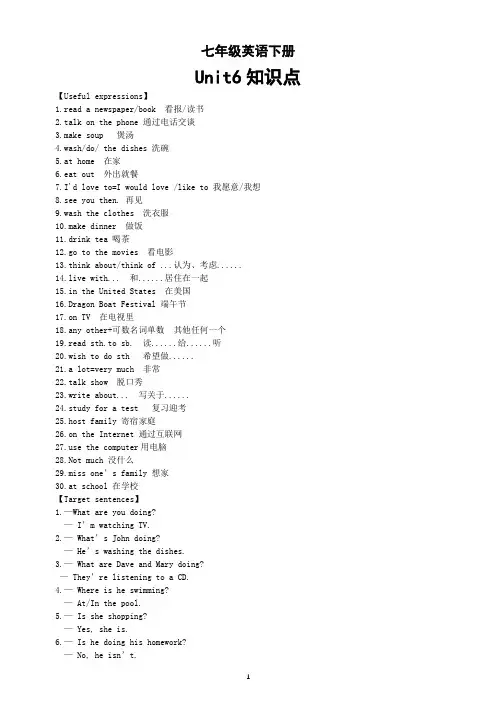
七年级英语下册Unit6知识点【Useful expressions】1.read a newspaper/book 看报/读书2.talk on the phone 通过电话交谈3.make soup 煲汤4.wash/do/ the dishes 洗碗5.at home 在家6.eat out 外出就餐7.I'd love to=I would love /like to 我愿意/我想8.see you then. 再见9.wash the clothes 洗衣服10.make dinner 做饭11.drink tea 喝茶12.go to the movies 看电影13.think about/think of ...认为、考虑......14.live with... 和......居住在一起15.in the United States 在美国16.Dragon Boat Festival 端午节17.on TV 在电视里18.any other+可数名词单数其他任何一个19.read sth.to sb. 读......给......听20.wish to do sth 希望做......21.a lot=very much 非常22.talk show 脱口秀23.write about... 写关于......24.study for a test 复习迎考25.host family 寄宿家庭26.on the Internet 通过互联网e the computer用电脑28.Not much 没什么29.miss one’s family 想家30.at school 在学校【Target sentences】1.—What are you doing?—I’m watching TV.2.—What’s John doing?—He’s washing the dishes.3.— What are Dave and Mary doing?—They’re listening to a CD.4.— Where is he swimming?— At/In the pool.5.— Is she shopping?— Yes, she is.6.— Is he doing his homework?—No, he isn’t.7.—Are you doing your homework?—No,I'm not.I'm cleaning my room.8.Do you want to join me for dinner?9.What do you think of his home in China?10.His dad and uncle are watching the boat races on TV.11.The mother is reading a story to her young children.12.He's talking on the phone to/with his cousin in Shenzhen.13.Zhu Hui misses his family and hopes to have his mom's delicious zongzi.14.But there's still no place like homehome.15.Zhu Hui loves New York and his host family a lot.【Language points】1.He is reading a newspaper.newspaper n.报纸为可数名词,“看报纸”要用read a newspaper.【易混辨析】in the newspaper与on the newspaperLook! Your photo is in the newspaper.看!你的照片上报纸了。
仁爱英语七年级下册unit6知识点
仁爱英语七年级下册unit6知识点Unit6主要讲授了关于时间和节日的相关知识点,掌握这些内容对于学生来说是非常重要的,因为它可以帮助他们更好地了解全球文化和习俗,同时也可以扩展他们的视野和知识面。
以下是本单元的知识点。
1. 时间的表达:单元中主要涉及到的时间表达方式有:a. 用数字表达时间,比如“7:30 am”(上午7:30),“8:45 pm”(晚上8:45);b. 用 am 或 pm 表示上午或下午,比如“10:00 am”(上午10点),“2:30 pm”(下午2点半)。
2. 节日的表达:单元中介绍了一些重要的节日,比如感恩节、圣诞节、元旦等,掌握这些节日的表达方式能够帮助学生更好地了解全球文化。
3. 手表和日历:学生需要学会如何读取手表和日历上的时间和日期,这是非常基础的技能,可以在日常生活中得到广泛应用。
4. 时间的比较:学生需要学会利用单元中所涉及的单词和短语,比较不同时间段之间的差别,例如:morning(上午)和 afternoon (下午)的时间差,小时和分钟的差别等等。
5. 祈使句:本单元中也介绍了各种各样的祈使句,例如:“turn left”(向左转)、“open your book”(打开你的书)等等。
这些祈使句非常常见,也是学生口头表达和书面表达的重要基础。
6. 时间和节日的阅读理解:单元中也涉及到了一些有关时间和节日的阅读理解,包括短文和问题,这可以帮助学生更好地理解所学内容并掌握相关技能和知识点。
总结:本单元的内容涉及到了时间和节日的相关知识点,在日常生活中非常重要,掌握好这些内容可以帮助学生更好地了解全球文化和习俗,扩展他们的视野和知识面。
同时,这些内容也是学生书面表达和口头表达的基础,是他们日后学习英语的重要支撑。
仁爱版英语七年级下册unit6知识点

仁爱版英语七年级下册unit6知识点仁爱版英语七年级下册unit6是一个非常重要的单元,本文将对该单元的知识点进行详细地介绍,以帮助学生更好地掌握英语知识。
一、单词
1. add:加
2. back:回来,后面
3. borrow:借
4. cinema:电影院
5. while:当……的时候
二、重点短语
1. add up:计算总和
2. go back:回来
3. borrow sb. sth.:借给某人某物
4. go to the cinema:去电影院
5. while doing:在做……的时候
三、语法
1. There be句型
There be句型表示“有”、“存在”之意,例如:There is a book on the desk.即桌子上有一本书。
2. 句型I'm + doing sth.
这种结构常用来表达我们正在做某件事情,例如:I'm playing basketball. 即我正在打篮球。
四、例句
1. There is a cinema near our school.(我们学校附近有一家电影院。
)
2. I'm studying English while listening to music.(我边听音乐边学英语。
)
3. Can I borrow your pen for a moment?(我可以借用你的笔一下吗?)
总结
通过对仁爱版英语七年级下册unit6的学习,我们了解了很多单词、短语和语法结构。
好的掌握这些知识点,一定会对我们的英语学习帮助很大。
希望大家能够认真学习,并不断提高自己的英语能力。
七年级下册英语书第六单元单词
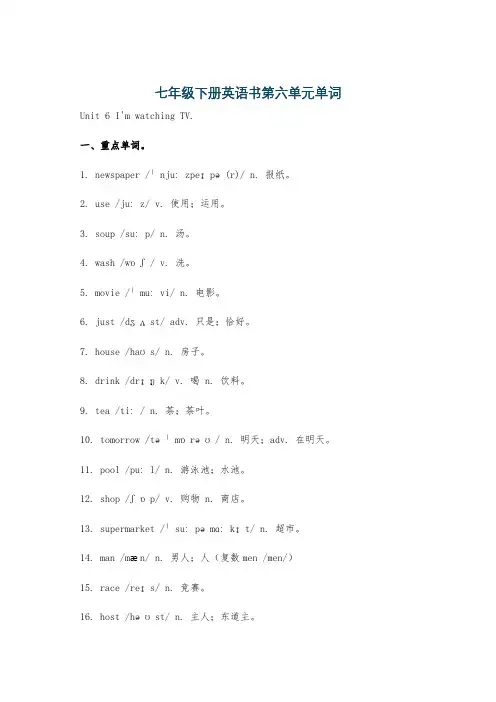
七年级下册英语书第六单元单词Unit 6 I'm watching TV.一、重点单词。
1. newspaper /ˈnjuːzpeɪpə(r)/ n. 报纸。
2. use /juːz/ v. 使用;运用。
3. soup /suːp/ n. 汤。
4. wash /wɒʃ/ v. 洗。
5. movie /ˈmuːvi/ n. 电影。
6. just /dʒʌst/ adv. 只是;恰好。
7. house /haʊs/ n. 房子。
8. drink /drɪŋk/ v. 喝 n. 饮料。
9. tea /tiː/ n. 茶;茶叶。
10. tomorrow /təˈmɒrəʊ/ n. 明天;adv. 在明天。
11. pool /puːl/ n. 游泳池;水池。
12. shop /ʃɒp/ v. 购物 n. 商店。
13. supermarket /ˈsuːpəmɑːkɪt/ n. 超市。
14. man /mæn/ n. 男人;人(复数men /men/)15. race /reɪs/ n. 竞赛。
16. host /həʊst/ n. 主人;东道主。
17. study /ˈstʌdi/ v. & n. 学习;研究。
18. state /steɪt/ n. 州。
19. the United States 美国;美利坚合众国(the USA)20. American /əˈmerɪkən/ adj. 美国的;美洲的 n. 美国人;美洲人。
21. dragon /ˈdræɡən/ n. 龙。
22. Dragon Boat Festival 端午节。
23. any /ˈeni/ adj. 任何的;任一的;pron. 任何;任一。
24. other /ˈʌðə(r)/ adj. 另外的;其他的;pron. 另外的人(或物)25. young /jʌŋ/ adj. 幼小的;年轻的。
七年级下册人教版第六单元英语知识点
人教版英语七年级下册第六单元知识点如下:单词:1.看电视/电影 watch TV/ watch a movie2.看报纸 read a newspaper3.通过电话交谈 talk on the phone4.听音乐 listen to music5.使用电脑 use the computer6.做汤 make soup7.洗餐具 wash the dishes8.有点儿 kind of9.去电影院 go to the movies10.电视节目 TV show11.在六点钟 at six o’clock12.等待 sb/ sth Wait for sb/ sth13.那听起来不错 That sounds good14.电视新闻 TV news15.在周末 on the weekend16.购物中心 shopping center17.举起,抬起 lift up18.倒掉,倾倒 pour out19.报警 call the police20.报警电话 the police phone number21.消防电话 the fire phone number22.帮助,救援 help, rescue23.伤,受伤 hurt24.丢失,失落 lost25.迷路,迷失 lost way26.希望希望 hope to do sth/ hope that+句子27.想要,需要 want to do sth/ need sth28.谢谢你的帮助 Thank you for your help29.在乡下 in the countryside30.野餐 have a picnic31.湖,湖泊 lake32.在湖边 on the lake33.山,山峦 mountain34.在山顶 on the top of the mountain35.高楼大厦 tall building36.银行 bank37.超市 super market38.公园 park39.自然自然 nature40.电影院电影院 cinema41.剧院 theatre42.书店 book store43.学校 school44.医院 hospital45.大街,街道 street46.邮局 post office47.工厂 factory48.警察局 police station49.超市 super market50.银行 bank51.医院 hospital52.学校 school53.剧院 theatre54.公园 park55.图书馆 library56.购物中心 shopping center57.餐馆 restaurant。
Unit6单元知识点归纳总结--人教版七年级英语下册
Unit 6 知识归纳重点短语read a newspaper 看报纸in the/a newspaper 在报纸上use the puter 使用电脑shop for sth. 购买……shopping center 购物中心(dragon) boat races 龙舟赛wash the dishes / clothes 洗餐具 / 衣服go to the movies 去电影院;去看电影eat out 出去吃饭take out 拿出,取出work out 计算出,解决drink tea 喝茶make soup 做/煮汤in the living room 在客厅host family 寄宿家庭each other 互相,彼此just now 刚才right now 现在,立刻,马上in the swimming pool 在游泳池里Dragon Boat Festival 端午节study/work hard 努力学习the day after tomorrow 后天tomorrow evening 明天晚上join sb. for sth. 与某人一起做某事use sth. to do sth. 用……来做某事read a story to sb. 给某人读故事listen to the radio 听收音机study for a test 为考试学习;备考talk show 脱口秀,谈话节目talk to / with sb. on the phone 跟某人通talk to / with sb. on QQ/Wechat 跟某人QQ/微信聊天any other+单数名词其他任何一个……;任何其他的……I’ d love/like to do sth. 我很乐意做某事。
wish to do sth. 希望做某事wish sb. to do sth. 希望某人做某事Not much. 没做什么(没什么事儿)。
人教版七年级英语下册-Unit 6:知识点总结+单元测试(word版,含答案)
Unit6 I’m watching TV.【重点单词】newspaper n .报纸read a newspaper 看报纸use v.使用;运用soup n.汤make soup 做汤wash v.洗movie n.电影go to movies 看电影just adv. 只是;恰好eat out 出去吃饭house n.房子drink v..喝n.饮料tea n.茶;茶叶drink tea 喝茶tomorrow adv. 在明天 n. 明天;未来pool n. 游泳池;水池shop v. 购物 n. 商店supermarket n. 超市man n.男人;人race n.竞赛host n.主人;东道主study v./n. 学习;研究state n. 洲the United States 美国;美利坚合众国American adj. 美国的;美洲的n. 美国人;美洲人dragon n.龙Dragon Boat Festival 端午节any adj. 任何的,任一的 pron. 任何;任一other adj. 另外的;其他的 pron. 另外的人(或物)young adj. 幼小的,年轻的children n. 儿童miss v.怀念. 思念wish v. 希望delicious adj. 可口的,美味的still adv. 还.仍然living room 客厅【重点短语】1.watch TV看电视2. read a newspaper 看报纸3. talk on the phone 通过电话交谈4. listen to a CD 听CD5. a useful book 一本有用的书6. make soup 做汤7. wash the dishes 洗碟子8. go to the movies 去看电影9. at home 在家10. eat out 在外面吃11. drink tea 喝茶12.Dragon Boat Festival 端午节13. make zongzi 包粽子14. watch the boat races 看龙舟比赛15. the night before the festival 节日前的晚上16. any other night 任何其他的晚上17. his host family 他的寄宿家庭18. read a story to sb 读故事给某人19. miss sb. 思念某人miss doing sth 错过做某事20. wish to do sth希望做某事wish sb to do sth希望某人做某事hope to do sth希望做某事21. no place like home 没有地方像家一样22. in the United States 在美国23. study for a test 为一个考试而学习【重点句型】1.一What are they doing?他们在干什么?—They’re listening to a CD.他们在听光碟。
七年级英语下册第六单元知识点
七年级英语下册第六单元知识点一、词汇学习1. 基础词汇- family(家庭)- parent(父母)- grandparent(祖父母)- cousin(堂兄弟姐妹)- uncle(叔叔/伯伯)- aunt(阿姨/姑姑)- brother(兄弟)- sister(姐妹)- friend(朋友)- school(学校)- teacher(老师)- student(学生)- class(班级)- grade(年级)- subject(科目)- lesson(课程)- homework(家庭作业)- project(项目)- activity(活动)- sport(运动)- game(游戏)- hobby(爱好)- interest(兴趣)2. 动词短语- go to school(上学)- study English(学习英语)- do homework(做家庭作业)- play sports(进行体育运动)- watch TV(看电视)- read books(读书)- listen to music(听音乐)- talk with(与...交谈)3. 常用表达- I have...(我有...)- He/She is...(他/她是...)- They are...(他们/她们是...)- We are in the same class.(我们在同一个班级。
)- My favorite subject is...(我最喜欢的科目是...)- I like to...(我喜欢...)二、语法要点1. 一般现在时- 描述习惯性动作或状态。
- 使用动词原形,第三人称单数时动词要加 -s 或 -es。
2. 代词- 主格代词:I, you, he, she, it, we, they 用于句子主语。
- 宾格代词:me, you, him, her, it, us, them 用于句子宾语。
3. 形容词性物主代词- my(我的)- your(你的/你们的)- his(他的)- her(她的)- its(它的)- our(我们的)- their(他们的/她们的/它们的)4. 名词性物主代词- mine(我的)- yours(你的/你们的)- his(他的)- hers(她的)- its(它的)- ours(我们的)- theirs(他们的/她们的/它们的)5. 介词- in(在...里)- on(在...上)- at(在...处)- with(和...一起)- for(为了)6. 特殊疑问词- Who(谁)- What(什么)- Where(哪里)- When(何时)- Why(为什么)- How(怎样)三、句型结构1. 简单句- 主语 + 动词 + 宾语/状语例如:I go to school every day.(我每天上学。