
高中英语选修六人教版:Unit+4+Global+Warming+教学设计1.doc
教学设计
高二年级英语导学案
精美句子
1、善思则能“从无字句处读书”。
读沙漠,读出了它坦荡豪放的胸怀;读太阳,读出了它普照万物的无私;读春雨,读出了它润物无声的柔情。
读大海,读出了它气势磅礴的豪情。
读石灰,读出了它粉身碎骨不变色的清白。
2、幸福幸福是“临行密密缝,意恐迟迟归”的牵挂;幸福是“春种一粒粟,秋收千颗子”的收获. 幸福是“采菊东篱下,悠然见南山”的闲适;幸福是“奇闻共欣赏,疑义相与析”的愉悦。
幸福是“随风潜入夜,润物细无声”的奉献;幸福是“夜来风雨声,花落知多少”的恬淡。
幸福是“零落成泥碾作尘,只有香如故”的圣洁。
幸福是“壮志饥餐胡虏肉,笑谈渴饮匈奴血”的豪壮。
幸福是“先天下之忧而忧,后天下之乐而乐”的胸怀。
幸福是“人生自古谁无死,留取丹心照汗青”的气节。
3、大自然的语言丰富多彩:从秋叶的飘零中,我们读出了季节的变换;从归雁的行列中,我读出了集体的力量;从冰雪的消融中,我们读出了春天的脚步;从穿石的滴水中,我们读出了坚持的可贵;从蜂蜜的浓香中,我们读出了勤劳的甜美。
4、成功与失败种子,如果害怕埋没,那它永远不能发芽。
鲜花,如果害怕凋谢,那它永远不能开放。
矿石,如果害怕焚烧(熔炉),那它永远不能成钢(炼成金子)。
蜡烛,
如果害怕熄灭(燃烧),那它永远不能发光。
航船,如果害怕风浪,那它永远不能到达彼岸。
5、墙角的花,当你孤芳自赏时,天地便小了。
井底的蛙,当你自我欢唱时,视野便窄了。
笼中的鸟,当你安于供养时,自由便没了。
山中的石!当你背靠群峰时,意志就坚了。
水中的萍!当你随波逐流后,根基就没了。
空中的鸟!当你展翅蓝天中,宇宙就大了。
空中的雁!当你离开队伍时,危险就大了。
地下的煤!你燃烧自己后,贡献就大了
6、朋友是什么?
朋友是快乐日子里的一把吉它,尽情地为你弹奏生活的愉悦;朋友是忧伤日子里的一股春风,轻轻地为你拂去心中的愁云。
朋友是成功道路上的一位良师,热情的将你引向阳光的地带;朋友是失败苦闷中的一盏明灯,默默地为你驱赶心灵的阴霾。
7、一粒种子,可以无声无息地在泥土里腐烂掉,也可以长成参天的大树。
一块铀块,可以平庸无奇地在石头里沉睡下去,也可以产生惊天动地的力量。
一个人,可以碌碌无为地在世上厮混日子,也可以让生命发出耀眼的光芒。
8、青春是一首歌,她拨动着我们年轻的心弦;青春是一团火,她点燃了我们沸腾的热血;青春是一面旗帜,她召唤着我们勇敢前行;青春是一本教科书,她启迪着我们的智慧和心灵。
英语:Unit4 Global warming Period 1优秀教案(新人教版选修6)
英语:Unit4 Global warming Period 1优秀教案(新人教版选修6)Unit 4Global warming单元要览本单元的中心话题是人类当今面临的环境问题,主要探讨了“全球变暖”和“节约能源”等方面的问题。
由于人类过多使用不可再生能源,大气中二氧化碳的含量逐年增加,导致全球气温上升。
通过学习本单元,让学生了解能源分为“不可再生能源”和“可再生能源”,帮助学生树立“节约能源、保护环境”的主人翁意识。
本单元的主要教学内容如下表所示:Period 1Warming Up,Pre-reading,Reading and Comprehending整体设计教学内容分析This is the first teaching period of this unit.The central part of this period is the reading passage with the title of “The Earth Is Becoming Warmer—But Does It Matter?” talking about the global issue which has a great effect on human beings' life.Warming Up gives six pictures to help students list the sources of energy they can think of in our daily life.Then they will be led to discuss which energy source is “renewable” and which is “non-renewable”.This part is designed to help the students to recall their background knowledge about energy and prepares students for the whole unit.Pre-reading provides a picture of a greenhouse and then tells us what a greenhouse is and what “greenhouse gases” are.The students will be led to discuss what they think greenh ouse gases do,leading to the topic of the reading passage.Reading is a passage from an environmental magazine for young people.It puts forward the possible effect of increased carbon dioxide in the atmosphere and different points of view about it.It also analyzes the causes of the earth's increased temperature.It poses questions and encourages students to think about the issues.There are two graphs in it that tell us the “temperature difference from long-term average,1860-2000”and “carbon dioxide content in the atmosphere,1957-1997”.Characters in the passage—Dr Janice Foster,George Hambley and Charles Keeling are all real persons and their views reflect the views of some scientists today.Comprehending consists of three written or oral exercises for the students to do so as to help the students to get a better understanding of the text,that is to say,to help the teacher to check how much the students have understood the text.三维目标设计Knowledge and skills1.To know the meanings of the following new words and phrases:consume(消费;消耗;耗尽),come about(发生;造成),random(胡乱的;任意的),phenomenon(现象),subscribe(同意;捐赠;订阅;签署文件),subscribe to(同意;赞成;订购),fuel(燃料),quantity(量;数量),quantities of (大量的),tend(趋向;易于;照顾),go up(上升;增长;升起),per(每;每一),data(资料;数据),result in(导致),trend(趋势;倾向),catastrophe(大灾难;浩劫),flood(洪水;洪灾),oppose(反对;反抗),opposed(反对的;对立的),be opposed to(反对),consequence(结果;后果),state(陈述;说明),range(种类;范围),even if(即使),keep on(继续),glance(看一下;扫视),steady(平稳的;持续的),steadily(平稳地,持续地)2.To learn about some facts and views about global warming.3.To learn how the information is organized.4.To develop the students' reading ability by skimming and scanning the passage.5.To develop the students' speaking ability by talking about global warming.Process and methods1.While doing Warming Up the teacher can lead in the topic of this unit by showing students some pictures or videos about sources of energy,making the students recall their own knowledge about energy.2.During Pre-reading the teacher can go around the classroom and discuss the questions with several students.This discussion should be student-centered and lead them to the topic of global warming.The teacher should also ask the students to look at the graphs in the reading passage and try to find out the general idea of the text.3.While doing Reading and Comprehending,the teacher may first ask the students to read the text quickly to get the general idea of each paragraph.After reading the passage,students are encouraged to answer some questions and discuss the text structure.4.To consolidate the contents of the reading passage,the students should be required to retell the text in their own words at the end of the class.Emotion,attitude and value1.To make students realize the harm of global warming and the importance of environmental protection.2.To develop students' sense of cooperative learning.教学重、难点1.To enable the students to learn about global warming and to develop their reading ability.2.To enable the students to talk about what we should do to prevent global warming.教学过程Step 1Warming up1.Warming up by reading and talking:Read through the exercise with the class.Put students in groups of four to talk about what we use energy for,what are the sources of these energy and whether the sources are renewable or non -renewable.Suggested answer:The six photos are:windmills;a coal power station;an oil refinery;a nuclear power plant;solar panels;a hydro-electric dam.2.Warming up by discussion:Draw a form on the blackboard as follows:Things that use energy Sources of energy Renewable/non-renewableLet the students have a discussion and collect suggestions from students and write them under the appropriate heading.Suggested answer:Things that use energy Sources of energy Renewable/non-renewablelightsheating television cassette player video recorder computerfridgestovehairdryer...coal non-renewableoil non-renewable natural gas non-renewable wind power renewablesolar energy renewable nuclear energy non-renewable hydro-electricpowerrenewable biomass energy renewable geothermal energy renewable tidal energy renewableStep 2Pre-reading1.Show a picture of a greenhouse to students and ask them what a greenhouse is made of andwhat its purpose is.Suggested answer:It's made of glass and plants can grow in it when it's cold outside.Ask the students how it works.Suggested answer:The glass traps the heat from the sun,making the air warm so that plants grow better.2.Ask students what they think “greenhouse gases” are and what they think greenhouse gases do.Look at the picture above and explain it to their partners.Suggested answer:Greenhouse gases perform the same function as the glass in a glasshouse:they trap the heat of the sun and keep the air surrounding the earth warm.This is called the greenhouse effect.)Step 3Reading and comprehending1.Fast readingAsk students to read the passage quickly so as to get the key words and general idea of each paragraph and answer the following questions:(1)What is the main topic of the article?________________________________________________________________________(2)Who wrote the magazine article?What is the name of the magazine?________________________________________________________________________(3)What are the names of the three scientists mentioned in the article?Do they agree with one another?________________________________________________________________________ Suggested answers:(1)Global warming/the warming of the earth.(2)Sophie Armstrong,Earth Care.(3)Dr Janice Foster,Charles Keeling,George Hambley.They don't agree with each other.2.Detailed reading(1)Read the passage carefully and judge whether the statements are true(T) or false(F).①Janice Foster believes that global warming is caused by the burning fossil fuels.()②Natural gas is a greenhouse gas.()③Carbon dioxide is a byproduct of burning fossil fuels.()④People accept Charles Keeling's data because he took accurate measurements.()⑤Flooding could be one of the effects of future global warming.()⑥George Hambley believes scientists are just guessing about the effects of global warming.()⑦George Hambley is worried about the effects of carbon dioxide on plant growth.()⑧It is clear what the effects of global warming will be.()(Suggested answers:TFTTTTFF)3.Structure analyzingAsk students to read the text carefully and try to find out how many parts they can divide the text into and find out the main idea of each part.Part Main ideaPart 1(Paragraph ______)Part 2(Paragraphs ______ to ______)Part 3(Paragraphs ______ to ______)Part 4(Paragraph ______)Suggested answer:Part Main ideaPart 1(Paragraph 1) To introduce a debate over the issue of global warming.Part 2(Paragraphs 2 to 5) To illustrate how global warming comes about.To list two different attitudes among scientists towards global Part 3(Paragraph 6)warming.It's up to readers to think and decide whether people should do Part 4(Paragraph 7)something about global warming or not.Step 4Language studyDealing with any language problem if any(words or sentences students might not understand)to help the students to have a better understanding of the text.Step 5Listening,reading aloud and underliningAsk students to read the passage aloud to the tape and let them pay attention to the pronunciation of each word and the pauses within each sentence.Tell them to pick out all the useful expressions or collocations from the passage while reading and copy them to the notebook after class as homework.Collocations:come about,There is no doubt that...,subscribe to,due to,greenhouse effect,quantities of,tend to,be trapped in,go up,result in,on the one hand...on the other hand,be opposed to,build up,keep on.Step 6RetellingAsk students to talk about global warming in their own words.Give them some key words and expressions on the blackboard.Then let them try to retell the passage.Step 7Homework1.Learn the useful new words and expressions in this part by heart.2.Try to find some data about global warming on the Internet,and show your class in the next period and talk about them.Step 8Reflection after teaching________________________________________________________________________ ________________________________________________________________________教学参考About Global Warming(关于全球变暖)Global warming is the increase in the average temperature of Earth's near-surface air and oceans since the mid-20th century and its projected continuation.Global surface temperature increased 0.74±0.18℃(1.33±0.32)between the start and the end of the 20th century.The Intergovernmental Panel on Climate Change(IPCC)concludes that most of the observed temperature increase since the middle of the 20th century was very likely caused by increasing concentrations of greenhouse gases resulting from human activity such as fossil fuel burning and deforestation.The IPCC also concludes that variations in natural phenomena such as solar radiation and volcanic eruptions had a small cooling effect after 1950.These basic conclusions have been endorsed by more than 40 scientific societies and academies of science,including all of the national academies of science of the major industrialized countries.Climate model projections summarized in the latest IPCC report indicate that the global surface temperature is likely to rise a further 1.1 to 6.4℃(2.0 to 11.5)during the 21st century.The uncertainty in this estimate arises from the use of models with differing sensitivity to greenhouse gas concentrations and the use of differing estimates of future greenhouse gas emissions.Most studies focus on the period up to the year 2100.However,warming is expected to continue beyond 2100 even if emissions stop,because of the large heat capacity of the oceans and the long lifetime of carbon dioxide in the atmosphere.An increase in global temperature will cause sea levels to rise and will change the amount and pattern of precipitation,probably including expansion of subtropical deserts.Warming is expected to be strongest in the Arctic and would be associated with continuing retreat of glaciers,permafrost and sea ice.Other likely effects include changes in the frequency and intensity of extreme weather events,species extinctions,and changes in agricultural yields.Warming and related changes will vary from region to region around the globe,though the nature of these regional variations is uncertain.Political and public debate continues regarding global warming,and what actions(if any)to take in response.The available options are mitigation to reduce further emissions;adaptation to reduce the damage caused by warming;and,more speculatively,geoengineering(地球工程)to reverse global warming.Most national governments have signed and ratified the Kyoto Protocolaimed at reducing greenhouse gas emissions.。
高二英语选修六 Unit 4 Global warming教案

教案1 Unit 4 Global warmingWarming up & ListeningTeaching goalsEnable the students to know something about energy resources and something that use energy, and listen for details and catch the specific information as much as possible. Learning ability goalsEnable the students to predict some important information in the process of listening and encourage the students to talk about the situations according to the listening materials.Teaching important and difficult pointsHow to make sure the answers of listening material.Teaching aidsA recorder and cassette tapes, a projector, and a computerTeaching proceduresStep 1 Warming upDo you know any kind of energy resource?Do you know anything that use energy?things that use energy in a housele ornot.(Slide show: pictures of some forms of energy)wind energy renewablesolar energy renewablehydroelectric power renewablegeothermal energy renewabletidal energy renewablebiomass energy renewablenuclear power plant, non-renewable (picture)an oil refinery(精炼厂), non-renewable (picture)coal power station, non-renewable (picture)natural gas non-renewable (picture)uranium Ore (铀矿石) non-renewable (picture)The element uranium does not occur in pure form in nature but is found in m inerals such as carnotite(钒钾铀矿), pictured above. (picture)Conclusionnon-renewablecoal oil natural gas Uranium fossil fuelsrenewablewind (wind power) sun (solar energy) water (hydro-electric power)plant waste (biomass energy) hot springs or geysers (geothermal energy)the sea (tidal energy)Slide showWhat are fossil fuels?Ancient animal and plant material below the surface of the earth with a high carbon content, such as coal, oil and natural gas, which can be burnt to produ ce energy.Also known as non-renewable energy because once they are used they have go neforever; they cannot be renewed.Step 2 Pre-listeningRead Exercise 1 together:1. Read the statements below and tick the ones you agree with.2. Listen to the tape and answer and decide which statement Professor Chen d oesNOT agree with.1. We'll have to stop using fossil fuels.2. About 90% of the world's energy comes from fossil fuels.3. We can replace fossil fuels with renewable sources of energy.4. Nuclear power is a good source of energy.5. In the future, we'll need new technologies to replace fossil fuels.6. It's the developed countries who are to blame for producing most of the car bondioxide.3. Listen again and tick the phrases that Professor Chen uses to agree or disag reewith Li Bin.Slide showExactly. I’m afraid I di sagree with you.That’s true. I’m afraid not.That’s right. I don’t think so.That’s correct. No way.I agree. I don’t agree.4. Listen for the third time and fill in the blanks.1.Our modern _________ societies depend on the energy we get from___ ______.2.It’s a very ____________ and cheap form of energy.3.Can’t we just ________ fossil fuels with ________ sources of energy li ke sun or wind power?4.However, whatever we do, we have to do it as a ________________.5.The _________ countries are really the ones to ______.Keys:1.industrial; fossil fuels 2. concentrated 3。
人教版选修六Unit4《Globalwarming》word教案1
Teaching Plan for Unit 4 Global Warming (1st period)设计思路:教材分析:本课文取自于人教版新教材选修6 Unit 4,文章篇幅较长,题材属于科普类文章。
科普类文章内容较为枯燥,术语、生僻词较多,学生读起来较有困难。
好在文章话题——全球变暖的问题已为公众熟知,学生对此话题并不陌生,这一点有利于教学。
学情分析:学生是外国语学校学生,语言基础和能力水平较高,这对教学活动的展开很有帮助;但是授课者从未接触过这些学生,对他们的实际情况几乎一无所知,且上海和江西同级别的重点学校的学生水平并不一致,这给授课者在预估学生能力方面产生较大的障碍,给备课带来极大的困难。
另外,本节课因特殊原因只有35分钟,这是本堂课最难解决的问题。
授课者不得不考虑既要将文本作适当的阅读处理又要有适当的拓展,以及保证课堂的完整性的问题。
上课框架:本堂课是这篇课文的第一课时,以学生掌握文章的主旨和具体内容为主要目标。
文章标题“The earth is getting warmer but does it matter?”非常清楚地告诉了我们文章将阐述地球在不断变暖的事实,并提出疑问这究竟有没有关系?因此,本课大体分两部分进行:第一部分处理地球正在变暖的原因和事实依据,第二部分则带领学生阅读“这是否有关系”,并引发自己的思考。
因此,我设计了6个任务来完成本堂课的阅读教学。
其中五个任务以文本为基础,通过带读、自读、互相读的方式,学生利用predicting、scanning、skipping等阅读技巧来完成文本阅读,了解主旨,熟悉文章内容,抓取相关信息。
最后一个活动为讨论,使学生明白全球变暖问题日趋严重,我们还是要有应对措施,并加强环保意识。
Teaching materials:Textbook---Student’s Book 6, New Senior English for China, People’s Education Press Teaching Aids: a blackboard, a multimedia kitObjectives:I.Of Knowledge:Students will know basic scientific facts concerning global warming, scientist s’differentattitudes towards it and the writer’s opinion as well.II.Of AbilityA.Students will continue to develop their predicting skill to guess the main idea of the articleand get prepared for the reading.B.Students will practice the scanning skill to get the specific information.C.Students will learn to think critically about the problems the writer has raised.III.Of EmotionA.Students will learn we should conserve energy and protect the earth.B.Students will want to get involved in the classroom activities when doing the tasks.Procedures:I.Before ReadingLead-inA graph which shows the changes of the average temperatures of Jiangxi Province from 1959 to 2006. What can you tell from the graph? (Students’ answer may vary.)This leads to our topic today---Global warming.1. Predicting:1)What can you infer from the title?2)What are the two graphs about?II. While Reading(To make sure we are always on the same page, please mark each paragraph by writing Para. 1, Para. 2…in front of each paragraph. How many paragraphs do we have?)2. Scanning1)Look for people’s names. Circle them with a red pen.①Who wrote the magazine article?②What are the names of the three scientists mentioned in the article?2)Para. 1 & 2①What has caused global warming? (vocabulary teaching involved)②Which sentence tells us what the writer will talk about in the article?3.Reading: Para. 3, 4&5How has this come about?Further questions:1)Can you give the three examples of the fossil fuels?2)Who gave us scientific evidence that the amount of carbon dioxide has been increasing?3)Some gases can trap heat from the sun. What do scientists call this phenomenon?What would happen if there were no greenhouse effect? What would happen if there were too many greenhouse gases?4)How high will the temperature increase go according to Janice Foster?4.Reading: Does it matter? Pair Work (Para. 6)The students sitting on my left hand side will read about Janice Foster while the others will read about George Hambley. Then fill in the blanks in the table concerning your reading part. Exchange information with your desk mate so that he/she can fill in the other half.5. Reading: Para. 71)The writer probably thinks ________.A. It matters.B. It doesn’t matter.2) What probably does the writer want us to do by the last two questions? III. Post Reading6. Group Discussion: What can/should we do?•At home/work/school•Clothing /food/ housing/ transportation •Policies, laws, finance•Media, transportation, design ofbuildings•You may also refer to the pictures on Page 25.Make a list:(Summary: Wrap up the topic)IV. Homework:1.Read the text again and finish Comprehending 1&2 on Page 27.2.Choose sides and prepare for a mini debate on whether we should something about globalwarming. You may refer to the following websites.①/pub_display.php?pub_id=2872②/xiawf001/default.html?page=5③/global-warming-positives-negatives.htm3. Underline important words and phrases.。
选修六-Unit-4-Global-Warming-教案设计
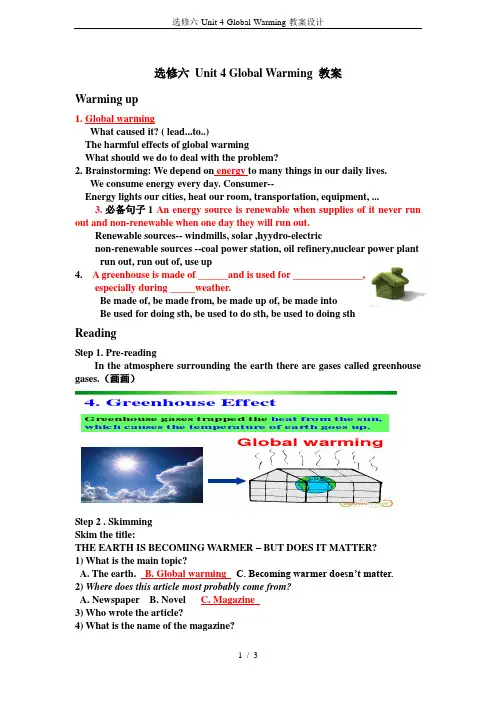
选修六 Unit 4 Global Warming 教案Warming up1. Global warmingWhat caused it? ( lead...to..)The harmful effects of global warmingWhat should we do to deal with the problem?2. Brainstorming: We depend on energy to many things in our daily lives. We consume energy every day. Consumer--Energy lights our cities, heat our room, transportation, equipment, ...3. 必备句子1 An energy source is renewable when supplies of it never run out and non-renewable when one day they will run out.Renewable sources-- windmills, solar ,hyydro-electricnon-renewable sources --coal power station, oil refinery,nuclear power plant run out, run out of, use up4. A greenhouse is made of ______and is used for ______________, especially during _____weather.Be made of, be made from, be made up of, be made intoBe used for doing sth, be used to do sth, be used to doing sthReadingStep 1. Pre-readingIn the atmosphere surrounding the earth there are gases called greenhouse gases.(画画)4. Greenhouse EffectGlobal warmingGr eenhouse gases tr appe d the heat fr o m the sun,whic h causes the tempe r atur e of ea r th goes up.Step 2 . SkimmingSkim the title:THE EARTH IS BECOMING WARMER – BUT DOES IT MATTER?1) What is the main topic?A. The earth.B. Global warmingC. Becoming warmer doesn’t matter.2) Where does this article most probably come from?A. NewspaperB. NovelC. Magazine3) Who wrote the article?4) What is the name of the magazine?Tip: In English, some nouns begin with a capital letter(大写字母), such as names of people and places, title s of magazines, newspapers, stories and books, people’s titles(头衔), etc..必背句子2—Earth Care’s Sophie Armstrong explores these questions.Step 3 Careful reading1) What causes global warming?(para 1)= How has this come about?come about表示“发生、产生”,多指事情已经发生了,但还不知道为什么,常用于疑问句和否定句,例如:happen常指具体事件的发生,特别指那些偶然的或未能预见的“发生”。
高中英语 Unit4 Global warming Period 1优秀教案 新人教版选修6
Unit 4 Global warming单元要览本单元的中心话题是人类当今面临的环境问题,主要探讨了“全球变暖”和“节约能源”等方面的问题。
由于人类过多使用不可再生能源,大气中二氧化碳的含量逐年增加,导致全球气温上升。
通过学习本单元,让学生了解能源分为“不可再生能源”和“可再生能源”,帮助学生树立“节约能源、保护环境”的主人翁意识。
Period 1Warming Up,Pre-reading,Reading and Comprehending整体设计教学内容分析This is the first teaching period of this unit.The central part of this period is the reading passage with the title of “The Earth Is Becoming Warmer—But Does It Matter?” talking about the global issue which has a great effect on human beings' life.Warming Up gives six pictures to help students list the sources of energy they can think of in our daily life.Then they will be led to discuss which energy source is “renewable” and which is “non-renewable”.This part is designed to help the students to recall their background knowledge about energy and prepares students for the whole unit.Pre-reading provides a picture of a greenhouse and then tells us what a greenhouse is and what “greenhouse gases” are.The students will be led to discuss what they think greenhouse gases do,leading to the topic of the reading passage.Reading is a passage from an environmental magazine for young people.It puts forward the possible effect of increased carbon dioxide in the atmosphere and different points of view about it.It also analyzes the causes of the earth's increased temperature.It poses questions and encourages students to think about the issues.There are two graphs in it that tell us the “temperature difference from long-term average,1860-2000”and “carbon dioxide content in the atmosphere,1957-1997”.Characters in the passage—Dr Janice Foster,George Hambley and Charles Keeling are all real persons and their views reflect the views of some scientists today.Comprehending consists of three written or oral exercises for the students to do so as to help the students to get a better understanding of the text,that is to say,to help the teacher to check how much the students have understood the text.三维目标设计Knowledge and skills1.To know the meanings of the following new words and phrases:consume(消费;消耗;耗尽),come about(发生;造成),random(胡乱的;任意的),phenomenon(现象),subscribe(同意;捐赠;订阅;签署文件),subscribe to(同意;赞成;订购),fuel(燃料),quantity(量;数量),quantities of (大量的),tend(趋向;易于;照顾),go up(上升;增长;升起),per(每;每一),data(资料;数据),result in(导致),trend(趋势;倾向),catastrophe(大灾难;浩劫),flood(洪水;洪灾),oppose(反对;反抗),opposed(反对的;对立的),be opposed to(反对),consequence(结果;后果),state(陈述;说明),range(种类;范围),even if(即使),keep on(继续),glance(看一下;扫视),steady(平稳的;持续的),steadily(平稳地,持续地)2.To learn about some facts and views about global warming.3.To learn how the information is organized.4.To develop the students' reading ability by skimming and scanning the passage.5.To develop the students' speaking ability by talking about global warming.Process and methods1.While doing Warming Up the teacher can lead in the topic of this unit by showing students some pictures or videos about sources of energy,making the students recall their own knowledge about energy.2.During Pre-reading the teacher can go around the classroom and discuss the questions with several students.This discussion should be student-centered and lead them to the topic of global warming.The teacher should also ask the students to look at the graphs in the reading passage and try to find out the general idea of the text.3.While doing Reading and Comprehending,the teacher may first ask the students to read the text quickly to get the general idea of each paragraph.After reading the passage,students are encouraged to answer some questions and discuss the text structure.4.To consolidate the contents of the reading passage,the students should be required to retell the text in their own words at the end of the class.Emotion,attitude and value1.To make students realize the harm of global warming and the importance of environmental protection.2.To develop students' sense of cooperative learning.教学重、难点1.To enable the students to learn about global warming and to develop their reading ability.2.To enable the students to talk about what we should do to prevent global warming.教学过程1Warming up1.Warming up by reading and talking:Read through the exercise with the class.Put students in groups of four to talk about what we use energy for,what are the sources of these energy and whether the sources are renewable or non -renewable.Suggested answer:The six photos are:windmills;a coal power station;an oil refinery;a nuclear power plant;solar panels;a hydro-electric dam.2.Warming up by discussion:Let the students have a discussion and collect suggestions from students and write them under the appropriate heading.2 Pre -reading 1.Show a picture of a greenhouse to students and ask them what a greenhouse is made of and what its purpose is.Suggested answer :It's made of glass and plants can grow in it when it's cold outside.Ask the students how it works.Suggested answer :The glass traps the heat from the sun ,making the air warm so that plants grow better.2.Ask students what they think “greenhouse gases” are and what they think greenhouse gases do.Look at the picture above and explain it to their partners.Suggested answer :Greenhouse gases perform the same function as the glass in a glasshouse :they trap the heat of the sun and keep the air surrounding the earth warm.This is called the greenhouse effect.)3 Reading and comprehending 1.Fast readingAsk students to read the passage quickly so as to get the key words and general idea of each paragraph and answer the following questions :(1)What is the main topic of the article?________________________________________________________________________ (2)Who wrote the magazine article ?What is the name of the magazine?________________________________________________________________________ (3)What are the names of the three scientists mentioned in the article ?Do they agree with one another?________________________________________________________________________ Suggested answers :(1)Global warming/the warming of the earth.(2)Sophie Armstrong ,Earth Care.(3)Dr Janice Foster,Charles Keeling,George Hambley.They don't agree with each other.2.Detailed reading(1)Read the passage carefully and judge whether the statements are true(T) or false(F).①Janice Foster believes that global warming is caused by the burning fossil fuels.()②Natural gas is a greenhouse gas.()③Carbon dioxide is a byproduct of burning fossil fuels.()④People accept Charles Keeling's data because he took accurate measurements.()⑤Flooding could be one of the effects of future global warming.()⑥George Hambley believes scientists are just guessing about the effects of global warming.()⑦George Hambley is worried about the effects of carbon dioxide on plant growth.()⑧It is clear what the effects of global warming will be.()(Suggested answers:TFTTTTFF)3.Structure analyzingAsk students to read the text carefully and try to find out how many parts they can divide theSuggested answer:4Language studyDealing with any language problem if any(words or sentences students might not understand)to help the students to have a better understanding of the text.5Listening,reading aloud and underliningAsk students to read the passage aloud to the tape and let them pay attention to the pronunciation of each word and the pauses within each sentence.Tell them to pick out all the useful expressions or collocations from the passage while reading and copy them to the notebook after class as homework.Collocations:come about,There is no doubt that...,subscribe to,due to,greenhouse effect,quantities of,tend to,be trapped in,go up,result in,on the one hand...on the other hand,be opposed to,build up,keep on.6RetellingAsk students to talk about global warming in their own words.Give them some key words and expressions on the blackboard.Then let them try to retell the passage.7Homework1.Learn the useful new words and expressions in this part by heart.2.Try to find some data about global warming on the Internet,and show your class in the next period and talk about them.8Reflection after teaching________________________________________________________________________ ________________________________________________________________________教学参考About Global Warming(关于全球变暖)Global warming is the increase in the average temperature of Earth's near-surface air and oceans since the mid-20th century and its projected continuation.Global surface temperature increased 0.74±0.18℃()between the start and the end of the 20th century.The Intergovernmental Panel on Climate Change(IPCC)concludes that most of the observed temperature increase since the middle of the 20th century was very likely caused by increasing concentrations of greenhouse gases resulting from human activity such as fossil fuel burning and deforestation.The IPCC also concludes that variations in natural phenomena such as solar radiation and volcanic eruptions had a small cooling effect after 1950.These basic conclusions have been endorsed by more than 40 scientific societies and academies of science,including all of the national academies of science of the major industrialized countries.Climate model projections summarized in the latest IPCC report indicate that the global surface temperature is likely to rise a further 1.1 to 6.4℃(2.0 to )during the 21st century.The uncertainty in this estimate arises from the use of models with differing sensitivity to greenhouse gas concentrations and the use of differing estimates of future greenhouse gas emissions.Most studies focus on the period up to the year 2100.However,warming is expected to continue beyond 2100 even if emissions stop,because of the large heat capacity of the oceans and the long lifetime of carbon dioxide in the atmosphere.An increase in global temperature will cause sea levels to rise and will change the amount and pattern of precipitation,probably including expansion of subtropical deserts.Warming is expected to be strongest in the Arctic and would be associated with continuing retreat of glaciers,permafrost and sea ice.Other likely effects include changes in the frequency and intensity of extreme weather events,species extinctions,and changes in agricultural yields.Warming and related changes will vary from region to region around the globe,though the nature of these regional variations is uncertain.Political and public debate continues regarding global warming,and what actions(if any)to take in response.The available options are mitigation to reduce further emissions;adaptation to reduce the damage caused by warming;and,more speculatively,geoengineering(地球工程)to reverse global warming.Most national governments have signed and ratified the Kyoto Protocolaimed at reducing greenhouse gas emissions.。
Unit 4 Global Warming 教学设计1-公开课-优质课(人教选修6精品)
Unit 4 Global warming教学案1教材分析Ⅰ.教学内容分析本单元的中心话题是人类当今面对的环境问题,主要探讨了“全球变暖”和“节约能源”等方面的问题。
由于人类过多使用不可再生能源,大气中二氧化碳的含量逐年增加,导致全球气温上升。
通过学习本单元,让学生了解能源分为“不可再生能源”和“可再生能源”,帮助学生树立“节约能源、保护环境”的主人翁意识。
语言知识和语言技能主要围绕“全球变暖”和“节约能源”这一主题设计的。
“热身”(Warming up) 部分要求学生列举家中、学校或其他地方使用能源的物体,指出这些能源的来源,并尽可能多地列举不同的能源。
能源可分为两类:一类是可再利用能源;另一类是一次性能源。
把前面列举的能源按能否再利用这一标准进行分类。
本部分提供了六幅图片,教师可以从识图开始组织教学。
还可以让学生搜集一些其他相关图片。
这六幅图分别为:风力(wind power)、燃煤发电站(a coal power station)、炼油厂(an oil refinery)、原子能发电站(a nuclear power plant)、太阳能接受器(solar panels)、水坝(a hydro dam)。
“读前”(Pre-reading) 部分首先介绍什么是温室、它有什么作用,然后要求学生讨论大气中温室气体的作用。
温室是由玻璃构成的建筑,主要用于花果蔬菜的培植。
温室是由玻璃构成的建筑,主要用于花果蔬菜的培植。
温室能阻止热量散发,因而能帮助植物度过寒冷的时期。
该部分的讨论有利于学生预测课文内容和理解阅读课文中的温室气体效应。
“阅读”(Reading) 部分是一篇杂志文章,主要讲述了地球温度上升的现象和原因。
20世纪中,地球的温度上升了华氏1度。
这看上去是一个很小的数字,但相对于自然界的其他现象来说,这个增长速度是迅猛的。
这种现象是自然发生的还是人为的?这个问题引起激烈的争论。
许多科学家认为,这种变化是人类燃烧矿物燃料所致。
高中英语(人教版)选修六 Unit 4 Global warming-Reading教案
Teaching PlanUnit 4 Global warmingReading: The earth is becoming warmer—but does it matter?Ⅰ Teaching Aims1.Enable the students to learn the following useful new words and expressions:fossil fuel, go up, come about, flood, drought, famine etc.by pictures.2. Enable students to master the reading skills by skimming, scanning.3. Enable students to get the knowledge of global warming through the reading strategies and skills.II Teaching Important and Difficult PointsEnable the students to get information about global warming using the reading strategies and skills.III Emotion, attitude and valueEnable the students to be more aware of the importance of stopping global warming Teaching Methods:Asking-and-answering activity to check the students’ understanding of the text;individual,pair or group work to finish each task.Teaching Aids:A multimedia computer and a blackboard.Teaching ProceduresStep 1 Lead-in1) Greetings and lead in.Show a film of The Day After Tomorrow and ask them the following question:What can you see in the film?--hurricane, tsunami, glacier melting .What other disasters do you know?--Flood, drought, famine.What causes the disasters?--It’s the global warming.What causes the the global warming?--Picture1: the burning of fossil fuelsPicture2: greenhouse gases: carbon dioxide, water vapor, methaneAs a result, the earth will become warmer and warmer.Step2. Skimming:Glance the first paragraph:1. Who wrote the magazine article?A. Janice FosterB. Sophie Armstrong2. What is the topic of the article?A. The earthB. Global warming3. There are the names of the three scientistsin the article EXCEPT______.A.Dr Janice FosterB. Sophie ArmstrongC. Charles KeelingD. George HambleyStep3 Scanning for detailed information (Group work)Part2(2-5)1. What do the two graphs show?--The first graph shows the temperature increase of one degree Fahrenheit between 1860 to 2000.--The second graph shows carbon dioxide went up from 1957 to 19972. What do you know about greenhouse effect?Greenhouse gases trap(吸收) the _heat_from the sun and therefore _warm_the earth. 3. Which following is NOT TRUE about global warming? (D)A. The increase of temperature is due of the burning of the fossil fuels.B. The burning of the fossil fuels caused the increase in carbon dioxide.C. All believes that activities of humans have caused global warming.D. The attitudes of scientists toward it are the same.3.The different ideas of the effects of the global warming Part3(6)Step4 SummaryWhat can we learn from the text? Fill in the bland.A. fossil fuelsB. human activityC.warmerD.differentE. heatEveryone believes that the earth is becoming ______. _______________ has caused this global warming: human produce energy by burning ___________. During this process, greenhouse gases are produced. Greenhouse gases can trap _____ from the sun and warm the earth which is called “greenhouse effect ”.The attitudes of scientists towards global warming are ______. On the one hand, it is a positive thing. On the other hand, if there are too many greenhouse gases, more heat will be trapped, causing global warming.Step5 After-reading group workWhat should we do to stop global warming?Discussion:Suggestions on global warming:turn off the electrical applianceDr. Foster Hambley More carbon dioxide has negative effects: rise of the sea level severestorms, droughts, floods, famines, the spread of diseases, the disappearance of species. More carbon dioxide is a _positive_ thing, makes crops __produce__ more and will encourage __a great range of animals____.talk with family and friends about itrecycle things like bottles, plasticsplant more treesride bike rather than carwords 参考词汇: reduce, carbon dioxide, absorb, environment, plant, electrical appliances, recycleSentences structures 句型:We should ... in order to ...moIt is a good idea to ... because it can ...e.g. We should plant more trees in order to absorb the carbon dioxide .It is a good idea to plant more trees because it can absorb the carbon dioxide .Suggestions about global warmingNowadays, global warming is becoming warmer and warmer. It's time for us to take some actions to deal with it.Firstly, we should ________________________________________ in order to _______________________________________.Secondly, it's a good idea to _______________________________________ because _______________________________________.Finally, why not ______________________ because________________________.Let us save energy and stop the global warming together.Step6 HomeworkWrite a short passage about the suggestions.。
高中英语选修6教案:Unit+4+Global+Warmingperiod1
Where does all this energy come from?
Discuss thesix pictures in Warming up.
Show the answer to each question.
Correct and add more information.
Step5. Evaluation
Evaluate students’ shows and give proper scores.
课堂检测d the words.
课后作业布置
Look up the new words and expressions of the Reading in the dictionary.
新授课课时教案
科目: 英语 主备人 授课时间:第 周 星期 年月 日 授课教师:
单元(章节)课题
Unit4 Global warming
本节课题
Period1Warming up and new words
课标要求
在新课程教学理念的指导下,力求培养学生在学习总结环境问题中最严重的全球气候变暖中使用恰当的的语言知识、知识技能、情感态度、学习策略等素养的基础上发展学生综合运用语言的能力,充分发挥自己的学习潜能,形成有效的学习策略。
预习内容布置
Preview the Reading:The earth is becoming warmer-but does it matter?
三维目标
1.Students will be able to read the important words and expressions correctly.
2.Students will learn global warming.
高中英语 Unit 4 Global warming教案 新人教版选修6
高中英语 Unit 4 Global warming教案新人教版选修6 Ⅰ. 单元教学目标Ⅱ. 目标语言Ⅲ. 教材分析与教材重组1. 教材分析本单元以Global warming 为主线,旨在通过单元教学使学生经过思考、学习,认识到全球变暖的起因和它所带来的种种后果。
同时鼓励学生进一步阐述地球所面临的其它严重问题,激发学生的环保意识。
引导学生运用所学语言、句式表达自己对这些现象的看法,培养他们为自己的观点辩论的能力,并能运用所学知识写一篇有关环境问题的论文。
1.1 Warming Up通过直观的图片,使学生对能源的用途和种类有一个基本的了解。
让学生对当今人们开发和使用能源以及随之而来的种种影响有更深一步的思考和认识,从而为本单元主题Global warming 作了很好的铺垫。
1.2 Pre-reading是Reading的热身活动。
通过组织学生对这些问题的讨论、回答,激活他们头脑中相关的内容模式,为下一步阅读做好准备。
由于Global warming 是当今世界的一个热门话题,学生已从多种渠道对此有了很多的了解,因此教师可以在安排预习作业时让学生分组做 a project on global warming , 这样既符合了新课程的要求——体现学生的主体地位,激发学生自主学习的热情,又能得到很好的教学效果。
1.3 Reading是一篇从杂志节选的文章。
它讲述了全球加速变暖的原因——人为温室效应,后果以及人们对此的不同观点。
要求学生在理解文章大意的同时注意它的写作技巧:提出问题——分析现象——阐述各方面的不同观点——以疑问句作为总结引发读者深思,自行做出判断。
这为Comprehending 中Exercise 3的分组辩论活动留出了很大的空间,埋下了很好的伏笔。
1.4 Comprehending 包含了三大部分。
前两个部分中设计了诸多细节性的问题,旨在检测学生定位、理解细节及对文章大意的总结归纳的能力。
新人教选修六-Unit-4-Global-warming单元教学设计
目标
〔一〕知识目标
Tograsp someuseful words and expressionsandlearn some useful sentence patterns
〔二〕能力目标
1.Get students to use someuseful words and expressions correctly .
Step 2 listening
Play the tape for students and pay attention to some important words and phrases
Listen to the tape and pay attention to some important words and phrases
2.Everyone believes that global warming is caused by the activity of humans.
3.Janice Foster believes that she can measure the future global rise in temperature.
Step 3languagepoints
Go through the passage and deal with anylanguage points
Learn the useful languagepoints
Step 4Practice
Ask students to do some practice
2. Develop students’sense of group cooperation
教学
方法
1.Task–based teaching and learning