
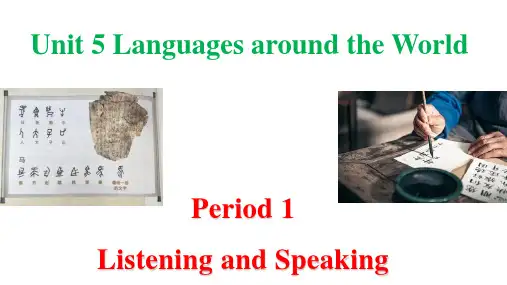
必修一Unit 5 Language around the world Listening and Speaking
BrE
●don't pronounce this sound
at all
●pronounce path with the sound [ɑː] ●pronounce tune as[tju:n]
●pronounce clerk as[klɑːk]
●pronounce tomato as[təˈmɑːtəʊ]
There are many pronunciation differences between American English and British English.
AmE
●pronounce [r] in such words as port, more, dinner ●pronounce path with the sound [æ ] ●pronounce tune as[tu:n] ●pronounce clerk as [klɜːrk] ●pronounce tomato as[təˈmeɪtoʊ]
1. refer to 指的是 2. do business with sb. 和某人做生意
3. Japanese cartoons 日本动漫 4. native speaker 说本族语的人
5. official language 官方语言
1. What languages can you speak? 2. What are the official languages of the
1. Finish the exercises in Learning English.
2. Preview Reading and Thinking on pages 62-63.
4. What is the attitude of the speaker towards foreign language learning? It is very useful to learn one or more foreign languages.
P60 4
Listen to the speech again. What do the italicised words refer to in the sentences? 1. They think it means better job chances in the future. They: students who choose
Hindi, English; there are several
there are 22 major regional languages,
France Russia GerlmanagnuaygeSspain sCucahnaasdCaataInladniaand
P60 1
Basque
Listen to a speech and tick the two languages with the most native speakers. Circle the official languages of the United Nations (UN).
2. Which languages do you think are officially used here?
Listening and Speaking
Explore languages around the world
There are around 7,000 living languages in the
2. How many languages are there in the world? Nearly 7,000.
3. How many billion people speak the UN's official languages as their native or second language? Around 2.8 billion.
Japanese.
Perhaps I should study French. I think it sounds beautiful, and I know it's used in many countries.
A: What language do you want to study? B: I really want to study French. I think that the French language sounds
hostilheostile ['hɒstaɪl] labor[a'htoɑrsytl]
either
['aɪð ə(r)]
['ið ɚ]
addresesither [ə'dres] adver[ætisderems]ent
direct
[də'rekt]
[də'rɜkt]
laborataodrydress[lə'bɒrətrɪ] sho['nlæebrəˌtɔrɪ]
RLiesatednthaendwopradysattoteenaticohnottohherowantdhesesepeifaykoeurs pronounce them.differently.
Words
BrE
AmE
schedsuclhe edule ['ʃedju:l] direc['stkedʒʊl]
English is a crazy language. ThereTishenowoemgganinhas a eggplant nor ham in hamburger;Bnreitiitshheracacpepnlet annodr the pine in pineapple. English muffinmsawnehreans'taninAvemneteridcain England or French fries in France. Sweeatcmceantts. are candies while sweetbreads, which aren't sweet, are meat. ... We find that quicksand can work slowly, boxing rings are square, and a guinea pig is neither from Guinea nor is it a pig. And why is it that writers write but... hammers don't ham? (Richard Lederer)
P60 2
Listen to the speech again and answer the questions.
1. What is the main topic of this speech? 2. How many languages are there in the world? 3. How many billion people speak the UN's
official languages as their native or second language? 4. What is the attitude of the speaker towards foreign language learning?
P60 3
1. What is the main topic of this speech? Learning a foreign language.
beautiful. A: Why? Do you want to go to France some day? B: Yes, I'd love to. Also, French is used by many international
organisations around the world. Do you know that FIFA's full name is in French? A: Oh, I remember that. But I don't know how to pronounce it.
to study a UN language it: studying a UN language 2. They are spoken by around 2.8 billion people... the six official UN languages
My father is doing business with
Russians. I'd like to learn Russian so I can help him
in the future.
Discuss which other language(s) you want to learn and why.
I like watching Japanese cartoons, so I'd like to learn
United Nations (UN)? 3. What foreign languages do you want
to study? Why? 4. Can you tell the differences between
BritiБайду номын сангаасh accent and American accent correctly?
advertisement [əd'vɜ:tɪsmənt] [ˌæ dvɚ'taɪzmənt]
shone
[ʃɒn]
[ʃon]
Listen to the paragraph read by two different speakers. Which speaker has a British accent and which has an American accent?
Unit5LanguagesAroundtheWorld(课件)

句式 12:形式倒装
1. 智慧和努力对于成功同样重要。
Equally important for success are wisdom and efforts.
2. 在我看来,保持在线学习和我们生活的平衡非常重要。 From my point of view,of great significance is keeping the balance between online learning and our life.
3. 浏览英语学习网站对英语学习非常有益。 Of great benefit to their English studies is visiting English learning websites.
四 续写赋能练习
(2017,6月浙江) A Brave Escape
麦克正沿着山路骑行,突然他看到一只狼张着血盆大口追赶他。他的恐惧无以言表。他乞 求路过的司机帮助他,但是徒劳无果。因此,他毫不犹豫地从自行车上下来,抓住自行车,用 尽全力把自行车扔向狼,尽力把狼吓走。他正要成为狼的盘中餐时,他的朋友加入了他。当他 向朋友描述这件恐怖的事情时,他仍然感到毛骨悚然。
随着年龄的增长,她对语言的迷 恋成为全球性的事情。她赞赏人们在 寻求掌握新语言时所面临的具体困难。 梅明白词汇的重要性以及弥合不同文 化之间差距的需求。在大学学期,梅 遇到了新的挑战。她意识到语言不仅 仅是关于文字,而是关于理解和平等。 这是一种与他人联系并理解他们的故 事的方式。她明白语言是一种强大的 工具,就像汽油一样,可以促进人与 人之间的联系。
As Mei grew older, her fascination with languages became a global affair. She appreciated the specific struggles people faced in their quest to master a new tongue. Mei understood the importance of vocabulary and the demand to bridge the gap between different cultures. During her college semester, Mei encountered new challenges. She realized that language was not just about words, but about understanding and equality. It was a way to relate to others and understand their stories. She understood that language was a powerful tool, like petrol that fueled connections between people.
Unit5 Languages around the World高一英语(人教版2019必修第一册)
English and Maori
(New Zealand)
Korean (Korea)
How to say “Hello” in different languages ?
中国:你好 Hello,hi 韩语: 안녕하세요 法语:Bonjour
Hallo 俄语: привет こんにちは 阿拉伯语: مرحبا 牙语: Olá 荷兰语: Hallo 牙语: ¡Buenas!
Around 2.8 billion.
4.What is the attitude of the speaker towards foreign language learning?
It’s very useful to learn one or more foreign languages.
4. Listen to the speech again. What do the italicised words refer to in the sentences?
1 They think it means better job
chances in the future.
Reference
They: students who choose to study
Pronouns (it, they, she, etc.) refer to something or
a UN language.
hello
The CN Tower 1 The Brandenburg Gate
The Louvre Museum
Red Square
The Taj Mahal
The Royal Palace of Madrid
高中英语必修一U5Languages around the world核心词汇讲解

She was good at physics
she found it boring.
尽管她认为物理枯燥无味,她却学得很好。[despite the fact that ]
②(2019·天津二考单选)In spite of all the problems , several of the players produced
thinking about which college to attend... 在考虑上哪所大学之前,学生应该对大学有一个正确的态度…… [to/towards ]
refer [rɪˈfɜː] vi. 提到,参考,查阅 vt.查询 refer to 指的是;描述;提到;查阅,涉及
refer...to 把……移交给;把…….托付给=deliver...as...
③Stonehenge is one of the world's most famous prehistoric monuments
over 5,000 years.
巨石阵是世界上最著名的史前遗迹之一,可追溯到5000多年前。[dating back ]现在分词短语作后置定语
variety [və'raɪəti] n.(植物,语言等的)变体,异体,多样化
vary .v.变化
various adj.各种各样的
varied adj.各种各样的
a variety of= varieties of各种各样的 各种各样的花various flowers(√) a variety of flowers (√) varieties of flowers (√) 拓 vary between...and...在……和……之间变化 vary from...to...从……到……不等;在……到……之间变化 vary in 在……方面有差异 vary with随……而变化 a variety of后接复数名词作主语 时,谓语动词通常用复数形式;the variety of后接复数名词作主语时,谓语动词通常用单 数形式。
人教版必修第一册Unit5Languagesaroundtheworld课件

8._s_t_ru_g_g_l_e_ n.& vi.斗争;奋斗;a_n_d_ n.要求;需求 vt.强烈要求;需要 vi.查问 11._r_e_la_t_e_ vt.联系;讲述
12._s_y_s_te_m__ n.体系;制度;系统
4._v_a_r_y_ vt.& vi.不同;变化;改变 →_v_a_r_ie_t_y_ n.(植物、语言等的)变体;异 体;多样化→__v_a_ri_o_u_s_ adj.不同的;各种各样的
5.__m_a_j_o_r_ adj.主要的;重要的;大的 n.主修课程;主修学生 vi.主修;专门研究 →__m_a_j_o_ri_ty__ n.大多数;大半→__m_i_n_o_ri_t_y_ n.少数
1.carve vt.& vi.__雕__刻__ 2.dynasty n.__王__朝__;__朝__代__ 3.dialect n.__地__方__话__;__方__言__ 4.calligraphy n.__书__法__;__书__法__艺__术__ 5.semester n.__学__期__ 6.gap n.__间__隔__;__开__口__;__差__距__ 7.tongue n.__舌__头__;__语__言__ 8.bone n._骨__头__;_骨__(__质__)__ 9.shell n._壳__;_壳__状__物__ 10.petrol n.__汽__油__ 11.pants n._内__裤__;_短__裤__;裤__子___
人教版(2019)必修第一册Unit 5 Languages Around the World 课件

Englsh It's 9omuc can sou ndnrea
SO MANYin head,and I
casi "Openterrl ibi .
描述问题I have some difficulty in ...I don't know how to........is a big difficulty for me....is my biggest problemI can not/I can never...I have no idea how/what..My biggest problem/headache is...
起首句 (the opening sentence)I'm writing to ask you a favor.我给您写信是为了得到您的帮助。I am writing in the hope that you will be kind enough to do me a favor.我希望你能帮我一个忙。
LANGUAGESweekly conversations
Reading for writing
Hallo!He
Learng objectives1.To state problems some Chinese students have with English learning and offer advice.2.To write a letter for help.
Name
Problem
Advice
LiRui
rememberingnew vocabulary
My advice:● create your own word bank;● carry a small notebook with you everywhere,and add new words every day● learn word chunks(词块) instead of single word,● learn word formation(构词法)● learn words in context
Unit 5 Languages Around the World 词汇课件-高中英语必修第一册

appreciate vt. 欣赏;重视;感激;意识到
appreciate (one’s) doing sth. 感激(某人)做某事 appreciate it … if… 如果……,将感激不尽 注意: 当appreciate, hate, dislike, love, like, depend/rely on等词后接宾语从句 时,一般先加it,再接宾语从句。
• regard / rɪˈgɑ:d / n. 尊重 vt. 把... 视为
(1)as regards sth. 关于;至于某事 with/in regard to 关于;对于in this/that regard 在这方面;在这一点 上
regard ... as 把...看着;认为...是
Whatever he said and did, I only regard him as a good friend.
You're foolish enough to base_your_hopes_upon his promise. 2. What you said in the court must be based on the fact.
你在法庭的言论必须以事实为依据。 (2) -based (构成复合词) 以……为重要部分(或特征);以 ……为主
have/show/ take a/a… attitude to/toward
经典例句
attitude
对……持有\采取……态度
[C] 态度;看法
an attitude of mind 心态问题
attitude n. altitude n. latitude n. longitude n. multitude n.
人教版高中英语必修第一册 UNIT 5 LANGUAGES AROUND THE WORLD Ⅰ
3.重音
英式英语习惯把单词的主重音放在后面的音节上,而美式英
语则把主重音放在前面的音节上。尤其是以-ary,-ory结尾的
单词。
BrE
AmE
la̍boratory
̍laboratory
dic̍tate
̍dictate
̩ciga̍rette
̍cigarette
4.英式英语中的/j/音在美式英语中逐渐失去发音
重点短语
1.refer to 指的是;描述;提到;查阅
2.pay attention to 注意
1.【教材原文】How many billion people speak the
UN’s official languages as their native or second
language?(page 60)
Section Ⅰ
Listening and Speaking
重点单词
1. billion n.十亿
2. native adj.出生地的;本地的,土著的 n.本地人
3. attitude n.态度;看法
词汇拓展
refer vi.提到;参考;查阅 vt.查询;叫……求助于
→ reference n.指称关系;参考
语境领悟
朗读下列单词,感悟英式英语和美式英语发音的不同。
/ə̍ɑːəʊ/
/ɒ/
tomato
not
/ɑː/
/ə̍ʊ/
/̍ɑː/
/̍əʊ/
mobile
sample
/̍æ/
/̍ʊ/
/̍ː/
student
/̍ː/
语境领悟
(1)We should have a positive attitude to life.
人教版必修第一册 Unit 5 Languages Around the World 课件
( B )3.The passage expresses that China has continued its civilisation all the way because ________. A.China plays a great role in global affairs B.the Chinese writing system plays an important role C.the Chinese writing system can unite the Chinese people D.Qinshihuang made the Chinese writing system begin to develop in one direction
(3)文章最后一句中用“amazing”一词形象地表达出了汉语的博 大精深。 2.逻辑运用 (1)第一段第一句中的“despite”在此处是介词,表示“尽管 ……”。此处用作让步状语。 (2)第一段最后一句“There are many reasons why this has been possible, but one of the main factors has been the Chinese writing system.”承上启下。
Task 2:析结构
本文是“总—分—总”模式,首段点题,说明汉字书写体系的 重大意义,然后以时间为线索分段讲述它的发展演变,尾段回扣 主题。注意这种结构的文章在提炼主旨大意时要从首尾段着手。
Task 3:理文化
中国的书法拥有五千年的发展历史,它是历代书法家精神的 结晶,是我国宝贵的文化遗产。中国书法是以汉字为基础的文 化艺术,是记录汉语的书写符号,在历史发展进程中经历了字 形、结体、笔画的演变,逐渐具有了特殊的审美意义,并且造 就了中国书法造型多变、种类繁多、颇具特色、美不胜收的艺 术发展史。联合国教科文组织将中国的汉字书法列为人类非物 质文化遗产之一,是对中国汉字书法文化及其作为书法源头的 最具说服力的肯定性评价。
人教版(2023)必修第一册 Unit 5 languages around the world L
人教版(2023)必修第一册Unit 5 languages around the world Listening and talking 教学设计Unit5口语课教案Exploring Different Kinds of EnglishTeaching Objectives:1. To develop students' listening, speaking, reading, and writing skills in English.2. To help students understand the different types of English (e.g., academic, business, casual, technical) and their respective contexts.3. To enhance students' cultural awareness and global perspectives through the study of English.4. To prepare students for college entrance exams and future academic and professional pursuits.Teaching Key Points:1. The definition and characteristics of different types of English.2. Examples of each type of English in real-life situations.3. Strategies to improve language proficiency in each type of English.4. The role of English in a globalized world.Teaching Difficulties:1. Students may find it challenging to differentiate between the various types of English in different contexts.2. Students may struggle to apply the strategies to their own language learning.3. Students may have difficulty understanding the cultural implications of using different types of English in certain situations.Student Analysis:The class consists of junior and senior high school students who have a basic level of English proficiency but varying levels of confidence in using the language. Most students are eager to learn and participate in class activities, but some may feel overwhelmed or unsure about their abilities.Teaching Methods:1. Lecture: Introduce the concept of different types of English and their characteristics. Use visual aids and real-life examples to illustrate points.2. Group Discussion: Encourage students to share their experiences with different types of English they encounter in daily life or during travels. Analyze and compare the examples given by different students.3. Role-play: Divide students into pairs or small groups and assign them roles based on the type of English they need to use (e.g., academic presentation, job interview). Give them time to prepare and practice their performances in front of the class.4. Cultural Insight: Discuss the cultural implications of using different types of English in various situations, such as business negotiations or social events. Use multimedia resources to explore the cultural backgrounds of English-speaking countries.5. Self-assessment: Assign quizzes or written assignments that test students' understanding of different types of English and their application skills. Offer feedback and guidance for improvement.6. Homework: Ask students to write short essays on how they use English in their daily lives, highlighting the differences between academic, business, casual, and technical English. Provide feedback on their essays and encourage them to continue practicing their language skills outside the classroom.Learning Activities:Introduction (5 minutes)1. Begin the class by asking students what they know about different types of English and why they are interested in learning about them.2. Introduce the concept of differentiating between various types of English based on context, situational requirements, and intended audiences.3. Present an example of each type of English (e.g., academic, business, casual, technical) and ask students to identify its characteristics and usage scenarios.4. Invite a few students to share their thoughts on the importance of understanding different types of English in today's globalized world. Group Discussion (20 minutes)1. Divide students into small groups (3-4 students per group). Assign each group a specific type of English (e.g., academic, business, casual, technical).2. Ask each group to discuss their assigned type of English and share their personal experiences or observations related to it. Encourage them to provide examples from real-life situations or events they have witnessed or participated in.3. After the group discussion, facilitate a larger class discussion by asking each group to report on their findings and share insights with the rest of the class. Facilitate a Q&A session to clarify any misunderstandings or questions raised by other students.Culture Insight (15 minutes)1. Introduce a specific type of English (e.g., academic) and discuss its cultural significance in a particular context (e.g., academia). Use multimedia resources to provide visual aids and examples related to this topic.2. Ask students to reflect on how this type of English might differ from other forms they have learned before (e.g., business, casual). Ask them to consider factors such as tone, register, vocabulary, and grammar whenanalyzing these differences in contextual usage scenarios.3. Encourage students to think critically about how cultural differences can impact communication across different types of English in various settings (e.g., international conferences, job interviews). Discuss potential challenges and opportunities that arise from these cross-cultural interactions and how they can be navigated effectively in professional settings or personal relationships with people from diverse backgrounds.Self-assessment (10 minutes)Assign a quiz or written assignment that tests students' understanding of different types of English and their ability to apply them effectively in various situations (e.g., multiple-choice questions, short answer questions). Include questions on contextual usage scenarios and cultural nuances related to each type of English.。
人教版必修第一册Unit5LanguagesAroundtheWorld课件(1)
Unit 5 Languages around the world 7.There are many reasons why this has been possible, but one of the main factors has been the Chinese writing system.
23.We offer courses that relate English literature to other subjects. 我们提供(把英国文学和其他学科联系起来的)课程。 24.He appreciated his teacher pointing out his mistakes in his composition. 他很感激老师指出他作文中的错误。 25.I’d appreciate it if you could give me the opportunity. 我将不胜感激如果你能给我这个机会。
Unit 5 Languages around the world 1. Official languages of the United Nations are spoken by2.8 billion people as their native or second language.
联合国官方语言被28亿人讲作为他们的母语或第二种语言。
在极其炎热的夏天,空调的需求量很大。 34. He gave us a brief description of the tXXXami. =He described the tXXXami to us briefly.
他简要地向我们描述了一下海啸。 35. That writing system was of great importance in uniting the Chinese people and culture. 这个书写体系很重要在联合中国人和中国文化。