
丙烯酸_MSDS
丙烯酸
1、物质的理化常数
国标编号: 81617 CAS: 79-10-7
中文名称: 丙烯酸
英文名称: Acrylic acid;Propenoic acid
别名:
分子式: C3H4O2;CH2CHCOOH 分子量: 72.06
熔点: 14℃沸点:141℃
密度: 相对密度(水=1)1.05;
蒸汽压: 50℃
溶解性: 与水混溶,可混溶于乙醇、乙醚
稳定性: 稳定
外观与性
无色液体,有刺激性气味
状:
危险标记: 20(酸性腐蚀品)
用途: 用于树脂制造
2.对环境的影响:
一、健康危害
侵入途径:吸入、食入、经皮吸收。
健康危害:本品对皮肤、眼睛和呼吸道有强烈刺激作用。
二、毒理学资料及环境行为
毒性:属低毒类。
急性毒性:LD502520mg/kg(大鼠经口);950mg/kg(兔经皮);LC505300mg/m3,2小时(小鼠吸入)
致突变性:细胞遗传学分析:小鼠淋巴细胞450mg/L。
生殖毒性:大鼠腹腔最低中毒剂量(TDL0):73216ug/kg(孕5~15天),致胚胎毒性,肌肉骨骼发育异常。
致癌性:IARC致癌性评论:动物、人类皆无可靠数据。
危险特性:其蒸气与空气形成爆炸性混合物,遇明火、高热能引起燃烧爆炸。
与氧化剂能发生强烈反应。
若遇高热,可能发生聚合反应,出现大量放热现象,引起容器破裂和爆炸事故。
燃烧(分解)产物:一氧化碳、二氧化碳。
3.现场应急监测方法:
4.实验室监测方法:
气相色谱法《气相色谱法测定环境大气中丙烯酸酯类化合物》顾海东等,上海环境监测,1998(1)P115~16
5.环境标准:
前苏联车间空气中有害物质的最高容许浓度5mg/m3
前苏联(1975)水体中有害物质最高允许浓度0.5mg/L
嗅觉阈浓度0.094ppm
6.应急处理处置方法:
一、泄漏应急处理
疏散泄漏污染区人员至安全区,禁止无关人员进入污染区,切断火源。
建议应急处理人员戴自给式呼吸器,穿化学防护服。
不要直接接触泄漏物,在确保安全情况下堵漏。
喷水雾能减少蒸发但不要使水进入储存容器内。
用沙土或其它不燃性吸附剂混合吸收,然后收集运至废物处理场所处置。
如大量泄漏,利用围堤收容,然后收集、转移、回收或无害处理后废弃。
二、防护措施
呼吸系统防护:空气中浓度超标时,应该佩带防毒面具。
紧急事态抢救或逃生时,佩带自给式呼吸器。
眼睛防护:戴化学安全防护眼镜。
防护服:穿工作服(防腐材料制作)。
手防护:戴橡皮手套。
其它:工作后,淋浴更衣。
注意个人清洁卫生。
三、急救措施
皮肤接触:脱去污染的衣着,立即用水冲洗至少15分钟。
眼睛接触:立即提起眼睑,用流动清水或生理盐水冲洗至少15分钟。
吸入:迅速脱离现场至空气新鲜处。
保持呼吸道通畅。
必要时进行人工呼吸。
就医。
食入:误服者给饮大量温水,催吐,就医。
灭火方法:雾状水、二氧化碳、砂土、抗溶性泡沫。
丙烯酸_MSDS

丙烯酸安全技术说明书MSDS说明书目录第一部分化学品名称第九部分理化特性第二部分成分/组成信息第十部分稳定性和反应活性第三部分危险性概述第十一部分毒理学资料第四部分急救措施第十二部分生态学资料第五部分消防措施第十三部分废弃处置第六部分泄漏应急处理第十四部分运输信息第七部分作处置与储存第十五部分法规信息第八部分接触控制/个体防护第十六部分其他信息第一部分:化学品名称化学品中文名称:丙烯酸化学品俗名:快速固化丙烯酸液体化学品英文名称: acrylic acid 英文名称: propenoic acid/Qutck Set Acrylic Liquid技术说明书编码: 917 CAS No.:79-10-7生产企业名称:地址:生效日期:第二部分:成分/组成信息有害物成分含量CAS No.丙烯酸≥99.0%79-10-7第三部分:危险性概述第四部分:急救措施第五部分:消防措施第六部分:泄漏应急处理第七部分:操作处置与储存第八部分:接触控制/个体防护外观与性状:无色液体,有刺激性气味。
pH:熔点(℃):14 相对密度(水=1):1.05 沸点(℃):141 相对蒸气密度(空气=1):2.45 分子式:C3H4O2分子量:72.06 主要成分:含量≥99.0%。
饱和蒸气压(kPa):1.33(39.9℃) 燃烧热(kJ/mol):1366.9临界温度(℃): 无资料 临界压力(MPa): 无资料辛醇/水分配系数的对数值: 0.36(计算值)闪点(℃):50爆炸上限%(V/V): 8.0 引燃温度(℃): 438 爆炸下限%(V/V): 2.4 溶解性: 与水混溶,可混溶于乙醇、乙醚。
主要用途:用于树脂制造。
其它理化性质:第十部分:稳定性和反应活性第十一部分:毒理学资料第十二部分:生态学资料第十三部分:废弃处置第十四部分:运输信息危险货物编号: 81617UN 编号: 2218 包装标志:第九部分:理化特性包装类别: O52包装方法:塑料桶(胆)外钢塑复合桶;安瓿瓶外普通木箱;螺纹口玻璃瓶、铁盖压口玻璃瓶、塑料瓶或金属桶(罐)外普通木箱;螺纹口玻璃瓶、塑料瓶或镀锡薄钢板桶(罐)外满底板花格箱、纤维板箱或胶合板箱。
丙烯酸MSDS

propenoic acid
技术说明书编码:
917
CAS No.:
79-10—7
分子式:
C3H4O2
分子量:
72。06
第二部分:成分/组成信息
回目录
有害物成分
含量
CAS No。
丙烯酸
≥99.0%
79-10—7
第三部分:危险性概述
回目录
危险性类别:
侵入途径:
健康危害:
本品对皮肤、眼睛和呼吸道有强烈刺激作用.
第七部分:操作处置与储存
回目录
操作注意事项:
密闭操作,加强通风。操作人员必须经过专门培训,严格遵守操作规程.建议操作人员佩戴自吸过滤式防毒面具(全面罩),穿橡胶耐酸碱服,戴橡胶耐酸碱手套。远离火种、热源,工作场所严禁吸烟.使用防爆型的通风系统和设备。防止蒸气泄漏到工作场所空气中。避免与氧化剂、碱类接触。尤其要注意避免与水接触.搬运时要轻装轻卸,防止包装及容器损坏。配备相应品种和数量的消防器材及泄漏应急处理设备。倒空的容器可能残留有害物.
第十六部分:其他信息
回目录
参考文献:
填表部门:
数据审核单位:
修改说明:
其他信息:
第十五部分:法规信息
回目录
法规信息
化学危险物品安全管理条例 (1987年2月17日国务院发布),化学危险物品安全管理条例实施细则 (化劳发[1992] 677号),工作场所安全使用化学品规定 ([1996]劳部发423号)等法规,针对化学危险品的安全使用、生产、储存、运输、装卸等方面均作了相应规定;常用危险化学品的分类及标志 (GB 13690—92)将该物质划为第8.1 类酸性腐蚀品;车间空气中丙烯酸卫生标准 (GB 16213—1996),规定了车间空气中该物质的最高容许浓度及检测方法。
丙烯酸
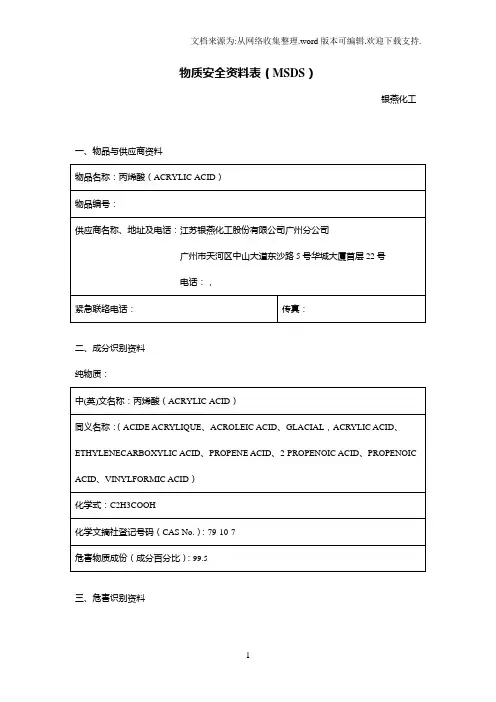
物质安全资料表(MSDS)
银燕化工一、物品与供应商资料
二、成分识别资料
纯物质:
三、危害识别资料
四、急救措施
五、灭火措施
六、泄露处理方法
七、安全处置及储藏方法
八、暴露预防措施
注:ACGIH是指美国政府工业卫生专家会议推荐的接触限值。
TWA(时间加权平均阈限值)是指八小时工作日的时间加权平均浓度规定的阈限值。
STEL(短时间接触阈限值)是指每次接触时间不得超过15分钟的时间加权平均接触限值,每天接触不超过4次,且前后两次接触至少要间隔60分钟。
同时当日的时间加权平均阈限值亦不得超过。
BEI (生物接触指数):ACGIH推荐的最高容许生物浓度。
中国最高容许浓度是指任何有代表性的采样测定均不得超过的浓度。
九、物理及化学性质
十、稳定性及反应性
十一、毒性资料
十二、生态资料
十三、废弃处置方法
十四、运输资料
十五、法规资料
十六、其他资料
上述资料由江苏银燕化工股份有限公司广州分公司提供,银燕公司对上述资料已力求正确,但错误恐仍难免,各项数据与资料仅供参考,使用者请依应用需求,自行负责判断其可用性,银燕公司不负任何责任。
丙烯酸树脂(MSDS)
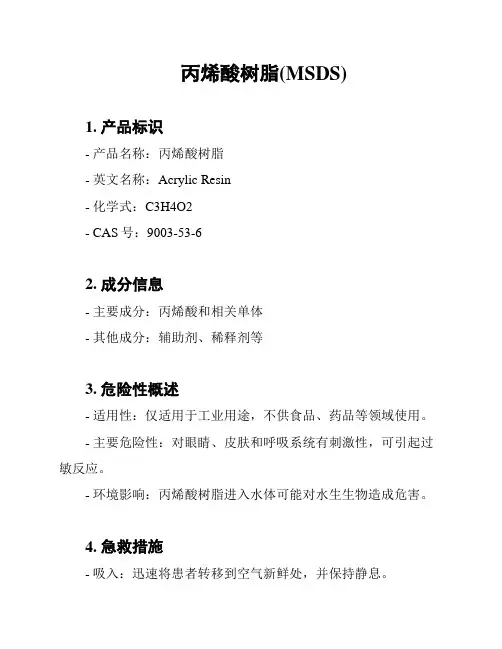
丙烯酸树脂(MSDS)1. 产品标识- 产品名称:丙烯酸树脂- 英文名称:Acrylic Resin- 化学式:C3H4O2- CAS号:9003-53-62. 成分信息- 主要成分:丙烯酸和相关单体- 其他成分:辅助剂、稀释剂等3. 危险性概述- 适用性:仅适用于工业用途,不供食品、药品等领域使用。
- 主要危险性:对眼睛、皮肤和呼吸系统有刺激性,可引起过敏反应。
- 环境影响:丙烯酸树脂进入水体可能对水生生物造成危害。
4. 急救措施- 吸入:迅速将患者转移到空气新鲜处,并保持静息。
- 眼部接触:立即用大量清水冲洗眼睛至少15分钟,必要时就医。
- 皮肤接触:立即用大量清水冲洗,并用低刺激性清洁剂清洗皮肤。
- 吞咽:立即给患者喝水漱口,不要催吐并就医。
5. 消防措施- 灭火剂:干粉、二氧化碳、泡沫或水雾喷射。
- 灭火注意事项:避免直接喷射水流,以免加剧火势。
- 灭火缺点:在燃烧过程中,可能会产生有毒烟雾。
- 防护注意事项:佩戴呼吸器和防护服进行灭火。
6. 泄漏应急处理- 人员防护:佩戴防护手套、防护眼镜和呼吸器。
- 泄漏物处置:用不可溶性物质(如干沙或滑石粉)吸附,用干净的铲子勾起并储存于密闭中,咨询相关专业机构处理。
7. 使用安全措施- 接触控制:使用化学防护服、防护手套、安全眼镜以及呼吸防护器材。
- 储存要求:存放在清洁、干燥且通风良好的地方,远离热源和火源。
- 防火措施:防止静电积聚,远离明火和高温。
储存并处理于远离热源、火源和有机物的区域。
8. 人体暴露控制与个人防护- 眼睛防护:佩戴密封性好的防护眼镜。
- 呼吸系统防护:在通风不良的环境中使用合适的呼吸防护器。
- 手部防护:佩戴具有耐化学品的手套。
- 皮肤防护:如有皮肤接触,及时清洗皮肤。
9. 废弃物处理- 废弃物亦属于有害垃圾,遵守当地相关法规进行处理。
10. 环境保护措施- 避免丙烯酸树脂进入水体或土壤,以免对环境造成污染。
> 注意:本文档为供参考之用途,使用者须遵守本产品的相关规范和法律法规,对于使用不当所致的损失及责任,生产厂商不予承担。
丙烯酸MSDS
职业接触限值
中国MAC(mg/m3):
6[皮]
前苏联MAC(mg/m3):
5
TLVTN:
ACGIH 2ppm,m3
TLVWN:
未制定标准
监测方法:
气相色谱法
工程控制:
生产过程密闭,加强通风。提供安全淋浴和洗眼设备。
呼吸系统防护:
可能接触其蒸气时,必须佩戴自吸过滤式防毒面具(全面罩)或直接式防毒面具(半面罩)。紧急事态抢救或撤离时,佩戴自给式呼吸器。
第十六部分:其他信息
参考文献:
填表部门:
数据审核单位:
修改说明:
其他信息:
包装方法:
塑料桶(胆)外钢塑复合桶;安瓿瓶外普通木箱;螺纹口玻璃瓶、铁盖压口玻璃瓶、塑料瓶或金属桶(罐)外普通木箱;螺纹口玻璃瓶、塑料瓶或镀锡薄钢板桶(罐)外满底板花格箱、纤维板箱或胶合板箱。
运输注意事项:
铁路运输时应严格按照铁道部《危险货物运输规则》中的危险货物配装表进行配装。起运时包装要完整,装载应稳妥。运输过程中要确保容器不泄漏、不倒塌、不坠落、不损坏。运输时所用的槽(罐)车应有接地链,槽内可设孔隔板以减少震荡产生静电。严禁与氧化剂、碱类、食用化学品等混装混运。公路运输时要按规定路线行驶,勿在居民区和人口稠密区停留。
第十五部分:法规信息
法规信息
化学危险物品安全管理条例 (1987年2月17日国务院发布),化学危险物品安全管理条例实施细则 (化劳发[1992] 677号),工作场所安全使用化学品规定 ([1996]劳部发423号)等法规,针对化学危险品的安全使用、生产、储存、运输、装卸等方面均作了相应规定;常用危险化学品的分类及标志 (GB 13690-92)将该物质划为第 类酸性腐蚀品;车间空气中丙烯酸卫生标准 (GB 16213-1996),规定了车间空气中该物质的最高容许浓度及检测方法。
丙烯酸AcrylicAcidMSDS
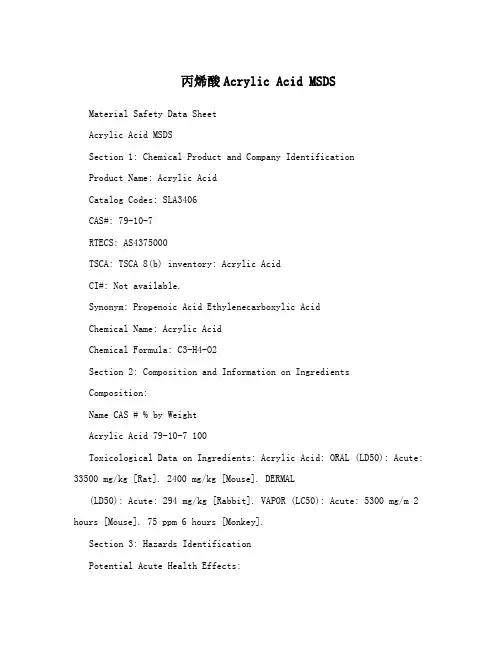
丙烯酸Acrylic Acid MSDSMaterial Safety Data SheetAcrylic Acid MSDSSection 1: Chemical Product and Company IdentificationProduct Name: Acrylic AcidCatalog Codes: SLA3406CAS#: 79-10-7RTECS: AS4375000TSCA: TSCA 8(b) inventory: Acrylic AcidCI#: Not available.Synonym: Propenoic Acid Ethylenecarboxylic AcidChemical Name: Acrylic AcidChemical Formula: C3-H4-O2Section 2: Composition and Information on IngredientsComposition:Name CAS # % by WeightAcrylic Acid 79-10-7 100Toxicological Data on Ingredients: Acrylic Acid: ORAL (LD50): Acute: 33500 mg/kg [Rat]. 2400 mg/kg [Mouse]. DERMAL(LD50): Acute: 294 mg/kg [Rabbit]. VAPOR (LC50): Acute: 5300 mg/m 2 hours [Mouse]. 75 ppm 6 hours [Monkey].Section 3: Hazards IdentificationPotential Acute Health Effects:Very hazardous in case of skin contact (permeator), of eye contact (irritant, corrosive). Corrosive to skin and eyes on contact.Liquid or spray mist may produce tissue damage particularly on mucous membranes of eyes, mouth and respiratory tract. Skin contact may produce burns. Inhalation of the spray mist may produce severeirritation of respiratory tract, characterized by coughing, choking, or shortness of breath. Severe over-exposure can result in death. Inflammation of the eye is characterized by redness, watering, and itching.Potential Chronic Health Effects:CARCINOGENIC EFFECTS: A4 (Not classifiable for human or animal.) by ACGIH, 3 (Not classifiable for human.) by IARC. MUTAGENIC EFFECTS: Classified POSSIBLE for human. Mutagenic for mammalian germ and somatic cells. TERATOGENIC EFFECTS: Classified SUSPECTED for human. DEVELOPMENTAL TOXICITY: Classified Reproductive system/toxin/male [POSSIBLE]. Classified Development toxin [SUSPECTED]. The substance is toxic to bladder, brain, upper respiratory tract, eyes, central nervous system (CNS). Repeated or prolonged exposure to the substance can produce target organs damage. Repeated or prolonged contact with spray mist may produce chronic eye irritation and severe skin irritation.p. 1Repeated or prolonged exposure to spray mist may produce respiratory tract irritation leading to frequent attacks of bronchial infection.Repeated exposure to a highly toxic material may produce general deterioration of health by an accumulation in one or many human organs.Section 4: First Aid MeasuresEye Contact:Check for and remove any contact lenses. In case of contact, immediately flush eyes with plenty of water for at least 15 minutes. Cold water may be used. Get medical attention immediately.Skin Contact:In case of contact, immediately flush skin with plenty of water for at least 15 minutes while removing contaminated clothing and shoes. Cold water may be used.Wash clothing before reuse. Thoroughly clean shoes before reuse. Get medical attention immediately.Serious Skin Contact:Wash with a disinfectant soap and cover the contaminated skin withan anti-bacterial cream. Seek immediate medical attention.Inhalation:If inhaled, remove to fresh air. If not breathing, give artificial respiration. If breathing is difficult, give oxygen. Get medical attention immediately.Serious Inhalation:Evacuate the victim to a safe area as soon as possible. Loosen tight clothing such as a collar, tie, belt or waistband. If breathing is difficult, administer oxygen. If the victim is not breathing, perform mouth-to-mouth resuscitation. WARNING: It maybe hazardous to the person providing aid to give mouth-to-mouth resuscitation when the inhaled material is toxic, infectious or corrosive. Seek immediate medical attention.Ingestion:Do NOT induce vomiting unless directed to do so by medical personnel. Never give anything by mouth to an unconscious person. Loosen tight clothing such as a collar, tie, belt or waistband. Get medical attention if symptoms appear.Serious Ingestion: Not available.Section 5: Fire and Explosion DataFlammability of the Product: Flammable.Auto-Ignition Temperature: 438?C (820.4?F)Flash Points: CLOSED CUP: 50?C (122?F).Flammable Limits: Not available.Products of Combustion: These products are carbon oxides (CO, CO2).Fire Hazards in Presence of Various Substances:Extremely flammable in presence of open flames and sparks. Highly flammable in presence of heat.Explosion Hazards in Presence of Various Substances:Risks of explosion of the product in presence of mechanical impact: Not available. Risks of explosion of the product in presence of static discharge: Not available.Fire Fighting Media and Instructions:Flammable liquid, soluble or dispersed in water. SMALL FIRE: Use DRY chemical powder. LARGE FIRE: Use alcohol foam, water spray or fog. Cool containing vessels with water jet in order to prevent pressure build-up, autoignition or explosion.Special Remarks on Fire Hazards: Not available.Special Remarks on Explosion Hazards: Not available.p. 2Section 6: Accidental Release MeasuresSmall Spill:Dilute with water and mop up, or absorb with an inert dry material and place in an appropriate waste disposal container.Large Spill:Flammable liquid. Corrosive liquid. Poisonous liquid. Keep away from heat. Keep away from sources of ignition. Stop leak if without risk. Absorb with DRY earth, sand or other non-combustible material. Do not get water inside container. Do not touch spilled material. Use water spray curtain to divert vapor drift. Use water spray to reduce vapors. Prevent entry into sewers, basements or confined areas; dike if needed. Call for assistance on disposal. Be careful that the product is not present at a concentration level above TLV. Check TLV on the MSDS and with local authorities.Section 7: Handling and StoragePrecautions:Keep locked up.. Keep container dry. Keep away from heat. Keep away from sources of ignition. Ground all equipment containing material. Do not ingest. Do not breathe gas/fumes/ vapor/spray. Never add water to this product. If ingested, seek medical advice immediately and show the container or the label. Avoid contact with skin and eyes. Keep away from incompatibles such as oxidizing agents, acids, alkalis, moisture.Storage:Store in a segregated and approved area. Keep container in a cool, well-ventilated area. Keep container tightly closed and sealed until ready for use. Avoid all possible sources of ignition (spark or flame).Section 8: Exposure Controls/Personal ProtectionEngineering Controls:Provide exhaust ventilation or other engineering controls to keepthe airborne concentrations of vapors below their respective threshold limit value. Ensure that eyewash stations and safety showers are proximal to the work-station location.Personal Protection:Face shield. Full suit. Vapor respirator. Be sure to use anapproved/certified respirator or equivalent. Gloves. Boots.Personal Protection in Case of a Large Spill:Splash goggles. Full suit. Vapor respirator. Boots. Gloves. A self contained breathing apparatus should be used to avoid inhalation of the product. Suggested protective clothing might not be sufficient; consult a specialist BEFORE handling this product.Exposure Limits:TWA: 2 (ppm) from ACGIH (TLV) [United States] [1997] TWA: 2 [Australia] STEL: 20 (ppm) [United Kingdom (UK)] TWA: 10 (ppm) [United Kingdom (UK)] Consult local authorities for acceptable exposure limits.Section 9: Physical and Chemical PropertiesPhysical state and appearance: Liquid.Odor: Acrid (Strong.)Taste: Not available.Molecular Weight: 72.06 g/moleColor: Colorless.pH (1% soln/water): Not available.Boiling Point: 141?C (285.8?F)Melting Point: 14?C (57.2?F)p. 3Critical Temperature: 342?C (647.6?F)Specific Gravity: 1.05 (Water = 1)Vapor Pressure: 0.5 kPa (@ 20?C)Vapor Density: 2.5 (Air = 1)Volatility: Not available.Odor Threshold: 0.092 ppmWater/Oil Dist. Coeff.: The product is more soluble in oil;log(oil/water) = 0.4Ionicity (in Water): Not available.Dispersion Properties:Partially dispersed in methanol, diethyl ether. See solubility in water.Solubility:Soluble in cold water. Very slightly soluble in acetone. Insoluble in diethyl ether.Section 10: Stability and Reactivity DataStability: The product is stable. InstabilityTemperature: Not available. Conditions ofInstability: Not available. Incompatibilitywith various substances:Extremely reactive or incompatible with oxidizing agents, acids, alkalis. Reactive with moisture.Corrosivity:Slightly corrosive in presence of steel, of aluminum, of zinc, of copper. Non-corrosive in presence of glass.Special Remarks on Reactivity: Not available.Special Remarks on Corrosivity: Not available.Polymerization: Yes.Section 11: Toxicological InformationRoutes of Entry: Absorbed through skin. Dermal contact. Eye contact. Inhalation.Toxicity to Animals:WARNING: THE LC50 VALUES HEREUNDER ARE ESTIMATED ON THE BASIS OF A 4-HOUR EXPOSURE. Acute oraltoxicity (LD50): 2400 mg/kg [Mouse]. Acute dermal toxicity (LD50): 294 mg/kg [Rabbit]. Acute toxicity of the vapor (LC50): 75 6 hours [Monkey].Chronic Effects on Humans:CARCINOGENIC EFFECTS: A4 (Not classifiable for human or animal.) by ACGIH, 3 (Not classifiable for human.) byIARC. MUTAGENIC EFFECTS: Classified POSSIBLE for human. Mutagenic for mammalian germ and somatic cells.TERATOGENIC EFFECTS: Classified SUSPECTED for human. DEVELOPMENTAL TOXICITY: Classified Reproductivesystem/toxin/male [POSSIBLE]. Classified Development toxin [SUSPECTED]. Causes damage to the following organs:bladder, brain, upper respiratory tract, eyes, central nervous system (CNS).Other Toxic Effects on Humans:Very hazardous in case of skin contact (permeator), of eye contact (corrosive). Hazardous in case of skin contact (corrosive), of inhalation (lung corrosive).Special Remarks on Toxicity to Animals: Not available.Special Remarks on Chronic Effects on Humans: Not available.p. 4Special Remarks on other Toxic Effects on Humans: Not available.Section 12: Ecological InformationEcotoxicity:Ecotoxicity in water (LC50): 130 mg/l 24 hours [Trout]. 460 mg/l 96 hours [Trout]. 270 mg/l 24 hours [Water flea].BOD5 and COD: Not available.Products of Biodegradation:Possibly hazardous short term degradation products are not likely. However, long term degradation products may arise.Toxicity of the Products of Biodegradation: The products of degradation are less toxic than the product itself.Special Remarks on the Products of Biodegradation: Not available.Section 13: Disposal ConsiderationsWaste Disposal:Section 14: Transport InformationDOT Classification: Class 8: Corrosive materialIdentification: : Acrylic Acid, Inhibited UNNA: UN2218 PG: IISpecial Provisions for Transport: Not available.Section 15: Other Regulatory InformationFederal and State Regulations:Rhode Island RTK hazardous substances: Acrylic Acid Pennsylvania RTK: Acrylic Acid Florida: Acrylic Acid Minnesota: AcrylicAcid Massachusetts RTK: Acrylic Acid New Jersey: Acrylic Acid TSCA8(b) inventory: Acrylic Acid TSCA 5(e) substanceconsent order: Acrylic Acid TSCA 8(a) IUR: Acrylic Acid TSCA 12(b) annual export notification: Acrylic Acid SARA 313 toxicchemical notification and release reporting: Acrylic Acid CERCLA: Hazardous substances.: Acrylic Acid: 1 lbs. (0.4536 kg)Other Regulations: OSHA: Hazardous by definition of Hazard Communication Standard (29 CFR 1910.1200).Other Classifications:WHMIS (Canada):CLASS B-3: Combustible liquid with a flash point between 37.8?C (100?F) and 93.3?C (200?F). CLASS E: Corrosive liquid.DSCL (EEC):HMIS (U.S.A.):Health Hazard: 3Fire Hazard: 2Reactivity: 2Personal Protection:National Fire Protection Association (U.S.A.): Health: 3Flammability: 2p. 5Reactivity: 2Specific hazard:Protective Equipment:Gloves. Full suit. Vapor respirator. Be sure to use anapproved/certified respirator or equivalent. Wear appropriate respirator when ventilation is inadequate. Face shield.Section 16: Other InformationReferences: Not available.Other Special Considerations: Not available.The information above is believed to be accurate and represents the best information currently available to us. However, we make no warranty of merchantability or any other warranty, express or implied, with respect to such information, and we assume no liability resulting from its use. Users should make their own investigations to determine the suitability of the information for their particular purposes.p. 6。
07危险化学品丙烯酸(2-羟乙基)酯理化特性表MSDS
毒
理
性
急性毒性:LD50:8005mg/kg(大鼠经口):1834 mg/kg(兔经皮)
LD50:8916mg/㎡,4小时(小鼠吸入):
储
运
包
装
通常商品加有聚剂,存放于阴凉、通风仓间内。远离火种、热源。仓内温度不宜超过30℃。防止阳光爆晒。包装要求严密,不可与空气接触。应与氧化剂、酸类分开存放。不宜大量或久存。储存间的照明、通风设施应采用防爆型,开关设在仓外。配备相应品种和数量的消防器材。禁止使用易产生火花的机械设备和工具。定期检查是否有泄漏现象,且有接地装置,防止静电积聚。搬运时应轻装轻卸,防止包装及容器破损。
亚急性和慢性毒性:大鼠吸入2.209g/3,19天,死亡率为12/18;
刺激性:家兔经眼,45㎎,轻度刺激:家兔经眼皮,10㎎(24小时),轻度刺激。
健
康
危
害
侵入途径:吸入、食入、经皮吸收:
健康危害:对呼吸道有刺激性,高浓度吸入引起肺水肿。有麻醉作用,眼直接接触可致灼伤。对皮肤有明显刺激和致敏作用。口服强烈刺激口腔及消化道,可出现头晕。呼吸困难,神经过敏。
丙烯酸(2-羟乙基)酯理化特性表
英文名
Ethyl acrylatc
分子式Байду номын сангаас
C5H8O2
分子量
100.00
理
化
性
质
外观性状:无色液体,有辛辣的刺激性气味;
溶点(℃): -72沸点(℃): 99.8相对密度(水=1): 0.94
丙烯酸-安全技术说明书MSDS
第1部分化学品及企业标识化学品中文名:丙烯酸化学品英文名:Acrylic acidCAS号:79-10-7分子式:C3H4O2分子量:72.06产品推荐及限制用途:工业及科研用途。
第2部分危险性概述紧急情况概述:易燃液体和蒸气。
吞咽有害。
皮肤接触有害。
造成严重皮肤灼伤和眼损伤。
吸入有害。
对水生生物毒性极大。
GHS危险性类别:易燃液体类别3急性经口毒性类别4急性经皮肤毒性类别4皮肤腐蚀/刺激类别1A急性吸入毒性类别4危害水生环境——急性危险类别1标签要素:象形图:警示词:危险危险性说明:H226易燃液体和蒸气H302吞咽有害H312皮肤接触有害H314造成严重皮肤灼伤和眼损伤H332吸入有害H400对水生生物毒性极大防范说明:•预防措施:——P210远离热源/火花/明火/热表面。
禁止吸烟。
——P233保持容器密闭。
——P240容器和装载设备接地/等势联接。
——P241使用防爆的电气/通风/照明/设备。
——P242只能使用不产生火花的工具。
——P243采取防止静电放电的措施。
——P280戴防护手套/穿防护服/戴防护眼罩/戴防护面具。
——P264作业后彻底清洗。
——P270使用本产品时不要进食、饮水或吸烟。
——P260不要吸入粉尘/烟/气体/烟雾/蒸气/喷雾。
——P261避免吸入粉尘/烟/气体/烟雾/蒸气/喷雾。
——P271只能在室外或通风良好处使用。
——P273避免释放到环境中。
•事故响应:——P303+P361+P353如皮肤(或头发)沾染:立即脱掉所有沾染的衣服。
用水清洗皮肤/淋浴。
——P370+P378火灾时:使用灭火器灭火。
——P301+P312如误吞咽:如感觉不适,呼叫解毒中心/医生——P330漱口。
——P302+P352如皮肤沾染:用水充分清洗。
——P312如感觉不适,呼叫解毒中心/医生——P362+P364脱掉沾染的衣服,清洗后方可重新使用——P301+P330+P331如误吞咽:漱口。
丙烯酸_MSDS
丙烯酸1、物质的理化常数国标编号: 81617 CAS: 79-10-7中文名称: 丙烯酸英文名称: Acrylic acid;Propenoic acid别名:分子式: C3H4O2;CH2CHCOOH 分子量: 72.06熔点: 14℃沸点:141℃密度: 相对密度(水=1)1.05;蒸汽压: 50℃溶解性: 与水混溶,可混溶于乙醇、乙醚稳定性: 稳定外观与性无色液体,有刺激性气味状:危险标记: 20(酸性腐蚀品)用途: 用于树脂制造2.对环境的影响:一、健康危害侵入途径:吸入、食入、经皮吸收。
健康危害:本品对皮肤、眼睛和呼吸道有强烈刺激作用。
二、毒理学资料及环境行为毒性:属低毒类。
急性毒性:LD502520mg/kg(大鼠经口);950mg/kg(兔经皮);LC505300mg/m3,2小时(小鼠吸入)致突变性:细胞遗传学分析:小鼠淋巴细胞450mg/L。
生殖毒性:大鼠腹腔最低中毒剂量(TDL0):73216ug/kg(孕5~15天),致胚胎毒性,肌肉骨骼发育异常。
致癌性:IARC致癌性评论:动物、人类皆无可靠数据。
危险特性:其蒸气与空气形成爆炸性混合物,遇明火、高热能引起燃烧爆炸。
与氧化剂能发生强烈反应。
若遇高热,可能发生聚合反应,出现大量放热现象,引起容器破裂和爆炸事故。
燃烧(分解)产物:一氧化碳、二氧化碳。
3.现场应急监测方法:4.实验室监测方法:气相色谱法《气相色谱法测定环境大气中丙烯酸酯类化合物》顾海东等,上海环境监测,1998(1)P115~165.环境标准:前苏联车间空气中有害物质的最高容许浓度5mg/m3前苏联(1975)水体中有害物质最高允许浓度0.5mg/L嗅觉阈浓度0.094ppm6.应急处理处置方法:一、泄漏应急处理疏散泄漏污染区人员至安全区,禁止无关人员进入污染区,切断火源。
建议应急处理人员戴自给式呼吸器,穿化学防护服。
不要直接接触泄漏物,在确保安全情况下堵漏。
喷水雾能减少蒸发但不要使水进入储存容器内。
丙烯酸树脂-MSDS资料
安全数据表丙烯酸树脂1.产品标识和公司资料1)产品组成:丙烯酸树脂与甲苯醋酸乙酯;2)产品描述:(甲基)丙烯酸酯类和(甲基)丙烯酸羟基酯的共聚树脂;3)联系电话:2.组成/成份资料丙烯酸树脂1)成份:(甲基)丙烯酸酯类和(甲基)丙烯酸羟基酯的共聚树脂,配合甲苯与醋酸乙酯混合溶剂;2)固体含量:50-70%;3)成分的健康危害及职业接触安全浓度:成份中的二甲苯与醋酸丁酯对健康有一定的危害,其中醋酸乙酯的接触安全允许浓度为300mg/m3 甲苯的接触安全允许浓度为100mg/m3;3.危害标识1)健康危害性:成份中的甲苯为中等毒性的物质;对呼吸道有刺激作用,能伤害粘膜,也可呈现兴奋、麻醉的作用;长时间的接触能被皮肤吸收且对皮肤有一定的损伤,表现出皮肤乾燥、皱裂,严重时会出现皮炎,对眼睛有一定的损害。
女工会出现例假异常的现象。
成份中的乙酯为低毒性的物质;对眼及呼吸道有刺激作用,高浓度时可呈现麻醉的作用;接触能引起皮肤乾燥。
2)物理和化学危害性:成份中的甲苯是易燃烧的液体,闪点为27.2-46.1℃,爆炸极限为1.0-5.3%(V)。
如高於闪点蒸汽达到爆炸极限容易引起爆炸、燃烧;在存储中应接地消除静电;成份中的乙酯是易燃烧的液体,闪点为22℃,爆炸极限为1.2-7.5%(V)。
如高於闪点蒸汽达到爆炸极限容易引起爆炸、燃烧;在存储中应接地消除静电;4.急救措施1)吸入:大量吸入後应立即到通风阴凉的地方作深呼吸,严重者送医院治疗。
2)皮肤接触:立即脱去污染的衣物,用溶剂擦掉树脂,再用肥皂水清洗,并用清水洗净。
3)眼睛接触:不慎入眼应当立即用大量清水冲洗,严重者送医院治疗。
4)误食:误食後应立即饮入液体石蜡,送医诊治。
5.灭火措施:1)灭火剂:可用泡沫、二氧化碳、乾粉灭火剂或消防砂,用灭火剂应对准火源根部灭火。
2)燃烧产物危害性:不完全燃烧会产生一氧化碳。
6.意外溢漏处理措施1)地面溢漏处理:先用铲刀铲出再用溶剂清洗。